Dr Gnanasekaran Thangavel
Professor and Head
Faculty of Information Technology
R M K College of Engineering and
Technology
CS6703 GRID AND CLOUD COMPUTING
Unit 2
UNIT II GRID SERVICES
Introduction to Open Grid Services Architecture
(OGSA) – Motivation – Functionality Requirements –
Practical & Detailed view of OGSA/OGSI – Data
intensive grid service models – OGSA services.
7/17/20162 Dr Gnanasekaran Thangavel
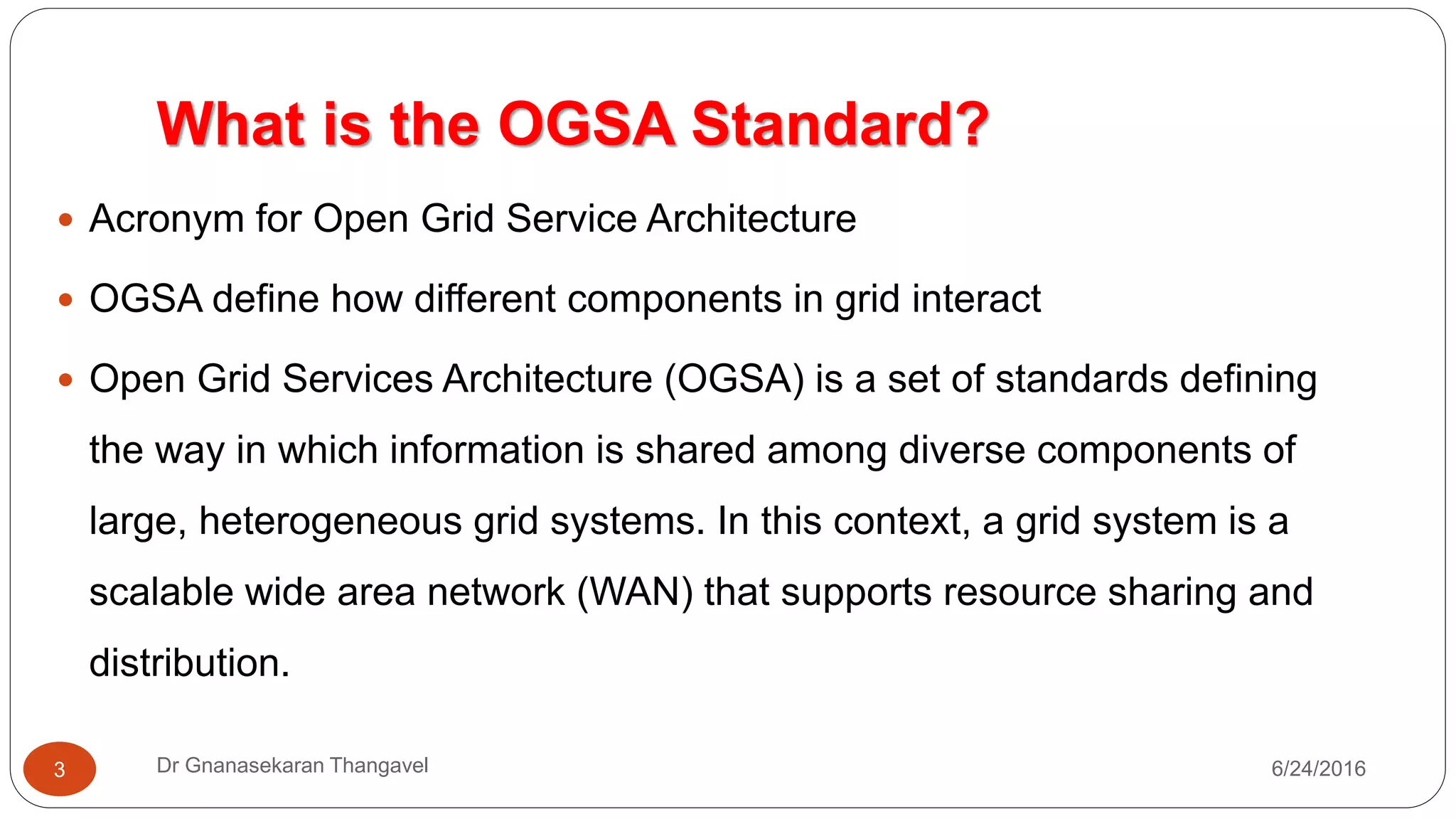
What is the OGSA Standard?
7/17/2016Dr Gnanasekaran Thangavel3
 Acronym for Open Grid Service Architecture
 OGSA define how different components in grid interact
 Open Grid Services Architecture (OGSA) is a set of standards defining
the way in which information is shared among diverse components of
large, heterogeneous grid systems. In this context, a grid system is a
scalable wide area network (WAN) that supports resource sharing and
distribution.
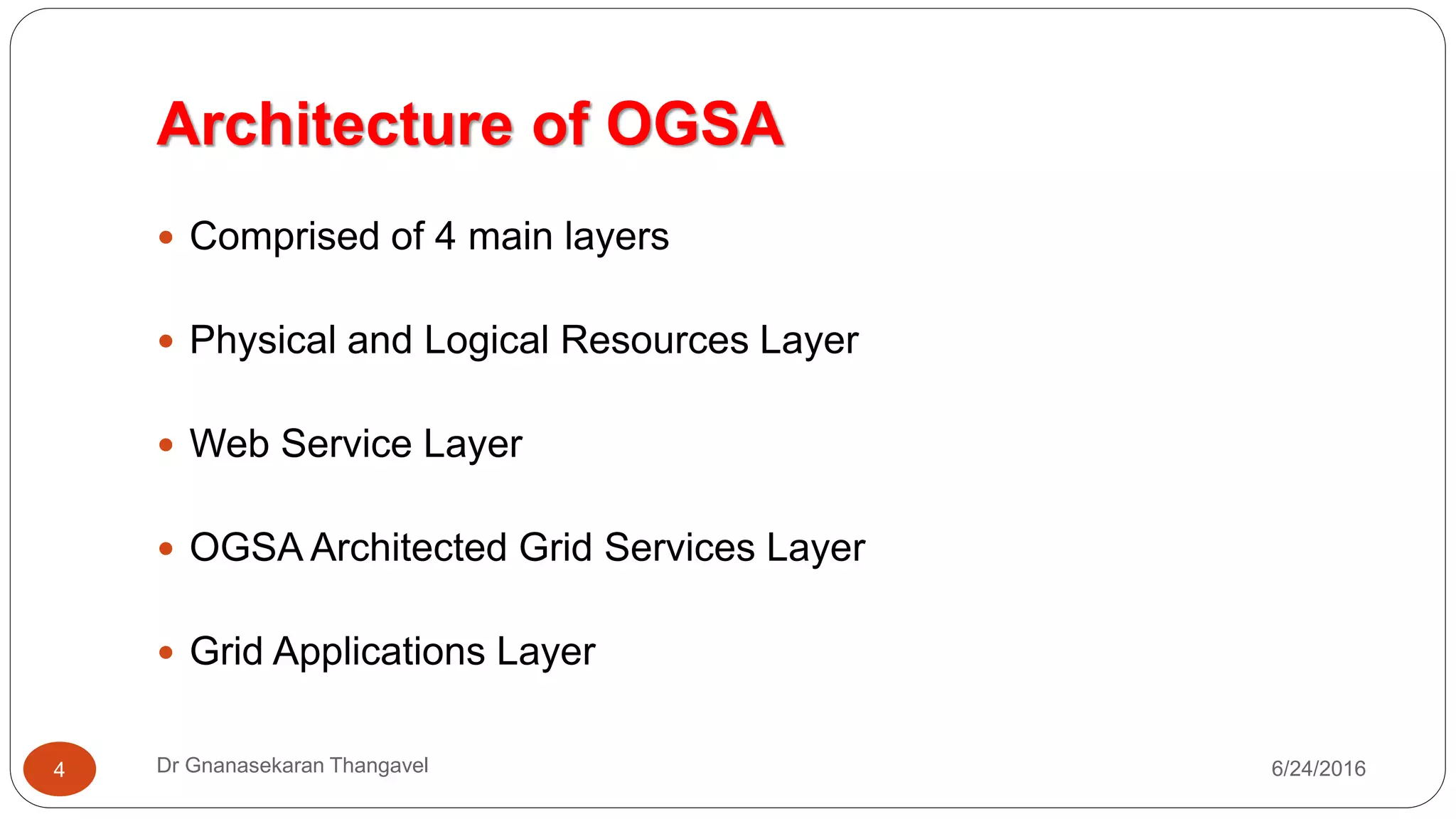
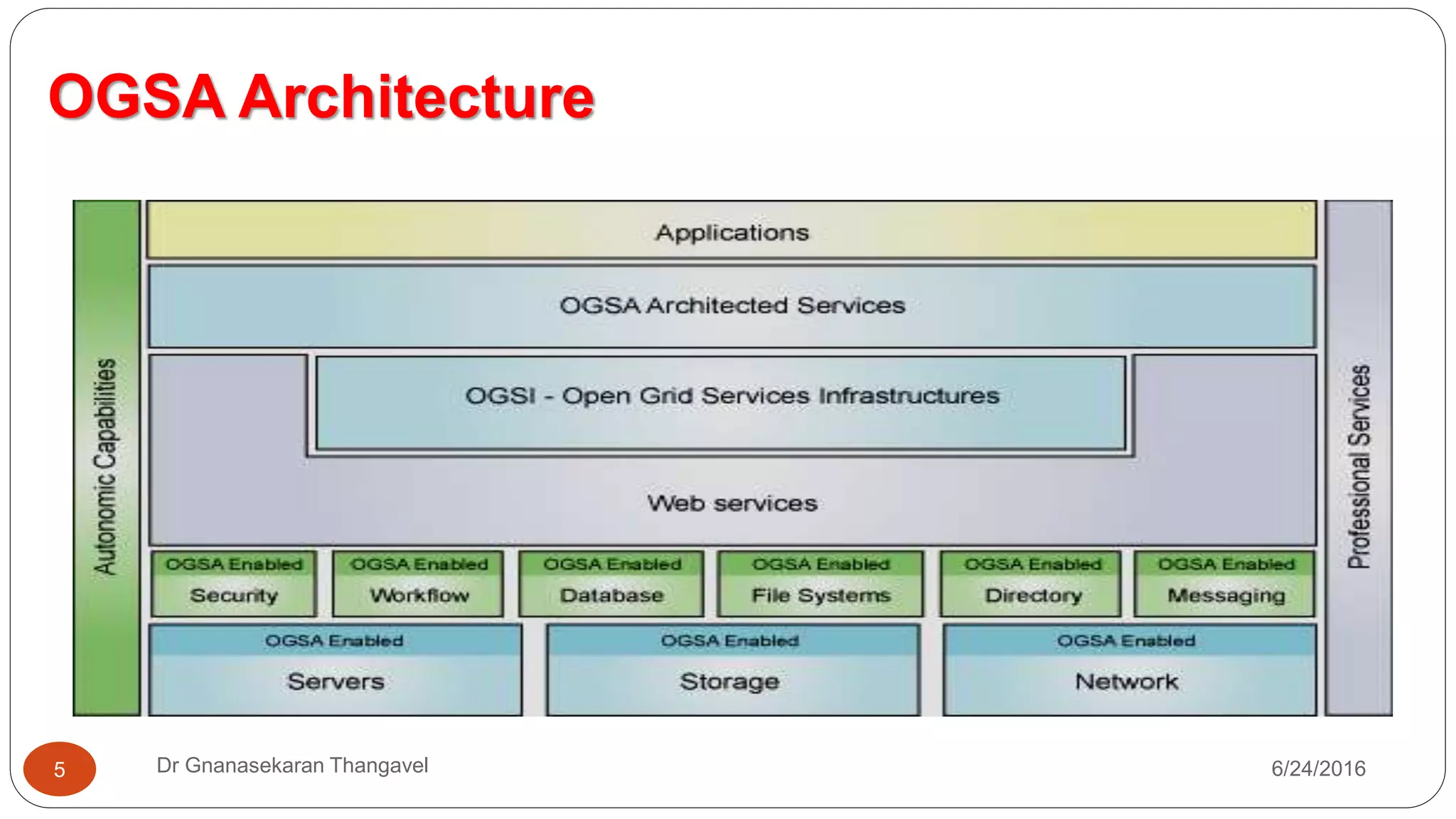
Architecture of OGSA
7/17/2016Dr Gnanasekaran Thangavel4
Comprised of 4 main layers
1. Physical and Logical Resources Layer
2. Web Service Layer
3. OGSA Architected Grid Services Layer
4. Grid Applications Layer
OGSA Architecture
7/17/2016Dr Gnanasekaran Thangavel5
OGSA Architecture - Physical and Logical
Resources Layer
 Physical resources are: servers, storage, network
 Logical resources manage physical resources
 Examples of logical resources: database managers, workflow
managers
OGSA Architecture - Web Services Layer
7/17/2016Dr Gnanasekaran Thangavel7
 Web service is software available online that could interact with other
software using XML
 Consists of Open Grid Services Infrastructure (OGSI) sub-layer which
specifies grid services and provide consistent way to interact with grid
services
 Also extends Web Service Capabilities
Consists of 5 interfaces:
1. Factory: provide way for creation of new grid services
2. Life Cycle: Manages grid service life cycles
3. State Management: Manage grid service states
4. Service Groups: collection of indexed grid services
5. Notification: Manages notification between services & resources
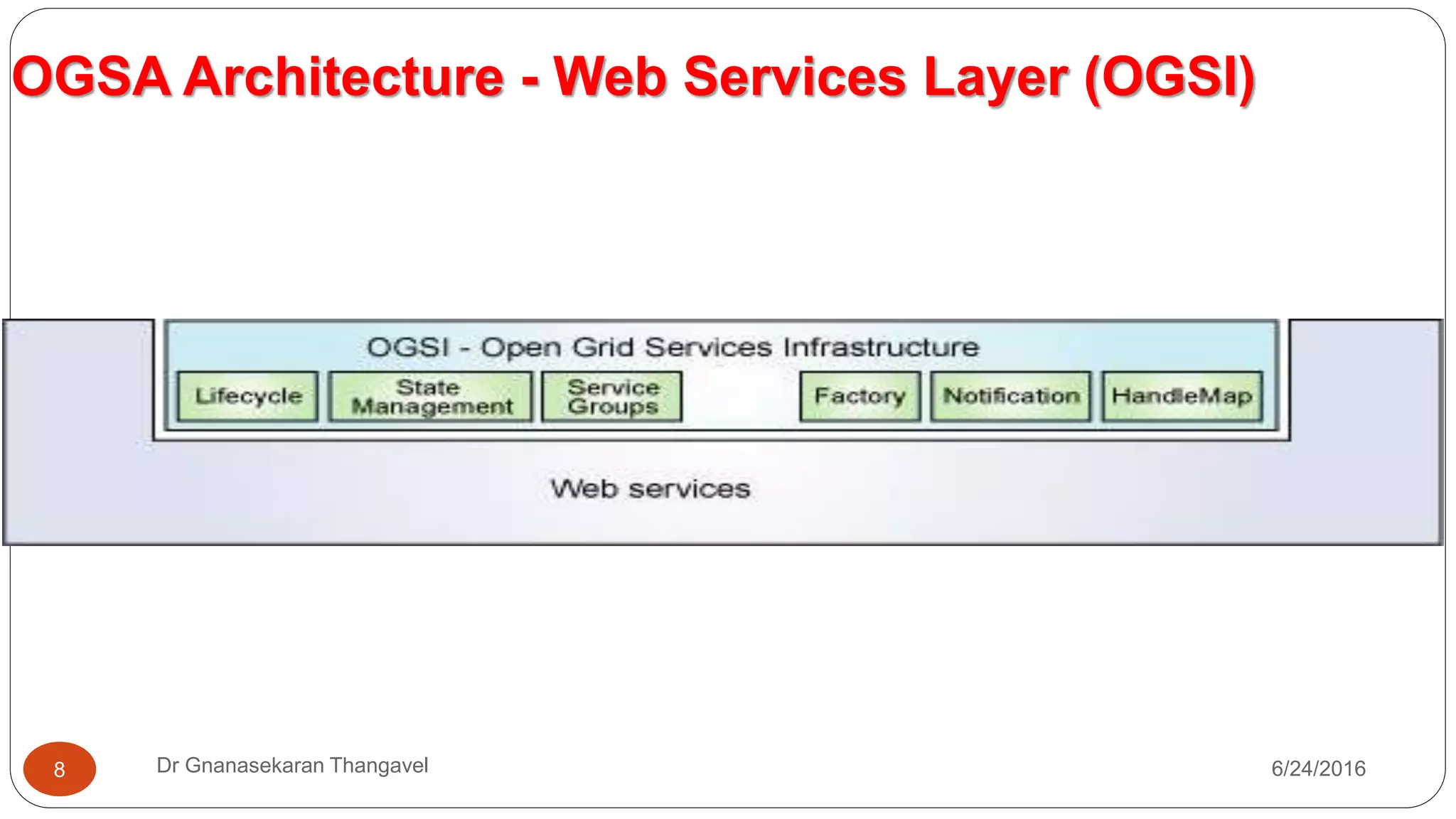
OGSA Architecture - Web Services Layer (OGSI)
7/17/2016Dr Gnanasekaran Thangavel8
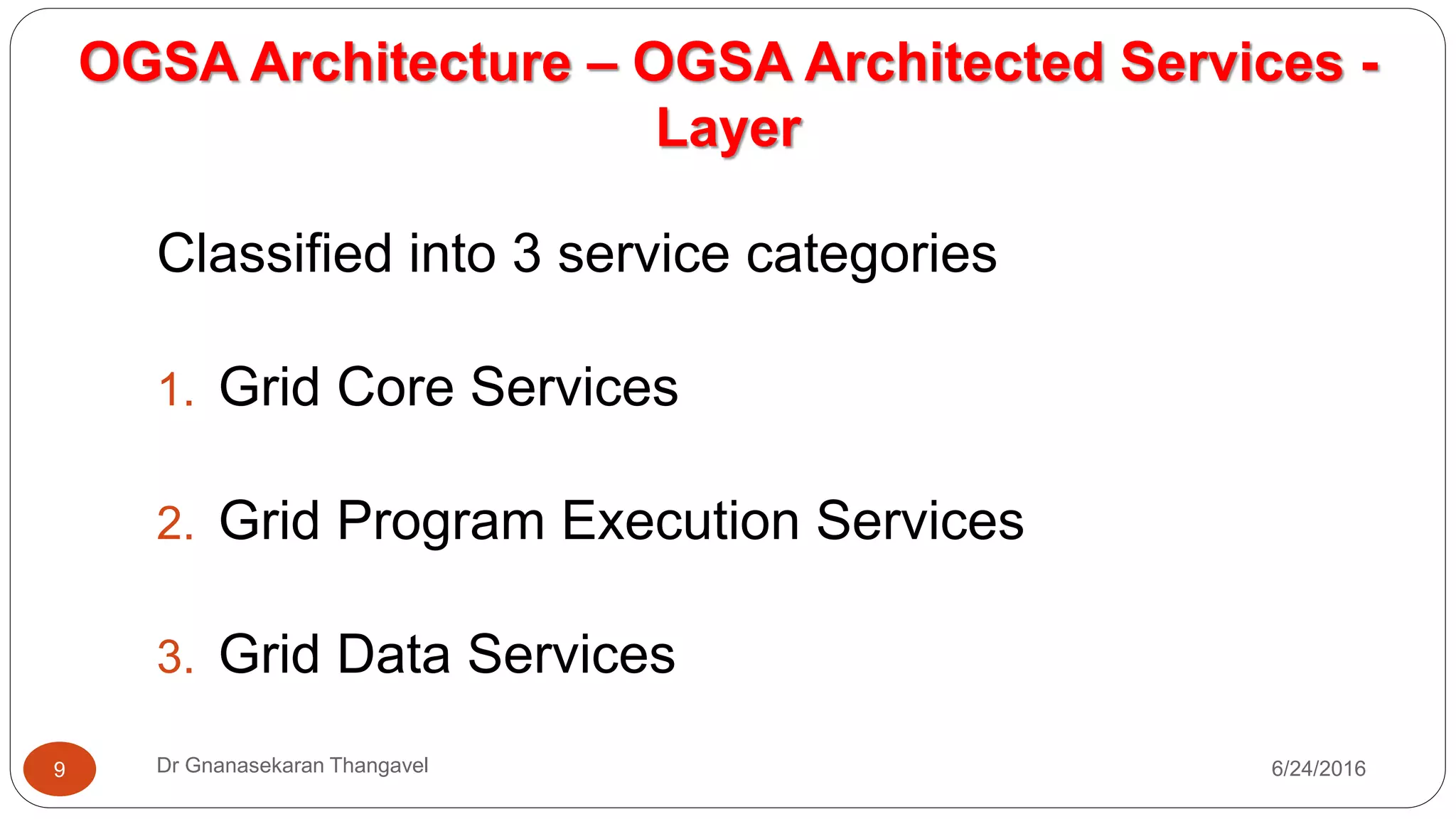
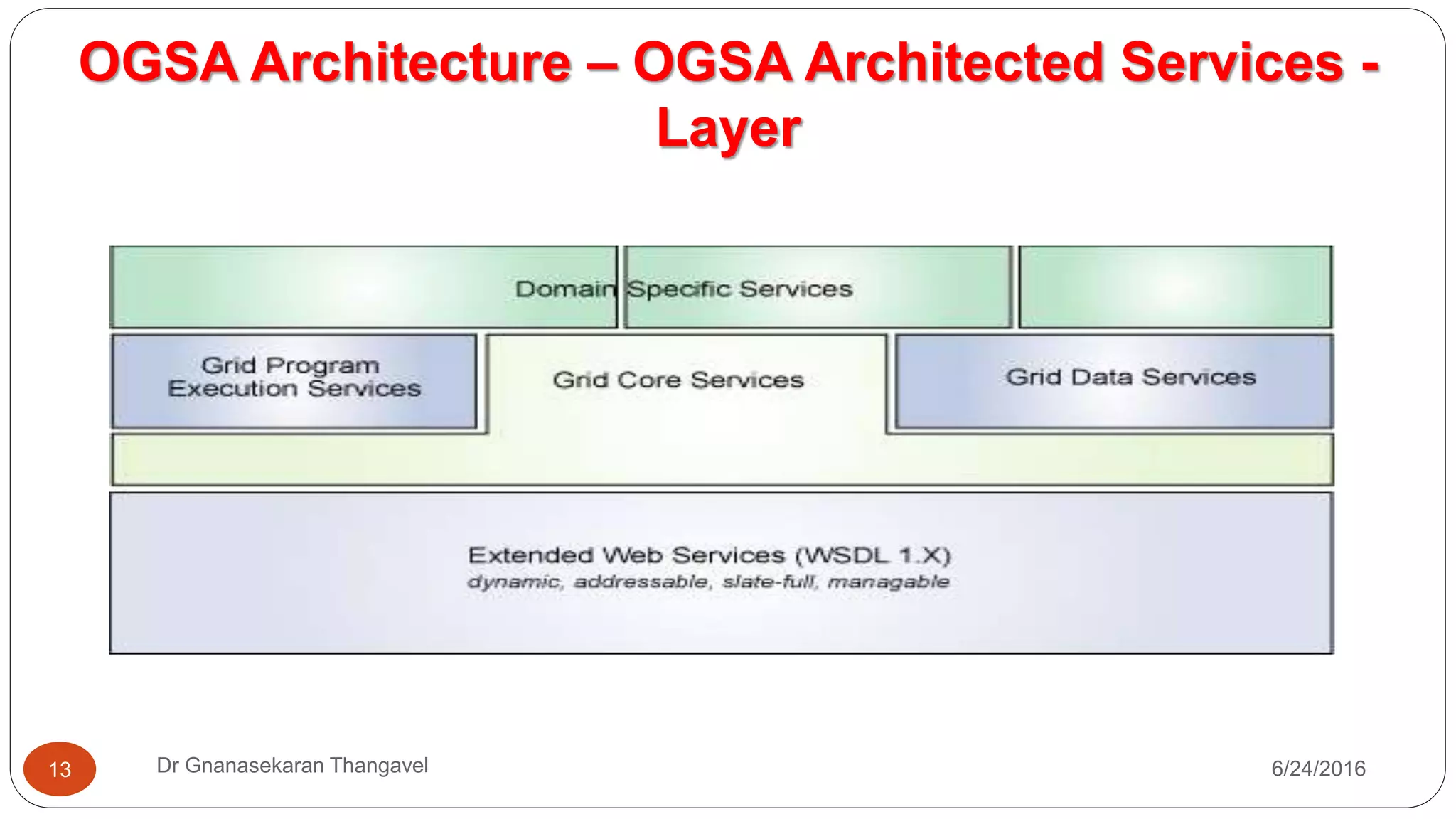
OGSA Architecture – OGSA Architected Services -
Layer
7/17/2016Dr Gnanasekaran Thangavel9
Classified into 3 service categories
1. Grid Core Services
2. Grid Program Execution Services
3. Grid Data Services
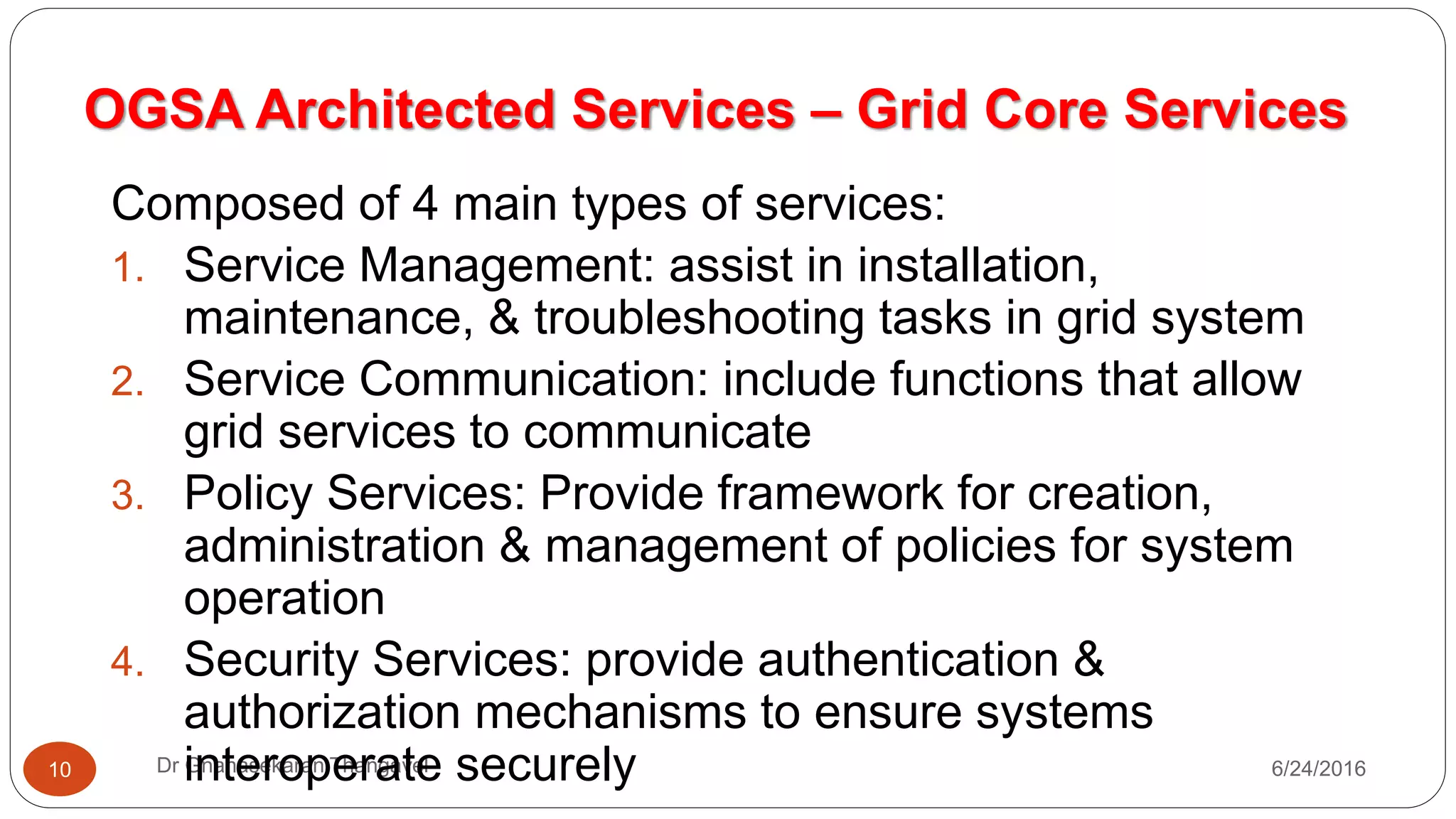
OGSA Architected Services – Grid Core Services
7/17/2016Dr Gnanasekaran Thangavel10
Composed of 4 main types of services:
1. Service Management: assist in installation,
maintenance, & troubleshooting tasks in grid system
2. Service Communication: include functions that allow
grid services to communicate
3. Policy Services: Provide framework for creation,
administration & management of policies for system
operation
4. Security Services: provide authentication &
authorization mechanisms to ensure systems
interoperate securely
OGSA Architected Services – Grid Program
Execution Services
7/17/2016Dr Gnanasekaran Thangavel11
 Supports unique grid systems in high performance
computing, collaboration, parallelism
 Support virtualization of resource processing
OGSA Architected Services – Grid Data Services
7/17/2016Dr Gnanasekaran Thangavel12
 Support data virtualization
 Provide mechanism for access to distributed
resources such as databases, files
OGSA Architecture – OGSA Architected Services -
Layer
7/17/2016Dr Gnanasekaran Thangavel13
OGSA Architecture – Grid Applications Layer
7/17/2016Dr Gnanasekaran Thangavel14
 This layer comprise of applications that use the
grid architected services
MIE456
Conclusion
 Grid-Computing allows networked resources to be
combined and used
 Grid-Computing offers great benefit to an organization
 OGSA are comprehensive standards which governs grid-
computing
Open Grid Services Infrastructure (OGSI)
7/17/2016Dr Gnanasekaran Thangavel16
 Gives a formal and technical specification of what a grid
service is.
 Its a excruciatingly detailed specification of how Grid
Services work.
 GT3 includes a complete implementation of OGSI.
 It is a formal and technical specification of the concepts
described in OGSA.
 The Globus Toolkit 3 is an implementation of OGSI.
 Some other implementations are OGSI::Lite (Perl)1 and the
UNICORE OGSA demonstrator2 from the EU GRIP project.
 OGSI specification defines grid services and builds upon
7/17/2016Dr Gnanasekaran Thangavel17
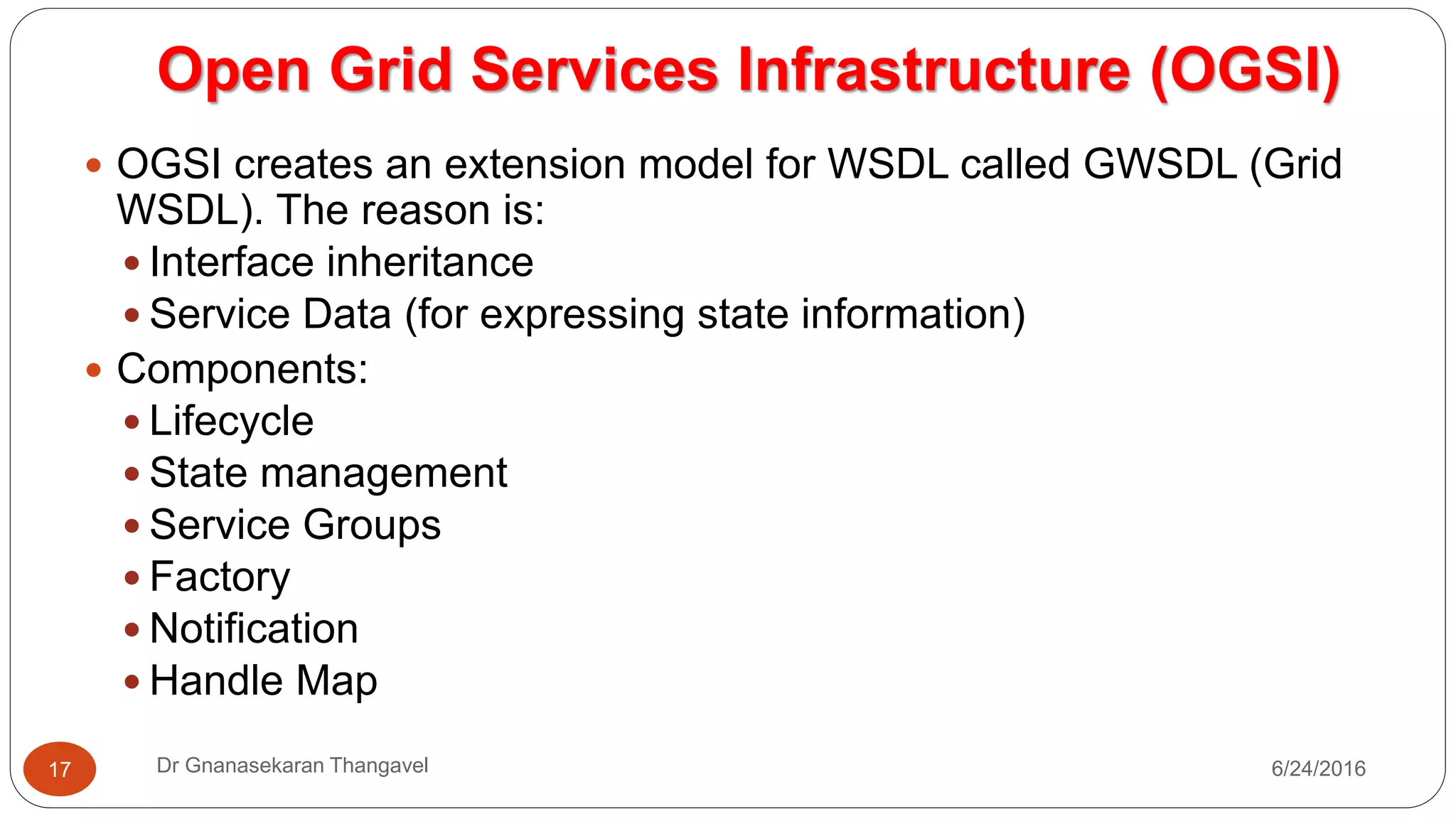
 OGSI creates an extension model for WSDL called GWSDL (Grid
WSDL). The reason is:
 Interface inheritance
 Service Data (for expressing state information)
 Components:
 Lifecycle
 State management
 Service Groups
 Factory
 Notification
 Handle Map
Open Grid Services Infrastructure (OGSI)
Data intensive grid service models
7/17/2016Dr Gnanasekaran Thangavel18
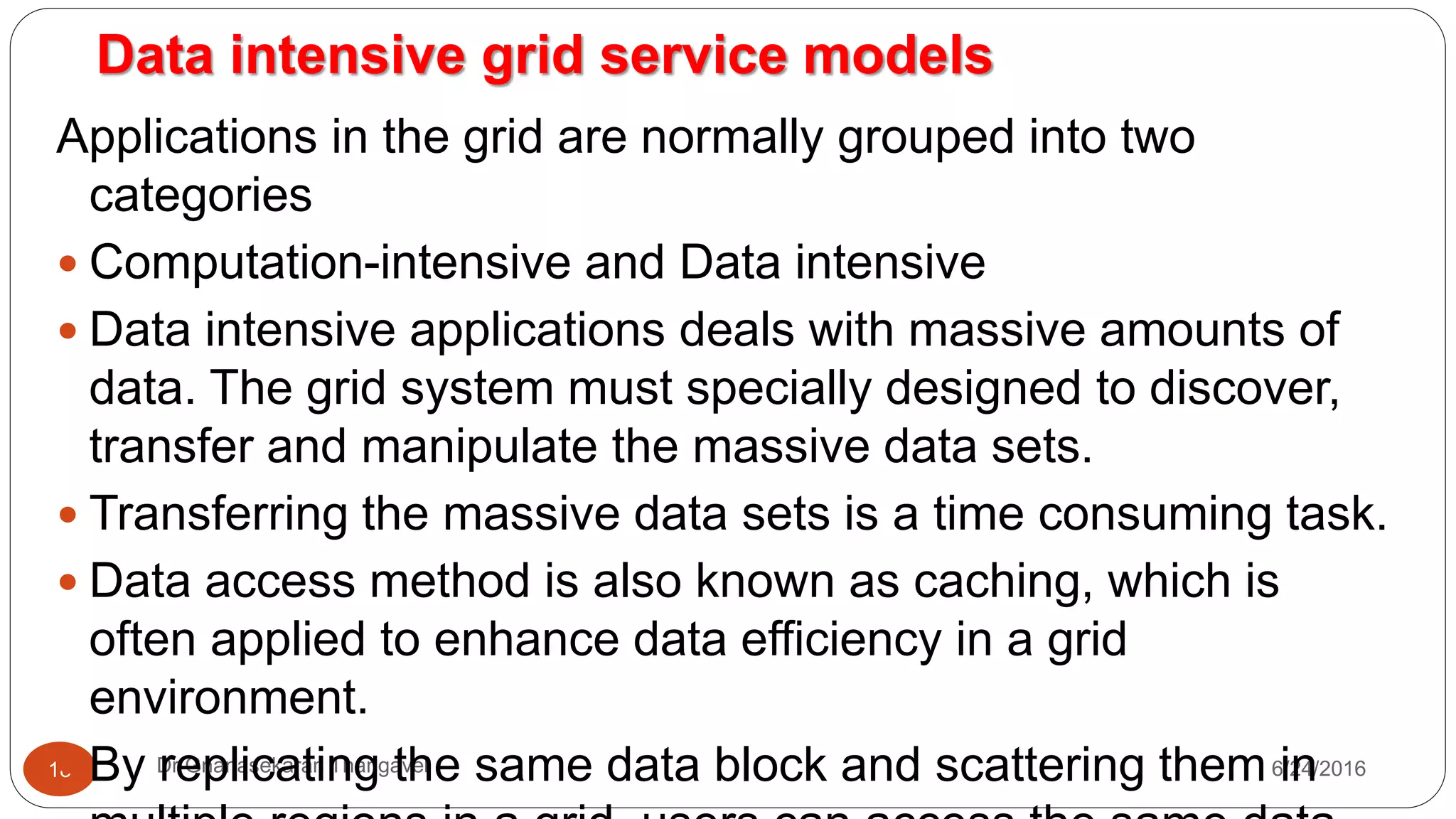
Applications in the grid are normally grouped into two
categories
 Computation-intensive and Data intensive
 Data intensive applications deals with massive amounts of
data. The grid system must specially designed to discover,
transfer and manipulate the massive data sets.
 Transferring the massive data sets is a time consuming task.
 Data access method is also known as caching, which is
often applied to enhance data efficiency in a grid
environment.
 By replicating the same data block and scattering them in
7/17/2016Dr Gnanasekaran Thangavel19
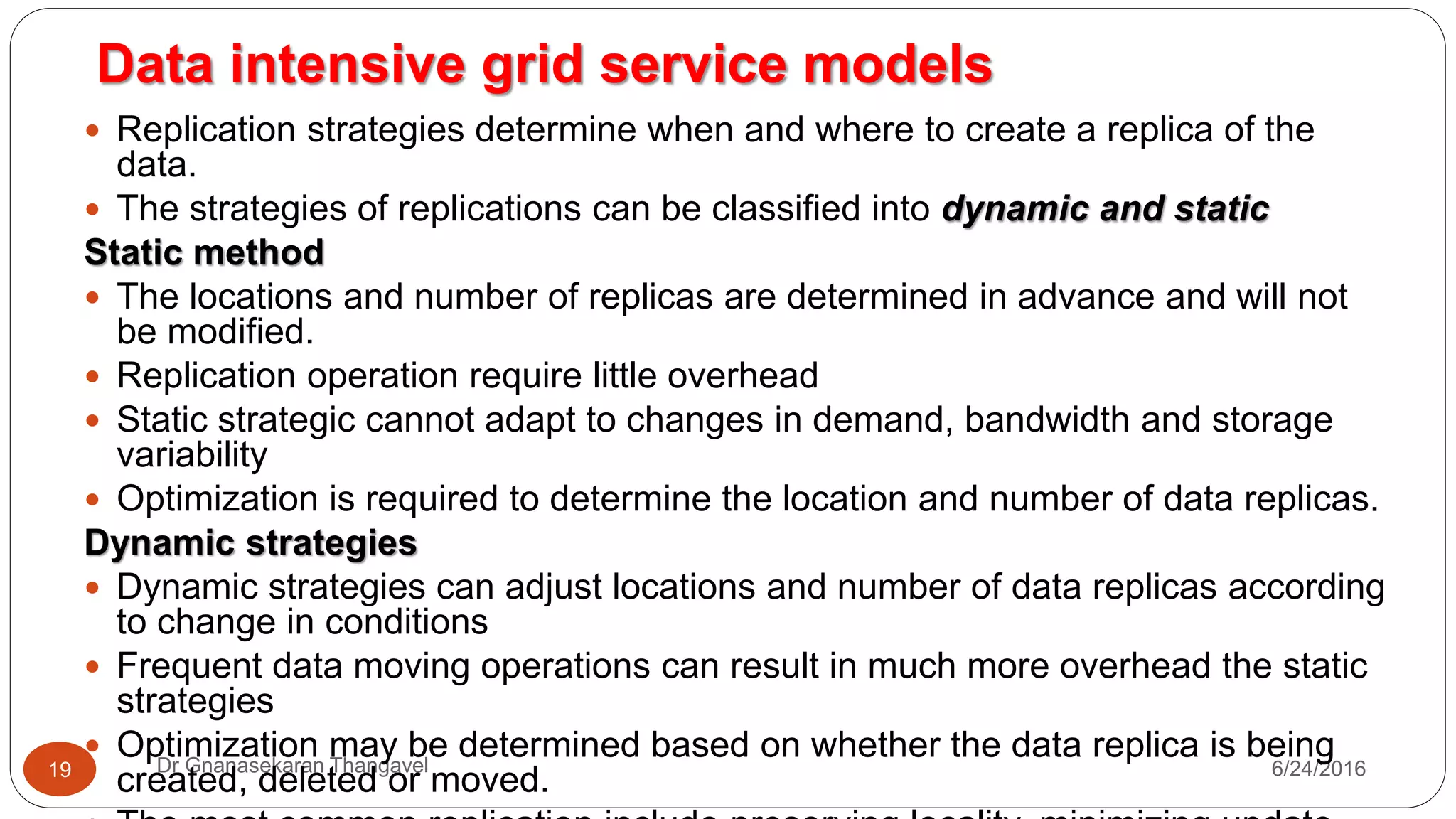
 Replication strategies determine when and where to create a replica of the
data.
 The strategies of replications can be classified into dynamic and static
Static method
 The locations and number of replicas are determined in advance and will not
be modified.
 Replication operation require little overhead
 Static strategic cannot adapt to changes in demand, bandwidth and storage
variability
 Optimization is required to determine the location and number of data replicas.
Dynamic strategies
 Dynamic strategies can adjust locations and number of data replicas according
to change in conditions
 Frequent data moving operations can result in much more overhead the static
strategies
 Optimization may be determined based on whether the data replica is being
created, deleted or moved.
Data intensive grid service models
Grid data Access models
7/17/2016Dr Gnanasekaran Thangavel20
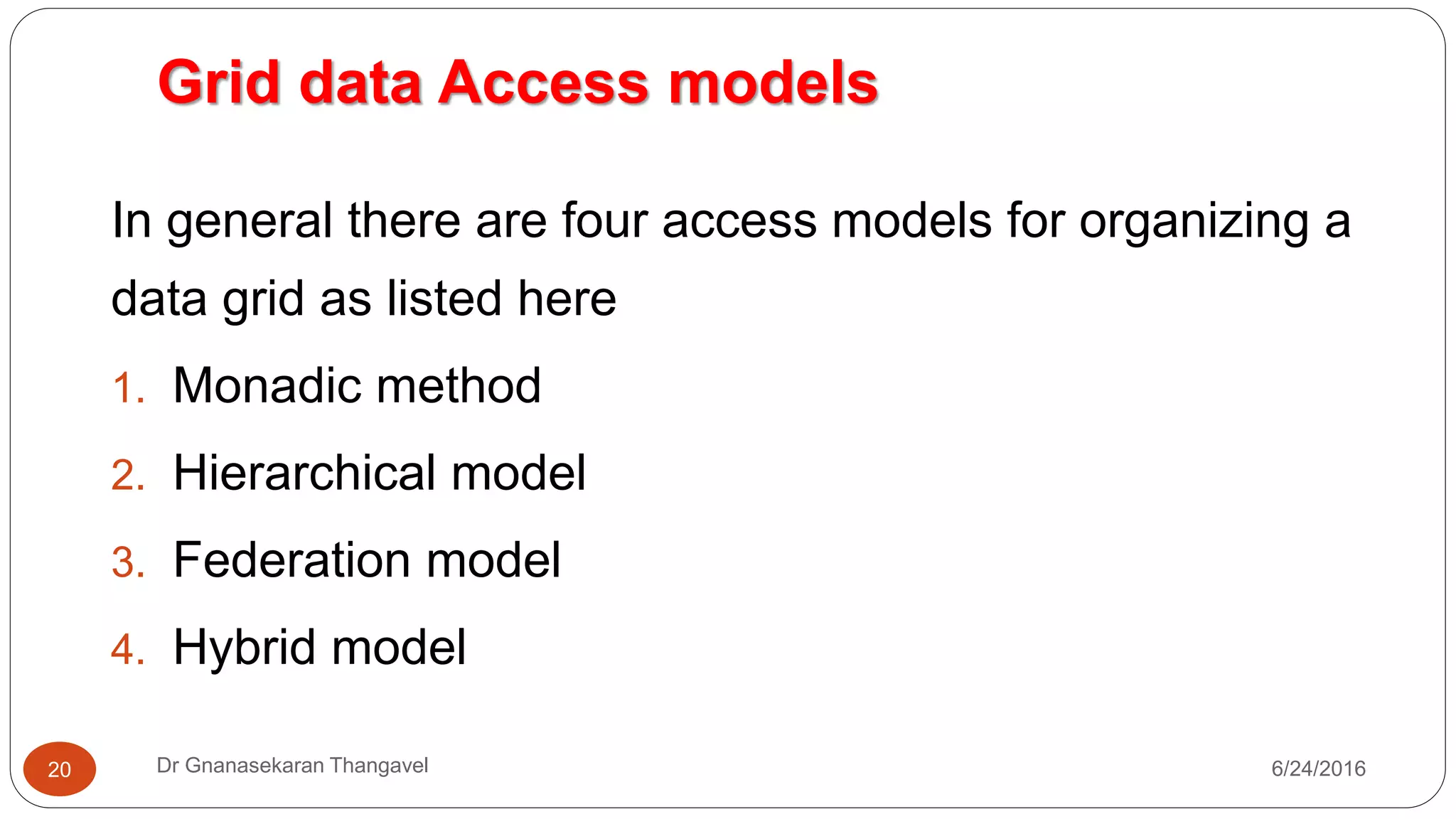
In general there are four access models for organizing a
data grid as listed here
1. Monadic method
2. Hierarchical model
3. Federation model
4. Hybrid model
Monadic method
7/17/2016Dr Gnanasekaran Thangavel21
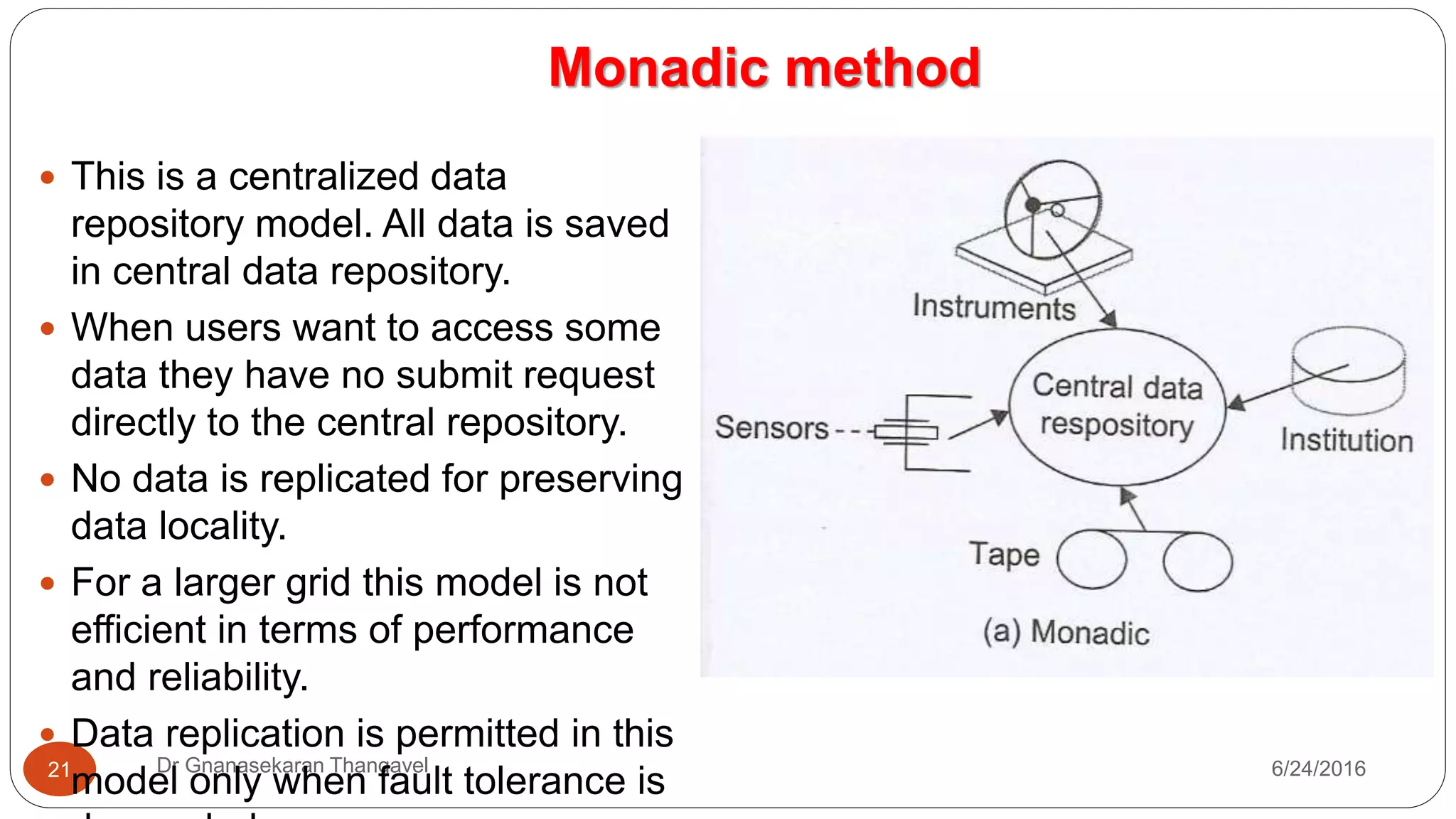
 This is a centralized data
repository model. All data is saved
in central data repository.
 When users want to access some
data they have no submit request
directly to the central repository.
 No data is replicated for preserving
data locality.
 For a larger grid this model is not
efficient in terms of performance
and reliability.
 Data replication is permitted in this
model only when fault tolerance is
Hierarchical model
7/17/2016Dr Gnanasekaran Thangavel22
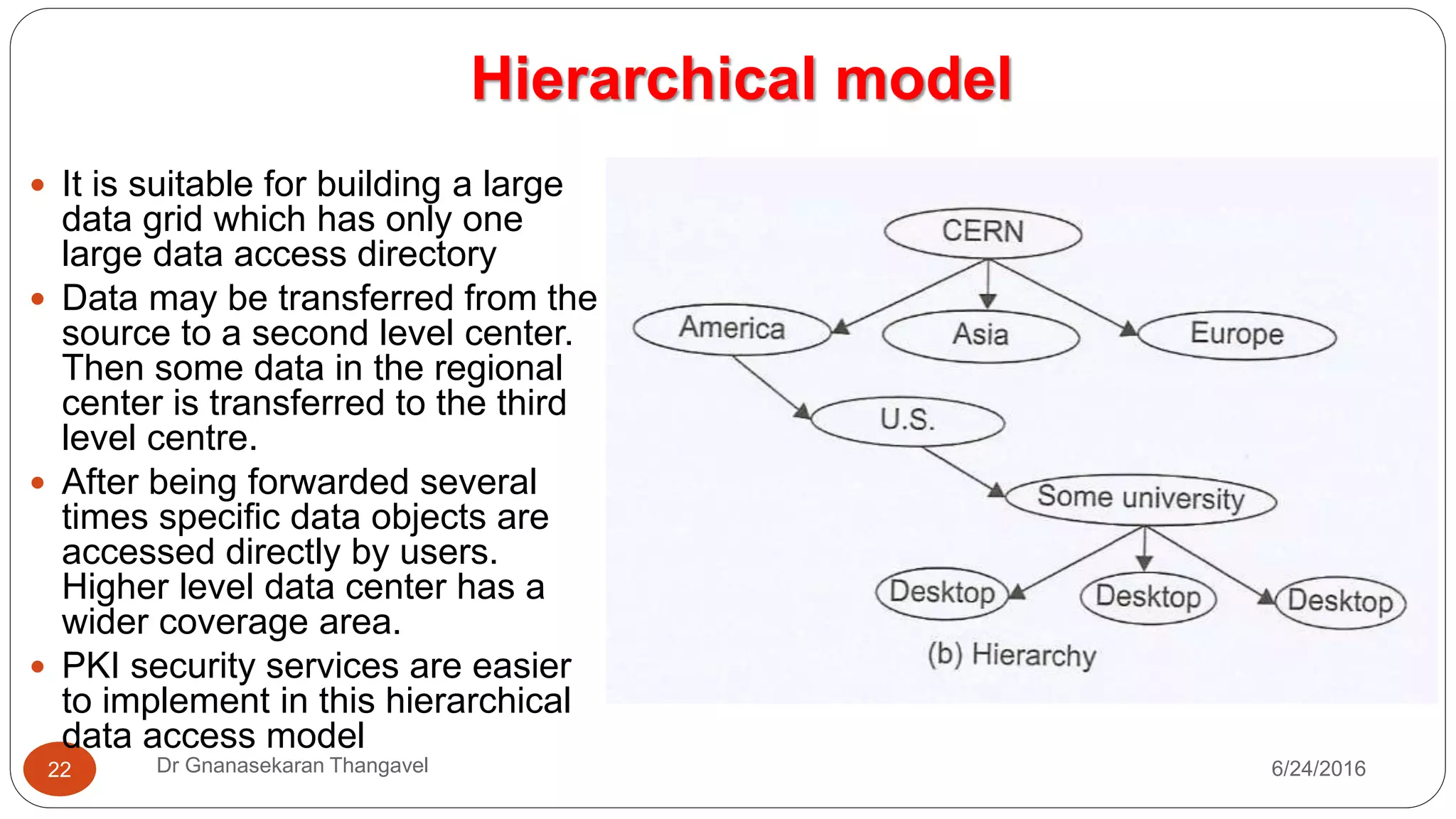
 It is suitable for building a large
data grid which has only one
large data access directory
 Data may be transferred from the
source to a second level center.
Then some data in the regional
center is transferred to the third
level centre.
 After being forwarded several
times specific data objects are
accessed directly by users.
Higher level data center has a
wider coverage area.
 PKI security services are easier
to implement in this hierarchical
data access model
Federation model
7/17/2016Dr Gnanasekaran Thangavel23
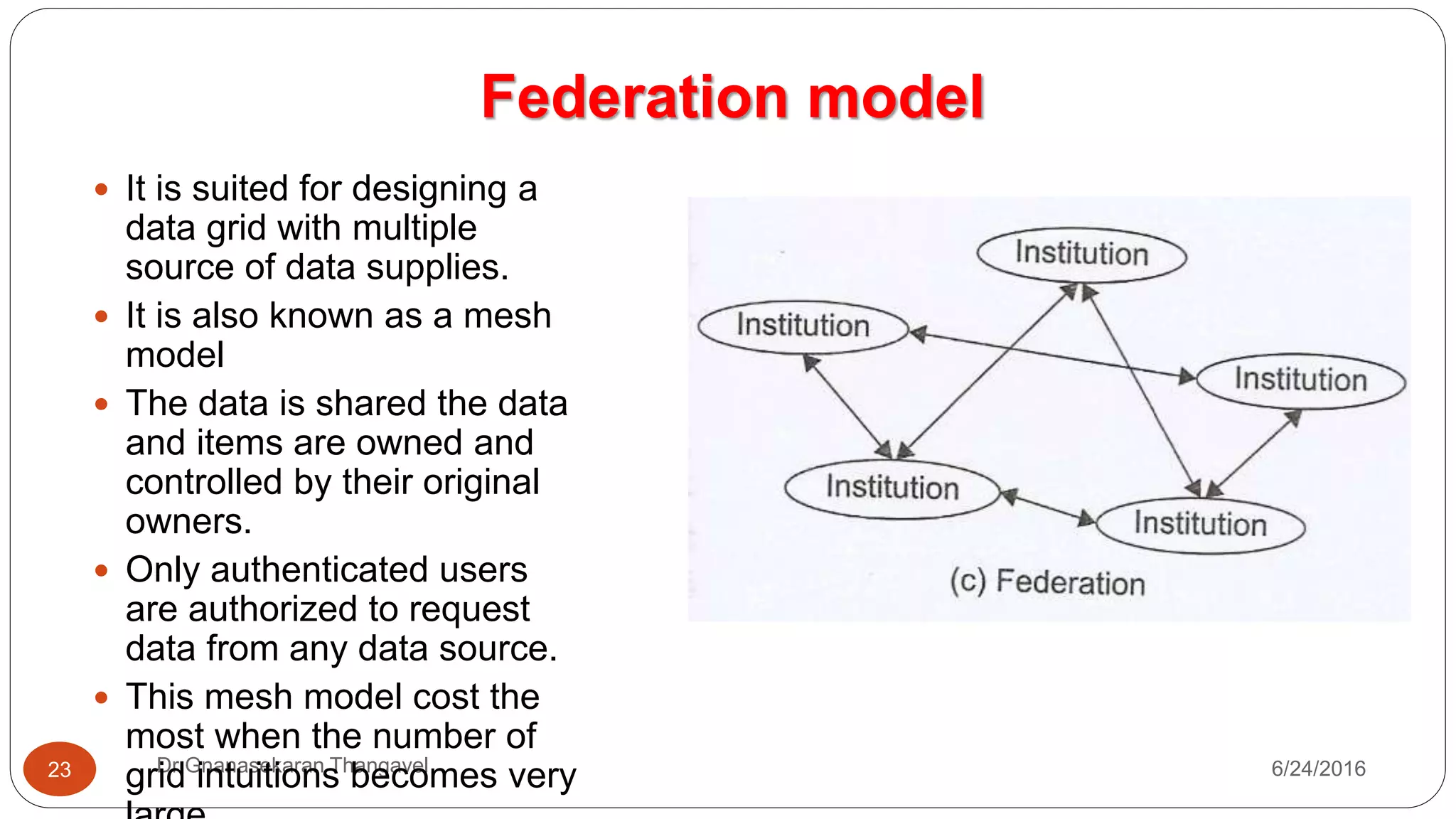
 It is suited for designing a
data grid with multiple
source of data supplies.
 It is also known as a mesh
model
 The data is shared the data
and items are owned and
controlled by their original
owners.
 Only authenticated users
are authorized to request
data from any data source.
 This mesh model cost the
most when the number of
grid intuitions becomes very
Hybrid model
7/17/2016Dr Gnanasekaran Thangavel24
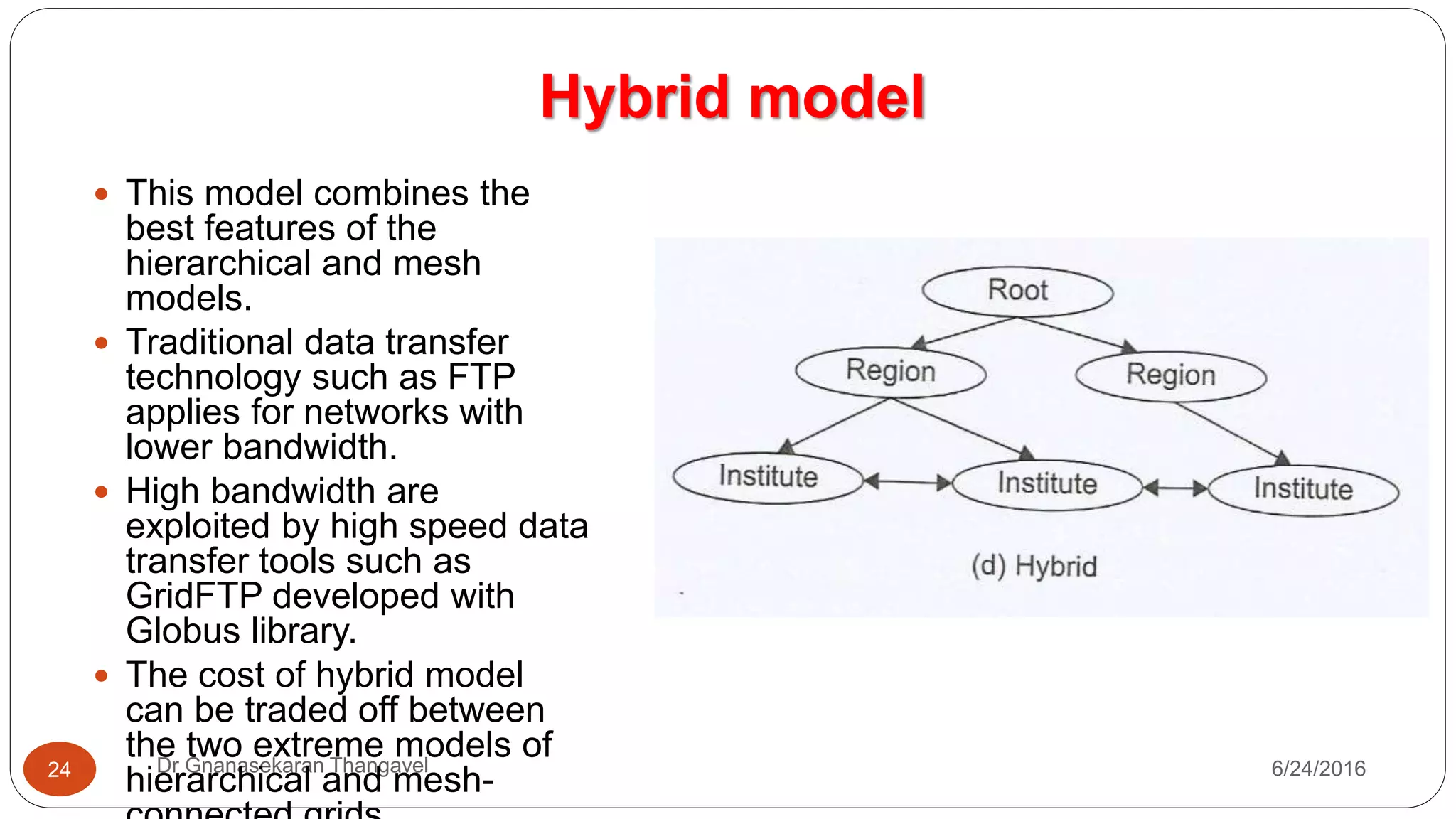
 This model combines the
best features of the
hierarchical and mesh
models.
 Traditional data transfer
technology such as FTP
applies for networks with
lower bandwidth.
 High bandwidth are
exploited by high speed data
transfer tools such as
GridFTP developed with
Globus library.
 The cost of hybrid model
can be traded off between
the two extreme models of
hierarchical and mesh-
Parallel versus Striped Data Transfers
7/17/2016Dr Gnanasekaran Thangavel25
 Parallel data transfer opens multiple data streams for passing
subdivided segments of a file simultaneously. Although the speed of
each stream is same as in sequential streaming, the total time to
move data in all streams can be significantly reduced compared to
FTP transfer.
 Striped data transfer a data objects is partitioned into a number of
sections and each section is placed in an individual site in a data grid.
When a user requests this piece of data, a data stream is created for
each site in a data gird. When user requests this piece of data, data
stream is created for each site, and all the sections of data objects ate
transected simultaneously.
Grid Services and OGSA
7/17/2016Dr Gnanasekaran Thangavel26
 Facilitate use and management of resources across distributed,
heterogeneous environments
 Deliver seamless QoS
 Define open, published interfaces in order to provide interoperability of
diverse resources
 Exploit industry-standard integration technologies
 Develop standards that achieve interoperability
 Integrate, virtualize, and manage services and resources in a distributed,
heterogeneous environment
 Deliver functionality as loosely coupled, interacting services aligned with
industry- accepted web service standards
7/17/2016Dr Gnanasekaran Thangavel27
 OGSA services fall into
seven broad areas,
defined in terms of
capabilities frequently
required in a grid
scenario. Figure shows
the OGSA architecture.
These services are
summarized as follows:
OGSA services - seven broad areas
7/17/2016Dr Gnanasekaran Thangavel28
1. Infrastructure Services Refer to a set of common functionalities,
such as naming, typically required by higher level services.
2. Execution Management Services Concerned with issues such as
starting and managing tasks, including placement, provisioning, and
life-cycle management. Tasks may range from simple j obs to complex
workflows or composite services.
3. Data Management Services Provide functionality to move data to
where it is needed, maintain replicated copies, run queries and
updates, and transform data into new formats. These services must
handle issues such as data consistency, persistency, and integrity. An
OGSA data service is a web service that implements one or more of
the base data interfaces to enable access to, and management of,
data resources in a distributed environment. The three base
interfaces, Da ta Access, Da ta Fa ctory, and Da ta Ma na gement,
define basic operations for representing, accessing, creating, and
7/17/2016Dr Gnanasekaran Thangavel29
4. Resource Management Services Provide management capabilities
for grid resources: management of the resources themselves,
management of the resources as grid components, and management
of the OGSA infrastructure. For example, resources can be
monitored, reserved, deployed, and configured as needed to meet
application QoS requirements. I t also requires an information model
(semantics) and data model (representation) of the grid resources
and services.
5. Security Services Facilitate the enforcement of security-related
policies within a (virtual) organization, and supports safe resource
sharing. Authentication, authorization, and integrity assurance are
essential functionalities provided by these services.
OGSA services - seven broad areas
7/17/2016Dr Gnanasekaran Thangavel30
6. Information Services Provide efficient production of, and access to,
information about the grid and its constituent resources. The term
“information” refers to dynamic data or events used for status
monitoring; relatively static data used for discovery; and any data that is
logged. Troubleshooting is j ust one of the possible uses for information
provided by these services.
7. Self-Management Services Support service-level attainment for a set
of services (or resources), with as much automation as possible, to
reduce the costs and complexity of managing the system. These
services are essential in addressing the increasing complexity of owning
and operating an I T infrastructure.
OGSA services - seven broad areas
References
1. Kai Hwang, Geoffery C. Fox and Jack J. Dongarra, “Distributed and Cloud Computing:
Clusters, Grids, Clouds and the Future of Internet”, First Edition, Morgan Kaufman
Publisher, an Imprint of Elsevier, 2012.
2. https://www.dcc.fc.up.pt/~ines/aulas/1213/CG/OGSA.ppt
3. http://www.computerworld.com/article/2552339/networking/open-grid-services-
architecture.html
4. http://searchsoa.techtarget.com/definition/Open-Grid-Services-Architecture
5. www.cs.umsl.edu/~sanjiv/classes/cs6740/presentation/OGSA.ppt
6. www.nesc.ac.uk/news/.../OpenGridServicesArchitectureApril20021.ppt31 Dr Gnanasekaran Thangavel 7/17/2016
Other presentations
http://www.slideshare.net/drgst/presentations
32 Dr Gnanasekaran Thangavel 7/17/2016
33
Thank You
Questions and Comments?
Dr Gnanasekaran Thangavel 7/17/2016

Cs6703 grid and cloud computing unit 2

  • 1.
    Dr Gnanasekaran Thangavel Professorand Head Faculty of Information Technology R M K College of Engineering and Technology CS6703 GRID AND CLOUD COMPUTING Unit 2
  • 2.
    UNIT II GRIDSERVICES Introduction to Open Grid Services Architecture (OGSA) – Motivation – Functionality Requirements – Practical & Detailed view of OGSA/OGSI – Data intensive grid service models – OGSA services. 7/17/20162 Dr Gnanasekaran Thangavel
  • 3.
    What is theOGSA Standard? 7/17/2016Dr Gnanasekaran Thangavel3  Acronym for Open Grid Service Architecture  OGSA define how different components in grid interact  Open Grid Services Architecture (OGSA) is a set of standards defining the way in which information is shared among diverse components of large, heterogeneous grid systems. In this context, a grid system is a scalable wide area network (WAN) that supports resource sharing and distribution.
  • 4.
    Architecture of OGSA 7/17/2016DrGnanasekaran Thangavel4 Comprised of 4 main layers 1. Physical and Logical Resources Layer 2. Web Service Layer 3. OGSA Architected Grid Services Layer 4. Grid Applications Layer
  • 5.
  • 6.
    OGSA Architecture -Physical and Logical Resources Layer  Physical resources are: servers, storage, network  Logical resources manage physical resources  Examples of logical resources: database managers, workflow managers
  • 7.
    OGSA Architecture -Web Services Layer 7/17/2016Dr Gnanasekaran Thangavel7  Web service is software available online that could interact with other software using XML  Consists of Open Grid Services Infrastructure (OGSI) sub-layer which specifies grid services and provide consistent way to interact with grid services  Also extends Web Service Capabilities Consists of 5 interfaces: 1. Factory: provide way for creation of new grid services 2. Life Cycle: Manages grid service life cycles 3. State Management: Manage grid service states 4. Service Groups: collection of indexed grid services 5. Notification: Manages notification between services & resources
  • 8.
    OGSA Architecture -Web Services Layer (OGSI) 7/17/2016Dr Gnanasekaran Thangavel8
  • 9.
    OGSA Architecture –OGSA Architected Services - Layer 7/17/2016Dr Gnanasekaran Thangavel9 Classified into 3 service categories 1. Grid Core Services 2. Grid Program Execution Services 3. Grid Data Services
  • 10.
    OGSA Architected Services– Grid Core Services 7/17/2016Dr Gnanasekaran Thangavel10 Composed of 4 main types of services: 1. Service Management: assist in installation, maintenance, & troubleshooting tasks in grid system 2. Service Communication: include functions that allow grid services to communicate 3. Policy Services: Provide framework for creation, administration & management of policies for system operation 4. Security Services: provide authentication & authorization mechanisms to ensure systems interoperate securely
  • 11.
    OGSA Architected Services– Grid Program Execution Services 7/17/2016Dr Gnanasekaran Thangavel11  Supports unique grid systems in high performance computing, collaboration, parallelism  Support virtualization of resource processing
  • 12.
    OGSA Architected Services– Grid Data Services 7/17/2016Dr Gnanasekaran Thangavel12  Support data virtualization  Provide mechanism for access to distributed resources such as databases, files
  • 13.
    OGSA Architecture –OGSA Architected Services - Layer 7/17/2016Dr Gnanasekaran Thangavel13
  • 14.
    OGSA Architecture –Grid Applications Layer 7/17/2016Dr Gnanasekaran Thangavel14  This layer comprise of applications that use the grid architected services
  • 15.
    MIE456 Conclusion  Grid-Computing allowsnetworked resources to be combined and used  Grid-Computing offers great benefit to an organization  OGSA are comprehensive standards which governs grid- computing
  • 16.
    Open Grid ServicesInfrastructure (OGSI) 7/17/2016Dr Gnanasekaran Thangavel16  Gives a formal and technical specification of what a grid service is.  Its a excruciatingly detailed specification of how Grid Services work.  GT3 includes a complete implementation of OGSI.  It is a formal and technical specification of the concepts described in OGSA.  The Globus Toolkit 3 is an implementation of OGSI.  Some other implementations are OGSI::Lite (Perl)1 and the UNICORE OGSA demonstrator2 from the EU GRIP project.  OGSI specification defines grid services and builds upon
  • 17.
    7/17/2016Dr Gnanasekaran Thangavel17 OGSI creates an extension model for WSDL called GWSDL (Grid WSDL). The reason is:  Interface inheritance  Service Data (for expressing state information)  Components:  Lifecycle  State management  Service Groups  Factory  Notification  Handle Map Open Grid Services Infrastructure (OGSI)
  • 18.
    Data intensive gridservice models 7/17/2016Dr Gnanasekaran Thangavel18 Applications in the grid are normally grouped into two categories  Computation-intensive and Data intensive  Data intensive applications deals with massive amounts of data. The grid system must specially designed to discover, transfer and manipulate the massive data sets.  Transferring the massive data sets is a time consuming task.  Data access method is also known as caching, which is often applied to enhance data efficiency in a grid environment.  By replicating the same data block and scattering them in
  • 19.
    7/17/2016Dr Gnanasekaran Thangavel19 Replication strategies determine when and where to create a replica of the data.  The strategies of replications can be classified into dynamic and static Static method  The locations and number of replicas are determined in advance and will not be modified.  Replication operation require little overhead  Static strategic cannot adapt to changes in demand, bandwidth and storage variability  Optimization is required to determine the location and number of data replicas. Dynamic strategies  Dynamic strategies can adjust locations and number of data replicas according to change in conditions  Frequent data moving operations can result in much more overhead the static strategies  Optimization may be determined based on whether the data replica is being created, deleted or moved. Data intensive grid service models
  • 20.
    Grid data Accessmodels 7/17/2016Dr Gnanasekaran Thangavel20 In general there are four access models for organizing a data grid as listed here 1. Monadic method 2. Hierarchical model 3. Federation model 4. Hybrid model
  • 21.
    Monadic method 7/17/2016Dr GnanasekaranThangavel21  This is a centralized data repository model. All data is saved in central data repository.  When users want to access some data they have no submit request directly to the central repository.  No data is replicated for preserving data locality.  For a larger grid this model is not efficient in terms of performance and reliability.  Data replication is permitted in this model only when fault tolerance is
  • 22.
    Hierarchical model 7/17/2016Dr GnanasekaranThangavel22  It is suitable for building a large data grid which has only one large data access directory  Data may be transferred from the source to a second level center. Then some data in the regional center is transferred to the third level centre.  After being forwarded several times specific data objects are accessed directly by users. Higher level data center has a wider coverage area.  PKI security services are easier to implement in this hierarchical data access model
  • 23.
    Federation model 7/17/2016Dr GnanasekaranThangavel23  It is suited for designing a data grid with multiple source of data supplies.  It is also known as a mesh model  The data is shared the data and items are owned and controlled by their original owners.  Only authenticated users are authorized to request data from any data source.  This mesh model cost the most when the number of grid intuitions becomes very
  • 24.
    Hybrid model 7/17/2016Dr GnanasekaranThangavel24  This model combines the best features of the hierarchical and mesh models.  Traditional data transfer technology such as FTP applies for networks with lower bandwidth.  High bandwidth are exploited by high speed data transfer tools such as GridFTP developed with Globus library.  The cost of hybrid model can be traded off between the two extreme models of hierarchical and mesh-
  • 25.
    Parallel versus StripedData Transfers 7/17/2016Dr Gnanasekaran Thangavel25  Parallel data transfer opens multiple data streams for passing subdivided segments of a file simultaneously. Although the speed of each stream is same as in sequential streaming, the total time to move data in all streams can be significantly reduced compared to FTP transfer.  Striped data transfer a data objects is partitioned into a number of sections and each section is placed in an individual site in a data grid. When a user requests this piece of data, a data stream is created for each site in a data gird. When user requests this piece of data, data stream is created for each site, and all the sections of data objects ate transected simultaneously.
  • 26.
    Grid Services andOGSA 7/17/2016Dr Gnanasekaran Thangavel26  Facilitate use and management of resources across distributed, heterogeneous environments  Deliver seamless QoS  Define open, published interfaces in order to provide interoperability of diverse resources  Exploit industry-standard integration technologies  Develop standards that achieve interoperability  Integrate, virtualize, and manage services and resources in a distributed, heterogeneous environment  Deliver functionality as loosely coupled, interacting services aligned with industry- accepted web service standards
  • 27.
    7/17/2016Dr Gnanasekaran Thangavel27 OGSA services fall into seven broad areas, defined in terms of capabilities frequently required in a grid scenario. Figure shows the OGSA architecture. These services are summarized as follows:
  • 28.
    OGSA services -seven broad areas 7/17/2016Dr Gnanasekaran Thangavel28 1. Infrastructure Services Refer to a set of common functionalities, such as naming, typically required by higher level services. 2. Execution Management Services Concerned with issues such as starting and managing tasks, including placement, provisioning, and life-cycle management. Tasks may range from simple j obs to complex workflows or composite services. 3. Data Management Services Provide functionality to move data to where it is needed, maintain replicated copies, run queries and updates, and transform data into new formats. These services must handle issues such as data consistency, persistency, and integrity. An OGSA data service is a web service that implements one or more of the base data interfaces to enable access to, and management of, data resources in a distributed environment. The three base interfaces, Da ta Access, Da ta Fa ctory, and Da ta Ma na gement, define basic operations for representing, accessing, creating, and
  • 29.
    7/17/2016Dr Gnanasekaran Thangavel29 4.Resource Management Services Provide management capabilities for grid resources: management of the resources themselves, management of the resources as grid components, and management of the OGSA infrastructure. For example, resources can be monitored, reserved, deployed, and configured as needed to meet application QoS requirements. I t also requires an information model (semantics) and data model (representation) of the grid resources and services. 5. Security Services Facilitate the enforcement of security-related policies within a (virtual) organization, and supports safe resource sharing. Authentication, authorization, and integrity assurance are essential functionalities provided by these services. OGSA services - seven broad areas
  • 30.
    7/17/2016Dr Gnanasekaran Thangavel30 6.Information Services Provide efficient production of, and access to, information about the grid and its constituent resources. The term “information” refers to dynamic data or events used for status monitoring; relatively static data used for discovery; and any data that is logged. Troubleshooting is j ust one of the possible uses for information provided by these services. 7. Self-Management Services Support service-level attainment for a set of services (or resources), with as much automation as possible, to reduce the costs and complexity of managing the system. These services are essential in addressing the increasing complexity of owning and operating an I T infrastructure. OGSA services - seven broad areas
  • 31.
    References 1. Kai Hwang,Geoffery C. Fox and Jack J. Dongarra, “Distributed and Cloud Computing: Clusters, Grids, Clouds and the Future of Internet”, First Edition, Morgan Kaufman Publisher, an Imprint of Elsevier, 2012. 2. https://www.dcc.fc.up.pt/~ines/aulas/1213/CG/OGSA.ppt 3. http://www.computerworld.com/article/2552339/networking/open-grid-services- architecture.html 4. http://searchsoa.techtarget.com/definition/Open-Grid-Services-Architecture 5. www.cs.umsl.edu/~sanjiv/classes/cs6740/presentation/OGSA.ppt 6. www.nesc.ac.uk/news/.../OpenGridServicesArchitectureApril20021.ppt31 Dr Gnanasekaran Thangavel 7/17/2016
  • 32.
  • 33.
    33 Thank You Questions andComments? Dr Gnanasekaran Thangavel 7/17/2016

Editor's Notes