16
ADVERSARIAL SEARCH
GAMES & MINIMAX ALGORITHM
 The term “search” in the context of adversarial
search refers to games.
Subscribe
Adversarial Search
“Searches in which two or more players with
conflicting goals are trying to explore the same
search space for the solution, are called
adversarial searches, often known as Games”.
Problem Formulation
 INITIAL STATE: It specifies how the game is set up at the start.
 PLAYER(s): It specifies which player has moved in the state
space.
 ACTION(s): It returns the set of legal moves in state space.
 RESULT(s, a): It is the transition model, which specifies the
result of moves in the state space.
 TERMINAL-TEST(s): Terminal test is true if the game is over,
else it is false at any case. The state where the game ends is
called terminal states.
 UTILITY(s, p): A utility function gives the final numeric value for a
game that ends in terminal states s for player p. It is also called
payoff function. For Chess, the outcomes are a win, loss, or draw
and its payoff values are +1, 0, ½. And for tic-tac-toe, utility
values are +1, -1, and 0.
Subscribe
Game Tree
Subscribe
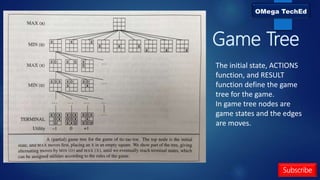
The initial state, ACTIONS
function, and RESULT
function define the game
tree for the game.
In game tree nodes are
game states and the edges
are moves.
Subscribe
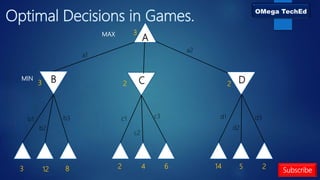
Optimal Decisions in Games.
A
B D
C
MAX
MIN
3 8
12 6
4
2 14 5 2
3 2 2
3
a1
a2
b1
b2
b3 c1
c2
c3 d1
d2
d3
Minimax Algorithm
Subscribe
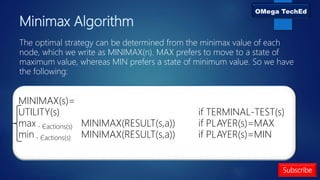
The optimal strategy can be determined from the minimax value of each
node, which we write as MINIMAX(n). MAX prefers to move to a state of
maximum value, whereas MIN prefers a state of minimum value. So we have
the following:
MINIMAX(s)=
UTILITY(s) if TERMINAL-TEST(s)
max Єactions(s) MINIMAX(RESULT(s,a)) if PLAYER(s)=MAX
min Єactions(s) MINIMAX(RESULT(s,a)) if PLAYER(s)=MIN
Subscribe
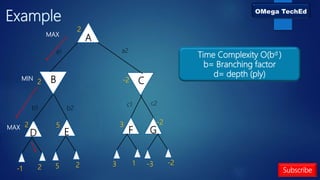
Example
A
D F G
B C
MAX
MIN
-1 5
2
-2
-3
3
a1 a2
b1 b2
c1 c2
2
MAX
1
2 5
2
2
3 -2
-2
E
Time Complexity O(bd )
b= Branching factor
d= depth (ply)
Thanks For
Watching
Reference:
Artificial Intelligence
A Modern Approach Third Edition
Peter Norvig and Stuart J. Russell
Subscribe
Like
Share
Next Topic: ALPHA-BETA PRUNING
OMega TechEd
About the Channel
This channel helps you to prepare for BSc IT and BSc computer science subjects.
In this channel we will learn Business Intelligence ,Artificial Intelligence, Digital Electronics,
Internet OF Things Python programming , Data-Structure etc.
Which is useful for upcoming university exams.
Gmail: omega.teched@gmail.com
Social Media Handles:
omega.teched
megha_with
Subscribe

Adversarial Search

  • 1.
  • 2.
     The term“search” in the context of adversarial search refers to games. Subscribe Adversarial Search “Searches in which two or more players with conflicting goals are trying to explore the same search space for the solution, are called adversarial searches, often known as Games”.
  • 3.
    Problem Formulation  INITIALSTATE: It specifies how the game is set up at the start.  PLAYER(s): It specifies which player has moved in the state space.  ACTION(s): It returns the set of legal moves in state space.  RESULT(s, a): It is the transition model, which specifies the result of moves in the state space.  TERMINAL-TEST(s): Terminal test is true if the game is over, else it is false at any case. The state where the game ends is called terminal states.  UTILITY(s, p): A utility function gives the final numeric value for a game that ends in terminal states s for player p. It is also called payoff function. For Chess, the outcomes are a win, loss, or draw and its payoff values are +1, 0, ½. And for tic-tac-toe, utility values are +1, -1, and 0. Subscribe
  • 4.
    Game Tree Subscribe The initialstate, ACTIONS function, and RESULT function define the game tree for the game. In game tree nodes are game states and the edges are moves.
  • 5.
    Subscribe Optimal Decisions inGames. A B D C MAX MIN 3 8 12 6 4 2 14 5 2 3 2 2 3 a1 a2 b1 b2 b3 c1 c2 c3 d1 d2 d3
  • 6.
    Minimax Algorithm Subscribe The optimalstrategy can be determined from the minimax value of each node, which we write as MINIMAX(n). MAX prefers to move to a state of maximum value, whereas MIN prefers a state of minimum value. So we have the following: MINIMAX(s)= UTILITY(s) if TERMINAL-TEST(s) max Єactions(s) MINIMAX(RESULT(s,a)) if PLAYER(s)=MAX min Єactions(s) MINIMAX(RESULT(s,a)) if PLAYER(s)=MIN
  • 7.
    Subscribe Example A D F G BC MAX MIN -1 5 2 -2 -3 3 a1 a2 b1 b2 c1 c2 2 MAX 1 2 5 2 2 3 -2 -2 E Time Complexity O(bd ) b= Branching factor d= depth (ply)
  • 8.
    Thanks For Watching Reference: Artificial Intelligence AModern Approach Third Edition Peter Norvig and Stuart J. Russell Subscribe Like Share Next Topic: ALPHA-BETA PRUNING
  • 9.
    OMega TechEd About theChannel This channel helps you to prepare for BSc IT and BSc computer science subjects. In this channel we will learn Business Intelligence ,Artificial Intelligence, Digital Electronics, Internet OF Things Python programming , Data-Structure etc. Which is useful for upcoming university exams. Gmail: omega.teched@gmail.com Social Media Handles: omega.teched megha_with Subscribe