Quality management 
in 
Emergency Care 
Department 
W.A .Keerthirathne(RN,BScN,PGDDE,Dip Teaching 
& Sup,Dip in Edu,Mgt & Leadership,Dip in Psy) 
Special Grade Nursing Tutor 
PBCN
is a nursing specialty in 
which nurses care for 
patients in the emergency 
or critical phase of 
their illness or injury.
 Emergency Nursing is a specialty in which nurses 
care for patients in the emergency or critical phase of 
their illness or injury and are adept at discerning life-threatening 
problems, prioritizing the urgency of 
care, rapidly and effectively carrying out resuscitative 
measures and other treatment, acting with a high 
degree of autonomy and ability to initiate needed 
measures without outside direction, educating the 
patient and his family with the information and 
emotional support needed to preserve themselves as 
they cope with a new reality. These activities may be 
carried out in a variety of settings and not necessarily 
in an "Emergency Room."
Every other specialty of nursing, 
 a patient arrives with a diagnosis by a physician and the 
nurse must manage patient's care according to that 
diagnosis, 
 Emergency nurses work with patients diagnosis has not yet 
been made and the cause of the problem is not known. 
 Emergency nurses frequently contact patients in 
the emergency department before the patient sees a 
physician. 
 In this situation, the nurse must be skilled at rapid, 
accurate physical examination, early recognition of life-threatening 
illness or injury, the use of advanced 
monitoring and treatment equipment, and in some cases, 
the ordering of testing and medication according to 
"advance treatment guidelines" or "standing orders" set out 
by the hospital's emergency physician staff.
 . How is "Emergency Nursing" different from other 
nursing? 
 An Emergency Nurse is hold high degrees of 
knowledge and skills, with diagnostic and decision-making 
power to effectuate urgently needed activities 
in autonomous or in the closely-collaborative with 
other health professionals. An Emergency Nurse is 
capable of providing a broad spectrum of skills that in 
other settings would be delegated to other health care 
workers. Without disregarding the critical activities, 
Emergency Nurses commonly triage and treat less 
urgent problems, providing care and treatment of 
those injuries or illnesses, and providing the 
educational and psychosocial evaluations and support 
to return the patient successfully
 High level of value or excellence 
 How good or bad some thing
 The combine and unceasing 
effort of everyone
 The combine and continuous effort of 
every one ,health care professionals, 
patients and their families, payers 
,researchers, educators and planners 
 to make changes that will leads to 
better patient outcome(health), 
 better system performance(care) 
 and better professional 
development(learning)
 Concept is complex 
 Main goal is to change performance not to 
discover new knowledge. 
 To do their work, improve it. 
 Change in care process and routine work in 
health care 
 All improvement require changers but not 
every change is improvement. 
 Do more carefully. 
 Faster ,better, more effective and safer
 Patients in emergency care not always satisfied 
with the care 
 Nursing care describe as instrumental and non-holistic.
 Information 
 Respect and empathy 
 Pain relief 
 Nutrition 
 Waiting time 
 General atmosphere 
 Patent safety 
 Cost effectiveness 
 Evidenced based practice
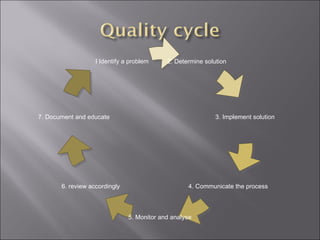
2. Determine solution 
I Identify a problem 
7. Document and educate 3. Implement solution 
6. review accordingly 4. Communicate the process 
5. Monitor and analyse
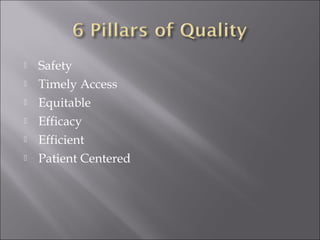
 Safety 
 Timely Access 
 Equitable 
 Efficacy 
 Efficient 
 Patient Centered
 How can you improve a system to achieve 
better results in the 6 pillars of quality?
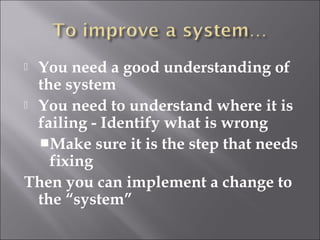
 You need a good understanding of 
the system 
 You need to understand where it is 
failing - Identify what is wrong 
Make sure it is the step that needs 
fixing 
Then you can implement a change to 
the “system”
 System = any assembly of procedures, 
resources and routines to carry out a specific 
activity
 To understand a system and identify what is 
wrong with it Map it out!
 Use a flow chart/diagram 
 Use different perspectives (a 
doctor’s perspective is different to a 
nurse’s or a porter’s to a patient’s 
perspective)
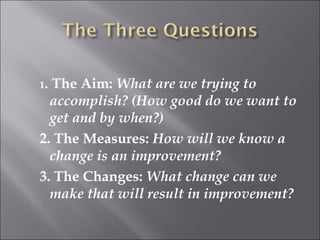
1. The Aim: What are we trying to 
accomplish? (How good do we want to 
get and by when?) 
2. The Measures: How will we know a 
change is an improvement? 
3. The Changes: What change can we 
make that will result in improvement?
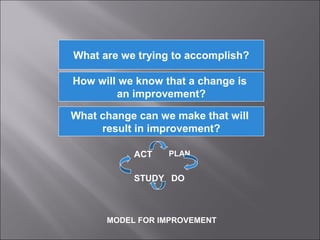
What are we trying to accomplish? 
How will we know that a change is 
an improvement? 
What change can we make that will 
result in improvement? 
ACT PLAN 
STUDY 
DO 
MODEL FOR IMPROVEMENT
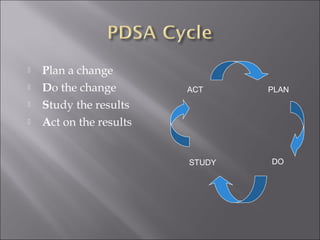
 Plan a change 
 Do the change 
 Study the results 
 Act on the results 
ACT PLAN 
STUDY 
DO
 Eight fundamental 
priority rights to 
improve quality of 
emergency 
department
 Health care staff who are 
appropriately trained and qualified 
to deliver emergency care, with the 
early involvement of senior doctors 
with specific expertise in E M where 
life-threatening/changing illness 
(physical or mental) or injury is 
suspected.
1. Properly equipped (for example with monitoring 
equipment and supplies) 
2. Appropriate compliance with hygiene 
3. Infection control measures reduce the incidence of 
hospital acquired infection for the anticipated 
number of patients and all commonly presenting 
conditions, as well as less common but predictable 
emergencies.
3.Adequate space to provide the necessary patient 
care in an environment that is secure and 
promotes patient privacy and dignity; 
4. Acutely ill and injured patients should not be 
routinely cared for in hallways or non-equipped 
overflow spaces.
 At all levels of ED function, from 
managerial/administrative levels to the 
frontline, the importance of critical thinking in 
decision making should be recognized and 
emphasized.
 To ensure early recognition of those patients 
requiring immediate attention and prompt 
time critical interventions, and the timely 
assessment, investigation and management of 
those with emergency conditions
 Patient-centred care with an emphasis on 
relieving suffering, good communication and 
the overall experience of patients and those 
accompanying and/or caring for them.
 Optimal outcomes from treatment within the 
ED for all patients presenting with emergency 
healthcare needs.
 Which enables the patient to access timely and 
appropriate emergency care, and which 
continues to support them after they have left 
the ED. There should be strong links to the 
community including education and 
prevention, alongside the promotion of public 
health.
 From community and hospital-based 
healthcare teams, and managers of the ED, 
who should ensure that the above 
arrangements are sustainable. There should be 
established and agreed mechanisms to monitor 
standards and compliance, with action taken if 
an ED falls short.
 Appropriate access and utilization of, diagnostic 
support services (e.g. plain radiography, 
ultrasound, CT scanning and laboratory services) 
by EM doctors when needed for the immediate 
diagnosis of life threatening conditions 
 Expertise in critical care in collaboration with 
colleagues from anaesthesia and intensive care 
 Early access to specialist inpatient and outpatient 
services to assure appropriate on-going evaluation 
and treatment of patients with emergency care 
needs
 Appropriate duration of stay in the ED to 
maximise patient care and comfort, and to 
optimise clinical outcomes 
 Additional services to enhance the quality and 
safety of emergency care. Such as short-stay/ 
observation facilities, alternative patient 
pathways, social and mental health services or 
associated outpatient activity. 
 However excellent ED care is the constant 
development of innovative and enhanced 
services to support the delivery of quality and 
safety.
 Safe - Avoiding harm to patients . 
 Effective -Providing services based on 
scientific knowledge to all who could benefit, and 
refraining from providing services/care to those 
not likely to benefit. 
 Patient-centred -Providing care that is respectful of 
and responsive to individual patient preferences, 
needs, and values . 
 Timely -Reducing waits and sometimes harmful 
delays . 
 Efficient -Avoid waste (personnel, ressources, 
finance). 
 Equitable -Providing care that does not vary in 
quality because of personal characteristics .

Quality management in emergency care

  • 1.
    Quality management in Emergency Care Department W.A .Keerthirathne(RN,BScN,PGDDE,Dip Teaching & Sup,Dip in Edu,Mgt & Leadership,Dip in Psy) Special Grade Nursing Tutor PBCN
  • 2.
    is a nursingspecialty in which nurses care for patients in the emergency or critical phase of their illness or injury.
  • 3.
     Emergency Nursingis a specialty in which nurses care for patients in the emergency or critical phase of their illness or injury and are adept at discerning life-threatening problems, prioritizing the urgency of care, rapidly and effectively carrying out resuscitative measures and other treatment, acting with a high degree of autonomy and ability to initiate needed measures without outside direction, educating the patient and his family with the information and emotional support needed to preserve themselves as they cope with a new reality. These activities may be carried out in a variety of settings and not necessarily in an "Emergency Room."
  • 4.
    Every other specialtyof nursing,  a patient arrives with a diagnosis by a physician and the nurse must manage patient's care according to that diagnosis,  Emergency nurses work with patients diagnosis has not yet been made and the cause of the problem is not known.  Emergency nurses frequently contact patients in the emergency department before the patient sees a physician.  In this situation, the nurse must be skilled at rapid, accurate physical examination, early recognition of life-threatening illness or injury, the use of advanced monitoring and treatment equipment, and in some cases, the ordering of testing and medication according to "advance treatment guidelines" or "standing orders" set out by the hospital's emergency physician staff.
  • 5.
     . Howis "Emergency Nursing" different from other nursing?  An Emergency Nurse is hold high degrees of knowledge and skills, with diagnostic and decision-making power to effectuate urgently needed activities in autonomous or in the closely-collaborative with other health professionals. An Emergency Nurse is capable of providing a broad spectrum of skills that in other settings would be delegated to other health care workers. Without disregarding the critical activities, Emergency Nurses commonly triage and treat less urgent problems, providing care and treatment of those injuries or illnesses, and providing the educational and psychosocial evaluations and support to return the patient successfully
  • 7.
     High levelof value or excellence  How good or bad some thing
  • 8.
     The combineand unceasing effort of everyone
  • 9.
     The combineand continuous effort of every one ,health care professionals, patients and their families, payers ,researchers, educators and planners  to make changes that will leads to better patient outcome(health),  better system performance(care)  and better professional development(learning)
  • 10.
     Concept iscomplex  Main goal is to change performance not to discover new knowledge.  To do their work, improve it.  Change in care process and routine work in health care  All improvement require changers but not every change is improvement.  Do more carefully.  Faster ,better, more effective and safer
  • 11.
     Patients inemergency care not always satisfied with the care  Nursing care describe as instrumental and non-holistic.
  • 12.
     Information Respect and empathy  Pain relief  Nutrition  Waiting time  General atmosphere  Patent safety  Cost effectiveness  Evidenced based practice
  • 13.
    2. Determine solution I Identify a problem 7. Document and educate 3. Implement solution 6. review accordingly 4. Communicate the process 5. Monitor and analyse
  • 14.
     Safety Timely Access  Equitable  Efficacy  Efficient  Patient Centered
  • 15.
     How canyou improve a system to achieve better results in the 6 pillars of quality?
  • 16.
     You needa good understanding of the system  You need to understand where it is failing - Identify what is wrong Make sure it is the step that needs fixing Then you can implement a change to the “system”
  • 17.
     System =any assembly of procedures, resources and routines to carry out a specific activity
  • 18.
     To understanda system and identify what is wrong with it Map it out!
  • 19.
     Use aflow chart/diagram  Use different perspectives (a doctor’s perspective is different to a nurse’s or a porter’s to a patient’s perspective)
  • 21.
    1. The Aim:What are we trying to accomplish? (How good do we want to get and by when?) 2. The Measures: How will we know a change is an improvement? 3. The Changes: What change can we make that will result in improvement?
  • 22.
    What are wetrying to accomplish? How will we know that a change is an improvement? What change can we make that will result in improvement? ACT PLAN STUDY DO MODEL FOR IMPROVEMENT
  • 23.
     Plan achange  Do the change  Study the results  Act on the results ACT PLAN STUDY DO
  • 24.
     Eight fundamental priority rights to improve quality of emergency department
  • 25.
     Health carestaff who are appropriately trained and qualified to deliver emergency care, with the early involvement of senior doctors with specific expertise in E M where life-threatening/changing illness (physical or mental) or injury is suspected.
  • 26.
    1. Properly equipped(for example with monitoring equipment and supplies) 2. Appropriate compliance with hygiene 3. Infection control measures reduce the incidence of hospital acquired infection for the anticipated number of patients and all commonly presenting conditions, as well as less common but predictable emergencies.
  • 27.
    3.Adequate space toprovide the necessary patient care in an environment that is secure and promotes patient privacy and dignity; 4. Acutely ill and injured patients should not be routinely cared for in hallways or non-equipped overflow spaces.
  • 28.
     At alllevels of ED function, from managerial/administrative levels to the frontline, the importance of critical thinking in decision making should be recognized and emphasized.
  • 29.
     To ensureearly recognition of those patients requiring immediate attention and prompt time critical interventions, and the timely assessment, investigation and management of those with emergency conditions
  • 30.
     Patient-centred carewith an emphasis on relieving suffering, good communication and the overall experience of patients and those accompanying and/or caring for them.
  • 31.
     Optimal outcomesfrom treatment within the ED for all patients presenting with emergency healthcare needs.
  • 32.
     Which enablesthe patient to access timely and appropriate emergency care, and which continues to support them after they have left the ED. There should be strong links to the community including education and prevention, alongside the promotion of public health.
  • 33.
     From communityand hospital-based healthcare teams, and managers of the ED, who should ensure that the above arrangements are sustainable. There should be established and agreed mechanisms to monitor standards and compliance, with action taken if an ED falls short.
  • 34.
     Appropriate accessand utilization of, diagnostic support services (e.g. plain radiography, ultrasound, CT scanning and laboratory services) by EM doctors when needed for the immediate diagnosis of life threatening conditions  Expertise in critical care in collaboration with colleagues from anaesthesia and intensive care  Early access to specialist inpatient and outpatient services to assure appropriate on-going evaluation and treatment of patients with emergency care needs
  • 35.
     Appropriate durationof stay in the ED to maximise patient care and comfort, and to optimise clinical outcomes  Additional services to enhance the quality and safety of emergency care. Such as short-stay/ observation facilities, alternative patient pathways, social and mental health services or associated outpatient activity.  However excellent ED care is the constant development of innovative and enhanced services to support the delivery of quality and safety.
  • 36.
     Safe -Avoiding harm to patients .  Effective -Providing services based on scientific knowledge to all who could benefit, and refraining from providing services/care to those not likely to benefit.  Patient-centred -Providing care that is respectful of and responsive to individual patient preferences, needs, and values .  Timely -Reducing waits and sometimes harmful delays .  Efficient -Avoid waste (personnel, ressources, finance).  Equitable -Providing care that does not vary in quality because of personal characteristics .

Editor's Notes

  • #18 Instructions: Ask the learner: Describe your morning “system”…alarm goes off, you walk to the washroom, you turn on the water, grab your toothbrush etc Describe the triage system in your ED
  • #20 Notes: Example of perspectives and role: Let’s say you identify that the flow of the emergency department is disrupted by the large number of patient family members and friends who are allowed in the department, leading to overcrowding and multiple interruptions/distractions to your staff. You decide to respond to the problem by limiting the number of patient family members and friends in the department to one at a time. You discuss this policy with the nurses and the doctors, who all agree with your decision. You create signs at the entrance that state the new “rule”. A week later you visit the emergency department and the place is still chaotic with patient families in the middle of the hallways etc. You go to the front of the department, and find your sign is on the door, but the door is wide open, the security guard is nowhere to be found (he is on break). It becomes clear to you that the perspective of the security guard was key here in devising a method to decrease the number of non-patients who come in the ED and how to keep them out. Notes: There will be more details on flow charts later in the presentation
  • #21 Notes: The rest of the presentation describes the different steps in the Model of Improvement
  • #22 Notes: The three questions in the Model for Improvement give you the framework
  • #23 Notes: This slide is a summary slide summarizing the steps described in slides 12-15. Your three questions create a working framework. Your PDSA cycle is your road map.
  • #24 Notes: Walter Shewhart was the first person to propose a version of the PDSA cycle as the Plan-Do-Check-Act (PDCA) cycle. Then Shewhart’s colleague W. Edwards Deming modified Shewhart's cycle to PDSA, replacing "check" with "study."