Computer-Aided Qualitative Research Europe
         7 & 8 Oct 2010, Lisbon


     For more information about our events, please visit:
                   http://www.merlien.org
3rd European workshop on COMPUTER-AIDED QUALITATIVE RESEARCH 2010


      Quality in Qualitative Research:
    The role of the software’s in Quality
                 Assurance
                            SÍLVIA SILVA
                           SARA RAMOS
                             ISCTE-IUL
OVERVIEW
Main points of our presentation:
• Aims
• Background
• Literature review and results
• Quality and CAQDAS

  Additionally :
- Distribution of Some Examples
- Distribution of List of Main References
AIM
To present a review of quality criteria in
Qualitative Research and explore and
conclude about the potential roles that
software packages may play in quality
assurance.
Specific goals:

(1) Identify the criteria used
(2) Identify the most common/consensual
  criteria;
(3) Link quality to CAQDAS
(4) Contribute for debate and consensus (?)
Background
• In the last thirty years several authors
  proposed criteria for considering when
  approaching the issue of Quality in Qualitative
  Research (QR).

• It is somehow recognized that we are far from
  having shared quality assumptions
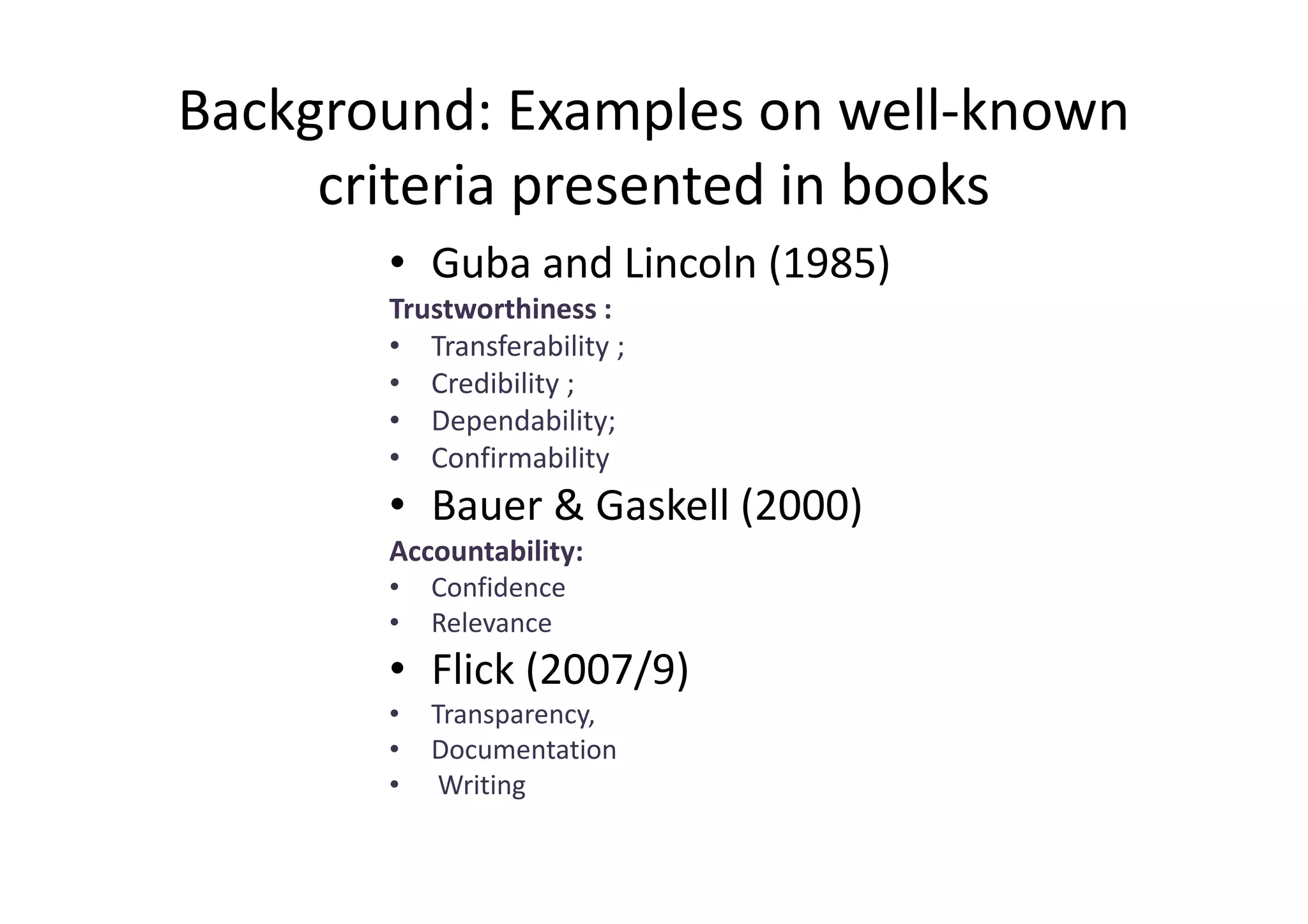
Background: Examples on well-known
     criteria presented in books
       • Guba and Lincoln (1985)
       Trustworthiness :
       • Transferability ;
       • Credibility ;
       • Dependability;
       • Confirmability
       • Bauer & Gaskell (2000)
       Accountability:
       •   Confidence
       •   Relevance
       • Flick (2007/9)
       •   Transparency,
       •   Documentation
       •    Writing
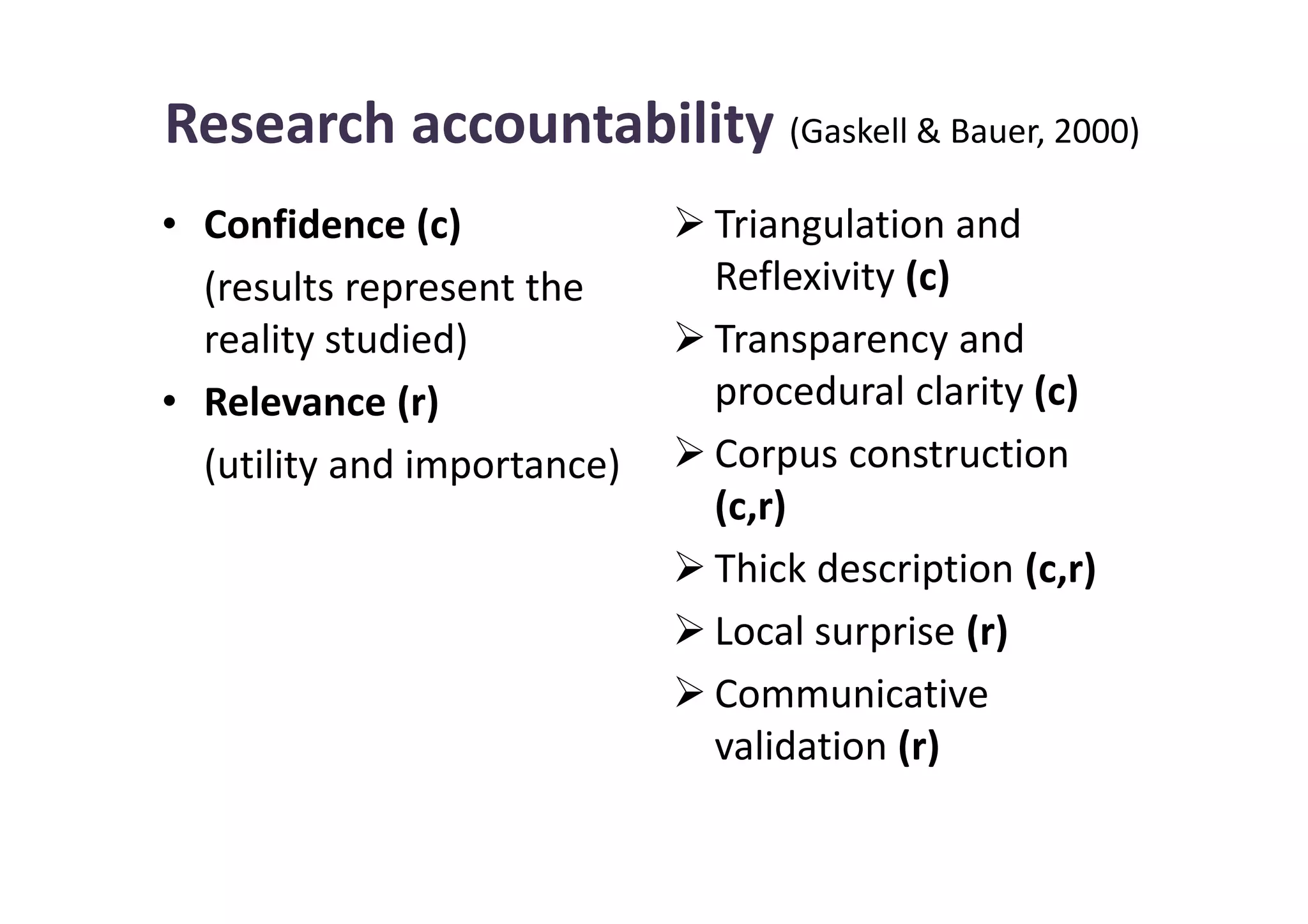
Research accountability (Gaskell & Bauer, 2000)
• Confidence (c)             Triangulation and
  (results represent the     Reflexivity (c)
  reality studied)           Transparency and
• Relevance (r)              procedural clarity (c)
  (utility and importance)   Corpus construction
                             (c,r)
                             Thick description (c,r)
                             Local surprise (r)
                             Communicative
                             validation (r)
Background: Why to focus on Quality

• The relevance of quality criteria: epistemological issues and
  practical issues

• A well-written description of the rigour in research analysis
  should convince readers that the study findings are credible
  and trustworthy (Belgrave et al., 2002).

Moreover:
• QR Internal needs (development and proliferation)
  (Flick,2007)
• QR external challenges (e.g. competition: publication;
  funding; teaching and curriculum planning) (Flick,2007)
The big question:


One size fits all?
Literature Review: Search Approach (I)
• Covering last 20 years
• Databases:
- Psycharticles;
- ABI/INFORM;
- ISI
- Google academics
• Search in the Abstracts and Titles
Literature Review: Search Approach (II)
• Papers focusing Quality Issues/Criteria in Qualitative
  Research
• Keywords used:
  Quality+ Qualitative Research/Methods;
  Validity+ Qualitative Research/Methods;
   Rigor/our + Qualitative Research/Methods;
  Trustworthiness +Qualitative Research/Methods;
  all the above with Computer Programs, Software and
  CAQDAS
• Results: > 100 papers ; >30 specifically focusing quality
  as the main topic
Literature Review: Main Characteristics
• Huge progressive increase of papers about
  Quality Issues in QR or QS in the last 20 years
• Journals: Either general (Methods in General;
  Methods in QR); either in specific fields
  (mainly: health; business; education;
  communication)
Literature Review: Main Characteristics
Therefore:
  Papers focusing QR Quality in specific research
  fields VS generic criteria and
  recommendations
• Papers departing from validity & reliability and
  framing them in the QR VS papers against that
  assumptions
Literature Review: Main Findings
Main types of papers focus:
• Criteria used by Journals and Referees
• Specific Criteria for specific QR
• Generic Criteria for all QR
• Techniques for assuring quality: Audit;
  triangulation; …
• Quality and CAQDAS

Most cited Authors:
• Guba and Lincoln (1985)
LR Results – Journals and Referees
                 criteria
• Papers focusing specific Criteria used by
  Journals and Referees to sustain Qualitative
  Papers Review

Examples:
• Academy of Management Journal Editors (2002,
  2004 & 2009)
• Savall et al. (2008)
• Crescentini & Mainard (2009)
Academy of Management Journal 2009
      Editors: Tips for Writing Qualitative Papers
1. Make sure your paper includes “the basics”:
• Discuss why this research is needed
• Are you building a new theory or elaborating existing theory?
• Why did you choose this context and this “unit of analysis”?
• How did you get from your data to your findings?

2. Show data in a smart fashion
3. Think about using/organizing figures
4. Think about telling a story
5. Consider “modeling” someone whose style you like who
   consistently publishes qualitative
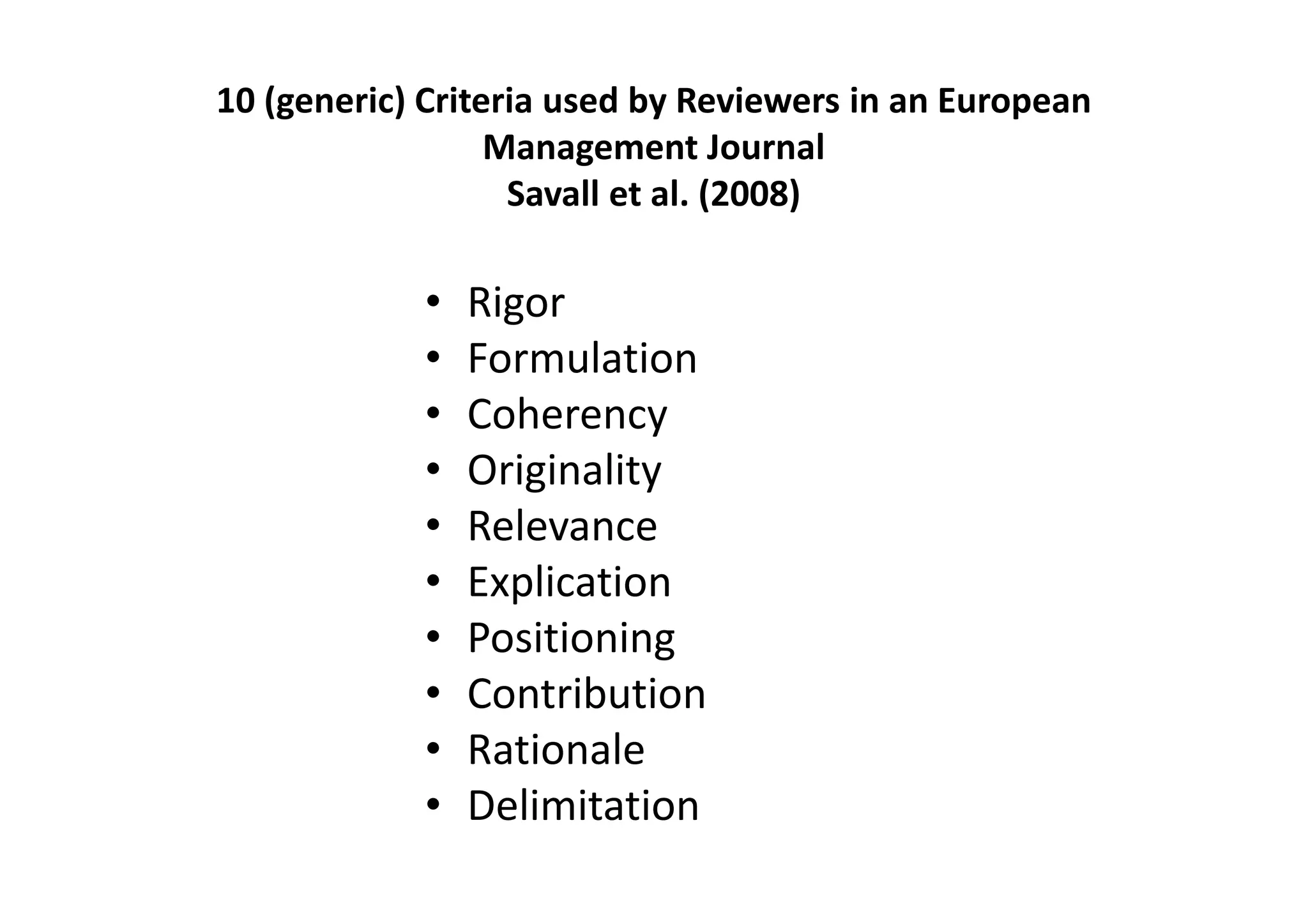
10 (generic) Criteria used by Reviewers in an European
                  Management Journal
                   Savall et al. (2008)

            •   Rigor
            •   Formulation
            •   Coherency
            •   Originality
            •   Relevance
            •   Explication
            •   Positioning
            •   Contribution
            •   Rationale
            •   Delimitation
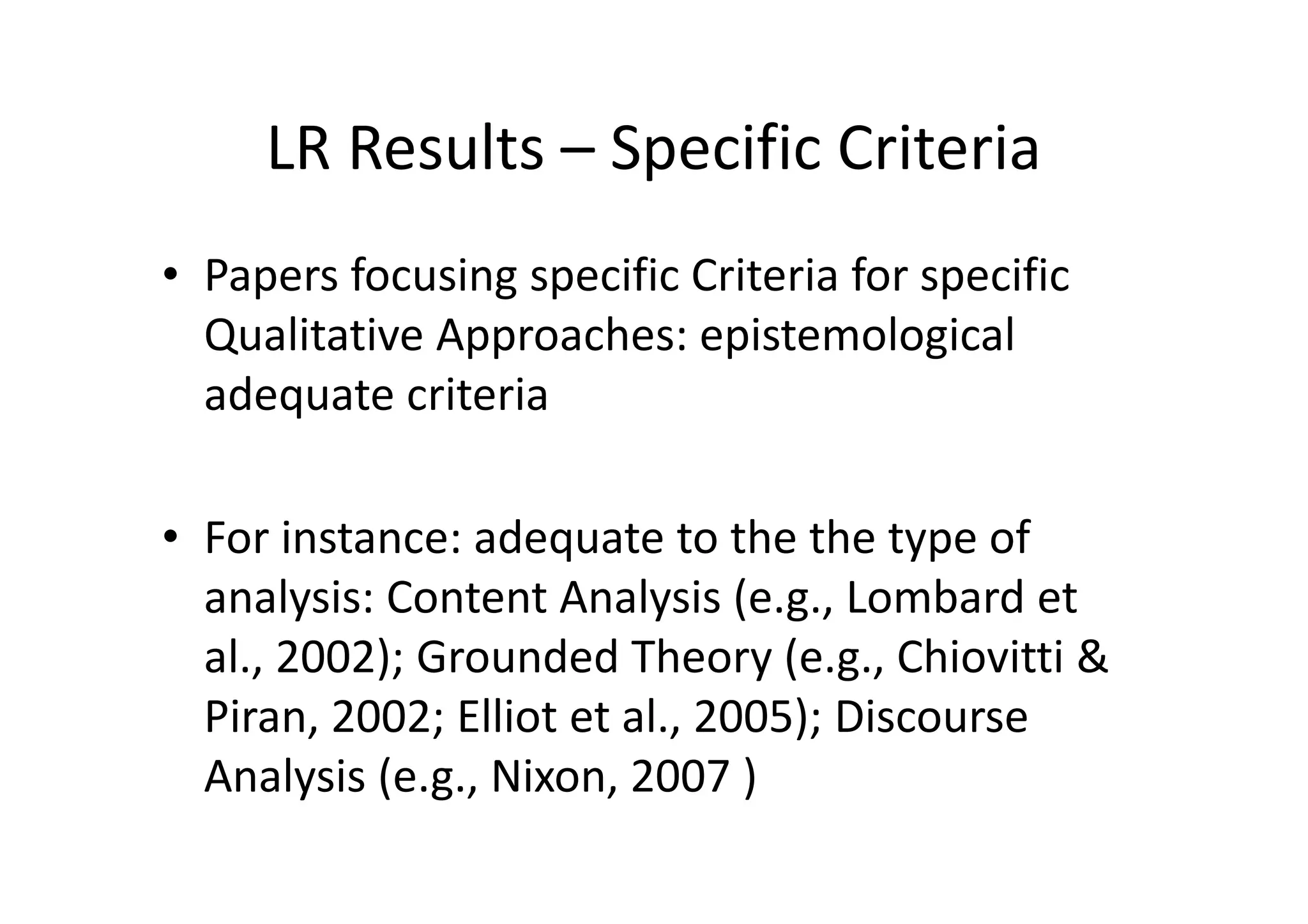
LR Results – Specific Criteria
• Papers focusing specific Criteria for specific
  Qualitative Approaches: epistemological
  adequate criteria

• For instance: adequate to the the type of
  analysis: Content Analysis (e.g., Lombard et
  al., 2002); Grounded Theory (e.g., Chiovitti &
  Piran, 2002; Elliot et al., 2005); Discourse
  Analysis (e.g., Nixon, 2007 )
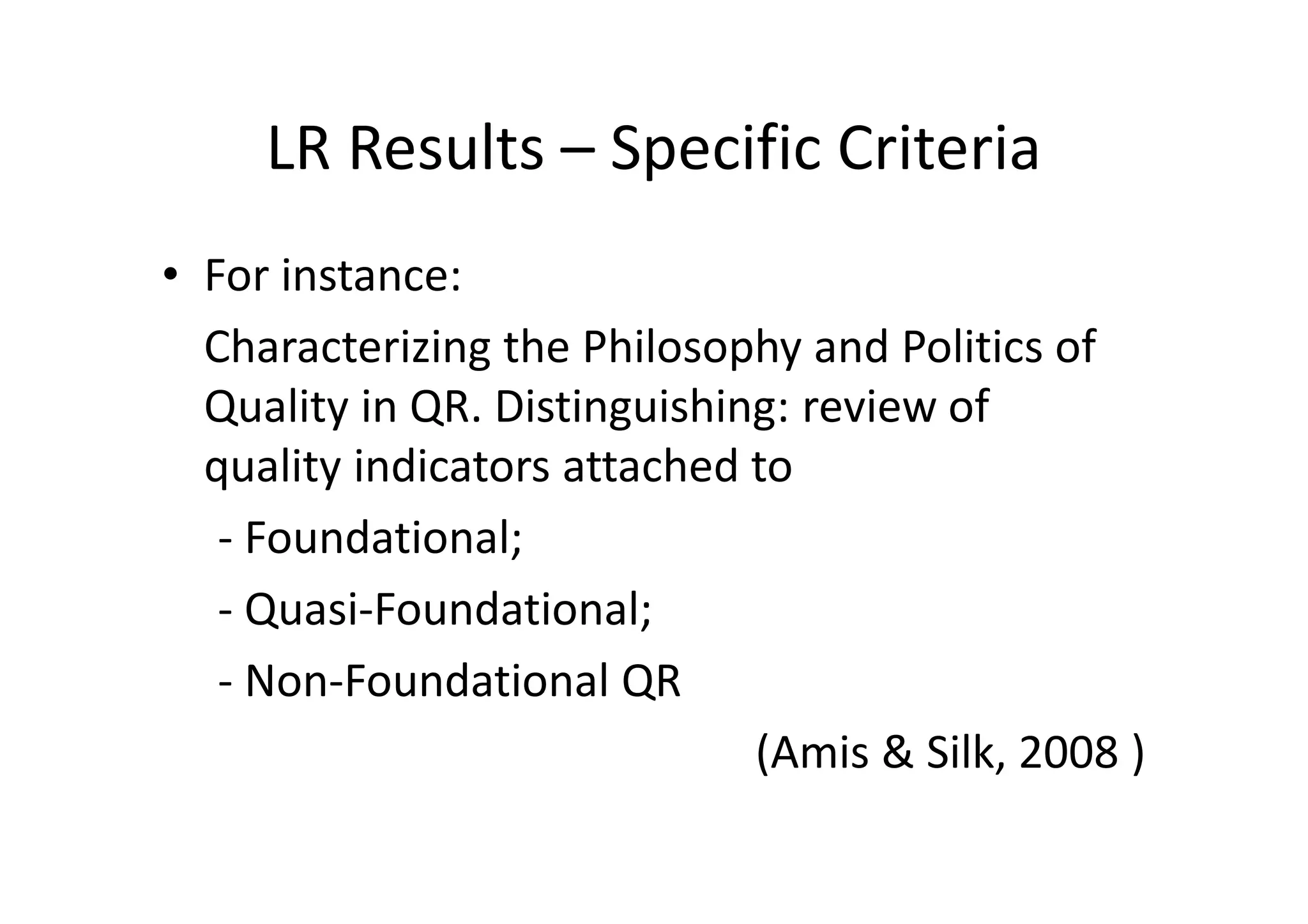
LR Results – Specific Criteria
• For instance:
  Characterizing the Philosophy and Politics of
  Quality in QR. Distinguishing: review of
  quality indicators attached to
   - Foundational;
   - Quasi-Foundational;
   - Non-Foundational QR
                              (Amis & Silk, 2008 )
LR Results - Generic Criteria or
           Recomendations I
• Papers focusing specific Criteria for
  generic/transversal Qualitative Approaches:
  criteria that applies to all approaches
LR Results - Generic Criteria or
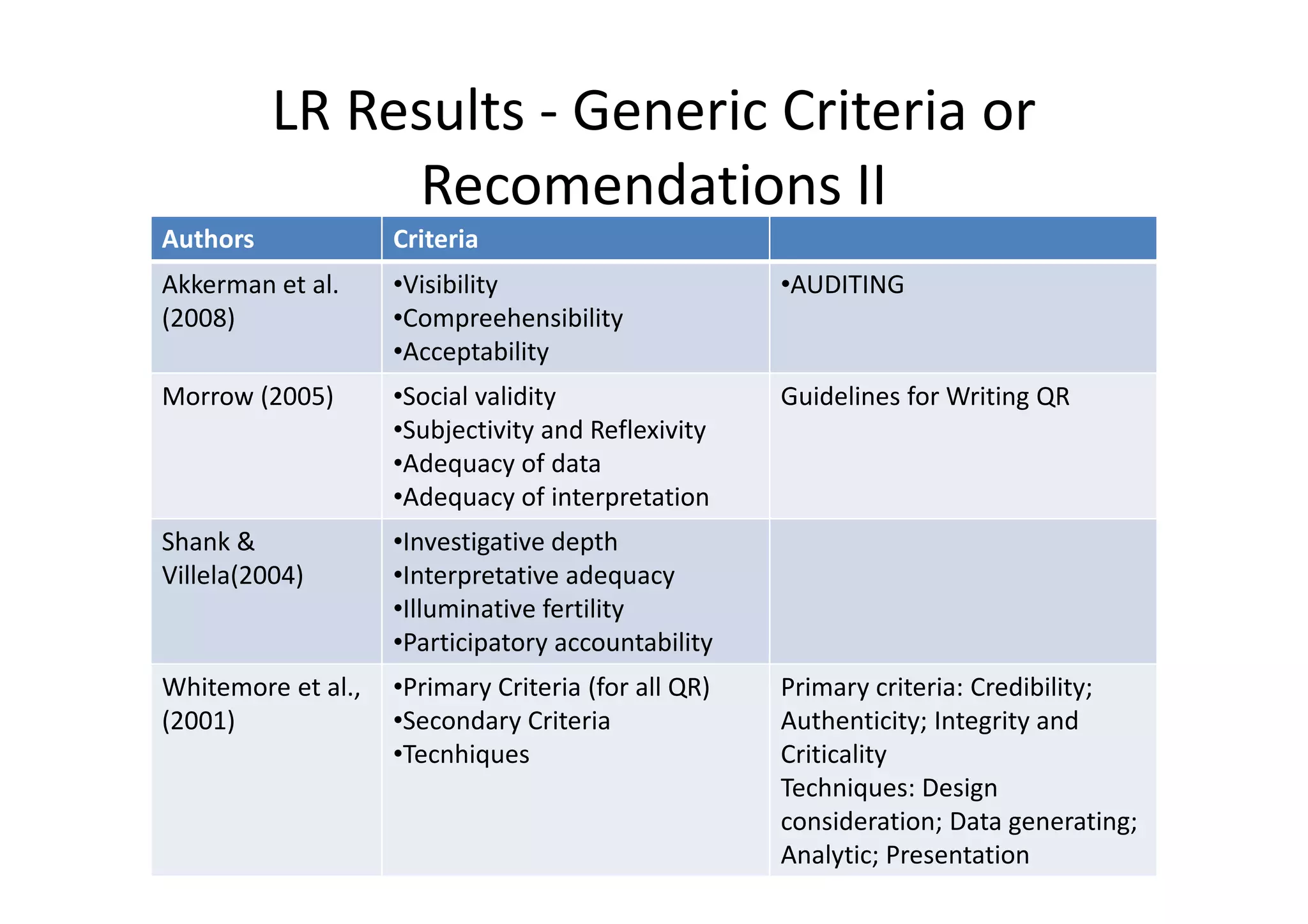
               Recomendations II
Authors             Criteria
Akkerman et al.     •Visibility                      •AUDITING
(2008)              •Compreehensibility
                    •Acceptability
Morrow (2005)       •Social validity                 Guidelines for Writing QR
                    •Subjectivity and Reflexivity
                    •Adequacy of data
                    •Adequacy of interpretation
Shank &             •Investigative depth
Villela(2004)       •Interpretative adequacy
                    •Illuminative fertility
                    •Participatory accountability
Whitemore et al.,   •Primary Criteria (for all QR)   Primary criteria: Credibility;
(2001)              •Secondary Criteria              Authenticity; Integrity and
                    •Tecnhiques                      Criticality
                                                     Techniques: Design
                                                     consideration; Data generating;
                                                     Analytic; Presentation
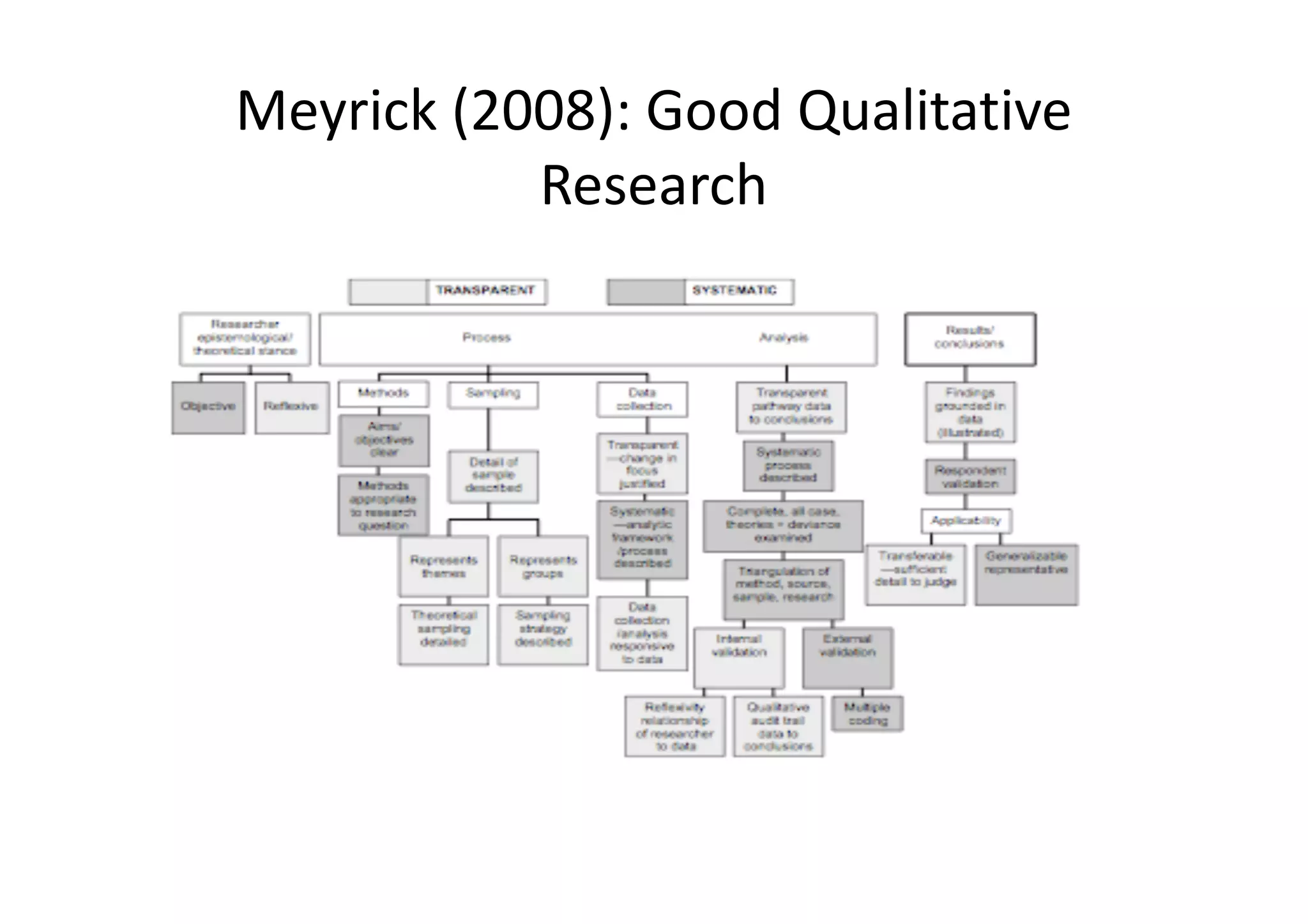
Meyrick (2008): Good Qualitative
           Research
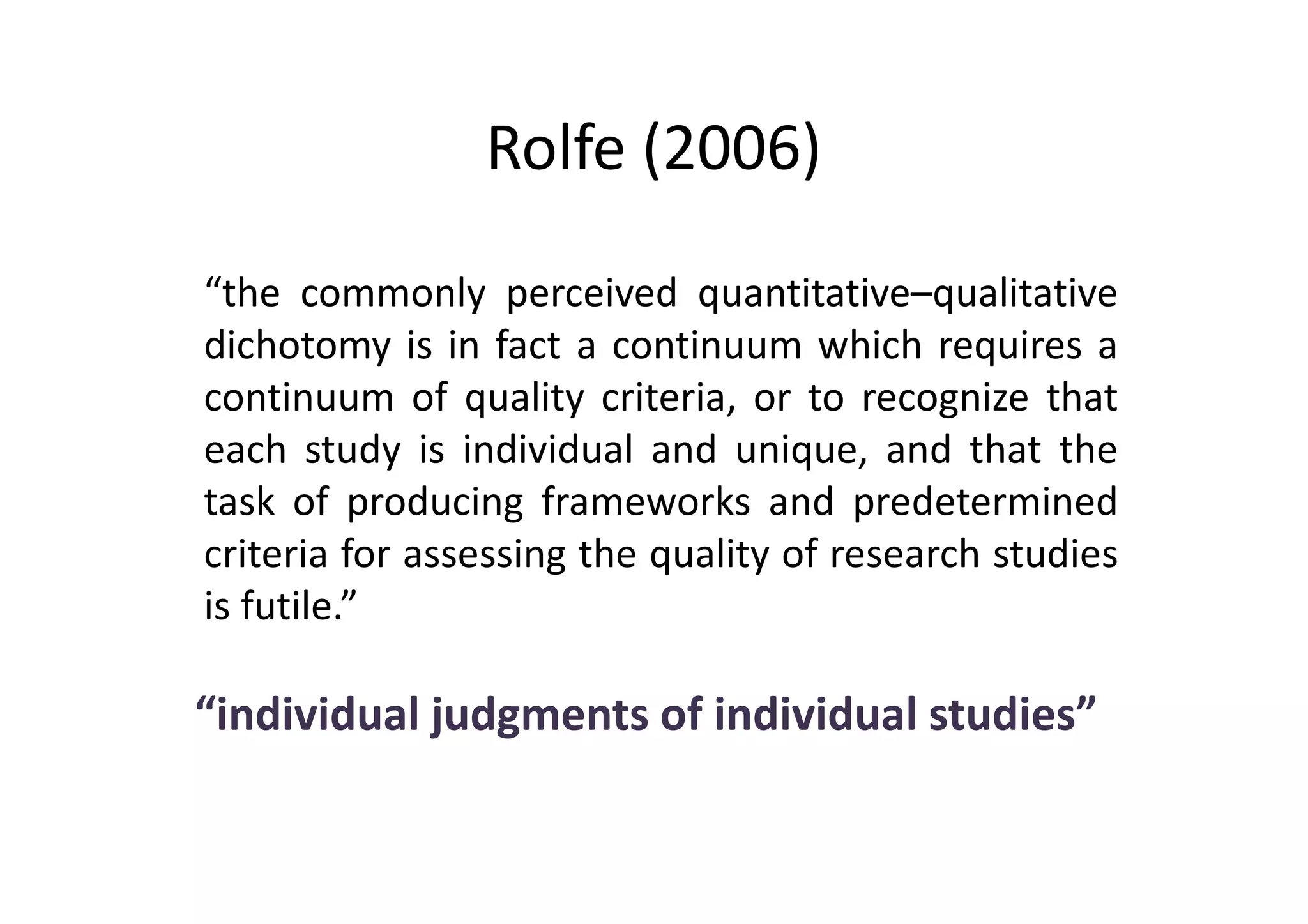
Rolfe (2006)

“the commonly perceived quantitative–qualitative
dichotomy is in fact a continuum which requires a
continuum of quality criteria, or to recognize that
each study is individual and unique, and that the
task of producing frameworks and predetermined
criteria for assessing the quality of research studies
is futile.”

“individual judgments of individual studies”
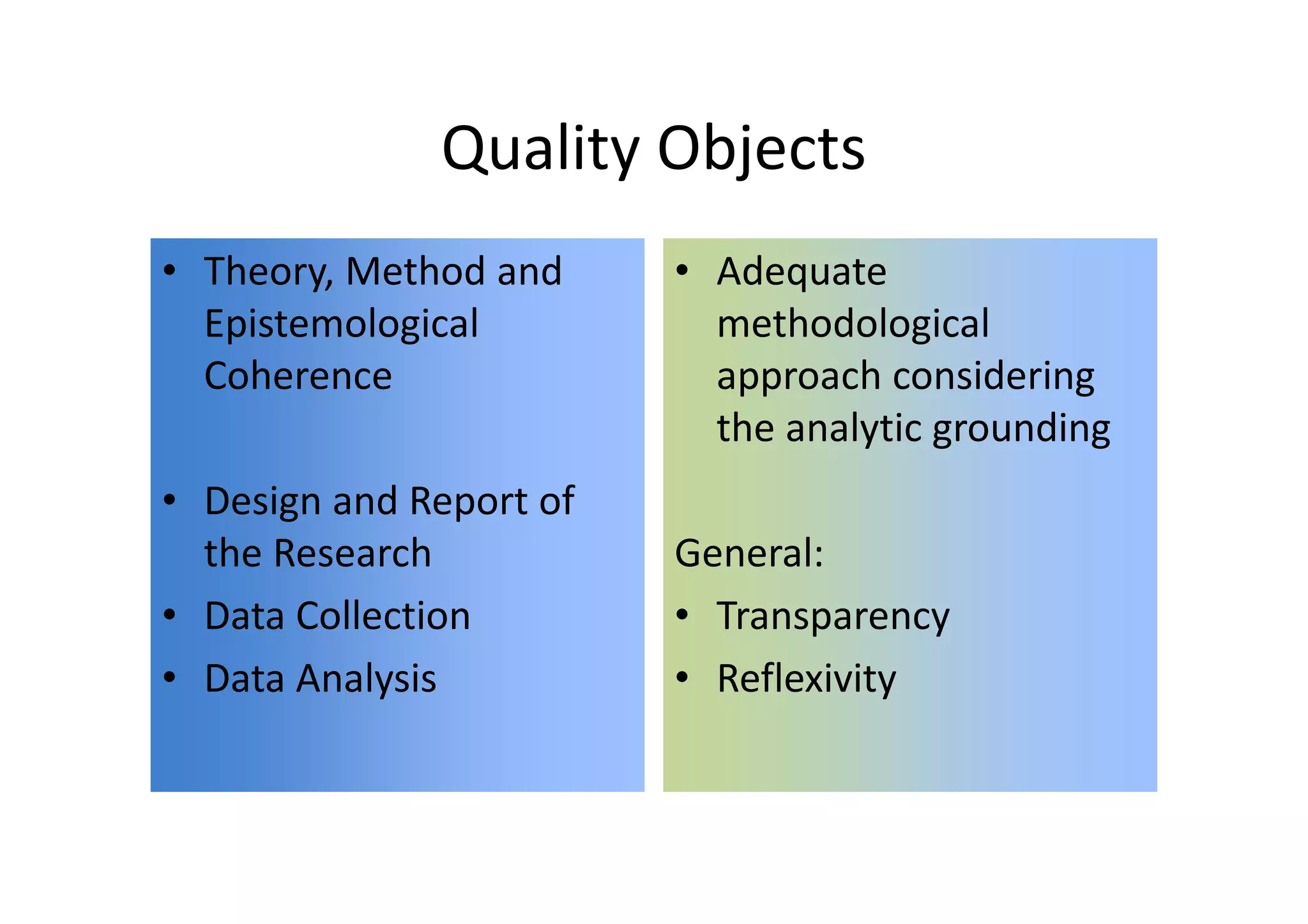
Quality Objects
• Theory, Method and     • Adequate
  Epistemological          methodological
  Coherence                approach considering
                           the analytic grounding
• Design and Report of
  the Research           General:
• Data Collection        • Transparency
• Data Analysis          • Reflexivity
LR Results – Quality and CAQDAS
• Papers focusing the role of CAQDAS on
  assuring Rigor and Quality
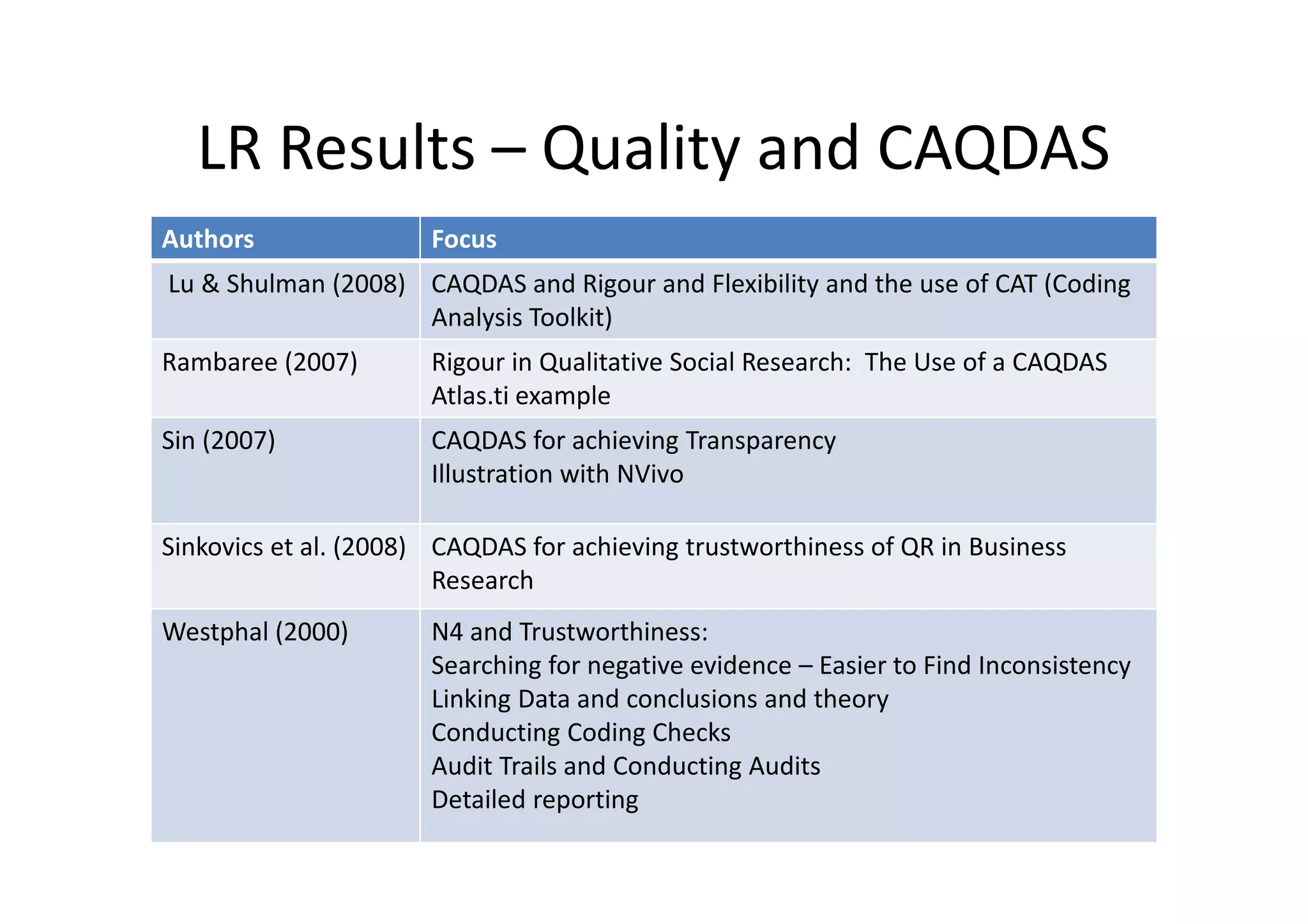
LR Results – Quality and CAQDAS
Authors                Focus
Lu & Shulman (2008) CAQDAS and Rigour and Flexibility and the use of CAT (Coding
                    Analysis Toolkit)
Rambaree (2007)        Rigour in Qualitative Social Research: The Use of a CAQDAS
                       Atlas.ti example
Sin (2007)             CAQDAS for achieving Transparency
                       Illustration with NVivo

Sinkovics et al. (2008) CAQDAS for achieving trustworthiness of QR in Business
                        Research
Westphal (2000)        N4 and Trustworthiness:
                       Searching for negative evidence – Easier to Find Inconsistency
                       Linking Data and conclusions and theory
                       Conducting Coding Checks
                       Audit Trails and Conducting Audits
                       Detailed reporting
What Software Do (Gibbs, Lewins & Silver, 2005;
                     Lewins & Silver,2009)
• Structure work (access and organization of all project elements)
• 'Closeness to data' interactivity (quick access to source data
  files)
• Explore data
• Code and Retrieve Functionality
• Project Management and Data Organisation
• Search and interrogating the database
• Writing tools - Memos, comments and annotations,
• Output - Reports to view a hard copy or export to another
  package.
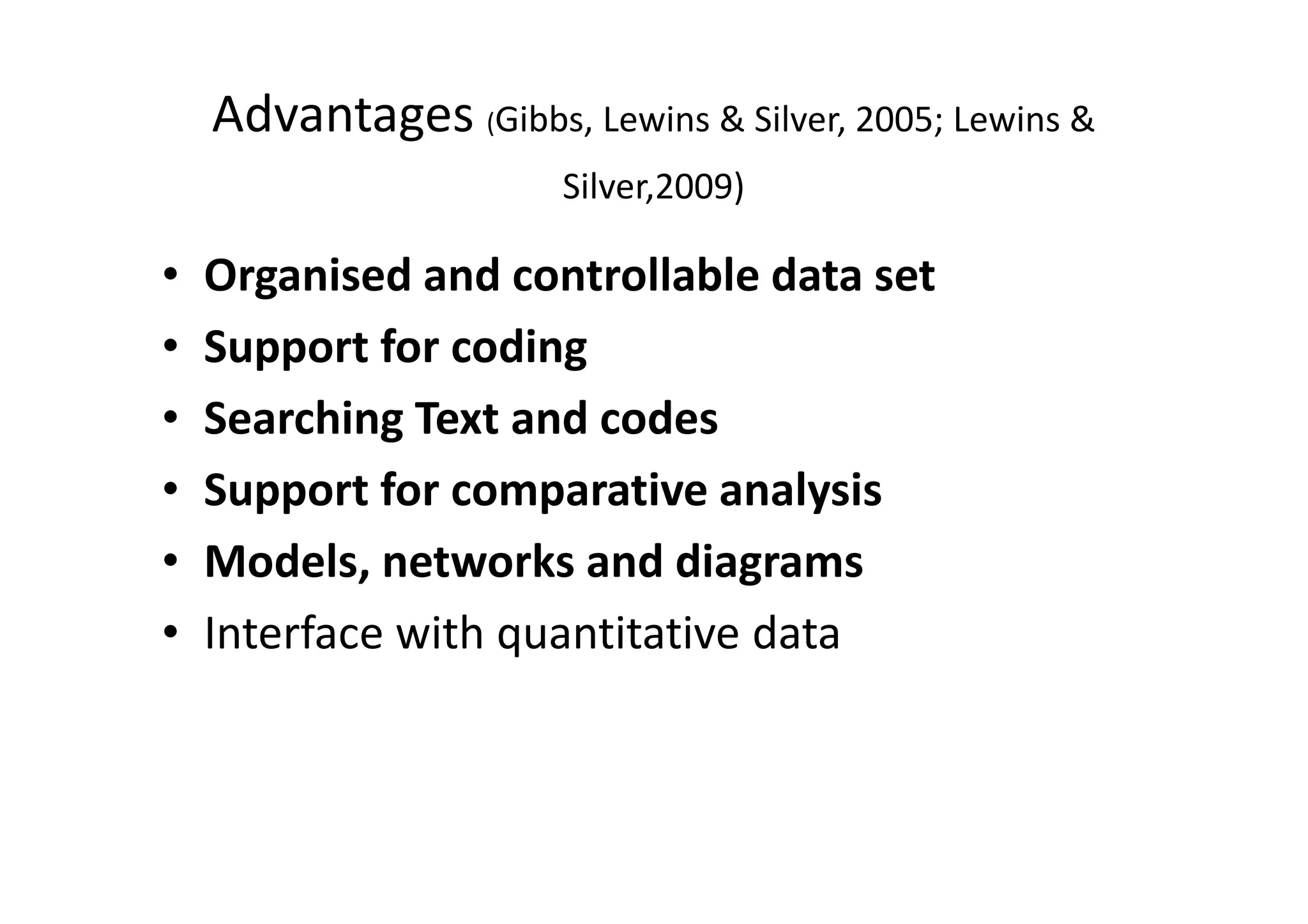
Advantages (Gibbs, Lewins & Silver, 2005; Lewins &
                       Silver,2009)

•   Organised and controllable data set
•   Support for coding
•   Searching Text and codes
•   Support for comparative analysis
•   Models, networks and diagrams
•   Interface with quantitative data
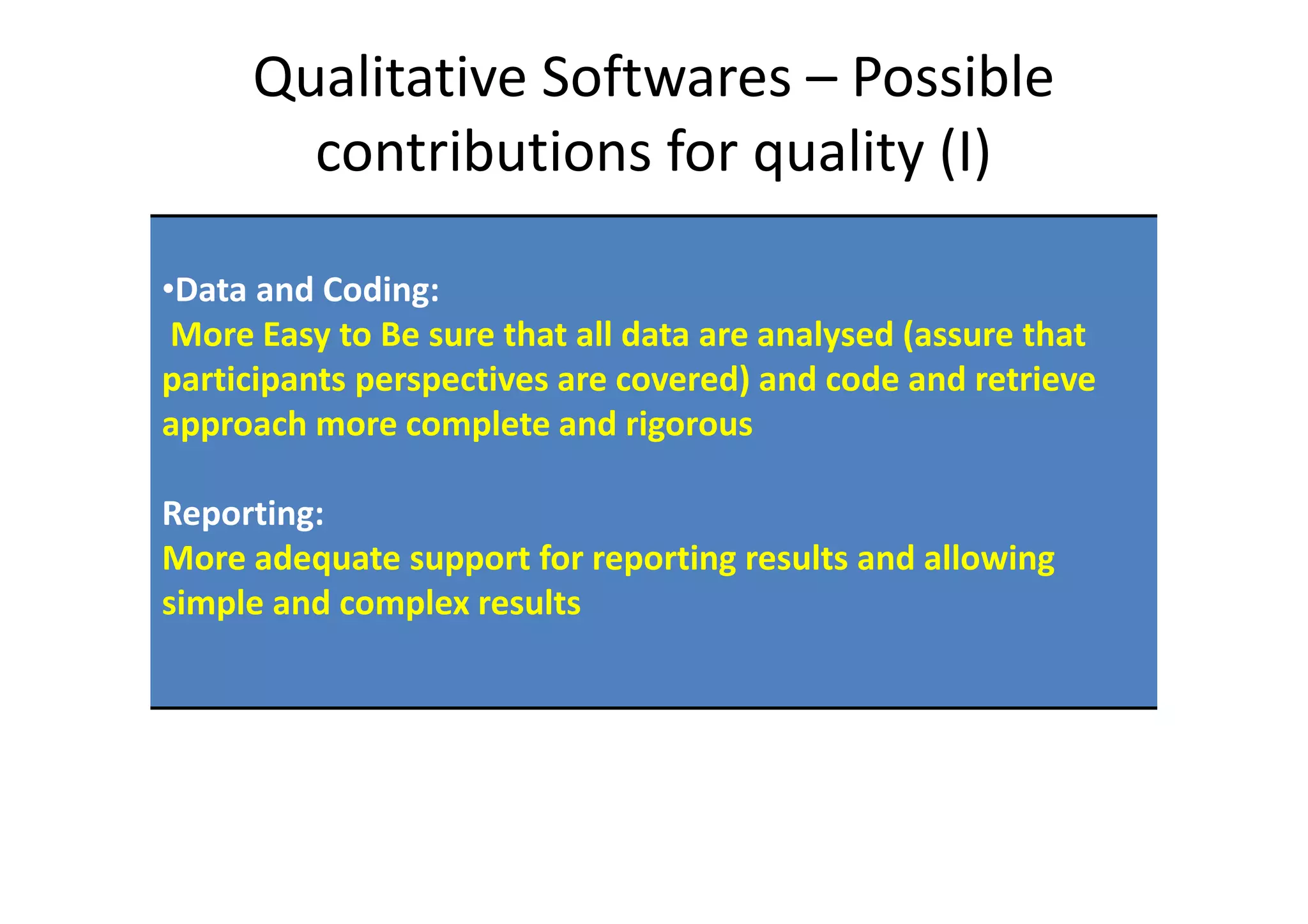
Qualitative Softwares – Possible
       contributions for quality (I)

•Data and Coding:
 More Easy to Be sure that all data are analysed (assure that
participants perspectives are covered) and code and retrieve
approach more complete and rigorous

Reporting:
More adequate support for reporting results and allowing
simple and complex results
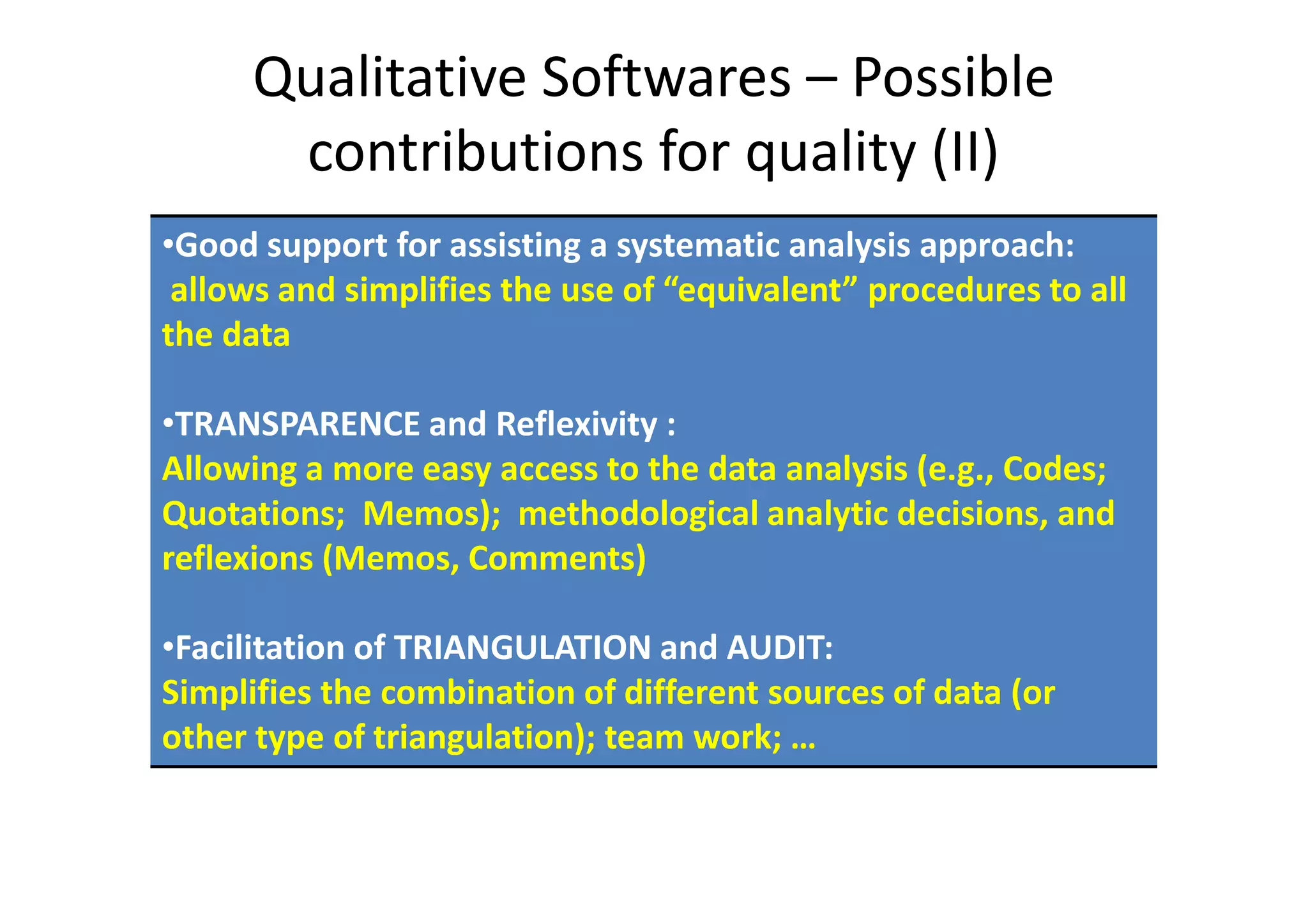
Qualitative Softwares – Possible
       contributions for quality (II)
•Good support for assisting a systematic analysis approach:
 allows and simplifies the use of “equivalent” procedures to all
the data

•TRANSPARENCE and Reflexivity :
Allowing a more easy access to the data analysis (e.g., Codes;
Quotations; Memos); methodological analytic decisions, and
reflexions (Memos, Comments)

•Facilitation of TRIANGULATION and AUDIT:
Simplifies the combination of different sources of data (or
other type of triangulation); team work; …
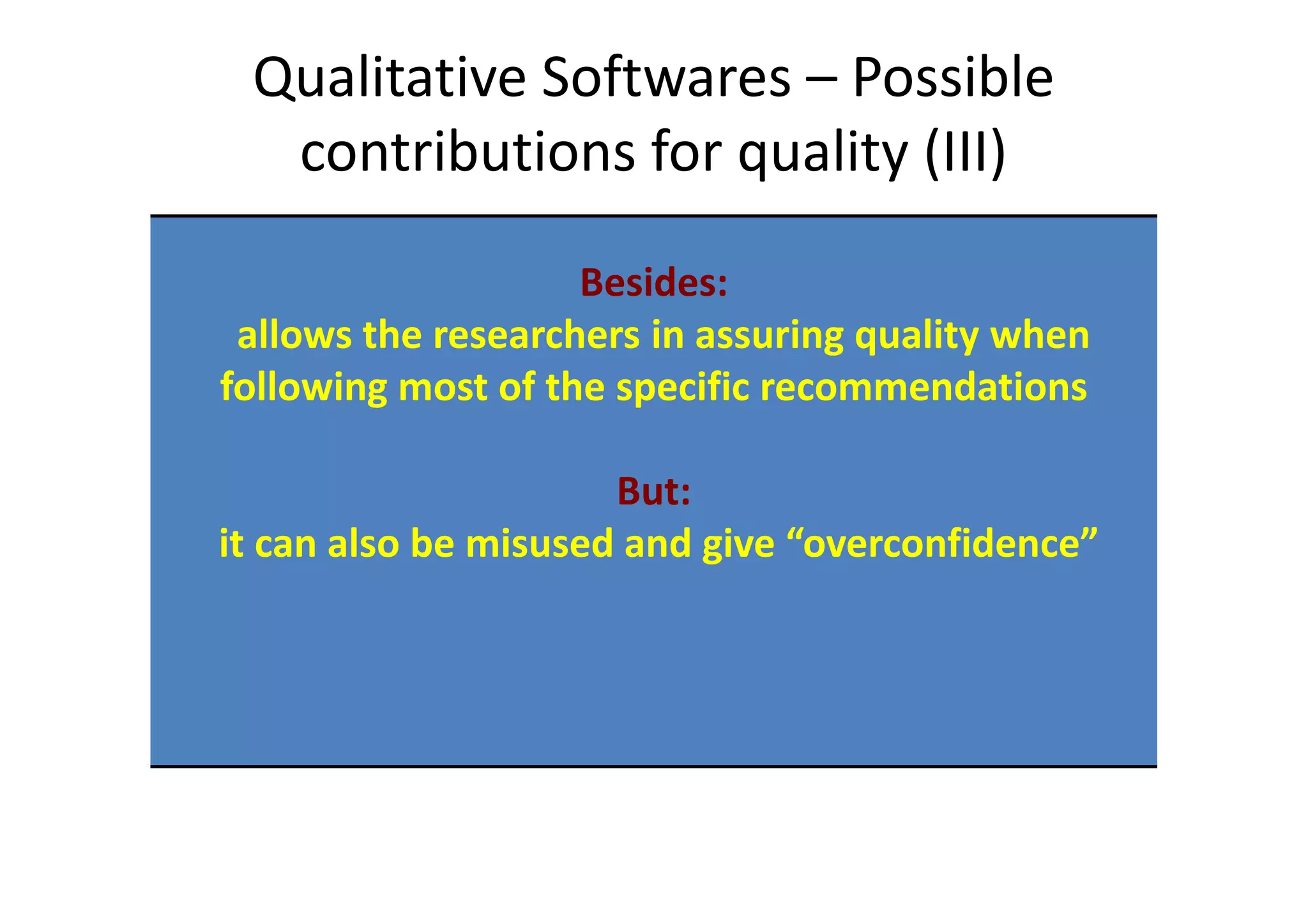
Qualitative Softwares – Possible
  contributions for quality (III)

                    Besides:
 allows the researchers in assuring quality when
following most of the specific recommendations

                      But:
it can also be misused and give “overconfidence”
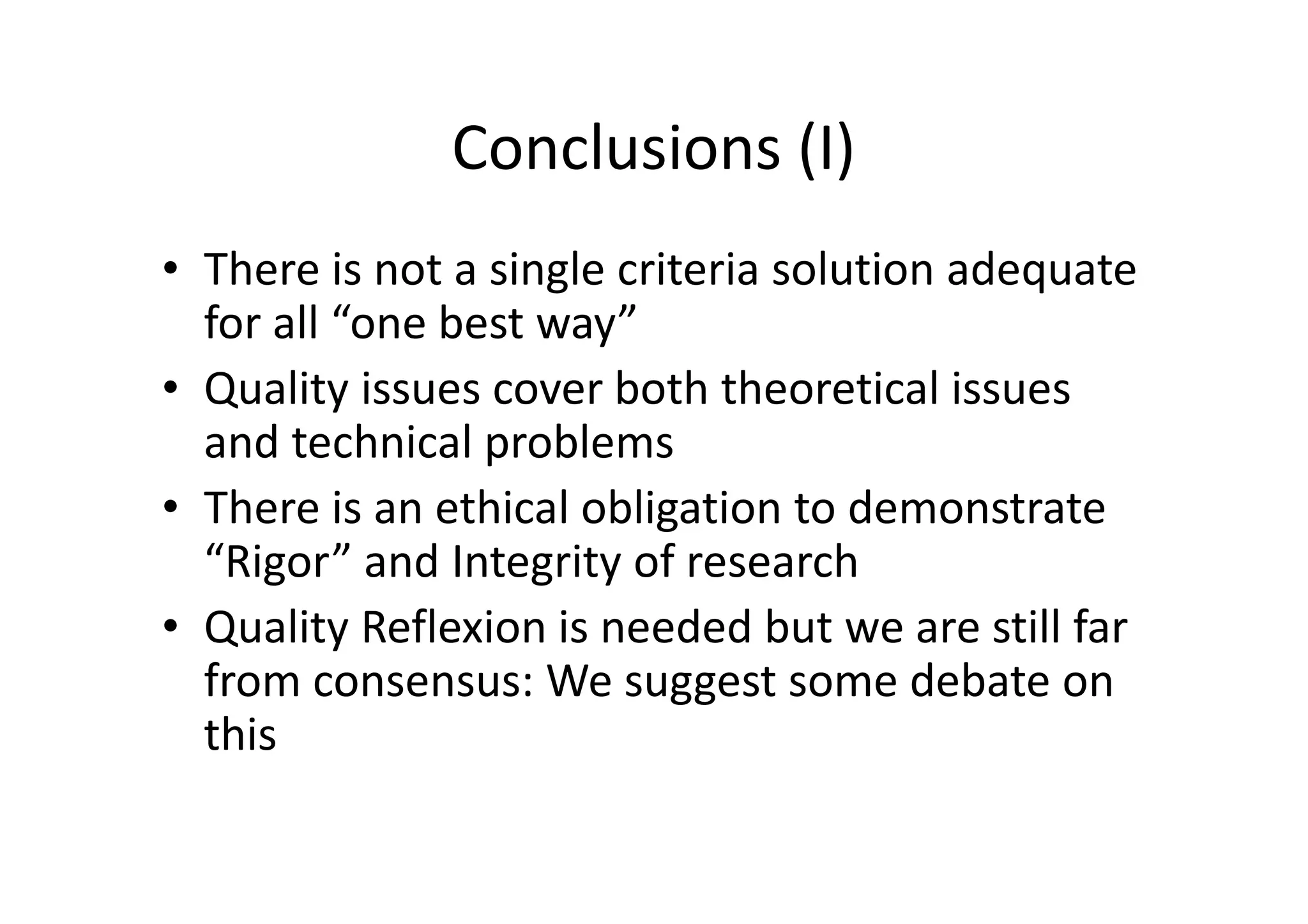
Conclusions (I)
• There is not a single criteria solution adequate
  for all “one best way”
• Quality issues cover both theoretical issues
  and technical problems
• There is an ethical obligation to demonstrate
  “Rigor” and Integrity of research
• Quality Reflexion is needed but we are still far
  from consensus: We suggest some debate on
  this
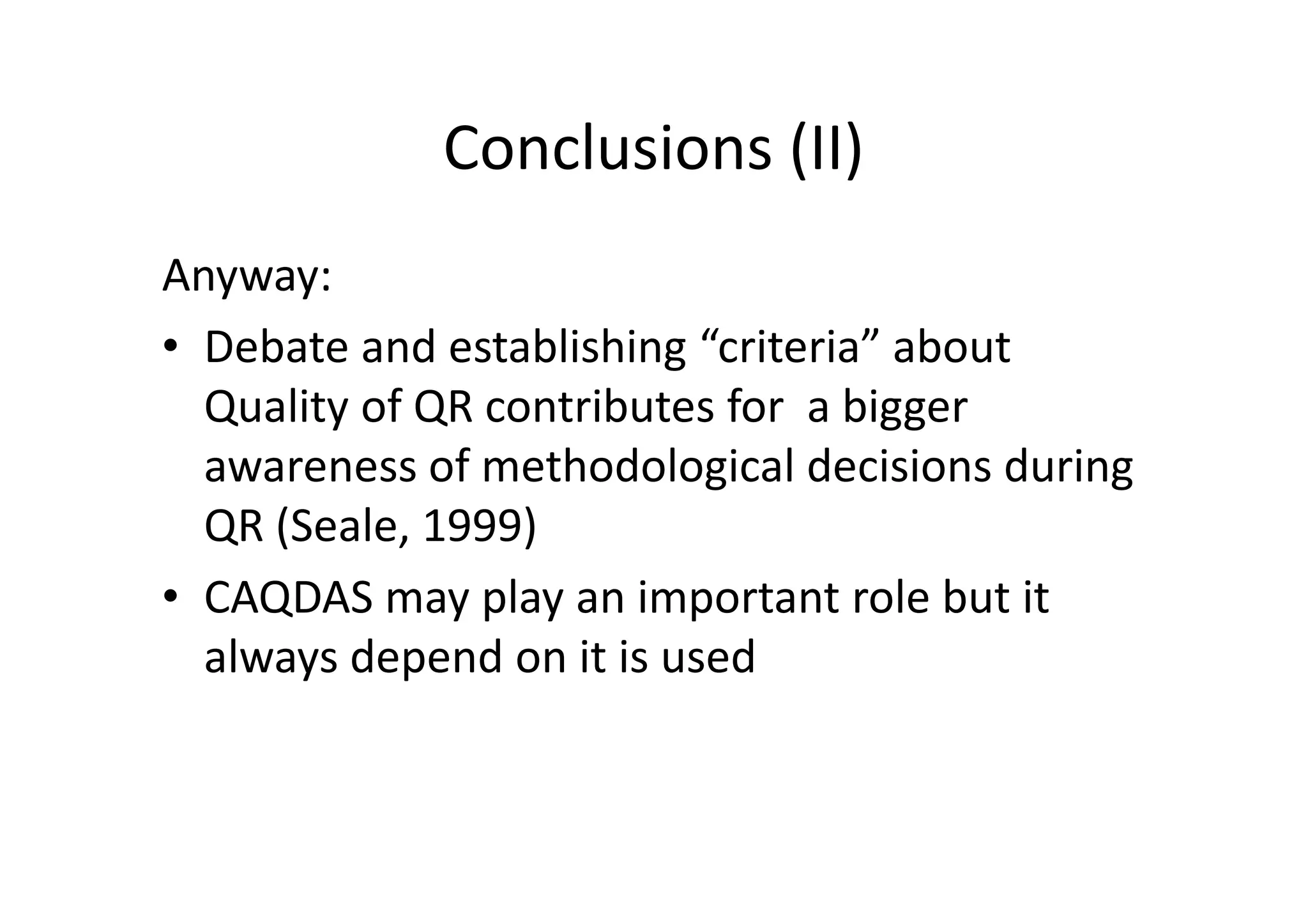
Conclusions (II)
Anyway:
• Debate and establishing “criteria” about
  Quality of QR contributes for a bigger
  awareness of methodological decisions during
  QR (Seale, 1999)
• CAQDAS may play an important role but it
  always depend on it is used
Conclusions (III)

             Myth 94:
qualitative researchers will agree
               about
              validity
           Sparkes (2001)
Our Future work on this subject

• First Paper in Preparation
• Project about the Quality of Qualitative
  Research and CAQDAS(without funding at the
  moment) in the beginning; looking forward
  possible cooperation/network for proposal to
  be submitted to the Portuguese Science
  Foundation
References
A list with the Main References will be
distributed
Computer-Aided Qualitative Research Europe
         7 & 8 Oct 2010, Lisbon


     For more information about our events, please visit:
                   http://www.merlien.org

Quality in qualitative research the role of the software’s in quality assurance

  • 1.
    Computer-Aided Qualitative ResearchEurope 7 & 8 Oct 2010, Lisbon For more information about our events, please visit: http://www.merlien.org
  • 2.
    3rd European workshopon COMPUTER-AIDED QUALITATIVE RESEARCH 2010 Quality in Qualitative Research: The role of the software’s in Quality Assurance SÍLVIA SILVA SARA RAMOS ISCTE-IUL
  • 3.
    OVERVIEW Main points ofour presentation: • Aims • Background • Literature review and results • Quality and CAQDAS Additionally : - Distribution of Some Examples - Distribution of List of Main References
  • 4.
    AIM To present areview of quality criteria in Qualitative Research and explore and conclude about the potential roles that software packages may play in quality assurance.
  • 5.
    Specific goals: (1) Identifythe criteria used (2) Identify the most common/consensual criteria; (3) Link quality to CAQDAS (4) Contribute for debate and consensus (?)
  • 6.
    Background • In thelast thirty years several authors proposed criteria for considering when approaching the issue of Quality in Qualitative Research (QR). • It is somehow recognized that we are far from having shared quality assumptions
  • 7.
    Background: Examples onwell-known criteria presented in books • Guba and Lincoln (1985) Trustworthiness : • Transferability ; • Credibility ; • Dependability; • Confirmability • Bauer & Gaskell (2000) Accountability: • Confidence • Relevance • Flick (2007/9) • Transparency, • Documentation • Writing
  • 8.
    Research accountability (Gaskell& Bauer, 2000) • Confidence (c) Triangulation and (results represent the Reflexivity (c) reality studied) Transparency and • Relevance (r) procedural clarity (c) (utility and importance) Corpus construction (c,r) Thick description (c,r) Local surprise (r) Communicative validation (r)
  • 9.
    Background: Why tofocus on Quality • The relevance of quality criteria: epistemological issues and practical issues • A well-written description of the rigour in research analysis should convince readers that the study findings are credible and trustworthy (Belgrave et al., 2002). Moreover: • QR Internal needs (development and proliferation) (Flick,2007) • QR external challenges (e.g. competition: publication; funding; teaching and curriculum planning) (Flick,2007)
  • 10.
    The big question: Onesize fits all?
  • 11.
    Literature Review: SearchApproach (I) • Covering last 20 years • Databases: - Psycharticles; - ABI/INFORM; - ISI - Google academics • Search in the Abstracts and Titles
  • 12.
    Literature Review: SearchApproach (II) • Papers focusing Quality Issues/Criteria in Qualitative Research • Keywords used: Quality+ Qualitative Research/Methods; Validity+ Qualitative Research/Methods; Rigor/our + Qualitative Research/Methods; Trustworthiness +Qualitative Research/Methods; all the above with Computer Programs, Software and CAQDAS • Results: > 100 papers ; >30 specifically focusing quality as the main topic
  • 13.
    Literature Review: MainCharacteristics • Huge progressive increase of papers about Quality Issues in QR or QS in the last 20 years • Journals: Either general (Methods in General; Methods in QR); either in specific fields (mainly: health; business; education; communication)
  • 14.
    Literature Review: MainCharacteristics Therefore: Papers focusing QR Quality in specific research fields VS generic criteria and recommendations • Papers departing from validity & reliability and framing them in the QR VS papers against that assumptions
  • 15.
    Literature Review: MainFindings Main types of papers focus: • Criteria used by Journals and Referees • Specific Criteria for specific QR • Generic Criteria for all QR • Techniques for assuring quality: Audit; triangulation; … • Quality and CAQDAS Most cited Authors: • Guba and Lincoln (1985)
  • 16.
    LR Results –Journals and Referees criteria • Papers focusing specific Criteria used by Journals and Referees to sustain Qualitative Papers Review Examples: • Academy of Management Journal Editors (2002, 2004 & 2009) • Savall et al. (2008) • Crescentini & Mainard (2009)
  • 17.
    Academy of ManagementJournal 2009 Editors: Tips for Writing Qualitative Papers 1. Make sure your paper includes “the basics”: • Discuss why this research is needed • Are you building a new theory or elaborating existing theory? • Why did you choose this context and this “unit of analysis”? • How did you get from your data to your findings? 2. Show data in a smart fashion 3. Think about using/organizing figures 4. Think about telling a story 5. Consider “modeling” someone whose style you like who consistently publishes qualitative
  • 18.
    10 (generic) Criteriaused by Reviewers in an European Management Journal Savall et al. (2008) • Rigor • Formulation • Coherency • Originality • Relevance • Explication • Positioning • Contribution • Rationale • Delimitation
  • 19.
    LR Results –Specific Criteria • Papers focusing specific Criteria for specific Qualitative Approaches: epistemological adequate criteria • For instance: adequate to the the type of analysis: Content Analysis (e.g., Lombard et al., 2002); Grounded Theory (e.g., Chiovitti & Piran, 2002; Elliot et al., 2005); Discourse Analysis (e.g., Nixon, 2007 )
  • 20.
    LR Results –Specific Criteria • For instance: Characterizing the Philosophy and Politics of Quality in QR. Distinguishing: review of quality indicators attached to - Foundational; - Quasi-Foundational; - Non-Foundational QR (Amis & Silk, 2008 )
  • 21.
    LR Results -Generic Criteria or Recomendations I • Papers focusing specific Criteria for generic/transversal Qualitative Approaches: criteria that applies to all approaches
  • 22.
    LR Results -Generic Criteria or Recomendations II Authors Criteria Akkerman et al. •Visibility •AUDITING (2008) •Compreehensibility •Acceptability Morrow (2005) •Social validity Guidelines for Writing QR •Subjectivity and Reflexivity •Adequacy of data •Adequacy of interpretation Shank & •Investigative depth Villela(2004) •Interpretative adequacy •Illuminative fertility •Participatory accountability Whitemore et al., •Primary Criteria (for all QR) Primary criteria: Credibility; (2001) •Secondary Criteria Authenticity; Integrity and •Tecnhiques Criticality Techniques: Design consideration; Data generating; Analytic; Presentation
  • 23.
    Meyrick (2008): GoodQualitative Research
  • 24.
    Rolfe (2006) “the commonlyperceived quantitative–qualitative dichotomy is in fact a continuum which requires a continuum of quality criteria, or to recognize that each study is individual and unique, and that the task of producing frameworks and predetermined criteria for assessing the quality of research studies is futile.” “individual judgments of individual studies”
  • 25.
    Quality Objects • Theory,Method and • Adequate Epistemological methodological Coherence approach considering the analytic grounding • Design and Report of the Research General: • Data Collection • Transparency • Data Analysis • Reflexivity
  • 26.
    LR Results –Quality and CAQDAS • Papers focusing the role of CAQDAS on assuring Rigor and Quality
  • 27.
    LR Results –Quality and CAQDAS Authors Focus Lu & Shulman (2008) CAQDAS and Rigour and Flexibility and the use of CAT (Coding Analysis Toolkit) Rambaree (2007) Rigour in Qualitative Social Research: The Use of a CAQDAS Atlas.ti example Sin (2007) CAQDAS for achieving Transparency Illustration with NVivo Sinkovics et al. (2008) CAQDAS for achieving trustworthiness of QR in Business Research Westphal (2000) N4 and Trustworthiness: Searching for negative evidence – Easier to Find Inconsistency Linking Data and conclusions and theory Conducting Coding Checks Audit Trails and Conducting Audits Detailed reporting
  • 28.
    What Software Do(Gibbs, Lewins & Silver, 2005; Lewins & Silver,2009) • Structure work (access and organization of all project elements) • 'Closeness to data' interactivity (quick access to source data files) • Explore data • Code and Retrieve Functionality • Project Management and Data Organisation • Search and interrogating the database • Writing tools - Memos, comments and annotations, • Output - Reports to view a hard copy or export to another package.
  • 29.
    Advantages (Gibbs, Lewins& Silver, 2005; Lewins & Silver,2009) • Organised and controllable data set • Support for coding • Searching Text and codes • Support for comparative analysis • Models, networks and diagrams • Interface with quantitative data
  • 30.
    Qualitative Softwares –Possible contributions for quality (I) •Data and Coding: More Easy to Be sure that all data are analysed (assure that participants perspectives are covered) and code and retrieve approach more complete and rigorous Reporting: More adequate support for reporting results and allowing simple and complex results
  • 31.
    Qualitative Softwares –Possible contributions for quality (II) •Good support for assisting a systematic analysis approach: allows and simplifies the use of “equivalent” procedures to all the data •TRANSPARENCE and Reflexivity : Allowing a more easy access to the data analysis (e.g., Codes; Quotations; Memos); methodological analytic decisions, and reflexions (Memos, Comments) •Facilitation of TRIANGULATION and AUDIT: Simplifies the combination of different sources of data (or other type of triangulation); team work; …
  • 32.
    Qualitative Softwares –Possible contributions for quality (III) Besides: allows the researchers in assuring quality when following most of the specific recommendations But: it can also be misused and give “overconfidence”
  • 33.
    Conclusions (I) • Thereis not a single criteria solution adequate for all “one best way” • Quality issues cover both theoretical issues and technical problems • There is an ethical obligation to demonstrate “Rigor” and Integrity of research • Quality Reflexion is needed but we are still far from consensus: We suggest some debate on this
  • 34.
    Conclusions (II) Anyway: • Debateand establishing “criteria” about Quality of QR contributes for a bigger awareness of methodological decisions during QR (Seale, 1999) • CAQDAS may play an important role but it always depend on it is used
  • 35.
    Conclusions (III) Myth 94: qualitative researchers will agree about validity Sparkes (2001)
  • 36.
    Our Future workon this subject • First Paper in Preparation • Project about the Quality of Qualitative Research and CAQDAS(without funding at the moment) in the beginning; looking forward possible cooperation/network for proposal to be submitted to the Portuguese Science Foundation
  • 37.
    References A list withthe Main References will be distributed
  • 38.
    Computer-Aided Qualitative ResearchEurope 7 & 8 Oct 2010, Lisbon For more information about our events, please visit: http://www.merlien.org