Quality Circle
Quality Circle A quality circle is a group composed of regular  employees who meet together to discuss workplace  improvement, and make presentations to management with  their ideas. The concept was invented in the United States  and introduced in post-war Japan in the early 1950s.
The  Philosophy of QCC  is based on the concepts of  Participative  management  and  Humanistic management .  Humanistic management  refers to management that gives importance to  people and their feelings. This is because people are the most valuable asset of  ‘ a department.  Participative management  means that worker regardless of his /  her position in the organisation is given the opportunity to make meaningful  contribution to the department . QCC is, therefore a mechanism whereby workers are able to participate  in the problem-solving process leading to improvement of quality and  productivity in their department . Philosophy of Quality Circle
History of Quality Circle Quality circles were first  established  in  Japan  in  1962 , and  Kaoru Ishikawa  has been credited with their creation.  The movement in Japan was coordinated by the  Japanese  Union of Scientists and Engineers (JUSE). The use of quality circles then spread beyond Japan.  Quality circles have been implemented even in educational  sectors in India and  QCFI   (Quality Circle Forum of India)   is promoting such activities.
Need of Quality Circle The need for public and private businesses to improve quality of  services is no longer an option but a necessity. Since the early 1960’s  businesses across the Globe have been searching for ways to improve overall  operational efficiency.  This trend has been more heightened with the onset of free open trade  And Customers demanding so much more for their dollars.  Some organisations have successfully implemented the use of quality  circles as part of an ongoing improvement programme.Others have  experimented with quality circles with the best intentions and faced several  obstacle, but what is true is that this type of participatory management  brings several benefits to all concerned.
Objectives of Quality Circle The  objective of QCC  is to improve and upgrade quality of work  through: (a) The problem solving capability of the workers; (b) Team work; (c) The cultivation and assimilation of positive values and work ethics; (d) Involvement and interest in work; (e) High motivation for work; and (f) Awareness of responsibility towards oneself, the group, the department / office and the nation.
Function of Quality Circle A group of employees who perform similar duties and meet at periodic  intervals, often with management, to discuss work-related issues and to  offer suggestions and ideas for improvements, as in production methods or  quality control.  The ideal size of a quality circle is from  eight to ten members.
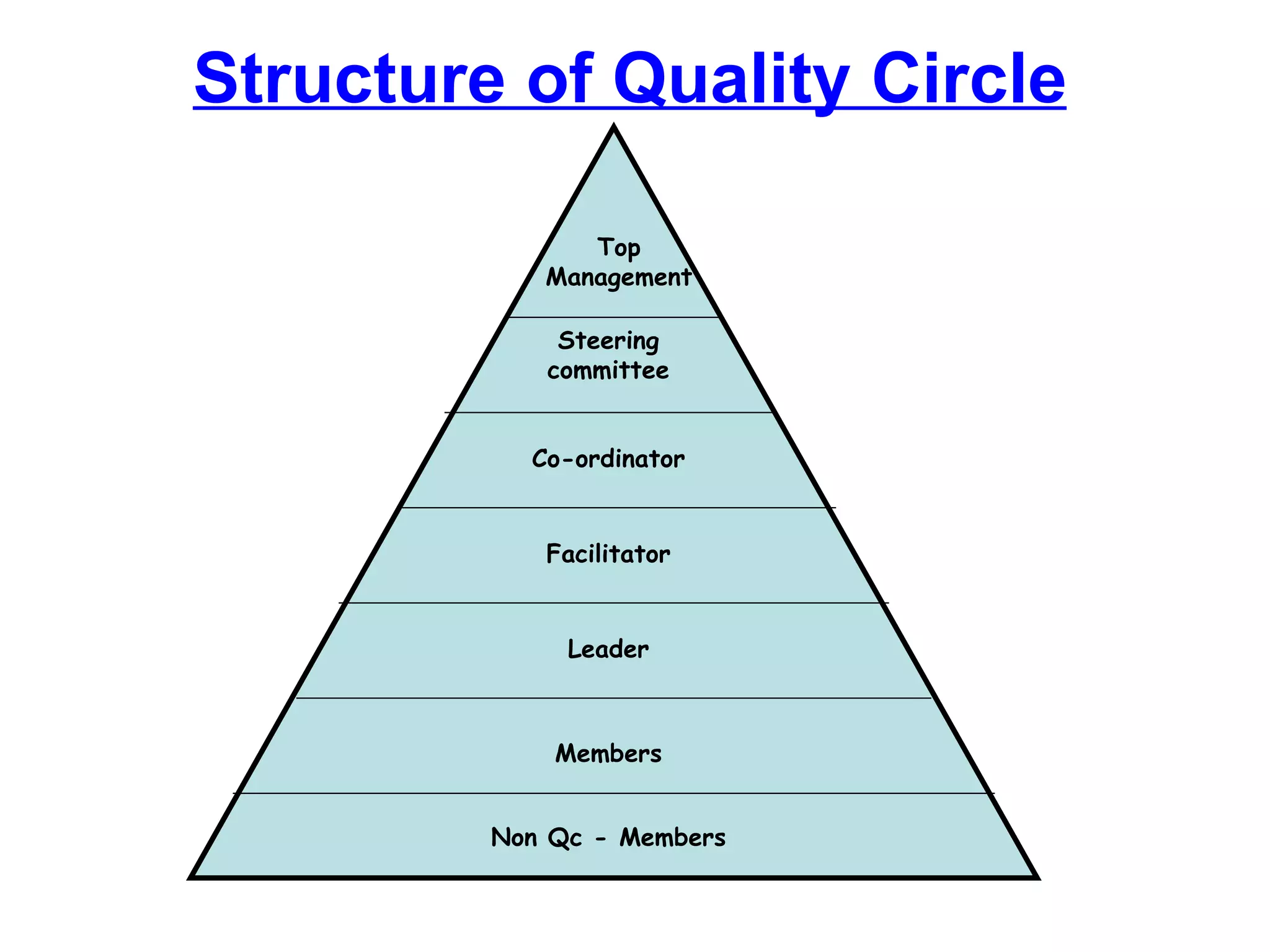
Structure of Quality Circle Non Qc - Members Members Leader Facilitator Co-ordinator Steering committee Top Management
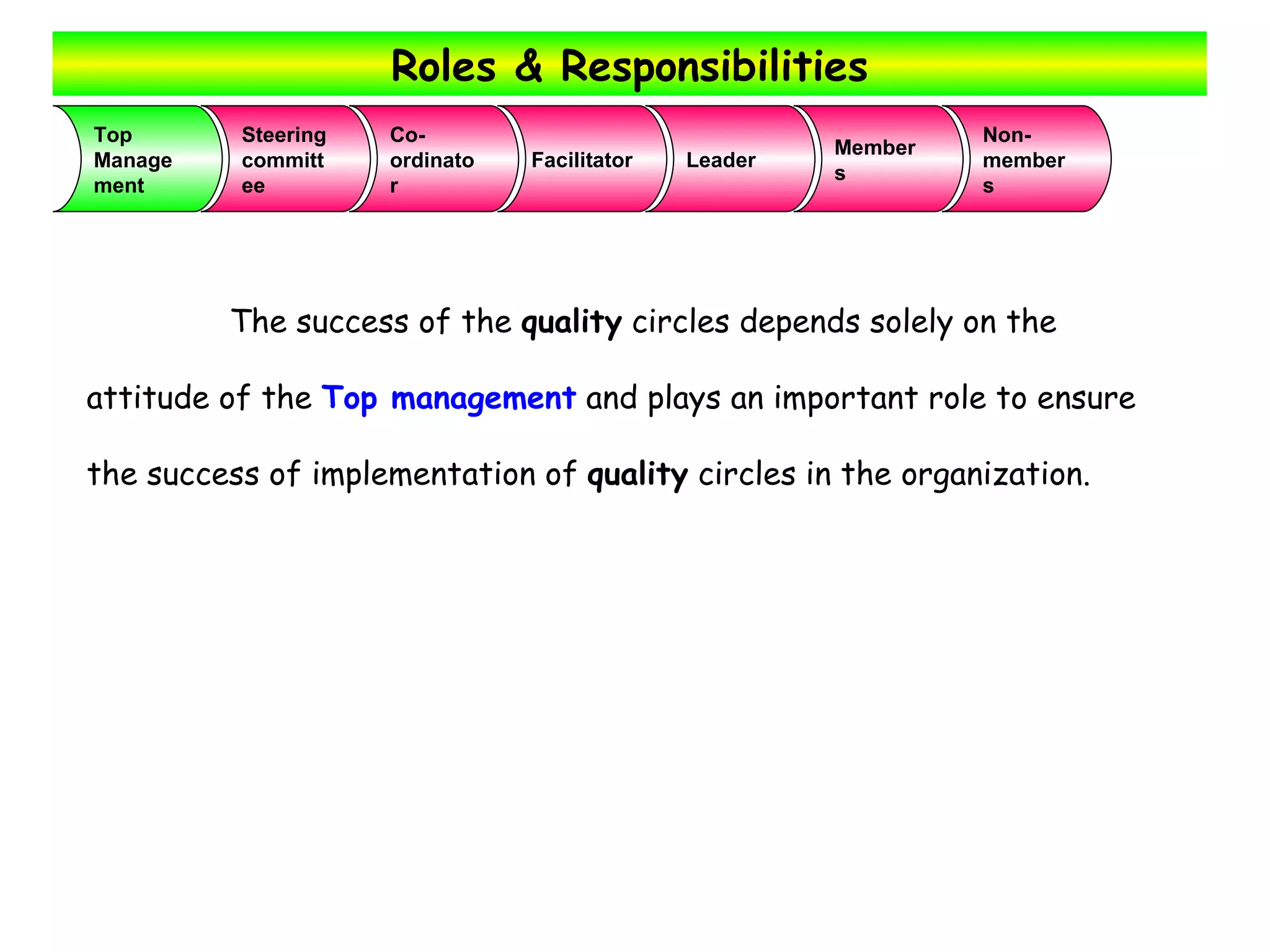
Roles & Responsibilities The success of the  quality  circles depends solely on the  attitude of the  Top management  and plays an important role to ensure  the success of implementation of  quality  circles in the organization. Top  Management Steering committee Co-ordinator Facilitator Leader Members Non-members
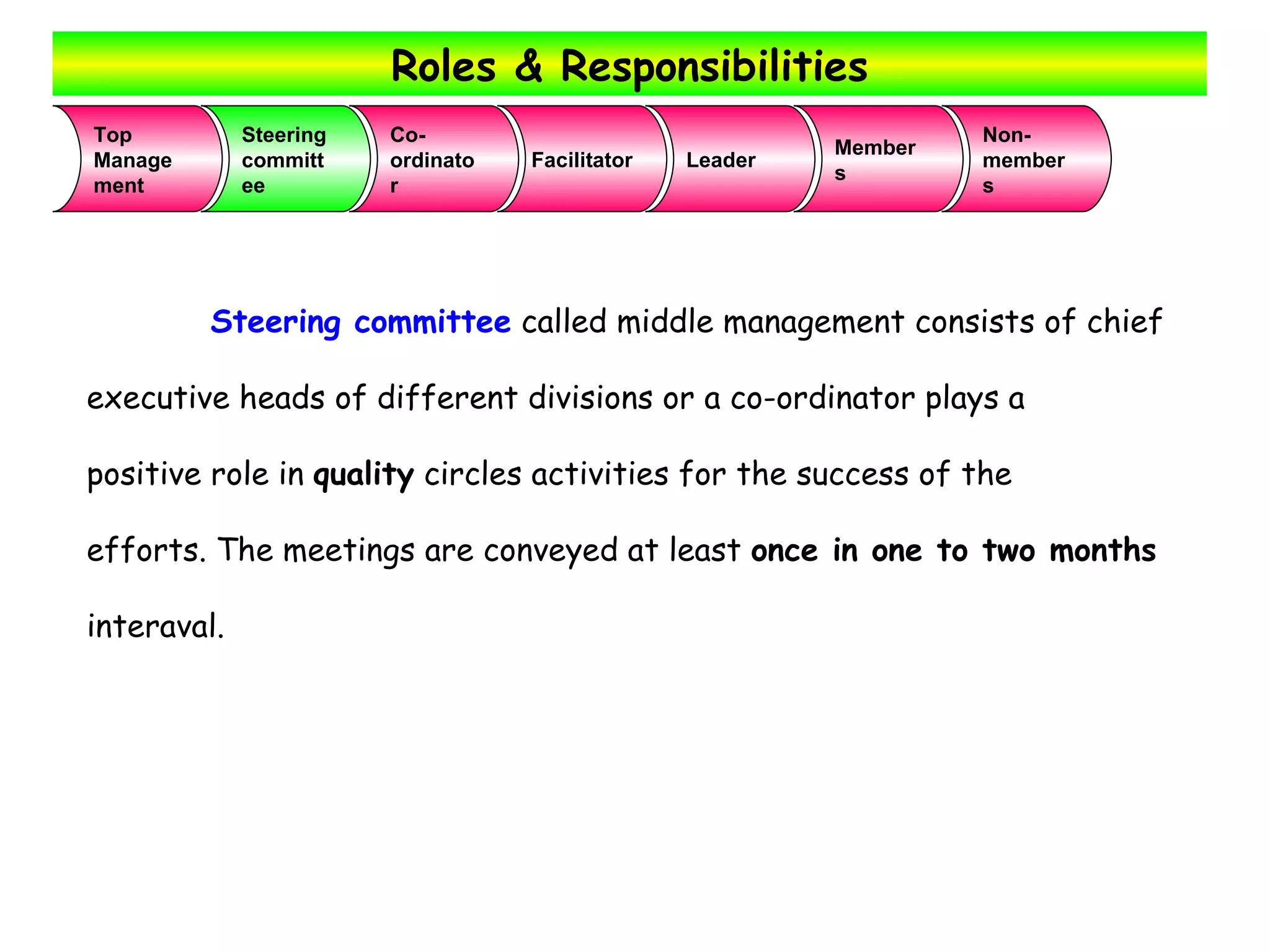
Roles & Responsibilities Steering committee  called middle management consists of chief executive heads of different divisions or a co-ordinator plays a positive role in  quality  circles activities for the success of the efforts. The meetings are conveyed at least  once in one to two months   interaval.  Top  Management Steering committee Co-ordinator Facilitator Leader Members Non-members
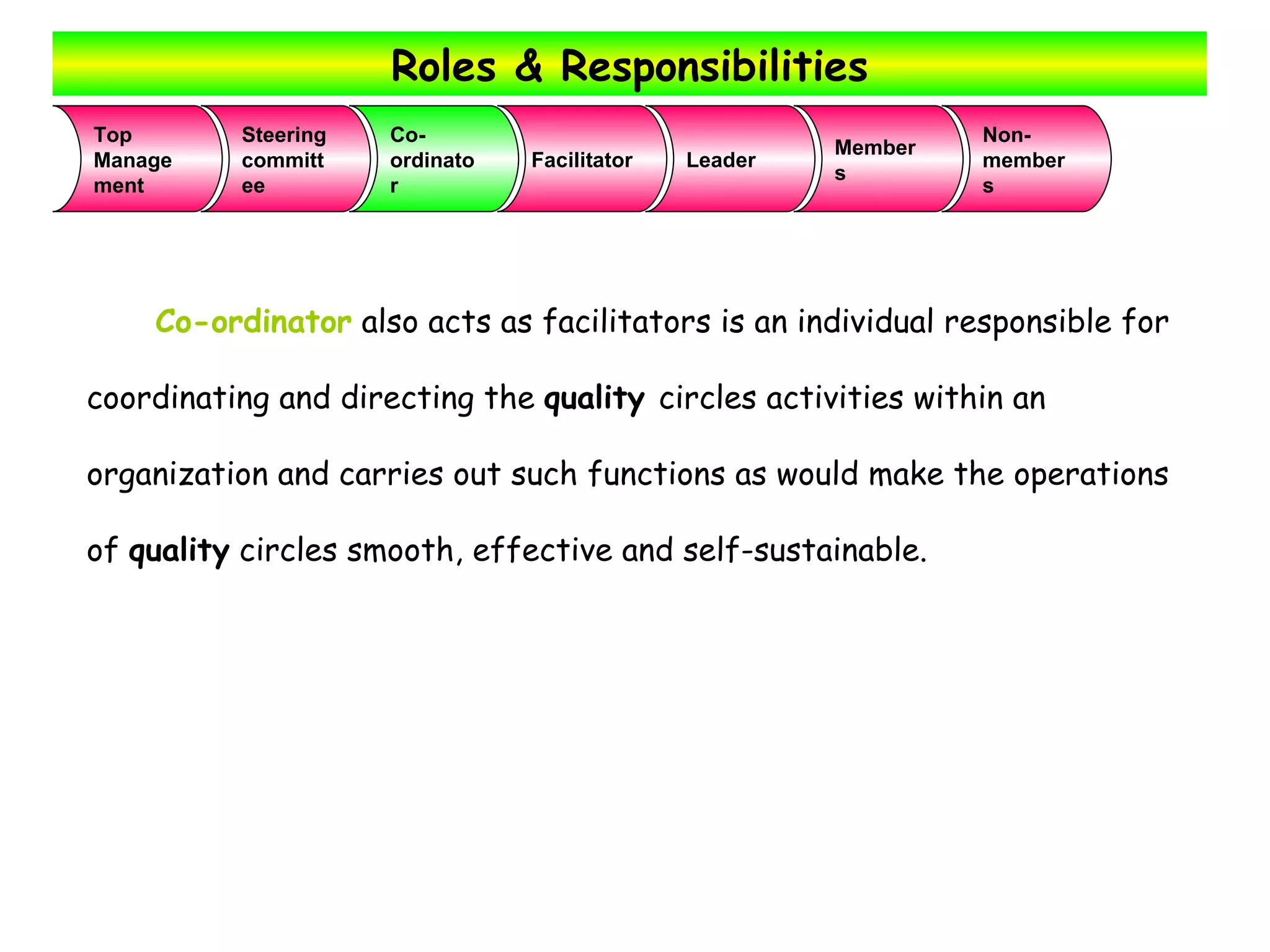
Roles & Responsibilities Co-ordinator  also acts as facilitators is an individual responsible for  coordinating and directing the  quality  circles activities within an  organization and carries out such functions as would make the operations  of  quality  circles smooth, effective and self-sustainable. Top  Management Steering committee Co-ordinator Facilitator Leader Members Non-members
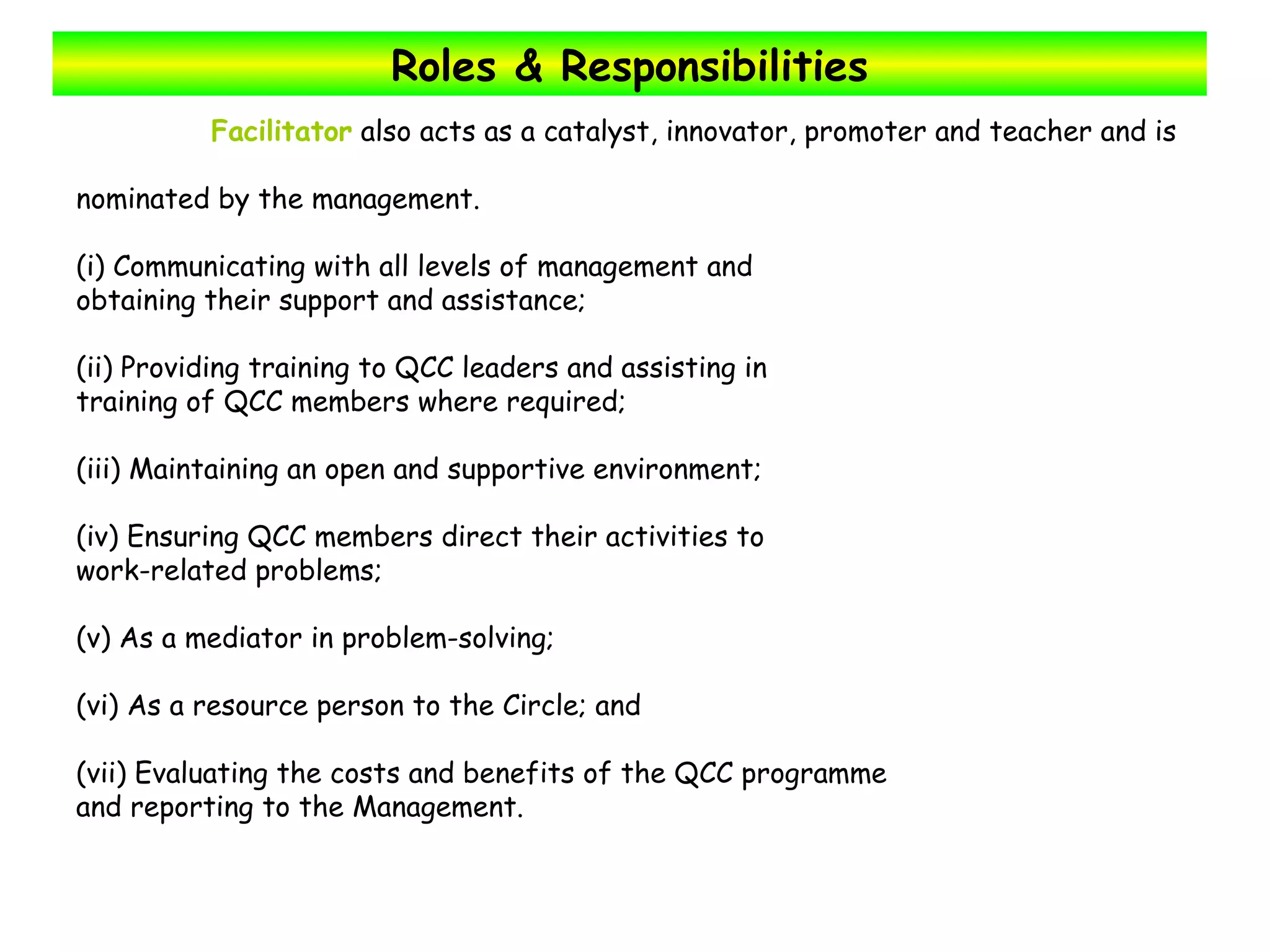
Roles & Responsibilities Facilitator  also acts as a catalyst, innovator, promoter and teacher and is  nominated by the management.  (i) Communicating with all levels of management and obtaining their support and assistance; (ii) Providing training to QCC leaders and assisting in training of QCC members where required; (iii) Maintaining an open and supportive environment; (iv) Ensuring QCC members direct their activities to work-related problems; (v) As a mediator in problem-solving; (vi) As a resource person to the Circle; and (vii) Evaluating the costs and benefits of the QCC programme and reporting to the Management.
Roles & Responsibilities Leader  of the  quality  circles is chosen by the members among  themselves and they may decide to have a leader by rotation since the  members are the basic elements of the  structure  of  quality   circle .  (i) Training members on problems-solving techniques with the assistance of the facilitator where required; (ii) Responsible for the smooth operation of QCC activities and fostering the spirit of cooperation and harmony among members; (iii) Assisting the Circle members in record keeping and in the preparation of management presentations; (iv) Conducting meetings in an orderly and effective manner; (v) Showing interest and support to the Circle; (vi) Encouraging other workers to become members; (vii) Assisting members in problem-solving; and (viii) Enforcing team discipline.
Roles & Responsibilities Members  of the  quality  circles are the small group of people from the  same work area or doing similar type of work whereas non-members are  those who are not members of the  quality   circle  but may be involved in  the  circle  recommendation.  (i) Attending meetings regularly; (ii) Directing their efforts towards solving work-related problems; (iii) Identifying problems, contributing ideas, undertaking research and  investigation (where necessary) and assisting the QCC in problem-solving. (iv) Participating in management presentations.
THANK YOU

Quality circle - copy

  • 1.
  • 2.
    Quality Circle Aquality circle is a group composed of regular employees who meet together to discuss workplace improvement, and make presentations to management with their ideas. The concept was invented in the United States and introduced in post-war Japan in the early 1950s.
  • 3.
    The Philosophyof QCC is based on the concepts of Participative management and Humanistic management . Humanistic management refers to management that gives importance to people and their feelings. This is because people are the most valuable asset of ‘ a department. Participative management means that worker regardless of his / her position in the organisation is given the opportunity to make meaningful contribution to the department . QCC is, therefore a mechanism whereby workers are able to participate in the problem-solving process leading to improvement of quality and productivity in their department . Philosophy of Quality Circle
  • 4.
    History of QualityCircle Quality circles were first established in Japan in 1962 , and Kaoru Ishikawa has been credited with their creation. The movement in Japan was coordinated by the Japanese Union of Scientists and Engineers (JUSE). The use of quality circles then spread beyond Japan. Quality circles have been implemented even in educational sectors in India and QCFI (Quality Circle Forum of India) is promoting such activities.
  • 5.
    Need of QualityCircle The need for public and private businesses to improve quality of services is no longer an option but a necessity. Since the early 1960’s businesses across the Globe have been searching for ways to improve overall operational efficiency. This trend has been more heightened with the onset of free open trade And Customers demanding so much more for their dollars. Some organisations have successfully implemented the use of quality circles as part of an ongoing improvement programme.Others have experimented with quality circles with the best intentions and faced several obstacle, but what is true is that this type of participatory management brings several benefits to all concerned.
  • 6.
    Objectives of QualityCircle The objective of QCC is to improve and upgrade quality of work through: (a) The problem solving capability of the workers; (b) Team work; (c) The cultivation and assimilation of positive values and work ethics; (d) Involvement and interest in work; (e) High motivation for work; and (f) Awareness of responsibility towards oneself, the group, the department / office and the nation.
  • 7.
    Function of QualityCircle A group of employees who perform similar duties and meet at periodic intervals, often with management, to discuss work-related issues and to offer suggestions and ideas for improvements, as in production methods or quality control. The ideal size of a quality circle is from eight to ten members.
  • 8.
    Structure of QualityCircle Non Qc - Members Members Leader Facilitator Co-ordinator Steering committee Top Management
  • 9.
    Roles & ResponsibilitiesThe success of the quality circles depends solely on the attitude of the Top management and plays an important role to ensure the success of implementation of quality circles in the organization. Top Management Steering committee Co-ordinator Facilitator Leader Members Non-members
  • 10.
    Roles & ResponsibilitiesSteering committee called middle management consists of chief executive heads of different divisions or a co-ordinator plays a positive role in quality circles activities for the success of the efforts. The meetings are conveyed at least once in one to two months interaval. Top Management Steering committee Co-ordinator Facilitator Leader Members Non-members
  • 11.
    Roles & ResponsibilitiesCo-ordinator also acts as facilitators is an individual responsible for coordinating and directing the quality circles activities within an organization and carries out such functions as would make the operations of quality circles smooth, effective and self-sustainable. Top Management Steering committee Co-ordinator Facilitator Leader Members Non-members
  • 12.
    Roles & ResponsibilitiesFacilitator also acts as a catalyst, innovator, promoter and teacher and is nominated by the management. (i) Communicating with all levels of management and obtaining their support and assistance; (ii) Providing training to QCC leaders and assisting in training of QCC members where required; (iii) Maintaining an open and supportive environment; (iv) Ensuring QCC members direct their activities to work-related problems; (v) As a mediator in problem-solving; (vi) As a resource person to the Circle; and (vii) Evaluating the costs and benefits of the QCC programme and reporting to the Management.
  • 13.
    Roles & ResponsibilitiesLeader of the quality circles is chosen by the members among themselves and they may decide to have a leader by rotation since the members are the basic elements of the structure of quality circle . (i) Training members on problems-solving techniques with the assistance of the facilitator where required; (ii) Responsible for the smooth operation of QCC activities and fostering the spirit of cooperation and harmony among members; (iii) Assisting the Circle members in record keeping and in the preparation of management presentations; (iv) Conducting meetings in an orderly and effective manner; (v) Showing interest and support to the Circle; (vi) Encouraging other workers to become members; (vii) Assisting members in problem-solving; and (viii) Enforcing team discipline.
  • 14.
    Roles & ResponsibilitiesMembers of the quality circles are the small group of people from the same work area or doing similar type of work whereas non-members are those who are not members of the quality circle but may be involved in the circle recommendation. (i) Attending meetings regularly; (ii) Directing their efforts towards solving work-related problems; (iii) Identifying problems, contributing ideas, undertaking research and investigation (where necessary) and assisting the QCC in problem-solving. (iv) Participating in management presentations.
  • 15.