Quality and formulation of
medicines
Saajida Sultaana Mahusook
Quality Use of Medicines (QUM)
• Selecting management options wisely
▫ considering the place of medicines in treating illness and maintaining
health
▫ recognising that there may be better ways than medicine to manage
many disorders
• Choosing suitable medicines if a medicine is considered necessary
▫ the individual
▫ the clinical condition
▫ risks and benefits
▫ dosage and length of treatment
▫ any co-existing conditions
▫ other therapies
▫ monitoring considerations
▫ costs for the individual, the community and the health system as a whole
• Using medicines safely and effectively
▫ monitoring outcomes
▫ minimising misuse, over-use and under-use
▫ improving people’s ability to solve problems related to medication, such
as negative effects or managing multiple medications.
• Licensed pharmaceutical products should be manufactured only by
licensed manufacturers whose activities are regularly inspected by
competent national authorities.
• Every government allocates a substantial proportion of its total
health budget to medicines. This proportion tends to be greatest in
developing countries, where it may exceed 40%.
The system of quality assurance appropriate to the manufacture of
pharmaceutical products should ensure that:
• pharmaceutical products are designed and developed in a way that
takes account of the requirements of GMP and other associated
codes such as good laboratory practice (GLP) and good clinical
practice (GCP);
• production and control operations are clearly specified in a written
form
• managerial responsibilities are clearly specified in job descriptions;
• arrangements are made for the manufacture, supply and use of the
correct starting and packaging materials;
• all necessary controls on starting materials, intermediate products,
and bulk products and other in-process controls, calibrations, and
validations are carried out;
• the finished product is correctly processed and checked, according
to the defined procedures;
• pharmaceutical products are not sold or supplied before the
authorized persons have certified them.
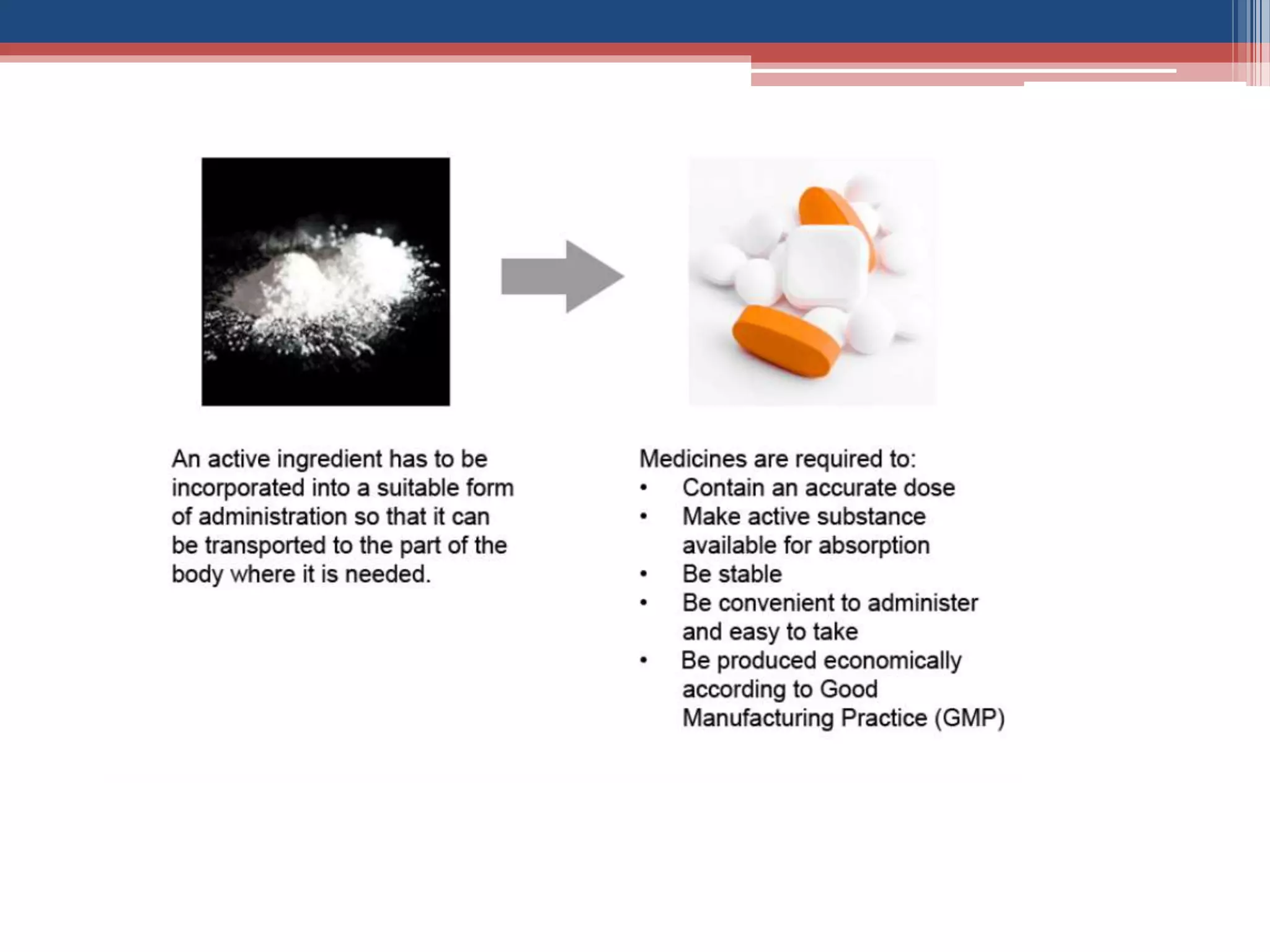
• Galenics is the process that turns an active ingredient into a ready-
to-use medicine that can be dosed as required.
• Galenic formulation deals with the principles of preparing and
compounding medicines in order to optimize their absorption and
forms part of pharmaceutics, of dosage form design.
• An active substance is required for formulation development, safety
assessment studies, and clinical studies.
• A sufficient quantity of quality active substance is produced in a
chemical development process to be used in safety testing and for
scientists to formulate a medicinal product.
• The medicinal product will comprise the active substance
• formulation (tablet, cream, suspension,solution),
• excipients (inactive ingredients such as lactose), and
• packaging (blisterpack, bottle, inhaler, vial, prefilled syringe).
Non-clinical safety studies aim to:
• Explore the response at up to maximum tolerable doses
• Detect potential hazards
• Generate enough data to make a risk assessment
• dose selection for initial clinical studies
• Suggest ‘markers’ to monitor safety in humans
• Provide a foundation for targeted specialised investigations
Safety testing assesses the margins of safety in animal and human data.
Considerations for these types of tests are:
• dose administered,
• extent and duration of systemic exposure,
• daily systemic exposure,
• exposure and identity of metabolites, and
• exposure in target organs.
• Safety testing is carried out on the active substance, as well as on all
related substances, solvents, degradation products, excipients, and
other active materials and extractives that are part of the final
formulation.
Galenic formulation for clinical studies
• Factors to be considered in the development of a suitable form of
administration include patient acceptability and specific requirements of
the active ingredient.
• Inactive ingredients (excipients) can make up most of a medicine’s volume
and serve as carriers for the active compound. For example, Maize starch or
lactose -used in tablets, water-oil emulsions are used in ointments.
• The administration form also influences absorption, availability of the
active substance, and a medicine’s therapeutic effect. It determines how the
active ingredient enters the body, where and in what dosage is released, and
the time it takes to be absorbed. In addition, the mode of administration
must ensure that the patient will be able to dose the medicine safely and
handle it easily.
• Formulation scientists ensure that the substance can be absorbed by the
body and that the therapeutic dose reaches the targeted organ. Not every
active substance is suitable for ingestion as a tablet, and special demands on
the form of administration (injection into the eye, products for inhalation,
or tablets that dissolve in the patient's mouth) regularly create new
challenges for formulation scientists.
Good Manufacturing Practice (GMP)
• All medicines, including generic medicines and biosimilars, should
be produced according to Good Manufacturing Practice (GMP)
guidelines before being administered to humans.
• The GMP guidelines provide direction for manufacturing, testing,
and quality assurance, in order to ensure that a medicine is safe for
human consumption. Many countries have specific laws and
regulations imposing that pharmaceutical and medical
device manufacturers follow GMP procedures. Most regulations are
based on internationally agreed guidelines.
• A biosimilar is a biologic medical product highly similar to another already approved biological
medicine. Biosimilars are approved according to the same standards of pharmaceutical quality,
safety and efficacy that apply to all biological medicines.
•
The GMP guidelines follow a few basic principles:
• Hygiene: Pharmaceutical manufacturing facilities must maintain a
clean and hygienic area.
• Controlled environmental conditions in order to prevent cross
contamination of a medicinal product from other compound or
unrelated particulate matter, which may make the medicine unsafe
for human consumption.
• Manufacturing processes clearly defined and controlled:
▫ All critical processes are validated to ensure consistency and compliance with
specifications.
▫ Any changes to the process are evaluated.
▫ Changes that have an impact on the quality of the medicine are validated as
necessary.
▫ Instructions and procedures are written in clear and unambiguous language. (Good
Documentation Practices - GDP).
▫ Operators are trained to carry out and document procedures.
• Records are generated manually or by instruments during manufacture to
demonstrate that all the steps required by the defined procedures and
instructions were actually taken, and that the quantity and quality of the
medicine is as expected.
• Deviations are investigated and documented.
• Records of manufacture (including distribution) that enable the complete
history of a batch to be traced are retained in a comprehensible and accessible
form.
• The distribution of the medicines minimizes any risk to their quality.
• A system is available for recalling any batch of medicine from sale or
supply.
• Complaints about marketed medicines are examined, the causes of
quality defects are investigated, and appropriate measures are taken with
respect to the defective medicines and to prevent recurrence.
Reference
• https://www.who.int/medicines/areas/quality_
safety/quality_assurance/QualityAssurancePhar
mVol2.pdf
• https://www1.health.gov.au/internet/main/publ
ishing.nsf/Content/nmp-quality.htm-copy2
• https://www.eupati.eu/non-clinical-
studies/how-medicines-are-formulated-galenic-
formulation/
• http://apps.who.int/medicinedocs/documents/s
19964en/s19964en.pdf
Thank you

Quality and formulation of medicines

  • 1.
    Quality and formulationof medicines Saajida Sultaana Mahusook
  • 2.
    Quality Use ofMedicines (QUM) • Selecting management options wisely ▫ considering the place of medicines in treating illness and maintaining health ▫ recognising that there may be better ways than medicine to manage many disorders • Choosing suitable medicines if a medicine is considered necessary ▫ the individual ▫ the clinical condition ▫ risks and benefits ▫ dosage and length of treatment ▫ any co-existing conditions ▫ other therapies ▫ monitoring considerations ▫ costs for the individual, the community and the health system as a whole • Using medicines safely and effectively ▫ monitoring outcomes ▫ minimising misuse, over-use and under-use ▫ improving people’s ability to solve problems related to medication, such as negative effects or managing multiple medications.
  • 3.
    • Licensed pharmaceuticalproducts should be manufactured only by licensed manufacturers whose activities are regularly inspected by competent national authorities. • Every government allocates a substantial proportion of its total health budget to medicines. This proportion tends to be greatest in developing countries, where it may exceed 40%.
  • 4.
    The system ofquality assurance appropriate to the manufacture of pharmaceutical products should ensure that: • pharmaceutical products are designed and developed in a way that takes account of the requirements of GMP and other associated codes such as good laboratory practice (GLP) and good clinical practice (GCP); • production and control operations are clearly specified in a written form • managerial responsibilities are clearly specified in job descriptions; • arrangements are made for the manufacture, supply and use of the correct starting and packaging materials; • all necessary controls on starting materials, intermediate products, and bulk products and other in-process controls, calibrations, and validations are carried out; • the finished product is correctly processed and checked, according to the defined procedures; • pharmaceutical products are not sold or supplied before the authorized persons have certified them.
  • 5.
    • Galenics isthe process that turns an active ingredient into a ready- to-use medicine that can be dosed as required. • Galenic formulation deals with the principles of preparing and compounding medicines in order to optimize their absorption and forms part of pharmaceutics, of dosage form design. • An active substance is required for formulation development, safety assessment studies, and clinical studies. • A sufficient quantity of quality active substance is produced in a chemical development process to be used in safety testing and for scientists to formulate a medicinal product. • The medicinal product will comprise the active substance • formulation (tablet, cream, suspension,solution), • excipients (inactive ingredients such as lactose), and • packaging (blisterpack, bottle, inhaler, vial, prefilled syringe).
  • 7.
    Non-clinical safety studiesaim to: • Explore the response at up to maximum tolerable doses • Detect potential hazards • Generate enough data to make a risk assessment • dose selection for initial clinical studies • Suggest ‘markers’ to monitor safety in humans • Provide a foundation for targeted specialised investigations Safety testing assesses the margins of safety in animal and human data. Considerations for these types of tests are: • dose administered, • extent and duration of systemic exposure, • daily systemic exposure, • exposure and identity of metabolites, and • exposure in target organs. • Safety testing is carried out on the active substance, as well as on all related substances, solvents, degradation products, excipients, and other active materials and extractives that are part of the final formulation.
  • 8.
    Galenic formulation forclinical studies • Factors to be considered in the development of a suitable form of administration include patient acceptability and specific requirements of the active ingredient. • Inactive ingredients (excipients) can make up most of a medicine’s volume and serve as carriers for the active compound. For example, Maize starch or lactose -used in tablets, water-oil emulsions are used in ointments. • The administration form also influences absorption, availability of the active substance, and a medicine’s therapeutic effect. It determines how the active ingredient enters the body, where and in what dosage is released, and the time it takes to be absorbed. In addition, the mode of administration must ensure that the patient will be able to dose the medicine safely and handle it easily. • Formulation scientists ensure that the substance can be absorbed by the body and that the therapeutic dose reaches the targeted organ. Not every active substance is suitable for ingestion as a tablet, and special demands on the form of administration (injection into the eye, products for inhalation, or tablets that dissolve in the patient's mouth) regularly create new challenges for formulation scientists.
  • 9.
    Good Manufacturing Practice(GMP) • All medicines, including generic medicines and biosimilars, should be produced according to Good Manufacturing Practice (GMP) guidelines before being administered to humans. • The GMP guidelines provide direction for manufacturing, testing, and quality assurance, in order to ensure that a medicine is safe for human consumption. Many countries have specific laws and regulations imposing that pharmaceutical and medical device manufacturers follow GMP procedures. Most regulations are based on internationally agreed guidelines. • A biosimilar is a biologic medical product highly similar to another already approved biological medicine. Biosimilars are approved according to the same standards of pharmaceutical quality, safety and efficacy that apply to all biological medicines. • The GMP guidelines follow a few basic principles: • Hygiene: Pharmaceutical manufacturing facilities must maintain a clean and hygienic area. • Controlled environmental conditions in order to prevent cross contamination of a medicinal product from other compound or unrelated particulate matter, which may make the medicine unsafe for human consumption.
  • 10.
    • Manufacturing processesclearly defined and controlled: ▫ All critical processes are validated to ensure consistency and compliance with specifications. ▫ Any changes to the process are evaluated. ▫ Changes that have an impact on the quality of the medicine are validated as necessary. ▫ Instructions and procedures are written in clear and unambiguous language. (Good Documentation Practices - GDP). ▫ Operators are trained to carry out and document procedures. • Records are generated manually or by instruments during manufacture to demonstrate that all the steps required by the defined procedures and instructions were actually taken, and that the quantity and quality of the medicine is as expected. • Deviations are investigated and documented. • Records of manufacture (including distribution) that enable the complete history of a batch to be traced are retained in a comprehensible and accessible form. • The distribution of the medicines minimizes any risk to their quality. • A system is available for recalling any batch of medicine from sale or supply. • Complaints about marketed medicines are examined, the causes of quality defects are investigated, and appropriate measures are taken with respect to the defective medicines and to prevent recurrence.
  • 11.
    Reference • https://www.who.int/medicines/areas/quality_ safety/quality_assurance/QualityAssurancePhar mVol2.pdf • https://www1.health.gov.au/internet/main/publ ishing.nsf/Content/nmp-quality.htm-copy2 •https://www.eupati.eu/non-clinical- studies/how-medicines-are-formulated-galenic- formulation/ • http://apps.who.int/medicinedocs/documents/s 19964en/s19964en.pdf Thank you