1
Institute of Pharmaceutical Technololgy and
Biopharmacy
University of Pécs
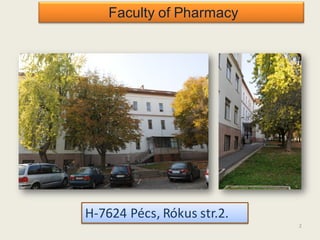
Faculty of Pharmacy
2
H-7624 Pécs, Rókus str.2.
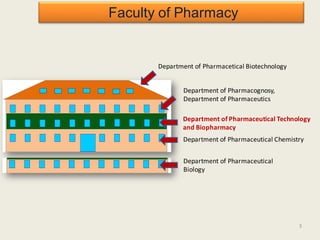
Faculty of Pharmacy
3
Department of Pharmaceutical Technology
and Biopharmacy
Department of Pharmaceutical Chemistry
Department of Pharmacognosy,
Department of Pharmaceutics
Department of Pharmaceutical
Biology
Department of Pharmacetical Biotechnology
Important notes
Conditionsfor acceptance of the semester
• Students must fulfil requirements determined by the Code of
Studies and Examinations
• Attendance of the lectures according to the Code of Studies and
Examinations
• 3 absences are allowed
• In case of 4 or more absences the course is rejected!
• During the semester students have to write three
assessments and they have to reach 60% after average
calculation.
• After two assessments if students reach average 60%
taking into account both tests, writing the third
assessmentis not compulsory.
• Summarized average of all three assessments has to be
above 60%.
• In case of confirmed absence from the assessment, re-
take chance is possible for the student. Missing the re-
take results 0% assessment.
Important notes
Education
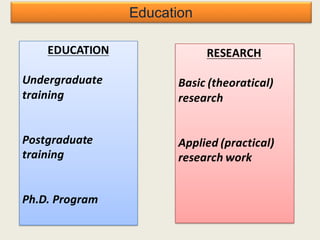
EDUCATION
Undergraduate
training
Postgraduate
training
Ph.D. Program
RESEARCH
Basic (theoratical)
research
Applied (practical)
research work
Education
Course literature
• theoretical knowledge
Ø Aulton’s Pharmaceutics – The Science of DosageForm Design
Ø PharmaceuticalTechnology e-book(pdf) (on our website)
Ø Lecture notes
• practical knowledge
Ø Laboratorypractices, notes
• theoretical + practical knowledge
our website includes:
Ø The program and materialof lectures and laboratoryeducation
http://gytk.pte.hu
Education
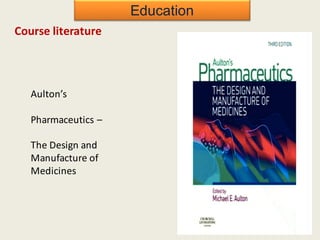
Course literature
Aulton’s
Pharmaceutics –
The Design and
Manufacture of
Medicines
9
• Introduction to the pharmaceutical terminology
• Introduction to the pharmaceutical technology
10
11
(pharmaceutical terms)
Ph. Hg. VIII. -Ph. Eur.
European Pharmacopoeia Commission
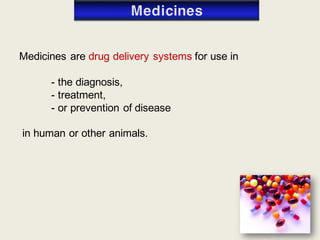
Medicines are drug delivery systems for use in
- the diagnosis,
- treatment,
- or prevention of disease
in human or other animals.
Characterization of medicines
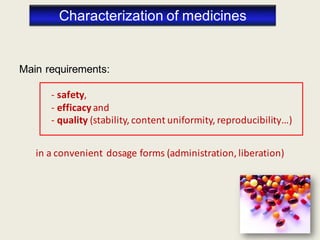
Main requirements:
- safety,
- efficacy and
- quality (stability, content uniformity, reproducibility…)
in a convenient dosage forms (administration, liberation)
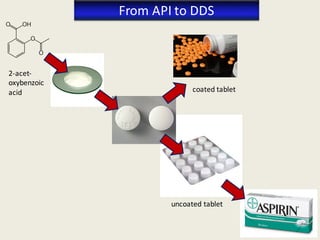
From API to DDS
2-acet-
oxybenzoic
acid coated tablet
uncoated tablet
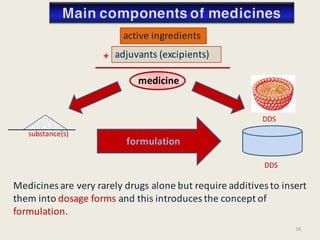
Medicinesare very rarely drugs alone but require additives to insert
them into dosage forms and this introducesthe concept of
formulation.
16
active ingredients
adjuvants (excipients)
medicine
DDS
DDS
substance(s)
+
formulation
Active ingredients are components in a drug
which provide some pharmaceutical value, in
contrast with the inactive ingredients, which act
as carriers to make the drug easier for the body to
process.
17
(API, AI, DS)
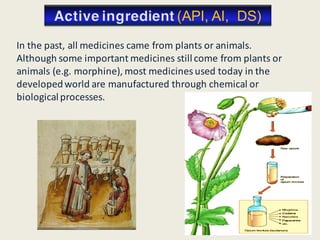
In the past, all medicines came from plants or animals.
Although some important medicines stillcome from plants or
animals (e.g. morphine), most medicines used today in the
developedworld are manufactured through chemical or
biologicalprocesses.
18
(API, AI, DS)
Excipients generally are pharmacologically inactive substances
used as carriers for the active ingredients of medications or as
adjuvants of manufacturing process or as regulators of liberation.
Its selection depends on
- technological,
- stabilityand/or
- biopharmaceutical reasons.
19
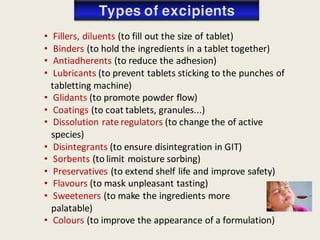
• Fillers, diluents (to fill out the size of tablet)
• Binders (to hold the ingredients in a tablet together)
• Antiadherents (to reduce the adhesion)
• Lubricants (to prevent tablets sticking to the punches of
tabletting machine)
• Glidants (to promote powder flow)
• Coatings (to coat tablets, granules...)
• Dissolution rate regulators (to change the of active
species)
• Disintegrants (to ensure disintegration in GIT)
• Sorbents (to limit moisture sorbing)
• Preservatives (to extend shelf life and improve safety)
• Flavours (to mask unpleasant tasting)
• Sweeteners (to make the ingredients more
palatable)
• Colours (to improve the appearance of a formulation)
Ph. Hg. VIII. -Ph. Eur. 4, 4.1 és 4.2
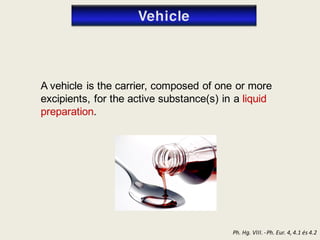
A vehicle is the carrier, composed of one or more
excipients, for the active substance(s) in a liquid
preparation.
Ph. Hg. VIII. -Ph. Eur. 4, 4.1 és 4.2
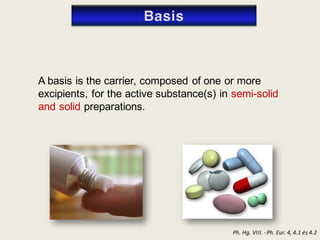
A basis is the carrier, composed of one or more
excipients, for the active substance(s) in semi-solid
and solid preparations.
Dosage form
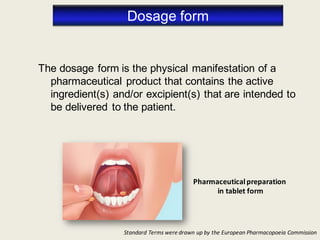
The dosage form is the physical manifestation of a
pharmaceutical product that contains the active
ingredient(s) and/or excipient(s) that are intended to
be delivered to the patient.
Pharmaceuticalpreparation
in tablet form
Standard Terms were drawn up by the European Pharmacopoeia Commission
24
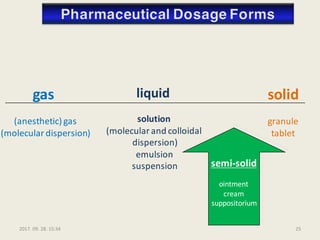
based on the consistency
gas
(anesthetic) gas
(molecular dispersion)
liquid
solution
(molecular and colloidal
dispersion)
emulsion
suspension
solid
granule
tablet
semi-solid
ointment
cream
suppositorium
2017. 09. 28. 15:34 25
26
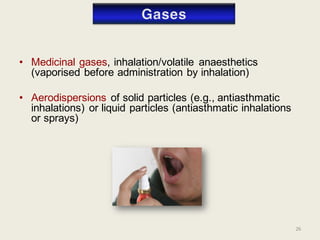
• Medicinal gases, inhalation/volatile anaesthetics
(vaporised before administration by inhalation)
• Aerodispersions of solid particles (e.g., antiasthmatic
inhalations) or liquid particles (antiasthmatic inhalations
or sprays)
27
• Solutions – one homogenous phase, prepared by dissolving
one or more solutes in a solvent
• Emulsions
• a dispersion system consisting of two immiscible
liquids
• o/w or w/o
• cloudy appearance
• Suspensions
• a dispersion system where solid particles (dispersed
phase) are dispersed in liquid phase (dispersion
medium)
• require shaking before administration
Liquids
28
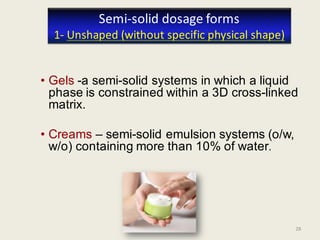
• Gels -a semi-solid systems in which a liquid
phase is constrained within a 3D cross-linked
matrix.
• Creams – semi-solid emulsion systems (o/w,
w/o) containing more than 10% of water.
Semi-solid dosage forms
1- Unshaped (without specific physical shape)
29
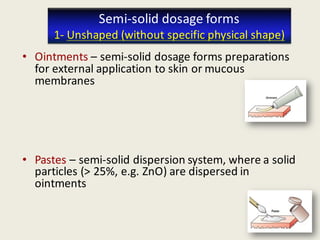
• Ointments – semi-solid dosage forms preparations
for external application to skin or mucous
membranes
• Pastes – semi-solid dispersion system, where a solid
particles (> 25%, e.g. ZnO) are dispersed in
ointments
Semi-solid dosage forms
1- Unshaped (without specific physical shape)
29
30
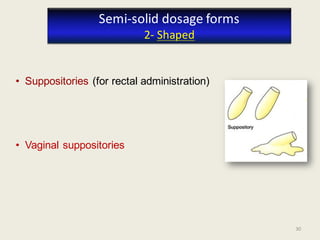
• Suppositories (for rectal administration)
• Vaginal suppositories
Semi-solid dosage forms
2- Shaped
31
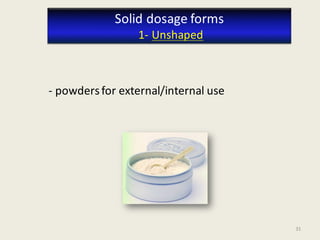
- powdersfor external/internal use
Solid dosage forms
1- Unshaped
32
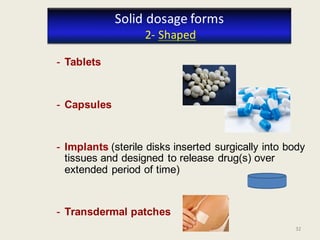
- Tablets
- Capsules
- Implants (sterile disks inserted surgically into body
tissues and designed to release drug(s) over
extended period of time)
- Transdermal patches
Solid dosage forms
2- Shaped
32
33
based on manufacture
34
• Manufactured in large scales by pharmaceutical
industry (original and generic preparations)
• Contemporaneous/magistral preparations
dispensed individually in pharmacies
35
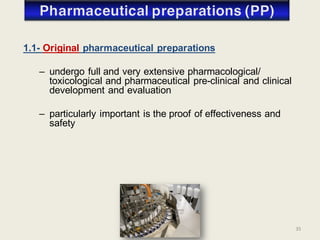
1.1- Original pharmaceutical preparations
– undergo full and very extensive pharmacological/
toxicological and pharmaceutical pre-clinical and clinical
development and evaluation
– particularly important is the proof of effectiveness and
safety
36
- Can be released after the expiration of the patent protection of the
original preparation
– The approval for clinical use is easier due to the prior experience
with the original preparation
– Must be pharmaceutically equivalent: same API, dose,
pharmaceutical dosage form and the same route of
administration as in original preparation
– Must be clinically bioequivalent: i.e. it must be of very close
biopharmaceutical profile as original preparation.
Pharmacokinetics (PK) parameters (Cmax, tmax, AUC) are within 80-
125 % range as compared with the original preparation.
1.2- Generic pharmaceutical preparations
(„authorized copies of original preparations“)
37
• These preparations are compounded individually for a particular
patient according to the physician's prescription in a pharmacy
licensed for compounding
• In contrast to the past, they are used rather rarely and mostly in
specific situations
• The major disadvantage is the lack of quality control and clinical
investigations.
2 –Magistral preparations compounded individually
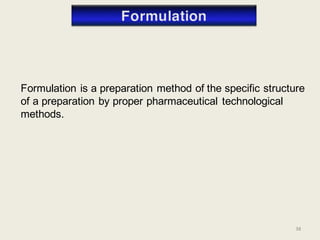
Formulation is a preparation method of the specific structure
of a preparation by proper pharmaceutical technological
methods.
38
2017. 09. 28. 15:34 39
Formulation studies then consider such factors
as particle size, polymorphism, pH, and solubility, as all
of these can influence liberation, bioavailability and
hence the activity of a drug.
The drug must be combined with inactive additives by a
method which ensures that the quantity of drug present is
consistent in each dosage unit e.g. each tablet. The
dosage should have a uniform appearance, with an
acceptable taste, tablet hardness, or capsule
disintegration.
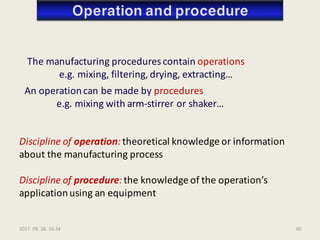
The manufacturing procedures contain operations
e.g. mixing, filtering, drying, extracting…
An operationcan be made by procedures
e.g. mixing with arm-stirrer or shaker…
Discipline of operation:theoretical knowledge or information
about the manufacturing process
Discipline of procedure:the knowledge of the operation’s
applicationusing an equipment
2017. 09. 28. 15:34 40
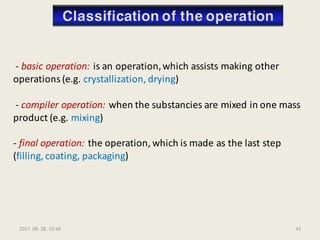
- basic operation: is an operation,which assists making other
operations (e.g. crystallization, drying)
- compiler operation: when the substancies are mixed in one mass
product (e.g. mixing)
- final operation: the operation, which is made as the last step
(filling, coating, packaging)
2017. 09. 28. 15:34 41
42
Pharmaceutical technology is the multidisciplinary
science of preparing pharmaceutical dosage forms.
Pharmaceutical technology combines knowledge
and understanding of active ingredients, excipient
substances, technological processes and
equipment and plays a key role in developing new
drugs.
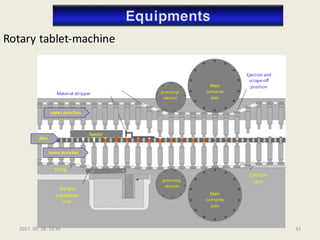
Rotary tablet-machine
upper punches
dies
lower punches
feeder
Weight
regulation
unit
Ejection
cam
filling
precomp
ression
precomp
ression
Main
compres
sion
Main
compres
sion
Ejection and
scrape-off
position
Material stripper
2017. 09. 28. 15:34 43
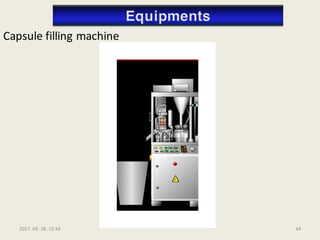
Capsule filling machine
2017. 09. 28. 15:34 44
45
based on biopharmacy
Standard Terms were drawn up by the European Pharmacopoeia Commission
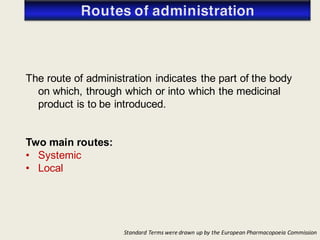
The route of administration indicates the part of the body
on which, through which or into which the medicinal
product is to be introduced.
Two main routes:
• Systemic
• Local
47
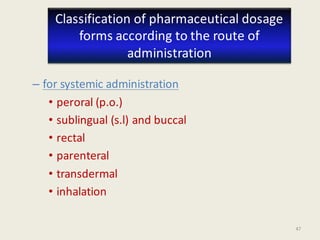
– for systemic administration
• peroral (p.o.)
• sublingual (s.l) and buccal
• rectal
• parenteral
• transdermal
• inhalation
Classification of pharmaceutical dosage
forms according to the route of
administration
48
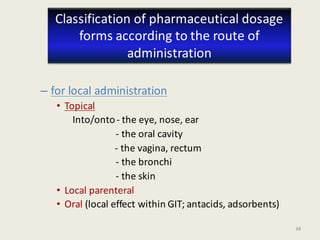
– for local administration
• Topical (on the skin or mucosa)
Into/onto- the eye, nose, ear
- the oral cavity
- the vagina, rectum
- the bronchi
- the skin
• Local parenteral
• Oral (local effect within GIT; antacids, adsorbents)
Classification of pharmaceutical dosage
forms according to the route of
administration
49

01._INTRODUCTION_TO_Pharmaceutical_technology_2017.pdf

  • 1.
    1 Institute of PharmaceuticalTechnololgy and Biopharmacy University of Pécs
  • 2.
    Faculty of Pharmacy 2 H-7624Pécs, Rókus str.2.
  • 3.
    Faculty of Pharmacy 3 Departmentof Pharmaceutical Technology and Biopharmacy Department of Pharmaceutical Chemistry Department of Pharmacognosy, Department of Pharmaceutics Department of Pharmaceutical Biology Department of Pharmacetical Biotechnology
  • 4.
    Important notes Conditionsfor acceptanceof the semester • Students must fulfil requirements determined by the Code of Studies and Examinations • Attendance of the lectures according to the Code of Studies and Examinations • 3 absences are allowed • In case of 4 or more absences the course is rejected!
  • 5.
    • During thesemester students have to write three assessments and they have to reach 60% after average calculation. • After two assessments if students reach average 60% taking into account both tests, writing the third assessmentis not compulsory. • Summarized average of all three assessments has to be above 60%. • In case of confirmed absence from the assessment, re- take chance is possible for the student. Missing the re- take results 0% assessment. Important notes
  • 6.
  • 7.
    Education Course literature • theoreticalknowledge Ø Aulton’s Pharmaceutics – The Science of DosageForm Design Ø PharmaceuticalTechnology e-book(pdf) (on our website) Ø Lecture notes • practical knowledge Ø Laboratorypractices, notes • theoretical + practical knowledge our website includes: Ø The program and materialof lectures and laboratoryeducation http://gytk.pte.hu
  • 8.
  • 9.
  • 10.
    • Introduction tothe pharmaceutical terminology • Introduction to the pharmaceutical technology 10
  • 11.
  • 12.
    Ph. Hg. VIII.-Ph. Eur. European Pharmacopoeia Commission
  • 13.
    Medicines are drugdelivery systems for use in - the diagnosis, - treatment, - or prevention of disease in human or other animals.
  • 14.
    Characterization of medicines Mainrequirements: - safety, - efficacy and - quality (stability, content uniformity, reproducibility…) in a convenient dosage forms (administration, liberation)
  • 15.
    From API toDDS 2-acet- oxybenzoic acid coated tablet uncoated tablet
  • 16.
    Medicinesare very rarelydrugs alone but require additives to insert them into dosage forms and this introducesthe concept of formulation. 16 active ingredients adjuvants (excipients) medicine DDS DDS substance(s) + formulation
  • 17.
    Active ingredients arecomponents in a drug which provide some pharmaceutical value, in contrast with the inactive ingredients, which act as carriers to make the drug easier for the body to process. 17 (API, AI, DS)
  • 18.
    In the past,all medicines came from plants or animals. Although some important medicines stillcome from plants or animals (e.g. morphine), most medicines used today in the developedworld are manufactured through chemical or biologicalprocesses. 18 (API, AI, DS)
  • 19.
    Excipients generally arepharmacologically inactive substances used as carriers for the active ingredients of medications or as adjuvants of manufacturing process or as regulators of liberation. Its selection depends on - technological, - stabilityand/or - biopharmaceutical reasons. 19
  • 20.
    • Fillers, diluents(to fill out the size of tablet) • Binders (to hold the ingredients in a tablet together) • Antiadherents (to reduce the adhesion) • Lubricants (to prevent tablets sticking to the punches of tabletting machine) • Glidants (to promote powder flow) • Coatings (to coat tablets, granules...) • Dissolution rate regulators (to change the of active species) • Disintegrants (to ensure disintegration in GIT) • Sorbents (to limit moisture sorbing) • Preservatives (to extend shelf life and improve safety) • Flavours (to mask unpleasant tasting) • Sweeteners (to make the ingredients more palatable) • Colours (to improve the appearance of a formulation)
  • 21.
    Ph. Hg. VIII.-Ph. Eur. 4, 4.1 és 4.2 A vehicle is the carrier, composed of one or more excipients, for the active substance(s) in a liquid preparation.
  • 22.
    Ph. Hg. VIII.-Ph. Eur. 4, 4.1 és 4.2 A basis is the carrier, composed of one or more excipients, for the active substance(s) in semi-solid and solid preparations.
  • 23.
    Dosage form The dosageform is the physical manifestation of a pharmaceutical product that contains the active ingredient(s) and/or excipient(s) that are intended to be delivered to the patient. Pharmaceuticalpreparation in tablet form Standard Terms were drawn up by the European Pharmacopoeia Commission
  • 24.
    24 based on theconsistency based on the consistency
  • 25.
    gas (anesthetic) gas (molecular dispersion) liquid solution (molecularand colloidal dispersion) emulsion suspension solid granule tablet semi-solid ointment cream suppositorium 2017. 09. 28. 15:34 25
  • 26.
    26 • Medicinal gases,inhalation/volatile anaesthetics (vaporised before administration by inhalation) • Aerodispersions of solid particles (e.g., antiasthmatic inhalations) or liquid particles (antiasthmatic inhalations or sprays)
  • 27.
    27 • Solutions –one homogenous phase, prepared by dissolving one or more solutes in a solvent • Emulsions • a dispersion system consisting of two immiscible liquids • o/w or w/o • cloudy appearance • Suspensions • a dispersion system where solid particles (dispersed phase) are dispersed in liquid phase (dispersion medium) • require shaking before administration Liquids
  • 28.
    28 • Gels -asemi-solid systems in which a liquid phase is constrained within a 3D cross-linked matrix. • Creams – semi-solid emulsion systems (o/w, w/o) containing more than 10% of water. Semi-solid dosage forms 1- Unshaped (without specific physical shape)
  • 29.
    29 • Ointments –semi-solid dosage forms preparations for external application to skin or mucous membranes • Pastes – semi-solid dispersion system, where a solid particles (> 25%, e.g. ZnO) are dispersed in ointments Semi-solid dosage forms 1- Unshaped (without specific physical shape) 29
  • 30.
    30 • Suppositories (forrectal administration) • Vaginal suppositories Semi-solid dosage forms 2- Shaped
  • 31.
    31 - powdersfor external/internaluse Solid dosage forms 1- Unshaped
  • 32.
    32 - Tablets - Capsules -Implants (sterile disks inserted surgically into body tissues and designed to release drug(s) over extended period of time) - Transdermal patches Solid dosage forms 2- Shaped 32
  • 33.
  • 34.
    34 • Manufactured inlarge scales by pharmaceutical industry (original and generic preparations) • Contemporaneous/magistral preparations dispensed individually in pharmacies
  • 35.
    35 1.1- Original pharmaceuticalpreparations – undergo full and very extensive pharmacological/ toxicological and pharmaceutical pre-clinical and clinical development and evaluation – particularly important is the proof of effectiveness and safety
  • 36.
    36 - Can bereleased after the expiration of the patent protection of the original preparation – The approval for clinical use is easier due to the prior experience with the original preparation – Must be pharmaceutically equivalent: same API, dose, pharmaceutical dosage form and the same route of administration as in original preparation – Must be clinically bioequivalent: i.e. it must be of very close biopharmaceutical profile as original preparation. Pharmacokinetics (PK) parameters (Cmax, tmax, AUC) are within 80- 125 % range as compared with the original preparation. 1.2- Generic pharmaceutical preparations („authorized copies of original preparations“)
  • 37.
    37 • These preparationsare compounded individually for a particular patient according to the physician's prescription in a pharmacy licensed for compounding • In contrast to the past, they are used rather rarely and mostly in specific situations • The major disadvantage is the lack of quality control and clinical investigations. 2 –Magistral preparations compounded individually
  • 38.
    Formulation is apreparation method of the specific structure of a preparation by proper pharmaceutical technological methods. 38
  • 39.
    2017. 09. 28.15:34 39 Formulation studies then consider such factors as particle size, polymorphism, pH, and solubility, as all of these can influence liberation, bioavailability and hence the activity of a drug. The drug must be combined with inactive additives by a method which ensures that the quantity of drug present is consistent in each dosage unit e.g. each tablet. The dosage should have a uniform appearance, with an acceptable taste, tablet hardness, or capsule disintegration.
  • 40.
    The manufacturing procedurescontain operations e.g. mixing, filtering, drying, extracting… An operationcan be made by procedures e.g. mixing with arm-stirrer or shaker… Discipline of operation:theoretical knowledge or information about the manufacturing process Discipline of procedure:the knowledge of the operation’s applicationusing an equipment 2017. 09. 28. 15:34 40
  • 41.
    - basic operation:is an operation,which assists making other operations (e.g. crystallization, drying) - compiler operation: when the substancies are mixed in one mass product (e.g. mixing) - final operation: the operation, which is made as the last step (filling, coating, packaging) 2017. 09. 28. 15:34 41
  • 42.
    42 Pharmaceutical technology isthe multidisciplinary science of preparing pharmaceutical dosage forms. Pharmaceutical technology combines knowledge and understanding of active ingredients, excipient substances, technological processes and equipment and plays a key role in developing new drugs.
  • 43.
    Rotary tablet-machine upper punches dies lowerpunches feeder Weight regulation unit Ejection cam filling precomp ression precomp ression Main compres sion Main compres sion Ejection and scrape-off position Material stripper 2017. 09. 28. 15:34 43
  • 44.
  • 45.
  • 46.
    Standard Terms weredrawn up by the European Pharmacopoeia Commission The route of administration indicates the part of the body on which, through which or into which the medicinal product is to be introduced. Two main routes: • Systemic • Local
  • 47.
    47 – for systemicadministration • peroral (p.o.) • sublingual (s.l) and buccal • rectal • parenteral • transdermal • inhalation Classification of pharmaceutical dosage forms according to the route of administration
  • 48.
    48 – for localadministration • Topical (on the skin or mucosa) Into/onto- the eye, nose, ear - the oral cavity - the vagina, rectum - the bronchi - the skin • Local parenteral • Oral (local effect within GIT; antacids, adsorbents) Classification of pharmaceutical dosage forms according to the route of administration
  • 49.