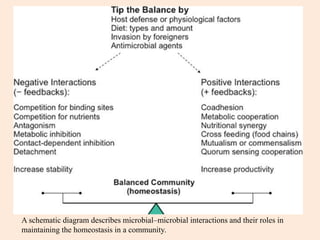
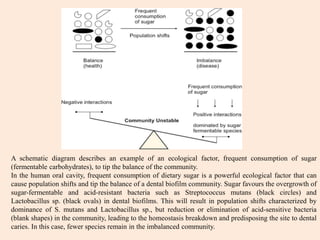
This document discusses homeostasis in bacteria. It begins by defining homeostasis as self-regulating processes that allow living organisms to maintain internal stability. It then describes several key homeostatic processes in bacteria, including iron homeostasis, metal homeostasis excluding iron, pH homeostasis, and membrane lipid homeostasis. Iron homeostasis involves specialized proteins that help bacteria absorb and store iron at optimal levels. Bacteria also regulate levels of other metals and can tolerate a wide range of pH through homeostatic mechanisms. Finally, the document presents diagrams depicting microbial interactions that maintain community homeostasis and how sugar consumption can disrupt this balance.