This document describes about one tailed test and Two Tailed Test.It describes when to use them.Also describes the relationship between the P values of both.
Two Tailed Testvs One Tailed Test
Understanding Hypothesis Testing in Statistics
Dr. Vikramjit Singh, SXCE, Patna
2.
Introduction to HypothesisTesting
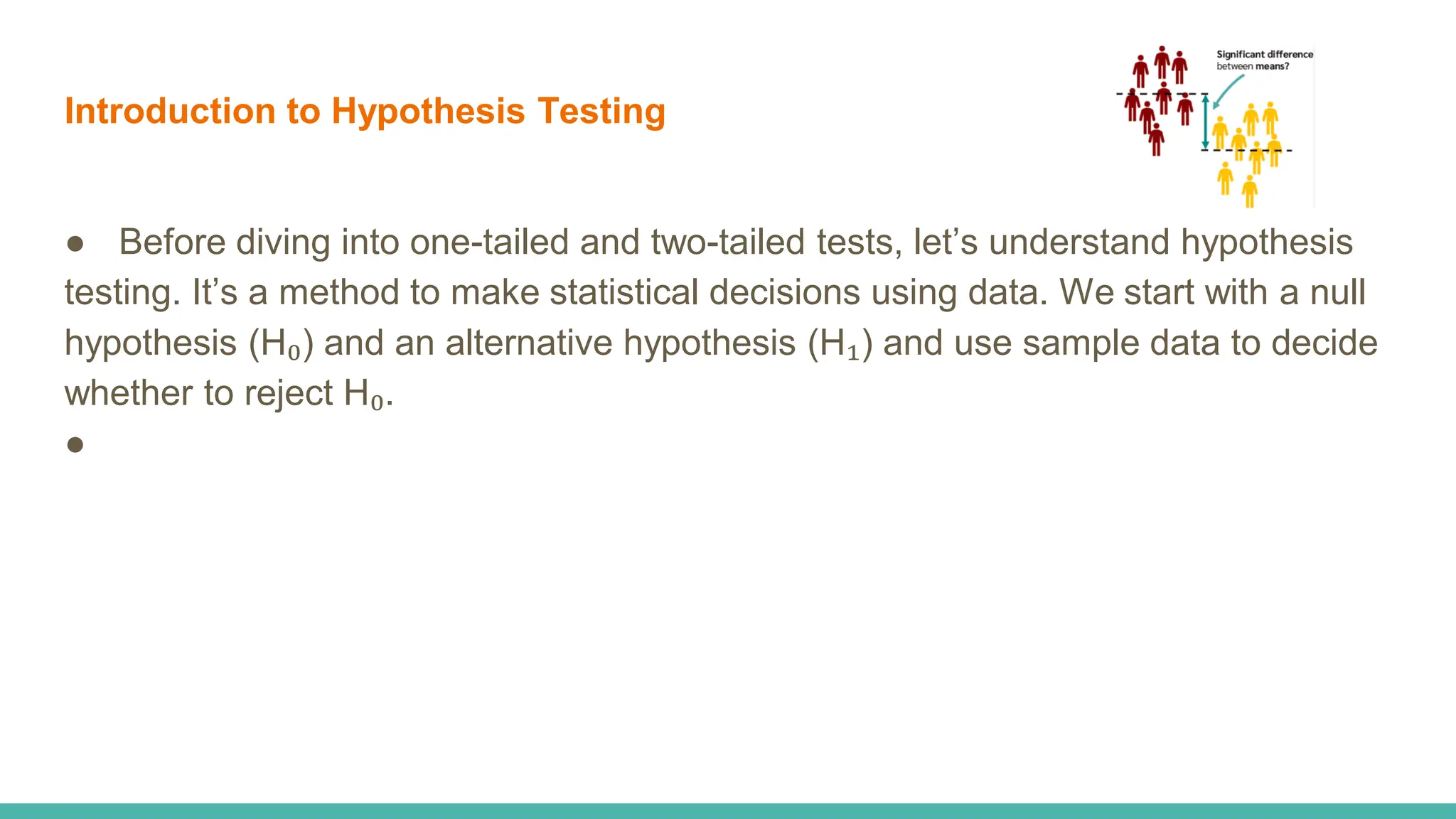
● Before diving into one-tailed and two-tailed tests, let’s understand hypothesis
testing. It’s a method to make statistical decisions using data. We start with a null
hypothesis (H₀) and an alternative hypothesis (H₁) and use sample data to decide
whether to reject H₀.
●
3.
What is aTwo-Tailed Test?
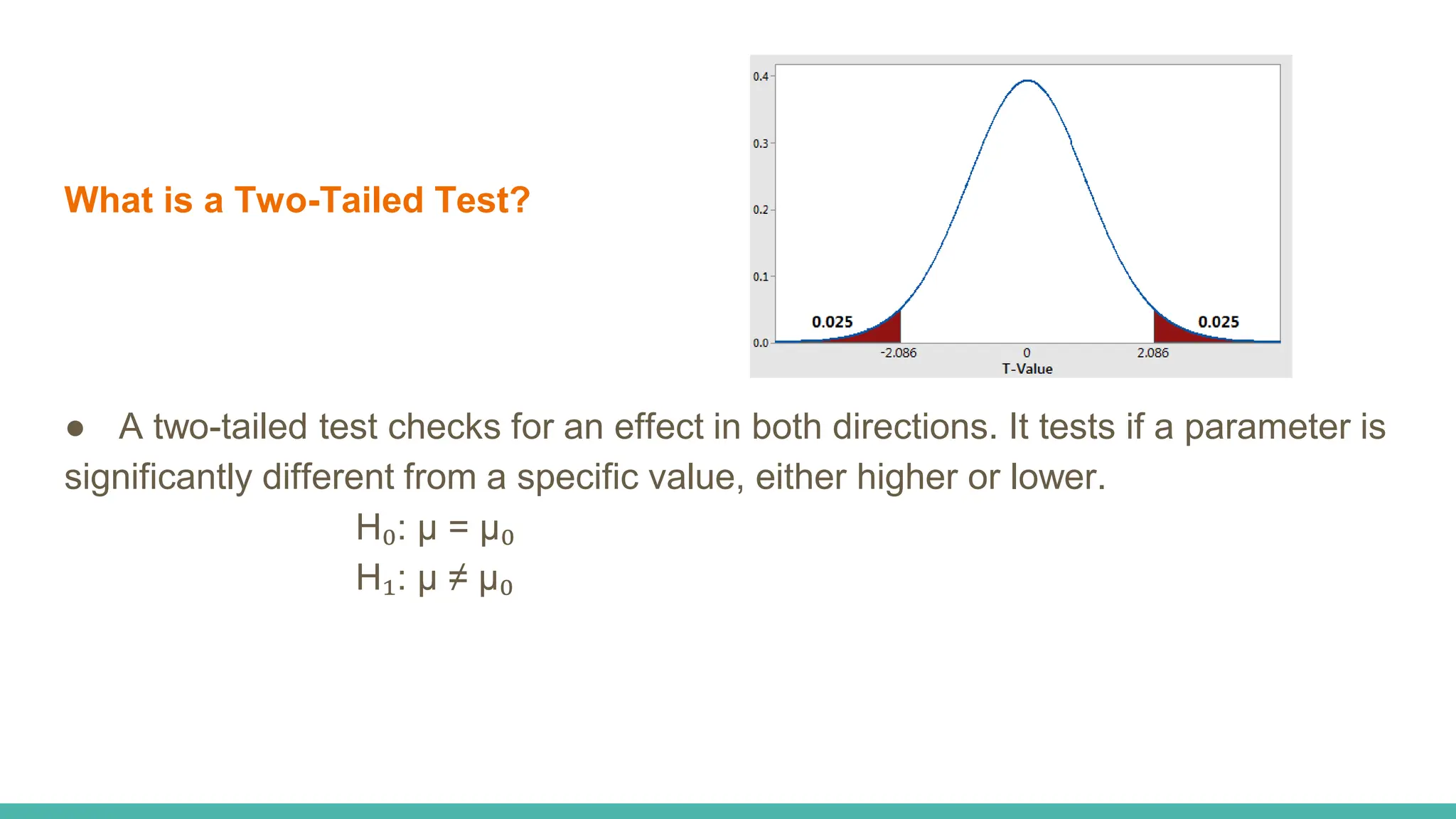
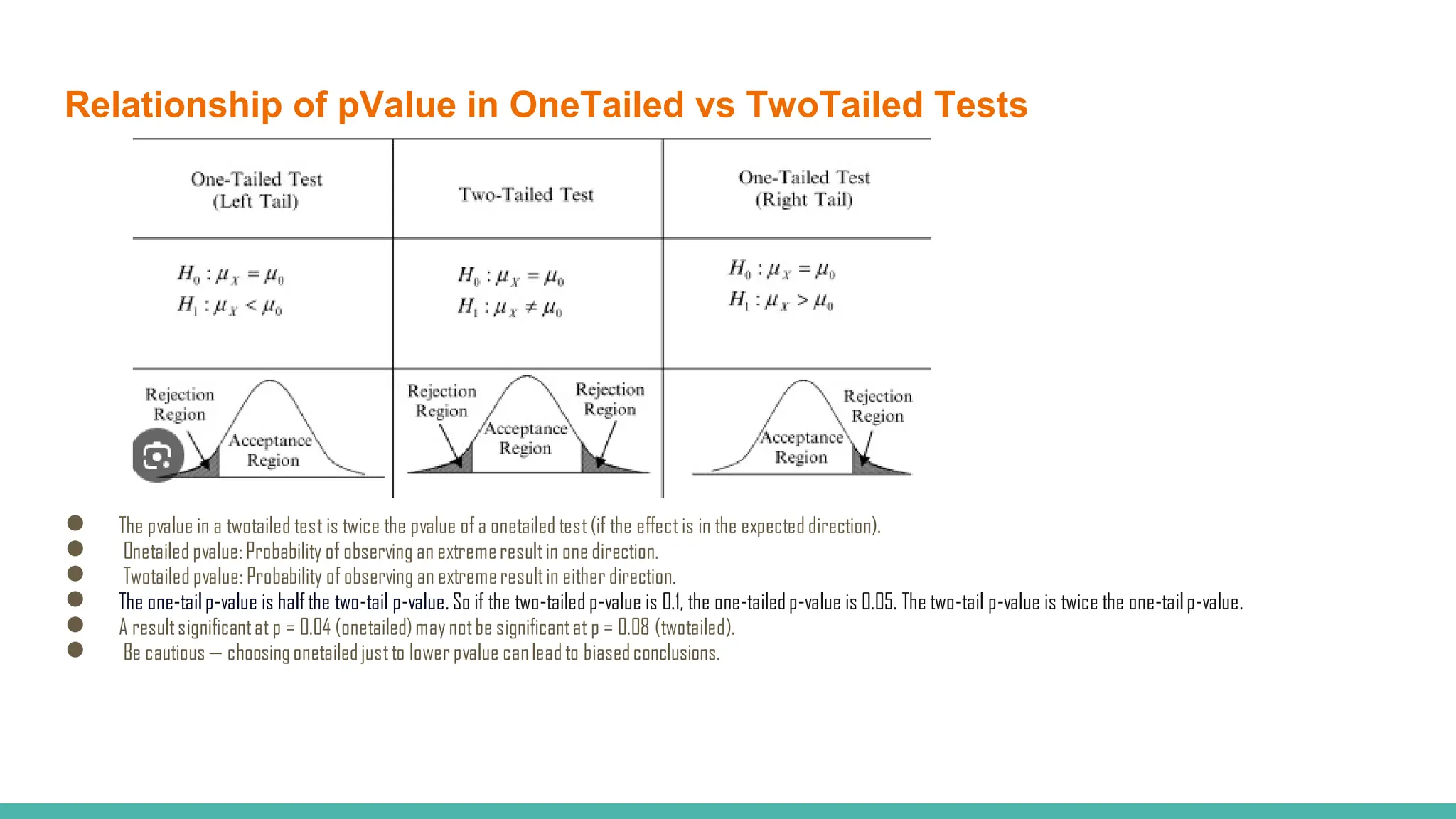
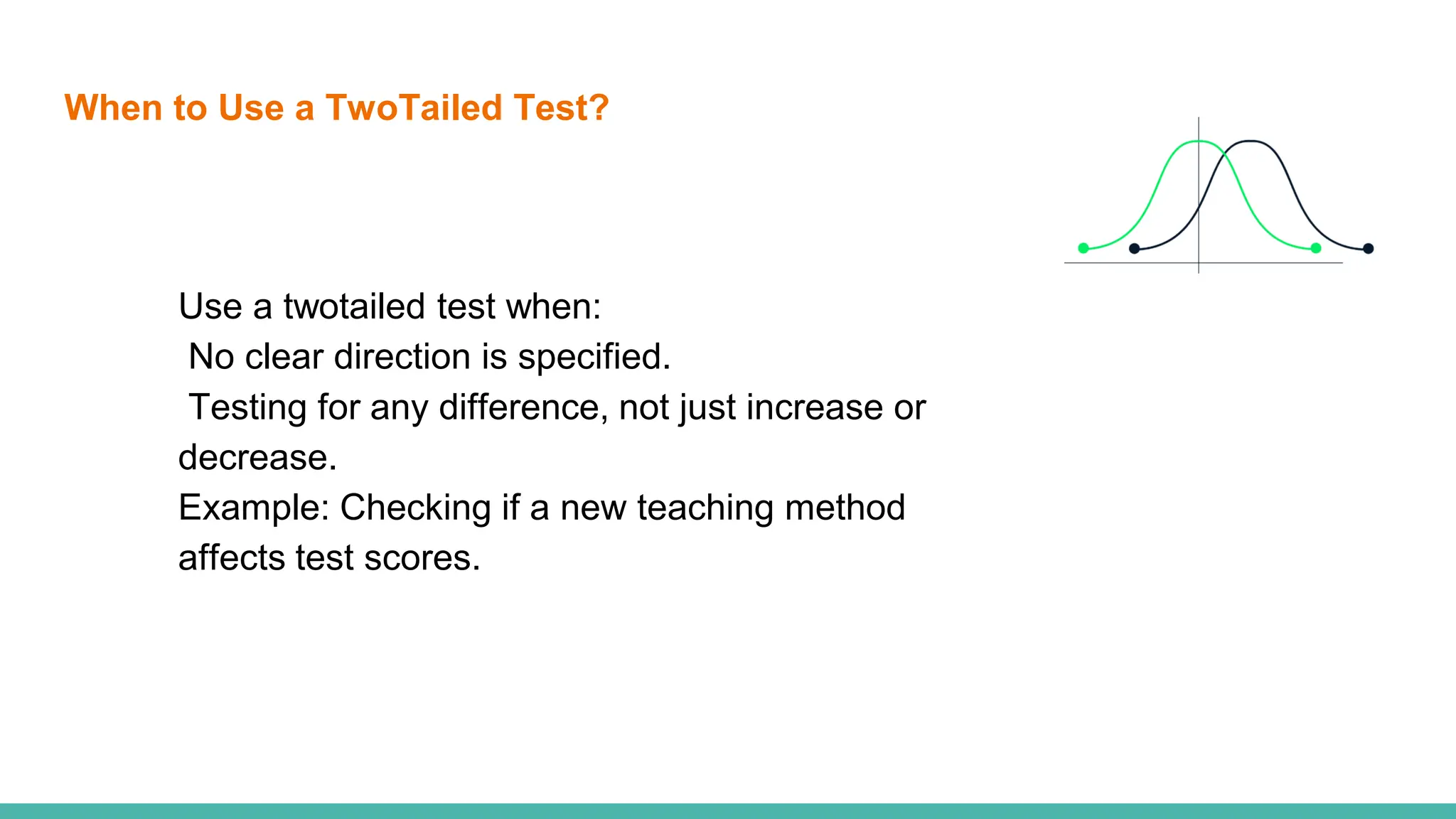
● A two-tailed test checks for an effect in both directions. It tests if a parameter is
significantly different from a specific value, either higher or lower.
H₀: μ = μ₀
H₁: μ ≠ μ₀
4.
What is aOne-Tailed Test?
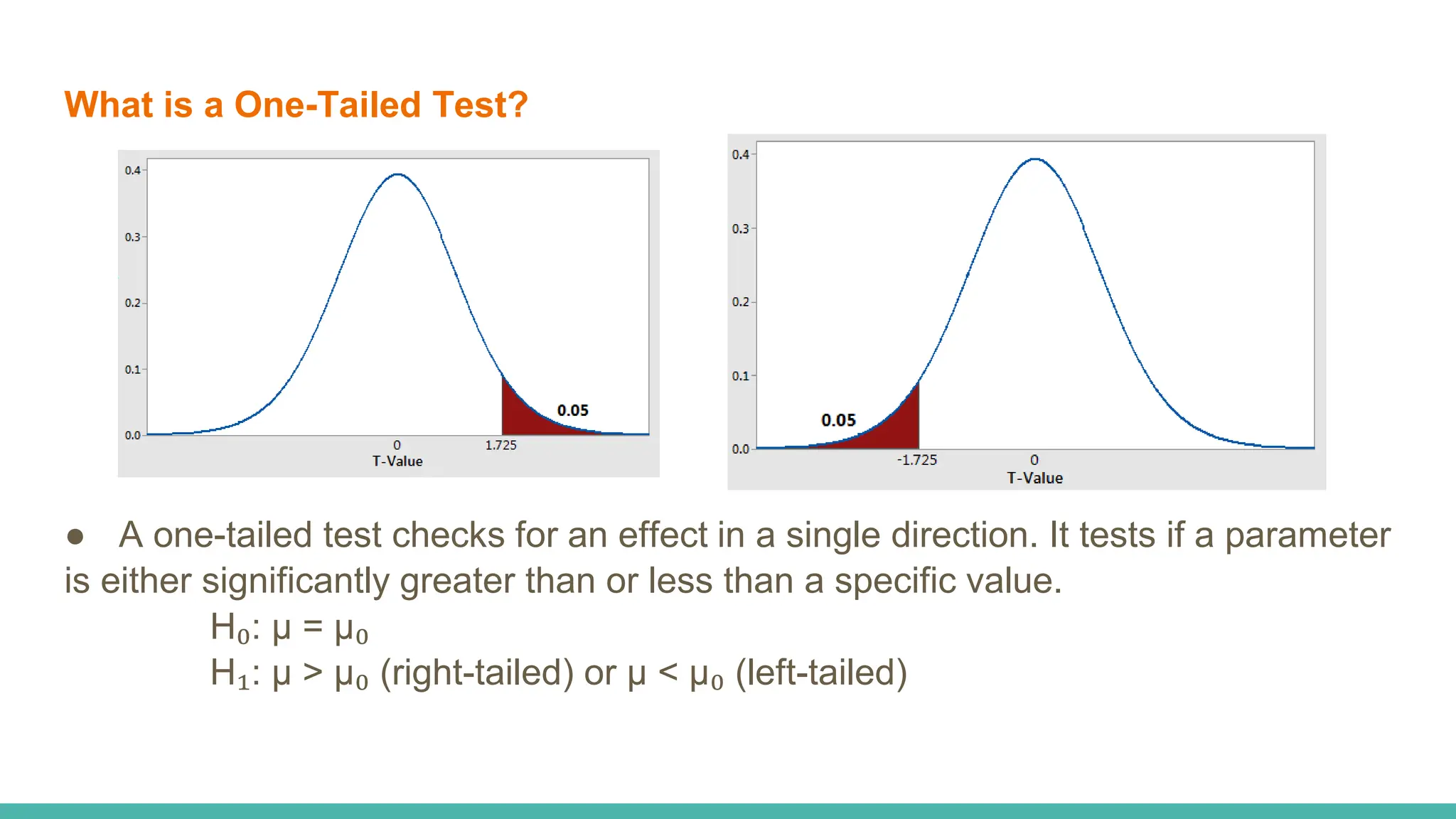
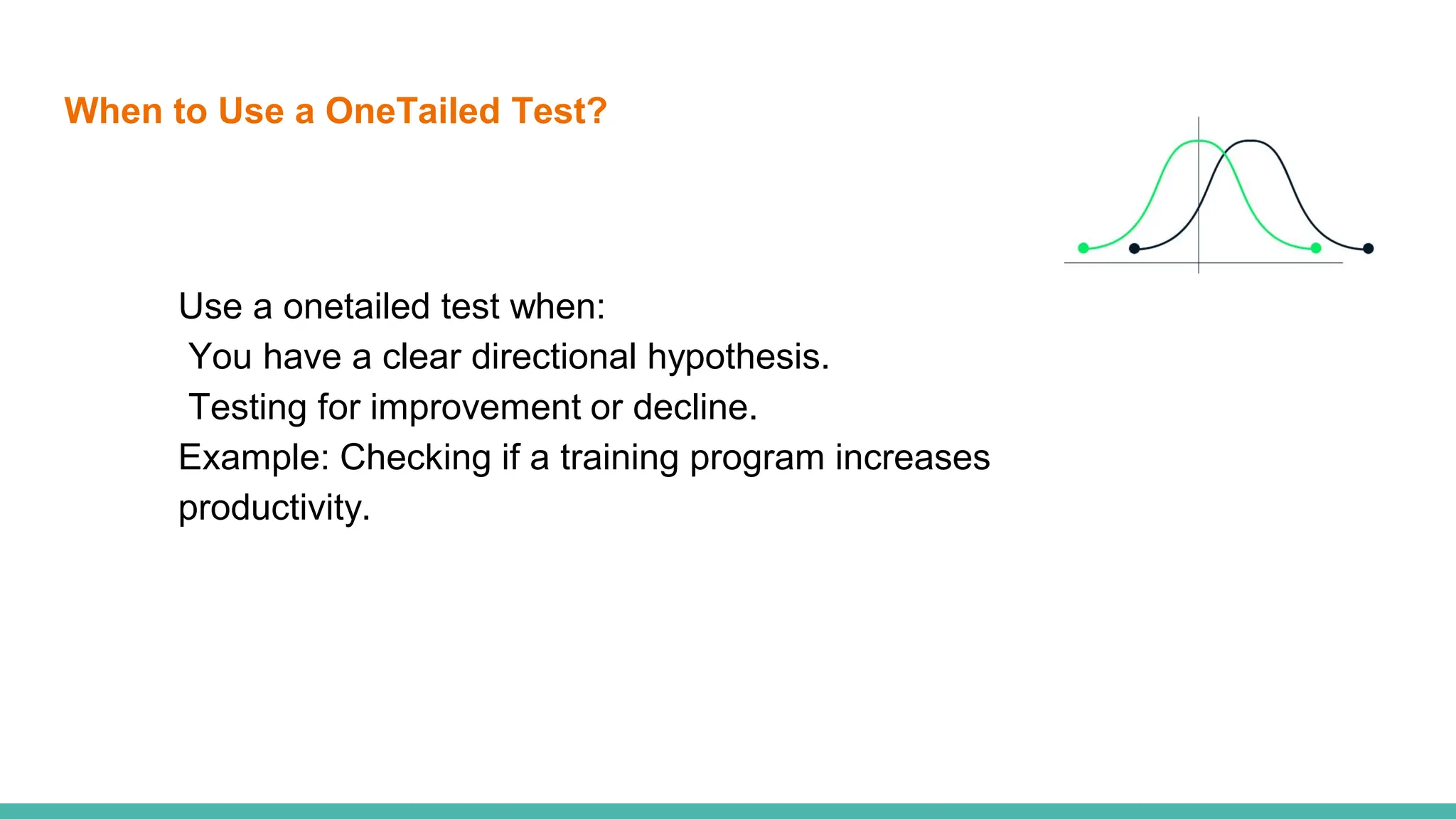
● A one-tailed test checks for an effect in a single direction. It tests if a parameter
is either significantly greater than or less than a specific value.
H₀: μ = μ₀
H₁: μ > μ₀ (right-tailed) or μ < μ₀ (left-tailed)
5.
Relationship of pValuein OneTailed vs TwoTailed Tests
● The pvalue in a twotailed test is twice the pvalue of a onetailed test(if the effectis in the expecteddirection).
● Onetailed pvalue:Probability of observing an extremeresultin one direction.
● Twotailed pvalue: Probability of observing an extremeresultin either direction.
● The one-tailp-value is halfthe two-tail p-value. So if the two-tailed p-value is 0.1, the one-tailedp-value is 0.05. The two-tail p-value is twice the one-tailp-value.
● A resultsignificantat p = 0.04 (onetailed)maynotbe significantat p = 0.08 (twotailed).
● Be cautious — choosingonetailedjustto lowerpvalue canleadto biasedconclusions.
6.
Level of Significance(α)
● The significance level (α) is the probability of
rejecting H₀ when it's true. Common values are 0.05 or
0.01.
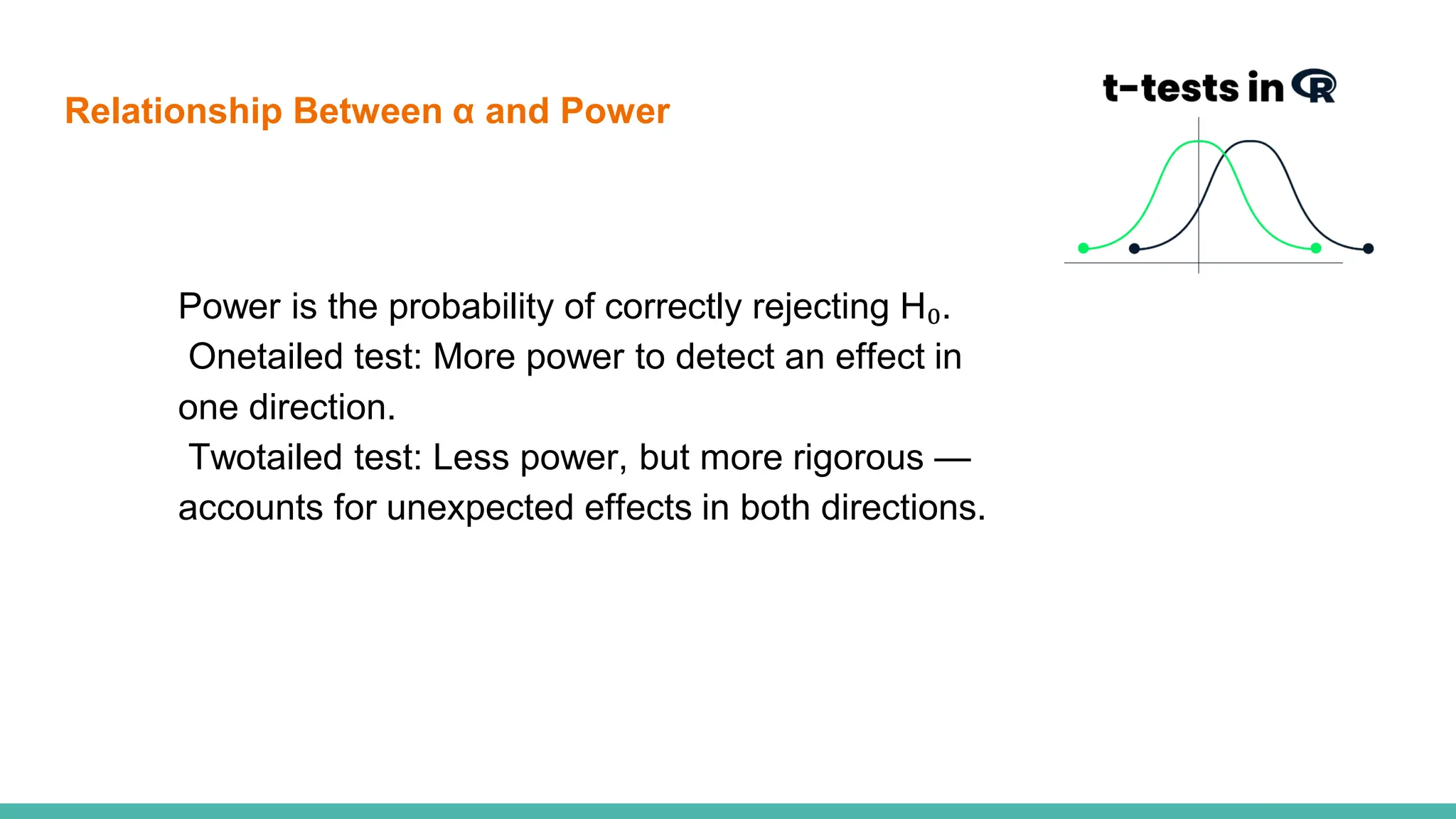
● Onetailed test: Entire α is in one tail.
● Twotailed test: α is split into two tails (α/2 on each
side).
7.
pValue and DecisionMaking
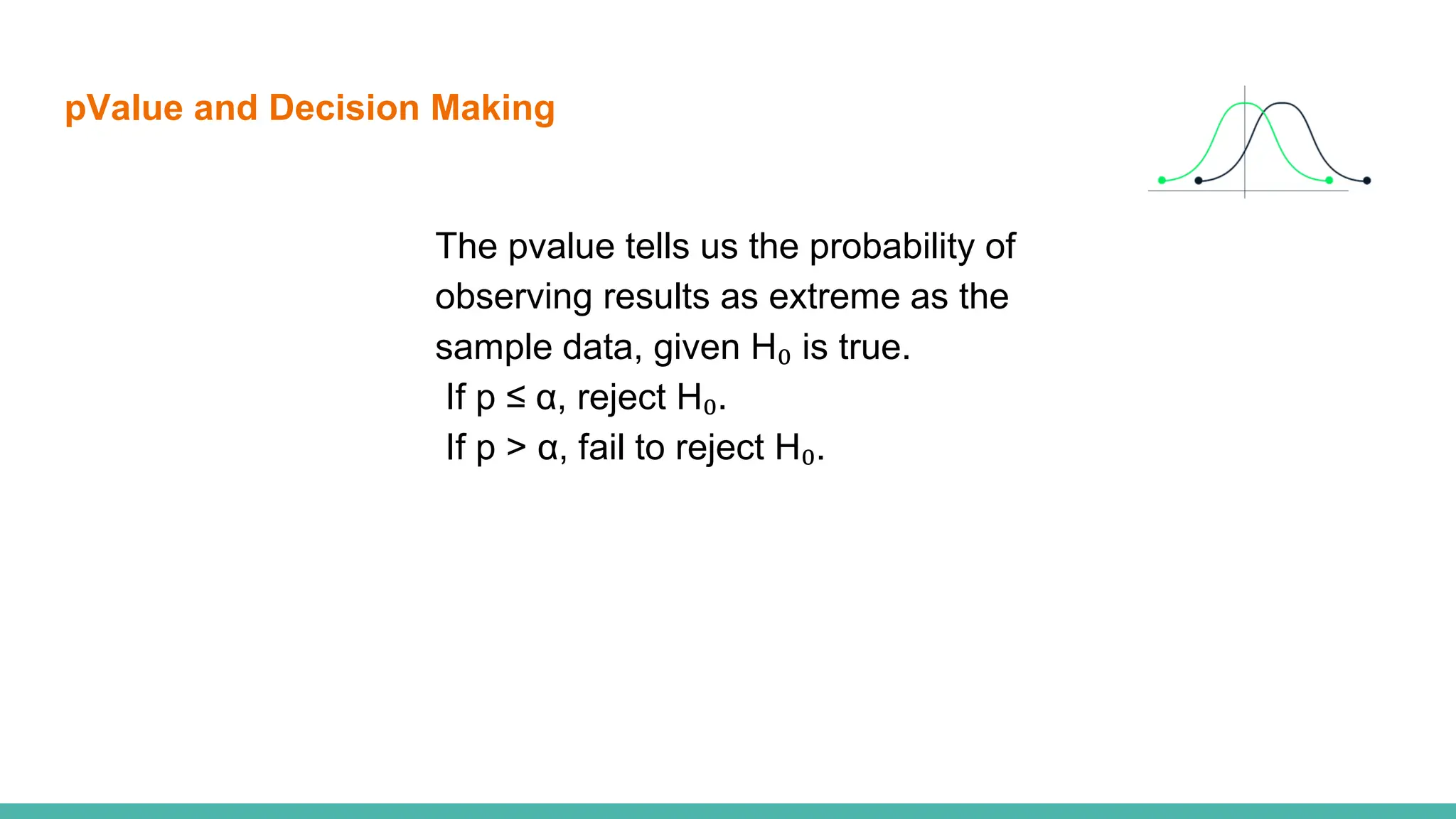
The pvalue tells us the probability of
observing results as extreme as the
sample data, given H₀ is true.
If p ≤ α, reject H₀.
If p > α, fail to reject H₀.
8.
TwoTailed Test Example
Example:Testing if a coin is biased.
H₀: The coin is fair (P = 0.5).
H₁: The coin is not fair (P ≠ 0.5).
If p = 0.04 and α = 0.05, we reject H₀,
suggesting bias.
9.
OneTailed Test Example
●Example: Testing if a new drug increases recovery rate.
● H₀: The drug has no effect.
● H₁: The drug increases the recovery rate (righttailed).
● If p = 0.03 and α = 0.05, we reject H₀, concluding the drug
works
10.
When to Usea TwoTailed Test?
Use a twotailed test when:
No clear direction is specified.
Testing for any difference, not just increase or
decrease.
Example: Checking if a new teaching method
affects test scores.
11.
When to Usea OneTailed Test?
Use a onetailed test when:
You have a clear directional hypothesis.
Testing for improvement or decline.
Example: Checking if a training program increases
productivity.
12.
Relationship Between αand Power
Power is the probability of correctly rejecting H₀.
Onetailed test: More power to detect an effect in
one direction.
Twotailed test: Less power, but more rigorous —
accounts for unexpected effects in both directions.
13.
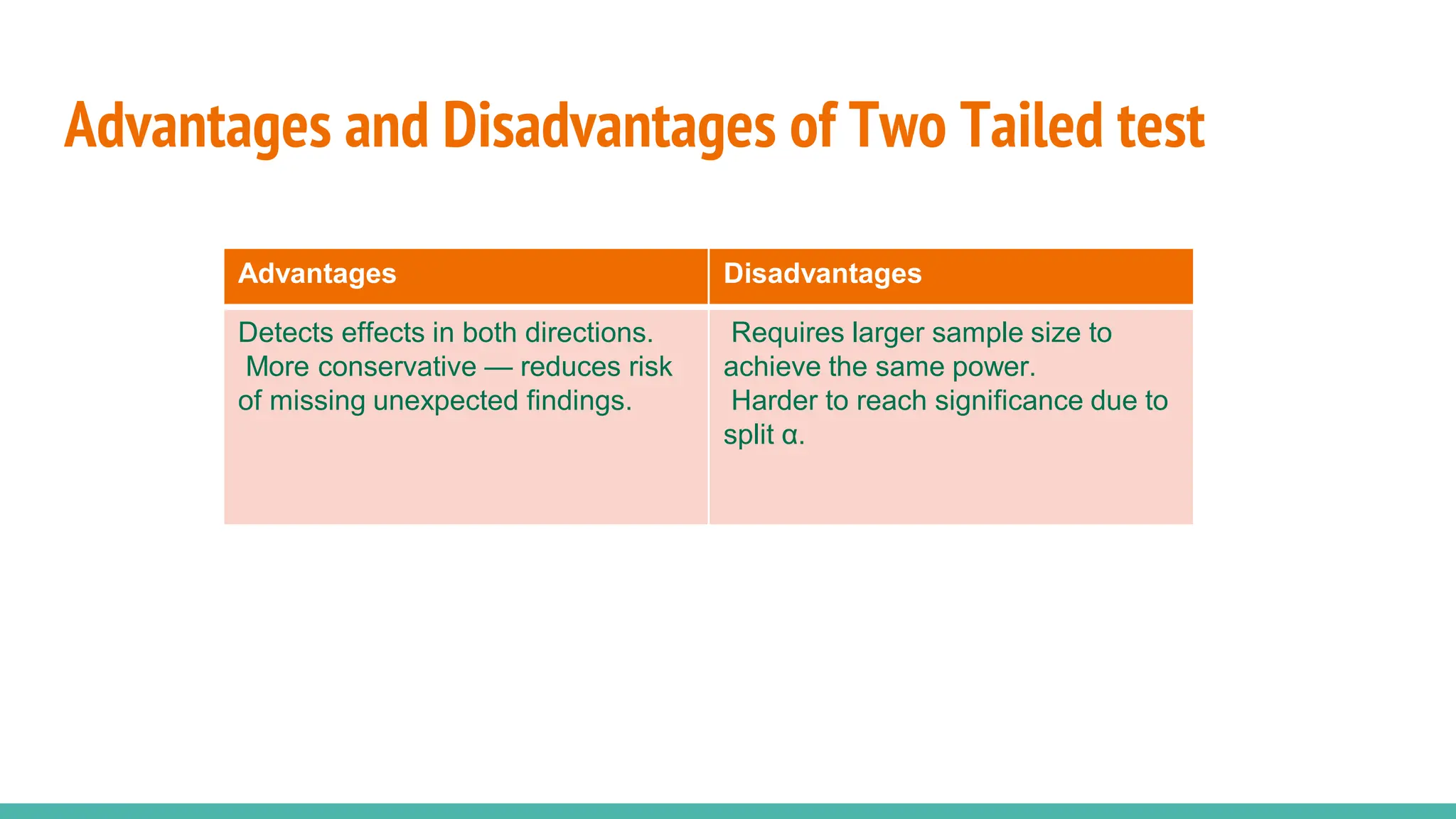
Advantages and Disadvantagesof Two Tailed test
Advantages Disadvantages
Detects effects in both directions.
More conservative — reduces risk
of missing unexpected findings.
Requires larger sample size to
achieve the same power.
Harder to reach significance due to
split α.
14.
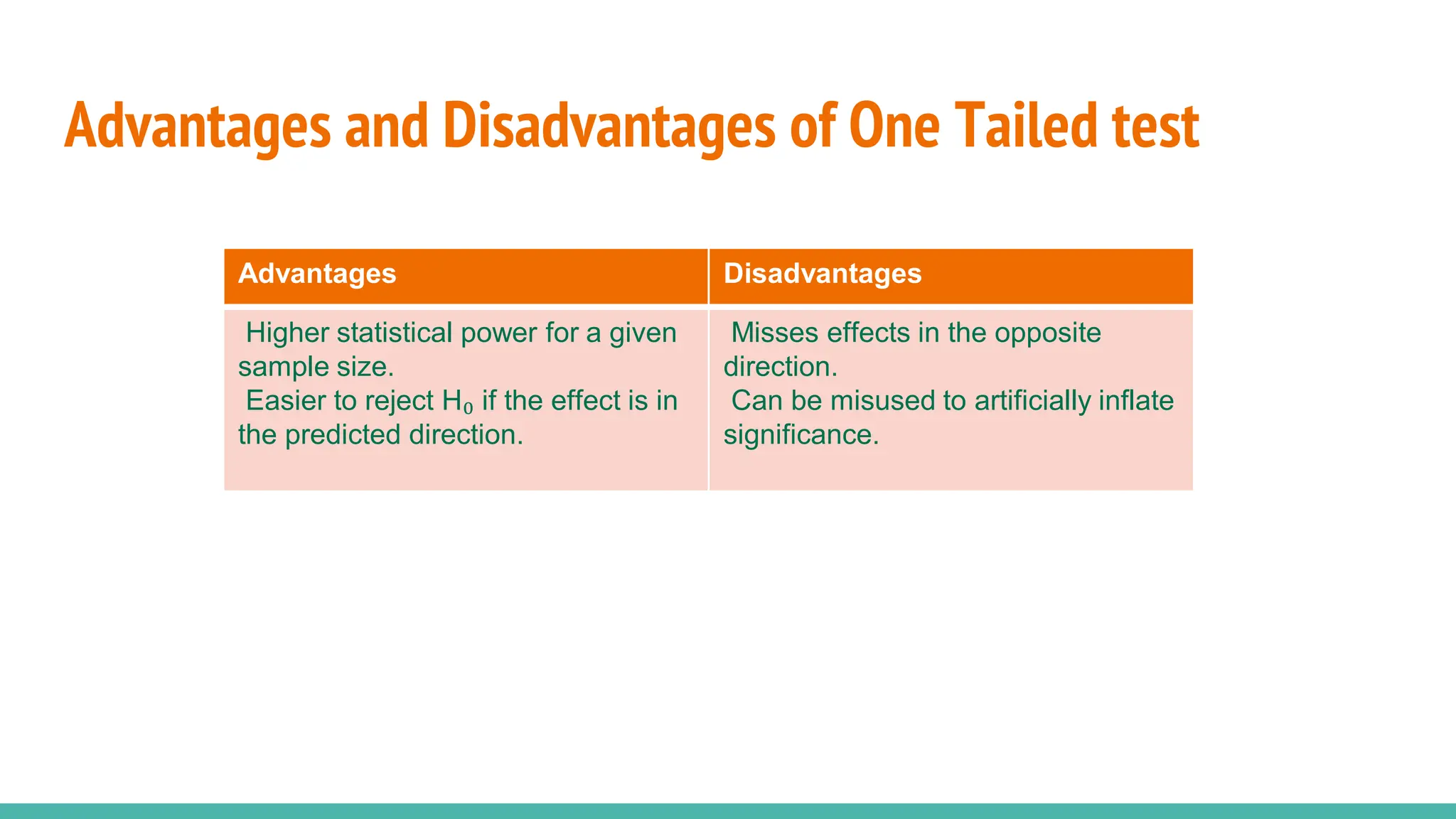
Advantages and Disadvantagesof One Tailed test
Advantages Disadvantages
Higher statistical power for a given
sample size.
Easier to reject H₀ if the effect is in
the predicted direction.
Misses effects in the opposite
direction.
Can be misused to artificially inflate
significance.
15.
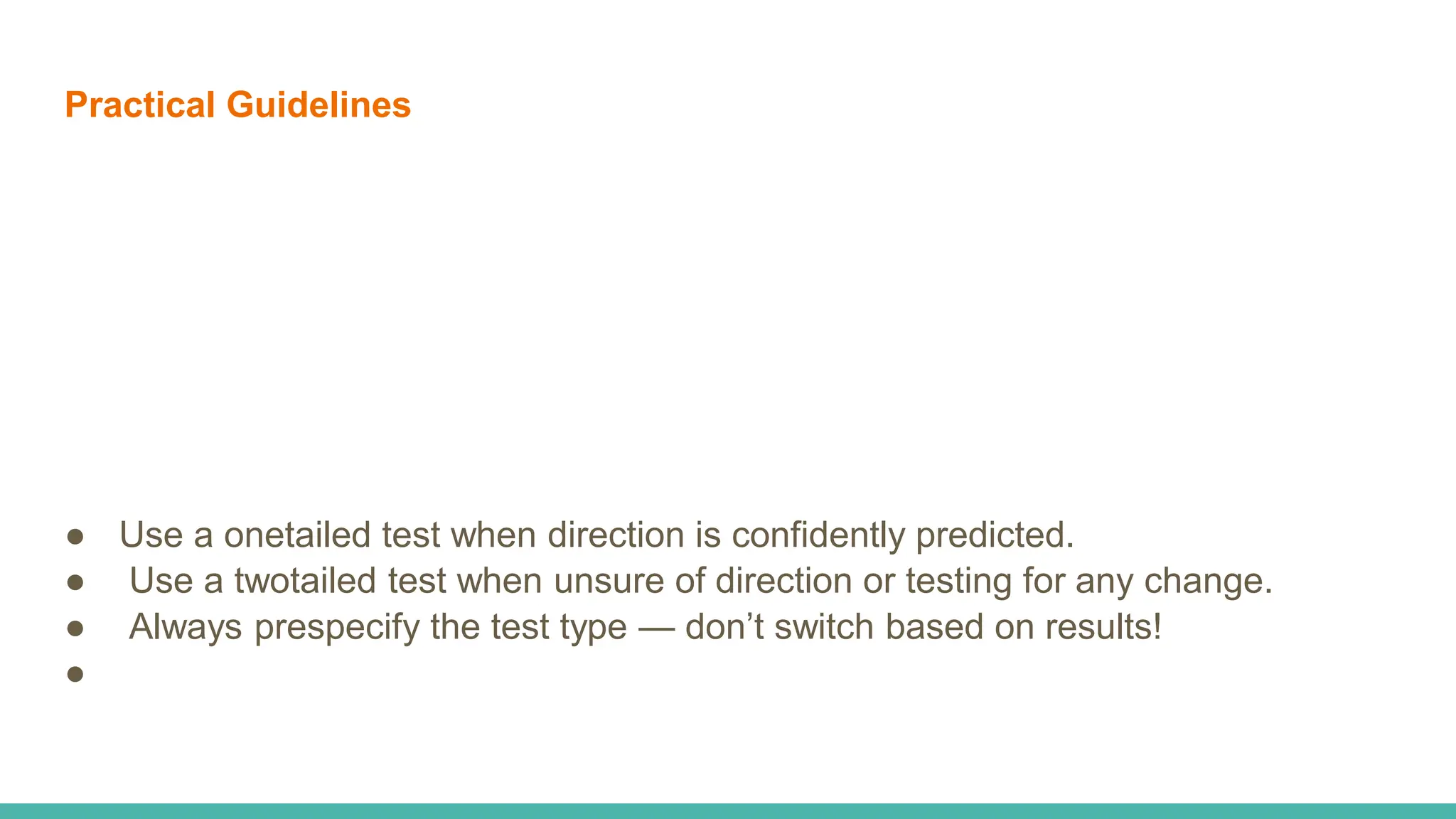
Practical Guidelines
● Usea onetailed test when direction is confidently predicted.
● Use a twotailed test when unsure of direction or testing for any change.
● Always prespecify the test type — don’t switch based on results!
●
16.
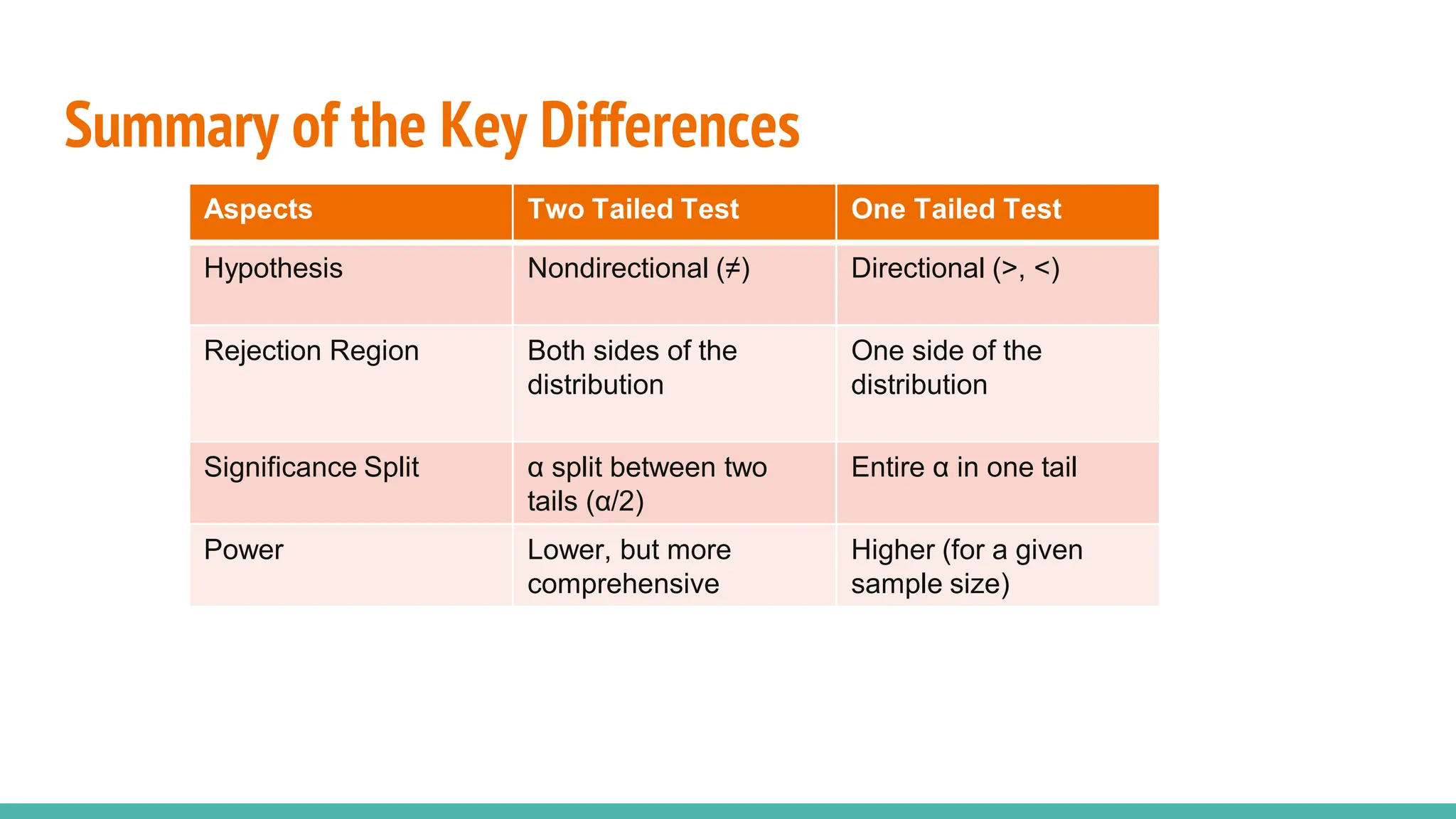
Summary of theKey Differences
Aspects Two Tailed Test One Tailed Test
Hypothesis Nondirectional (≠) Directional (>, <)
Rejection Region Both sides of the
distribution
One side of the
distribution
Significance Split α split between two
tails (α/2)
Entire α in one tail
Power Lower, but more
comprehensive
Higher (for a given
sample size)
17.
Conclusion
● Choosing betweena onetailed and twotailed test depends on your
hypothesis, research goals, and risk tolerance. Careful planning ensures your
test choice aligns with the study design and avoids biased conclusions.