Moving Beyond the Qual-Quant Divide 
Peter Davis 
Social Development Research Initiative 
Agnes Quisumbing 
IFPRI 
A4NH Gender-Nutrition Methods Workshop II, December 2-4, 2014 
Bioversity International - Rome, Italy
Introduction 
• Qualitative and quantitative research in the social 
sciences are too often conducted separately 
• There are a number of reasons for the qual-quant 
divide: 
– Different philosophical underpinnings 
– Different disciplinary traditions 
– Different research concerns and subjects 
– Different research contexts 
– Different gauges and status markers for judging research
CG researchers may not make the most of qual 
and quant approaches 
• From the gender inventory, CGIAR researchers feel that gender 
research is the monopoly of qualitative researchers, but at the 
same time, is given lower priority or viewed as less legitimate: 
“Data analysis is deemed a particularly weak point since analyzing the 
gender data is not always prioritized, especially not from surveys. Another 
challenge is that the results from the case studies are not always taken as 
seriously as survey results but rather considered anecdotal.”
But quant methods are often viewed as 
extractive 
“There is an emphasis on deductive, quantitative methods – especially in the 
baselines – even if researchers sometimes mix methods…Some gender data is 
even completely neglected during the analysis phase. 
The GFPs try add qualitative components to projects, but the need for more 
FGDs, unstructured interviews and participatory methods was noted even if 
they may be time consuming; both to facilitate the interpretation of 
quantitative data and to allow the participants to analyze their own realities. 
The latter was seen as important to mitigate power asymmetries between 
the researchers and communities, for achieving bottom-up change, and to 
address the problem in quantitative research of not always feeding back the 
results to the communities.”
Moving beyond the divide makes research 
better 
What are the essential differences between 
qualitative and quantitative research approaches? 
For five minutes – discuss with your neighbor the 
key differences between qualitative and quantitative 
research
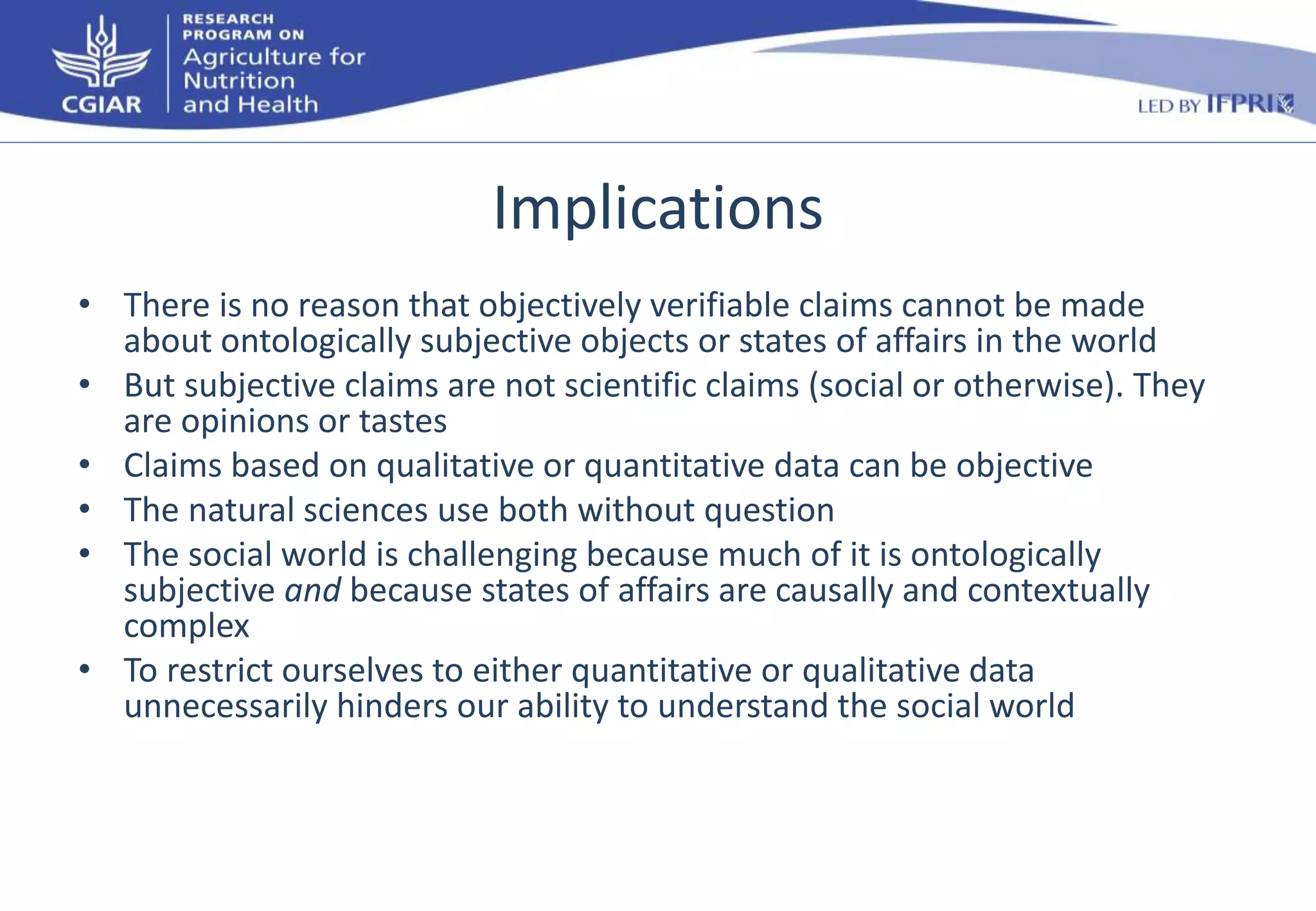
Inherent ambiguity in the subjective-objective distinction 
(adapted from Searle 2010) 
Ontological (about what exists) Epistemological (about claims to 
knowledge) 
Subjective • Individual observer dependent (pains, 
aches, tickles) 
• Collective observer dependence for the 
most important aspects of their 
existence (e.g. money, marriage, 
property boundaries, declarations of 
war). Much of the subject matter of the 
social sciences. 
Non-scientific claims that are 
observer dependent. (e.g. 
aesthetic claims or judgments 
about art and literature - such as - 
that Rembrandt was a better 
painter than Rubens). Susceptible 
to observer bias and idiosyncratic 
tastes. 
Objective Observer independent – things that exist 
independently of the minds of observers 
(e.g. mountains, molecules, tectonic 
plates). Much of the subject matter of the 
natural sciences. 
Natural and social science 
knowledge claims. Attempt to be 
observer-independent and can be 
based on either quantified or 
non-quantified evidence, or both.
Implications 
• There is no reason that objectively verifiable claims cannot be made 
about ontologically subjective objects or states of affairs in the world 
• But subjective claims are not scientific claims (social or otherwise). They 
are opinions or tastes 
• Claims based on qualitative or quantitative data can be objective 
• The natural sciences use both without question 
• The social world is challenging because much of it is ontologically 
subjective and because states of affairs are causally and contextually 
complex 
• To restrict ourselves to either quantitative or qualitative data 
unnecessarily hinders our ability to understand the social world
Page 8 
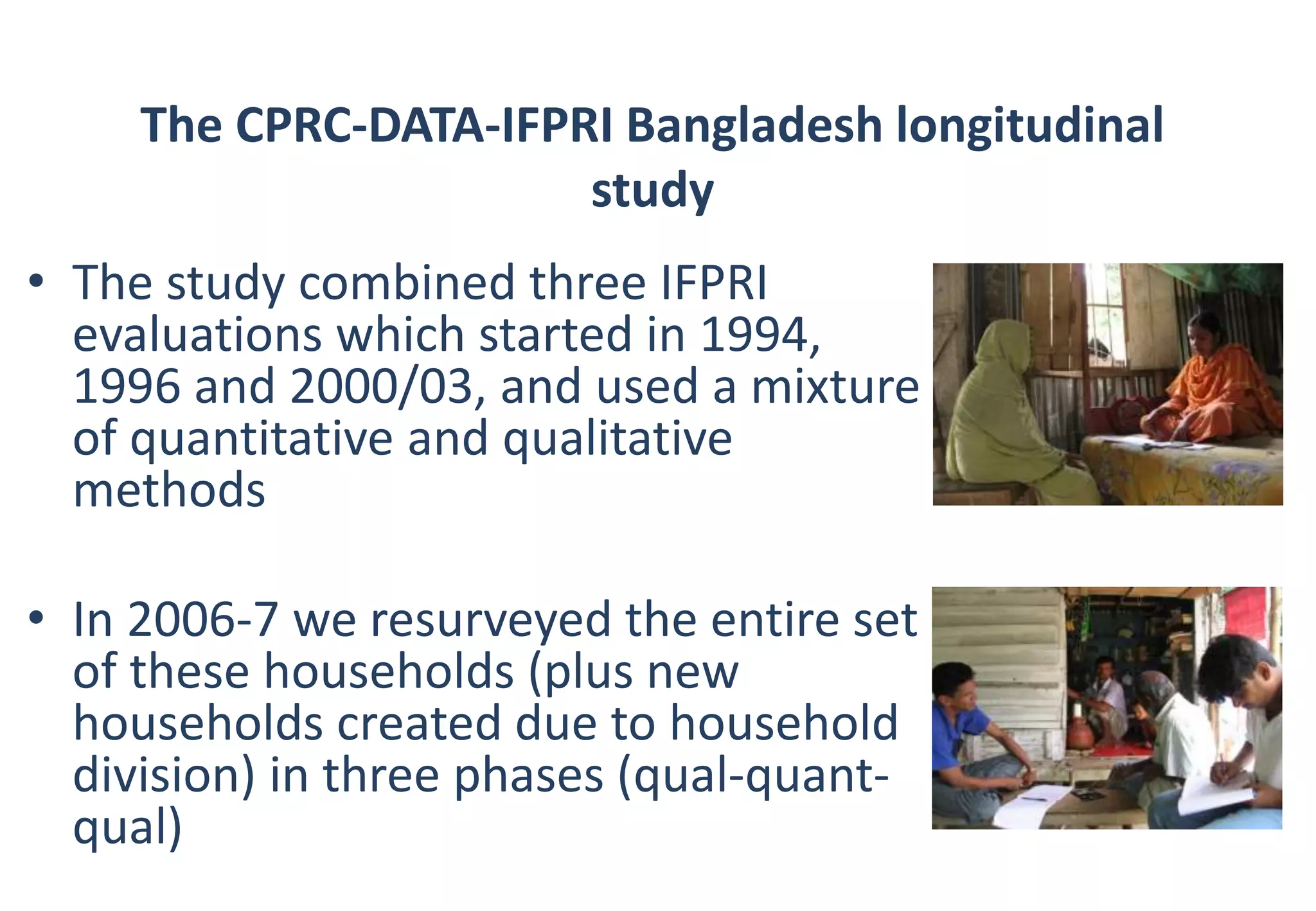
Example of a Q-squared study: 
The CPRC-DATA-IFPRI Longitudinal Study
The CPRC-DATA-IFPRI Bangladesh longitudinal 
study 
• The study combined three IFPRI 
evaluations which started in 1994, 
1996 and 2000/03, and used a mixture 
of quantitative and qualitative 
methods 
• In 2006-7 we resurveyed the entire set 
of these households (plus new 
households created due to household 
division) in three phases (qual-quant-qual)
The 2006-7 Study’s 3 Phases 
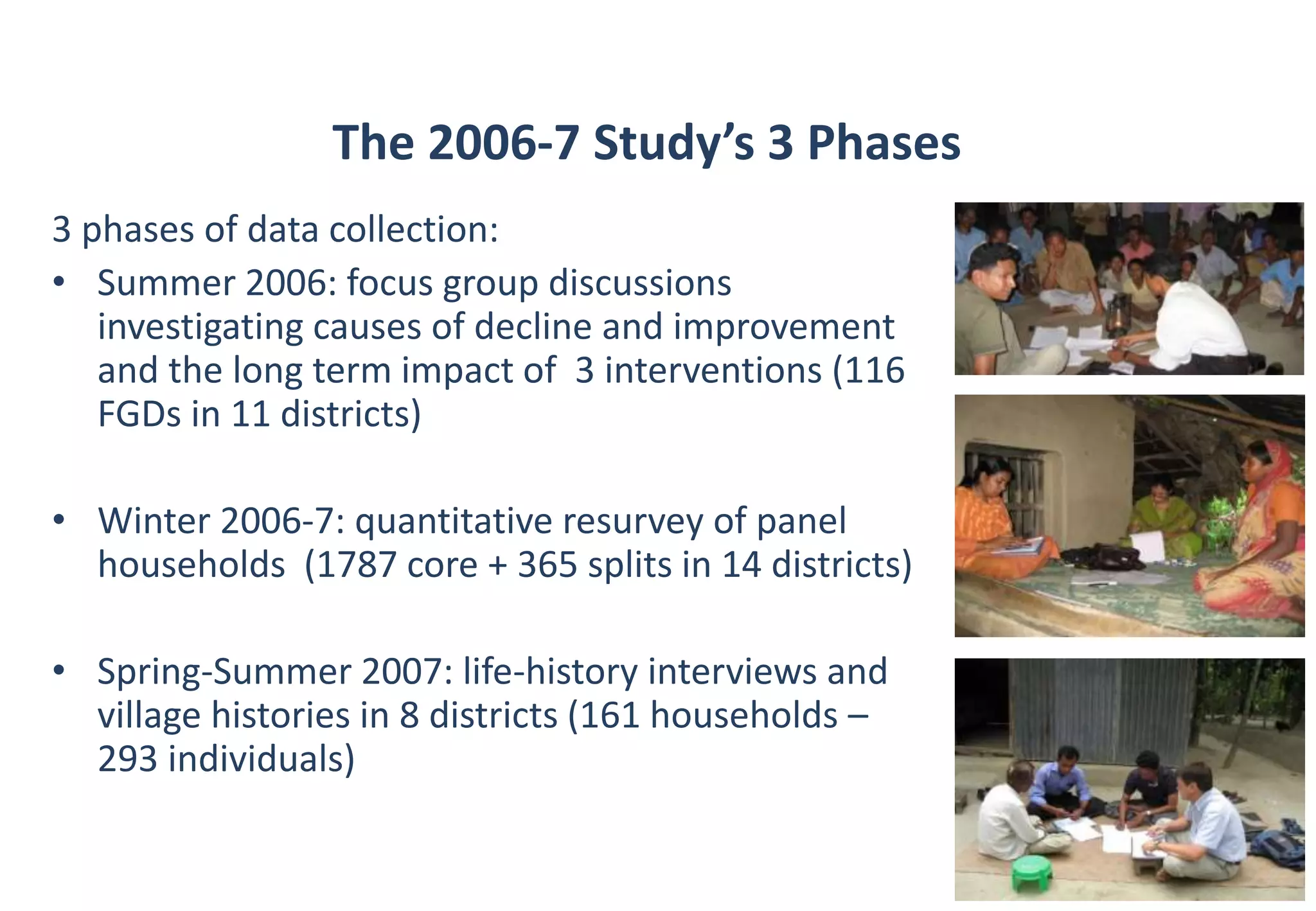
3 phases of data collection: 
• Summer 2006: focus group discussions 
investigating causes of decline and improvement 
and the long term impact of 3 interventions (116 
FGDs in 11 districts) 
• Winter 2006-7: quantitative resurvey of panel 
households (1787 core + 365 splits in 14 districts) 
• Spring-Summer 2007: life-history interviews and 
village histories in 8 districts (161 households – 
293 individuals)
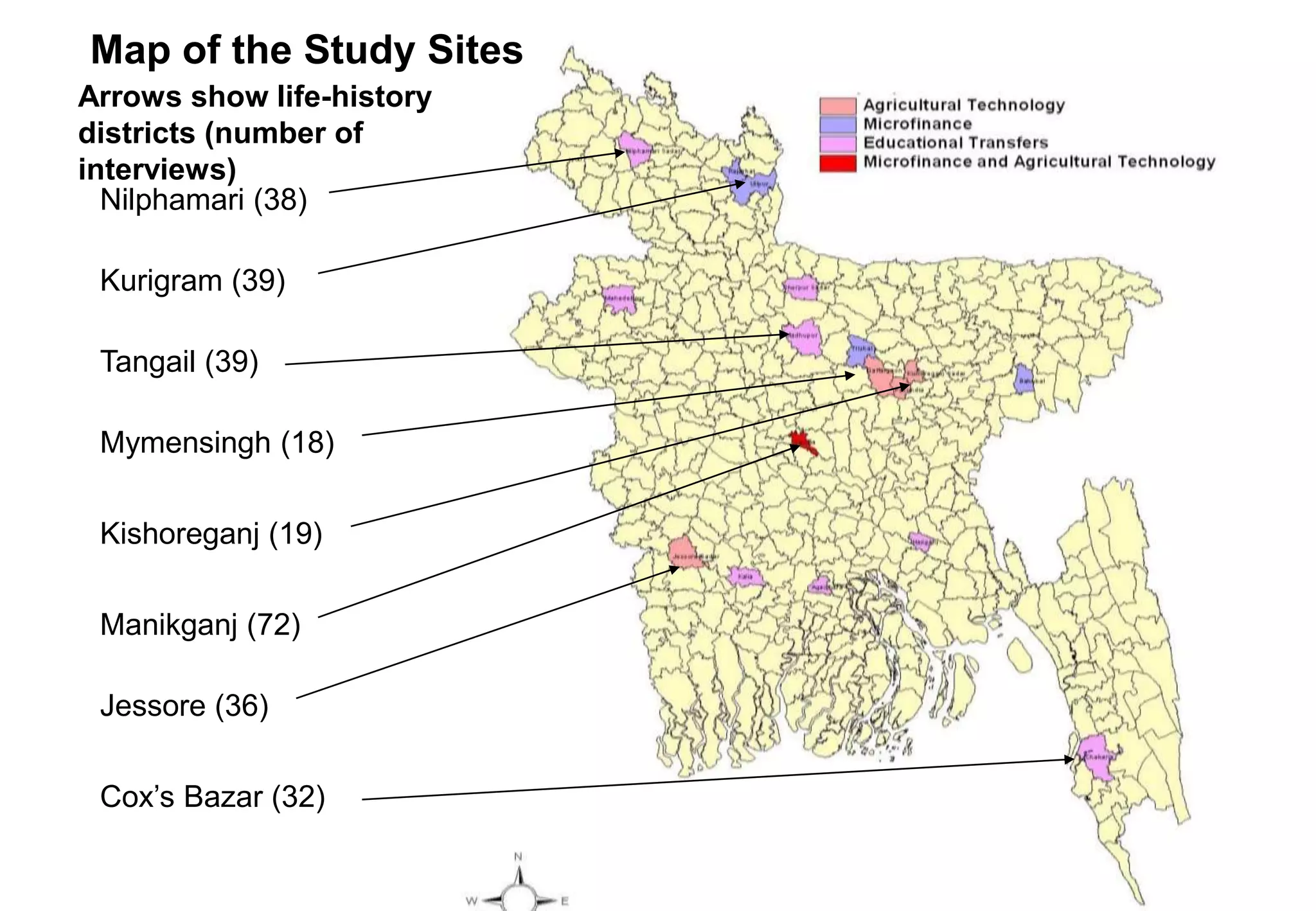
Map of the Study Sites 
Arrows show life-history 
districts (number of 
interviews) 
Nilphamari (38) 
Kurigram (39) 
Tangail (39) 
Mymensingh (18) 
Kishoreganj (19) 
Manikganj (72) 
Jessore (36) 
Cox’s Bazar (32)
What does qual research bring to quant? 
• Challenges in researching the social world 
– dealing with complexity 
– intangibility 
– ontological subjectivity 
– morality and ethics 
• Exploration of context (in space and time) 
• A better qualitative understanding of social realities so that good 
variables are chosen for quantitative measurement 
• Better identification of complex processes and causal relationships – 
which can then be more systematically investigated quantitatively (qual 
work to inform formulation of hypotheses that can be tested 
quantitatively)
What does quant research bring to qual? 
• Larger numbers of randomly selected cases control bias and 
increase representativeness of cases and therefore 
generalizability of findings 
• The ability to compare the effects of interventions without 
being led astray by random variation or confounding causes 
• Reduction in observer dependence due to larger numbers of 
cases and more formal methods 
• Systematic, transparent, repeatable methods (replicability)
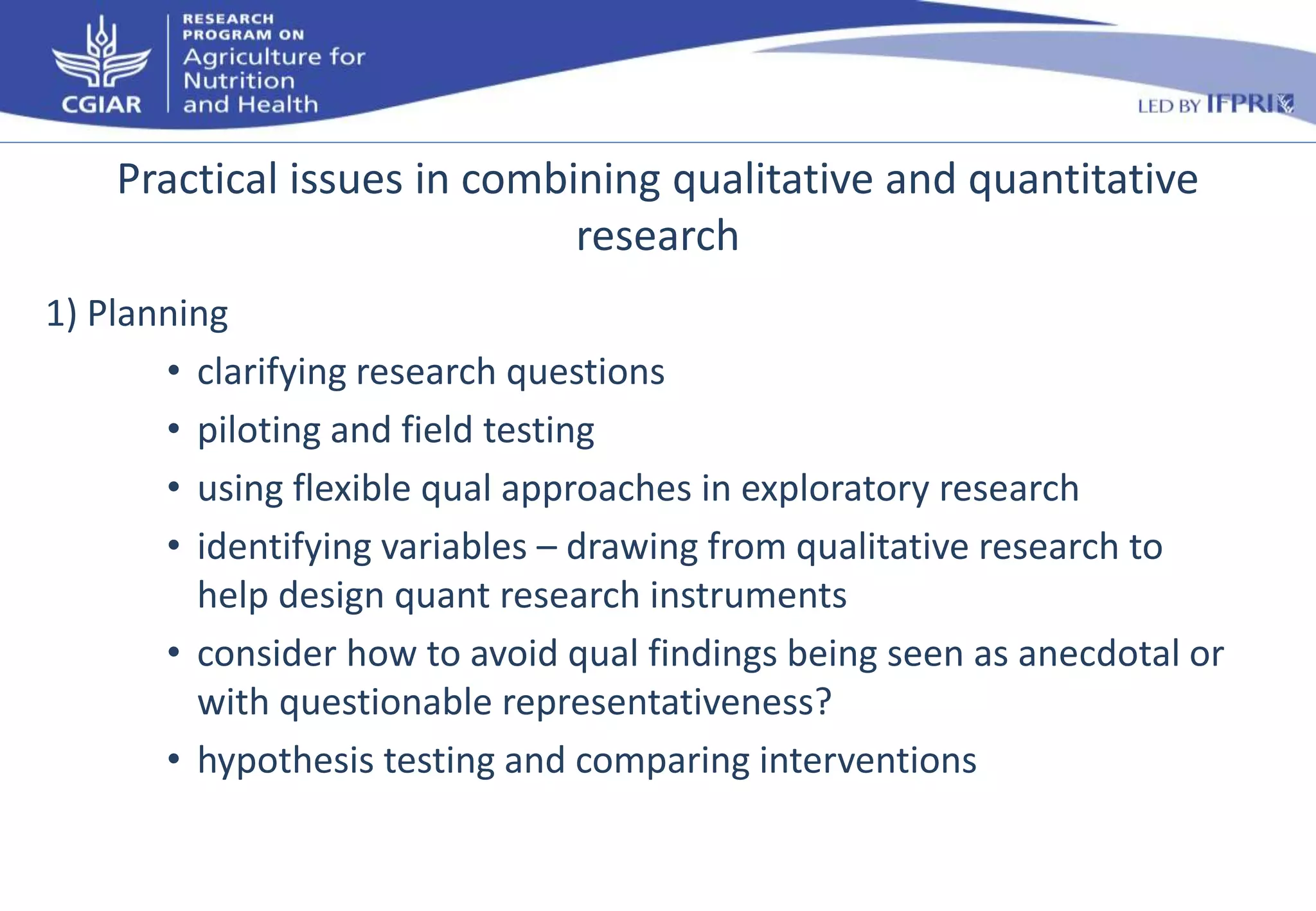
Practical issues in combining qualitative and quantitative 
research 
1) Planning 
• clarifying research questions 
• piloting and field testing 
• using flexible qual approaches in exploratory research 
• identifying variables – drawing from qualitative research to 
help design quant research instruments 
• consider how to avoid qual findings being seen as anecdotal or 
with questionable representativeness? 
• hypothesis testing and comparing interventions
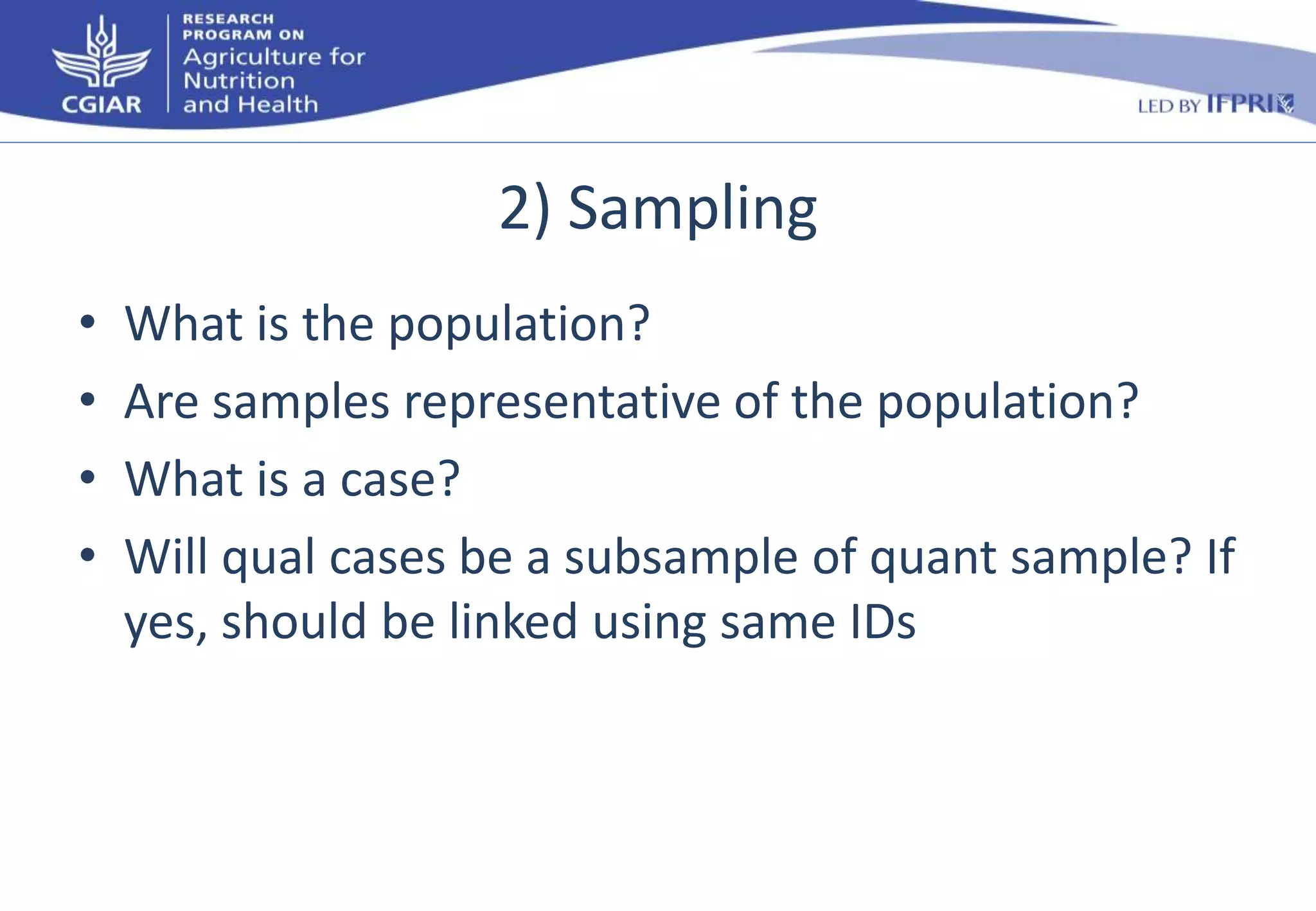
2) Sampling 
• What is the population? 
• Are samples representative of the population? 
• What is a case? 
• Will qual cases be a subsample of quant sample? If 
yes, should be linked using same IDs
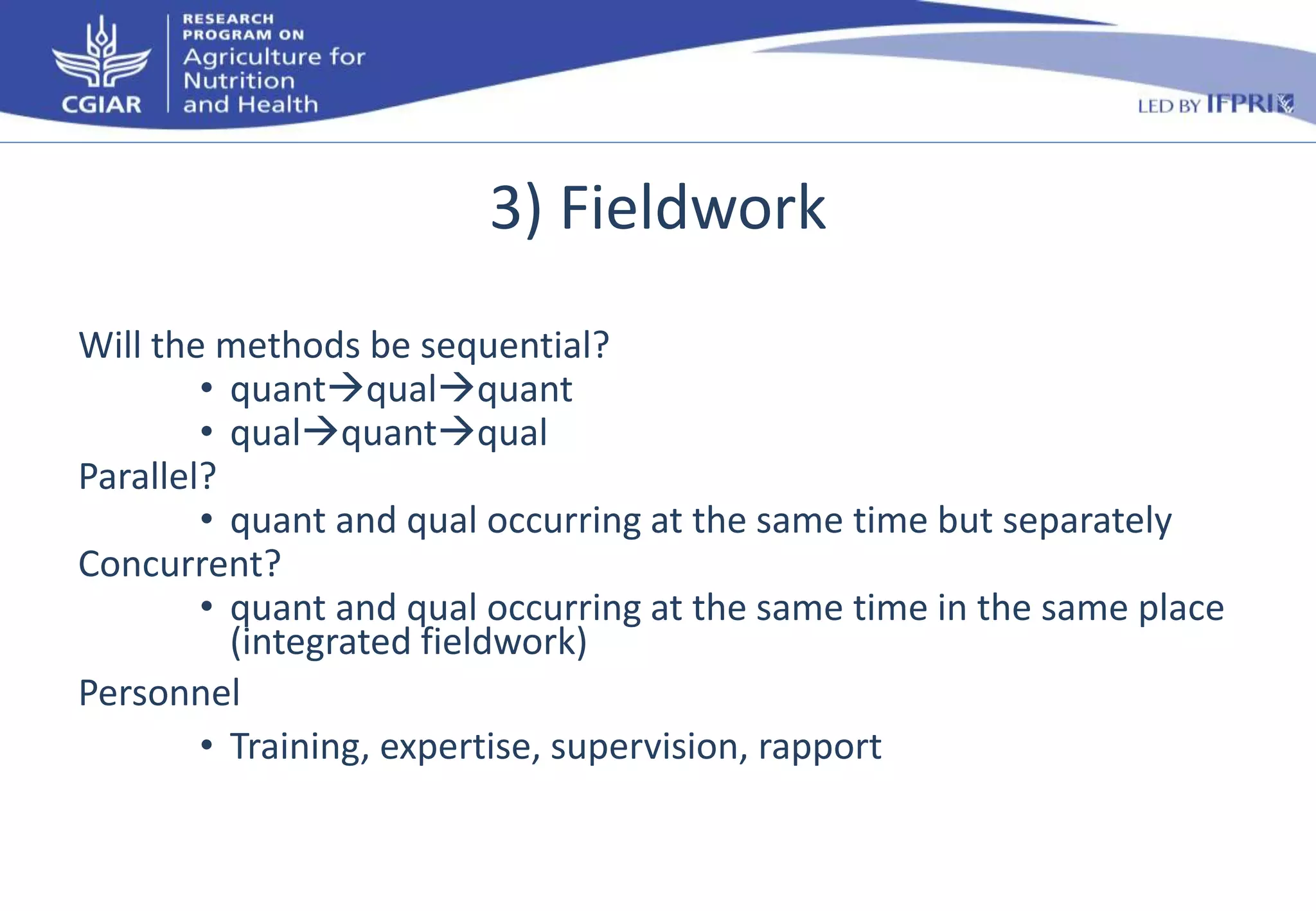
3) Fieldwork 
Will the methods be sequential? 
• quantqualquant 
• qualquantqual 
Parallel? 
• quant and qual occurring at the same time but separately 
Concurrent? 
• quant and qual occurring at the same time in the same place 
(integrated fieldwork) 
Personnel 
• Training, expertise, supervision, rapport
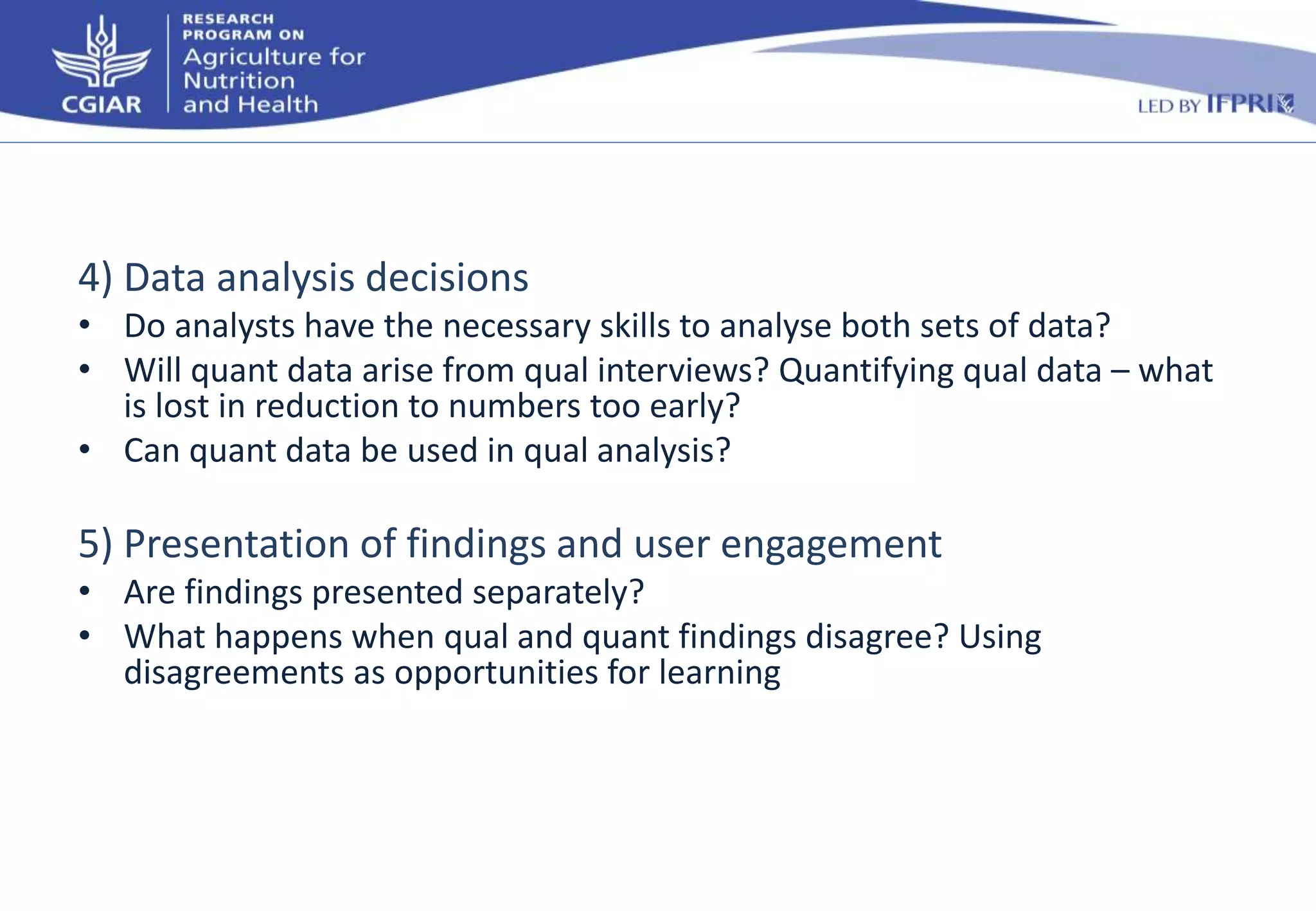
4) Data analysis decisions 
• Do analysts have the necessary skills to analyse both sets of data? 
• Will quant data arise from qual interviews? Quantifying qual data – what 
is lost in reduction to numbers too early? 
• Can quant data be used in qual analysis? 
5) Presentation of findings and user engagement 
• Are findings presented separately? 
• What happens when qual and quant findings disagree? Using 
disagreements as opportunities for learning
6) Ethical concerns 
• Protection of research participants 
– Is there more risk of harming participants? 
– Maintenance of anonymity when ‘thick descriptions’ 
are part of the dataset 
– Release of data to other users 
• Is there greater potential to influence policy in a 
positive direction? And less risk of misrepresenting 
social, economic, political reality?
Useful publications and websites: 
Journals 
• Journal of mixed methods research http://mmr.sagepub.com 
• International Journal of Multiple Research Approaches http://mra.e-contentmanagement.com 
Books, papers and book chapters 
• Bryman. A. Social research methods. Chapters 21 and 22 
• Mayoux, L. “Quantitative, Qualitative or Participatory? Which Method, for What and When?” 
Chapter 13 in Desai and Potter, Doing Development Research. Sage: London. 
• Tashakkori, A. Handbook of mixed methods in social & behavioural research 
• R. Kanbur (Ed.), Q-squared: Qualitative and quantitative methods of poverty appraisal. New 
Delhi, India: Permanent Black 
– Available from www.q-squared.ca/pdf/Q2_WP1_Kanbur.pdf 
• McGee, R. Constructing Poverty Trends in Uganda: A Multidisciplinary Perspective. 
Development and Change 35(3): 499–523 (2004). 
Useful websites: 
• www.q-squared.ca a research project looking at mixed methods approaches in poverty 
research 
• www.compasss.org linked to Charles Ragin’s Qualitative Comparative Analysis approach (QCA)

Day 1 - Quisumbing and Davis - Moving Beyond the Qual-Quant Divide

  • 1.
    Moving Beyond theQual-Quant Divide Peter Davis Social Development Research Initiative Agnes Quisumbing IFPRI A4NH Gender-Nutrition Methods Workshop II, December 2-4, 2014 Bioversity International - Rome, Italy
  • 2.
    Introduction • Qualitativeand quantitative research in the social sciences are too often conducted separately • There are a number of reasons for the qual-quant divide: – Different philosophical underpinnings – Different disciplinary traditions – Different research concerns and subjects – Different research contexts – Different gauges and status markers for judging research
  • 3.
    CG researchers maynot make the most of qual and quant approaches • From the gender inventory, CGIAR researchers feel that gender research is the monopoly of qualitative researchers, but at the same time, is given lower priority or viewed as less legitimate: “Data analysis is deemed a particularly weak point since analyzing the gender data is not always prioritized, especially not from surveys. Another challenge is that the results from the case studies are not always taken as seriously as survey results but rather considered anecdotal.”
  • 4.
    But quant methodsare often viewed as extractive “There is an emphasis on deductive, quantitative methods – especially in the baselines – even if researchers sometimes mix methods…Some gender data is even completely neglected during the analysis phase. The GFPs try add qualitative components to projects, but the need for more FGDs, unstructured interviews and participatory methods was noted even if they may be time consuming; both to facilitate the interpretation of quantitative data and to allow the participants to analyze their own realities. The latter was seen as important to mitigate power asymmetries between the researchers and communities, for achieving bottom-up change, and to address the problem in quantitative research of not always feeding back the results to the communities.”
  • 5.
    Moving beyond thedivide makes research better What are the essential differences between qualitative and quantitative research approaches? For five minutes – discuss with your neighbor the key differences between qualitative and quantitative research
  • 6.
    Inherent ambiguity inthe subjective-objective distinction (adapted from Searle 2010) Ontological (about what exists) Epistemological (about claims to knowledge) Subjective • Individual observer dependent (pains, aches, tickles) • Collective observer dependence for the most important aspects of their existence (e.g. money, marriage, property boundaries, declarations of war). Much of the subject matter of the social sciences. Non-scientific claims that are observer dependent. (e.g. aesthetic claims or judgments about art and literature - such as - that Rembrandt was a better painter than Rubens). Susceptible to observer bias and idiosyncratic tastes. Objective Observer independent – things that exist independently of the minds of observers (e.g. mountains, molecules, tectonic plates). Much of the subject matter of the natural sciences. Natural and social science knowledge claims. Attempt to be observer-independent and can be based on either quantified or non-quantified evidence, or both.
  • 7.
    Implications • Thereis no reason that objectively verifiable claims cannot be made about ontologically subjective objects or states of affairs in the world • But subjective claims are not scientific claims (social or otherwise). They are opinions or tastes • Claims based on qualitative or quantitative data can be objective • The natural sciences use both without question • The social world is challenging because much of it is ontologically subjective and because states of affairs are causally and contextually complex • To restrict ourselves to either quantitative or qualitative data unnecessarily hinders our ability to understand the social world
  • 8.
    Page 8 Exampleof a Q-squared study: The CPRC-DATA-IFPRI Longitudinal Study
  • 9.
    The CPRC-DATA-IFPRI Bangladeshlongitudinal study • The study combined three IFPRI evaluations which started in 1994, 1996 and 2000/03, and used a mixture of quantitative and qualitative methods • In 2006-7 we resurveyed the entire set of these households (plus new households created due to household division) in three phases (qual-quant-qual)
  • 10.
    The 2006-7 Study’s3 Phases 3 phases of data collection: • Summer 2006: focus group discussions investigating causes of decline and improvement and the long term impact of 3 interventions (116 FGDs in 11 districts) • Winter 2006-7: quantitative resurvey of panel households (1787 core + 365 splits in 14 districts) • Spring-Summer 2007: life-history interviews and village histories in 8 districts (161 households – 293 individuals)
  • 11.
    Map of theStudy Sites Arrows show life-history districts (number of interviews) Nilphamari (38) Kurigram (39) Tangail (39) Mymensingh (18) Kishoreganj (19) Manikganj (72) Jessore (36) Cox’s Bazar (32)
  • 12.
    What does qualresearch bring to quant? • Challenges in researching the social world – dealing with complexity – intangibility – ontological subjectivity – morality and ethics • Exploration of context (in space and time) • A better qualitative understanding of social realities so that good variables are chosen for quantitative measurement • Better identification of complex processes and causal relationships – which can then be more systematically investigated quantitatively (qual work to inform formulation of hypotheses that can be tested quantitatively)
  • 13.
    What does quantresearch bring to qual? • Larger numbers of randomly selected cases control bias and increase representativeness of cases and therefore generalizability of findings • The ability to compare the effects of interventions without being led astray by random variation or confounding causes • Reduction in observer dependence due to larger numbers of cases and more formal methods • Systematic, transparent, repeatable methods (replicability)
  • 14.
    Practical issues incombining qualitative and quantitative research 1) Planning • clarifying research questions • piloting and field testing • using flexible qual approaches in exploratory research • identifying variables – drawing from qualitative research to help design quant research instruments • consider how to avoid qual findings being seen as anecdotal or with questionable representativeness? • hypothesis testing and comparing interventions
  • 15.
    2) Sampling •What is the population? • Are samples representative of the population? • What is a case? • Will qual cases be a subsample of quant sample? If yes, should be linked using same IDs
  • 16.
    3) Fieldwork Willthe methods be sequential? • quantqualquant • qualquantqual Parallel? • quant and qual occurring at the same time but separately Concurrent? • quant and qual occurring at the same time in the same place (integrated fieldwork) Personnel • Training, expertise, supervision, rapport
  • 17.
    4) Data analysisdecisions • Do analysts have the necessary skills to analyse both sets of data? • Will quant data arise from qual interviews? Quantifying qual data – what is lost in reduction to numbers too early? • Can quant data be used in qual analysis? 5) Presentation of findings and user engagement • Are findings presented separately? • What happens when qual and quant findings disagree? Using disagreements as opportunities for learning
  • 18.
    6) Ethical concerns • Protection of research participants – Is there more risk of harming participants? – Maintenance of anonymity when ‘thick descriptions’ are part of the dataset – Release of data to other users • Is there greater potential to influence policy in a positive direction? And less risk of misrepresenting social, economic, political reality?
  • 19.
    Useful publications andwebsites: Journals • Journal of mixed methods research http://mmr.sagepub.com • International Journal of Multiple Research Approaches http://mra.e-contentmanagement.com Books, papers and book chapters • Bryman. A. Social research methods. Chapters 21 and 22 • Mayoux, L. “Quantitative, Qualitative or Participatory? Which Method, for What and When?” Chapter 13 in Desai and Potter, Doing Development Research. Sage: London. • Tashakkori, A. Handbook of mixed methods in social & behavioural research • R. Kanbur (Ed.), Q-squared: Qualitative and quantitative methods of poverty appraisal. New Delhi, India: Permanent Black – Available from www.q-squared.ca/pdf/Q2_WP1_Kanbur.pdf • McGee, R. Constructing Poverty Trends in Uganda: A Multidisciplinary Perspective. Development and Change 35(3): 499–523 (2004). Useful websites: • www.q-squared.ca a research project looking at mixed methods approaches in poverty research • www.compasss.org linked to Charles Ragin’s Qualitative Comparative Analysis approach (QCA)

Editor's Notes

  • #2 Peter and Agnes Explain who we are and why we are doing the presentation together. We will interact and exchange with each other. Feel free to ask questions if something is unclear or if you disagree.
  • #3 Peter There doesn’t seem to be the same divide in the natural sciences. Astronomers land a probe on one comet, but they also do statistical analyses of millions of stars. Neuroscientists will dissect one brain, and also study hundreds of MRI scans. Different social sciences have been influenced by different philosophical movements – post-modernism, logical positivism, utilitarianism, idealism. In economics quantitative methods are favored, in anthropology qualitative methods – particularly ethnography – help define the discipline.
  • #4 Agnes Quotes are taken from the gender inventory, but are not attributed to individuals or centers
  • #5 Agnes So, even within the A4NH gender and nutrition research community, there may be a mutual distrust between qual and quant researchers.
  • #6 Peter
  • #7 Peter One problem to overcome is the idea that qual research is subjective and quant research is objective. There is an inherent ambiguity in the subjective-objective distinction that can trip us up.
  • #8 Peter
  • #9 Agnes
  • #10 Agnes
  • #11 Agnes
  • #12 Agnes
  • #13 Agnes It would be nice if I presented this (if I can explain it!) and you present the next slide
  • #14 Peter
  • #15 Peter and Agnes
  • #16 Agnes abd Peter
  • #17 Peter and Agnes
  • #18 Agnes and Peter
  • #19 Peter and Agnes
  • #20 N/A