QUADRATIC EQUATION
Identities
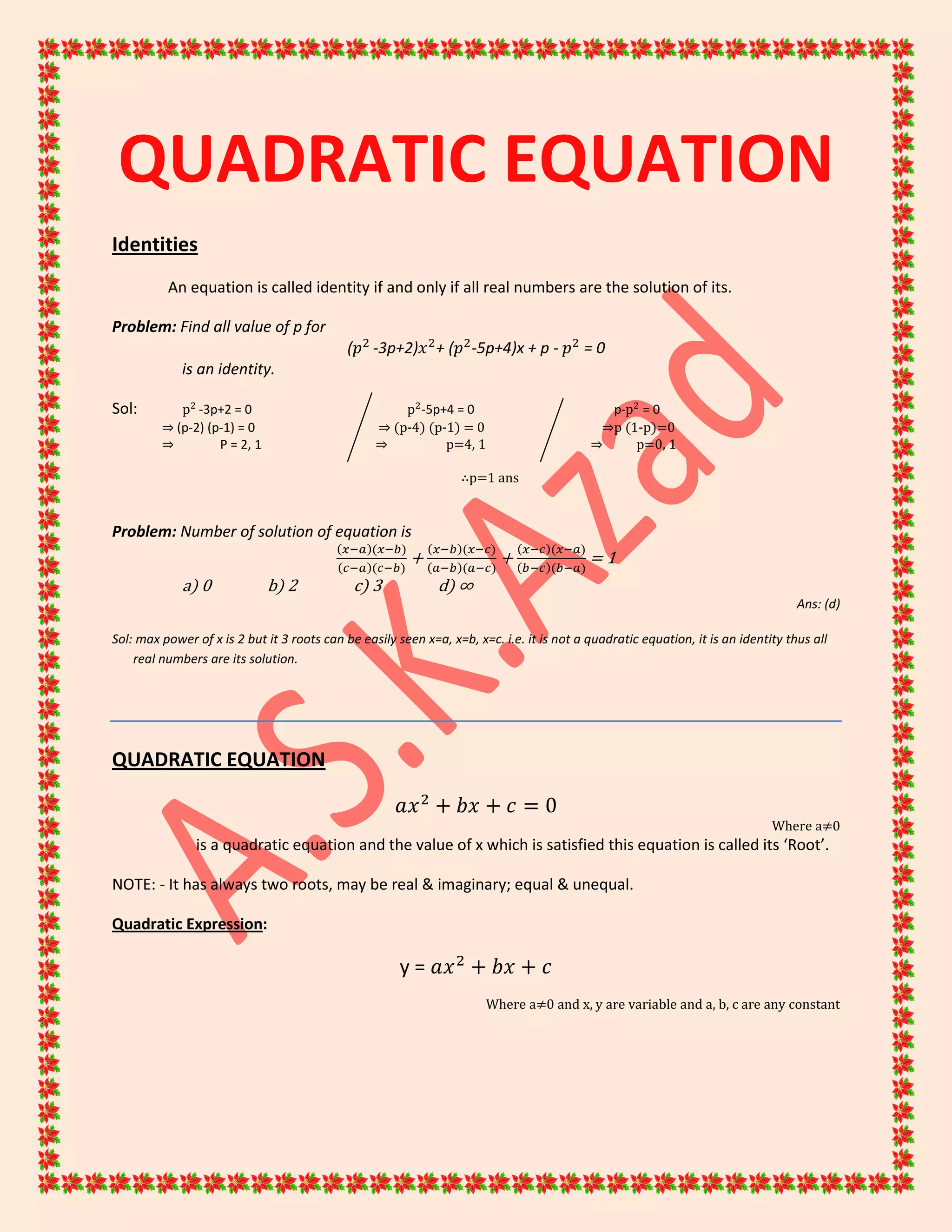
An equation is called identity if and only if all real numbers are the solution of its.
Problem: Find all value of p for
( -3p+2) + ( -5p+4)x + p - = 0
is an identity.
Sol: -3p+2 = 0 -5p+4 = 0 p- = 0
⇒ (p-2) (p-1) = 0 ⇒ (p-4) (p-1) = 0 ⇒p (1-p)=0
⇒ P = 2, 1 ⇒ p=4, 1 ⇒ p=0, 1
∴p=1 ans
Problem: Number of solution of equation is
+ + = 1
a) 0 b) 2 c) 3 d) ∞
Ans: (d)
Sol: max power of x is 2 but it 3 roots can be easily seen x=a, x=b, x=c. i.e. it is not a quadratic equation, it is an identity thus all
real numbers are its solution.
QUADRATIC EQUATION
Where a≠0
is a quadratic equation and the value of x which is satisfied this equation is called its ‘Root’.
NOTE: - It has always two roots, may be real & imaginary; equal & unequal.
Quadratic Expression:
y =
Where a≠0 and x, y are variable and a, b, c are any constant
Sridharacharya Method for finding root of quadratic equation
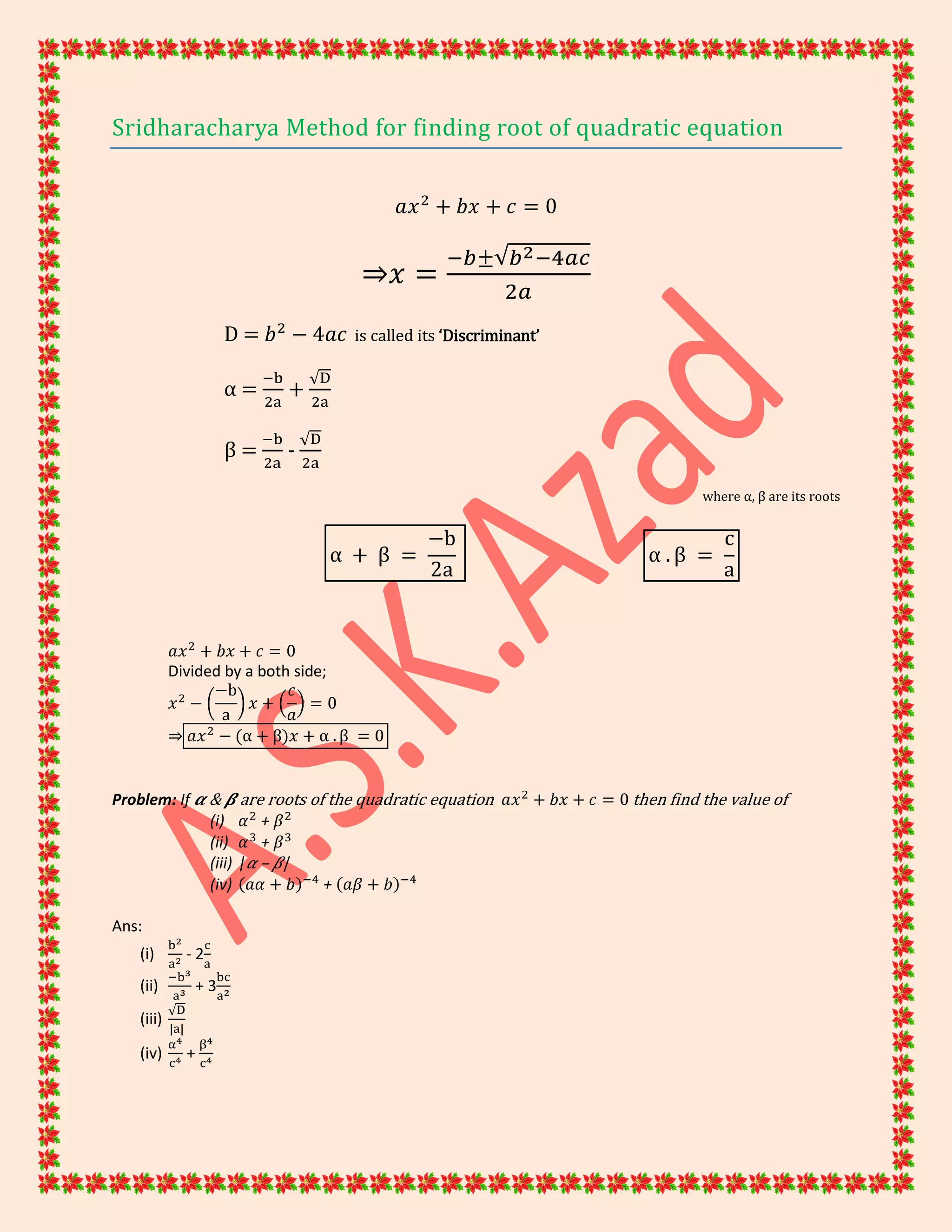
⇒
D = is called its ‘Discriminant’
Îą = +
β = -
where ι, β are its roots
Divided by a both side;
⇒
Problem: If & are roots of the quadratic equation then find the value of
(i) +
(ii) +
(iii) | – |
(iv) +
Ans:
(i) - 2
(ii) + 3
(iii)
(iv) +
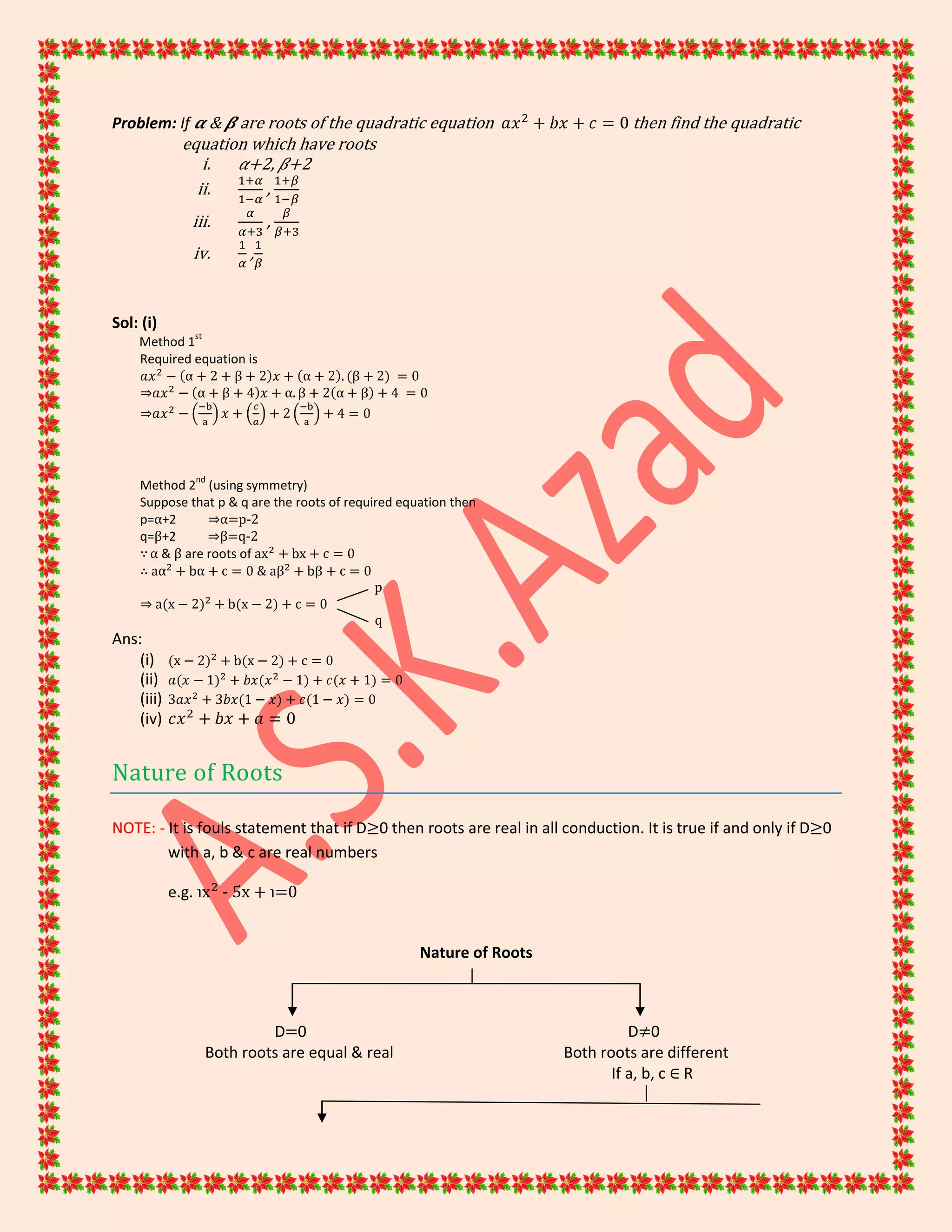
Problem: If & are roots of the quadratic equation then find the quadratic
equation which have roots
i. +2, +2
ii. ,
iii. ,
iv. ,
Sol: (i)
Method 1
st
Required equation is
⇒
⇒
Method 2
nd
(using symmetry)
Suppose that p & q are the roots of required equation then
p=α+2 ⇒α=p-2
q=β+2 ⇒β=q-2
∾ι & β are roots of
∴ &
p
⇒
q
Ans:
(i)
(ii)
(iii)
(iv)
Nature of Roots
NOTE: - It is fouls statement that if D≥0 then roots are real in all conduction. It is true if and only if D≥0
with a, b & c are real numbers
e.g. ℩ - 5x + ℩=0
Nature of Roots
D=0 D≠0
Both roots are equal & real Both roots are different
If a, b, c ∈ R
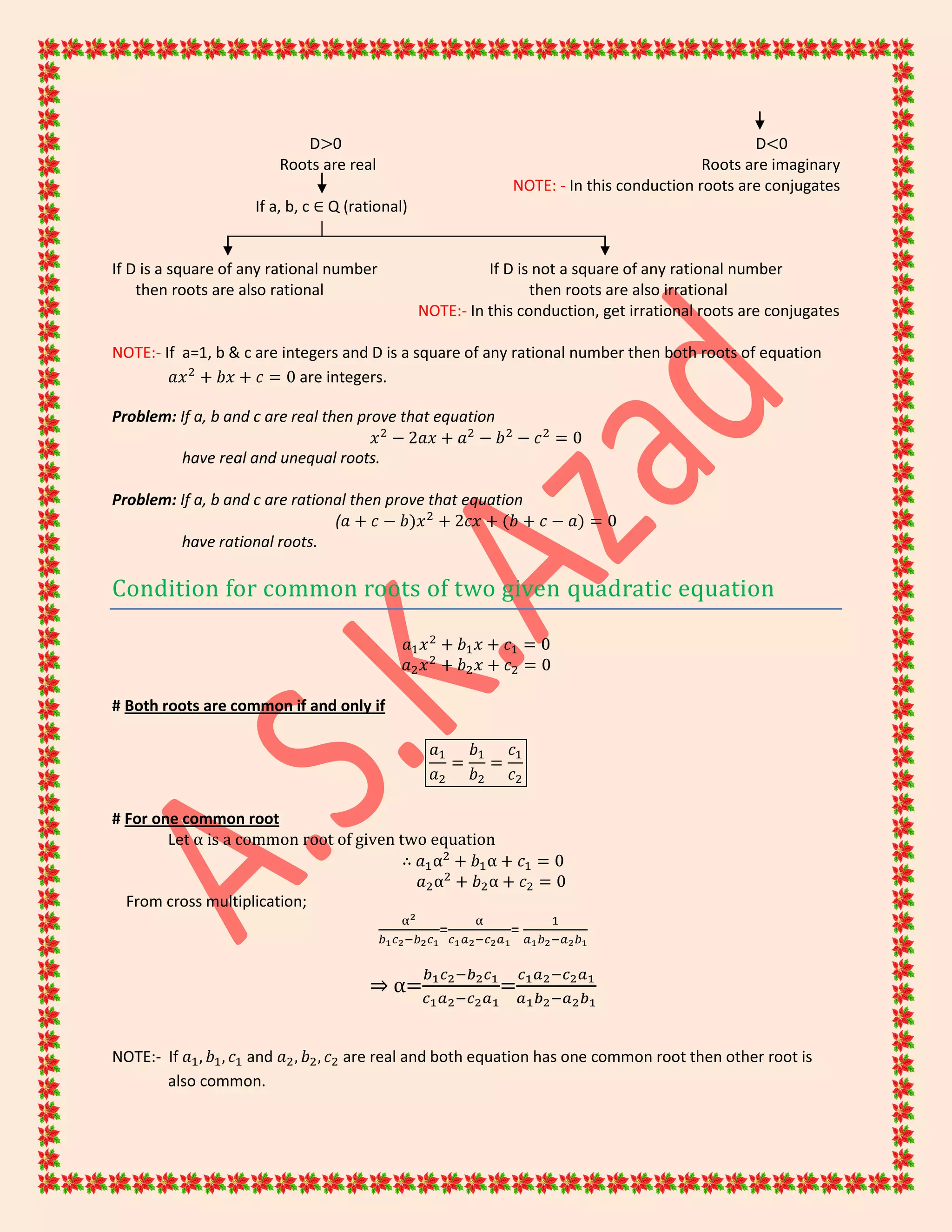
D>0 D<0
Roots are real Roots are imaginary
NOTE: - In this conduction roots are conjugates
If a, b, c ∈ Q (rational)
If D is a square of any rational number If D is not a square of any rational number
then roots are also rational then roots are also irrational
NOTE:- In this conduction, get irrational roots are conjugates
NOTE:- If a=1, b & c are integers and D is a square of any rational number then both roots of equation
are integers.
Problem: If a, b and c are real then prove that equation
have real and unequal roots.
Problem: If a, b and c are rational then prove that equation
(
have rational roots.
Condition for common roots of two given quadratic equation
# Both roots are common if and only if
# For one common root
Let Îą is a common root of given two equation
∴
From cross multiplication;
= =
⇒ α= =
NOTE:- If and are real and both equation has one common root then other root is
also common.
Problem: If and have a common root then find the value of k.
Ans: k=1
Problem:

Quadratic Eqution

  • 1.
    QUADRATIC EQUATION Identities An equationis called identity if and only if all real numbers are the solution of its. Problem: Find all value of p for ( -3p+2) + ( -5p+4)x + p - = 0 is an identity. Sol: -3p+2 = 0 -5p+4 = 0 p- = 0 ⇒ (p-2) (p-1) = 0 ⇒ (p-4) (p-1) = 0 ⇒p (1-p)=0 ⇒ P = 2, 1 ⇒ p=4, 1 ⇒ p=0, 1 ∴p=1 ans Problem: Number of solution of equation is + + = 1 a) 0 b) 2 c) 3 d) ∞ Ans: (d) Sol: max power of x is 2 but it 3 roots can be easily seen x=a, x=b, x=c. i.e. it is not a quadratic equation, it is an identity thus all real numbers are its solution. QUADRATIC EQUATION Where a≠0 is a quadratic equation and the value of x which is satisfied this equation is called its ‘Root’. NOTE: - It has always two roots, may be real & imaginary; equal & unequal. Quadratic Expression: y = Where a≠0 and x, y are variable and a, b, c are any constant
  • 2.
    Sridharacharya Method forfinding root of quadratic equation ⇒ D = is called its ‘Discriminant’ α = + β = - where α, β are its roots Divided by a both side; ⇒ Problem: If & are roots of the quadratic equation then find the value of (i) + (ii) + (iii) | – | (iv) + Ans: (i) - 2 (ii) + 3 (iii) (iv) +
  • 3.
    Problem: If &are roots of the quadratic equation then find the quadratic equation which have roots i. +2, +2 ii. , iii. , iv. , Sol: (i) Method 1 st Required equation is ⇒ ⇒ Method 2 nd (using symmetry) Suppose that p & q are the roots of required equation then p=α+2 ⇒α=p-2 q=β+2 ⇒β=q-2 ∵α & β are roots of ∴ & p ⇒ q Ans: (i) (ii) (iii) (iv) Nature of Roots NOTE: - It is fouls statement that if D≥0 then roots are real in all conduction. It is true if and only if D≥0 with a, b & c are real numbers e.g. ℩ - 5x + ℩=0 Nature of Roots D=0 D≠0 Both roots are equal & real Both roots are different If a, b, c ∈ R
  • 4.
    D>0 D<0 Roots arereal Roots are imaginary NOTE: - In this conduction roots are conjugates If a, b, c ∈ Q (rational) If D is a square of any rational number If D is not a square of any rational number then roots are also rational then roots are also irrational NOTE:- In this conduction, get irrational roots are conjugates NOTE:- If a=1, b & c are integers and D is a square of any rational number then both roots of equation are integers. Problem: If a, b and c are real then prove that equation have real and unequal roots. Problem: If a, b and c are rational then prove that equation ( have rational roots. Condition for common roots of two given quadratic equation # Both roots are common if and only if # For one common root Let α is a common root of given two equation ∴ From cross multiplication; = = ⇒ α= = NOTE:- If and are real and both equation has one common root then other root is also common.
  • 5.
    Problem: If andhave a common root then find the value of k. Ans: k=1 Problem: