QUADRATIC 
EQUATIONS 
MSJC ~ San Jacinto Campus 
Math Center Workshop Series 
Janice Levasseur
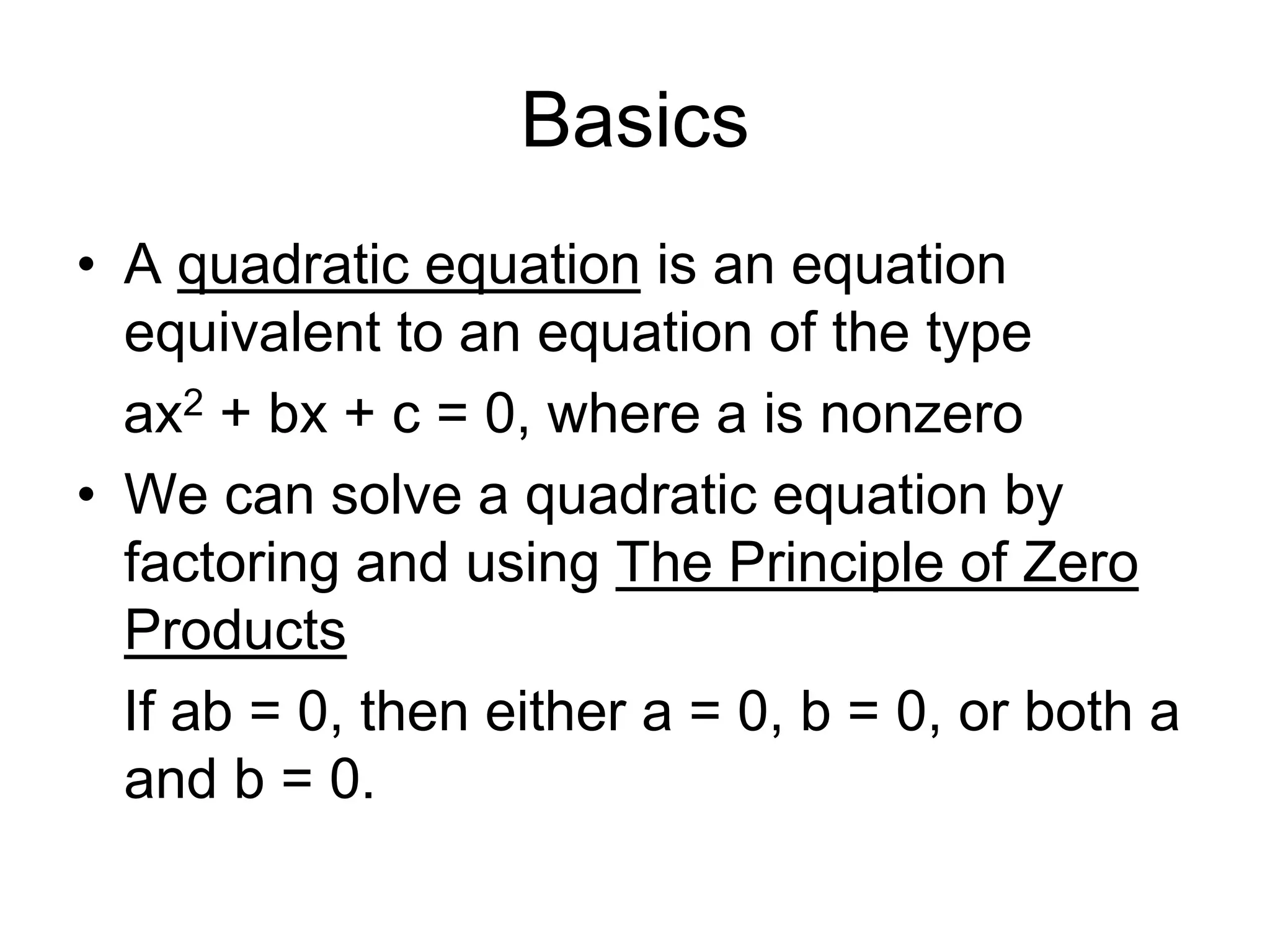
Basics 
• A quadratic equation is an equation 
equivalent to an equation of the type 
ax2 + bx + c = 0, where a is nonzero 
• We can solve a quadratic equation by 
factoring and using The Principle of Zero 
Products 
If ab = 0, then either a = 0, b = 0, or both a 
and b = 0.
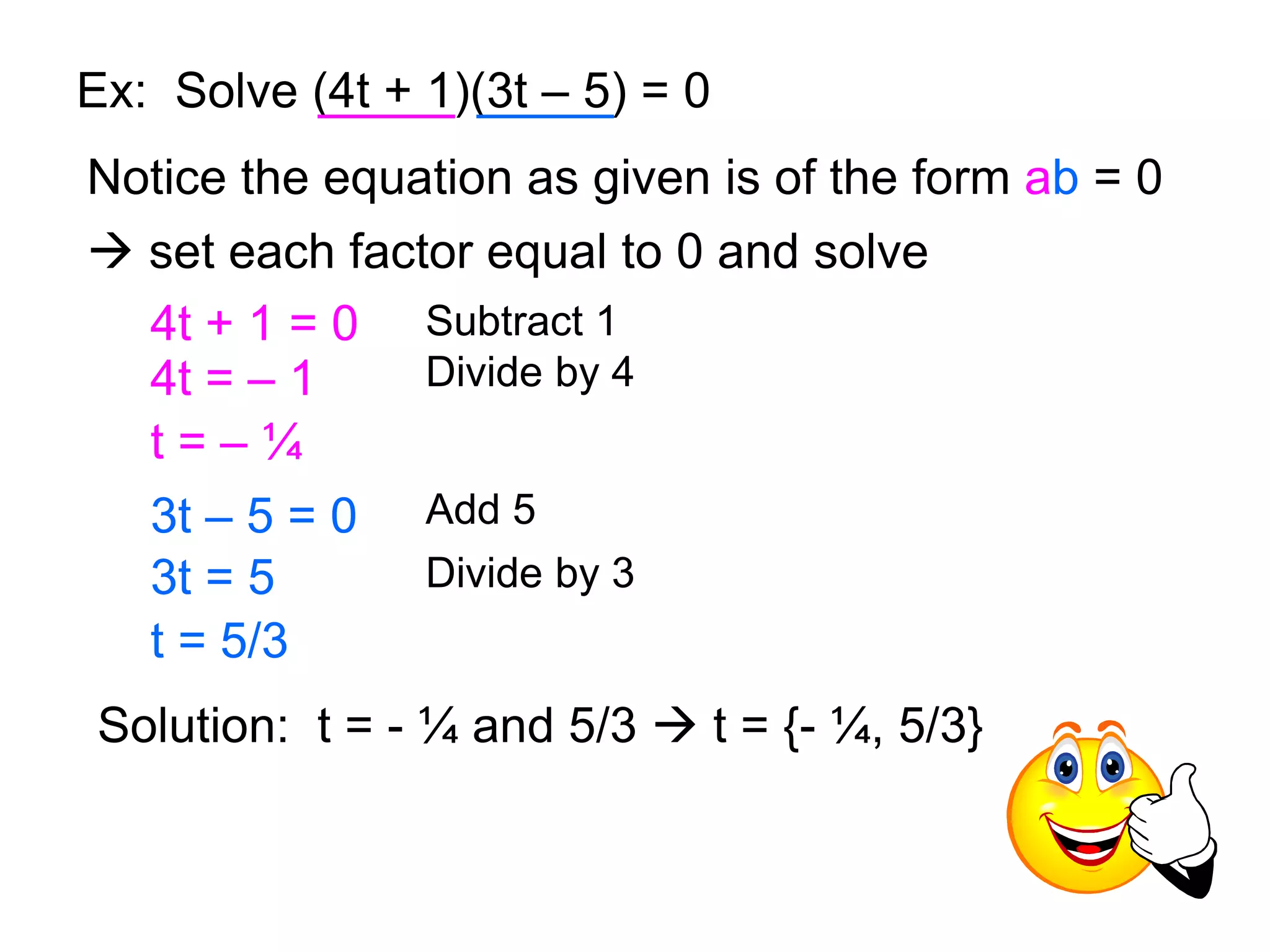
Ex: Solve (4t + 1)(3t – 5) = 0 
Notice the equation as given is of the form ab = 0 
 set each factor equal to 0 and solve 
4t + 1 = 0 Subtract 1 
4t = – 1 Divide by 4 
t = – ¼ 
3t – 5 = 0 Add 5 
3t = 5 Divide by 3 
t = 5/3 
Solution: t = - ¼ and 5/3  t = {- ¼, 5/3}
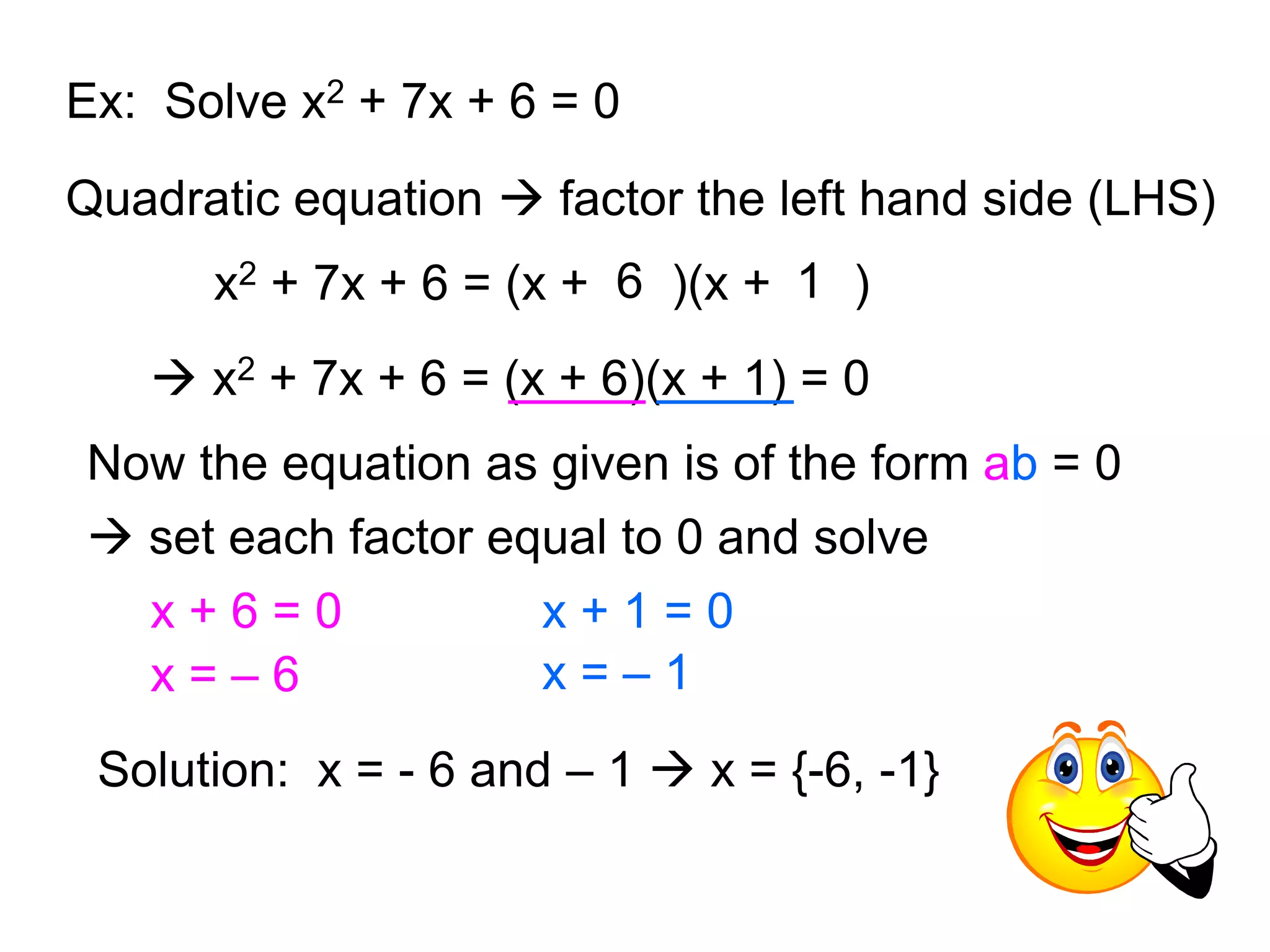
Ex: Solve x2 + 7x + 6 = 0 
Quadratic equation  factor the left hand side (LHS) 
x2 + 7x + 6 = (x + 6 )(x + 1 ) 
 x2 + 7x + 6 = (x + 6)(x + 1) = 0 
Now the equation as given is of the form ab = 0 
 set each factor equal to 0 and solve 
x + 6 = 0 
x = – 6 
x + 1 = 0 
x = – 1 
Solution: x = - 6 and – 1  x = {-6, -1}
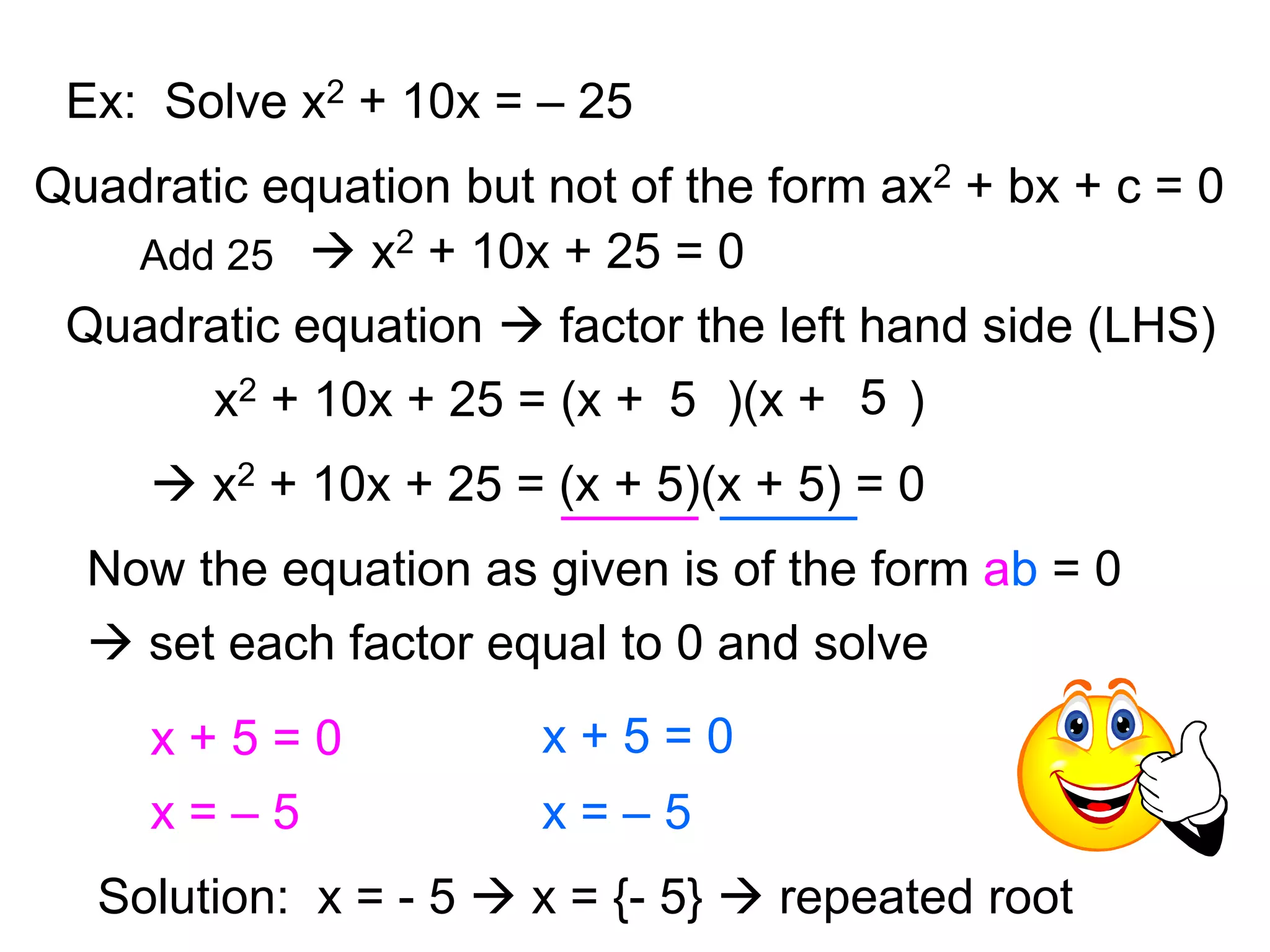
Ex: Solve x2 + 10x = – 25 
Quadratic equation but not of the form ax2 + bx + c = 0 
Add 25  x2 + 10x + 25 = 0 
Quadratic equation  factor the left hand side (LHS) 
x2 + 10x + 25 = (x + 5 )(x + 5 ) 
 x2 + 10x + 25 = (x + 5)(x + 5) = 0 
Now the equation as given is of the form ab = 0 
 set each factor equal to 0 and solve 
x + 5 = 0 
x = – 5 
x + 5 = 0 
x = – 5 
Solution: x = - 5  x = {- 5}  repeated root
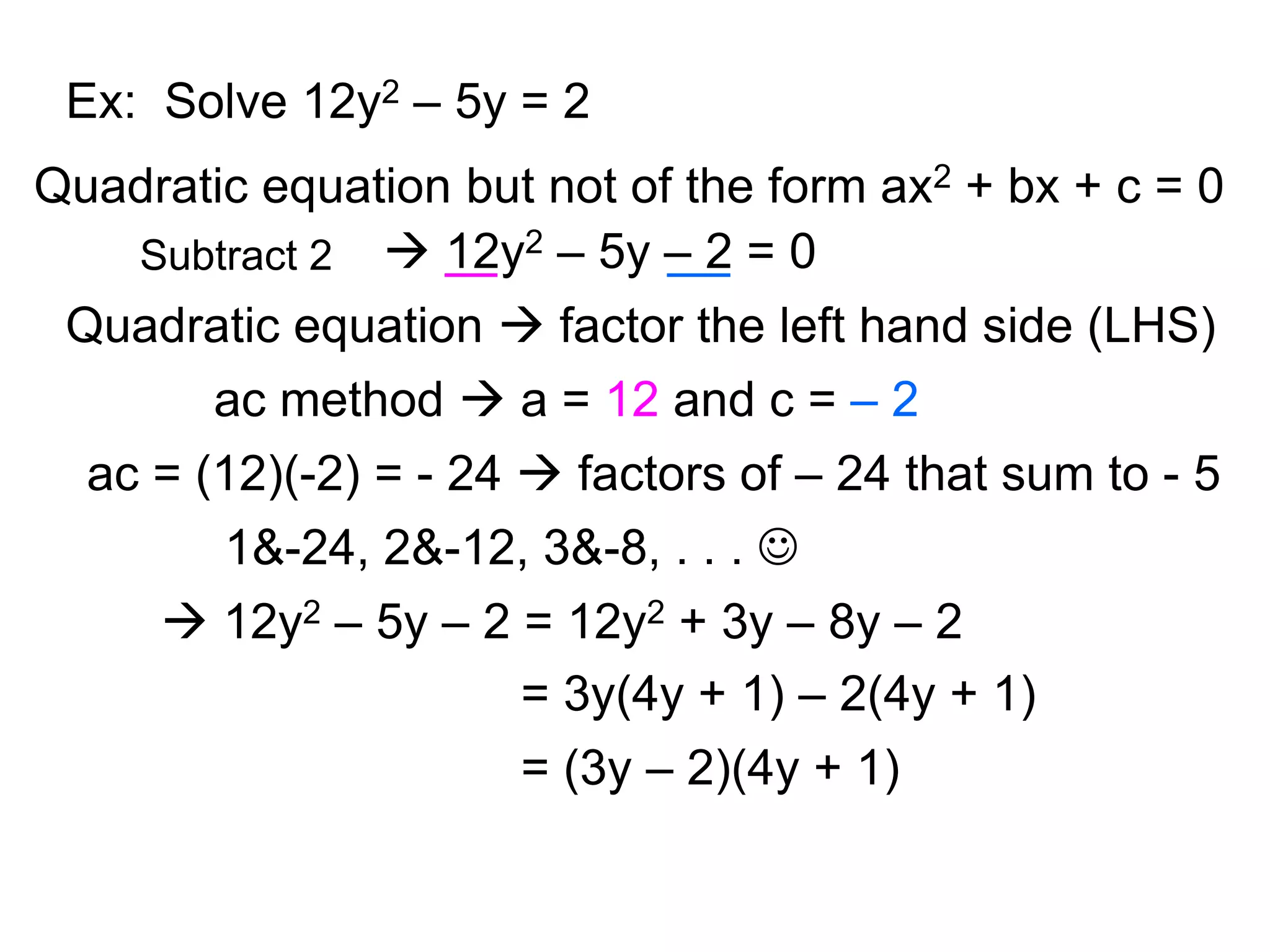
Ex: Solve 12y2 – 5y = 2 
Quadratic equation but not of the form ax2 + bx + c = 0 
Subtract 2  12y2 – 5y – 2 = 0 
Quadratic equation  factor the left hand side (LHS) 
ac method  a = 12 and c = – 2 
ac = (12)(-2) = - 24  factors of – 24 that sum to - 5 
1&-24, 2&-12, 3&-8, . . .  
 12y2 – 5y – 2 = 12y2 + 3y – 8y – 2 
= 3y(4y + 1) – 2(4y + 1) 
= (3y – 2)(4y + 1)
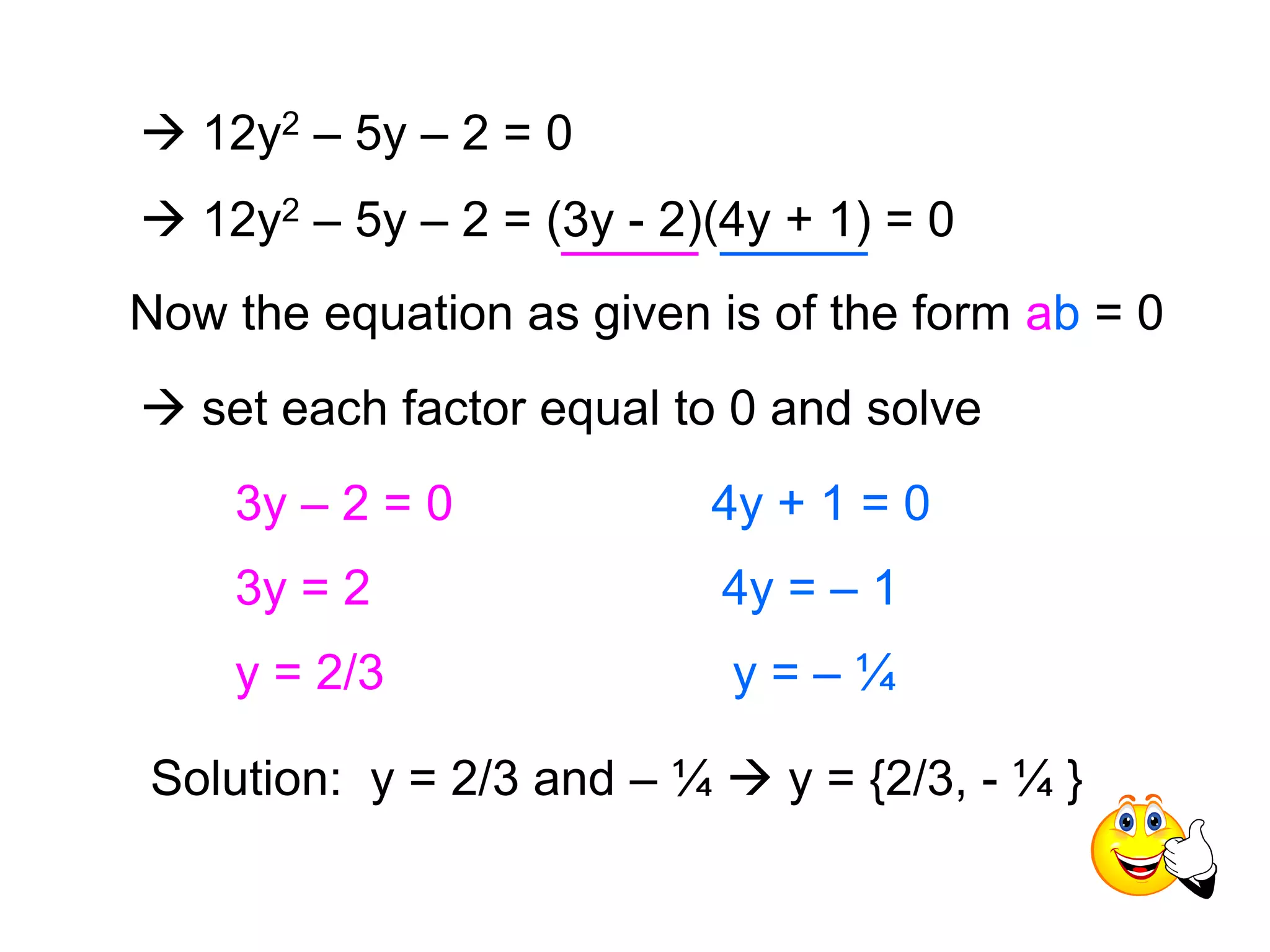
 12y2 – 5y – 2 = 0 
 12y2 – 5y – 2 = (3y - 2)(4y + 1) = 0 
Now the equation as given is of the form ab = 0 
 set each factor equal to 0 and solve 
3y – 2 = 0 
3y = 2 
4y + 1 = 0 
4y = – 1 
y = 2/3 y = – ¼ 
Solution: y = 2/3 and – ¼  y = {2/3, - ¼ }
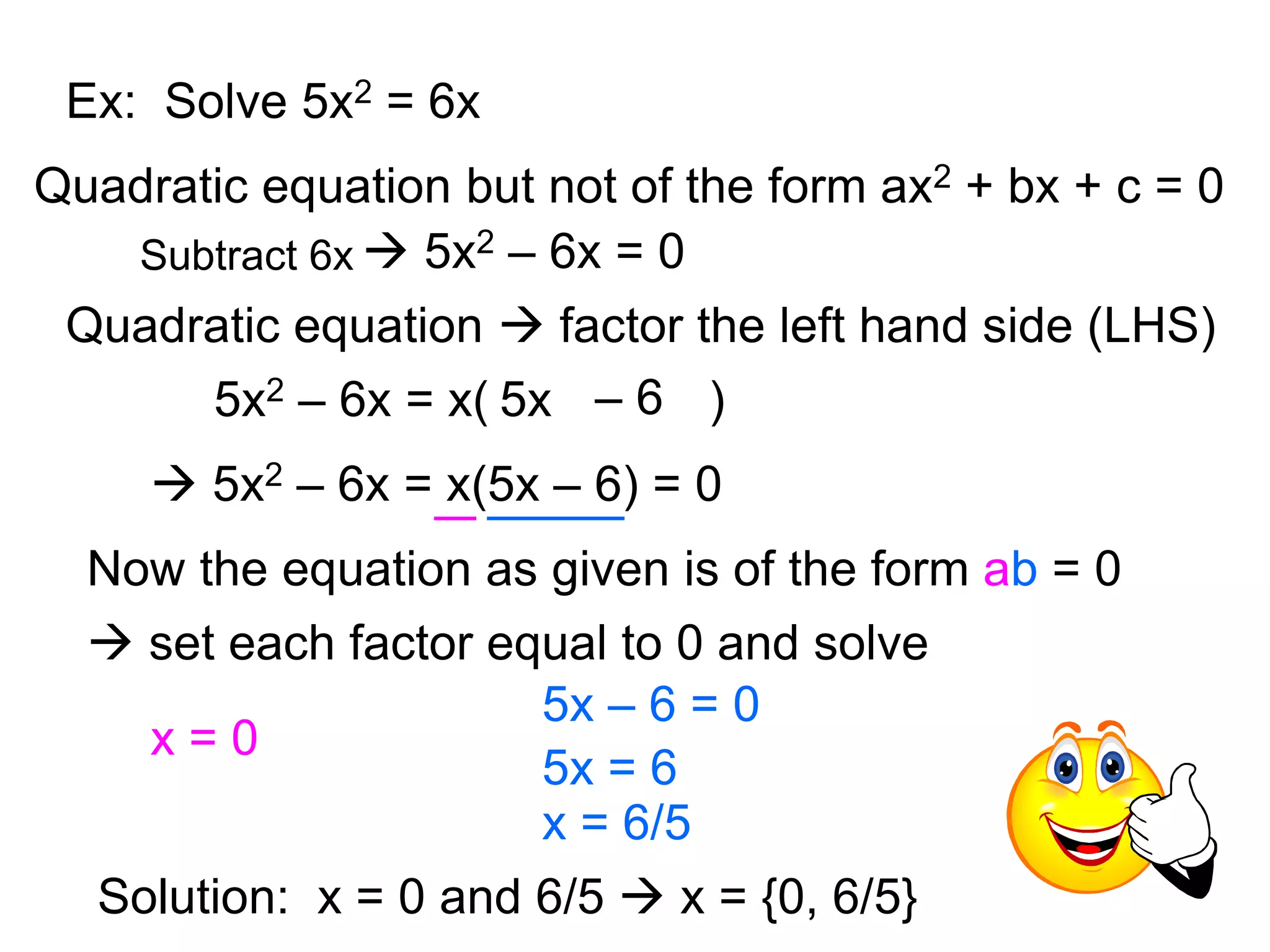
Ex: Solve 5x2 = 6x 
Quadratic equation but not of the form ax2 + bx + c = 0 
Subtract 6x  5x2 – 6x = 0 
Quadratic equation  factor the left hand side (LHS) 
5x2 – 6x = x( 5 x – 6 ) 
 5x2 – 6x = x(5x – 6) = 0 
Now the equation as given is of the form ab = 0 
 set each factor equal to 0 and solve 
x = 0 
5x – 6 = 0 
5x = 6 
x = 6/5 
Solution: x = 0 and 6/5  x = {0, 6/5}
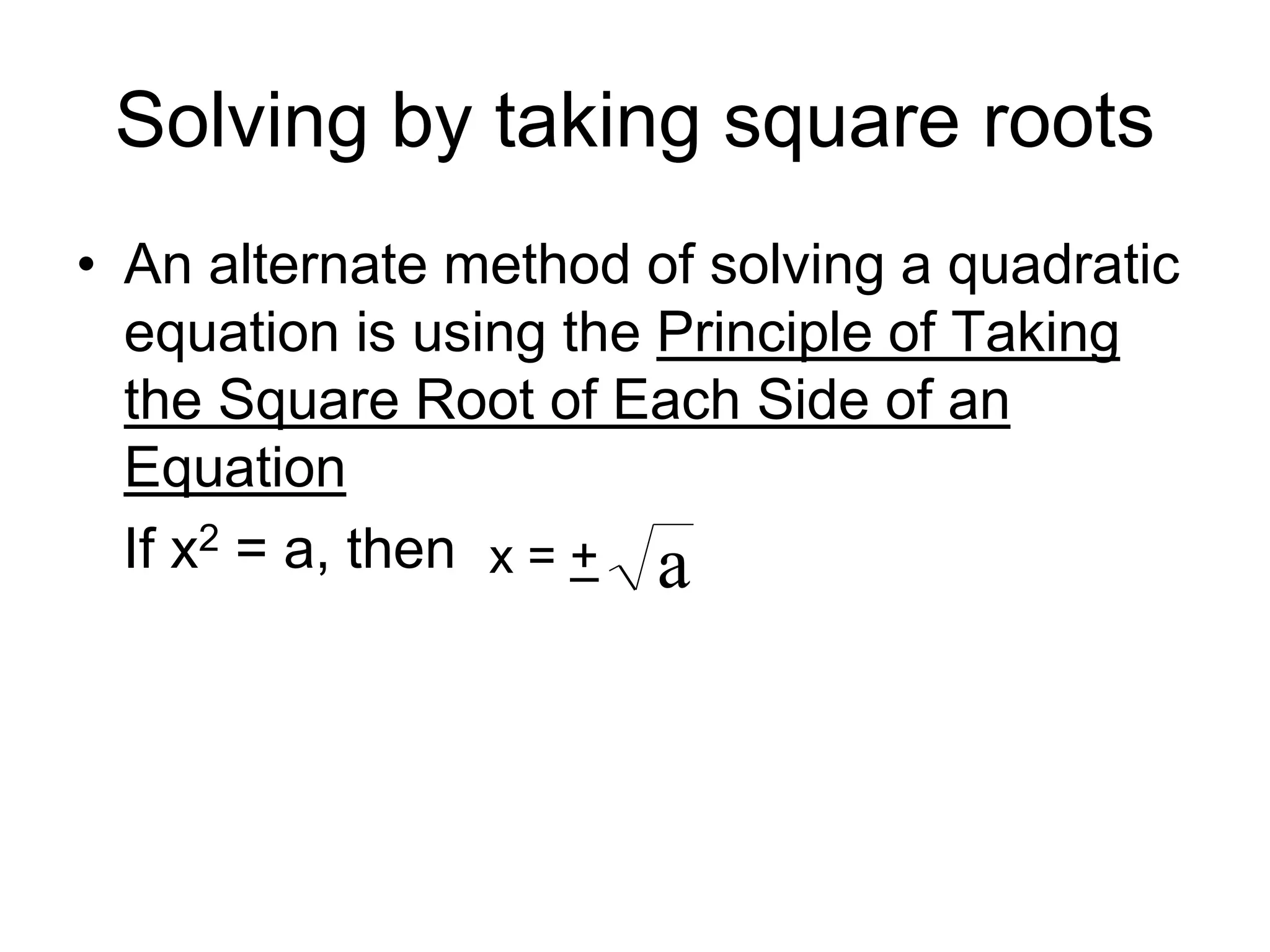
Solving by taking square roots 
• An alternate method of solving a quadratic 
equation is using the Principle of Taking 
the Square Root of Each Side of an 
Equation 
If x2 = a, then x = + a
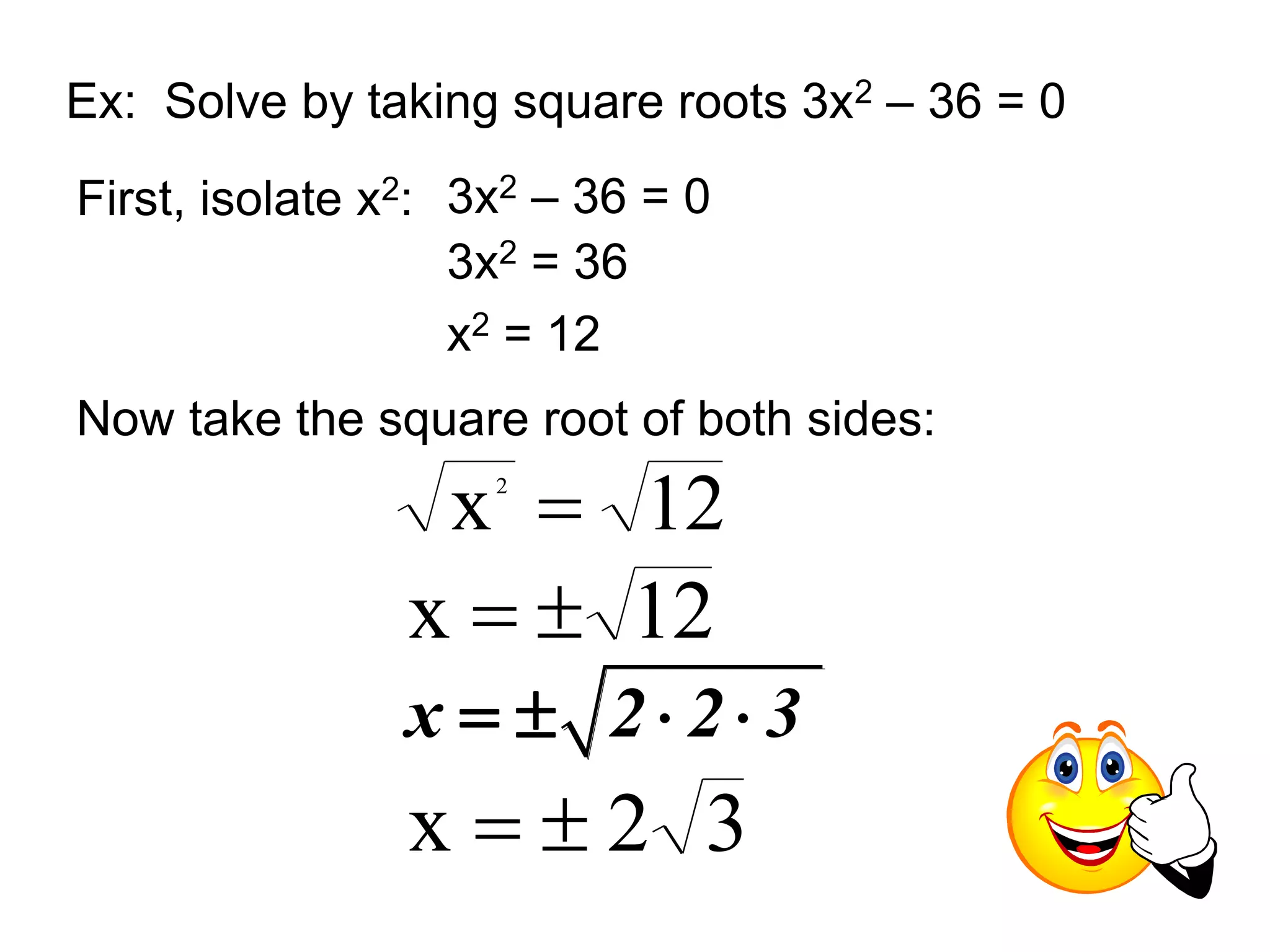
Ex: Solve by taking square roots 3x2 – 36 = 0 
First, isolate x2: 3x2 – 36 = 0 
3x2 = 36 
x2 = 12 
Now take the square root of both sides: 
x 12 2  
x   12 
x   2  2  3 
x   2 3
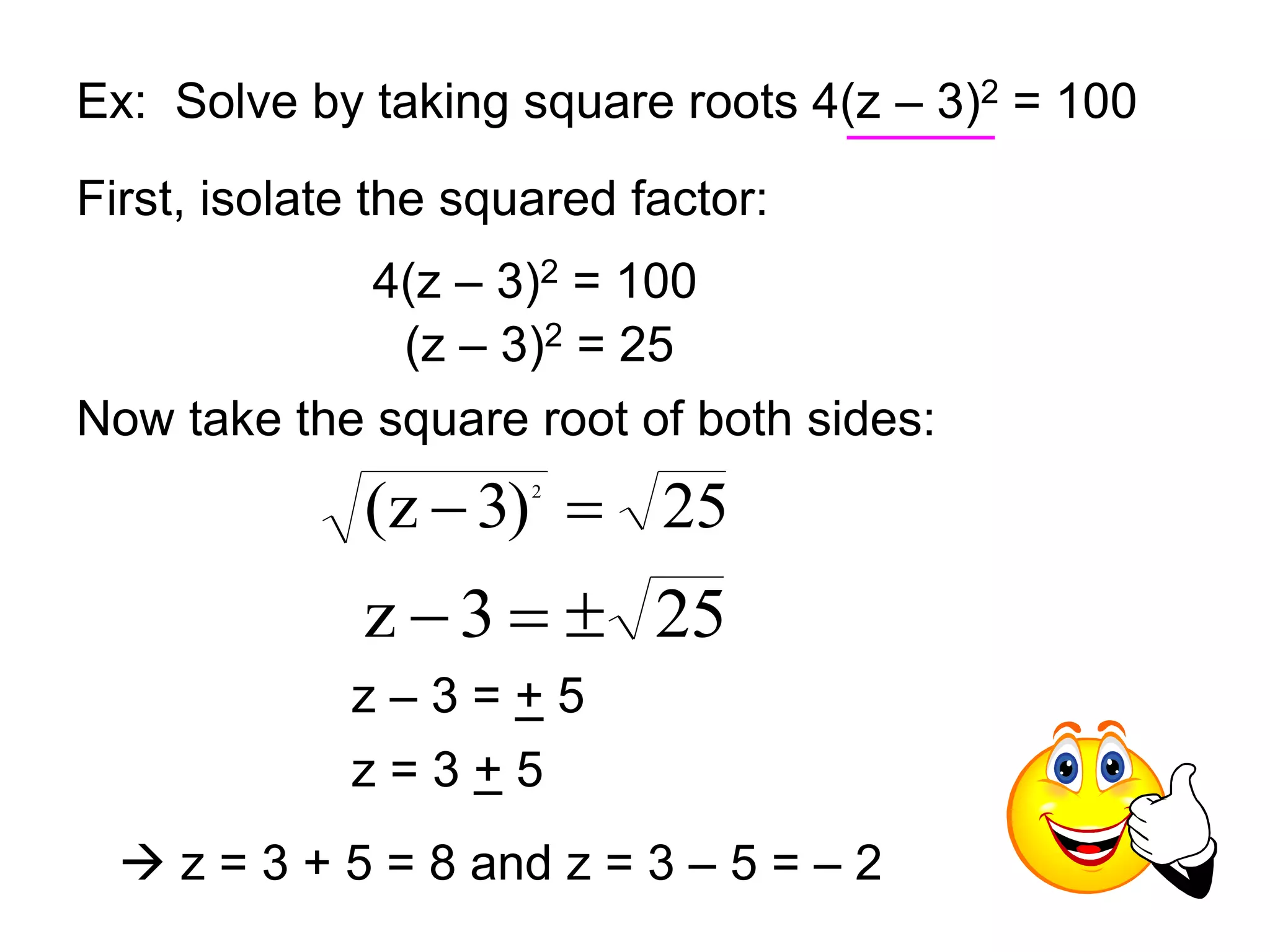
Ex: Solve by taking square roots 4(z – 3)2 = 100 
First, isolate the squared factor: 
4(z – 3)2 = 100 
(z – 3)2 = 25 
Now take the square root of both sides: 
(z 3) 25 2   
z  3   25 
z – 3 = + 5 
z = 3 + 5 
 z = 3 + 5 = 8 and z = 3 – 5 = – 2
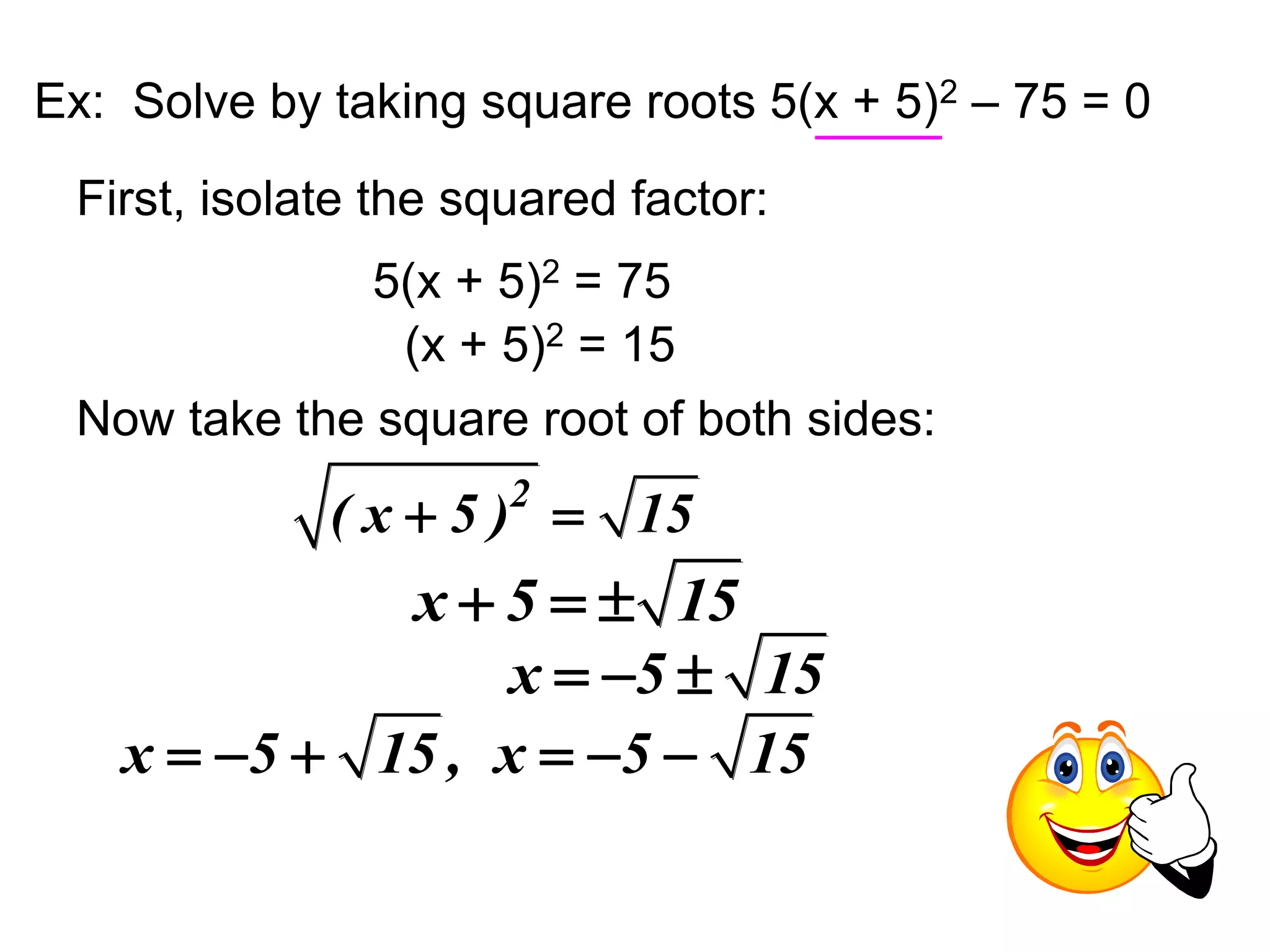
Ex: Solve by taking square roots 5(x + 5)2 – 75 = 0 
First, isolate the squared factor: 
5(x + 5)2 = 75 
(x + 5)2 = 15 
Now take the square root of both sides: 
( x  5 )2  15 
x  5   15 
x  5  15 
x  5  15 , x  5  15
Completing the Square 
• Recall from factoring that a Perfect-Square 
Trinomial is the square of a binomial: 
Perfect square Trinomial Binomial Square 
x2 + 8x + 16 (x + 4)2 
x2 – 6x + 9 (x – 3)2 
• The square of half of the coefficient of x 
equals the constant term: 
( ½ * 8 )2 = 16 
[½ (-6)]2 = 9
Completing the Square 
• Write the equation in the form x2 + bx = c 
• Add to each side of the equation [½(b)]2 
• Factor the perfect-square trinomial 
x2 + bx + [½(b)] 2 = c + [½(b)]2 
• Take the square root of both sides of the 
equation 
• Solve for x
Ex: Solve w2 + 6w + 4 = 0 by completing the square 
First, rewrite the equation with the constant on one 
side of the equals and a lead coefficient of 1. 
w2 + 6 
6w = – 4 
Add [½(b)]2 to both sides: b = 
6  [½(6)]2 = 32 = 9 
w2 + 6w + 9 = – 4 + 9 
w2 + 6w + 9 = 5 
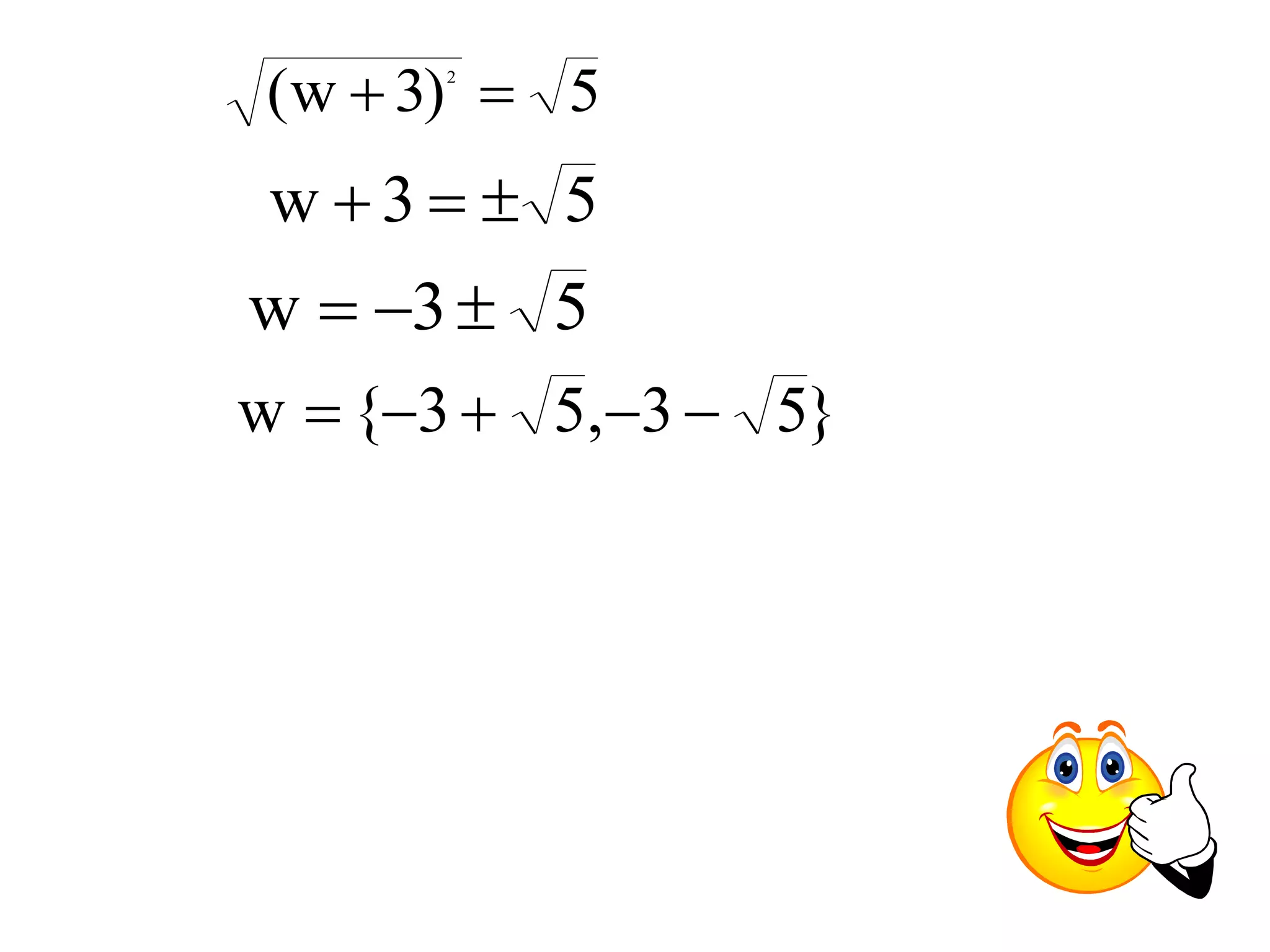
(w + 3)2 = 5 
Now take the square root of both sides
5 ) 3 w ( 2   
w  3   5 
w  3 5 
w  {3  5,3  5}
Ex: Solve 2r2 = 3 – 5r by completing the square 
First, rewrite the equation with the constant on one 
side of the equals and a lead coefficient of 1. 
2r2 + 5r = 3 
 r2 + (5/2) 
r = (3/2) 
Add [½(b)]2 to both sides: b = 
5/2 [½(5/2)]2 = (5/4)2 
= 25/16 
r2 + (5/2)r + 25/16 = (3/2) + 25/16 
r2 + (5/2)r + 25/16 = 24/16 + 25/16 
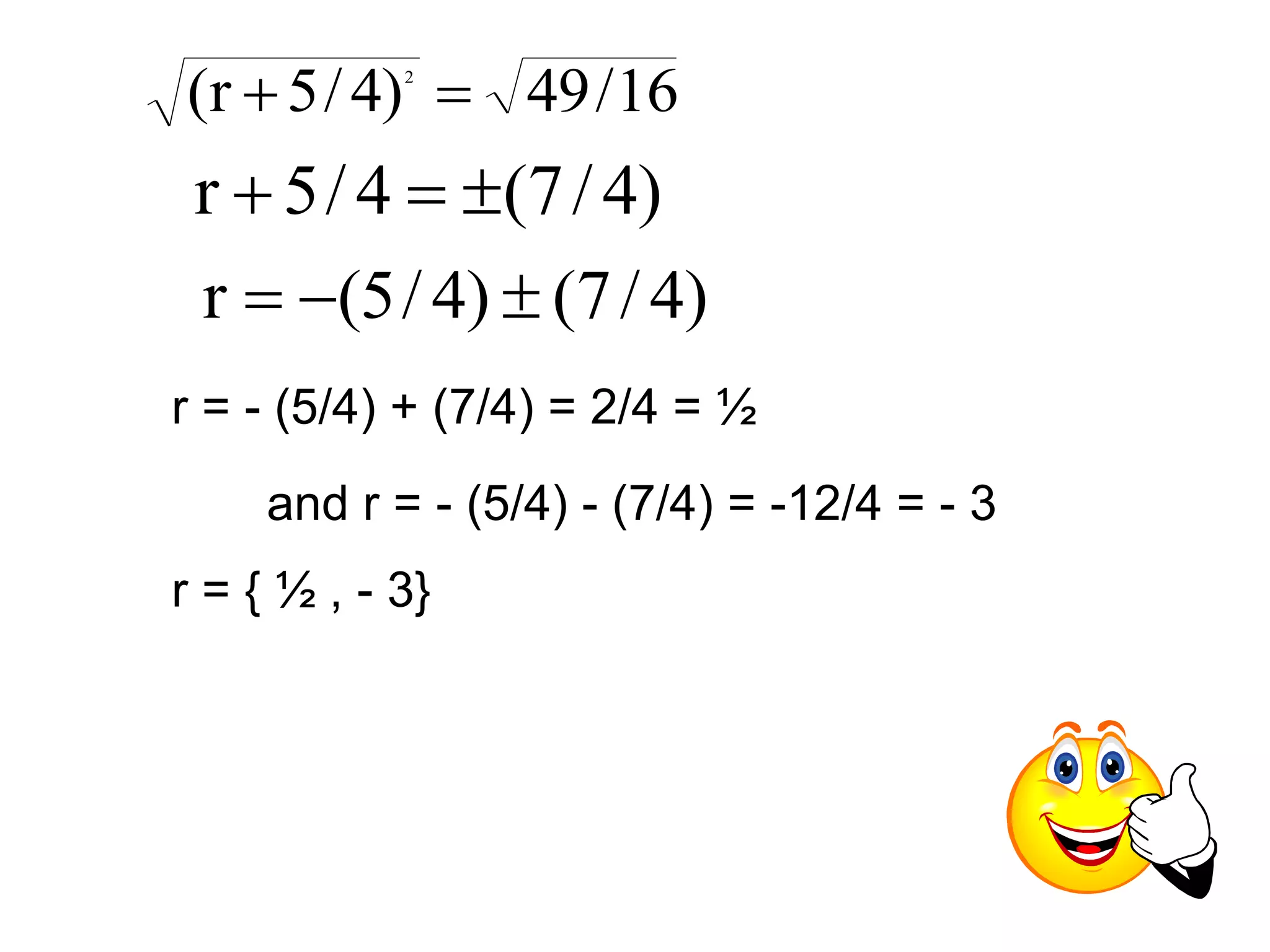
(r + 5/4)2 = 49/16 
Now take the square root of both sides
(r 5/ 4) 49/16 2   
r  5/ 4  (7/ 4) 
r  (5/ 4)  (7/ 4) 
r = - (5/4) + (7/4) = 2/4 = ½ 
and r = - (5/4) - (7/4) = -12/4 = - 3 
r = { ½ , - 3}
Ex: Solve 3p – 5 = (p – 1)(p – 2) 
Is this a quadratic equation? FOIL the RHS 
3p – 5 = p2 – 2p – p + 2 
3p – 5 = p2 – 3p + 2 
p2 – 6p + 7 = 0 
Collect all terms 
A-ha . . . 
Quadratic Equation  complete the square 
p2 – 6p = – 7  [½(-6)]2 = (-3)2 = 9 
p2 – 6p + 9 = – 7 + 9 
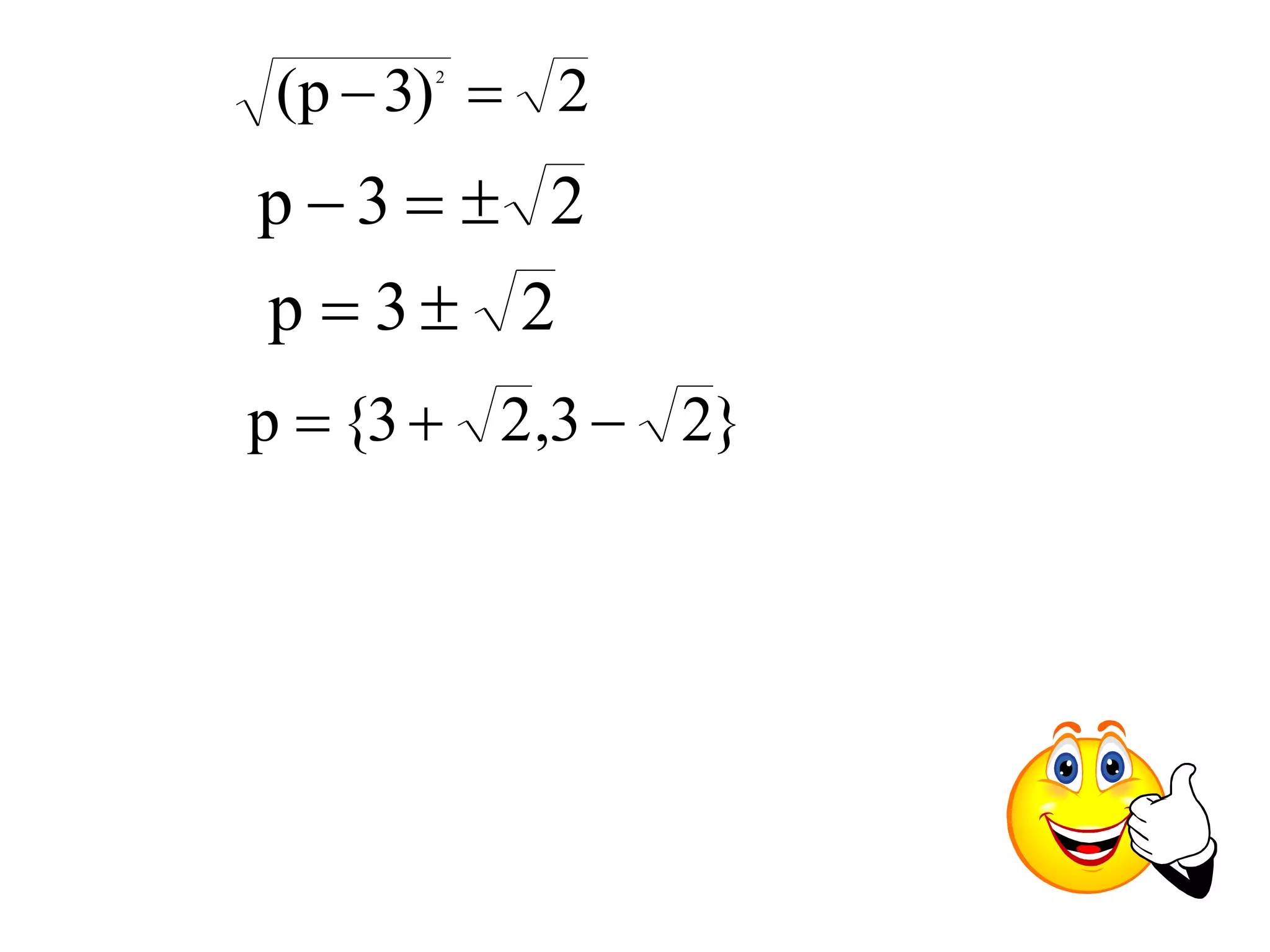
(p – 3)2 = 2
2 ) 3 p( 2   
p  3   2 
p  3  2 
p  {3  2,3  2}
The Quadratic Formula 
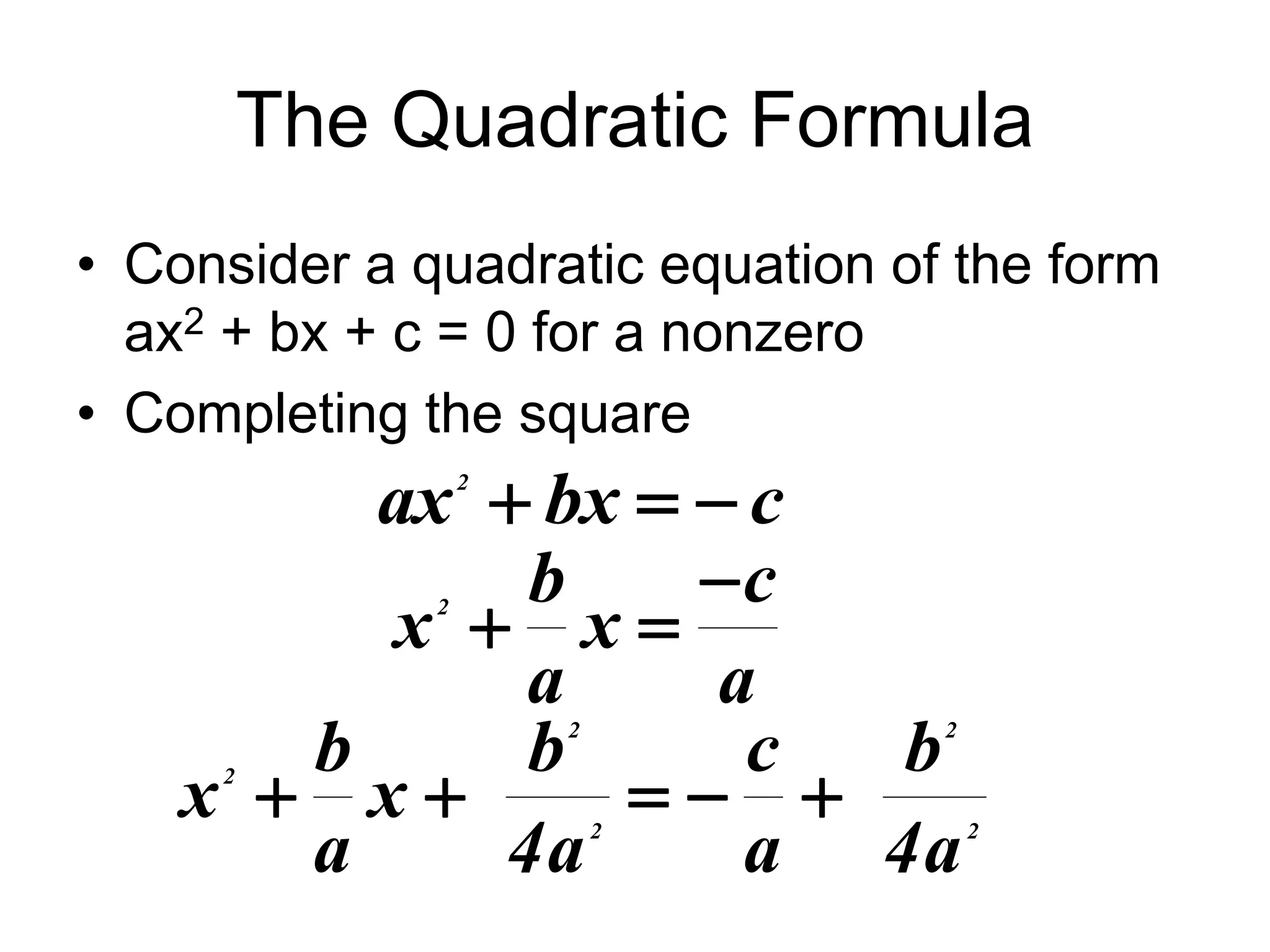
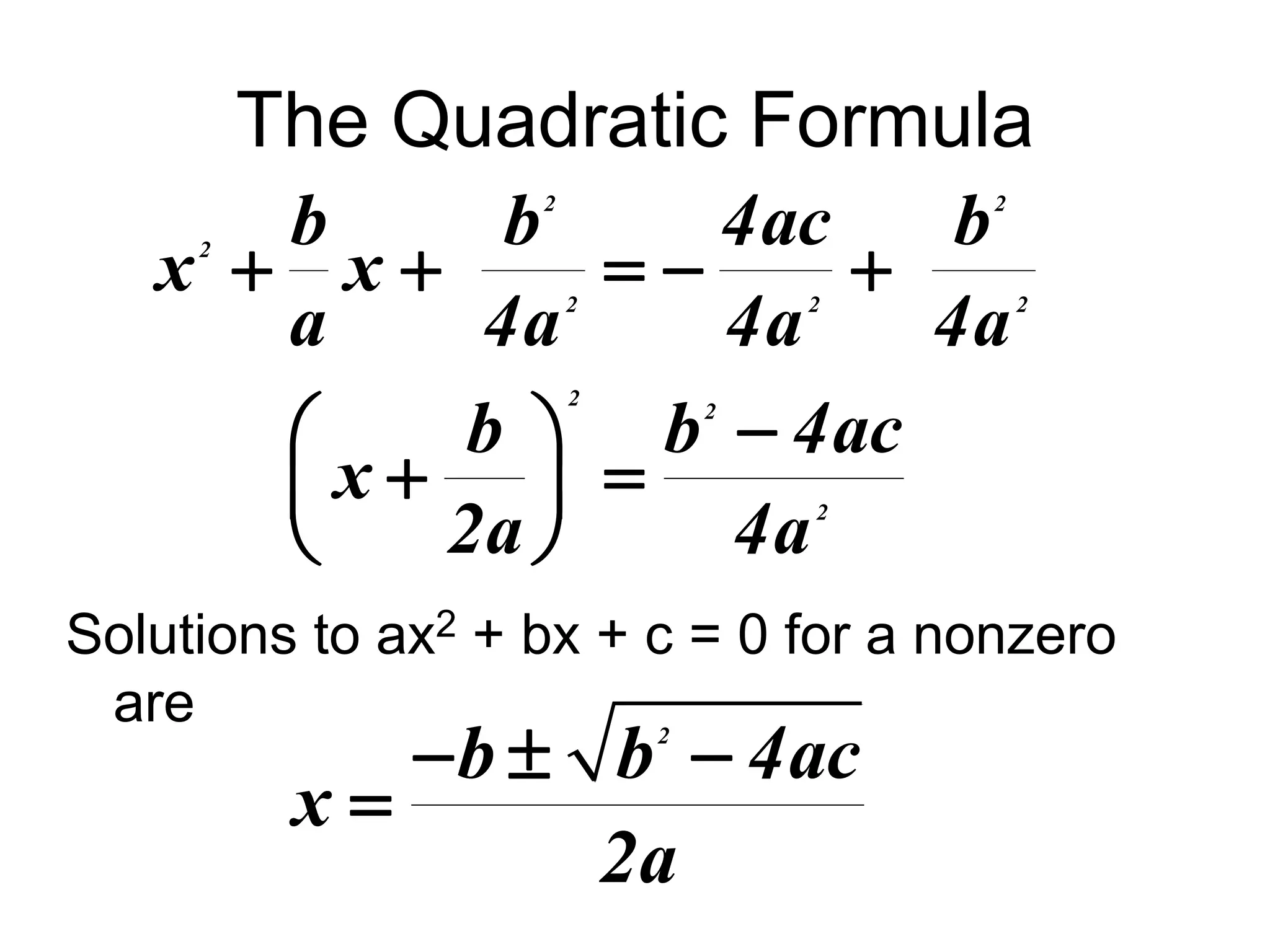
• Consider a quadratic equation of the form 
ax2 + bx + c = 0 for a nonzero 
• Completing the square 
ax2  bx   c 
 
b c 
x 2  x 
 
a a 
b b c b 
2 2 
2 
     
2 2 
x x 
a 4a a 4a
The Quadratic Formula 
b b 4ac b 
2 2 
     
2 
   
    
  
b b 2 
4ac 
2 
x 
2a 4a 
Solutions to ax2 + bx + c = 0 for a nonzero 
are 
   
 
2 b b 4ac 
x 
2a 
2 
2 2 2 
x x 
a 4a 4a 4a
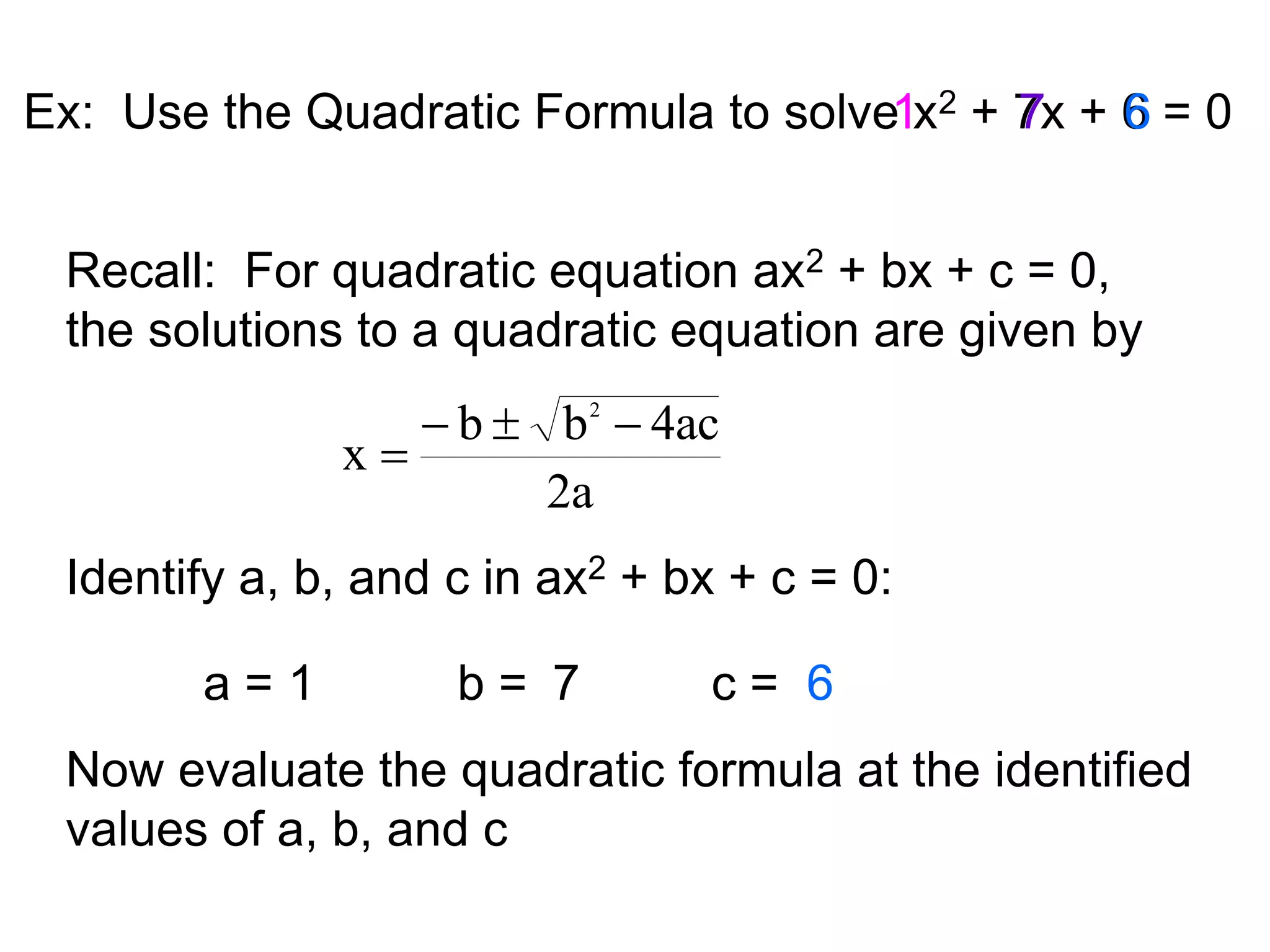
Ex: Use the Quadratic Formula to solve x2 + 7x + 6 
= 0 
Recall: For quadratic equation ax2 + bx + c = 0, 
the solutions to a quadratic equation are given by 
b b 4ac 
2a 
x 
2    
 
Identify a, b, and c in ax2 + bx + c = 0: 
a = 1 b = c = 
1 
7 
7 
6 
Now evaluate the quadratic formula at the identified 
values of a, b, and c
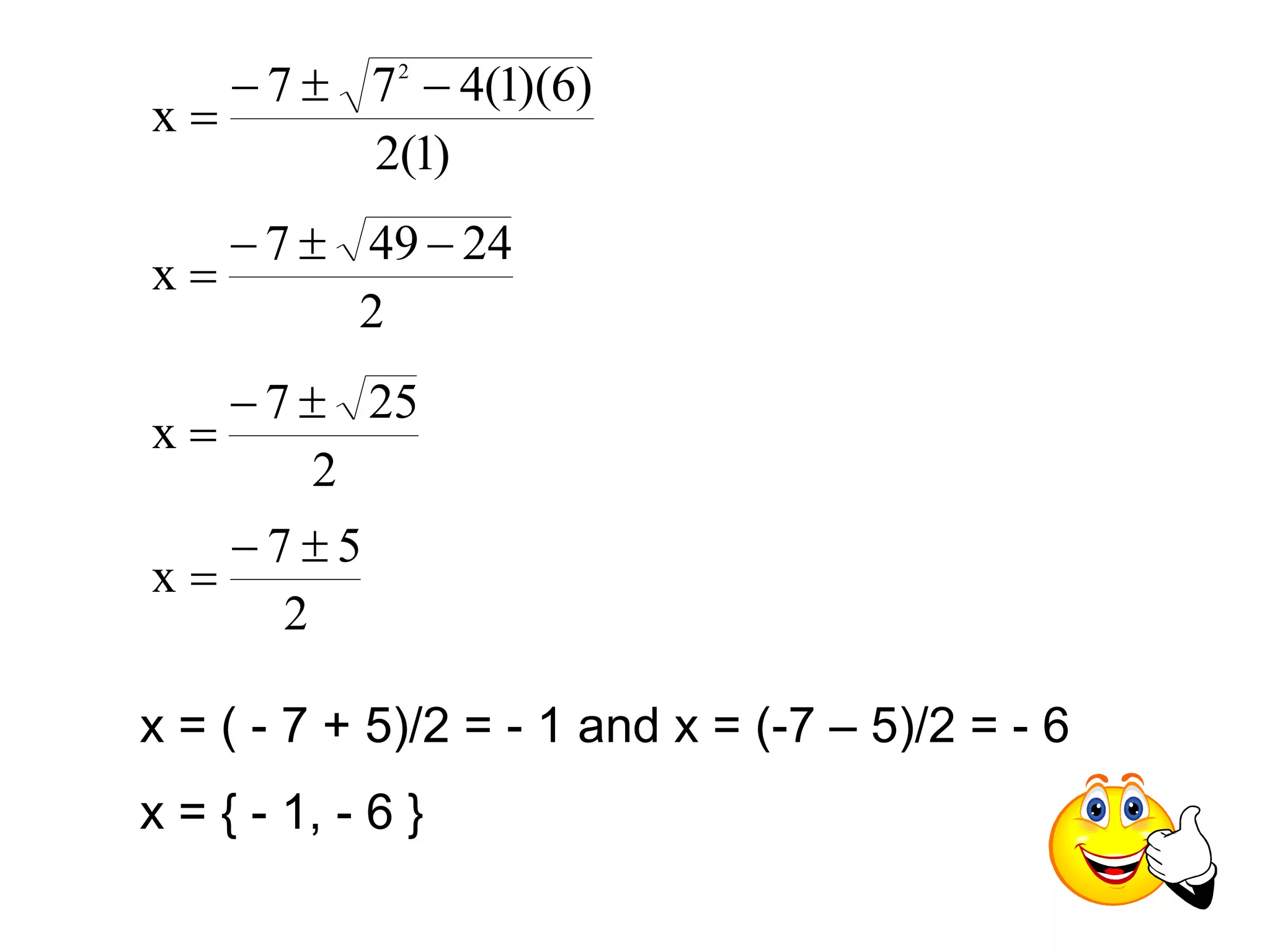
7 7 4(1)(6) 
2(1) 
x 
2    
 
7 49 24 
2 
x 
   
 
7 25 
2 
x 
  
 
7 5 
2 
x 
  
 
x = ( - 7 + 5)/2 = - 1 and x = (-7 – 5)/2 = - 6 
x = { - 1, - 6 }
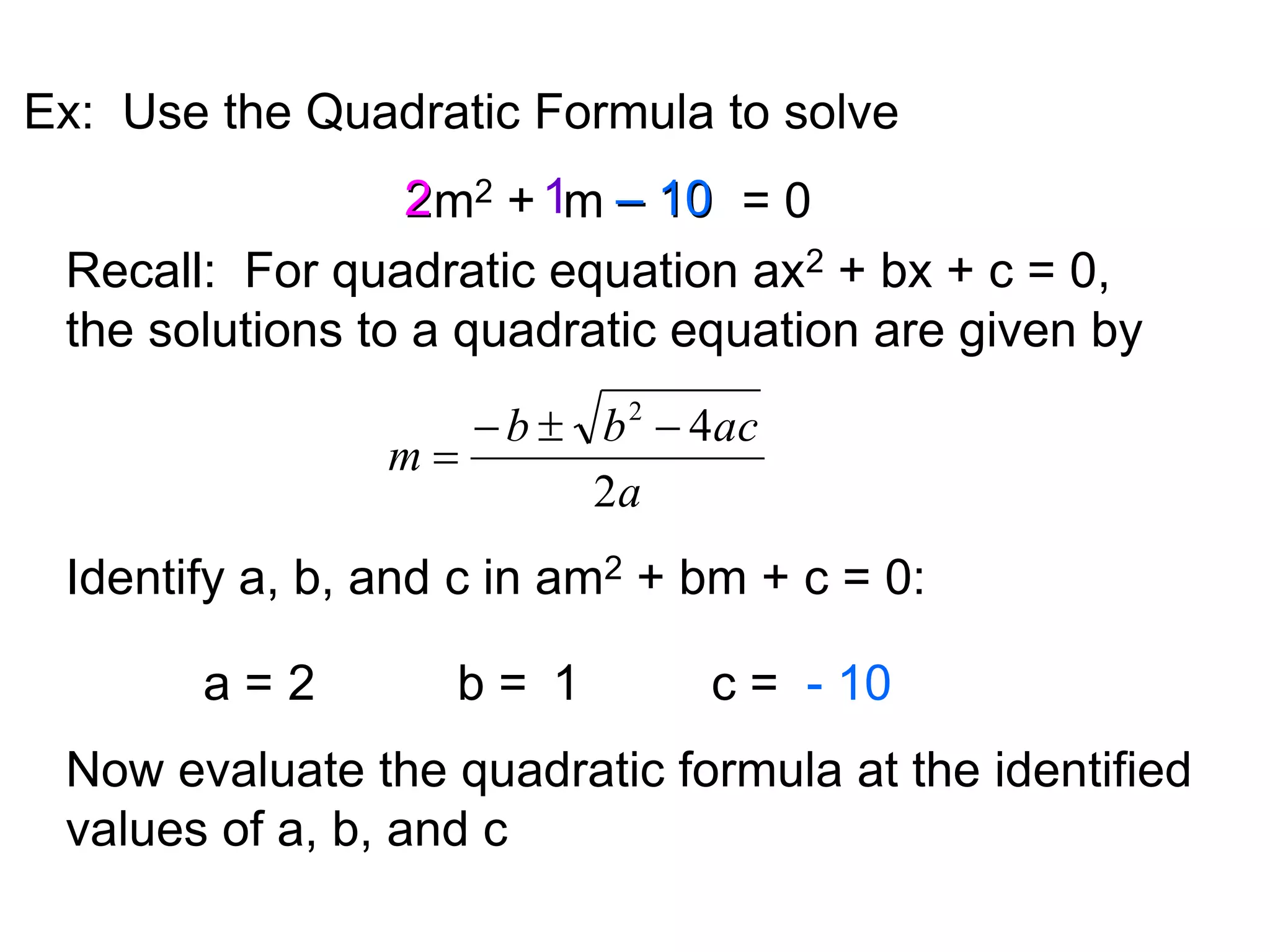
Ex: Use the Quadratic Formula to solve 
1 
2m2 + m = 0 
2 
Recall: For quadratic equation ax2 + bx + c = 0, 
the solutions to a quadratic equation are given by 
4 2    
 
b b ac 
a 
m 
2 
Identify a, b, and c in am2 + bm + c = 0: 
a = 2 b = 1 
c = 
- 10 
– 10 
Now evaluate the quadratic formula at the identified 
values of a, b, and c
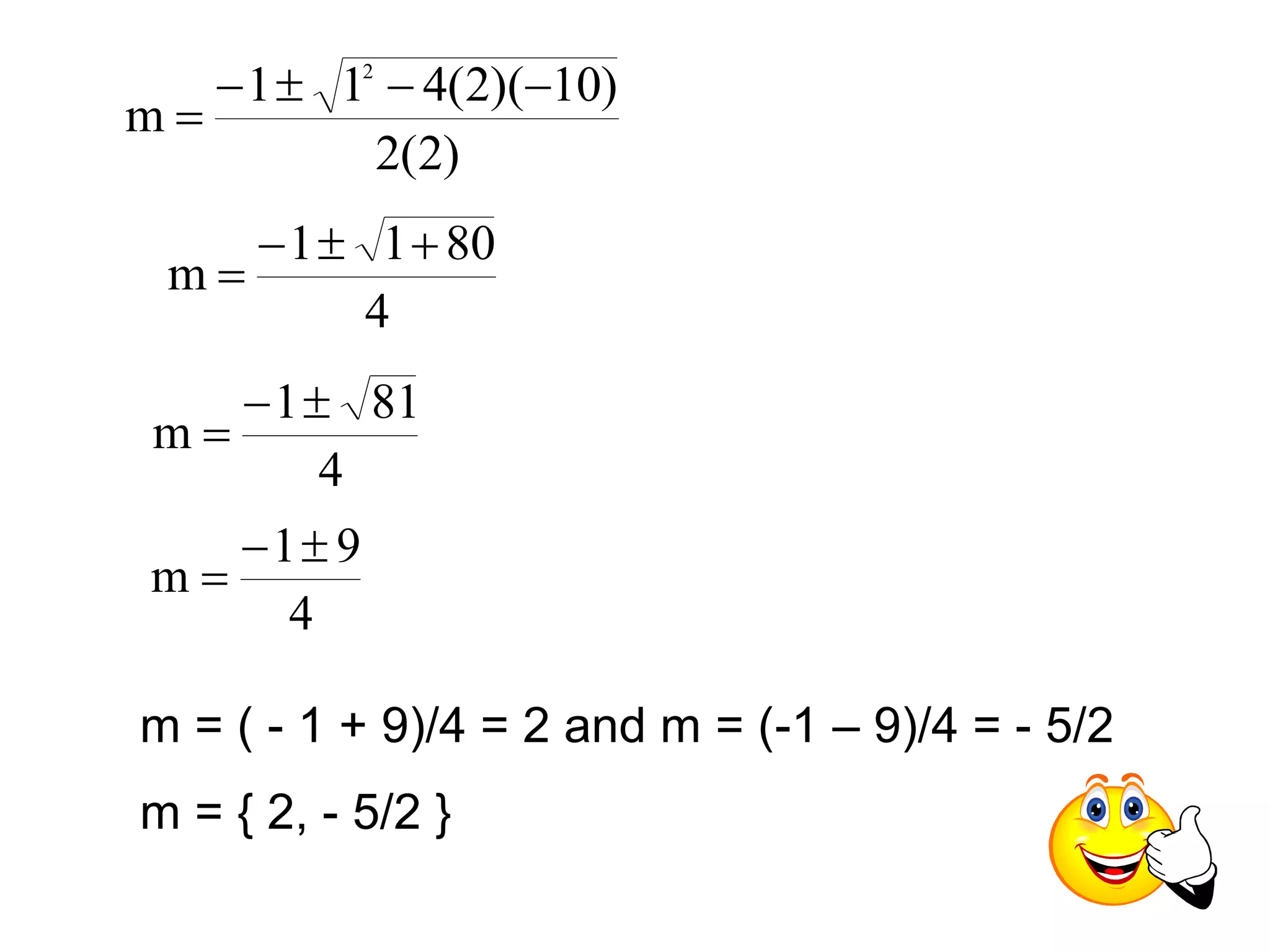
1 1 4(2)( 10) 
2(2) 
m 
2     
 
1 1 80 
4 
m 
   
 
1 81 
4 
m 
  
 
1 9 
4 
m 
  
 
m = ( - 1 + 9)/4 = 2 and m = (-1 – 9)/4 = - 5/2 
m = { 2, - 5/2 }
Any questions . . .
Lecture quadratic equations good one

Lecture quadratic equations good one

  • 1.
    QUADRATIC EQUATIONS MSJC~ San Jacinto Campus Math Center Workshop Series Janice Levasseur
  • 2.
    Basics • Aquadratic equation is an equation equivalent to an equation of the type ax2 + bx + c = 0, where a is nonzero • We can solve a quadratic equation by factoring and using The Principle of Zero Products If ab = 0, then either a = 0, b = 0, or both a and b = 0.
  • 3.
    Ex: Solve (4t+ 1)(3t – 5) = 0 Notice the equation as given is of the form ab = 0  set each factor equal to 0 and solve 4t + 1 = 0 Subtract 1 4t = – 1 Divide by 4 t = – ¼ 3t – 5 = 0 Add 5 3t = 5 Divide by 3 t = 5/3 Solution: t = - ¼ and 5/3  t = {- ¼, 5/3}
  • 4.
    Ex: Solve x2+ 7x + 6 = 0 Quadratic equation  factor the left hand side (LHS) x2 + 7x + 6 = (x + 6 )(x + 1 )  x2 + 7x + 6 = (x + 6)(x + 1) = 0 Now the equation as given is of the form ab = 0  set each factor equal to 0 and solve x + 6 = 0 x = – 6 x + 1 = 0 x = – 1 Solution: x = - 6 and – 1  x = {-6, -1}
  • 5.
    Ex: Solve x2+ 10x = – 25 Quadratic equation but not of the form ax2 + bx + c = 0 Add 25  x2 + 10x + 25 = 0 Quadratic equation  factor the left hand side (LHS) x2 + 10x + 25 = (x + 5 )(x + 5 )  x2 + 10x + 25 = (x + 5)(x + 5) = 0 Now the equation as given is of the form ab = 0  set each factor equal to 0 and solve x + 5 = 0 x = – 5 x + 5 = 0 x = – 5 Solution: x = - 5  x = {- 5}  repeated root
  • 6.
    Ex: Solve 12y2– 5y = 2 Quadratic equation but not of the form ax2 + bx + c = 0 Subtract 2  12y2 – 5y – 2 = 0 Quadratic equation  factor the left hand side (LHS) ac method  a = 12 and c = – 2 ac = (12)(-2) = - 24  factors of – 24 that sum to - 5 1&-24, 2&-12, 3&-8, . . .   12y2 – 5y – 2 = 12y2 + 3y – 8y – 2 = 3y(4y + 1) – 2(4y + 1) = (3y – 2)(4y + 1)
  • 7.
     12y2 –5y – 2 = 0  12y2 – 5y – 2 = (3y - 2)(4y + 1) = 0 Now the equation as given is of the form ab = 0  set each factor equal to 0 and solve 3y – 2 = 0 3y = 2 4y + 1 = 0 4y = – 1 y = 2/3 y = – ¼ Solution: y = 2/3 and – ¼  y = {2/3, - ¼ }
  • 8.
    Ex: Solve 5x2= 6x Quadratic equation but not of the form ax2 + bx + c = 0 Subtract 6x  5x2 – 6x = 0 Quadratic equation  factor the left hand side (LHS) 5x2 – 6x = x( 5 x – 6 )  5x2 – 6x = x(5x – 6) = 0 Now the equation as given is of the form ab = 0  set each factor equal to 0 and solve x = 0 5x – 6 = 0 5x = 6 x = 6/5 Solution: x = 0 and 6/5  x = {0, 6/5}
  • 9.
    Solving by takingsquare roots • An alternate method of solving a quadratic equation is using the Principle of Taking the Square Root of Each Side of an Equation If x2 = a, then x = + a
  • 10.
    Ex: Solve bytaking square roots 3x2 – 36 = 0 First, isolate x2: 3x2 – 36 = 0 3x2 = 36 x2 = 12 Now take the square root of both sides: x 12 2  x   12 x   2  2  3 x   2 3
  • 11.
    Ex: Solve bytaking square roots 4(z – 3)2 = 100 First, isolate the squared factor: 4(z – 3)2 = 100 (z – 3)2 = 25 Now take the square root of both sides: (z 3) 25 2   z  3   25 z – 3 = + 5 z = 3 + 5  z = 3 + 5 = 8 and z = 3 – 5 = – 2
  • 12.
    Ex: Solve bytaking square roots 5(x + 5)2 – 75 = 0 First, isolate the squared factor: 5(x + 5)2 = 75 (x + 5)2 = 15 Now take the square root of both sides: ( x  5 )2  15 x  5   15 x  5  15 x  5  15 , x  5  15
  • 13.
    Completing the Square • Recall from factoring that a Perfect-Square Trinomial is the square of a binomial: Perfect square Trinomial Binomial Square x2 + 8x + 16 (x + 4)2 x2 – 6x + 9 (x – 3)2 • The square of half of the coefficient of x equals the constant term: ( ½ * 8 )2 = 16 [½ (-6)]2 = 9
  • 14.
    Completing the Square • Write the equation in the form x2 + bx = c • Add to each side of the equation [½(b)]2 • Factor the perfect-square trinomial x2 + bx + [½(b)] 2 = c + [½(b)]2 • Take the square root of both sides of the equation • Solve for x
  • 15.
    Ex: Solve w2+ 6w + 4 = 0 by completing the square First, rewrite the equation with the constant on one side of the equals and a lead coefficient of 1. w2 + 6 6w = – 4 Add [½(b)]2 to both sides: b = 6  [½(6)]2 = 32 = 9 w2 + 6w + 9 = – 4 + 9 w2 + 6w + 9 = 5 (w + 3)2 = 5 Now take the square root of both sides
  • 16.
    5 ) 3w ( 2   w  3   5 w  3 5 w  {3  5,3  5}
  • 17.
    Ex: Solve 2r2= 3 – 5r by completing the square First, rewrite the equation with the constant on one side of the equals and a lead coefficient of 1. 2r2 + 5r = 3  r2 + (5/2) r = (3/2) Add [½(b)]2 to both sides: b = 5/2 [½(5/2)]2 = (5/4)2 = 25/16 r2 + (5/2)r + 25/16 = (3/2) + 25/16 r2 + (5/2)r + 25/16 = 24/16 + 25/16 (r + 5/4)2 = 49/16 Now take the square root of both sides
  • 18.
    (r 5/ 4)49/16 2   r  5/ 4  (7/ 4) r  (5/ 4)  (7/ 4) r = - (5/4) + (7/4) = 2/4 = ½ and r = - (5/4) - (7/4) = -12/4 = - 3 r = { ½ , - 3}
  • 19.
    Ex: Solve 3p– 5 = (p – 1)(p – 2) Is this a quadratic equation? FOIL the RHS 3p – 5 = p2 – 2p – p + 2 3p – 5 = p2 – 3p + 2 p2 – 6p + 7 = 0 Collect all terms A-ha . . . Quadratic Equation  complete the square p2 – 6p = – 7  [½(-6)]2 = (-3)2 = 9 p2 – 6p + 9 = – 7 + 9 (p – 3)2 = 2
  • 20.
    2 ) 3p( 2   p  3   2 p  3  2 p  {3  2,3  2}
  • 21.
    The Quadratic Formula • Consider a quadratic equation of the form ax2 + bx + c = 0 for a nonzero • Completing the square ax2  bx   c  b c x 2  x  a a b b c b 2 2 2      2 2 x x a 4a a 4a
  • 22.
    The Quadratic Formula b b 4ac b 2 2      2          b b 2 4ac 2 x 2a 4a Solutions to ax2 + bx + c = 0 for a nonzero are     2 b b 4ac x 2a 2 2 2 2 x x a 4a 4a 4a
  • 23.
    Ex: Use theQuadratic Formula to solve x2 + 7x + 6 = 0 Recall: For quadratic equation ax2 + bx + c = 0, the solutions to a quadratic equation are given by b b 4ac 2a x 2     Identify a, b, and c in ax2 + bx + c = 0: a = 1 b = c = 1 7 7 6 Now evaluate the quadratic formula at the identified values of a, b, and c
  • 24.
    7 7 4(1)(6) 2(1) x 2     7 49 24 2 x     7 25 2 x    7 5 2 x    x = ( - 7 + 5)/2 = - 1 and x = (-7 – 5)/2 = - 6 x = { - 1, - 6 }
  • 25.
    Ex: Use theQuadratic Formula to solve 1 2m2 + m = 0 2 Recall: For quadratic equation ax2 + bx + c = 0, the solutions to a quadratic equation are given by 4 2     b b ac a m 2 Identify a, b, and c in am2 + bm + c = 0: a = 2 b = 1 c = - 10 – 10 Now evaluate the quadratic formula at the identified values of a, b, and c
  • 26.
    1 1 4(2)(10) 2(2) m 2      1 1 80 4 m     1 81 4 m    1 9 4 m    m = ( - 1 + 9)/4 = 2 and m = (-1 – 9)/4 = - 5/2 m = { 2, - 5/2 }
  • 27.