1
Numerical Analysis
Lecture 3
Solution of a quadratic equation
2
An equation is a quadratic equation if it can be written in the form:
𝑎𝑥2
+ 𝑏𝑥 + 𝑐 = 0
where a, b, c are known numbers, a ≠ 0
Examples
▪ 4𝑤2 − 10 = 0 is a quadratic equation (it is in the form 𝑎𝑥2 + 𝑏𝑥 + 𝑐 = 0
where 𝑏 = 0 and instead of x as our unknown variable we have 𝑤).
▪ 3(2𝑥2
+ 1) = −5𝑥 is a quadratic equation (we can first expand the left-
hand side into 6𝑥2
+ 3 = −5𝑥, then rearrange it into 6𝑥2
+ 5𝑥 + 3 = 0).
▪ 7𝑥 − 4 is not a quadratic equation (because 𝑎 = 0).
Solve by Factoring
3
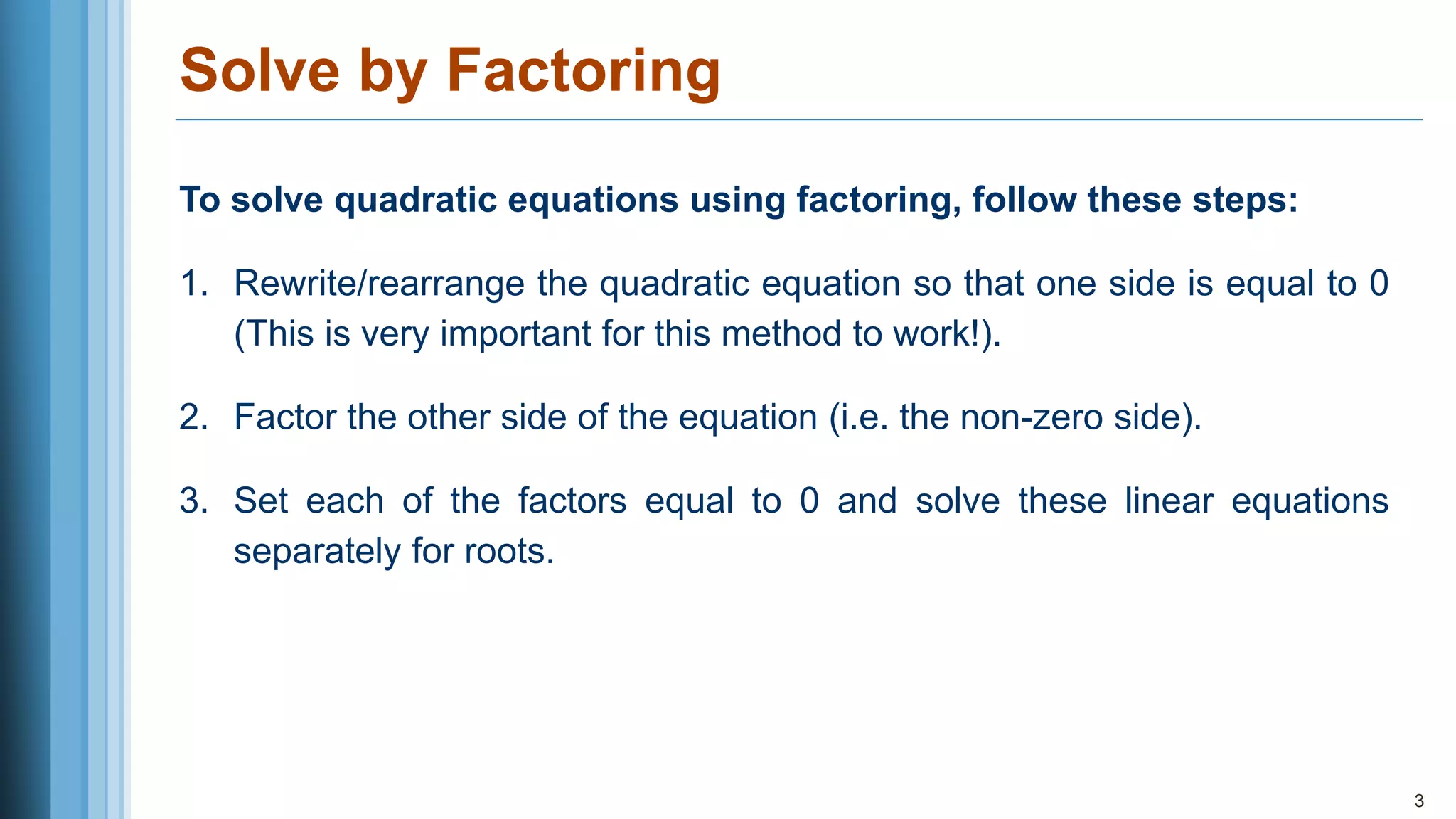
To solve quadratic equations using factoring, follow these steps:
1. Rewrite/rearrange the quadratic equation so that one side is equal to 0
(This is very important for this method to work!).
2. Factor the other side of the equation (i.e. the non-zero side).
3. Set each of the factors equal to 0 and solve these linear equations
separately for roots.
Solve by Factoring
4
Example: Solve 2𝑥2
− 6 = 𝑥 by factoring.
Solve by Factoring
5
Solve using the Quadratic Formula
6
The quadratic formula:
𝑥 =
−𝑏 ± 𝑏2 −4𝑎𝑐
2𝑎
For this formula to work properly, you first need to make sure
that your quadratic equation is in the form: 𝑎𝑥2 + 𝑏𝑥 + 𝑐 = 0 .
We have to consider two expressions:
𝑥 =
−𝑏+ 𝑏2−4𝑎𝑐
2𝑎
and 𝑥 =
−𝑏− 𝑏2−4𝑎𝑐
2𝑎
Solve using the Quadratic Formula
7
Example:
One number is the square of another number. If their sum is 176, what are
the two numbers? Round answers to two decimal places.
Solve using the Quadratic Formula
8
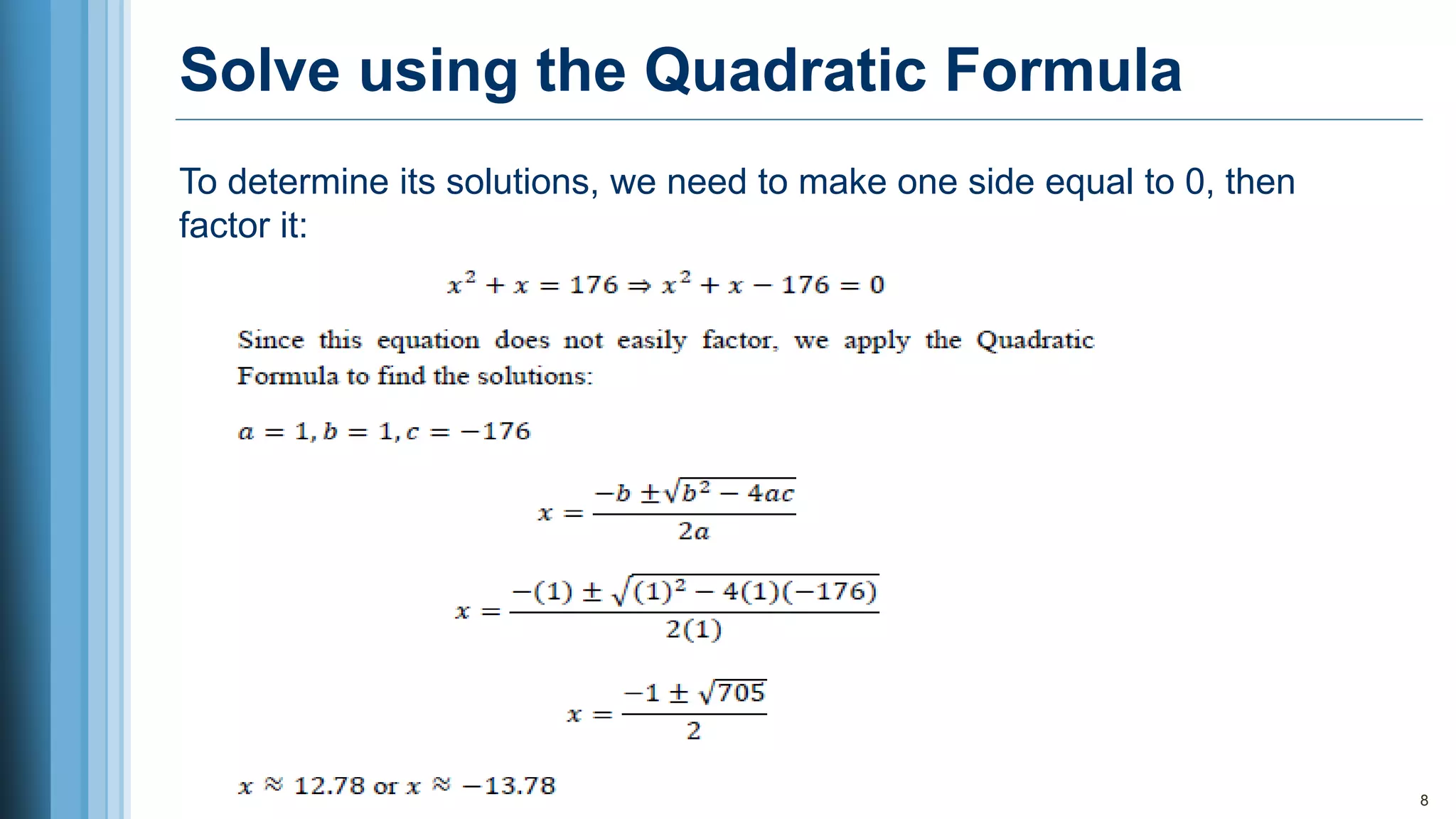
To determine its solutions, we need to make one side equal to 0, then
factor it:
Solve using the Quadratic Formula
9
Number of roots
10
To determine the number of roots a quadratic equation has, we can
use a part of the quadratic formula called the discriminant:
𝐷 = 𝑏2 − 4𝑎𝑐
There are three possible cases:
- If 𝑏2 − 4𝑎𝑐 < 0, then 𝑎𝑥2 + 𝑏𝑥 + 𝑐 = 0 has no real roots.
- If 𝑏2 − 4𝑎𝑐 = 0 , then 𝑎𝑥2 + 𝑏𝑥 + 𝑐 = 0 has one root.
- If 𝑏2 − 4𝑎𝑐 > 0 , then 𝑎𝑥2 + 𝑏𝑥 + 𝑐 = 0 has two (distinct) roots.
Number of roots
11
Problems
12
13

Lec

  • 1.
  • 2.
    Solution of aquadratic equation 2 An equation is a quadratic equation if it can be written in the form: 𝑎𝑥2 + 𝑏𝑥 + 𝑐 = 0 where a, b, c are known numbers, a ≠ 0 Examples ▪ 4𝑤2 − 10 = 0 is a quadratic equation (it is in the form 𝑎𝑥2 + 𝑏𝑥 + 𝑐 = 0 where 𝑏 = 0 and instead of x as our unknown variable we have 𝑤). ▪ 3(2𝑥2 + 1) = −5𝑥 is a quadratic equation (we can first expand the left- hand side into 6𝑥2 + 3 = −5𝑥, then rearrange it into 6𝑥2 + 5𝑥 + 3 = 0). ▪ 7𝑥 − 4 is not a quadratic equation (because 𝑎 = 0).
  • 3.
    Solve by Factoring 3 Tosolve quadratic equations using factoring, follow these steps: 1. Rewrite/rearrange the quadratic equation so that one side is equal to 0 (This is very important for this method to work!). 2. Factor the other side of the equation (i.e. the non-zero side). 3. Set each of the factors equal to 0 and solve these linear equations separately for roots.
  • 4.
    Solve by Factoring 4 Example:Solve 2𝑥2 − 6 = 𝑥 by factoring.
  • 5.
  • 6.
    Solve using theQuadratic Formula 6 The quadratic formula: 𝑥 = −𝑏 ± 𝑏2 −4𝑎𝑐 2𝑎 For this formula to work properly, you first need to make sure that your quadratic equation is in the form: 𝑎𝑥2 + 𝑏𝑥 + 𝑐 = 0 . We have to consider two expressions: 𝑥 = −𝑏+ 𝑏2−4𝑎𝑐 2𝑎 and 𝑥 = −𝑏− 𝑏2−4𝑎𝑐 2𝑎
  • 7.
    Solve using theQuadratic Formula 7 Example: One number is the square of another number. If their sum is 176, what are the two numbers? Round answers to two decimal places.
  • 8.
    Solve using theQuadratic Formula 8 To determine its solutions, we need to make one side equal to 0, then factor it:
  • 9.
    Solve using theQuadratic Formula 9
  • 10.
    Number of roots 10 Todetermine the number of roots a quadratic equation has, we can use a part of the quadratic formula called the discriminant: 𝐷 = 𝑏2 − 4𝑎𝑐 There are three possible cases: - If 𝑏2 − 4𝑎𝑐 < 0, then 𝑎𝑥2 + 𝑏𝑥 + 𝑐 = 0 has no real roots. - If 𝑏2 − 4𝑎𝑐 = 0 , then 𝑎𝑥2 + 𝑏𝑥 + 𝑐 = 0 has one root. - If 𝑏2 − 4𝑎𝑐 > 0 , then 𝑎𝑥2 + 𝑏𝑥 + 𝑐 = 0 has two (distinct) roots.
  • 11.
  • 12.
  • 13.