QMPs for Large D-B &
D-B-B Projects
Brown Bag
Quote
“… If it is signed by George Little, then it is a requirement
not a guideline.”
(Bill Raleigh 2012)
QMP is a Project Requirement
Project Quality Management Plan is:
• An extension of our internal protocols
• Tailored to meet project requirements
• Contract requirement
 FTA
 Denver RTD
 D-B
Company vs. Project
COMPANY LEVEL
We typically refer to our
internal QC processes as
“QC Reviews”.
PROJECT LEVEL
At the project level, we
distinguish between Checks
and Reviews.
• Detail Checking
• Constructability Review
• Crossdisciplinary Review
• Technical Review
Design Quality Management Plan
• Quality Statement - “Quality is the responsibility of each
person working on the Project”
• Quality Goal - “… produce deliverables in a well-defined
and systematic fashion that meet the contract
requirements”
• Quality Objectives - training, submittal reviews, etc.
Design Quality Management Plan
• Narrative
• Appendices
 Design Control Procedures
 Forms and Tools
 List of Deliverables
ISO Compliant
ISO Certified
FTA Compliant
Design Quality Management Plan
Design Control Procedures
o DCPR-01 Quality Records
o DCPR-02 Checking of Reports and Studies
o DCPR-03 Checking of Calculations
o DCPR-04 Independent Design Check
o DCPR-05 Checking of Drawings
o DCPR-06 Checking of Input to Computer Programs
o DCPR-07 Checking of Special Provisions
o DCPR-08 Spreadsheet Checking
o DCPR-09 Revisions to Released for Construction Documents
o DCPR-10 Computer Software
o DCPR-11 Constructability and Cross Disciplinary Reviews
o DCPR-12 Quality Control Reviews
o DCPR-13 Design Quality Assurance Audits
o DCPR-14 As-Built Documents
o DCPR-15 Corrective and Preventive Actions
o DCPR-16 Parallel Model Checking
More on the way!
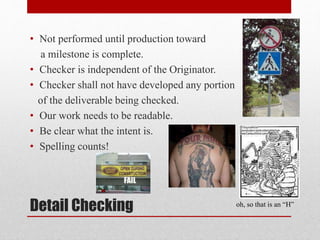
Detail Checking
• Not performed until production toward
a milestone is complete.
• Checker is independent of the Originator.
• Checker shall not have developed any portion
of the deliverable being checked.
• Our work needs to be readable.
• Be clear what the intent is.
• Spelling counts!
oh, so that is an “H”
Detail Checking
• Rechecker must confirm the edit on a hard copy!
First Page Only: Design Package No. or Description
No. Date
CHECK PRINT
Dwg. Only: Checked against calcs. and calc. check
confirmed by _________ Date ________
Originator Date
Checker Date
Backchecker Date
Updater Date
Rechecker Date
The Checker and Rechecker must be independent from
the Originator, Backchecker and Updater.
The Checker and Rechecker do not have to be the same
person, but it is preferred,
Originator, Checker and Backchecker always required.
Updater and Rechecker based on Checker’s red lines.
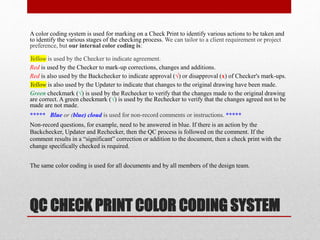
QC CHECK PRINT COLOR CODING SYSTEM
A color coding system is used for marking on a Check Print to identify various actions to be taken and
to identify the various stages of the checking process. We can tailor to a client requirement or project
preference, but our internal color coding is:
Yellow is used by the Checker to indicate agreement.
Red is used by the Checker to mark-up corrections, changes and additions.
Red is also used by the Backchecker to indicate approval (√) or disapproval (x) of Checker's mark-ups.
Yellow is also used by the Updater to indicate that changes to the original drawing have been made.
Green checkmark (√) is used by the Rechecker to verify that the changes made to the original drawing
are correct. A green checkmark (√) is used by the Rechecker to verify that the changes agreed not to be
made are not made.
***** Blue or (blue) cloud is used for non-record comments or instructions. *****
Non-record questions, for example, need to be answered in blue. If there is an action by the
Backchecker, Updater and Rechecker, then the QC process is followed on the comment. If the
comment results in a “significant” correction or addition to the document, then a check print with the
change specifically checked is required.
The same color coding is used for all documents and by all members of the design team.
Constructability Reviews
The Contractor can help
see problems:
Crossdisciplinary Reviews
Looking for conflicts
(CDR, DCR, IDR)
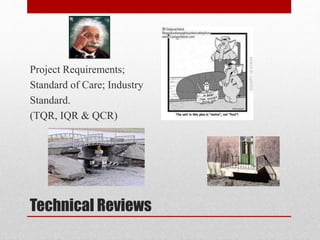
Technical Reviews
Project Requirements;
Standard of Care; Industry
Standard.
(TQR, IQR & QCR)
Responses are Important
“There aren’t any utilities on that side of the road;
so put the pole wherever you want”.
Responses are Important
“Just do what it shows on
the drawing!”
Quality Assurance
DQCM will:
• Create DQMP
• Perform review of QC Documentation
• Review submittal prior to submittal
• Certify QC performed per DQMP
• Perform internal audits, report the results
and resolve nonconformances
May be required to have ASQ, or equal,
Certification
Oversights Happen
Don’t beat yourself up; there is a
reason we perform checks
and reviews.
Questions?
David Irish, PE, CMQ/OE
David.irish@hdrinc.com
(208) 387-7004 off
(208) 869-1197 cell

Qm ps for large db dbb projects

  • 1.
    QMPs for LargeD-B & D-B-B Projects Brown Bag
  • 2.
    Quote “… If itis signed by George Little, then it is a requirement not a guideline.” (Bill Raleigh 2012)
  • 3.
    QMP is aProject Requirement Project Quality Management Plan is: • An extension of our internal protocols • Tailored to meet project requirements • Contract requirement  FTA  Denver RTD  D-B
  • 4.
    Company vs. Project COMPANYLEVEL We typically refer to our internal QC processes as “QC Reviews”. PROJECT LEVEL At the project level, we distinguish between Checks and Reviews. • Detail Checking • Constructability Review • Crossdisciplinary Review • Technical Review
  • 5.
    Design Quality ManagementPlan • Quality Statement - “Quality is the responsibility of each person working on the Project” • Quality Goal - “… produce deliverables in a well-defined and systematic fashion that meet the contract requirements” • Quality Objectives - training, submittal reviews, etc.
  • 6.
    Design Quality ManagementPlan • Narrative • Appendices  Design Control Procedures  Forms and Tools  List of Deliverables ISO Compliant ISO Certified FTA Compliant
  • 7.
    Design Quality ManagementPlan Design Control Procedures o DCPR-01 Quality Records o DCPR-02 Checking of Reports and Studies o DCPR-03 Checking of Calculations o DCPR-04 Independent Design Check o DCPR-05 Checking of Drawings o DCPR-06 Checking of Input to Computer Programs o DCPR-07 Checking of Special Provisions o DCPR-08 Spreadsheet Checking o DCPR-09 Revisions to Released for Construction Documents o DCPR-10 Computer Software o DCPR-11 Constructability and Cross Disciplinary Reviews o DCPR-12 Quality Control Reviews o DCPR-13 Design Quality Assurance Audits o DCPR-14 As-Built Documents o DCPR-15 Corrective and Preventive Actions o DCPR-16 Parallel Model Checking More on the way!
  • 8.
    Detail Checking • Notperformed until production toward a milestone is complete. • Checker is independent of the Originator. • Checker shall not have developed any portion of the deliverable being checked. • Our work needs to be readable. • Be clear what the intent is. • Spelling counts! oh, so that is an “H”
  • 9.
    Detail Checking • Recheckermust confirm the edit on a hard copy! First Page Only: Design Package No. or Description No. Date CHECK PRINT Dwg. Only: Checked against calcs. and calc. check confirmed by _________ Date ________ Originator Date Checker Date Backchecker Date Updater Date Rechecker Date The Checker and Rechecker must be independent from the Originator, Backchecker and Updater. The Checker and Rechecker do not have to be the same person, but it is preferred, Originator, Checker and Backchecker always required. Updater and Rechecker based on Checker’s red lines.
  • 10.
    QC CHECK PRINTCOLOR CODING SYSTEM A color coding system is used for marking on a Check Print to identify various actions to be taken and to identify the various stages of the checking process. We can tailor to a client requirement or project preference, but our internal color coding is: Yellow is used by the Checker to indicate agreement. Red is used by the Checker to mark-up corrections, changes and additions. Red is also used by the Backchecker to indicate approval (√) or disapproval (x) of Checker's mark-ups. Yellow is also used by the Updater to indicate that changes to the original drawing have been made. Green checkmark (√) is used by the Rechecker to verify that the changes made to the original drawing are correct. A green checkmark (√) is used by the Rechecker to verify that the changes agreed not to be made are not made. ***** Blue or (blue) cloud is used for non-record comments or instructions. ***** Non-record questions, for example, need to be answered in blue. If there is an action by the Backchecker, Updater and Rechecker, then the QC process is followed on the comment. If the comment results in a “significant” correction or addition to the document, then a check print with the change specifically checked is required. The same color coding is used for all documents and by all members of the design team.
  • 11.
  • 12.
    Crossdisciplinary Reviews Looking forconflicts (CDR, DCR, IDR)
  • 13.
    Technical Reviews Project Requirements; Standardof Care; Industry Standard. (TQR, IQR & QCR)
  • 14.
    Responses are Important “Therearen’t any utilities on that side of the road; so put the pole wherever you want”.
  • 15.
    Responses are Important “Justdo what it shows on the drawing!”
  • 16.
    Quality Assurance DQCM will: •Create DQMP • Perform review of QC Documentation • Review submittal prior to submittal • Certify QC performed per DQMP • Perform internal audits, report the results and resolve nonconformances May be required to have ASQ, or equal, Certification
  • 17.
    Oversights Happen Don’t beatyourself up; there is a reason we perform checks and reviews.
  • 18.
    Questions? David Irish, PE,CMQ/OE David.irish@hdrinc.com (208) 387-7004 off (208) 869-1197 cell