QITCOM 2011 Conference
Richard Kerby
Senior Inter-Regional Adviser
E-Government and Knowledge Management
kerby@un.org
E-Government Services
http://www.UNPAN.org/DPADM/
2
E-Government Services
1. Overview of e-Government Services
2. Key Performance Indicators (KPIs)
3. M-Government
4. Cloud Computing
5. Open Government Data
6. Way Forward
http://www.UNPAN.org/DPADM/
3
1. Overview of e-Government Services
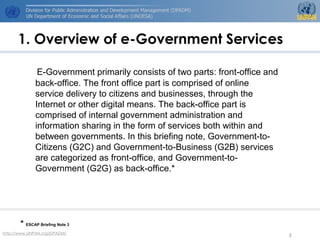
E-Government primarily consists of two parts: front-office and
back-office. The front office part is comprised of online
service delivery to citizens and businesses, through the
Internet or other digital means. The back-office part is
comprised of internal government administration and
information sharing in the form of services both within and
between governments. In this briefing note, Government-to-
Citizens (G2C) and Government-to-Business (G2B) services
are categorized as front-office, and Government-to-
Government (G2G) as back-office.*
* ESCAP Briefing Note 3
http://www.UNPAN.org/DPADM/
4
2. Key Performance Indicators (KPIs)
You cannot manage what you do not
measure
You cannot improve if you do not measure
* ForeSee
http://www.UNPAN.org/DPADM/
5
2. Key Performance Indicators (KPIs)
* ForeSee
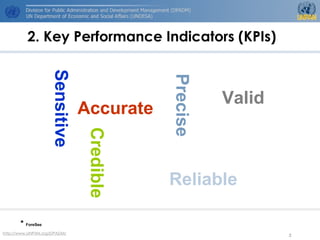
Credible
Valid
Accurate
PreciseReliable
Sensitive
http://www.UNPAN.org/DPADM/
6
2. Key Performance Indicators (KPIs)
* ForeSee
Success = Satisfaction
http://kpilibrary.com/home
http://www.UNPAN.org/DPADM/
7
3. M-Government
Mobile Government is the next inevitable direction of evolution of
eGovernment. It is about modernising the public sector
organisations - hence the business processes, the work and the
workers - using mobile technologies, applications and services. M-
Government is not only about technology but rather how technology
revolutionise the public sector activities and how the society adopts
these technologies. Mobile devices provide a faster and timely way
of delivering information to citizens and is considered as the most
common medium or enabler of m-government.
In countries with limited wireless infrastructure and m-services,
short message service (SMS) can transmit simple m-services to
provide services to citizens.
Mobile Government Consortium
http://www.UNPAN.org/DPADM/
8
3. M-Government
The main benefit of the m-government is that it truly helps to create
an integrated digital nervous system for government. The
advancement of ICT explains why new m-government applications
emerge and why government has many opportunities through the
wireless channels. Its immediacy and convenience reduces the
previous barriers to public service operations, encouraging citizens
or service providers to make use of the technology. Digital systems
enable public service personnel to gather data more efficiently and
improve its delivery, also encourage citizens to utilize public
services more easily and be more cordial in the city's or
government's decision process.
Mobi Solutions Ltd
http://www.UNPAN.org/DPADM/
9
4. Cloud Technology
“Don't fight Mother Nature. It's inevitable that
applications will move to the cloud, it's just a
matter of which ones. Embrace the change
and manage the change in a way that's
effective for your business. When it comes to
cloud computing, the train has left the station”
- John W. Thompson, Chairman and Ex-CEO
Symantec
http://searchsecurity.techtarget.com/news/article/0,289142,sid14_gci1523794,00.html
* eFortresses
http://www.UNPAN.org/DPADM/
10
4. Cloud Technology
* eFortresses
http://www.UNPAN.org/DPADM/
11
4. Cloud Technology
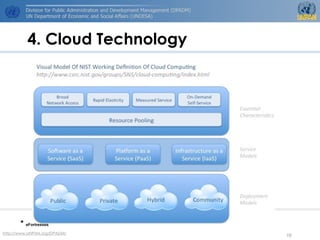
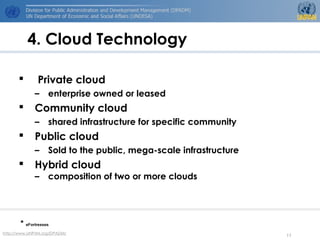
 Private cloud
– enterprise owned or leased
 Community cloud
– shared infrastructure for specific community
 Public cloud
– Sold to the public, mega-scale infrastructure
 Hybrid cloud
– composition of two or more clouds
* eFortresses
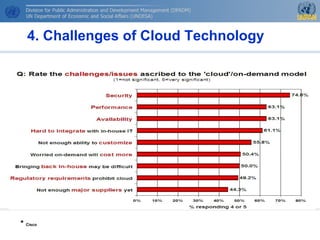
4. Challenges of Cloud Technology
* Cisco
data and information
produced or commissioned
by government or
government controlled
entities
5. Open Government data
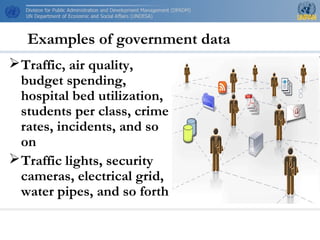
Examples of government data
Traffic, air quality,
budget spending,
hospital bed utilization,
students per class, crime
rates, incidents, and so
on
Traffic lights, security
cameras, electrical grid,
water pipes, and so forth
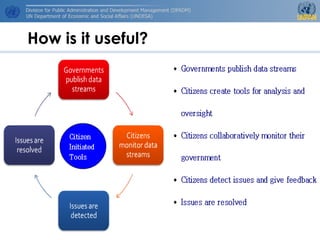
How is it useful?
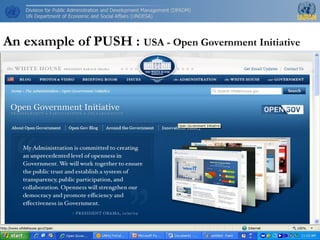
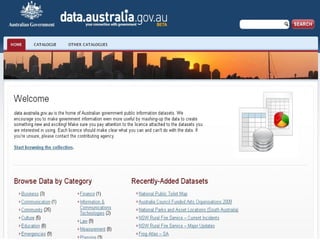
An example of PUSH : USA - Open Government Initiative
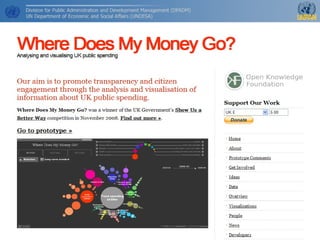
Citizens monitor data streams
http://www.UNPAN.org/DPADM/
20
6. Way Forward
* ESCAP Briefing Note 3
• Government institutions need to identify Key Performance
Indicators (KPIs) that can measure citizen satisfaction.
• Citizens are looking for multi-channel approach to the delivery
of e-services through i-phones, PCs, Kiosk, ATM machine,
mobiles, front offices
• M-Government should one of the priority of e-government
decision-makers
• Governments need to insure that security is a major priority in
Cloud Computing
• Open Government Data creates greater trust between
government and citizens
http://www.UNPAN.org/DPADM/
21
Thank You
kerby@un.org

Qitcom Presentation on e-government services

  • 1.
    QITCOM 2011 Conference RichardKerby Senior Inter-Regional Adviser E-Government and Knowledge Management kerby@un.org E-Government Services
  • 2.
    http://www.UNPAN.org/DPADM/ 2 E-Government Services 1. Overviewof e-Government Services 2. Key Performance Indicators (KPIs) 3. M-Government 4. Cloud Computing 5. Open Government Data 6. Way Forward
  • 3.
    http://www.UNPAN.org/DPADM/ 3 1. Overview ofe-Government Services E-Government primarily consists of two parts: front-office and back-office. The front office part is comprised of online service delivery to citizens and businesses, through the Internet or other digital means. The back-office part is comprised of internal government administration and information sharing in the form of services both within and between governments. In this briefing note, Government-to- Citizens (G2C) and Government-to-Business (G2B) services are categorized as front-office, and Government-to- Government (G2G) as back-office.* * ESCAP Briefing Note 3
  • 4.
    http://www.UNPAN.org/DPADM/ 4 2. Key PerformanceIndicators (KPIs) You cannot manage what you do not measure You cannot improve if you do not measure * ForeSee
  • 5.
    http://www.UNPAN.org/DPADM/ 5 2. Key PerformanceIndicators (KPIs) * ForeSee Credible Valid Accurate PreciseReliable Sensitive
  • 6.
    http://www.UNPAN.org/DPADM/ 6 2. Key PerformanceIndicators (KPIs) * ForeSee Success = Satisfaction http://kpilibrary.com/home
  • 7.
    http://www.UNPAN.org/DPADM/ 7 3. M-Government Mobile Governmentis the next inevitable direction of evolution of eGovernment. It is about modernising the public sector organisations - hence the business processes, the work and the workers - using mobile technologies, applications and services. M- Government is not only about technology but rather how technology revolutionise the public sector activities and how the society adopts these technologies. Mobile devices provide a faster and timely way of delivering information to citizens and is considered as the most common medium or enabler of m-government. In countries with limited wireless infrastructure and m-services, short message service (SMS) can transmit simple m-services to provide services to citizens. Mobile Government Consortium
  • 8.
    http://www.UNPAN.org/DPADM/ 8 3. M-Government The mainbenefit of the m-government is that it truly helps to create an integrated digital nervous system for government. The advancement of ICT explains why new m-government applications emerge and why government has many opportunities through the wireless channels. Its immediacy and convenience reduces the previous barriers to public service operations, encouraging citizens or service providers to make use of the technology. Digital systems enable public service personnel to gather data more efficiently and improve its delivery, also encourage citizens to utilize public services more easily and be more cordial in the city's or government's decision process. Mobi Solutions Ltd
  • 9.
    http://www.UNPAN.org/DPADM/ 9 4. Cloud Technology “Don'tfight Mother Nature. It's inevitable that applications will move to the cloud, it's just a matter of which ones. Embrace the change and manage the change in a way that's effective for your business. When it comes to cloud computing, the train has left the station” - John W. Thompson, Chairman and Ex-CEO Symantec http://searchsecurity.techtarget.com/news/article/0,289142,sid14_gci1523794,00.html * eFortresses
  • 10.
  • 11.
    http://www.UNPAN.org/DPADM/ 11 4. Cloud Technology Private cloud – enterprise owned or leased  Community cloud – shared infrastructure for specific community  Public cloud – Sold to the public, mega-scale infrastructure  Hybrid cloud – composition of two or more clouds * eFortresses
  • 12.
    4. Challenges ofCloud Technology * Cisco
  • 13.
    data and information producedor commissioned by government or government controlled entities 5. Open Government data
  • 14.
    Examples of governmentdata Traffic, air quality, budget spending, hospital bed utilization, students per class, crime rates, incidents, and so on Traffic lights, security cameras, electrical grid, water pipes, and so forth
  • 15.
    How is ituseful?
  • 16.
    An example ofPUSH : USA - Open Government Initiative
  • 18.
  • 20.
    http://www.UNPAN.org/DPADM/ 20 6. Way Forward *ESCAP Briefing Note 3 • Government institutions need to identify Key Performance Indicators (KPIs) that can measure citizen satisfaction. • Citizens are looking for multi-channel approach to the delivery of e-services through i-phones, PCs, Kiosk, ATM machine, mobiles, front offices • M-Government should one of the priority of e-government decision-makers • Governments need to insure that security is a major priority in Cloud Computing • Open Government Data creates greater trust between government and citizens
  • 21.

Editor's Notes

  • #2 http://www.UNPAN.org/DPADM/ Division for Public Administration and Development Management
  • #3 http://www.UNPAN.org/DPADM/ Division for Public Administration and Development Management
  • #4 http://www.UNPAN.org/DPADM/ Division for Public Administration and Development Management
  • #5 http://www.UNPAN.org/DPADM/ Division for Public Administration and Development Management
  • #6 http://www.UNPAN.org/DPADM/ Division for Public Administration and Development Management
  • #7 http://www.UNPAN.org/DPADM/ Division for Public Administration and Development Management
  • #8 http://www.UNPAN.org/DPADM/ Division for Public Administration and Development Management
  • #9 http://www.UNPAN.org/DPADM/ Division for Public Administration and Development Management
  • #10 http://www.UNPAN.org/DPADM/ Division for Public Administration and Development Management
  • #11 http://www.UNPAN.org/DPADM/ Division for Public Administration and Development Management
  • #12 http://www.UNPAN.org/DPADM/ Division for Public Administration and Development Management
  • #21 http://www.UNPAN.org/DPADM/ Division for Public Administration and Development Management