Copyright © 2012, Oracle and/or its affiliates. All rights reserved. Insert Information Protection Policy Classification from Slide 131
Keynote Address: Changing
Public Sector through
ICT Innovation
Christian Wernberg-Tougaard,
Director, Government, Education & Health
EMEA
Copyright © 2012, Oracle and/or its affiliates. All rights reserved. Insert Information Protection Policy Classification from Slide 132
The following is intended to outline our general product direction. It
is intended for information purposes only, and may not be
incorporated into any contract. It is not a commitment to deliver any
material, code, or functionality, and should not be relied upon in
making purchasing decision. The development, release, and timing
of any features or functionality described for Oracle’s products
remains at the sole discretion of Oracle.
Safe Harbor Statement
Copyright © 2012, Oracle and/or its affiliates. All rights reserved. Insert Information Protection Policy Classification from Slide 133
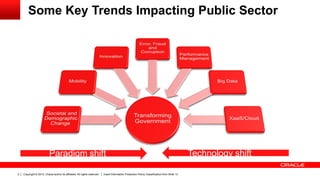
Some Key Trends Impacting Public Sector
Paradigm shift Technology shift
Copyright © 2012, Oracle and/or its affiliates. All rights reserved. Insert Information Protection Policy Classification from Slide 134
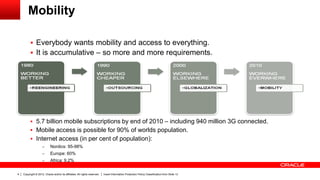
Mobility
 Everybody wants mobility and access to everything.
 It is accumulative – so more and more requirements.
 5.7 billion mobile subscriptions by end of 2010 – including 940 million 3G connected.
 Mobile access is possible for 90% of worlds population.
 Internet access (in per cent of population):
– Nordics: 95-98%
– Europe: 60%
– Africa: 9.2%
Copyright © 2012, Oracle and/or its affiliates. All rights reserved. Insert Information Protection Policy Classification from Slide 135
Innovation
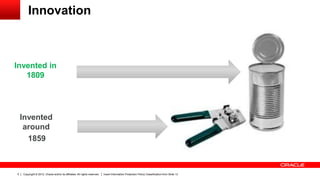
Invented in
1809
Invented
around
?1859
Copyright © 2012, Oracle and/or its affiliates. All rights reserved. Insert Information Protection Policy Classification from Slide 136
Innovation
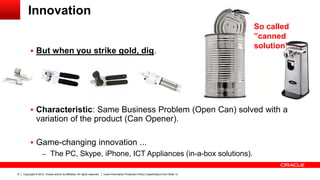
 But when you strike gold, dig.
 Characteristic: Same Business Problem (Open Can) solved with a
variation of the product (Can Opener).
 Game-changing innovation ...
– The PC, Skype, iPhone, ICT Appliances (in-a-box solutions).
So called
”canned
solution” ...
Copyright © 2012, Oracle and/or its affiliates. All rights reserved. Insert Information Protection Policy Classification from Slide 137
ICT Innovation
 ICT innovation takes many forms:
– User Interfaces and ease of use.
– Interconnectivity across different platforms (ex. Netflix)
– Hardware optimization and specialization
– Product specialization – functional and industry-specific
– etc etc etc
 The complexity of the choices of which ICT innovations to include, is
overwhelming for Governments and Agencies.
 So how to choose the “right” innovations at the right time?
Copyright © 2012, Oracle and/or its affiliates. All rights reserved. Insert Information Protection Policy Classification from Slide 138
Prerequisites for innovation to be utilized
 The World Bank: Impact of new technology (5% market penetration).
– 28 innovations in developed world -> 23 got penetration over 50%.
– 67 innovations in developing world –> 6 got penetration over 50%.
 Conclusion:
– Technology innovation in developed world have higher acceptance rate
and faster uptake.
– This can be explained by the fact that core infrastructure in developed
countries exists and are available for most citizens / companies.
Copyright © 2012, Oracle and/or its affiliates. All rights reserved. Insert Information Protection Policy Classification from Slide 139
Prerequisites for innovation to be utilized (II)
 So Governments should initially care about enabling core infrastructure services – rather
than deploy advanced eServices to citizens. What is the point of a good service than no-
one can access or authenticate?
– Master Data: Governments needs to know who are who and what is what. Who are you, where
do you live, what is your job, how many kids do you have, what is your school record, what is
your health record etc. All of this is meta-data that can be connected to the MASTER DATA (or
core registration data), the data that describes individuals, companies, property etc. Denmark
can do “real-time” census and organizing a general election can be done in 17 days, all due to
extensive and digital master data.
– Authentication: In order to secure the rightfulness of users, citizens and companies to the
services, one needs to validate identity. A unified PKI-infrastructure as a back-bone service could
establish this.
– Communication: Access to internet is a key requirement in order to offer services or demand
digital service usage. As companies often have better options to be “mandated” to use digital
services, G2B is the obvious choice to start with. And that might provide a better competitive
marked for broad-band connectivity.
Copyright © 2012, Oracle and/or its affiliates. All rights reserved. Insert Information Protection Policy Classification from Slide 1310
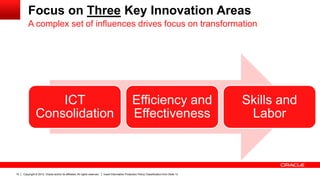
Focus on Three Key Innovation Areas
ICT
Consolidation
Efficiency and
Effectiveness
Skills and
Labor
A complex set of influences drives focus on transformation
Copyright © 2012, Oracle and/or its affiliates. All rights reserved. Insert Information Protection Policy Classification from Slide 1311
ICT Consolidation
 Governments need to be:
– Aware of the costs that can be saved on ICT consolidation.
 Datacenter consolidation and Centralized Licenses Agreements for whole
Government / Public Sector is a low-hanging fruit.
– Examining Cloud/Virtualization and Shared Service as future operation model
 Governments are investigation how local and “Safe Harbor” cloud services
can meet their privacy protection requirements.
– Collaborating around information and data sharing
 Programs (like Schengen, Europol, EESSI, HccH’s iSupport System) will be
more globally focused – cloud would save costs, improve deployment and
reduce risks on implementation/maintenance.
Copyright © 2012, Oracle and/or its affiliates. All rights reserved. Insert Information Protection Policy Classification from Slide 1312
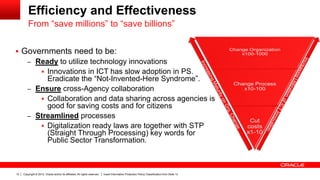
Efficiency and Effectiveness
 Governments need to be:
– Ready to utilize technology innovations
 Innovations in ICT has slow adoption in PS.
Eradicate the “Not-Invented-Here Syndrome”.
– Ensure cross-Agency collaboration
 Collaboration and data sharing across agencies is
good for saving costs and for citizens
– Streamlined processes
 Digitalization ready laws are together with STP
(Straight Through Processing) key words for
Public Sector Transformation.
From “save millions” to “save billions”
Copyright © 2012, Oracle and/or its affiliates. All rights reserved. Insert Information Protection Policy Classification from Slide 1313
Citizens and Employees
 Governments need to be:
– Aware of the Citizen’s Experience
 The citizen expects a comfortable journey – through health systems, through citizens
services, through the legal system.
– Ready for the demographic changes
 Governments face a triple challenge:
– Young people growing reluctance to join Public Sector,
– Most senior employees will retire and
– The aging population will increase the wage-gap between Public and Private
Sector.
– Willing to develop new service models
 This will change the operational set up of ICT. Consider data centers, cloud and XaaS
Copyright © 2012, Oracle and/or its affiliates. All rights reserved. Insert Information Protection Policy Classification from Slide 1314
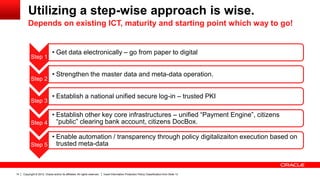
Utilizing a step-wise approach is wise.
Step 1
• Get data electronically – go from paper to digital
Step 2
• Strengthen the master data and meta-data operation.
Step 3
• Establish a national unified secure log-in – trusted PKI
Step 4
• Establish other key core infrastructures – unified “Payment Engine”, citizens
“public” clearing bank account, citizens DocBox.
Step 5
• Enable automation / transparency through policy digitalizaiton execution based on
trusted meta-data
Depends on existing ICT, maturity and starting point which way to go!
Copyright © 2012, Oracle and/or its affiliates. All rights reserved. Insert Information Protection Policy Classification from Slide 1315
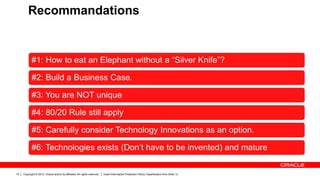
Recommandations
#1: How to eat an Elephant without a “Silver Knife”?
#2: Build a Business Case.
#3: You are NOT unique
#4: 80/20 Rule still apply
#5: Carefully consider Technology Innovations as an option.
#6: Technologies exists (Don’t have to be invented) and mature
Copyright © 2012, Oracle and/or its affiliates. All rights reserved. Insert Information Protection Policy Classification from Slide 1316
#1: The “right” path steered by maturity and
existing investments
 It’s complicated to eat an Elephant. Where to start?
 Different starting points makes every agency “individual”.
So from that point of view, you are unique.
 ICT investments should be respectful of existing investments
(“ex ante” / sunk cost).
Easier when you start from scratch / green field.
 There is NO SILVER BULLET (KNIFE?) on how to eat an
Elephant – but there is best practice and experience from
others.
 Oracle help agencies with drafting business cases and share
roadmap experiences through an INSIGHT engagement.
Copyright © 2012, Oracle and/or its affiliates. All rights reserved. Insert Information Protection Policy Classification from Slide 1317
#2: Build a business case
 As investment €/$/£ budgets are tight, you need to justify
investments – and buying, implementing and running an
ICT solution is not free.
 A holistic Business Case also quantify the areas with most
potential – need to balance investments with results.
 Remember to do “as-is” and “to-be” evaluations, so that
KPI’s of transformation can be followed and documented.
Copyright © 2012, Oracle and/or its affiliates. All rights reserved. Insert Information Protection Policy Classification from Slide 1318
#3: You are NOT unique.
 Remember: Public Sector Agencies are NOT unique from a
PROCESS point of view.
 Separate “What you do?” and “How you do it?”.
 PROCESSES are very similar globally, what differs are the
POLICIES / RULES.
 Separating PROCESSES from POLICIES also a must when
addressing high-performance / efficiency and how to enable STP –
Straight Through Processing.
 Hence almost all requirements can be dealt with using Commercial-
of-the-shelf Software and Hardware (so-called COTS).
Copyright © 2012, Oracle and/or its affiliates. All rights reserved. Insert Information Protection Policy Classification from Slide 1319
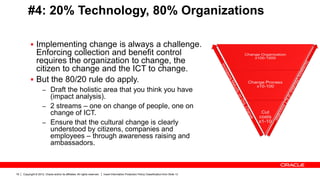
#4: 20% Technology, 80% Organizations
 Implementing change is always a challenge.
Enforcing collection and benefit control
requires the organization to change, the
citizen to change and the ICT to change.
 But the 80/20 rule do apply.
– Draft the holistic area that you think you have
(impact analysis).
– 2 streams – one on change of people, one on
change of ICT.
– Ensure that the cultural change is clearly
understood by citizens, companies and
employees – through awareness raising and
ambassadors.
Copyright © 2012, Oracle and/or its affiliates. All rights reserved. Insert Information Protection Policy Classification from Slide 1320
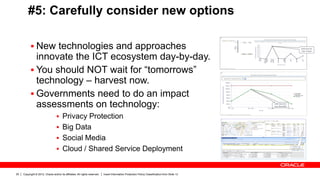
#5: Carefully consider new options
 New technologies and approaches
innovate the ICT ecosystem day-by-day.
 You should NOT wait for “tomorrows”
technology – harvest now.
 Governments need to do an impact
assessments on technology:
 Privacy Protection
 Big Data
 Social Media
 Cloud / Shared Service Deployment
Copyright © 2012, Oracle and/or its affiliates. All rights reserved. Insert Information Protection Policy Classification from Slide 1321
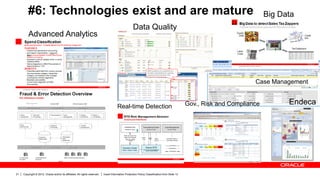
#6: Technologies exist and are mature Big Data
Advanced Analytics
Endeca
Data Quality
Gov., Risk and ComplianceReal-time Detection
Case Management
Copyright © 2012, Oracle and/or its affiliates. All rights reserved. Insert Information Protection Policy Classification from Slide 1322
Transforming Government
 Governments have to:
– Become more agile on their execution – no more ”we need 2-3 years to implement this
supporting system”.
– Reuse their data cross agencies with an undelying enablement infrastrcuture
– Focus on building and operating core infrastructures (if there isn’t a market doing that).
– Enable efficiency and insight through use of Big Data. Become more targeted,
knowledgable and segmented in policy execution
– Ensure a strong platform independence for the way that Citizens access information
(multi-channels). Enable mobility for case workers.
– Improved Citizen’s experience (digital and physical journey through Public Sector).
– Involve external industry experts (other countries and ICT expertise) to navigate
best practice and implementation of innovations through an advisory committee.
Copyright © 2012, Oracle and/or its affiliates. All rights reserved. Insert Information Protection Policy Classification from Slide 1323
Copyright © 2012, Oracle and/or its affiliates. All rights reserved. Insert Information Protection Policy Classification from Slide 1324

Digitalization of Public Sector: How to LeapFrog with ICT - global best practice.

  • 1.
    Copyright © 2012,Oracle and/or its affiliates. All rights reserved. Insert Information Protection Policy Classification from Slide 131 Keynote Address: Changing Public Sector through ICT Innovation Christian Wernberg-Tougaard, Director, Government, Education & Health EMEA
  • 2.
    Copyright © 2012,Oracle and/or its affiliates. All rights reserved. Insert Information Protection Policy Classification from Slide 132 The following is intended to outline our general product direction. It is intended for information purposes only, and may not be incorporated into any contract. It is not a commitment to deliver any material, code, or functionality, and should not be relied upon in making purchasing decision. The development, release, and timing of any features or functionality described for Oracle’s products remains at the sole discretion of Oracle. Safe Harbor Statement
  • 3.
    Copyright © 2012,Oracle and/or its affiliates. All rights reserved. Insert Information Protection Policy Classification from Slide 133 Some Key Trends Impacting Public Sector Paradigm shift Technology shift
  • 4.
    Copyright © 2012,Oracle and/or its affiliates. All rights reserved. Insert Information Protection Policy Classification from Slide 134 Mobility  Everybody wants mobility and access to everything.  It is accumulative – so more and more requirements.  5.7 billion mobile subscriptions by end of 2010 – including 940 million 3G connected.  Mobile access is possible for 90% of worlds population.  Internet access (in per cent of population): – Nordics: 95-98% – Europe: 60% – Africa: 9.2%
  • 5.
    Copyright © 2012,Oracle and/or its affiliates. All rights reserved. Insert Information Protection Policy Classification from Slide 135 Innovation Invented in 1809 Invented around ?1859
  • 6.
    Copyright © 2012,Oracle and/or its affiliates. All rights reserved. Insert Information Protection Policy Classification from Slide 136 Innovation  But when you strike gold, dig.  Characteristic: Same Business Problem (Open Can) solved with a variation of the product (Can Opener).  Game-changing innovation ... – The PC, Skype, iPhone, ICT Appliances (in-a-box solutions). So called ”canned solution” ...
  • 7.
    Copyright © 2012,Oracle and/or its affiliates. All rights reserved. Insert Information Protection Policy Classification from Slide 137 ICT Innovation  ICT innovation takes many forms: – User Interfaces and ease of use. – Interconnectivity across different platforms (ex. Netflix) – Hardware optimization and specialization – Product specialization – functional and industry-specific – etc etc etc  The complexity of the choices of which ICT innovations to include, is overwhelming for Governments and Agencies.  So how to choose the “right” innovations at the right time?
  • 8.
    Copyright © 2012,Oracle and/or its affiliates. All rights reserved. Insert Information Protection Policy Classification from Slide 138 Prerequisites for innovation to be utilized  The World Bank: Impact of new technology (5% market penetration). – 28 innovations in developed world -> 23 got penetration over 50%. – 67 innovations in developing world –> 6 got penetration over 50%.  Conclusion: – Technology innovation in developed world have higher acceptance rate and faster uptake. – This can be explained by the fact that core infrastructure in developed countries exists and are available for most citizens / companies.
  • 9.
    Copyright © 2012,Oracle and/or its affiliates. All rights reserved. Insert Information Protection Policy Classification from Slide 139 Prerequisites for innovation to be utilized (II)  So Governments should initially care about enabling core infrastructure services – rather than deploy advanced eServices to citizens. What is the point of a good service than no- one can access or authenticate? – Master Data: Governments needs to know who are who and what is what. Who are you, where do you live, what is your job, how many kids do you have, what is your school record, what is your health record etc. All of this is meta-data that can be connected to the MASTER DATA (or core registration data), the data that describes individuals, companies, property etc. Denmark can do “real-time” census and organizing a general election can be done in 17 days, all due to extensive and digital master data. – Authentication: In order to secure the rightfulness of users, citizens and companies to the services, one needs to validate identity. A unified PKI-infrastructure as a back-bone service could establish this. – Communication: Access to internet is a key requirement in order to offer services or demand digital service usage. As companies often have better options to be “mandated” to use digital services, G2B is the obvious choice to start with. And that might provide a better competitive marked for broad-band connectivity.
  • 10.
    Copyright © 2012,Oracle and/or its affiliates. All rights reserved. Insert Information Protection Policy Classification from Slide 1310 Focus on Three Key Innovation Areas ICT Consolidation Efficiency and Effectiveness Skills and Labor A complex set of influences drives focus on transformation
  • 11.
    Copyright © 2012,Oracle and/or its affiliates. All rights reserved. Insert Information Protection Policy Classification from Slide 1311 ICT Consolidation  Governments need to be: – Aware of the costs that can be saved on ICT consolidation.  Datacenter consolidation and Centralized Licenses Agreements for whole Government / Public Sector is a low-hanging fruit. – Examining Cloud/Virtualization and Shared Service as future operation model  Governments are investigation how local and “Safe Harbor” cloud services can meet their privacy protection requirements. – Collaborating around information and data sharing  Programs (like Schengen, Europol, EESSI, HccH’s iSupport System) will be more globally focused – cloud would save costs, improve deployment and reduce risks on implementation/maintenance.
  • 12.
    Copyright © 2012,Oracle and/or its affiliates. All rights reserved. Insert Information Protection Policy Classification from Slide 1312 Efficiency and Effectiveness  Governments need to be: – Ready to utilize technology innovations  Innovations in ICT has slow adoption in PS. Eradicate the “Not-Invented-Here Syndrome”. – Ensure cross-Agency collaboration  Collaboration and data sharing across agencies is good for saving costs and for citizens – Streamlined processes  Digitalization ready laws are together with STP (Straight Through Processing) key words for Public Sector Transformation. From “save millions” to “save billions”
  • 13.
    Copyright © 2012,Oracle and/or its affiliates. All rights reserved. Insert Information Protection Policy Classification from Slide 1313 Citizens and Employees  Governments need to be: – Aware of the Citizen’s Experience  The citizen expects a comfortable journey – through health systems, through citizens services, through the legal system. – Ready for the demographic changes  Governments face a triple challenge: – Young people growing reluctance to join Public Sector, – Most senior employees will retire and – The aging population will increase the wage-gap between Public and Private Sector. – Willing to develop new service models  This will change the operational set up of ICT. Consider data centers, cloud and XaaS
  • 14.
    Copyright © 2012,Oracle and/or its affiliates. All rights reserved. Insert Information Protection Policy Classification from Slide 1314 Utilizing a step-wise approach is wise. Step 1 • Get data electronically – go from paper to digital Step 2 • Strengthen the master data and meta-data operation. Step 3 • Establish a national unified secure log-in – trusted PKI Step 4 • Establish other key core infrastructures – unified “Payment Engine”, citizens “public” clearing bank account, citizens DocBox. Step 5 • Enable automation / transparency through policy digitalizaiton execution based on trusted meta-data Depends on existing ICT, maturity and starting point which way to go!
  • 15.
    Copyright © 2012,Oracle and/or its affiliates. All rights reserved. Insert Information Protection Policy Classification from Slide 1315 Recommandations #1: How to eat an Elephant without a “Silver Knife”? #2: Build a Business Case. #3: You are NOT unique #4: 80/20 Rule still apply #5: Carefully consider Technology Innovations as an option. #6: Technologies exists (Don’t have to be invented) and mature
  • 16.
    Copyright © 2012,Oracle and/or its affiliates. All rights reserved. Insert Information Protection Policy Classification from Slide 1316 #1: The “right” path steered by maturity and existing investments  It’s complicated to eat an Elephant. Where to start?  Different starting points makes every agency “individual”. So from that point of view, you are unique.  ICT investments should be respectful of existing investments (“ex ante” / sunk cost). Easier when you start from scratch / green field.  There is NO SILVER BULLET (KNIFE?) on how to eat an Elephant – but there is best practice and experience from others.  Oracle help agencies with drafting business cases and share roadmap experiences through an INSIGHT engagement.
  • 17.
    Copyright © 2012,Oracle and/or its affiliates. All rights reserved. Insert Information Protection Policy Classification from Slide 1317 #2: Build a business case  As investment €/$/£ budgets are tight, you need to justify investments – and buying, implementing and running an ICT solution is not free.  A holistic Business Case also quantify the areas with most potential – need to balance investments with results.  Remember to do “as-is” and “to-be” evaluations, so that KPI’s of transformation can be followed and documented.
  • 18.
    Copyright © 2012,Oracle and/or its affiliates. All rights reserved. Insert Information Protection Policy Classification from Slide 1318 #3: You are NOT unique.  Remember: Public Sector Agencies are NOT unique from a PROCESS point of view.  Separate “What you do?” and “How you do it?”.  PROCESSES are very similar globally, what differs are the POLICIES / RULES.  Separating PROCESSES from POLICIES also a must when addressing high-performance / efficiency and how to enable STP – Straight Through Processing.  Hence almost all requirements can be dealt with using Commercial- of-the-shelf Software and Hardware (so-called COTS).
  • 19.
    Copyright © 2012,Oracle and/or its affiliates. All rights reserved. Insert Information Protection Policy Classification from Slide 1319 #4: 20% Technology, 80% Organizations  Implementing change is always a challenge. Enforcing collection and benefit control requires the organization to change, the citizen to change and the ICT to change.  But the 80/20 rule do apply. – Draft the holistic area that you think you have (impact analysis). – 2 streams – one on change of people, one on change of ICT. – Ensure that the cultural change is clearly understood by citizens, companies and employees – through awareness raising and ambassadors.
  • 20.
    Copyright © 2012,Oracle and/or its affiliates. All rights reserved. Insert Information Protection Policy Classification from Slide 1320 #5: Carefully consider new options  New technologies and approaches innovate the ICT ecosystem day-by-day.  You should NOT wait for “tomorrows” technology – harvest now.  Governments need to do an impact assessments on technology:  Privacy Protection  Big Data  Social Media  Cloud / Shared Service Deployment
  • 21.
    Copyright © 2012,Oracle and/or its affiliates. All rights reserved. Insert Information Protection Policy Classification from Slide 1321 #6: Technologies exist and are mature Big Data Advanced Analytics Endeca Data Quality Gov., Risk and ComplianceReal-time Detection Case Management
  • 22.
    Copyright © 2012,Oracle and/or its affiliates. All rights reserved. Insert Information Protection Policy Classification from Slide 1322 Transforming Government  Governments have to: – Become more agile on their execution – no more ”we need 2-3 years to implement this supporting system”. – Reuse their data cross agencies with an undelying enablement infrastrcuture – Focus on building and operating core infrastructures (if there isn’t a market doing that). – Enable efficiency and insight through use of Big Data. Become more targeted, knowledgable and segmented in policy execution – Ensure a strong platform independence for the way that Citizens access information (multi-channels). Enable mobility for case workers. – Improved Citizen’s experience (digital and physical journey through Public Sector). – Involve external industry experts (other countries and ICT expertise) to navigate best practice and implementation of innovations through an advisory committee.
  • 23.
    Copyright © 2012,Oracle and/or its affiliates. All rights reserved. Insert Information Protection Policy Classification from Slide 1323
  • 24.
    Copyright © 2012,Oracle and/or its affiliates. All rights reserved. Insert Information Protection Policy Classification from Slide 1324