Towards the launch of
the eGovernment Action
Plan 2016-2020
Serge Novaretti
European Commission, DG CONNECT
Unit H3 Public Services
ICT for Government & Public
Services – activities
Policy
eGov Action Plan
Ministerial Conferences
Research&Innovation
H2020
ICT enabled PSI /
open government
Deployment
CEF / CIP LSPs:
Cross border digital
public services
eGovernance – eGovernment - eParticipation
Malmö Ministerial Declaration on
eGovernment (2009)
"… We aspire to a vision whereby European governments are
recognised for being open, flexible and collaborative in their
relations with citizens and businesses. They use
eGovernment to increase their efficiency and effectiveness
and to constantly improve public services in a way that caters
for users’ different needs and maximises public value, thus
supporting the transition of Europe to a leading knowledge-
based economy…"
Open, Innovative and Collaborative Government
Open
Data
Open
Process
Open
Service
Open
Government
Transparency Collaboration
Participation
Source of diagram: http://www.govloop.com/profiles/blogs/three-dimensions-of-open-government
'Vision for Public Services':
https://ec.europa.eu/digital-agenda/en/ict-enabled-public-sector-innovation-through-open-government
• User-friendly, digitaldigital service delivery to reduce administrative burden;
• ConnectingConnecting public administrations across Europe to facilitate seamless
cross-border service delivery and reuse of successful technologies;
• OpeningOpening government data, services and processes to engage third-
parties to create better or new services and help improve policies.
Vision for a digital, border-less and
open public administrations
Launching actions based
on a set of underling principles
• Digital-by-default: actions should privilege online delivery of services
while still enabling other channels for those who are disconnected by
choice or necessity, to ensure inclusiveness
• Cross-border by default: actions should not create new barriers to the
internal market
• Once-only principle: actions should require citizen / business
data/information only if not yet in possession of an administration
• Inclusive by default: actions should enable all citizens and businesses
to interact with the administration
• Privacy & data protection: all digital public services must be designed
with full respect for the protection of personal data as a fundamental
right
• Open & transparency by default: actions should be open for reuse or
transparency
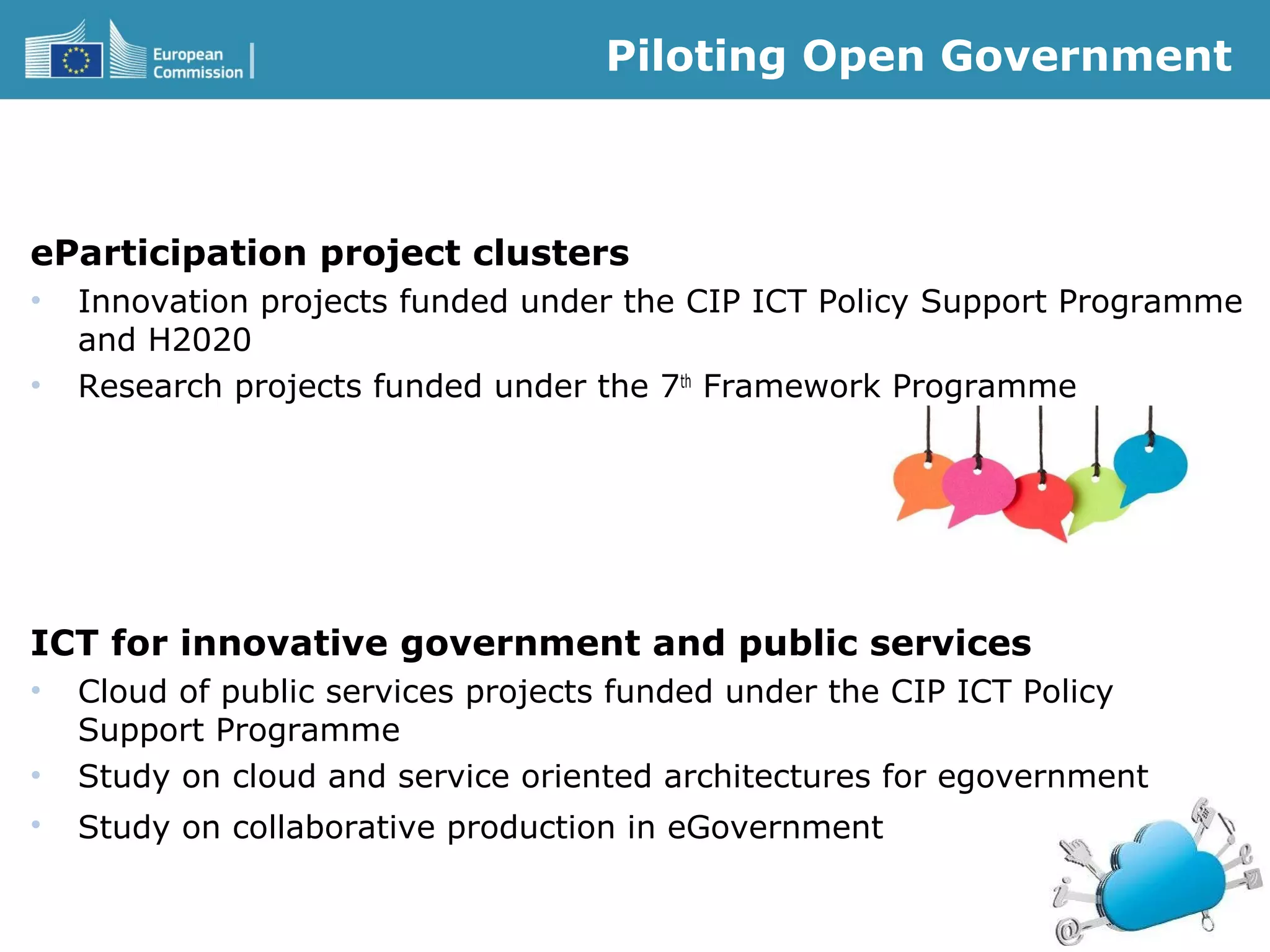
Piloting Open Government
eParticipation project clusters
• Innovation projects funded under the CIP ICT Policy Support Programme
and H2020
• Research projects funded under the 7th
Framework Programme
ICT for innovative government and public services
• Cloud of public services projects funded under the CIP ICT Policy
Support Programme
• Study on cloud and service oriented architectures for egovernment
• Study on collaborative production in eGovernment
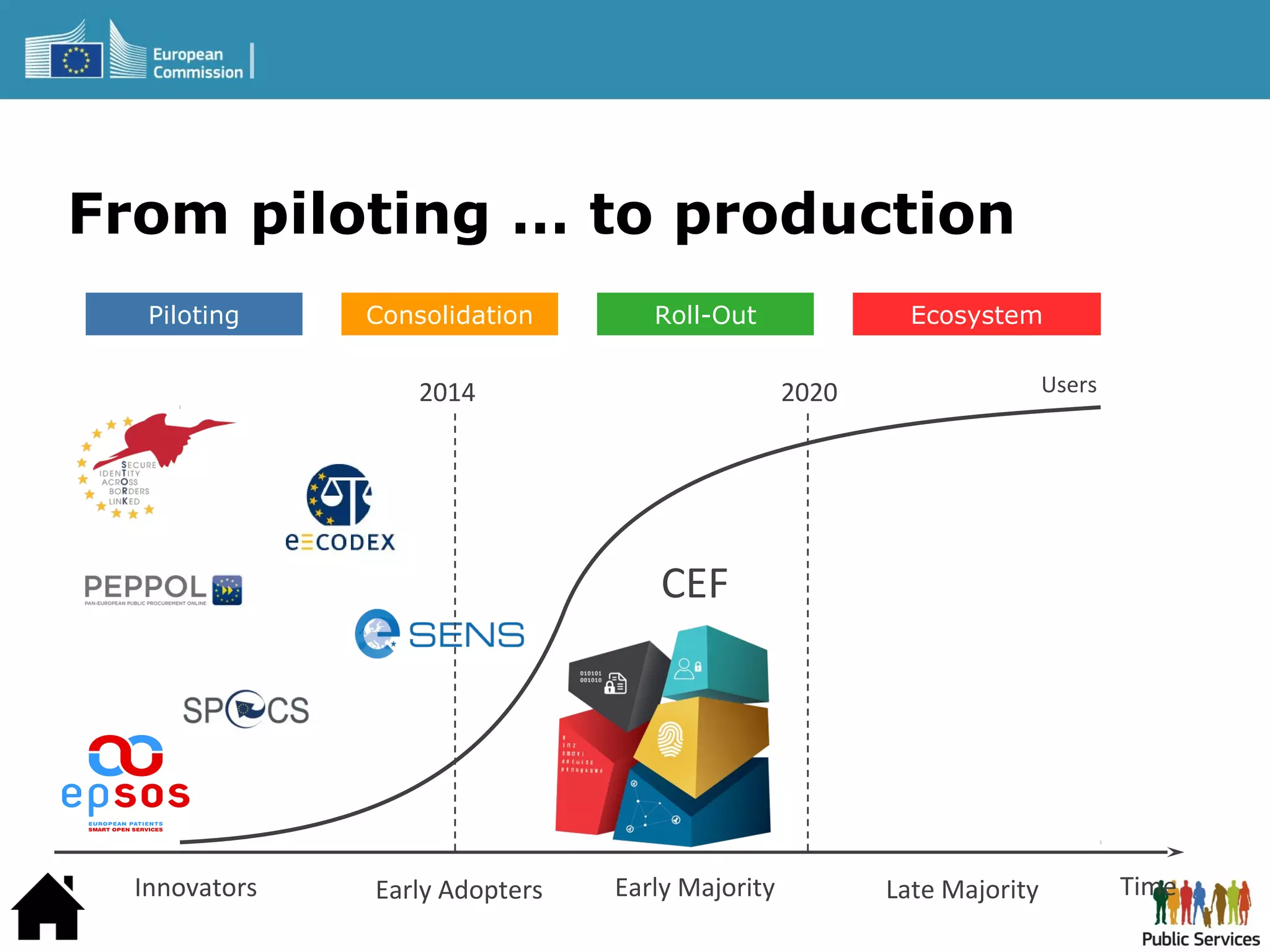
Piloting Consolidation Roll-Out Ecosystem
Users
TimeEarly Adopters Early Majority Late Majority
CEF
Innovators
2014 2020
From piloting … to production
eSENS Pilot
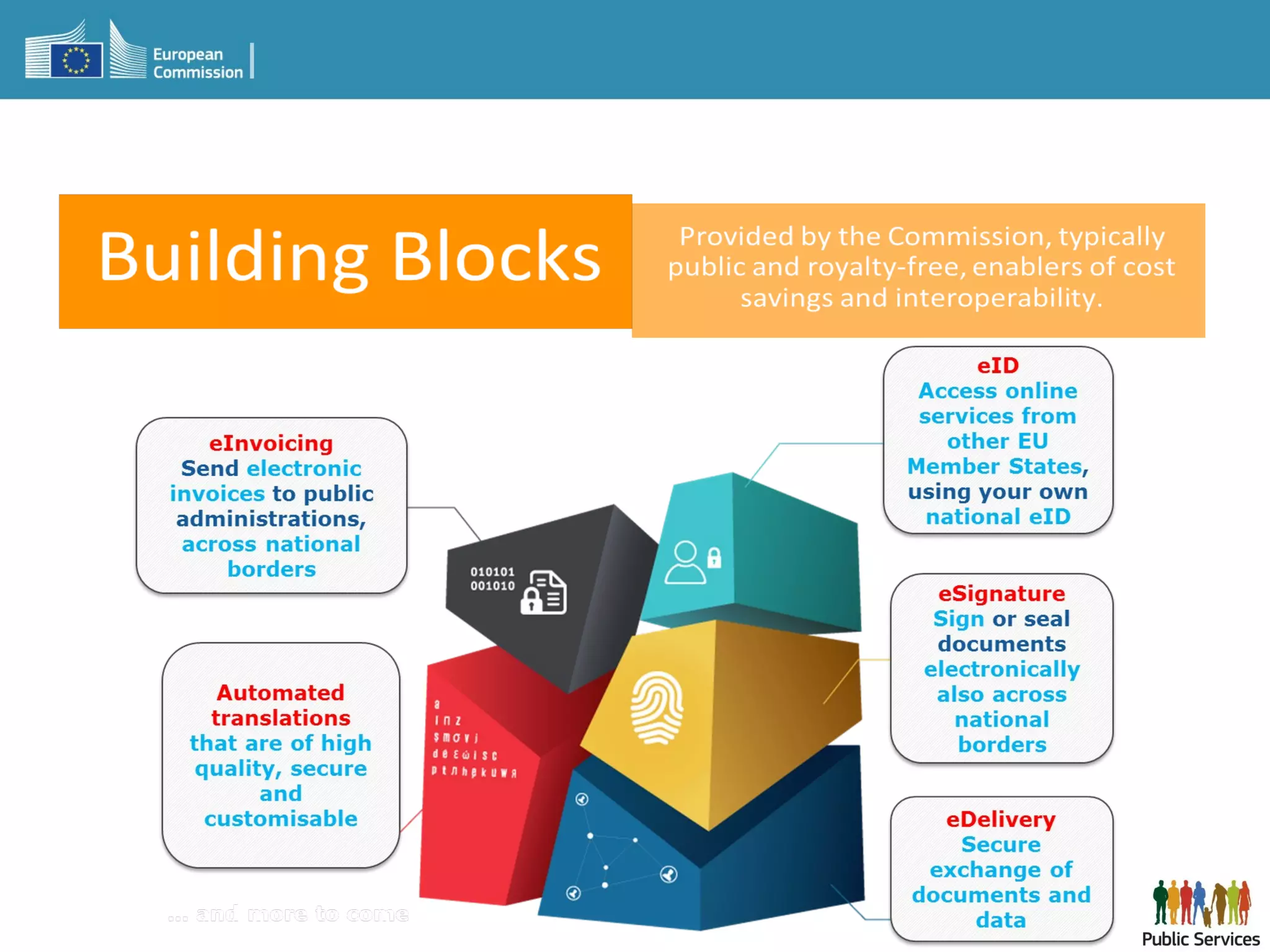
Digital Service
Infrastructures
Building block DSIs
Sector-specific DSIs
Maintenance
Training
Support
Stakeholder Management
Architecture
Software
Central
Services
Specifications
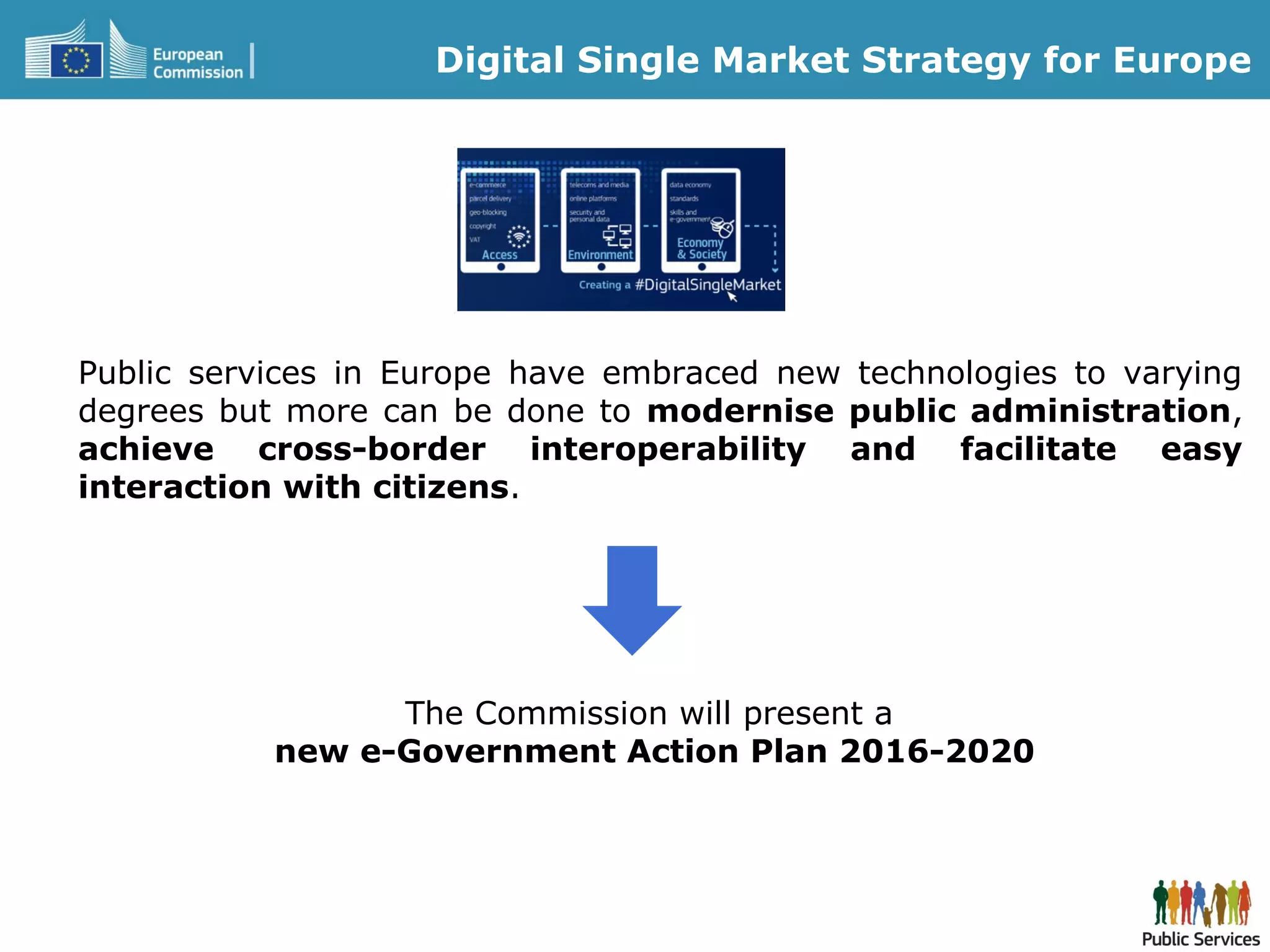
Public services in Europe have embraced new technologies to varying
degrees but more can be done to modernise public administration,
achieve cross-border interoperability and facilitate easy
interaction with citizens.
Digital Single Market Strategy for Europe
The Commission will present a
new e-Government Action Plan 2016-2020
Policy Priorities - Pillars
Key digital enablers & facilitators
DIGITALISE
Modernising
public
administration
with ICT
CONNECT
Enabling cross-
border mobility
with digital
public services
ENGAGE
Facilitating
participation in
policy making
and co creation
of services
eGovernment Action Plan
2016-2020
'…more can be done to modernise public administration,
achieve cross-border interoperability and facilitate easy
interaction with citizens….' (DSM Communication)
Two dimensions for the identification and
definition of actions:
• (i) one which serves to implement objectives agreed at EU-
level, in order to implement EU legislation or to identify further
areas where joint action is necessary to improve eGovernment
services in the EU (i.e. mandatory requirements set down in
EU law)
• (ii) another one which enables citizens and stakeholders to
suggest actions to be taken by Member States or the
Commission (i.e. actions that Member States commit to in a
voluntary manner)
Actions
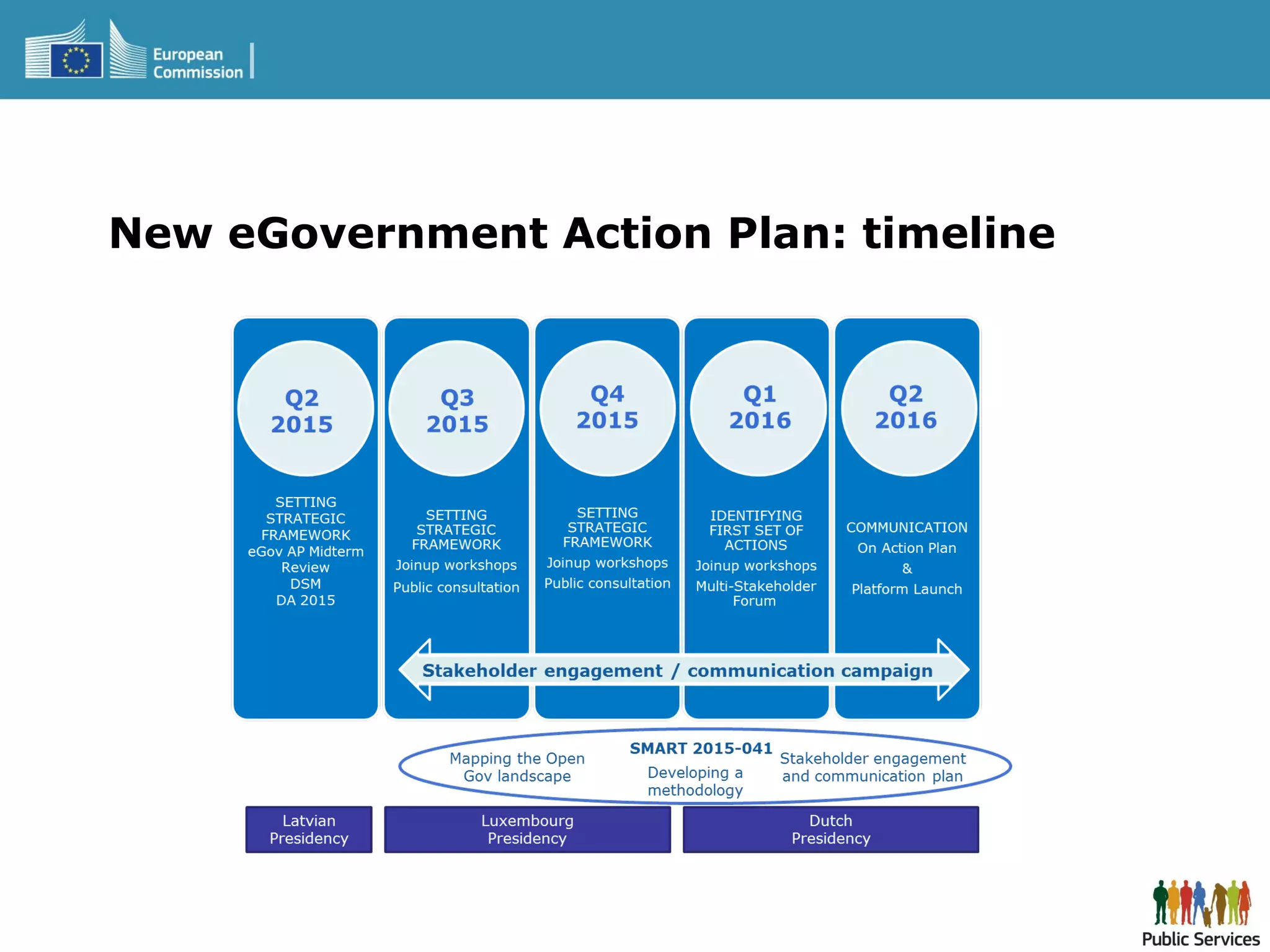
New eGovernment Action Plan: timeline
• Ideas for action can also be proposed, improved or voted on
by stakeholders
• These will be evaluated against a set of transparent criteria
(MS and EC)
• If selected, these will then be also reflected in one of the
pillars or among the enablers
• Actions approved will be implemented by the European
Commission and/or a number of Member States as well as
by stakeholders
Further actions to be proposed by stakeholders
Stakeholder Consultation
Platform with data
analytics tools
•Crowdsourcing ideas for
concrete action and submission
process
•Use of evidence, statistics and
data
•Filtering and selection process
•Monitoring and evaluating
implementation of actions
•Feedback mechanism and
iterative processes
MS1
MS2
MS3
MS4
MSx
EC
Filtering
Rules
Actions
DATA
Certified
Monitoring
Envisaged stakeholder engagement platform
Pillar II.Pillar I. Pillar III.
Key digital enablers
• Collecting ideas for concrete action, submission
process, voting
• Submit, modify and improve (co-create)
• Voting on proposed ideas
• Use of evidence, statistics and data to visualise
rationale, discover correlations, justify proposed
actions
• Substantiating ideas with evidence collected from any
source
• Key Performance Indicators
• Tools to visualise the relevant data, discover correlations
Functionalities I.
• Monitoring and evaluating implementation of
actions using data and measurements / KPIs
• Mechanism to enable monitoring of implementation
• Open and big data for real time results
• Feedback mechanism and iterative processes
• To improve the process iteratively
• To fine-tune the actions
-> Community management (discussions, posts,
blogs, etc.)
Functionalities II.
Stakeholder engagement platform
Read the Vision Paper
https://ec.europa.eu/digital-agenda/en/ict-enabled-public-sector-
innovation-through-open-government
H2020
http://ec.europa.eu/research/horizon2020
Public Services
http://ec.europa.eu/egovernment
Cnect-egovernment@ec.europa.eu
Thank you
Follow us on @EU_eGov EU_Public Services

eGovernment Action Plan 2016-2020, UC

  • 1.
    Towards the launchof the eGovernment Action Plan 2016-2020 Serge Novaretti European Commission, DG CONNECT Unit H3 Public Services
  • 2.
    ICT for Government& Public Services – activities Policy eGov Action Plan Ministerial Conferences Research&Innovation H2020 ICT enabled PSI / open government Deployment CEF / CIP LSPs: Cross border digital public services eGovernance – eGovernment - eParticipation
  • 3.
    Malmö Ministerial Declarationon eGovernment (2009) "… We aspire to a vision whereby European governments are recognised for being open, flexible and collaborative in their relations with citizens and businesses. They use eGovernment to increase their efficiency and effectiveness and to constantly improve public services in a way that caters for users’ different needs and maximises public value, thus supporting the transition of Europe to a leading knowledge- based economy…"
  • 4.
    Open, Innovative andCollaborative Government Open Data Open Process Open Service Open Government Transparency Collaboration Participation Source of diagram: http://www.govloop.com/profiles/blogs/three-dimensions-of-open-government 'Vision for Public Services': https://ec.europa.eu/digital-agenda/en/ict-enabled-public-sector-innovation-through-open-government
  • 5.
    • User-friendly, digitaldigitalservice delivery to reduce administrative burden; • ConnectingConnecting public administrations across Europe to facilitate seamless cross-border service delivery and reuse of successful technologies; • OpeningOpening government data, services and processes to engage third- parties to create better or new services and help improve policies. Vision for a digital, border-less and open public administrations
  • 6.
    Launching actions based ona set of underling principles • Digital-by-default: actions should privilege online delivery of services while still enabling other channels for those who are disconnected by choice or necessity, to ensure inclusiveness • Cross-border by default: actions should not create new barriers to the internal market • Once-only principle: actions should require citizen / business data/information only if not yet in possession of an administration • Inclusive by default: actions should enable all citizens and businesses to interact with the administration • Privacy & data protection: all digital public services must be designed with full respect for the protection of personal data as a fundamental right • Open & transparency by default: actions should be open for reuse or transparency
  • 8.
    Piloting Open Government eParticipationproject clusters • Innovation projects funded under the CIP ICT Policy Support Programme and H2020 • Research projects funded under the 7th Framework Programme ICT for innovative government and public services • Cloud of public services projects funded under the CIP ICT Policy Support Programme • Study on cloud and service oriented architectures for egovernment • Study on collaborative production in eGovernment
  • 9.
    Piloting Consolidation Roll-OutEcosystem Users TimeEarly Adopters Early Majority Late Majority CEF Innovators 2014 2020 From piloting … to production
  • 10.
  • 11.
  • 13.
  • 14.
    Public services inEurope have embraced new technologies to varying degrees but more can be done to modernise public administration, achieve cross-border interoperability and facilitate easy interaction with citizens. Digital Single Market Strategy for Europe The Commission will present a new e-Government Action Plan 2016-2020
  • 15.
    Policy Priorities -Pillars Key digital enablers & facilitators DIGITALISE Modernising public administration with ICT CONNECT Enabling cross- border mobility with digital public services ENGAGE Facilitating participation in policy making and co creation of services eGovernment Action Plan 2016-2020 '…more can be done to modernise public administration, achieve cross-border interoperability and facilitate easy interaction with citizens….' (DSM Communication)
  • 16.
    Two dimensions forthe identification and definition of actions: • (i) one which serves to implement objectives agreed at EU- level, in order to implement EU legislation or to identify further areas where joint action is necessary to improve eGovernment services in the EU (i.e. mandatory requirements set down in EU law) • (ii) another one which enables citizens and stakeholders to suggest actions to be taken by Member States or the Commission (i.e. actions that Member States commit to in a voluntary manner) Actions
  • 17.
    New eGovernment ActionPlan: timeline
  • 18.
    • Ideas foraction can also be proposed, improved or voted on by stakeholders • These will be evaluated against a set of transparent criteria (MS and EC) • If selected, these will then be also reflected in one of the pillars or among the enablers • Actions approved will be implemented by the European Commission and/or a number of Member States as well as by stakeholders Further actions to be proposed by stakeholders
  • 19.
    Stakeholder Consultation Platform withdata analytics tools •Crowdsourcing ideas for concrete action and submission process •Use of evidence, statistics and data •Filtering and selection process •Monitoring and evaluating implementation of actions •Feedback mechanism and iterative processes MS1 MS2 MS3 MS4 MSx EC Filtering Rules Actions DATA Certified Monitoring Envisaged stakeholder engagement platform Pillar II.Pillar I. Pillar III. Key digital enablers
  • 20.
    • Collecting ideasfor concrete action, submission process, voting • Submit, modify and improve (co-create) • Voting on proposed ideas • Use of evidence, statistics and data to visualise rationale, discover correlations, justify proposed actions • Substantiating ideas with evidence collected from any source • Key Performance Indicators • Tools to visualise the relevant data, discover correlations Functionalities I.
  • 21.
    • Monitoring andevaluating implementation of actions using data and measurements / KPIs • Mechanism to enable monitoring of implementation • Open and big data for real time results • Feedback mechanism and iterative processes • To improve the process iteratively • To fine-tune the actions -> Community management (discussions, posts, blogs, etc.) Functionalities II.
  • 22.
  • 24.
    Read the VisionPaper https://ec.europa.eu/digital-agenda/en/ict-enabled-public-sector- innovation-through-open-government H2020 http://ec.europa.eu/research/horizon2020 Public Services http://ec.europa.eu/egovernment Cnect-egovernment@ec.europa.eu Thank you Follow us on @EU_eGov EU_Public Services