ICT as an infrastructure for Investment

Ashraf Abdelwahab, Ph.D.
Corporate Affairs Manager
Egypt & North Africa
asab@microsoft.com
Microsoft
AGENDA
Investing in ICT infrastructure
Connected Government: Government as a
Service
New Technologies, New Era
The Cloud
How can Microsoft support Iraqi’s Economic
Growth?
The case of Egypt

2
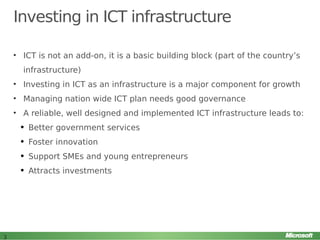
Investing in ICT infrastructure
• ICT is not an add-on, it is a basic building block (part of the country’s
infrastructure)
• Investing in ICT as an infrastructure is a major component for growth
• Managing nation wide ICT plan needs good governance
• A reliable, well designed and implemented ICT infrastructure leads to:
q

q

Foster innovation

q

Support SMEs and young entrepreneurs

q

3

Better government services

Attracts investments
How?
• International ICT companies would invest in Iraq if there is a clear vision,
that translates into a set of policies to support ICT. For example:
q

Transform government services to electronic format (including health, education,
justice, subsidy, …)

q

Deploy broadband connectivity and explore alternative technologies

q

Promote access to Internet through different models

q

Neutral and open Government Procurement law and regulations

q

Support IPR through fair regulations and law enforcement mechanisms

q

Legislative infrastructure for data protection and privacy, cyber security,
authentication, ….

q

Adopting outsourcing for implementing government ICT projects

q

Encouraging PPP models for capital intensive ICT projects

q

Partner as government with International ICT companies for better deals on
products and the development of the Iraqi’s ICT eco system

q

q

4

Support initiatives for capacity building in ICT
Establish hubs for innovation and technology (including ICT Zones)
Connected Government: Government
as a service
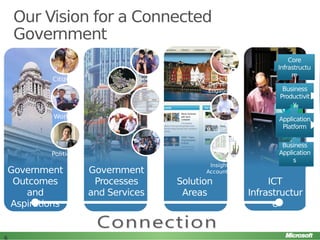
Our Vision for a Connected
Government
Service
Delivery and
Engagement

Citizens

Workers
Workplace
Modernization

Politicians

Government
Outcomes
and
Aspirations

6

Government
Processes
and Services

Insight and
Accountability

Solution
Areas

Core
Infrastructu
re
Business
Productivit
y
Application
Platform
Business
Application
s

ICT
Infrastructur
e
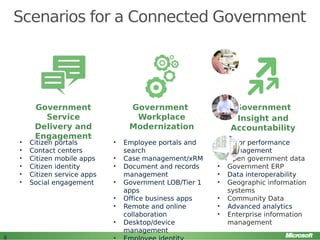
Scenarios for a Connected Government

•
•
•
•
•
•

Government
Service
Delivery and
Engagement

Citizen portals
Contact centers
Citizen mobile apps
Citizen identity
Citizen service apps
Social engagement

Government
Workplace
Modernization
•
•
•
•
•
•
•

8

Employee portals and
search
Case management/xRM
Document and records
management
Government LOB/Tier 1
apps
Office business apps
Remote and online
collaboration
Desktop/device
management

Government
Insight and
Accountability
•
•
•
•
•
•
•
•

BI for performance
management
Open government data
Government ERP
Data interoperability
Geographic information
systems
Community Data
Advanced analytics
Enterprise information
management
New Technologies, New era
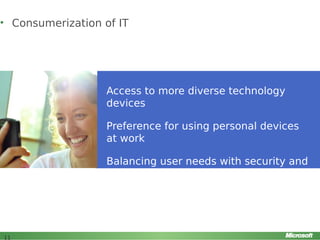
• Consumerization of IT

Access to more diverse technology
devices
Preference for using personal devices
at work
Balancing user needs with security and
compliance requirements

11
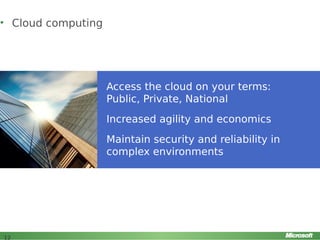
• Cloud computing

Access the cloud on your terms:
Public, Private, National
Increased agility and economics
Maintain security and reliability in
complex environments

12
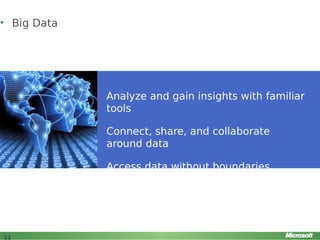
• Big Data

Analyze and gain insights with familiar
tools
Connect, share, and collaborate
around data
Access data without boundaries

13
• Connected Enterprise
•
Integrate social into customer
business processes
Identify line-of-business owner requirements
Start simple and share wins
Pilot social in a B2C application

14
The Cloud

15
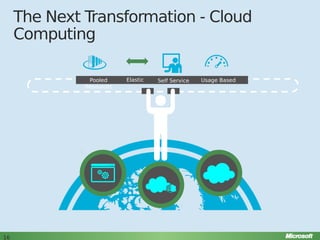
The Next Transformation - Cloud
Computing
Pooled
Resources

16

Elastic

Self Service

Usage Based
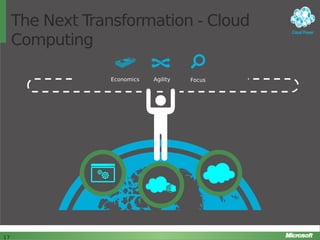
The Next Transformation - Cloud
Computing
Economics

17

Agility

Focus

17
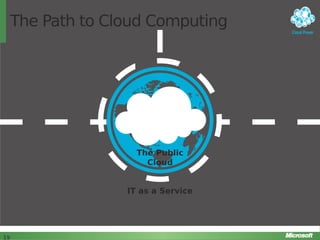
The Path to Cloud Computing

The Public
Cloud
IT as a Service

19

19
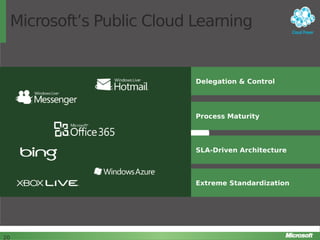
Microsoft’s Public Cloud Learning

Delegation & Control

Customer Self Service

Re-imagined
Processes

Automation

Scale Out Application

Change Control

Process Maturity

SLA-Driven Architecture

Extreme Standardization

20

20
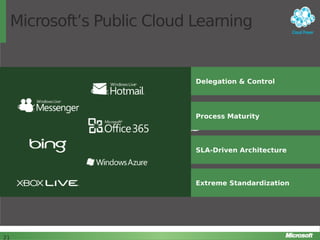
Microsoft’s Public Cloud Learning

Delegation & Control

Process Maturity

The Public
Cloud

SLA-Driven Architecture

Extreme Standardization

21

21
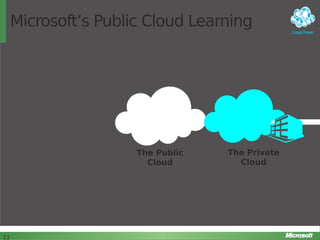
Microsoft’s Public Cloud Learning

The Public
Cloud

22

The Private
Cloud

22
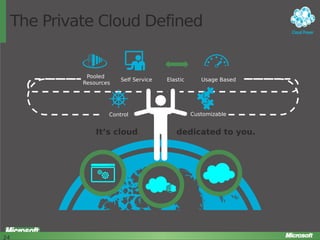
The Private Cloud Defined

Pooled
Resources

Self Service

Control

It’s cloud

24

Elastic

Usage Based

Customizable

dedicated to you.

24
Important Questions ?
• What “IT Service” are you offering ?

• What resources are you going to
Manage ?

• Which resources do Entities (Consumers ) are managing

25

25
Applications

Runtimes

Security,
Management, Load
Balancing &
Integration

Storage
Virtualization
OS
Server
Hardware
Networking

Databases
Security,
Management, Load
Balancing &
Integration

Storage
You Manage

You Manage

Databases

Runtimes

Virtualization
OS
Server
Hardware
Networking

Higher Control & Higher Cost

26

Runtimes
Databases
Security,
Management, Load
Balancing &
Integration

Storage
Virtualization
OS
Server
Hardware
Networking

Consumed By Entity

Applications

Platform as a
Service
(PaaS)
Applications

You Manage

Infrastructure
as a Service
(IaaS)
Managed By
Entity

Traditional IT

You Manage Managed By Entity

“IT as Service” Offerings
Software as a
Service
(SaaS)
Applications
Runtimes
Databases
Security,
Management, Load
Balancing &
Integration

Storage
Virtualization
OS
Server
Hardware
Networking

Lower Cost & Higher Agility

26
How can Microsoft support Iraqi’s Economic
Growth?
The case of Egypt
Strategic partnership with Government
• The Government of Egypt got into a strategic partnership with
Microsoft in 2000
q

Microsoft was the first international company to establish its
subsidiary’s HQ in the Smart Village

q

Establish the ATL (Advance Technology Lab) in Egypt, one of 5 labs
around the world for applications’ research

q

Establish Center of Expertise in Egypt

• The Enterprise Agreement between GoE and MS legalizes all
licenses in Government (desktop and servers) in addition to
supporting the E-government program

28
Developing the Eco System
• Microsoft partners in Egypt increased from 2 in 2000 to over 1000
in 2013 (about 25% of the total ICT companies in Egypt)
• According to IDC, Microsoft partners earn more than 8 EGP for
every EGP earned by Microsoft
• Microsoft is the only company that doubled the number of
employees after the revolution in 2011
• As a result of the outsourcing policy, and based on expertise
acquired by MS partners, they were able to open new businesses
abroad (Arab/African countries, and even Europe and the US)
• Developing thousands of youth and young entrepreneurs on
Microsoft products
• Establishing the Win 8 App Factory for mobile applications (5th
around the world)
29
The National Cloud and the SMEs
• Moving to the Cloud:
q

q

Providing marketing and customer relations tools

q

Tools for e-commerce

q

Build capacity of IT SMEs to support other SMEs

q

30

Availing productivity tools to SMEs

Develop mobile apps
The National Cloud and PPP
• Automation and delivering quality services to citizens is costly and
time consuming
• One way to speed up the process is through the partnership with the
Private sector
• The government has two options:
q

Set the standards and develop a SLA framework for private
companies to automate, operate and maintain a specific
organization (for example, the Real Estate Registry)

q

Or, the government develops the main application and private
sector companies takes care of its deployment in different offices,
providing connectivity, support and maintenance

• Payment can be based on number of transactions performed
• All data and applications are stored on the National Cloud
31
© 2013 Microsoft Corporation. All rights reserved.
This presentation is for information purposes only. Microsoft makes no warranties, express or implied, in this summary.
Microsoft, Active Directory, Bing, BizTalk, Excel, Forefront, InfoPath, Kinect, Lync, Microsoft Dynamics, SharePoint, Silverlight, SQL Azure,
SQL Server, Surface, Visual Studio, Windows, Windows Azure, Windows Mobile, Windows Server, and Xbox are trademarks of the Microsoft
group of companies.
The names of actual companies and products mentioned herein may be the trademarks of their respective owners.

ICT as an infrastructure for investment in Iraq

  • 1.
    ICT as aninfrastructure for Investment Ashraf Abdelwahab, Ph.D. Corporate Affairs Manager Egypt & North Africa asab@microsoft.com Microsoft
  • 2.
    AGENDA Investing in ICTinfrastructure Connected Government: Government as a Service New Technologies, New Era The Cloud How can Microsoft support Iraqi’s Economic Growth? The case of Egypt 2
  • 3.
    Investing in ICTinfrastructure • ICT is not an add-on, it is a basic building block (part of the country’s infrastructure) • Investing in ICT as an infrastructure is a major component for growth • Managing nation wide ICT plan needs good governance • A reliable, well designed and implemented ICT infrastructure leads to: q q Foster innovation q Support SMEs and young entrepreneurs q 3 Better government services Attracts investments
  • 4.
    How? • International ICTcompanies would invest in Iraq if there is a clear vision, that translates into a set of policies to support ICT. For example: q Transform government services to electronic format (including health, education, justice, subsidy, …) q Deploy broadband connectivity and explore alternative technologies q Promote access to Internet through different models q Neutral and open Government Procurement law and regulations q Support IPR through fair regulations and law enforcement mechanisms q Legislative infrastructure for data protection and privacy, cyber security, authentication, …. q Adopting outsourcing for implementing government ICT projects q Encouraging PPP models for capital intensive ICT projects q Partner as government with International ICT companies for better deals on products and the development of the Iraqi’s ICT eco system q q 4 Support initiatives for capacity building in ICT Establish hubs for innovation and technology (including ICT Zones)
  • 5.
  • 6.
    Our Vision fora Connected Government Service Delivery and Engagement Citizens Workers Workplace Modernization Politicians Government Outcomes and Aspirations 6 Government Processes and Services Insight and Accountability Solution Areas Core Infrastructu re Business Productivit y Application Platform Business Application s ICT Infrastructur e
  • 7.
    Scenarios for aConnected Government • • • • • • Government Service Delivery and Engagement Citizen portals Contact centers Citizen mobile apps Citizen identity Citizen service apps Social engagement Government Workplace Modernization • • • • • • • 8 Employee portals and search Case management/xRM Document and records management Government LOB/Tier 1 apps Office business apps Remote and online collaboration Desktop/device management Government Insight and Accountability • • • • • • • • BI for performance management Open government data Government ERP Data interoperability Geographic information systems Community Data Advanced analytics Enterprise information management
  • 8.
  • 9.
    • Consumerization ofIT Access to more diverse technology devices Preference for using personal devices at work Balancing user needs with security and compliance requirements 11
  • 10.
    • Cloud computing Accessthe cloud on your terms: Public, Private, National Increased agility and economics Maintain security and reliability in complex environments 12
  • 11.
    • Big Data Analyzeand gain insights with familiar tools Connect, share, and collaborate around data Access data without boundaries 13
  • 12.
    • Connected Enterprise • Integratesocial into customer business processes Identify line-of-business owner requirements Start simple and share wins Pilot social in a B2C application 14
  • 13.
  • 14.
    The Next Transformation- Cloud Computing Pooled Resources 16 Elastic Self Service Usage Based
  • 15.
    The Next Transformation- Cloud Computing Economics 17 Agility Focus 17
  • 16.
    The Path toCloud Computing The Public Cloud IT as a Service 19 19
  • 17.
    Microsoft’s Public CloudLearning Delegation & Control Customer Self Service Re-imagined Processes Automation Scale Out Application Change Control Process Maturity SLA-Driven Architecture Extreme Standardization 20 20
  • 18.
    Microsoft’s Public CloudLearning Delegation & Control Process Maturity The Public Cloud SLA-Driven Architecture Extreme Standardization 21 21
  • 19.
    Microsoft’s Public CloudLearning The Public Cloud 22 The Private Cloud 22
  • 20.
    The Private CloudDefined Pooled Resources Self Service Control It’s cloud 24 Elastic Usage Based Customizable dedicated to you. 24
  • 21.
    Important Questions ? •What “IT Service” are you offering ? • What resources are you going to Manage ? • Which resources do Entities (Consumers ) are managing 25 25
  • 22.
    Applications Runtimes Security, Management, Load Balancing & Integration Storage Virtualization OS Server Hardware Networking Databases Security, Management,Load Balancing & Integration Storage You Manage You Manage Databases Runtimes Virtualization OS Server Hardware Networking Higher Control & Higher Cost 26 Runtimes Databases Security, Management, Load Balancing & Integration Storage Virtualization OS Server Hardware Networking Consumed By Entity Applications Platform as a Service (PaaS) Applications You Manage Infrastructure as a Service (IaaS) Managed By Entity Traditional IT You Manage Managed By Entity “IT as Service” Offerings Software as a Service (SaaS) Applications Runtimes Databases Security, Management, Load Balancing & Integration Storage Virtualization OS Server Hardware Networking Lower Cost & Higher Agility 26
  • 23.
    How can Microsoftsupport Iraqi’s Economic Growth? The case of Egypt
  • 24.
    Strategic partnership withGovernment • The Government of Egypt got into a strategic partnership with Microsoft in 2000 q Microsoft was the first international company to establish its subsidiary’s HQ in the Smart Village q Establish the ATL (Advance Technology Lab) in Egypt, one of 5 labs around the world for applications’ research q Establish Center of Expertise in Egypt • The Enterprise Agreement between GoE and MS legalizes all licenses in Government (desktop and servers) in addition to supporting the E-government program 28
  • 25.
    Developing the EcoSystem • Microsoft partners in Egypt increased from 2 in 2000 to over 1000 in 2013 (about 25% of the total ICT companies in Egypt) • According to IDC, Microsoft partners earn more than 8 EGP for every EGP earned by Microsoft • Microsoft is the only company that doubled the number of employees after the revolution in 2011 • As a result of the outsourcing policy, and based on expertise acquired by MS partners, they were able to open new businesses abroad (Arab/African countries, and even Europe and the US) • Developing thousands of youth and young entrepreneurs on Microsoft products • Establishing the Win 8 App Factory for mobile applications (5th around the world) 29
  • 26.
    The National Cloudand the SMEs • Moving to the Cloud: q q Providing marketing and customer relations tools q Tools for e-commerce q Build capacity of IT SMEs to support other SMEs q 30 Availing productivity tools to SMEs Develop mobile apps
  • 27.
    The National Cloudand PPP • Automation and delivering quality services to citizens is costly and time consuming • One way to speed up the process is through the partnership with the Private sector • The government has two options: q Set the standards and develop a SLA framework for private companies to automate, operate and maintain a specific organization (for example, the Real Estate Registry) q Or, the government develops the main application and private sector companies takes care of its deployment in different offices, providing connectivity, support and maintenance • Payment can be based on number of transactions performed • All data and applications are stored on the National Cloud 31
  • 28.
    © 2013 MicrosoftCorporation. All rights reserved. This presentation is for information purposes only. Microsoft makes no warranties, express or implied, in this summary. Microsoft, Active Directory, Bing, BizTalk, Excel, Forefront, InfoPath, Kinect, Lync, Microsoft Dynamics, SharePoint, Silverlight, SQL Azure, SQL Server, Surface, Visual Studio, Windows, Windows Azure, Windows Mobile, Windows Server, and Xbox are trademarks of the Microsoft group of companies. The names of actual companies and products mentioned herein may be the trademarks of their respective owners.