Regional Policy in Europe
Sevilla 17.12.2013

“Regional Digital Agendas"
Miguel Gonzalez-Sancho
European Commission
DG Communications Networks, Content and Technology
Overview
•

Digital Agenda and scoreboard

•

Broadband

•

Cohesion policy and ICT

•

Jobs & skills; Horizon 2020; conclusions
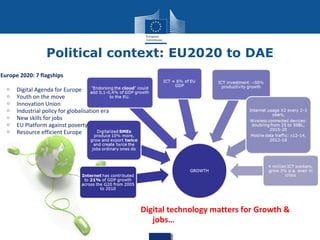
Political context: EU2020 to DAE
Europe 2020: 7 flagships
o
o
o
o
o
o
o

Digital Agenda for Europe
Youth on the move
Innovation Union
Industrial policy for globalisation era
New skills for jobs
EU Platform against poverty
Resource efficient Europe

Digital technology matters for Growth &
jobs…
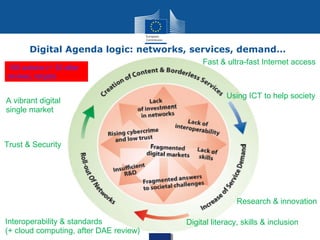
Digital Agenda logic: networks, services, demand…
100 actions (+ 32 after
review), targets

A vibrant digital
single market

Fast & ultra-fast Internet access

Using ICT to help society

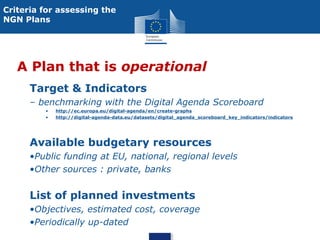
Trust & Security

Research & innovation
Interoperability & standards
(+ cloud computing, after DAE review)

Digital literacy, skills & inclusion
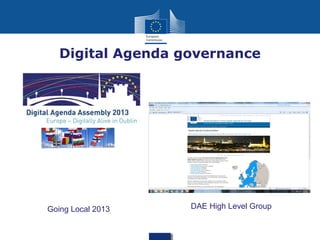
Digital Agenda governance

Going Local 2013

DAE High Level Group
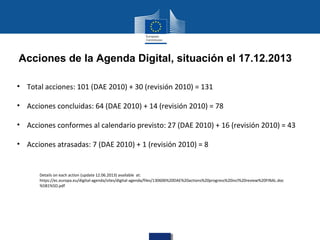
Acciones de la Agenda Digital, situación el 17.12.2013
• Total acciones: 101 (DAE 2010) + 30 (revisión 2010) = 131
• Acciones concluidas: 64 (DAE 2010) + 14 (revisión 2010) = 78
• Acciones conformes al calendario previsto: 27 (DAE 2010) + 16 (revisión 2010) = 43
• Acciones atrasadas: 7 (DAE 2010) + 1 (revisión 2010) = 8

Details on each action (update 12.06.2013) available at:
https://ec.europa.eu/digital-agenda/sites/digital-agenda/files/130606%20DAE%20actions%20progress%20incl%20review%20FINAL.doc
%5B1%5D.pdf
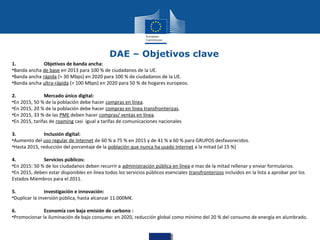
DAE – Objetivos clave
1.
Objetivos de banda ancha:
•Banda ancha de base en 2013 para 100 % de ciudadanos de la UE.
•Banda ancha rápida (> 30 Mbps) en 2020 para 100 % de ciudadanos de la UE.
•Banda ancha ultra-rápida (> 100 Mbps) en 2020 para 50 % de hogares europeos.
2.
Mercado único digital:
•En 2015, 50 % de la población debe hacer compras en línea.
•En 2015, 20 % de la población debe hacer compras en línea transfronterizas.
•En 2015, 33 % de las PME deben hacer compras/ ventas en línea.
•En 2015, tarifas de roaming casi igual a tarifas de comunicaciones nacionales
3.
Inclusión digital:
•Aumento del uso regular de Internet de 60 % a 75 % en 2015 y de 41 % a 60 % para GRUPOS desfavorecidos.
•Hasta 2015, reducción del porcentaje de la población que nunca ha usado Internet a la mitad (al 15 %)
4.
Servicios públicos:
•En 2015: 50 % de los ciudadanos deben recurrir a administración pública en línea e mas de la mitad rellenar y enviar formularios.
•En 2015, deben estar disponibles en línea todos los servicios públicos esenciales transfronterizos incluidos en la lista a aprobar por los
Estados Miembros para el 2011.
5.
Investigación e innovación:
•Duplicar la inversión pública, hasta alcanzar 11.000M€.
6.
Economía con baja emisión de carbono :
•Promocionar la iluminación de bajo consumo: en 2020, reducción global como mínimo del 20 % del consumo de energía en alumbrado.
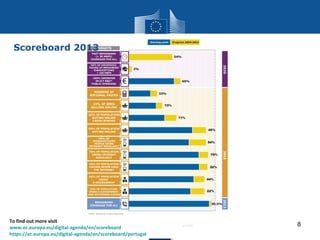
Scoreboard 2013

To find out more visit
www.ec.europa.eu/digital-agenda/en/scoreboard
https://ec.europa.eu/digital-agenda/en/scoreboard/portugal

8
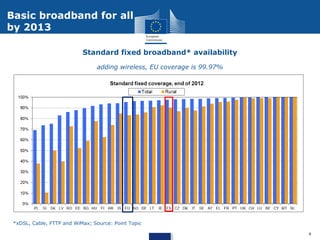
Basic broadband for all
by 2013
Standard fixed broadband* availability
adding wireless, EU coverage is 99.97%

*xDSL, Cable, FTTP and WiMax; Source: Point Topic
9
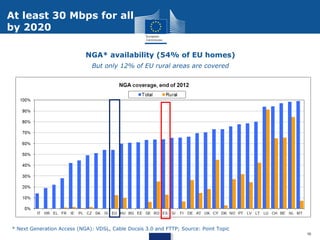
At least 30 Mbps for all
by 2020
NGA* availability (54% of EU homes)
But only 12% of EU rural areas are covered

* Next Generation Access (NGA): VDSL, Cable Docsis 3.0 and FTTP; Source: Point Topic
10
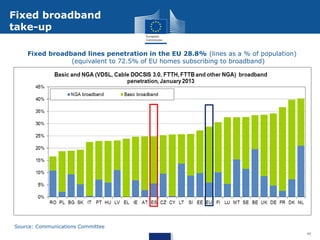
Fixed broadband
take-up
Fixed broadband lines penetration in the EU 28.8% (lines as a % of population)
(equivalent to 72.5% of EU homes subscribing to broadband)

Source: Communications Committee
11
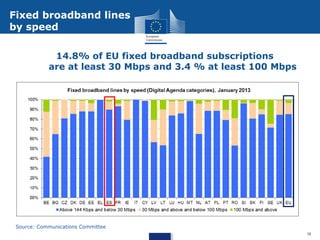
Fixed broadband lines
by speed
14.8% of EU fixed broadband subscriptions
are at least 30 Mbps and 3.4 % at least 100 Mbps

Source: Communications Committee
12
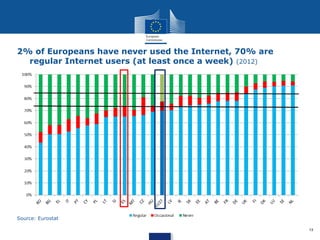
2% of Europeans have never used the Internet, 70% are
regular Internet users (at least once a week) (2012)

Source: Eurostat
13
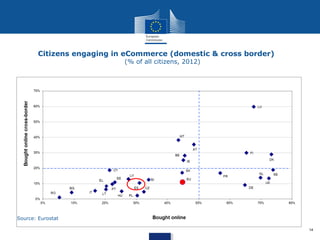
Citizens engaging in eCommerce (domestic & cross border)
(% of all citizens, 2012)

Source: Eurostat
14
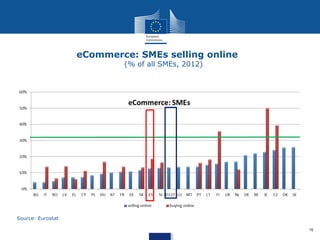
eCommerce: SMEs selling online
(% of all SMEs, 2012)

Source: Eurostat
15
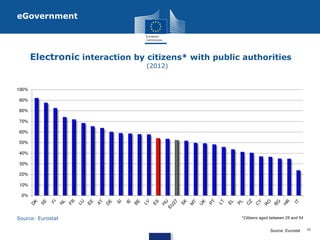
eGovernment

•Electronic interaction by citizens* with public authorities
(2012)

Source: Eurostat

*Citizens aged between 25 and 54
Source: Eurostat

16
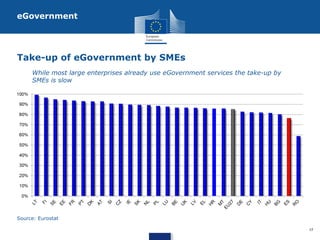
eGovernment

Take-up of eGovernment by SMEs
While most large enterprises already use eGovernment services the take-up by
SMEs is slow

Source: Eurostat
17
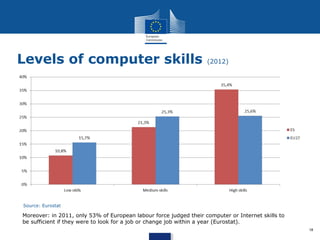
Levels of computer skills

(2012)

Source: Eurostat

Moreover: in 2011, only 53% of European labour force judged their computer or Internet skills to
be sufficient if they were to look for a job or change job within a year (Eurostat).
18
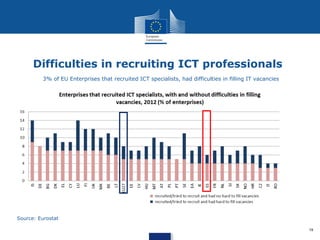
Difficulties in recruiting ICT professionals
3% of EU Enterprises that recruited ICT specialists, had difficulties in filling IT vacancies

Source: Eurostat
19
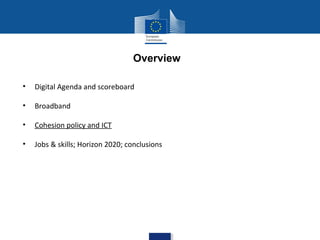
Overview
•

Digital Agenda and scoreboard

•

Broadband

•

Cohesion policy and ICT

•

Jobs & skills; Horizon 2020; conclusions
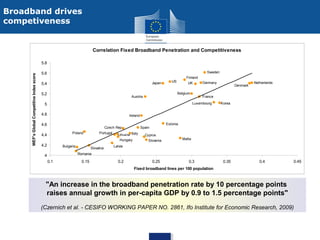
Broadband drives
competiveness

Correlation Fixed Broadband Penetration and Competitiveness

WEF's Global Competitive Index score

5.8
Sweden

5.6
Japan

5.4
5.2

Finland

US

UK
Belgium

Austria

Germany

4.8

Netherlands

France
Luxembourg

5

Denmark

Korea

Ireland

4.6

Czech Rep.
Poland

4.4

Portugal

Lithuania Italy

Hungary

4.2

Bulgaria

Slovakia

Estonia

Spain
Cyprus
Slovenia

Malta

Latvia

Romania

4
0.1

0.15

0.2

0.25

0.3

0.35

0.4

0.45

Fixed broadband lines per 100 population

"An increase in the broadband penetration rate by 10 percentage points
raises annual growth in per-capita GDP by 0.9 to 1.5 percentage points"
(Czernich et al. - CESIFO WORKING PAPER NO. 2861, Ifo Institute for Economic Research, 2009)
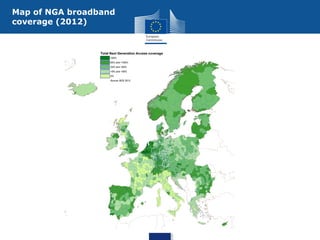
Map of NGA broadband
coverage (2012)
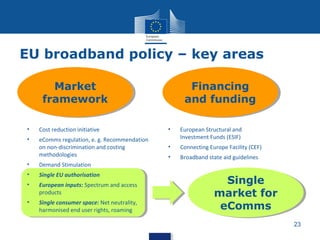
EU broadband policy – key areas
Market
Market
framework
framework

Financing
Financing
and funding
and funding

•

Cost reduction initiative

•

•

eComms regulation, e. g. Recommendation
on non-discrimination and costing
methodologies

European Structural and
Investment Funds (ESIF)

•

Connecting Europe Facility (CEF)

•

Broadband state aid guidelines

•

Demand Stimulation

•

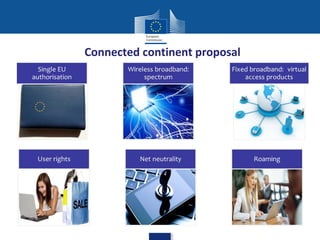
Single EU authorisation

•

European inputs: Spectrum and access
products

•

Single consumer space: Net neutrality,
harmonised end user rights, roaming

Single
Single
market for
market for
eComms
eComms
23
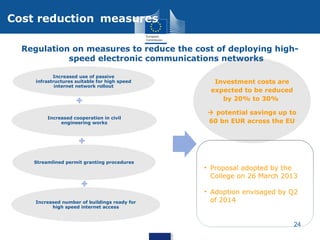
Cost reduction measures
Regulation on measures to reduce the cost of deploying highspeed electronic communications networks
Increased use of passive
infrastructures suitable for high speed
internet network rollout

Increased cooperation in civil
engineering works

Streamlined permit granting procedures

Increased number of buildings ready for
high speed internet access

Investment costs are
expected to be reduced
by 20% to 30%
 potential savings up to
60 bn EUR across the EU

• Proposal adopted by the
College on 26 March 2013
• Adoption envisaged by Q2
of 2014

24
Connected continent proposal
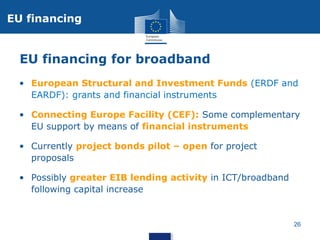
EU financing

EU financing for broadband
• European Structural and Investment Funds (ERDF and
EARDF): grants and financial instruments
• Connecting Europe Facility (CEF): Some complementary
EU support by means of financial instruments
• Currently project bonds pilot – open for project
proposals
• Possibly greater EIB lending activity in ICT/broadband
following capital increase

26
Overview
•

Digital Agenda and scoreboard

•

Broadband

•

Cohesion policy and ICT

•

Jobs & skills; Horizon 2020; conclusions
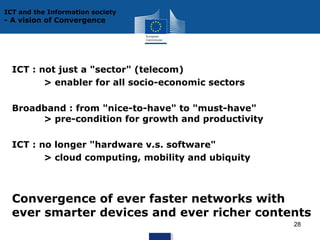
ICT and the Information society

- A vision of Convergence

ICT : not just a "sector" (telecom)
> enabler for all socio-economic sectors
Broadband : from "nice-to-have" to "must-have"
> pre-condition for growth and productivity
ICT : no longer "hardware v.s. software"
> cloud computing, mobility and ubiquity

Convergence of ever faster networks with
ever smarter devices and ever richer contents
28
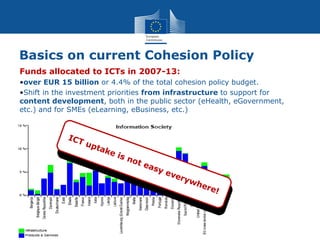
Basics on current Cohesion Policy
Funds allocated to ICTs in 2007-13:
•over EUR 15 billion or 4.4% of the total cohesion policy budget.
•Shift in the investment priorities from infrastructure to support for
content development, both in the public sector (eHealth, eGovernment,
etc.) and for SMEs (eLearning, eBusiness, etc.)

ICT
ICT upt
uptake
ak e i s n
is not e
o t as y
ea s e v
y e er y
ver wh
y w er e
he r !
e!

Cohesion
Policy
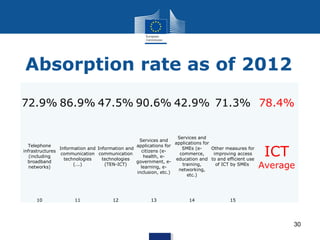
Absorption rate as of 2012
72.9% 86.9% 47.5% 90.6% 42.9% 71.3% 78.4%
Services and
Services and
applications for
Telephone
applications for
Information and Information and
SMEs (eOther measures for
infrastructures
citizens (ecommunication communication
commerce,
improving access
(including
health, etechnologies
technologies
education and to and efficient use
broadband
government, e(...)
(TEN-ICT)
training,
of ICT by SMEs
networks)
learning, enetworking,
inclusion, etc.)
etc.)

10

11

12

13

14

ICT
Average

15

30
sustainable
inclusive

Europe 2020

smart

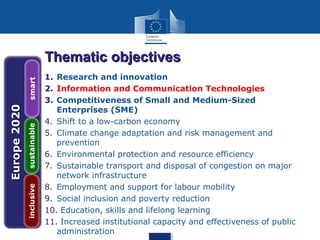
Thematic objectives
1. Research and innovation
2. Information and Communication Technologies
3. Competitiveness of Small and Medium-Sized
Enterprises (SME)
4. Shift to a low-carbon economy
5. Climate change adaptation and risk management and
prevention
6. Environmental protection and resource efficiency
7. Sustainable transport and disposal of congestion on major
network infrastructure
8. Employment and support for labour mobility
9. Social inclusion and poverty reduction
10. Education, skills and lifelong learning
11. Increased institutional capacity and effectiveness of public
administration
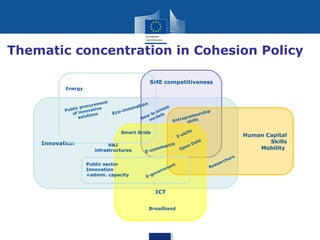
Thematic concentration in Cohesion Policy
SME competitiveness
Energy
ment
ocure
lic pr vative
Pub
o
of inn ions
solut

ion
s
vat
es
nno
-i
sin
Eco
bu ls
e
w
Ne

d
mo

i
ursh
rene
ep
Entr skills

ls
kil
E-s

Smart Grids

Innovation

R&I
infrastructures
Public sector
Innovation
+admin. capacity

p

erce
mm
E-co

ov
E-g

n
me
e rn

t

ICT
Broadband

Human Capital
Skills
Mobility

ta
Da
en
Op

Re

rs
he
arc
se
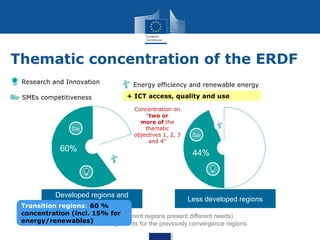
Thematic concentration of the ERDF
Research and Innovation
SMEs competitiveness

60%

Energy efficiency and renewable energy
+ ICT access, quality and use

20%

Developed regions and
transition regions
Transition regions: 60 %

Concentration on
"two or
more of the
thematic
objectives 1, 2, 3
and 4"

6%

44%

Less developed regions

concentration (incl. Flexibility (different regions present different needs)
15% for
energy/renewables) arrangements for the previously convergence regions
Special
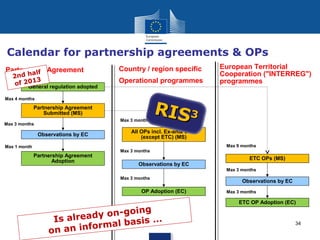
Calendar for partnership agreements & OPs
Partnership Agreement
alf

2nd h
3
of 201
General regulation adopted

Country / region specific
Operational programmes

Max 4 months

Partnership Agreement
Submitted (MS)
Max 3 months

Max 3 months

Observations by EC

European Territorial
Cooperation ("INTERREG")
programmes

RIS 3

All OPs incl. Ex-ante eval.
(except ETC) (MS)
Max 9 months

Max 1 month

Partnership Agreement
Adoption

Max 3 months

Observations by EC

ETC OPs (MS)
Max 3 months

Max 3 months

OP Adoption (EC)

in g
dy on-go
Is alrea
sis …
ormal ba
on an inf

Observations by EC
Max 3 months

ETC OP Adoption (EC)

34
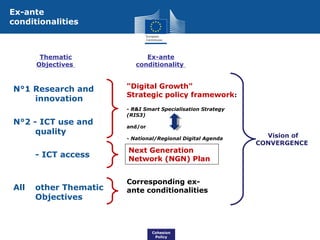
Ex-ante
conditionalities

Thematic
Objectives

N°1 Research and
innovation
N°2 - ICT use and
quality
- ICT access

All

other Thematic
Objectives

Ex-ante
conditionality

"Digital Growth"
Strategic policy framework:
- R&I Smart Specialisation Strategy
(RIS3)
and/or
- National/Regional Digital Agenda

Next Generation
Network (NGN) Plan
Corresponding exante conditionalities

Cohesion
Policy

Vision of
CONVERGENCE
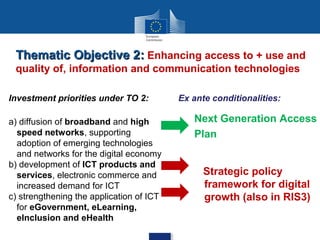
Thematic Objective 2: Enhancing access to + use and
quality of, information and communication technologies
Investment priorities under TO 2:
a) diffusion of broadband and high
speed networks, supporting
adoption of emerging technologies
and networks for the digital economy
b) development of ICT products and
services, electronic commerce and
increased demand for ICT
c) strengthening the application of ICT
for eGovernment, eLearning,
eInclusion and eHealth

Ex ante conditionalities:

Next Generation Access
Plan
Strategic policy
framework for digital
growth (also in RIS3)
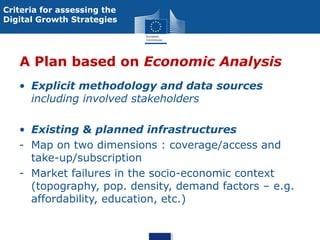
Criteria for assessing the
Digital Growth Strategies

A Plan based on Economic Analysis
• Explicit methodology and data sources
including involved stakeholders
• Existing & planned infrastructures
- Map on two dimensions : coverage/access and
take-up/subscription
- Market failures in the socio-economic context
(topography, pop. density, demand factors – e.g.
affordability, education, etc.)
Criteria for assessing the
Digital Growth Strategies

A SWOT analysis (or similar)
consistent with Digital Agenda
Digital Agenda Toolbox
• http://s3platform.jrc.ec.europa.eu/digital-agenda
Digital Agenda Scoreboard Indicators
•http://ec.europa.eu/digital-agenda/en/create-graphs
•http://digital-agendadata.eu/datasets/digital_agenda_scoreboard_key_indicators/indicators
Ex-ante
conditionalities

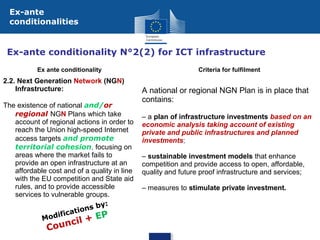
Ex-ante conditionality N°2(2) for ICT infrastructure
Ex ante conditionality

2.2. Next Generation Network (NGN)
Infrastructure:
The existence of national and/or
regional NGN Plans which take
account of regional actions in order to
reach the Union high-speed Internet
access targets and promote
territorial cohesion, focusing on
areas where the market fails to
provide an open infrastructure at an
affordable cost and of a quality in line
with the EU competition and State aid
rules, and to provide accessible
services to vulnerable groups.
by:
ions
c at
EP
odifi
M
il +

Co u n

c

Criteria for fulfilment

A national or regional NGN Plan is in place that
contains:
– a plan of infrastructure investments based on an
economic analysis taking account of existing
private and public infrastructures and planned
investments;
– sustainable investment models that enhance
competition and provide access to open, affordable,
quality and future proof infrastructure and services;
– measures to stimulate private investment.
Criteria for assessing the
NGN Plans

A Plan that is operational
Target & Indicators
– benchmarking with the Digital Agenda Scoreboard
•
•

http://ec.europa.eu/digital-agenda/en/create-graphs
http://digital-agenda-data.eu/datasets/digital_agenda_scoreboard_key_indicators/indicators

Available budgetary resources
•Public funding at EU, national, regional levels
•Other sources : private, banks

List of planned investments
•Objectives, estimated cost, coverage
•Periodically up-dated
Criteria for assessing the
NGN Plans

A Plan of sustainable models
• Envisaged investment models
- Broadband investment Guide
- Use of grants, financial instruments ?

• Regulatory measures to stimulate private
investment
- Cost-reduction measures
- Radio spectrum
Criteria for assessing the
NGN Plans

Identifying the priorities & capacity
Priorities and budgetisation
•available budgetary resources for ICT interventions
•sources of finance at EU, national and other sources
Administrative Capacity
•Self analysis: intermediate bodies and beneficiaries
•Remedial actions
Overview
•

Digital Agenda and scoreboard

•

Broadband

•

Cohesion policy and ICT

•

Jobs & skills; Horizon 2020; conclusions
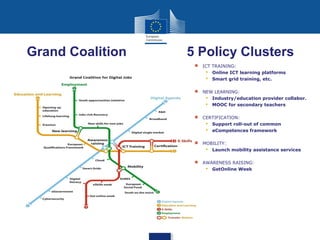
Grand Coalition

5 Policy Clusters


ICT TRAINING:
 Online ICT learning platforms
 Smart grid training, etc.



NEW LEARNING:
 Industry/education provider collabor.
 MOOC for secondary teachers



CERTIFICATION:
 Support roll-out of common
 eCompetences framework



MOBILITY:
 Launch mobility assistance services


AWARENESS RAISING:
 GetOnline Week
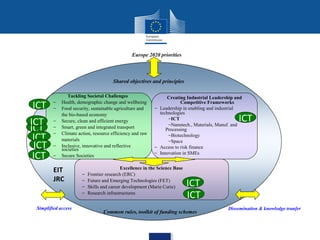
Europe 2020 priorities

Shared objectives and principles

ICT

−
−

ICT
ICT
ICT
ICT
ICT

−
−
−
−
−

Tackling Societal Challenges
Health, demographic change and wellbeing
Food security, sustainable agriculture and
the bio-based economy
Secure, clean and efficient energy
Smart, green and integrated transport
Climate action, resource efficiency and raw
materials
Inclusive, innovative and reflective
societies
Secure Societies

EIT
JRC

Simplified access

−
−
−
−

Creating Industrial Leadership and
Competitive Frameworks
− Leadership in enabling and industrial
technologies
−ICT
−Nanotech., Materials, Manuf. and
Processing
−Biotechnology
−Space
− Access to risk finance
− Innovation in SMEs

Excellence in the Science Base
Frontier research (ERC)
Future and Emerging Technologies (FET)
Skills and career development (Marie Curie)
Research infrastructures

ICT

ICT
ICT

Common rules, toolkit of funding schemes

Dissemination & knowledge tranfer
European Council of 24-25.10.2013;
digital economy and innovation
•

Complete Digital Single Market

•

Access to and portability of content and data across the single market

•

EC legal proposals on telecoms: connected continent; broadband engineering costs

•

EC legal proposals on trust and security: e-ID; network information security; einvoicing/ payments; data protection; web accessibility

•

Data, cloud, open government

•

Taxation of the digital economy

•

Skills

•

Research and innovation
Conclusions
•

Digitally-driven transformation is unstoppable; Europe cannot stay behind

•

Need for public sector strategies; European/ national/ local digital agendas

•

Remove barriers in the European space; towards a Digital Single Market

•

Build European capacity: networks, data/ cloud, skills, R&D&I, industrial base…

•

New EU legislature will start in 2014; in any case, the future is digital…
Gracias
ec.europa.eu/digital-agenda

blogs.ec.europa.eu/digital-agenda

@DigitalAgendaEU

DigitalAgenda

iMeeting: presentación Miguel González-Sancho

  • 1.
    Regional Policy inEurope Sevilla 17.12.2013 “Regional Digital Agendas" Miguel Gonzalez-Sancho European Commission DG Communications Networks, Content and Technology
  • 2.
    Overview • Digital Agenda andscoreboard • Broadband • Cohesion policy and ICT • Jobs & skills; Horizon 2020; conclusions
  • 3.
    Political context: EU2020to DAE Europe 2020: 7 flagships o o o o o o o Digital Agenda for Europe Youth on the move Innovation Union Industrial policy for globalisation era New skills for jobs EU Platform against poverty Resource efficient Europe Digital technology matters for Growth & jobs…
  • 4.
    Digital Agenda logic:networks, services, demand… 100 actions (+ 32 after review), targets A vibrant digital single market Fast & ultra-fast Internet access Using ICT to help society Trust & Security Research & innovation Interoperability & standards (+ cloud computing, after DAE review) Digital literacy, skills & inclusion
  • 5.
    Digital Agenda governance GoingLocal 2013 DAE High Level Group
  • 6.
    Acciones de laAgenda Digital, situación el 17.12.2013 • Total acciones: 101 (DAE 2010) + 30 (revisión 2010) = 131 • Acciones concluidas: 64 (DAE 2010) + 14 (revisión 2010) = 78 • Acciones conformes al calendario previsto: 27 (DAE 2010) + 16 (revisión 2010) = 43 • Acciones atrasadas: 7 (DAE 2010) + 1 (revisión 2010) = 8 Details on each action (update 12.06.2013) available at: https://ec.europa.eu/digital-agenda/sites/digital-agenda/files/130606%20DAE%20actions%20progress%20incl%20review%20FINAL.doc %5B1%5D.pdf
  • 7.
    DAE – Objetivosclave 1. Objetivos de banda ancha: •Banda ancha de base en 2013 para 100 % de ciudadanos de la UE. •Banda ancha rápida (> 30 Mbps) en 2020 para 100 % de ciudadanos de la UE. •Banda ancha ultra-rápida (> 100 Mbps) en 2020 para 50 % de hogares europeos. 2. Mercado único digital: •En 2015, 50 % de la población debe hacer compras en línea. •En 2015, 20 % de la población debe hacer compras en línea transfronterizas. •En 2015, 33 % de las PME deben hacer compras/ ventas en línea. •En 2015, tarifas de roaming casi igual a tarifas de comunicaciones nacionales 3. Inclusión digital: •Aumento del uso regular de Internet de 60 % a 75 % en 2015 y de 41 % a 60 % para GRUPOS desfavorecidos. •Hasta 2015, reducción del porcentaje de la población que nunca ha usado Internet a la mitad (al 15 %) 4. Servicios públicos: •En 2015: 50 % de los ciudadanos deben recurrir a administración pública en línea e mas de la mitad rellenar y enviar formularios. •En 2015, deben estar disponibles en línea todos los servicios públicos esenciales transfronterizos incluidos en la lista a aprobar por los Estados Miembros para el 2011. 5. Investigación e innovación: •Duplicar la inversión pública, hasta alcanzar 11.000M€. 6. Economía con baja emisión de carbono : •Promocionar la iluminación de bajo consumo: en 2020, reducción global como mínimo del 20 % del consumo de energía en alumbrado.
  • 8.
    Scoreboard 2013 To findout more visit www.ec.europa.eu/digital-agenda/en/scoreboard https://ec.europa.eu/digital-agenda/en/scoreboard/portugal 8
  • 9.
    Basic broadband forall by 2013 Standard fixed broadband* availability adding wireless, EU coverage is 99.97% *xDSL, Cable, FTTP and WiMax; Source: Point Topic 9
  • 10.
    At least 30Mbps for all by 2020 NGA* availability (54% of EU homes) But only 12% of EU rural areas are covered * Next Generation Access (NGA): VDSL, Cable Docsis 3.0 and FTTP; Source: Point Topic 10
  • 11.
    Fixed broadband take-up Fixed broadbandlines penetration in the EU 28.8% (lines as a % of population) (equivalent to 72.5% of EU homes subscribing to broadband) Source: Communications Committee 11
  • 12.
    Fixed broadband lines byspeed 14.8% of EU fixed broadband subscriptions are at least 30 Mbps and 3.4 % at least 100 Mbps Source: Communications Committee 12
  • 13.
    2% of Europeanshave never used the Internet, 70% are regular Internet users (at least once a week) (2012) Source: Eurostat 13
  • 14.
    Citizens engaging ineCommerce (domestic & cross border) (% of all citizens, 2012) Source: Eurostat 14
  • 15.
    eCommerce: SMEs sellingonline (% of all SMEs, 2012) Source: Eurostat 15
  • 16.
    eGovernment •Electronic interaction bycitizens* with public authorities (2012) Source: Eurostat *Citizens aged between 25 and 54 Source: Eurostat 16
  • 17.
    eGovernment Take-up of eGovernmentby SMEs While most large enterprises already use eGovernment services the take-up by SMEs is slow Source: Eurostat 17
  • 18.
    Levels of computerskills (2012) Source: Eurostat Moreover: in 2011, only 53% of European labour force judged their computer or Internet skills to be sufficient if they were to look for a job or change job within a year (Eurostat). 18
  • 19.
    Difficulties in recruitingICT professionals 3% of EU Enterprises that recruited ICT specialists, had difficulties in filling IT vacancies Source: Eurostat 19
  • 20.
    Overview • Digital Agenda andscoreboard • Broadband • Cohesion policy and ICT • Jobs & skills; Horizon 2020; conclusions
  • 21.
    Broadband drives competiveness Correlation FixedBroadband Penetration and Competitiveness WEF's Global Competitive Index score 5.8 Sweden 5.6 Japan 5.4 5.2 Finland US UK Belgium Austria Germany 4.8 Netherlands France Luxembourg 5 Denmark Korea Ireland 4.6 Czech Rep. Poland 4.4 Portugal Lithuania Italy Hungary 4.2 Bulgaria Slovakia Estonia Spain Cyprus Slovenia Malta Latvia Romania 4 0.1 0.15 0.2 0.25 0.3 0.35 0.4 0.45 Fixed broadband lines per 100 population "An increase in the broadband penetration rate by 10 percentage points raises annual growth in per-capita GDP by 0.9 to 1.5 percentage points" (Czernich et al. - CESIFO WORKING PAPER NO. 2861, Ifo Institute for Economic Research, 2009)
  • 22.
    Map of NGAbroadband coverage (2012)
  • 23.
    EU broadband policy– key areas Market Market framework framework Financing Financing and funding and funding • Cost reduction initiative • • eComms regulation, e. g. Recommendation on non-discrimination and costing methodologies European Structural and Investment Funds (ESIF) • Connecting Europe Facility (CEF) • Broadband state aid guidelines • Demand Stimulation • Single EU authorisation • European inputs: Spectrum and access products • Single consumer space: Net neutrality, harmonised end user rights, roaming Single Single market for market for eComms eComms 23
  • 24.
    Cost reduction measures Regulationon measures to reduce the cost of deploying highspeed electronic communications networks Increased use of passive infrastructures suitable for high speed internet network rollout Increased cooperation in civil engineering works Streamlined permit granting procedures Increased number of buildings ready for high speed internet access Investment costs are expected to be reduced by 20% to 30%  potential savings up to 60 bn EUR across the EU • Proposal adopted by the College on 26 March 2013 • Adoption envisaged by Q2 of 2014 24
  • 25.
  • 26.
    EU financing EU financingfor broadband • European Structural and Investment Funds (ERDF and EARDF): grants and financial instruments • Connecting Europe Facility (CEF): Some complementary EU support by means of financial instruments • Currently project bonds pilot – open for project proposals • Possibly greater EIB lending activity in ICT/broadband following capital increase 26
  • 27.
    Overview • Digital Agenda andscoreboard • Broadband • Cohesion policy and ICT • Jobs & skills; Horizon 2020; conclusions
  • 28.
    ICT and theInformation society - A vision of Convergence ICT : not just a "sector" (telecom) > enabler for all socio-economic sectors Broadband : from "nice-to-have" to "must-have" > pre-condition for growth and productivity ICT : no longer "hardware v.s. software" > cloud computing, mobility and ubiquity Convergence of ever faster networks with ever smarter devices and ever richer contents 28
  • 29.
    Basics on currentCohesion Policy Funds allocated to ICTs in 2007-13: •over EUR 15 billion or 4.4% of the total cohesion policy budget. •Shift in the investment priorities from infrastructure to support for content development, both in the public sector (eHealth, eGovernment, etc.) and for SMEs (eLearning, eBusiness, etc.) ICT ICT upt uptake ak e i s n is not e o t as y ea s e v y e er y ver wh y w er e he r ! e! Cohesion Policy
  • 30.
    Absorption rate asof 2012 72.9% 86.9% 47.5% 90.6% 42.9% 71.3% 78.4% Services and Services and applications for Telephone applications for Information and Information and SMEs (eOther measures for infrastructures citizens (ecommunication communication commerce, improving access (including health, etechnologies technologies education and to and efficient use broadband government, e(...) (TEN-ICT) training, of ICT by SMEs networks) learning, enetworking, inclusion, etc.) etc.) 10 11 12 13 14 ICT Average 15 30
  • 31.
    sustainable inclusive Europe 2020 smart Thematic objectives 1.Research and innovation 2. Information and Communication Technologies 3. Competitiveness of Small and Medium-Sized Enterprises (SME) 4. Shift to a low-carbon economy 5. Climate change adaptation and risk management and prevention 6. Environmental protection and resource efficiency 7. Sustainable transport and disposal of congestion on major network infrastructure 8. Employment and support for labour mobility 9. Social inclusion and poverty reduction 10. Education, skills and lifelong learning 11. Increased institutional capacity and effectiveness of public administration
  • 32.
    Thematic concentration inCohesion Policy SME competitiveness Energy ment ocure lic pr vative Pub o of inn ions solut ion s vat es nno -i sin Eco bu ls e w Ne d mo i ursh rene ep Entr skills ls kil E-s Smart Grids Innovation R&I infrastructures Public sector Innovation +admin. capacity p erce mm E-co ov E-g n me e rn t ICT Broadband Human Capital Skills Mobility ta Da en Op Re rs he arc se
  • 33.
    Thematic concentration ofthe ERDF Research and Innovation SMEs competitiveness 60% Energy efficiency and renewable energy + ICT access, quality and use 20% Developed regions and transition regions Transition regions: 60 % Concentration on "two or more of the thematic objectives 1, 2, 3 and 4" 6% 44% Less developed regions concentration (incl. Flexibility (different regions present different needs) 15% for energy/renewables) arrangements for the previously convergence regions Special
  • 34.
    Calendar for partnershipagreements & OPs Partnership Agreement alf 2nd h 3 of 201 General regulation adopted Country / region specific Operational programmes Max 4 months Partnership Agreement Submitted (MS) Max 3 months Max 3 months Observations by EC European Territorial Cooperation ("INTERREG") programmes RIS 3 All OPs incl. Ex-ante eval. (except ETC) (MS) Max 9 months Max 1 month Partnership Agreement Adoption Max 3 months Observations by EC ETC OPs (MS) Max 3 months Max 3 months OP Adoption (EC) in g dy on-go Is alrea sis … ormal ba on an inf Observations by EC Max 3 months ETC OP Adoption (EC) 34
  • 35.
    Ex-ante conditionalities Thematic Objectives N°1 Research and innovation N°2- ICT use and quality - ICT access All other Thematic Objectives Ex-ante conditionality "Digital Growth" Strategic policy framework: - R&I Smart Specialisation Strategy (RIS3) and/or - National/Regional Digital Agenda Next Generation Network (NGN) Plan Corresponding exante conditionalities Cohesion Policy Vision of CONVERGENCE
  • 36.
    Thematic Objective 2:Enhancing access to + use and quality of, information and communication technologies Investment priorities under TO 2: a) diffusion of broadband and high speed networks, supporting adoption of emerging technologies and networks for the digital economy b) development of ICT products and services, electronic commerce and increased demand for ICT c) strengthening the application of ICT for eGovernment, eLearning, eInclusion and eHealth Ex ante conditionalities: Next Generation Access Plan Strategic policy framework for digital growth (also in RIS3)
  • 37.
    Criteria for assessingthe Digital Growth Strategies A Plan based on Economic Analysis • Explicit methodology and data sources including involved stakeholders • Existing & planned infrastructures - Map on two dimensions : coverage/access and take-up/subscription - Market failures in the socio-economic context (topography, pop. density, demand factors – e.g. affordability, education, etc.)
  • 38.
    Criteria for assessingthe Digital Growth Strategies A SWOT analysis (or similar) consistent with Digital Agenda Digital Agenda Toolbox • http://s3platform.jrc.ec.europa.eu/digital-agenda Digital Agenda Scoreboard Indicators •http://ec.europa.eu/digital-agenda/en/create-graphs •http://digital-agendadata.eu/datasets/digital_agenda_scoreboard_key_indicators/indicators
  • 39.
    Ex-ante conditionalities Ex-ante conditionality N°2(2)for ICT infrastructure Ex ante conditionality 2.2. Next Generation Network (NGN) Infrastructure: The existence of national and/or regional NGN Plans which take account of regional actions in order to reach the Union high-speed Internet access targets and promote territorial cohesion, focusing on areas where the market fails to provide an open infrastructure at an affordable cost and of a quality in line with the EU competition and State aid rules, and to provide accessible services to vulnerable groups. by: ions c at EP odifi M il + Co u n c Criteria for fulfilment A national or regional NGN Plan is in place that contains: – a plan of infrastructure investments based on an economic analysis taking account of existing private and public infrastructures and planned investments; – sustainable investment models that enhance competition and provide access to open, affordable, quality and future proof infrastructure and services; – measures to stimulate private investment.
  • 40.
    Criteria for assessingthe NGN Plans A Plan that is operational Target & Indicators – benchmarking with the Digital Agenda Scoreboard • • http://ec.europa.eu/digital-agenda/en/create-graphs http://digital-agenda-data.eu/datasets/digital_agenda_scoreboard_key_indicators/indicators Available budgetary resources •Public funding at EU, national, regional levels •Other sources : private, banks List of planned investments •Objectives, estimated cost, coverage •Periodically up-dated
  • 41.
    Criteria for assessingthe NGN Plans A Plan of sustainable models • Envisaged investment models - Broadband investment Guide - Use of grants, financial instruments ? • Regulatory measures to stimulate private investment - Cost-reduction measures - Radio spectrum
  • 42.
    Criteria for assessingthe NGN Plans Identifying the priorities & capacity Priorities and budgetisation •available budgetary resources for ICT interventions •sources of finance at EU, national and other sources Administrative Capacity •Self analysis: intermediate bodies and beneficiaries •Remedial actions
  • 43.
    Overview • Digital Agenda andscoreboard • Broadband • Cohesion policy and ICT • Jobs & skills; Horizon 2020; conclusions
  • 44.
    Grand Coalition 5 PolicyClusters  ICT TRAINING:  Online ICT learning platforms  Smart grid training, etc.  NEW LEARNING:  Industry/education provider collabor.  MOOC for secondary teachers  CERTIFICATION:  Support roll-out of common  eCompetences framework  MOBILITY:  Launch mobility assistance services  AWARENESS RAISING:  GetOnline Week
  • 45.
    Europe 2020 priorities Sharedobjectives and principles ICT − − ICT ICT ICT ICT ICT − − − − − Tackling Societal Challenges Health, demographic change and wellbeing Food security, sustainable agriculture and the bio-based economy Secure, clean and efficient energy Smart, green and integrated transport Climate action, resource efficiency and raw materials Inclusive, innovative and reflective societies Secure Societies EIT JRC Simplified access − − − − Creating Industrial Leadership and Competitive Frameworks − Leadership in enabling and industrial technologies −ICT −Nanotech., Materials, Manuf. and Processing −Biotechnology −Space − Access to risk finance − Innovation in SMEs Excellence in the Science Base Frontier research (ERC) Future and Emerging Technologies (FET) Skills and career development (Marie Curie) Research infrastructures ICT ICT ICT Common rules, toolkit of funding schemes Dissemination & knowledge tranfer
  • 46.
    European Council of24-25.10.2013; digital economy and innovation • Complete Digital Single Market • Access to and portability of content and data across the single market • EC legal proposals on telecoms: connected continent; broadband engineering costs • EC legal proposals on trust and security: e-ID; network information security; einvoicing/ payments; data protection; web accessibility • Data, cloud, open government • Taxation of the digital economy • Skills • Research and innovation
  • 47.
    Conclusions • Digitally-driven transformation isunstoppable; Europe cannot stay behind • Need for public sector strategies; European/ national/ local digital agendas • Remove barriers in the European space; towards a Digital Single Market • Build European capacity: networks, data/ cloud, skills, R&D&I, industrial base… • New EU legislature will start in 2014; in any case, the future is digital…
  • 48.

Editor's Notes

  • #4 Overall EU policy action is framed by the EU2020 strategy, which features a few high-level targets and "flagship initiatives"; one of those is the DAE. Digital technology has an ever-growing impact in today's economy and society, which justifies dedicated digital strategies from EU (DAE) and MS (e.g. DA Portugal). [Mention some data from the slide]
  • #5 DAE comprehensive approach: stimulate fast connections, which support value services and content, for the benefit of competent users (citizens, enterprises, administrations). Structure: 7 pillars, over 100 actions, key performance targets, supporting benchmarks. Review December 2012: cloud becomes a fully-fledged pillar, "key transformative actions" in each pillar, additional actions (many of the original actions already completed).
  • #6 This is the 4th edition of DAE GL. One year ago coincided the adoption of the DAE review and DA Portugal; we can now take stock of 2013 achievements. GL is one of the DAE governance tools amongst others (HLG, DAA, scoreboard…). These all aim at active stakeholders involvement , which is key to DAE delivery.
  • #26 Background slides at: http://connected.cnect.cec.eu.int/docs/DOC-18998
  • #30 Biggest spender on infrastructure: Poland (€ 984 million) – Greece (€ 210 million – Italy / Spain (€ 164 million each) AT: only 1,5% goes to ICT. This percentage is similar to that of BG (1.1%) contrast: the 9.5% of the Slovak Republic for ICT investments
  • #35 Message: Last trilogue: 16 May – then EP debates & votes Despite the adoption of te regulation texts slipping back to October – probably – we cannot afford to wait with the drafting of the partnership agreements and operational programmes until then. We would loose precious time for the laucnh of the implementation of the new programmes We expect to get the Pas and OP by summer and then negotiate to be able to adopt them by the end of this year. One element of the negotiations will be to check the compliance with the RIS3 conditionality. The second important step in terms of innovation and research investments is then to check the cosistency between the OP innovation investments and the RIS3. To put it simple: A RIS3 can (and should) include many more elements and activities than merely the ERDF / ESIF funding But the IP1 and IP2bc axis in the OP should not fund anything outside the relevant RIS3 This means that the RIS3 should also be ready by summer …. But realistically some won't ….
  • #37 ERDF investment priority 2. Improve the access, quality and use of ICT: a) diffusion of broadband and high speed networksb) development of ICT products and services, electronic commerce and increased demand for ICTc) strengthening the application of ICT for eGovernment, eLearning, eInclusion and eHealth CSF key ERDF actions roll-out of open, affordable and future-proof Next Generation Access Infrastructures (NGA) that are accessible to all in under-served areas and in the economic centres of the less developed regions with the aim of creating jobs and contributing to higher productivity levels and a more competitive European economy; eGovernment applications with the aim of enhancing innovation, the modernisation of public administrations and access to these services by citizens, including marginalised groups and people with disabilities; ICT applications that contribute to meeting future societal challenges and opportunities such as eHealth, ageing population, reducing carbon emissions, resource-efficiency, education, eInclusion, energy efficiency, eGovernment, integrated ICT solutions for 'smart cities', consumer information and empowerment; investment in the large-scale uptake of ICT-based innovations within and between regions to address key societal challenges.
  • #46 Start-up Europe can be also referred to here Background: Following the Employment Package  of April 2012 VP Kroes called for the formation of a multi-stakeholder partnership, the Grand Coalition for Digital Jobs,  to tackle the twin issues of a projected shortfall of up to 900,000 ICT professionals in Europe by 2015, exacerbated by a decline in computing science graduates. Hence, its aim is to increase the overall supply of digitally skilled professionals and to better match supply and demand of digital skills. On 4-5 March 2013 the Commission launched the Grand Coalition at a Conference in Brussels, which was hosted by  President José Manuel Barroso Vice Presidents Neelie Kroes and Antonio Tajani, Commissioners László Andor and Androula Vassiliou as well as Richard Bruton, Irish Minister for Jobs, Entreprise and Innovation. The Grand Coalition for Digital Jobs will deliver concrete actions, which can be implemented in the short-term and have high local impact. It will build on on-going programmes and best practices that could be scaled-up. The following are some of the objectives of the actions: Improve the image and attractiveness of ICT careers Offer training packages co-designed with the ICT industry Offer more aligned degrees and curricula at vocational and university level education that will respond to the needs of the students and the industry Improve recognition of qualifications across countries by stimulating take-up of a European certification scheme for digital skills of ICT professionals, based on the existing e-Competence Framework Reduce labour market mismatches by stimulating mobility Stimulate digital entrepreneurship by liaising with Startup Europe, a single platform for tools and programmes supporting people wanting to set up and grow web start-ups in Europe The Grand Coalition will help accelerate and intensify efforts initiated by European policies, such as the Digital Agenda for Europe, the e-Skills Strategy, the Employment Package, the Opening up Education Initiative, the Rethinking Education Strategy, the Youth Opportunities Initiative, and the EU Skills Panorama.
  • #47 Background slides at: http://connected.cnect.cec.eu.int/docs/DOC-21932 The electronics industrial strategy can be also referred to here
  • #48 http://www.consilium.europa.eu/uedocs/cms_data/docs/pressdata/en/ec/139197.pdf
  • #50 This is the 4th edition of DAE GL. One year ago coincided the adoption of the DAE review and DA Portugal; we can now take stock of 2013 achievements. GL is one of the DAE governance tools amongst others (HLG, DAA, scoreboard…). These all aim at active stakeholders involvement , which is key to DAE delivery.