Quality Control in Biotechnology
Andrew Lees, Ph.D.
Scientific Director
Fina BioSolutions LLC
www.FinaBio.com
Fina
Chemical drugs vs Biologicals
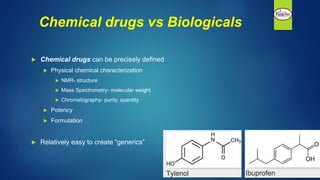
 Chemical drugs can be precisely defined
 Physical chemical characterization
 NMR- structure
 Mass Spectrometry- molecular weight
 Chromatography- purity, quantity
 Potency
 Formulation
 Relatively easy to create “generics”
Chemical drugs vs Biologicals
 Biologicals are produced by living cells
 Impossible to
 control every variable
 completely characterize
 Precisely replicate
 Traditionally, biologicals are defined by “product by process”
 Product is defined by the manufacturing process
 Quality is compliance-driven
 Goal is a “well-characterized biological”
current Good Manufacturing Process
cGMP
 Doing what you said you were going to do
 Proving that you did what you said
 Documenting that you did it.
 Following SOPs
 Validated methods
Examples of Biologicals
 Insulin
 EPO
 Interferons
 Toxins
 Antibody
 Conjugates
 Antibody-drug conjugates
 Fusion proteins
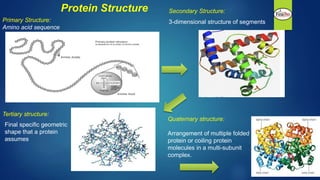
Protein Structure Secondary Structure:
3-dimensional structure of segments
Tertiary structure:
Final specific geometric
shape that a protein
assumes
Quaternary structure:
Arrangement of multiple folded
protein or coiling protein
molecules in a multi-subunit
complex.
Primary Structure:
Amino acid sequence
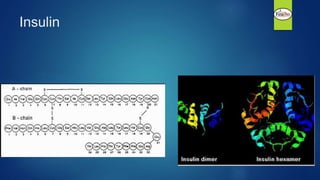
Insulin
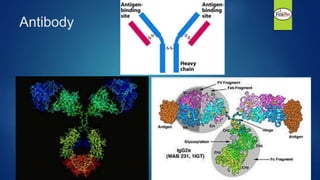
Antibody
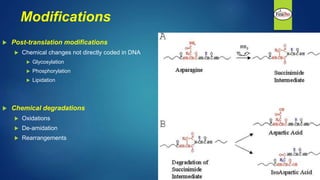
Modifications
 Post-translation modifications
 Chemical changes not directly coded in DNA
 Glycosylation
 Phosphorylation
 Lipidation
 Chemical degradations
 Oxidations
 De-amidation
 Rearrangements
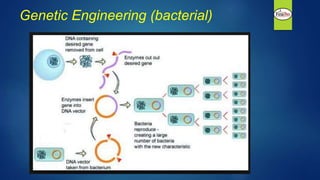
Genetic Engineering (bacterial)
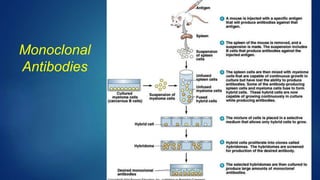
Monoclonal
Antibodies
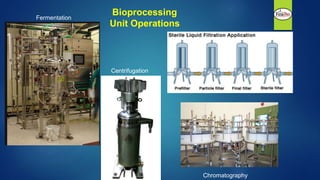
Bioprocessing
Unit Operations
Fermentation
Centrifugation
Chromatography
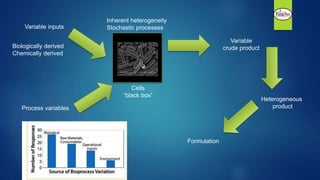
Variable inputs
Cells
“black box”
Process variables
Biologically derived
Chemically derived
Variable
crude product
Inherent heterogeneity
Stochastic processes
Heterogeneous
product
Formulation
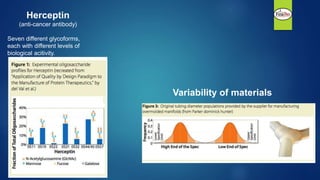
Herceptin
(anti-cancer antibody)
Seven different glycoforms,
each with different levels of
biological acitivity.
Variability of materials
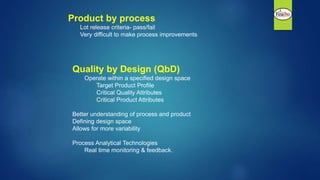
Quality by Design (QbD)
Operate within a specified design space
Target Product Profile
Critical Quality Attributes
Critical Product Attributes
Better understanding of process and product
Defining design space
Allows for more variability
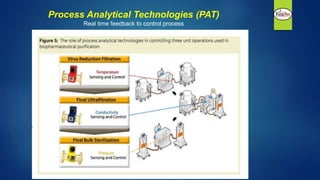
Process Analytical Technologies
Real time monitoring & feedback.
Product by process
Lot release criteria- pass/fail
Very difficult to make process improvements
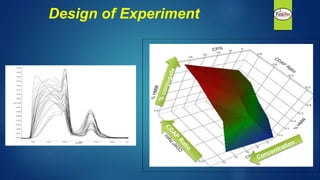
Design of Experiment
Understanding the operating space
Design of Experiment (DOE)
 A statistical method to model a process
 Many fewer experiments than “one factor at a
time”
 Allows for modeling interactions
 Useful to determine critical parameters
 Critical for “Quality by Design”
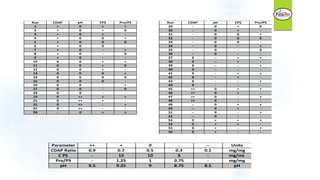
Run CDAP pH CPS Pro/PS Run CDAP pH CPS Pro/PS
1 + 0 + + 29 - 0 + 0
2 + 0 + 0 30 - 0 + -
3 + 0 + - 31 - 0 0 +
4 + 0 0 + 32 - 0 0 0
5 + 0 0 0 33 - 0 0 -
6 + 0 0 - 34 - 0 - +
7 + 0 - + 35 - 0 - 0
8 + 0 - 0 36 - 0 - -
9 + 0 - - 37 0 -- + +
10 0 0 + + 38 0 -- + -
11 0 0 + 0 39 0 -- - +
12 0 0 + - 40 0 -- - -
13 0 0 0 + 41 0 - + +
14 0 0 0 0 42 0 - + -
15 0 0 0 - 43 0 - - +
16 0 0 - + 44 0 - - -
17 0 0 - 0 45 ++ 0 + +
18 0 0 - - 46 ++ 0 + -
19 0 ++ + + 47 ++ 0 - +
21 0 ++ + - 48 ++ 0 - -
25 0 ++ - + 49 -- 0 + +
27 0 ++ - - 50 -- 0 + -
28 - 0 + + 51 -- 0 - +
52 -- 0 - -
53 0 + + +
54 0 + + -
55 0 + - +
56 0 + - -
Parameter ++ + 0 - -- Units
CDAP Ratio 0.9 0.7 0.5 0.3 0.1 mg/mg
C PS - 15 10 5 - mg/mL
Pro/PS - 1.25 1 0.75 - mg/mg
pH 9.5 9.25 9 8.75 8.5 pH
Application of Design of Experiment to Conjugate Vaccines
Design of Experiment
Process Analytical Technologies (PAT)
Real time feedback to control process
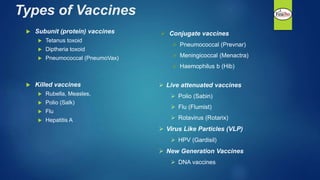
Types of Vaccines
 Subunit (protein) vaccines
 Tetanus toxoid
 Diptheria toxoid
 Pneumococcal (PneumoVax)
 Killed vaccines
 Rubella, Measles,
 Polio (Salk)
 Flu
 Hepatitis A
 Live attenuated vaccines
 Polio (Sabin)
 Flu (Flumist)
 Rotavirus (Rotarix)
 Virus Like Particles (VLP)
 HPV (Gardisil)
 New Generation Vaccines
 DNA vaccines
 Conjugate vaccines
 Pneumococcal (Prevnar)
 Meningicoccal (Menactra)
 Haemophilus b (Hib)
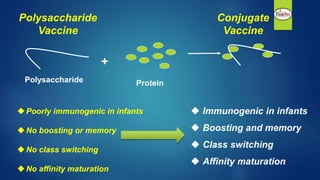
Polysaccharide
Vaccine
Polysaccharide Protein
+
Poorly immunogenic in infants
No boosting or memory
No class switching
No affinity maturation
 Immunogenic in infants
 Boosting and memory
 Class switching
 Affinity maturation
Conjugate
Vaccine
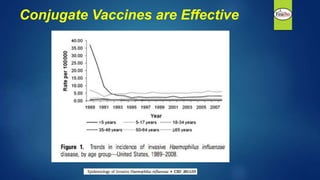
Conjugate Vaccines are Effective
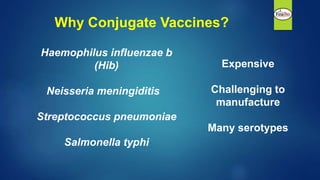
Why Conjugate Vaccines?
Expensive
Challenging to
manufacture
Many serotypes
Haemophilus influenzae b
(Hib)
Neisseria meningiditis
Streptococcus pneumoniae
Salmonella typhi
HARVARD
STRAIN
Cl. tetani
INTERMEDIATE SEED
HIGB (18 -32 hrs)
FERMENTOR
35 ± 5°C
ANAEROBIC CULTURE
Revival On ATG
medium
48 hours at 37 °C
Inculcation into production
Medium (Muller &Miller)
(PH – 7.5 ± 0.1)
CRUDE
TOXOID
SUBLOT
STERTILE
TOXIN
CULTURE
HARVEST 67
days
SMEAR
PH
LF/ML
Sterility test
LF/ML
MLD
MTV
Antigenic purity
LF/ML
Detoxification test in mice
Detoxification with 0.5 %
Formalin
4 days at Room temperature & 4
weeks at 35 °C
Millipore Filter
Clarification
Sterilization
CONCENTRATED
TOXOID
BULK PURIFIED TETANUS
TOXOID
POOLED CONCETRATE
(1-2 SUBLOTS)
Millipore Filter [30 KDa] 0.2
to 0.45 micron
SUPERNATANT
STERILE
FILTRATION
PURIFIED TOXOID PRECIPITATION
Sterility test
Antigenic purity
LF/ML
Specific Toxicity
Irreversibility
test
Released for
Blending
Final Filtration (Cartridge
Filter)
Dialysis
0.2 micron
bag pore size
LF Test LF Test
Centrifugation
(4000 rpm @45 minutes)
Precipitation with ammonium
Sulphate – I st salting
(10% - 12%)
5
th
Day
sample
collection
for
SMEAR,
pH,
growth
lysis
Precipitate
with
high
ammonium
sulphate
(22%
-
24%)
Centrifuge
4000 rpm
@ 1 hour
pooling
TETANUS TOXOID PRODUCTION
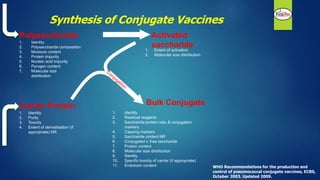
1. Identity
2. Polysaccharide composition
3. Moisture content
4. Protein impurity
5. Nucleic acid impurity
6. Pyrogen content
7. Molecular size
distribution
1. Extent of activation
2. Molecular size distribution
1. Identity
2. Purity
3. Toxicity
4. Extent of derivatisation (if
appropriate) NR
1. Identity
2. Residual reagents
3. Saccharide:protein ratio & conjugation
markers
4. Capping markers
5. Saccharide content NR
6. Conjugated v. free saccharide
7. Protein content
8. Molecular size distribution
9. Sterility
10. Specific toxicity of carrier (if appropriate)
11. Endotoxin content
Carrier Protein
Polysaccharide Activated
saccharide
Bulk Conjugate
Synthesis of Conjugate Vaccines
WHO Recommendations for the production and
control of pneumococcal conjugate vaccines, ECBS,
October 2003. Updated 2009.
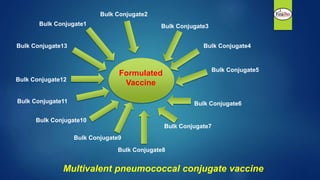
Bulk Conjugate1
Bulk Conjugate2
Bulk Conjugate3
Bulk Conjugate4
Bulk Conjugate5
Bulk Conjugate6
Bulk Conjugate7
Bulk Conjugate8
Bulk Conjugate9
Bulk Conjugate10
Bulk Conjugate11
Bulk Conjugate12
Bulk Conjugate13
Formulated
Vaccine
Multivalent pneumococcal conjugate vaccine
Carrier Protein Bulk Conjugate Final Vaccine
Polysaccharide Activated
saccharide
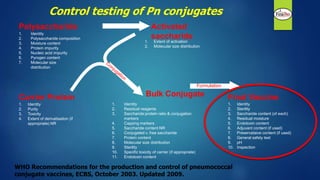
1. Identity
2. Polysaccharide composition
3. Moisture content
4. Protein impurity
5. Nucleic acid impurity
6. Pyrogen content
7. Molecular size
distribution
1. Extent of activation
2. Molecular size distribution
1. Identity
2. Purity
3. Toxicity
4. Extent of derivatisation (if
appropriate) NR
1. Identity
2. Residual reagents
3. Saccharide:protein ratio & conjugation
markers
4. Capping markers
5. Saccharide content NR
6. Conjugated v. free saccharide
7. Protein content
8. Molecular size distribution
9. Sterility
10. Specific toxicity of carrier (if appropriate)
11. Endotoxin content
1. Identity
2. Sterility
3. Saccharide content (of each)
4. Residual moisture
5. Endotoxin content
6. Adjuvant content (if used)
7. Preservataive content (if used)
8. General safety test
9. pH
10. Inspection
Formulation
Control testing of Pn conjugates
WHO Recommendations for the production and control of pneumococcal
conjugate vaccines, ECBS, October 2003. Updated 2009.
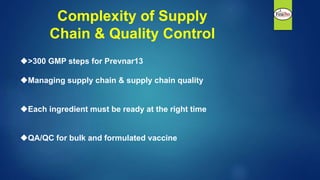
>300 GMP steps for Prevnar13
Managing supply chain & supply chain quality
Each ingredient must be ready at the right time
QA/QC for bulk and formulated vaccine
Complexity of Supply
Chain & Quality Control
Thank You!
www.FINABIO.com

QC in Biotechnology

  • 1.
    Quality Control inBiotechnology Andrew Lees, Ph.D. Scientific Director Fina BioSolutions LLC www.FinaBio.com
  • 2.
  • 3.
    Chemical drugs vsBiologicals  Chemical drugs can be precisely defined  Physical chemical characterization  NMR- structure  Mass Spectrometry- molecular weight  Chromatography- purity, quantity  Potency  Formulation  Relatively easy to create “generics”
  • 4.
    Chemical drugs vsBiologicals  Biologicals are produced by living cells  Impossible to  control every variable  completely characterize  Precisely replicate  Traditionally, biologicals are defined by “product by process”  Product is defined by the manufacturing process  Quality is compliance-driven  Goal is a “well-characterized biological”
  • 5.
    current Good ManufacturingProcess cGMP  Doing what you said you were going to do  Proving that you did what you said  Documenting that you did it.  Following SOPs  Validated methods
  • 6.
    Examples of Biologicals Insulin  EPO  Interferons  Toxins  Antibody  Conjugates  Antibody-drug conjugates  Fusion proteins
  • 7.
    Protein Structure SecondaryStructure: 3-dimensional structure of segments Tertiary structure: Final specific geometric shape that a protein assumes Quaternary structure: Arrangement of multiple folded protein or coiling protein molecules in a multi-subunit complex. Primary Structure: Amino acid sequence
  • 8.
  • 9.
  • 10.
    Modifications  Post-translation modifications Chemical changes not directly coded in DNA  Glycosylation  Phosphorylation  Lipidation  Chemical degradations  Oxidations  De-amidation  Rearrangements
  • 11.
  • 12.
  • 13.
  • 14.
    Variable inputs Cells “black box” Processvariables Biologically derived Chemically derived Variable crude product Inherent heterogeneity Stochastic processes Heterogeneous product Formulation
  • 15.
    Herceptin (anti-cancer antibody) Seven differentglycoforms, each with different levels of biological acitivity. Variability of materials
  • 16.
    Quality by Design(QbD) Operate within a specified design space Target Product Profile Critical Quality Attributes Critical Product Attributes Better understanding of process and product Defining design space Allows for more variability Process Analytical Technologies Real time monitoring & feedback. Product by process Lot release criteria- pass/fail Very difficult to make process improvements
  • 17.
  • 18.
    Design of Experiment(DOE)  A statistical method to model a process  Many fewer experiments than “one factor at a time”  Allows for modeling interactions  Useful to determine critical parameters  Critical for “Quality by Design”
  • 19.
    Run CDAP pHCPS Pro/PS Run CDAP pH CPS Pro/PS 1 + 0 + + 29 - 0 + 0 2 + 0 + 0 30 - 0 + - 3 + 0 + - 31 - 0 0 + 4 + 0 0 + 32 - 0 0 0 5 + 0 0 0 33 - 0 0 - 6 + 0 0 - 34 - 0 - + 7 + 0 - + 35 - 0 - 0 8 + 0 - 0 36 - 0 - - 9 + 0 - - 37 0 -- + + 10 0 0 + + 38 0 -- + - 11 0 0 + 0 39 0 -- - + 12 0 0 + - 40 0 -- - - 13 0 0 0 + 41 0 - + + 14 0 0 0 0 42 0 - + - 15 0 0 0 - 43 0 - - + 16 0 0 - + 44 0 - - - 17 0 0 - 0 45 ++ 0 + + 18 0 0 - - 46 ++ 0 + - 19 0 ++ + + 47 ++ 0 - + 21 0 ++ + - 48 ++ 0 - - 25 0 ++ - + 49 -- 0 + + 27 0 ++ - - 50 -- 0 + - 28 - 0 + + 51 -- 0 - + 52 -- 0 - - 53 0 + + + 54 0 + + - 55 0 + - + 56 0 + - - Parameter ++ + 0 - -- Units CDAP Ratio 0.9 0.7 0.5 0.3 0.1 mg/mg C PS - 15 10 5 - mg/mL Pro/PS - 1.25 1 0.75 - mg/mg pH 9.5 9.25 9 8.75 8.5 pH Application of Design of Experiment to Conjugate Vaccines
  • 20.
  • 21.
    Process Analytical Technologies(PAT) Real time feedback to control process
  • 22.
    Types of Vaccines Subunit (protein) vaccines  Tetanus toxoid  Diptheria toxoid  Pneumococcal (PneumoVax)  Killed vaccines  Rubella, Measles,  Polio (Salk)  Flu  Hepatitis A  Live attenuated vaccines  Polio (Sabin)  Flu (Flumist)  Rotavirus (Rotarix)  Virus Like Particles (VLP)  HPV (Gardisil)  New Generation Vaccines  DNA vaccines  Conjugate vaccines  Pneumococcal (Prevnar)  Meningicoccal (Menactra)  Haemophilus b (Hib)
  • 23.
    Polysaccharide Vaccine Polysaccharide Protein + Poorly immunogenicin infants No boosting or memory No class switching No affinity maturation  Immunogenic in infants  Boosting and memory  Class switching  Affinity maturation Conjugate Vaccine
  • 24.
  • 25.
    Why Conjugate Vaccines? Expensive Challengingto manufacture Many serotypes Haemophilus influenzae b (Hib) Neisseria meningiditis Streptococcus pneumoniae Salmonella typhi
  • 26.
    HARVARD STRAIN Cl. tetani INTERMEDIATE SEED HIGB(18 -32 hrs) FERMENTOR 35 ± 5°C ANAEROBIC CULTURE Revival On ATG medium 48 hours at 37 °C Inculcation into production Medium (Muller &Miller) (PH – 7.5 ± 0.1) CRUDE TOXOID SUBLOT STERTILE TOXIN CULTURE HARVEST 67 days SMEAR PH LF/ML Sterility test LF/ML MLD MTV Antigenic purity LF/ML Detoxification test in mice Detoxification with 0.5 % Formalin 4 days at Room temperature & 4 weeks at 35 °C Millipore Filter Clarification Sterilization CONCENTRATED TOXOID BULK PURIFIED TETANUS TOXOID POOLED CONCETRATE (1-2 SUBLOTS) Millipore Filter [30 KDa] 0.2 to 0.45 micron SUPERNATANT STERILE FILTRATION PURIFIED TOXOID PRECIPITATION Sterility test Antigenic purity LF/ML Specific Toxicity Irreversibility test Released for Blending Final Filtration (Cartridge Filter) Dialysis 0.2 micron bag pore size LF Test LF Test Centrifugation (4000 rpm @45 minutes) Precipitation with ammonium Sulphate – I st salting (10% - 12%) 5 th Day sample collection for SMEAR, pH, growth lysis Precipitate with high ammonium sulphate (22% - 24%) Centrifuge 4000 rpm @ 1 hour pooling TETANUS TOXOID PRODUCTION
  • 27.
    1. Identity 2. Polysaccharidecomposition 3. Moisture content 4. Protein impurity 5. Nucleic acid impurity 6. Pyrogen content 7. Molecular size distribution 1. Extent of activation 2. Molecular size distribution 1. Identity 2. Purity 3. Toxicity 4. Extent of derivatisation (if appropriate) NR 1. Identity 2. Residual reagents 3. Saccharide:protein ratio & conjugation markers 4. Capping markers 5. Saccharide content NR 6. Conjugated v. free saccharide 7. Protein content 8. Molecular size distribution 9. Sterility 10. Specific toxicity of carrier (if appropriate) 11. Endotoxin content Carrier Protein Polysaccharide Activated saccharide Bulk Conjugate Synthesis of Conjugate Vaccines WHO Recommendations for the production and control of pneumococcal conjugate vaccines, ECBS, October 2003. Updated 2009.
  • 28.
    Bulk Conjugate1 Bulk Conjugate2 BulkConjugate3 Bulk Conjugate4 Bulk Conjugate5 Bulk Conjugate6 Bulk Conjugate7 Bulk Conjugate8 Bulk Conjugate9 Bulk Conjugate10 Bulk Conjugate11 Bulk Conjugate12 Bulk Conjugate13 Formulated Vaccine Multivalent pneumococcal conjugate vaccine
  • 29.
    Carrier Protein BulkConjugate Final Vaccine Polysaccharide Activated saccharide 1. Identity 2. Polysaccharide composition 3. Moisture content 4. Protein impurity 5. Nucleic acid impurity 6. Pyrogen content 7. Molecular size distribution 1. Extent of activation 2. Molecular size distribution 1. Identity 2. Purity 3. Toxicity 4. Extent of derivatisation (if appropriate) NR 1. Identity 2. Residual reagents 3. Saccharide:protein ratio & conjugation markers 4. Capping markers 5. Saccharide content NR 6. Conjugated v. free saccharide 7. Protein content 8. Molecular size distribution 9. Sterility 10. Specific toxicity of carrier (if appropriate) 11. Endotoxin content 1. Identity 2. Sterility 3. Saccharide content (of each) 4. Residual moisture 5. Endotoxin content 6. Adjuvant content (if used) 7. Preservataive content (if used) 8. General safety test 9. pH 10. Inspection Formulation Control testing of Pn conjugates WHO Recommendations for the production and control of pneumococcal conjugate vaccines, ECBS, October 2003. Updated 2009.
  • 30.
    >300 GMP stepsfor Prevnar13 Managing supply chain & supply chain quality Each ingredient must be ready at the right time QA/QC for bulk and formulated vaccine Complexity of Supply Chain & Quality Control
  • 31.