Can consuming Berries
prevent Erectile Dysfunction?
News Author: Peter Russell
CME Author: Laurie Barclay, MD
Reported by: Krizia J. Diaz
What is Erectile
Dysfunction?
• Erectile
dysfunction
(ED) is the
inability to get
or keep an
erection firm
enough to have
sexual
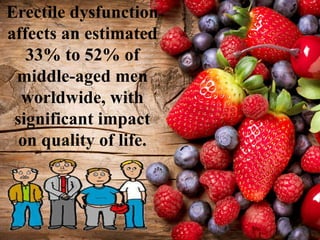
Erectile dysfunction
affects an estimated
33% to 52% of
middle-aged men
worldwide, with
significant impact
on quality of life.
GOAL OF THE STUDY
• The goal of this
study was to
evaluate possible
associations
between diets
varying in
flavonoid
subclasses and ED
STUDY SYNOPSIS AND
PERSPECTIVE
• According to a new study by
the University of East
Anglia (UEA) and Harvard
University in the US, eating
berries and citrus fruit
which contains flavonoids
(anthocyanins, flavanones,
and flavones) may reduce
the risk of men developing
problems getting and
STUDY HIGHLIGHTS
• Type of study:
Observational study
• Sample: 25,096 men
enrolled in US health
study
METHODOLOGY
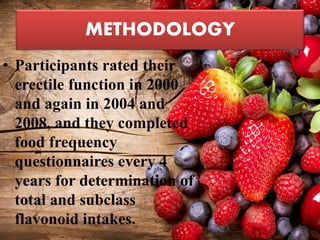
• Participants rated their
erectile function in 2000
and again in 2004 and
2008, and they completed
food frequency
questionnaires every 4
years for determination of
total and subclass
flavonoid intakes.
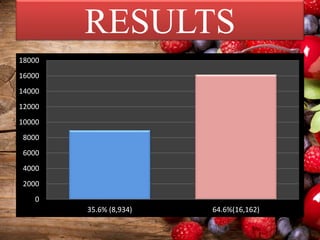
RESULTS
0
2000
4000
6000
8000
10000
12000
14000
16000
18000
35.6% (8,934) 64.6%(16,162)
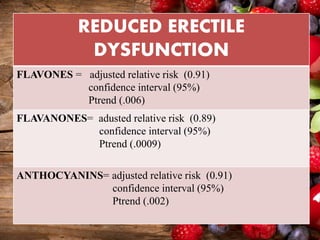
REDUCED ERECTILE
DYSFUNCTION
FLAVONES = adjusted relative risk (0.91)
confidence interval (95%)
Ptrend (.006)
FLAVANONES= adusted relative risk (0.89)
confidence interval (95%)
Ptrend (.0009)
ANTHOCYANINS= adjusted relative risk (0.91)
confidence interval (95%)
Ptrend (.002)
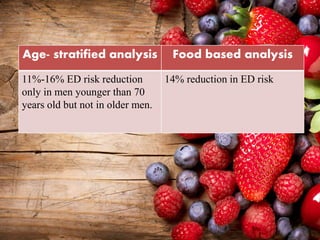
Age- stratified analysis Food based analysis
11%-16% ED risk reduction
only in men younger than 70
years old but not in older men.
14% reduction in ED risk
CONCLUSION
• The greatest benefits were from berries which are
rich in anthocyanins, and citrus flavanones were
second most effective.
• Investigators concluded that higher habitual intake
of fruit rich in flavonoids is associated with lower
ED incidence
• Dietary intake of fruits and vegetables should be
encouraged for other health benefits on
cardiovascular function and improvements in
cerebral blood flow enhancing cognitive function.

Can consuming berries prevent erectile dysfunction

  • 1.
    Can consuming Berries preventErectile Dysfunction? News Author: Peter Russell CME Author: Laurie Barclay, MD Reported by: Krizia J. Diaz
  • 2.
    What is Erectile Dysfunction? •Erectile dysfunction (ED) is the inability to get or keep an erection firm enough to have sexual
  • 3.
    Erectile dysfunction affects anestimated 33% to 52% of middle-aged men worldwide, with significant impact on quality of life.
  • 4.
    GOAL OF THESTUDY • The goal of this study was to evaluate possible associations between diets varying in flavonoid subclasses and ED
  • 5.
    STUDY SYNOPSIS AND PERSPECTIVE •According to a new study by the University of East Anglia (UEA) and Harvard University in the US, eating berries and citrus fruit which contains flavonoids (anthocyanins, flavanones, and flavones) may reduce the risk of men developing problems getting and
  • 6.
    STUDY HIGHLIGHTS • Typeof study: Observational study • Sample: 25,096 men enrolled in US health study
  • 7.
    METHODOLOGY • Participants ratedtheir erectile function in 2000 and again in 2004 and 2008, and they completed food frequency questionnaires every 4 years for determination of total and subclass flavonoid intakes.
  • 8.
  • 9.
    REDUCED ERECTILE DYSFUNCTION FLAVONES =adjusted relative risk (0.91) confidence interval (95%) Ptrend (.006) FLAVANONES= adusted relative risk (0.89) confidence interval (95%) Ptrend (.0009) ANTHOCYANINS= adjusted relative risk (0.91) confidence interval (95%) Ptrend (.002)
  • 10.
    Age- stratified analysisFood based analysis 11%-16% ED risk reduction only in men younger than 70 years old but not in older men. 14% reduction in ED risk
  • 11.
    CONCLUSION • The greatestbenefits were from berries which are rich in anthocyanins, and citrus flavanones were second most effective. • Investigators concluded that higher habitual intake of fruit rich in flavonoids is associated with lower ED incidence • Dietary intake of fruits and vegetables should be encouraged for other health benefits on cardiovascular function and improvements in cerebral blood flow enhancing cognitive function.