PROGRESSIONS
LEVEL 2
C.S.VEERARAGAVAN
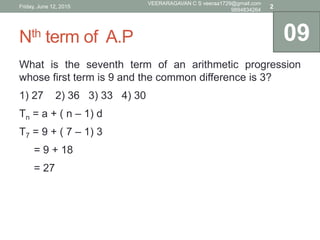
Nth term of A.P
What is the seventh term of an arithmetic progression
whose first term is 9 and the common difference is 3?
1) 27 2) 36 3) 33 4) 30
Tn = a + ( n – 1) d
T7 = 9 + ( 7 – 1) 3
= 9 + 18
= 27
09
Friday, June 12, 2015
VEERARAGAVAN C S veeraa1729@gmail.com
9894834264
2
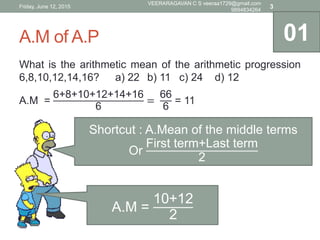
A.M of A.P
What is the arithmetic mean of the arithmetic progression
6,8,10,12,14,16? a) 22 b) 11 c) 24 d) 12
A.M =
6+8+10+12+14+16
6
=
66
6
= 11
01
Shortcut : A.Mean of the middle terms
Or
First term+Last term
2
A.M =
10+12
2
Friday, June 12, 2015
VEERARAGAVAN C S veeraa1729@gmail.com
9894834264
3
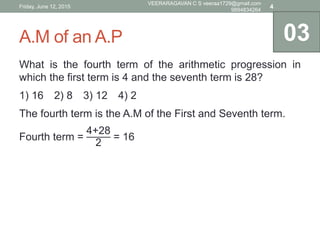
A.M of an A.P
What is the fourth term of the arithmetic progression in
which the first term is 4 and the seventh term is 28?
1) 16 2) 8 3) 12 4) 2
The fourth term is the A.M of the First and Seventh term.
Fourth term =
4+28
2
= 16
03
Friday, June 12, 2015
VEERARAGAVAN C S veeraa1729@gmail.com
9894834264
4
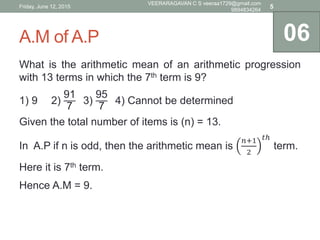
A.M of A.P
What is the arithmetic mean of an arithmetic progression
with 13 terms in which the 7th term is 9?
1) 9 2)
91
7
3)
95
7
4) Cannot be determined
Given the total number of items is (n) = 13.
In A.P if n is odd, then the arithmetic mean is
𝑛+1
2
𝑡ℎ
term.
Here it is 7th term.
Hence A.M = 9.
06
Friday, June 12, 2015
VEERARAGAVAN C S veeraa1729@gmail.com
9894834264
5
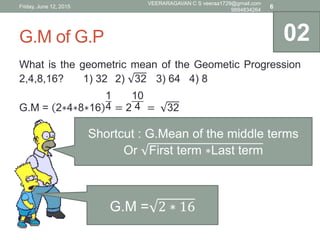
G.M of G.P
What is the geometric mean of the Geometic Progression
2,4,8,16? 1) 32 2) 32 3) 64 4) 8
G.M = 2∗4∗8∗16
1
4 = 2
10
4 = 32
02
Shortcut : G.Mean of the middle terms
Or First term ∗Last term
G.M = 2 ∗ 16
Friday, June 12, 2015
VEERARAGAVAN C S veeraa1729@gmail.com
9894834264
6
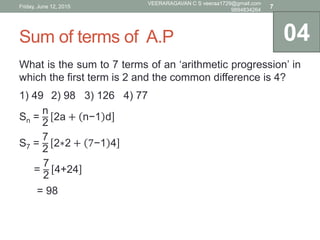
Sum of terms of A.P
What is the sum to 7 terms of an ‘arithmetic progression’ in
which the first term is 2 and the common difference is 4?
1) 49 2) 98 3) 126 4) 77
Sn =
n
2
2a + n−1 d
S7 =
7
2
2∗2 + 7−1 4
=
7
2
4+24
= 98
04
Friday, June 12, 2015
VEERARAGAVAN C S veeraa1729@gmail.com
9894834264
7
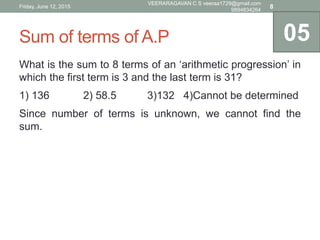
Sum of terms of A.P
What is the sum to 8 terms of an ‘arithmetic progression’ in
which the first term is 3 and the last term is 31?
1) 136 2) 58.5 3)132 4)Cannot be determined
Since number of terms is unknown, we cannot find the
sum.
05
Friday, June 12, 2015
VEERARAGAVAN C S veeraa1729@gmail.com
9894834264
8
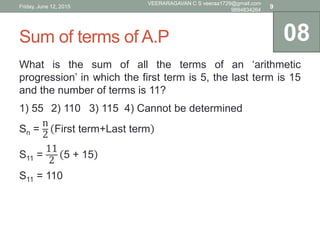
Sum of terms of A.P
What is the sum of all the terms of an ‘arithmetic
progression’ in which the first term is 5, the last term is 15
and the number of terms is 11?
1) 55 2) 110 3) 115 4) Cannot be determined
Sn =
n
2
First term+Last term
S11 =
11
2
5 + 15
S11 = 110
08
Friday, June 12, 2015
VEERARAGAVAN C S veeraa1729@gmail.com
9894834264
9
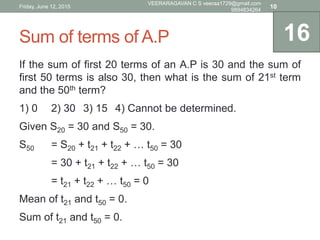
Sum of terms of A.P
If the sum of first 20 terms of an A.P is 30 and the sum of
first 50 terms is also 30, then what is the sum of 21st term
and the 50th term?
1) 0 2) 30 3) 15 4) Cannot be determined.
Given S20 = 30 and S50 = 30.
S50 = S20 + t21 + t22 + … t50 = 30
= 30 + t21 + t22 + … t50 = 30
= t21 + t22 + … t50 = 0
Mean of t21 and t50 = 0.
Sum of t21 and t50 = 0.
16
Friday, June 12, 2015
VEERARAGAVAN C S veeraa1729@gmail.com
9894834264
10
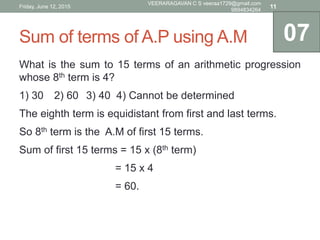
Sum of terms of A.P using A.M
What is the sum to 15 terms of an arithmetic progression
whose 8th term is 4?
1) 30 2) 60 3) 40 4) Cannot be determined
The eighth term is equidistant from first and last terms.
So 8th term is the A.M of first 15 terms.
Sum of first 15 terms = 15 x (8th term)
= 15 x 4
= 60.
07
Friday, June 12, 2015
VEERARAGAVAN C S veeraa1729@gmail.com
9894834264
11
Sum of terms of A.P using A.M
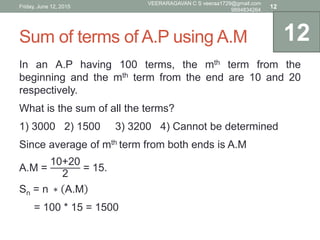
In an A.P having 100 terms, the mth term from the
beginning and the mth term from the end are 10 and 20
respectively.
What is the sum of all the terms?
1) 3000 2) 1500 3) 3200 4) Cannot be determined
Since average of mth term from both ends is A.M
A.M =
10+20
2
= 15.
Sn = n ∗ A.M
= 100 * 15 = 1500
12
Friday, June 12, 2015
VEERARAGAVAN C S veeraa1729@gmail.com
9894834264
12
nth term of a G.P using G.M
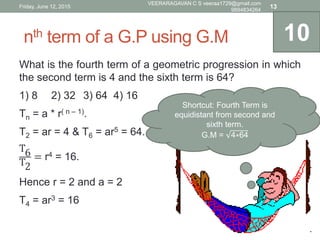
What is the fourth term of a geometric progression in which
the second term is 4 and the sixth term is 64?
1) 8 2) 32 3) 64 4) 16
Tn = a * r( n – 1).
T2 = ar = 4 & T6 = ar5 = 64.
T6
T2
= r4 = 16.
Hence r = 2 and a = 2
T4 = ar3 = 16
10
Shortcut: Fourth Term is
equidistant from second and
sixth term.
G.M = 4∗64
Friday, June 12, 2015
VEERARAGAVAN C S veeraa1729@gmail.com
9894834264
13
Sum of terms of G.P
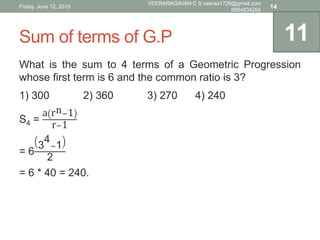
What is the sum to 4 terms of a Geometric Progression
whose first term is 6 and the common ratio is 3?
1) 300 2) 360 3) 270 4) 240
S4 =
a rn−1
r−1
= 6
3
4
−1
2
= 6 * 40 = 240.
11
Friday, June 12, 2015
VEERARAGAVAN C S veeraa1729@gmail.com
9894834264
14
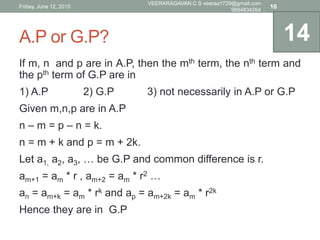
A.P or G.P ?
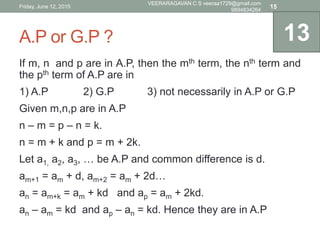
If m, n and p are in A.P, then the mth term, the nth term and
the pth term of A.P are in
1) A.P 2) G.P 3) not necessarily in A.P or G.P
Given m,n,p are in A.P
n – m = p – n = k.
n = m + k and p = m + 2k.
Let a1, a2, a3, … be A.P and common difference is d.
am+1 = am + d, am+2 = am + 2d…
an = am+k = am + kd and ap = am + 2kd.
an – am = kd and ap – an = kd. Hence they are in A.P
13
Friday, June 12, 2015
VEERARAGAVAN C S veeraa1729@gmail.com
9894834264
15
A.P or G.P?
If m, n and p are in A.P, then the mth term, the nth term and
the pth term of G.P are in
1) A.P 2) G.P 3) not necessarily in A.P or G.P
Given m,n,p are in A.P
n – m = p – n = k.
n = m + k and p = m + 2k.
Let a1, a2, a3, … be G.P and common difference is r.
am+1 = am * r , am+2 = am * r2 …
an = am+k = am * rk and ap = am+2k = am * r2k
Hence they are in G.P
14
Friday, June 12, 2015
VEERARAGAVAN C S veeraa1729@gmail.com
9894834264
16
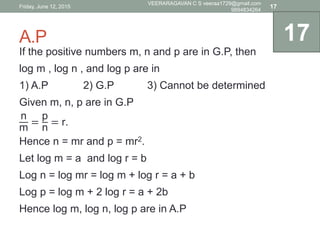
A.P
If the positive numbers m, n and p are in G.P, then
log m , log n , and log p are in
1) A.P 2) G.P 3) Cannot be determined
Given m, n, p are in G.P
n
m
=
p
n
= r.
Hence n = mr and p = mr2.
Let log m = a and log r = b
Log n = log mr = log m + log r = a + b
Log p = log m + 2 log r = a + 2b
Hence log m, log n, log p are in A.P
17
Friday, June 12, 2015
VEERARAGAVAN C S veeraa1729@gmail.com
9894834264
17
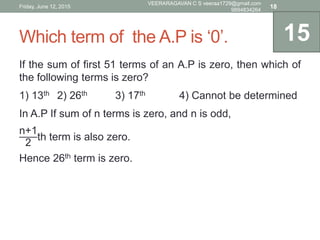
Which term of the A.P is ‘0’.
If the sum of first 51 terms of an A.P is zero, then which of
the following terms is zero?
1) 13th 2) 26th 3) 17th 4) Cannot be determined
In A.P If sum of n terms is zero, and n is odd,
n+1
2
th term is also zero.
Hence 26th term is zero.
15
Friday, June 12, 2015
VEERARAGAVAN C S veeraa1729@gmail.com
9894834264
18
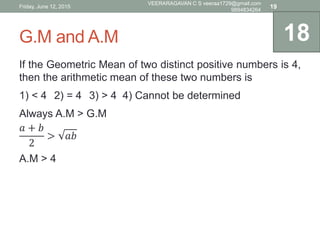
G.M and A.M
If the Geometric Mean of two distinct positive numbers is 4,
then the arithmetic mean of these two numbers is
1) < 4 2) = 4 3) > 4 4) Cannot be determined
Always A.M > G.M
𝑎 + 𝑏
2
> 𝑎𝑏
A.M > 4
18
Friday, June 12, 2015
VEERARAGAVAN C S veeraa1729@gmail.com
9894834264
19
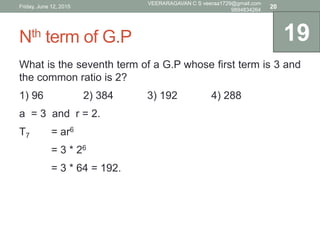
Nth term of G.P
What is the seventh term of a G.P whose first term is 3 and
the common ratio is 2?
1) 96 2) 384 3) 192 4) 288
a = 3 and r = 2.
T7 = ar6
= 3 * 26
= 3 * 64 = 192.
19
Friday, June 12, 2015
VEERARAGAVAN C S veeraa1729@gmail.com
9894834264
20
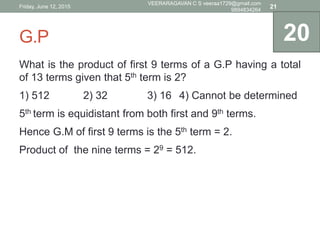
G.P
What is the product of first 9 terms of a G.P having a total
of 13 terms given that 5th term is 2?
1) 512 2) 32 3) 16 4) Cannot be determined
5th term is equidistant from both first and 9th terms.
Hence G.M of first 9 terms is the 5th term = 2.
Product of the nine terms = 29 = 512.
20
Friday, June 12, 2015
VEERARAGAVAN C S veeraa1729@gmail.com
9894834264
21
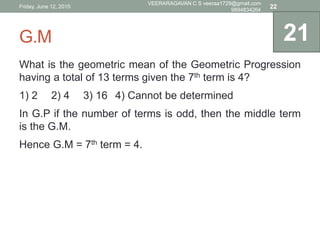
G.M
What is the geometric mean of the Geometric Progression
having a total of 13 terms given the 7th term is 4?
1) 2 2) 4 3) 16 4) Cannot be determined
In G.P if the number of terms is odd, then the middle term
is the G.M.
Hence G.M = 7th term = 4.
21
Friday, June 12, 2015
VEERARAGAVAN C S veeraa1729@gmail.com
9894834264
22
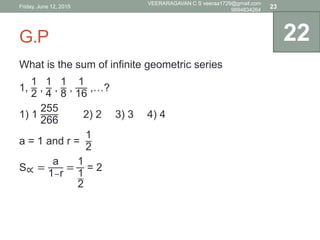
G.P
What is the sum of infinite geometric series
1,
1
2
,
1
4
,
1
8
,
1
16
,…?
1) 1
255
266
2) 2 3) 3 4) 4
a = 1 and r =
1
2
S∝ =
a
1−r
=
1
1
2
= 2
22
Friday, June 12, 2015
VEERARAGAVAN C S veeraa1729@gmail.com
9894834264
23
G.P
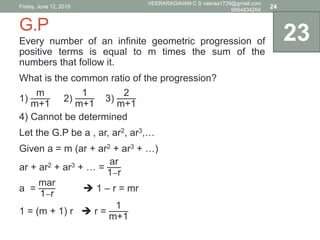
Every number of an infinite geometric progression of
positive terms is equal to m times the sum of the
numbers that follow it.
What is the common ratio of the progression?
1)
m
m+1
2)
1
m+1
3)
2
m+1
4) Cannot be determined
Let the G.P be a , ar, ar2, ar3,…
Given a = m (ar + ar2 + ar3 + …)
ar + ar2 + ar3 + … =
ar
1−r
a =
mar
1−r
 1 – r = mr
1 = (m + 1) r  r =
1
m+1
23
Friday, June 12, 2015
VEERARAGAVAN C S veeraa1729@gmail.com
9894834264
24
Sum of the terms of G.P
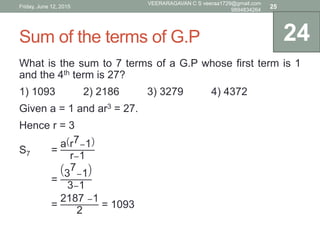
What is the sum to 7 terms of a G.P whose first term is 1
and the 4th term is 27?
1) 1093 2) 2186 3) 3279 4) 4372
Given a = 1 and ar3 = 27.
Hence r = 3
S7 =
a r7−1
r−1
=
3
7
−1
3−1
=
2187 −1
2
= 1093
24
Friday, June 12, 2015
VEERARAGAVAN C S veeraa1729@gmail.com
9894834264
25
Sum of the first n cubes
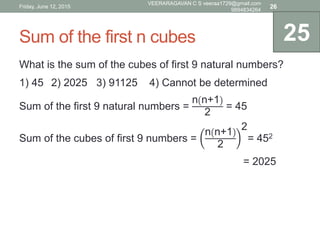
What is the sum of the cubes of first 9 natural numbers?
1) 45 2) 2025 3) 91125 4) Cannot be determined
Sum of the first 9 natural numbers =
n n+1
2
= 45
Sum of the cubes of first 9 numbers =
n n+1
2
2
= 452
= 2025
25
Friday, June 12, 2015
VEERARAGAVAN C S veeraa1729@gmail.com
9894834264
26

Progressions level 2

  • 1.
  • 2.
    Nth term ofA.P What is the seventh term of an arithmetic progression whose first term is 9 and the common difference is 3? 1) 27 2) 36 3) 33 4) 30 Tn = a + ( n – 1) d T7 = 9 + ( 7 – 1) 3 = 9 + 18 = 27 09 Friday, June 12, 2015 VEERARAGAVAN C S veeraa1729@gmail.com 9894834264 2
  • 3.
    A.M of A.P Whatis the arithmetic mean of the arithmetic progression 6,8,10,12,14,16? a) 22 b) 11 c) 24 d) 12 A.M = 6+8+10+12+14+16 6 = 66 6 = 11 01 Shortcut : A.Mean of the middle terms Or First term+Last term 2 A.M = 10+12 2 Friday, June 12, 2015 VEERARAGAVAN C S veeraa1729@gmail.com 9894834264 3
  • 4.
    A.M of anA.P What is the fourth term of the arithmetic progression in which the first term is 4 and the seventh term is 28? 1) 16 2) 8 3) 12 4) 2 The fourth term is the A.M of the First and Seventh term. Fourth term = 4+28 2 = 16 03 Friday, June 12, 2015 VEERARAGAVAN C S veeraa1729@gmail.com 9894834264 4
  • 5.
    A.M of A.P Whatis the arithmetic mean of an arithmetic progression with 13 terms in which the 7th term is 9? 1) 9 2) 91 7 3) 95 7 4) Cannot be determined Given the total number of items is (n) = 13. In A.P if n is odd, then the arithmetic mean is 𝑛+1 2 𝑡ℎ term. Here it is 7th term. Hence A.M = 9. 06 Friday, June 12, 2015 VEERARAGAVAN C S veeraa1729@gmail.com 9894834264 5
  • 6.
    G.M of G.P Whatis the geometric mean of the Geometic Progression 2,4,8,16? 1) 32 2) 32 3) 64 4) 8 G.M = 2∗4∗8∗16 1 4 = 2 10 4 = 32 02 Shortcut : G.Mean of the middle terms Or First term ∗Last term G.M = 2 ∗ 16 Friday, June 12, 2015 VEERARAGAVAN C S veeraa1729@gmail.com 9894834264 6
  • 7.
    Sum of termsof A.P What is the sum to 7 terms of an ‘arithmetic progression’ in which the first term is 2 and the common difference is 4? 1) 49 2) 98 3) 126 4) 77 Sn = n 2 2a + n−1 d S7 = 7 2 2∗2 + 7−1 4 = 7 2 4+24 = 98 04 Friday, June 12, 2015 VEERARAGAVAN C S veeraa1729@gmail.com 9894834264 7
  • 8.
    Sum of termsof A.P What is the sum to 8 terms of an ‘arithmetic progression’ in which the first term is 3 and the last term is 31? 1) 136 2) 58.5 3)132 4)Cannot be determined Since number of terms is unknown, we cannot find the sum. 05 Friday, June 12, 2015 VEERARAGAVAN C S veeraa1729@gmail.com 9894834264 8
  • 9.
    Sum of termsof A.P What is the sum of all the terms of an ‘arithmetic progression’ in which the first term is 5, the last term is 15 and the number of terms is 11? 1) 55 2) 110 3) 115 4) Cannot be determined Sn = n 2 First term+Last term S11 = 11 2 5 + 15 S11 = 110 08 Friday, June 12, 2015 VEERARAGAVAN C S veeraa1729@gmail.com 9894834264 9
  • 10.
    Sum of termsof A.P If the sum of first 20 terms of an A.P is 30 and the sum of first 50 terms is also 30, then what is the sum of 21st term and the 50th term? 1) 0 2) 30 3) 15 4) Cannot be determined. Given S20 = 30 and S50 = 30. S50 = S20 + t21 + t22 + … t50 = 30 = 30 + t21 + t22 + … t50 = 30 = t21 + t22 + … t50 = 0 Mean of t21 and t50 = 0. Sum of t21 and t50 = 0. 16 Friday, June 12, 2015 VEERARAGAVAN C S veeraa1729@gmail.com 9894834264 10
  • 11.
    Sum of termsof A.P using A.M What is the sum to 15 terms of an arithmetic progression whose 8th term is 4? 1) 30 2) 60 3) 40 4) Cannot be determined The eighth term is equidistant from first and last terms. So 8th term is the A.M of first 15 terms. Sum of first 15 terms = 15 x (8th term) = 15 x 4 = 60. 07 Friday, June 12, 2015 VEERARAGAVAN C S veeraa1729@gmail.com 9894834264 11
  • 12.
    Sum of termsof A.P using A.M In an A.P having 100 terms, the mth term from the beginning and the mth term from the end are 10 and 20 respectively. What is the sum of all the terms? 1) 3000 2) 1500 3) 3200 4) Cannot be determined Since average of mth term from both ends is A.M A.M = 10+20 2 = 15. Sn = n ∗ A.M = 100 * 15 = 1500 12 Friday, June 12, 2015 VEERARAGAVAN C S veeraa1729@gmail.com 9894834264 12
  • 13.
    nth term ofa G.P using G.M What is the fourth term of a geometric progression in which the second term is 4 and the sixth term is 64? 1) 8 2) 32 3) 64 4) 16 Tn = a * r( n – 1). T2 = ar = 4 & T6 = ar5 = 64. T6 T2 = r4 = 16. Hence r = 2 and a = 2 T4 = ar3 = 16 10 Shortcut: Fourth Term is equidistant from second and sixth term. G.M = 4∗64 Friday, June 12, 2015 VEERARAGAVAN C S veeraa1729@gmail.com 9894834264 13
  • 14.
    Sum of termsof G.P What is the sum to 4 terms of a Geometric Progression whose first term is 6 and the common ratio is 3? 1) 300 2) 360 3) 270 4) 240 S4 = a rn−1 r−1 = 6 3 4 −1 2 = 6 * 40 = 240. 11 Friday, June 12, 2015 VEERARAGAVAN C S veeraa1729@gmail.com 9894834264 14
  • 15.
    A.P or G.P? If m, n and p are in A.P, then the mth term, the nth term and the pth term of A.P are in 1) A.P 2) G.P 3) not necessarily in A.P or G.P Given m,n,p are in A.P n – m = p – n = k. n = m + k and p = m + 2k. Let a1, a2, a3, … be A.P and common difference is d. am+1 = am + d, am+2 = am + 2d… an = am+k = am + kd and ap = am + 2kd. an – am = kd and ap – an = kd. Hence they are in A.P 13 Friday, June 12, 2015 VEERARAGAVAN C S veeraa1729@gmail.com 9894834264 15
  • 16.
    A.P or G.P? Ifm, n and p are in A.P, then the mth term, the nth term and the pth term of G.P are in 1) A.P 2) G.P 3) not necessarily in A.P or G.P Given m,n,p are in A.P n – m = p – n = k. n = m + k and p = m + 2k. Let a1, a2, a3, … be G.P and common difference is r. am+1 = am * r , am+2 = am * r2 … an = am+k = am * rk and ap = am+2k = am * r2k Hence they are in G.P 14 Friday, June 12, 2015 VEERARAGAVAN C S veeraa1729@gmail.com 9894834264 16
  • 17.
    A.P If the positivenumbers m, n and p are in G.P, then log m , log n , and log p are in 1) A.P 2) G.P 3) Cannot be determined Given m, n, p are in G.P n m = p n = r. Hence n = mr and p = mr2. Let log m = a and log r = b Log n = log mr = log m + log r = a + b Log p = log m + 2 log r = a + 2b Hence log m, log n, log p are in A.P 17 Friday, June 12, 2015 VEERARAGAVAN C S veeraa1729@gmail.com 9894834264 17
  • 18.
    Which term ofthe A.P is ‘0’. If the sum of first 51 terms of an A.P is zero, then which of the following terms is zero? 1) 13th 2) 26th 3) 17th 4) Cannot be determined In A.P If sum of n terms is zero, and n is odd, n+1 2 th term is also zero. Hence 26th term is zero. 15 Friday, June 12, 2015 VEERARAGAVAN C S veeraa1729@gmail.com 9894834264 18
  • 19.
    G.M and A.M Ifthe Geometric Mean of two distinct positive numbers is 4, then the arithmetic mean of these two numbers is 1) < 4 2) = 4 3) > 4 4) Cannot be determined Always A.M > G.M 𝑎 + 𝑏 2 > 𝑎𝑏 A.M > 4 18 Friday, June 12, 2015 VEERARAGAVAN C S veeraa1729@gmail.com 9894834264 19
  • 20.
    Nth term ofG.P What is the seventh term of a G.P whose first term is 3 and the common ratio is 2? 1) 96 2) 384 3) 192 4) 288 a = 3 and r = 2. T7 = ar6 = 3 * 26 = 3 * 64 = 192. 19 Friday, June 12, 2015 VEERARAGAVAN C S veeraa1729@gmail.com 9894834264 20
  • 21.
    G.P What is theproduct of first 9 terms of a G.P having a total of 13 terms given that 5th term is 2? 1) 512 2) 32 3) 16 4) Cannot be determined 5th term is equidistant from both first and 9th terms. Hence G.M of first 9 terms is the 5th term = 2. Product of the nine terms = 29 = 512. 20 Friday, June 12, 2015 VEERARAGAVAN C S veeraa1729@gmail.com 9894834264 21
  • 22.
    G.M What is thegeometric mean of the Geometric Progression having a total of 13 terms given the 7th term is 4? 1) 2 2) 4 3) 16 4) Cannot be determined In G.P if the number of terms is odd, then the middle term is the G.M. Hence G.M = 7th term = 4. 21 Friday, June 12, 2015 VEERARAGAVAN C S veeraa1729@gmail.com 9894834264 22
  • 23.
    G.P What is thesum of infinite geometric series 1, 1 2 , 1 4 , 1 8 , 1 16 ,…? 1) 1 255 266 2) 2 3) 3 4) 4 a = 1 and r = 1 2 S∝ = a 1−r = 1 1 2 = 2 22 Friday, June 12, 2015 VEERARAGAVAN C S veeraa1729@gmail.com 9894834264 23
  • 24.
    G.P Every number ofan infinite geometric progression of positive terms is equal to m times the sum of the numbers that follow it. What is the common ratio of the progression? 1) m m+1 2) 1 m+1 3) 2 m+1 4) Cannot be determined Let the G.P be a , ar, ar2, ar3,… Given a = m (ar + ar2 + ar3 + …) ar + ar2 + ar3 + … = ar 1−r a = mar 1−r  1 – r = mr 1 = (m + 1) r  r = 1 m+1 23 Friday, June 12, 2015 VEERARAGAVAN C S veeraa1729@gmail.com 9894834264 24
  • 25.
    Sum of theterms of G.P What is the sum to 7 terms of a G.P whose first term is 1 and the 4th term is 27? 1) 1093 2) 2186 3) 3279 4) 4372 Given a = 1 and ar3 = 27. Hence r = 3 S7 = a r7−1 r−1 = 3 7 −1 3−1 = 2187 −1 2 = 1093 24 Friday, June 12, 2015 VEERARAGAVAN C S veeraa1729@gmail.com 9894834264 25
  • 26.
    Sum of thefirst n cubes What is the sum of the cubes of first 9 natural numbers? 1) 45 2) 2025 3) 91125 4) Cannot be determined Sum of the first 9 natural numbers = n n+1 2 = 45 Sum of the cubes of first 9 numbers = n n+1 2 2 = 452 = 2025 25 Friday, June 12, 2015 VEERARAGAVAN C S veeraa1729@gmail.com 9894834264 26