SQUARES AND
SQUARE ROOTS
Powerpoint presentation
by RISIKA PANWAR
INTRODUCTION TO
SQUARES
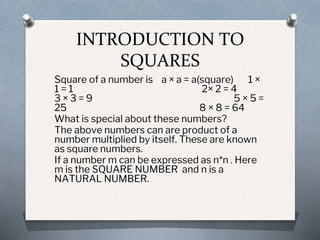
Square of a number is a × a = a(square) 1 ×
1 = 1 2× 2 = 4
3 × 3 = 9 5 × 5 =
25 8 × 8 = 64
What is special about these numbers?
The above numbers can are product of a
number multiplied by itself. These are known
as square numbers.
If a number m can be expressed as n*n . Here
m is the SQUARE NUMBER and n is a
NATURAL NUMBER.
Important square to
remember
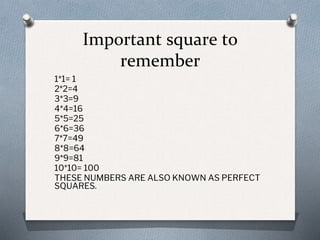
1*1= 1
2*2=4
3*3=9
4*4=16
5*5=25
6*6=36
7*7=49
8*8=64
9*9=81
10*10= 100
THESE NUMBERS ARE ALSO KNOWN AS PERFECT
SQUARES.
Properties of square numbers
O The numbers ending with either 0, 1, 4, 5, 6, 9 must be a
perfect square. Though it isn’t always necessary that
numbers with unit digits 0,1,4,5,6,9 are always a square
number.
O The unit’s digit of the square of a natural number is the
unit’s digit of the square of the digit at unit’s place of the
given natural number.
Example :
1) Unit digit of square of 146.
Solution : Unit digit of 6 2 = 36 and the unit digit of 36 is
6, so the unit digit of square of 146 is 6.
C) Squares of even numbers are always even numbers and
square of odd numbers are always odd.
Example : 12 2 = 12 x 12 = 144. (both are even numbers)
19 2 = 19 x 19 = 361 (both are odd numbers)
Properties continued

O The number of zeros at the end of a perfect square is always
even. In other words, a number ending in an odd number of
zeros is never a perfect square.
Example : 2500 is a perfect square as number of zeros are
2(even) and 25000 is not a perfect square as the number of
zeros are 3 (odd).
O PYTHAGOREAN TRIPLETS: This is a topic in maths that
helps us understand the relation between the sides of a
right-angled triangle.
O For any natural number m greater than 1,
(2m, m 2 - 1, m 2 + 1) is a Pythagorean triplet.
O : The square of a number n is equal to the sum of first n odd
natural numbers.
1 2 = 1
2 2 = 1 + 3
3 2 = 1 + 3 + 5
4 2 = 1 + 3 + 5 + 7
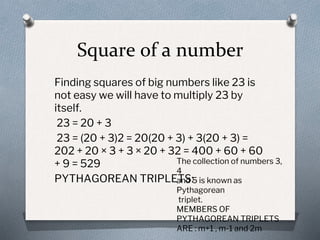
Square of a number
Finding squares of big numbers like 23 is
not easy we will have to multiply 23 by
itself.
23 = 20 + 3
23 = (20 + 3)2 = 20(20 + 3) + 3(20 + 3) =
202 + 20 × 3 + 3 × 20 + 32 = 400 + 60 + 60
+ 9 = 529
PYTHAGOREAN TRIPLETS:
The collection of numbers 3,
4
and 5 is known as
Pythagorean
triplet.
MEMBERS OF
PYTHAGOREAN TRIPLETS
ARE : m+1 , m-1 and 2m
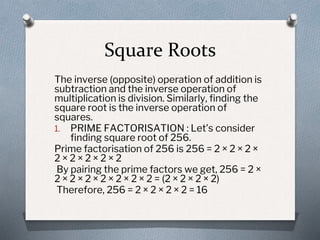
Square Roots
The inverse (opposite) operation of addition is
subtraction and the inverse operation of
multiplication is division. Similarly, finding the
square root is the inverse operation of
squares.
1. PRIME FACTORISATION : Let’s consider
finding square root of 256.
Prime factorisation of 256 is 256 = 2 × 2 × 2 ×
2 × 2 × 2 × 2 × 2
By pairing the prime factors we get, 256 = 2 ×
2 × 2 × 2 × 2 × 2 × 2 × 2 = (2 × 2 × 2 × 2)
Therefore, 256 = 2 × 2 × 2 × 2 = 16
Square root by long division
method
By long division method we can find the
square root of not only natural numbers also
of decimals.
Let us try to find root 5607 by long division
method.
We get the remainder 131
. It shows that 742 is less than 5607 by 131
. This means if we subtract the remainder
from the number, we get a perfect square.
Therefore, the required perfect square is
5607 – 131 = 5476. And, 5476 = 74.
Same procedure can be used for decimals as
well.
LET’S SUMMARISE
1. If a natural number m can be
expressed as n 2 , where n is also a
natural number, then m is a square
number.
2. All square numbers end with 0, 1, 4, 5,
6 or 9 at unit’s place.
3. Square numbers can only have even
number of zeros at the end.
4. Square root is the inverse operation of
square.
Thankyou everyone for paying attention at my presentation. I
hope y0u liked it . I tried and covered each and every topic I
could, still anything left I’M SORRY.

SQUARES AND SQUARE ROOTS.pptx powerpoint presentation square and square roots class 7

  • 1.
    SQUARES AND SQUARE ROOTS Powerpointpresentation by RISIKA PANWAR
  • 2.
    INTRODUCTION TO SQUARES Square ofa number is a × a = a(square) 1 × 1 = 1 2× 2 = 4 3 × 3 = 9 5 × 5 = 25 8 × 8 = 64 What is special about these numbers? The above numbers can are product of a number multiplied by itself. These are known as square numbers. If a number m can be expressed as n*n . Here m is the SQUARE NUMBER and n is a NATURAL NUMBER.
  • 3.
    Important square to remember 1*1=1 2*2=4 3*3=9 4*4=16 5*5=25 6*6=36 7*7=49 8*8=64 9*9=81 10*10= 100 THESE NUMBERS ARE ALSO KNOWN AS PERFECT SQUARES.
  • 4.
    Properties of squarenumbers O The numbers ending with either 0, 1, 4, 5, 6, 9 must be a perfect square. Though it isn’t always necessary that numbers with unit digits 0,1,4,5,6,9 are always a square number. O The unit’s digit of the square of a natural number is the unit’s digit of the square of the digit at unit’s place of the given natural number. Example : 1) Unit digit of square of 146. Solution : Unit digit of 6 2 = 36 and the unit digit of 36 is 6, so the unit digit of square of 146 is 6. C) Squares of even numbers are always even numbers and square of odd numbers are always odd. Example : 12 2 = 12 x 12 = 144. (both are even numbers) 19 2 = 19 x 19 = 361 (both are odd numbers)
  • 5.
    Properties continued
 O Thenumber of zeros at the end of a perfect square is always even. In other words, a number ending in an odd number of zeros is never a perfect square. Example : 2500 is a perfect square as number of zeros are 2(even) and 25000 is not a perfect square as the number of zeros are 3 (odd). O PYTHAGOREAN TRIPLETS: This is a topic in maths that helps us understand the relation between the sides of a right-angled triangle. O For any natural number m greater than 1, (2m, m 2 - 1, m 2 + 1) is a Pythagorean triplet. O : The square of a number n is equal to the sum of first n odd natural numbers. 1 2 = 1 2 2 = 1 + 3 3 2 = 1 + 3 + 5 4 2 = 1 + 3 + 5 + 7
  • 6.
    Square of anumber Finding squares of big numbers like 23 is not easy we will have to multiply 23 by itself. 23 = 20 + 3 23 = (20 + 3)2 = 20(20 + 3) + 3(20 + 3) = 202 + 20 × 3 + 3 × 20 + 32 = 400 + 60 + 60 + 9 = 529 PYTHAGOREAN TRIPLETS: The collection of numbers 3, 4 and 5 is known as Pythagorean triplet. MEMBERS OF PYTHAGOREAN TRIPLETS ARE : m+1 , m-1 and 2m
  • 7.
    Square Roots The inverse(opposite) operation of addition is subtraction and the inverse operation of multiplication is division. Similarly, finding the square root is the inverse operation of squares. 1. PRIME FACTORISATION : Let’s consider finding square root of 256. Prime factorisation of 256 is 256 = 2 × 2 × 2 × 2 × 2 × 2 × 2 × 2 By pairing the prime factors we get, 256 = 2 × 2 × 2 × 2 × 2 × 2 × 2 × 2 = (2 × 2 × 2 × 2) Therefore, 256 = 2 × 2 × 2 × 2 = 16
  • 8.
    Square root bylong division method By long division method we can find the square root of not only natural numbers also of decimals. Let us try to find root 5607 by long division method. We get the remainder 131 . It shows that 742 is less than 5607 by 131 . This means if we subtract the remainder from the number, we get a perfect square. Therefore, the required perfect square is 5607 – 131 = 5476. And, 5476 = 74. Same procedure can be used for decimals as well.
  • 9.
    LET’S SUMMARISE 1. Ifa natural number m can be expressed as n 2 , where n is also a natural number, then m is a square number. 2. All square numbers end with 0, 1, 4, 5, 6 or 9 at unit’s place. 3. Square numbers can only have even number of zeros at the end. 4. Square root is the inverse operation of square.
  • 10.
    Thankyou everyone forpaying attention at my presentation. I hope y0u liked it . I tried and covered each and every topic I could, still anything left I’M SORRY.