Reservoir Engineering 1 Course (1st Ed.)
1. SS Regime: R Flow, IC & SC Fluids
A. SS Regime: R Flow, C Fluids

2. Multiple-Phase Flow
3. Pressure Disturbance in Reservoirs
4. USS Flow Regime
A. USS: Mathematical Formulation
1. Diffusivity Equation
A. Solutions of Diffusivity Equation
a. Ei-Function Solution
b. pD Solution
c. Analytical Solution
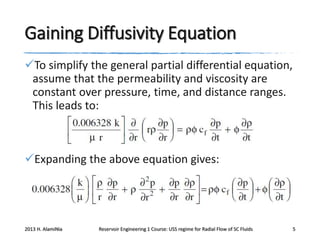
Gaining Diffusivity Equation
To simplify the general partial differential equation,
assume that the permeability and viscosity are
constant over pressure, time, and distance ranges.
This leads to:

Expanding the above equation gives:

2013 H. AlamiNia

Reservoir Engineering 1 Course: USS regime for Radial Flow of SC Fluids

5
Gaining Diffusivity Equation (Cont.)
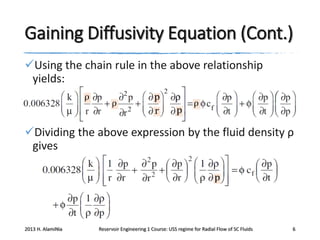
Using the chain rule in the above relationship
yields:

Dividing the above expression by the fluid density ρ
gives

2013 H. AlamiNia

Reservoir Engineering 1 Course: USS regime for Radial Flow of SC Fluids

6
Gaining Diffusivity Equation (Cont.)
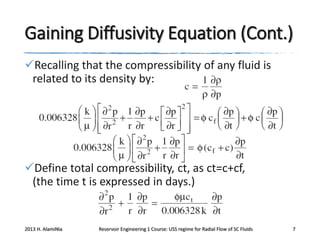
Recalling that the compressibility of any fluid is
related to its density by:

Define total compressibility, ct, as ct=c+cf,
(the time t is expressed in days.)

2013 H. AlamiNia

Reservoir Engineering 1 Course: USS regime for Radial Flow of SC Fluids

7
Diffusivity Equation
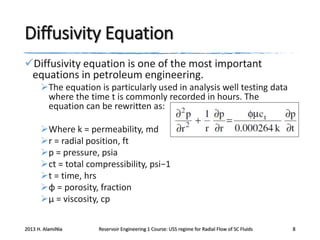
Diffusivity equation is one of the most important
equations in petroleum engineering.
The equation is particularly used in analysis well testing data
where the time t is commonly recorded in hours. The
equation can be rewritten as:
Where k = permeability, md
r = radial position, ft
p = pressure, psia
ct = total compressibility, psi−1
t = time, hrs
φ = porosity, fraction
μ = viscosity, cp
2013 H. AlamiNia

Reservoir Engineering 1 Course: USS regime for Radial Flow of SC Fluids

8
Total Compressibility
in Diffusivity Equation
When the reservoir contains more than one fluid,
total compressibility should be computed as ct =
coSo + cwSw + cgSg + cf
Note that the introduction of ct into diffusivity
equation does not make it applicable to multiphase
flow;
The use of ct, simply accounts for the compressibility of
any immobile fluids that may be in the reservoir with the
fluid that is flowing.

2013 H. AlamiNia

Reservoir Engineering 1 Course: USS regime for Radial Flow of SC Fluids

9
Diffusivity Constant
The term [0.000264 k/φμct] is called the diffusivity
constant and is denoted by the symbol η, or:

The diffusivity equation can then be written in a
more convenient form as:

2013 H. AlamiNia

Reservoir Engineering 1 Course: USS regime for Radial Flow of SC Fluids

10
Diffusivity Equation
Assumptions and Limitations
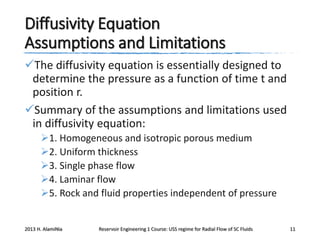
The diffusivity equation is essentially designed to
determine the pressure as a function of time t and
position r.
Summary of the assumptions and limitations used
in diffusivity equation:
1. Homogeneous and isotropic porous medium
2. Uniform thickness
3. Single phase flow
4. Laminar flow
5. Rock and fluid properties independent of pressure

2013 H. AlamiNia

Reservoir Engineering 1 Course: USS regime for Radial Flow of SC Fluids

11
Flash Back:
Laplace’s Equation for SS Regime
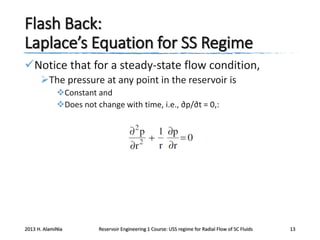
Notice that for a steady-state flow condition,
The pressure at any point in the reservoir is
Constant and
Does not change with time, i.e., ∂p/∂t = 0,:

2013 H. AlamiNia

Reservoir Engineering 1 Course: USS regime for Radial Flow of SC Fluids

13
Diffusivity Equation Solutions
Based on the boundary conditions imposed on
diffusivity equation, there are two generalized
solutions to the diffusivity equation:
Constant-terminal-pressure solution
Constant-terminal-rate solution

2013 H. AlamiNia

Reservoir Engineering 1 Course: USS regime for Radial Flow of SC Fluids

14
Constant-Terminal-Pressure Solution
The constant-terminal-pressure solution is
designed to provide the cumulative flow at any
particular time for a reservoir in which the pressure
at one boundary of the reservoir is held constant.
The pressure is known to be constant at some particular
radius and the solution is designed to provide the
cumulative fluid movement across the specified radius
(boundary).
This technique is frequently used in water influx
calculations in gas and oil reservoirs.

2013 H. AlamiNia

Reservoir Engineering 1 Course: USS regime for Radial Flow of SC Fluids

15
Application of
Constant-Terminal-Rate Solution
The constant-terminal-rate solution is an integral
part of most transient test analysis techniques, such
as with drawdown and pressure buildup analyses.
Most of these tests involve producing the well at a
constant flow rate and recording the flowing pressure as
a function of time, i.e., p (rw, t).

2013 H. AlamiNia

Reservoir Engineering 1 Course: USS regime for Radial Flow of SC Fluids

16
Constant-Terminal-Rate Solution
In the constant-rate solution to the radial diffusivity
equation, the flow rate is considered to be constant
at certain radius (usually wellbore radius) and
The pressure profile around that radius is
determined as a function of time and position.
 These are two commonly used forms of the
constant-terminal-rate solution:
The Ei-function solution
The dimensionless pressure pD solution

2013 H. AlamiNia

Reservoir Engineering 1 Course: USS regime for Radial Flow of SC Fluids

17
The Ei-Function Solution Assumptions
Matthews and Russell (1967) proposed a solution
to the diffusivity equation that is based on the
following assumptions:
Infinite acting reservoir, i.e., the reservoir is infinite in
size. (BC)
The well is producing at a constant flow rate. (BC)
The reservoir is at a uniform pressure, pi, when
production begins. (IC)
The well, with a wellbore radius of rw, is centered in a
cylindrical reservoir of radius re. (The Ei solution is
commonly referred to as the line-source solution.)
No flow across the outer boundary, i.e., at re.
2013 H. AlamiNia

Reservoir Engineering 1 Course: USS regime for Radial Flow of SC Fluids

19
Ei-Function Solution
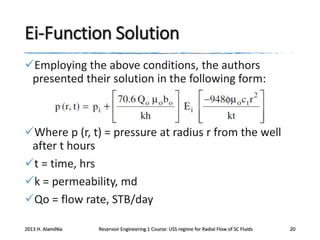
Employing the above conditions, the authors
presented their solution in the following form:

Where p (r, t) = pressure at radius r from the well
after t hours
t = time, hrs
k = permeability, md
Qo = flow rate, STB/day
2013 H. AlamiNia

Reservoir Engineering 1 Course: USS regime for Radial Flow of SC Fluids

20
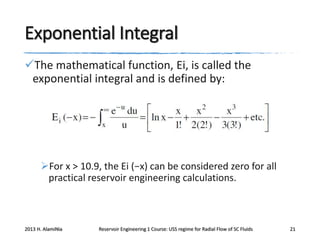
Exponential Integral
The mathematical function, Ei, is called the
exponential integral and is defined by:

For x > 10.9, the Ei (−x) can be considered zero for all
practical reservoir engineering calculations.

2013 H. AlamiNia

Reservoir Engineering 1 Course: USS regime for Radial Flow of SC Fluids

21
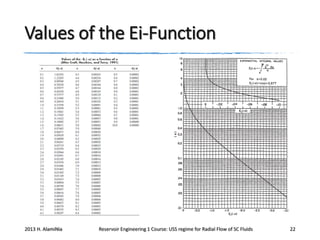
Values of the Ei-Function

2013 H. AlamiNia

Reservoir Engineering 1 Course: USS regime for Radial Flow of SC Fluids

22
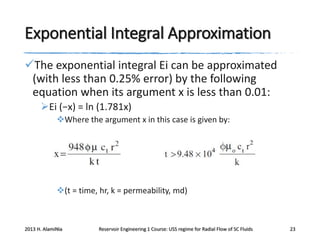
Exponential Integral Approximation
The exponential integral Ei can be approximated
(with less than 0.25% error) by the following
equation when its argument x is less than 0.01:
Ei (−x) = ln (1.781x)
Where the argument x in this case is given by:

(t = time, hr, k = permeability, md)

2013 H. AlamiNia

Reservoir Engineering 1 Course: USS regime for Radial Flow of SC Fluids

23
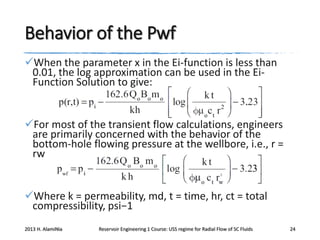
Behavior of the Pwf
When the parameter x in the Ei-function is less than
0.01, the log approximation can be used in the EiFunction Solution to give:

For most of the transient flow calculations, engineers
are primarily concerned with the behavior of the
bottom-hole flowing pressure at the wellbore, i.e., r =
rw

Where k = permeability, md, t = time, hr, ct = total
compressibility, psi−1
2013 H. AlamiNia

Reservoir Engineering 1 Course: USS regime for Radial Flow of SC Fluids

24
Pressure Profiles as a Function of Time
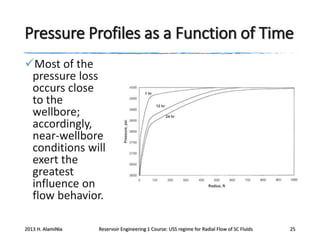
Most of the
pressure loss
occurs close
to the
wellbore;
accordingly,
near-wellbore
conditions will
exert the
greatest
influence on
flow behavior.
2013 H. AlamiNia

Reservoir Engineering 1 Course: USS regime for Radial Flow of SC Fluids

25
The Dimensionless Pressure Drop (pD)
Solution
The second form of solution to the diffusivity
equation is called the dimensionless pressure drop.
Well test analysis often makes use of the concept
of the dimensionless variables in solving the
unsteady-state flow equation.
The importance of dimensionless variables is that they
simplify the diffusivity equation and its solution by
combining the reservoir parameters (such as
permeability, porosity, etc.) and thereby reduce the total
number of unknowns.

2013 H. AlamiNia

Reservoir Engineering 1 Course: USS regime for Radial Flow of SC Fluids

28
Dimensionless Pressure Drop Solution
Introduction
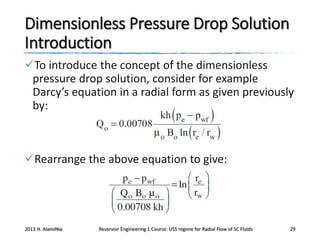
To introduce the concept of the dimensionless
pressure drop solution, consider for example
Darcy’s equation in a radial form as given previously
by:

Rearrange the above equation to give:

2013 H. AlamiNia

Reservoir Engineering 1 Course: USS regime for Radial Flow of SC Fluids

29
Dimensionless Pressure
It is obvious that the right hand side of the above
equation has no units (i.e., dimensionless) and,
accordingly, the left-hand side must be
dimensionless.
Since the left-hand side is dimensionless, and (pe −
pwf) has the units of psi, it follows that the term
[Qo Bo μo/ (0.00708kh)] has units of pressure.


2013 H. AlamiNia

Reservoir Engineering 1 Course: USS regime for Radial Flow of SC Fluids

30
pD in Transient Flow Analysis
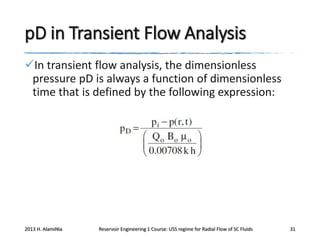
In transient flow analysis, the dimensionless
pressure pD is always a function of dimensionless
time that is defined by the following expression:

2013 H. AlamiNia

Reservoir Engineering 1 Course: USS regime for Radial Flow of SC Fluids

31
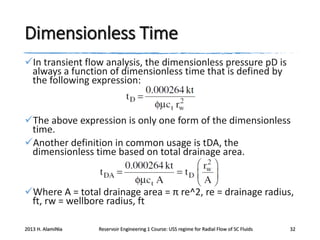
Dimensionless Time
In transient flow analysis, the dimensionless pressure pD is
always a function of dimensionless time that is defined by
the following expression:

The above expression is only one form of the dimensionless
time.
Another definition in common usage is tDA, the
dimensionless time based on total drainage area.

Where A = total drainage area = π re^2, re = drainage radius,
ft, rw = wellbore radius, ft
2013 H. AlamiNia

Reservoir Engineering 1 Course: USS regime for Radial Flow of SC Fluids

32
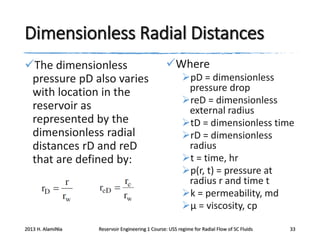
Dimensionless Radial Distances
The dimensionless
pressure pD also varies
with location in the
reservoir as
represented by the
dimensionless radial
distances rD and reD
that are defined by:

2013 H. AlamiNia

Where
pD = dimensionless
pressure drop
reD = dimensionless
external radius
tD = dimensionless time
rD = dimensionless
radius
t = time, hr
p(r, t) = pressure at
radius r and time t
k = permeability, md
μ = viscosity, cp

Reservoir Engineering 1 Course: USS regime for Radial Flow of SC Fluids

33
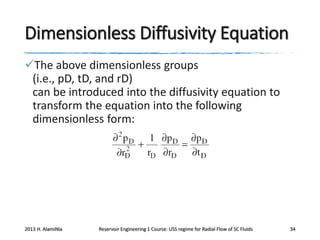
Dimensionless Diffusivity Equation
The above dimensionless groups
(i.e., pD, tD, and rD)
can be introduced into the diffusivity equation to
transform the equation into the following
dimensionless form:

2013 H. AlamiNia

Reservoir Engineering 1 Course: USS regime for Radial Flow of SC Fluids

34
Analytical Solution Assumptions
Van Everdingen and Hurst (1949) proposed an
analytical solution to the dimensionless diffusivity
equation by assuming:
Perfectly radial reservoir system
The producing well is in the center and producing at a
constant production rate of Q
Uniform pressure pi throughout the reservoir before
production
No flow across the external radius re

2013 H. AlamiNia

Reservoir Engineering 1 Course: USS regime for Radial Flow of SC Fluids

36
Van Everdingen and Hurst Solution
Van Everdingen and Hurst presented the solution to
the in a form of infinite series of exponential terms
and Bessel functions.
The authors evaluated this series for several values of
reD over a wide range of values for tD.

Chatas (1953) and Lee (1982) conveniently
tabulated these solutions for the following two
cases:
Infinite-acting reservoir
Finite-radial reservoir

2013 H. AlamiNia

Reservoir Engineering 1 Course: USS regime for Radial Flow of SC Fluids

37
Infinite-Acting Reservoir
When a well is put on production at a constant flow
rate after a shut-in period, the pressure in the
wellbore begins to drop and causes a pressure
disturbance to spread in the reservoir.
The influence of the reservoir boundaries or the shape
of the drainage area does not affect the rate at which
the pressure disturbance spreads in the formation.

That is why the transient state flow is also called
the infinite acting state.

2013 H. AlamiNia

Reservoir Engineering 1 Course: USS regime for Radial Flow of SC Fluids

38
Parameters Affecting Pwf
during Infinite Acting Period
During the infinite acting period, the declining rate
of wellbore pressure and the manner by which the
pressure disturbance spreads through the reservoir
are determined by reservoir and fluid
characteristics such as:
Porosity, φ
Permeability, k
Total compressibility, ct
Viscosity, μ

2013 H. AlamiNia

Reservoir Engineering 1 Course: USS regime for Radial Flow of SC Fluids

39
pD Values for
the Infinite-Acting Reservoir
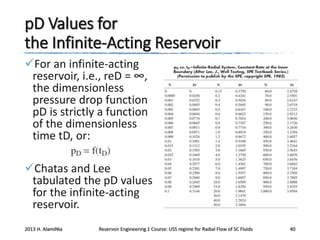
For an infinite-acting
reservoir, i.e., reD = ∞,
the dimensionless
pressure drop function
pD is strictly a function
of the dimensionless
time tD, or:

Chatas and Lee
tabulated the pD values
for the infinite-acting
reservoir.
2013 H. AlamiNia

Reservoir Engineering 1 Course: USS regime for Radial Flow of SC Fluids

40
pD Approximation
for the Infinite-Acting Reservoir
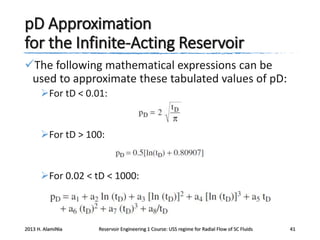
The following mathematical expressions can be
used to approximate these tabulated values of pD:
For tD < 0.01:

For tD > 100:

For 0.02 < tD < 1000:

2013 H. AlamiNia

Reservoir Engineering 1 Course: USS regime for Radial Flow of SC Fluids

41
1. Ahmed, T. (2006). Reservoir engineering
handbook (Gulf Professional Publishing). Ch6
1. USS(LT) Regime for Radial flow of SC Fluids:
Finite-Radial Reservoir
2. Relation between pD and Ei
3. USS Regime for Radial Flow of C Fluids
A. (Exact Method)
B. (P2 Approximation Method)
C. (P Approximation Method)

4. PSS regime Flow Constant
Q913 re1 w3 lec 9

Q913 re1 w3 lec 9

  • 1.
    Reservoir Engineering 1Course (1st Ed.)
  • 2.
    1. SS Regime:R Flow, IC & SC Fluids A. SS Regime: R Flow, C Fluids 2. Multiple-Phase Flow 3. Pressure Disturbance in Reservoirs 4. USS Flow Regime A. USS: Mathematical Formulation
  • 3.
    1. Diffusivity Equation A.Solutions of Diffusivity Equation a. Ei-Function Solution b. pD Solution c. Analytical Solution
  • 5.
    Gaining Diffusivity Equation Tosimplify the general partial differential equation, assume that the permeability and viscosity are constant over pressure, time, and distance ranges. This leads to: Expanding the above equation gives: 2013 H. AlamiNia Reservoir Engineering 1 Course: USS regime for Radial Flow of SC Fluids 5
  • 6.
    Gaining Diffusivity Equation(Cont.) Using the chain rule in the above relationship yields: Dividing the above expression by the fluid density ρ gives 2013 H. AlamiNia Reservoir Engineering 1 Course: USS regime for Radial Flow of SC Fluids 6
  • 7.
    Gaining Diffusivity Equation(Cont.) Recalling that the compressibility of any fluid is related to its density by: Define total compressibility, ct, as ct=c+cf, (the time t is expressed in days.) 2013 H. AlamiNia Reservoir Engineering 1 Course: USS regime for Radial Flow of SC Fluids 7
  • 8.
    Diffusivity Equation Diffusivity equationis one of the most important equations in petroleum engineering. The equation is particularly used in analysis well testing data where the time t is commonly recorded in hours. The equation can be rewritten as: Where k = permeability, md r = radial position, ft p = pressure, psia ct = total compressibility, psi−1 t = time, hrs φ = porosity, fraction μ = viscosity, cp 2013 H. AlamiNia Reservoir Engineering 1 Course: USS regime for Radial Flow of SC Fluids 8
  • 9.
    Total Compressibility in DiffusivityEquation When the reservoir contains more than one fluid, total compressibility should be computed as ct = coSo + cwSw + cgSg + cf Note that the introduction of ct into diffusivity equation does not make it applicable to multiphase flow; The use of ct, simply accounts for the compressibility of any immobile fluids that may be in the reservoir with the fluid that is flowing. 2013 H. AlamiNia Reservoir Engineering 1 Course: USS regime for Radial Flow of SC Fluids 9
  • 10.
    Diffusivity Constant The term[0.000264 k/φμct] is called the diffusivity constant and is denoted by the symbol η, or: The diffusivity equation can then be written in a more convenient form as: 2013 H. AlamiNia Reservoir Engineering 1 Course: USS regime for Radial Flow of SC Fluids 10
  • 11.
    Diffusivity Equation Assumptions andLimitations The diffusivity equation is essentially designed to determine the pressure as a function of time t and position r. Summary of the assumptions and limitations used in diffusivity equation: 1. Homogeneous and isotropic porous medium 2. Uniform thickness 3. Single phase flow 4. Laminar flow 5. Rock and fluid properties independent of pressure 2013 H. AlamiNia Reservoir Engineering 1 Course: USS regime for Radial Flow of SC Fluids 11
  • 13.
    Flash Back: Laplace’s Equationfor SS Regime Notice that for a steady-state flow condition, The pressure at any point in the reservoir is Constant and Does not change with time, i.e., ∂p/∂t = 0,: 2013 H. AlamiNia Reservoir Engineering 1 Course: USS regime for Radial Flow of SC Fluids 13
  • 14.
    Diffusivity Equation Solutions Basedon the boundary conditions imposed on diffusivity equation, there are two generalized solutions to the diffusivity equation: Constant-terminal-pressure solution Constant-terminal-rate solution 2013 H. AlamiNia Reservoir Engineering 1 Course: USS regime for Radial Flow of SC Fluids 14
  • 15.
    Constant-Terminal-Pressure Solution The constant-terminal-pressuresolution is designed to provide the cumulative flow at any particular time for a reservoir in which the pressure at one boundary of the reservoir is held constant. The pressure is known to be constant at some particular radius and the solution is designed to provide the cumulative fluid movement across the specified radius (boundary). This technique is frequently used in water influx calculations in gas and oil reservoirs. 2013 H. AlamiNia Reservoir Engineering 1 Course: USS regime for Radial Flow of SC Fluids 15
  • 16.
    Application of Constant-Terminal-Rate Solution Theconstant-terminal-rate solution is an integral part of most transient test analysis techniques, such as with drawdown and pressure buildup analyses. Most of these tests involve producing the well at a constant flow rate and recording the flowing pressure as a function of time, i.e., p (rw, t). 2013 H. AlamiNia Reservoir Engineering 1 Course: USS regime for Radial Flow of SC Fluids 16
  • 17.
    Constant-Terminal-Rate Solution In theconstant-rate solution to the radial diffusivity equation, the flow rate is considered to be constant at certain radius (usually wellbore radius) and The pressure profile around that radius is determined as a function of time and position.  These are two commonly used forms of the constant-terminal-rate solution: The Ei-function solution The dimensionless pressure pD solution 2013 H. AlamiNia Reservoir Engineering 1 Course: USS regime for Radial Flow of SC Fluids 17
  • 19.
    The Ei-Function SolutionAssumptions Matthews and Russell (1967) proposed a solution to the diffusivity equation that is based on the following assumptions: Infinite acting reservoir, i.e., the reservoir is infinite in size. (BC) The well is producing at a constant flow rate. (BC) The reservoir is at a uniform pressure, pi, when production begins. (IC) The well, with a wellbore radius of rw, is centered in a cylindrical reservoir of radius re. (The Ei solution is commonly referred to as the line-source solution.) No flow across the outer boundary, i.e., at re. 2013 H. AlamiNia Reservoir Engineering 1 Course: USS regime for Radial Flow of SC Fluids 19
  • 20.
    Ei-Function Solution Employing theabove conditions, the authors presented their solution in the following form: Where p (r, t) = pressure at radius r from the well after t hours t = time, hrs k = permeability, md Qo = flow rate, STB/day 2013 H. AlamiNia Reservoir Engineering 1 Course: USS regime for Radial Flow of SC Fluids 20
  • 21.
    Exponential Integral The mathematicalfunction, Ei, is called the exponential integral and is defined by: For x > 10.9, the Ei (−x) can be considered zero for all practical reservoir engineering calculations. 2013 H. AlamiNia Reservoir Engineering 1 Course: USS regime for Radial Flow of SC Fluids 21
  • 22.
    Values of theEi-Function 2013 H. AlamiNia Reservoir Engineering 1 Course: USS regime for Radial Flow of SC Fluids 22
  • 23.
    Exponential Integral Approximation Theexponential integral Ei can be approximated (with less than 0.25% error) by the following equation when its argument x is less than 0.01: Ei (−x) = ln (1.781x) Where the argument x in this case is given by: (t = time, hr, k = permeability, md) 2013 H. AlamiNia Reservoir Engineering 1 Course: USS regime for Radial Flow of SC Fluids 23
  • 24.
    Behavior of thePwf When the parameter x in the Ei-function is less than 0.01, the log approximation can be used in the EiFunction Solution to give: For most of the transient flow calculations, engineers are primarily concerned with the behavior of the bottom-hole flowing pressure at the wellbore, i.e., r = rw Where k = permeability, md, t = time, hr, ct = total compressibility, psi−1 2013 H. AlamiNia Reservoir Engineering 1 Course: USS regime for Radial Flow of SC Fluids 24
  • 25.
    Pressure Profiles asa Function of Time Most of the pressure loss occurs close to the wellbore; accordingly, near-wellbore conditions will exert the greatest influence on flow behavior. 2013 H. AlamiNia Reservoir Engineering 1 Course: USS regime for Radial Flow of SC Fluids 25
  • 28.
    The Dimensionless PressureDrop (pD) Solution The second form of solution to the diffusivity equation is called the dimensionless pressure drop. Well test analysis often makes use of the concept of the dimensionless variables in solving the unsteady-state flow equation. The importance of dimensionless variables is that they simplify the diffusivity equation and its solution by combining the reservoir parameters (such as permeability, porosity, etc.) and thereby reduce the total number of unknowns. 2013 H. AlamiNia Reservoir Engineering 1 Course: USS regime for Radial Flow of SC Fluids 28
  • 29.
    Dimensionless Pressure DropSolution Introduction To introduce the concept of the dimensionless pressure drop solution, consider for example Darcy’s equation in a radial form as given previously by: Rearrange the above equation to give: 2013 H. AlamiNia Reservoir Engineering 1 Course: USS regime for Radial Flow of SC Fluids 29
  • 30.
    Dimensionless Pressure It isobvious that the right hand side of the above equation has no units (i.e., dimensionless) and, accordingly, the left-hand side must be dimensionless. Since the left-hand side is dimensionless, and (pe − pwf) has the units of psi, it follows that the term [Qo Bo μo/ (0.00708kh)] has units of pressure.  2013 H. AlamiNia Reservoir Engineering 1 Course: USS regime for Radial Flow of SC Fluids 30
  • 31.
    pD in TransientFlow Analysis In transient flow analysis, the dimensionless pressure pD is always a function of dimensionless time that is defined by the following expression: 2013 H. AlamiNia Reservoir Engineering 1 Course: USS regime for Radial Flow of SC Fluids 31
  • 32.
    Dimensionless Time In transientflow analysis, the dimensionless pressure pD is always a function of dimensionless time that is defined by the following expression: The above expression is only one form of the dimensionless time. Another definition in common usage is tDA, the dimensionless time based on total drainage area. Where A = total drainage area = π re^2, re = drainage radius, ft, rw = wellbore radius, ft 2013 H. AlamiNia Reservoir Engineering 1 Course: USS regime for Radial Flow of SC Fluids 32
  • 33.
    Dimensionless Radial Distances Thedimensionless pressure pD also varies with location in the reservoir as represented by the dimensionless radial distances rD and reD that are defined by: 2013 H. AlamiNia Where pD = dimensionless pressure drop reD = dimensionless external radius tD = dimensionless time rD = dimensionless radius t = time, hr p(r, t) = pressure at radius r and time t k = permeability, md μ = viscosity, cp Reservoir Engineering 1 Course: USS regime for Radial Flow of SC Fluids 33
  • 34.
    Dimensionless Diffusivity Equation Theabove dimensionless groups (i.e., pD, tD, and rD) can be introduced into the diffusivity equation to transform the equation into the following dimensionless form: 2013 H. AlamiNia Reservoir Engineering 1 Course: USS regime for Radial Flow of SC Fluids 34
  • 36.
    Analytical Solution Assumptions VanEverdingen and Hurst (1949) proposed an analytical solution to the dimensionless diffusivity equation by assuming: Perfectly radial reservoir system The producing well is in the center and producing at a constant production rate of Q Uniform pressure pi throughout the reservoir before production No flow across the external radius re 2013 H. AlamiNia Reservoir Engineering 1 Course: USS regime for Radial Flow of SC Fluids 36
  • 37.
    Van Everdingen andHurst Solution Van Everdingen and Hurst presented the solution to the in a form of infinite series of exponential terms and Bessel functions. The authors evaluated this series for several values of reD over a wide range of values for tD. Chatas (1953) and Lee (1982) conveniently tabulated these solutions for the following two cases: Infinite-acting reservoir Finite-radial reservoir 2013 H. AlamiNia Reservoir Engineering 1 Course: USS regime for Radial Flow of SC Fluids 37
  • 38.
    Infinite-Acting Reservoir When awell is put on production at a constant flow rate after a shut-in period, the pressure in the wellbore begins to drop and causes a pressure disturbance to spread in the reservoir. The influence of the reservoir boundaries or the shape of the drainage area does not affect the rate at which the pressure disturbance spreads in the formation. That is why the transient state flow is also called the infinite acting state. 2013 H. AlamiNia Reservoir Engineering 1 Course: USS regime for Radial Flow of SC Fluids 38
  • 39.
    Parameters Affecting Pwf duringInfinite Acting Period During the infinite acting period, the declining rate of wellbore pressure and the manner by which the pressure disturbance spreads through the reservoir are determined by reservoir and fluid characteristics such as: Porosity, φ Permeability, k Total compressibility, ct Viscosity, μ 2013 H. AlamiNia Reservoir Engineering 1 Course: USS regime for Radial Flow of SC Fluids 39
  • 40.
    pD Values for theInfinite-Acting Reservoir For an infinite-acting reservoir, i.e., reD = ∞, the dimensionless pressure drop function pD is strictly a function of the dimensionless time tD, or: Chatas and Lee tabulated the pD values for the infinite-acting reservoir. 2013 H. AlamiNia Reservoir Engineering 1 Course: USS regime for Radial Flow of SC Fluids 40
  • 41.
    pD Approximation for theInfinite-Acting Reservoir The following mathematical expressions can be used to approximate these tabulated values of pD: For tD < 0.01: For tD > 100: For 0.02 < tD < 1000: 2013 H. AlamiNia Reservoir Engineering 1 Course: USS regime for Radial Flow of SC Fluids 41
  • 42.
    1. Ahmed, T.(2006). Reservoir engineering handbook (Gulf Professional Publishing). Ch6
  • 43.
    1. USS(LT) Regimefor Radial flow of SC Fluids: Finite-Radial Reservoir 2. Relation between pD and Ei 3. USS Regime for Radial Flow of C Fluids A. (Exact Method) B. (P2 Approximation Method) C. (P Approximation Method) 4. PSS regime Flow Constant