1
Differential Analysis of Fluid Flow
Chapter 4
Technology College
Mechanical Engineering Department
Contents of the Chapter
 Introduction
 Differential Analysis of Fluid Flow
 The Stream Function
2
Introduction
All real fluids possess viscosity, and are, to some degree,
compressible.
Nevertheless there are many instances in which the
behavior of real fluids quite closely approaches that of an
inviscid fluid.
It has already been remarked that the flow of a real fluid
may frequently be subdivided into two regions: one,
adjacent to the solid boundaries of the flow, is a thin layer
in which viscosity has a considerable effect; in the other
region, constituting the remainder of the flow, the viscous
effects are negligible.
3
Introduction
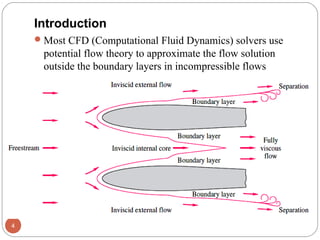
Most CFD (Computational Fluid Dynamics) solvers use
potential flow theory to approximate the flow solution
outside the boundary layers in incompressible flows
4
Differential Analysis of Fluid Flow
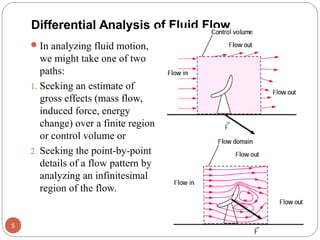
In analyzing fluid motion,
we might take one of two
paths:
1. Seeking an estimate of
gross effects (mass flow,
induced force, energy
change) over a finite region
or control volume or
2. Seeking the point-by-point
details of a flow pattern by
analyzing an infinitesimal
region of the flow.
5
The control volume technique is useful when we are
interested in the overall features of a flow, such as mass
flow rate into and out of the control volume or net forces
applied to bodies.
Differential analysis, on the other hand, involves
application of differential equations of fluid motion to any
and every point in the flow field over a region called the
flow domain.
When solved, these differential equations yield details
about the velocity, density, pressure, etc., at every point
throughout the entire flow domain.
6
Differential Analysis of Fluid Flow
The Acceleration Field of a Fluid
Velocity is a vector function of position and time and thus
has three components u, v, and w, each a scalar field in
itself.
This is the most important variable in fluid mechanics:
Knowledge of the velocity vector field is nearly equivalent
to solving a fluid flow problem.
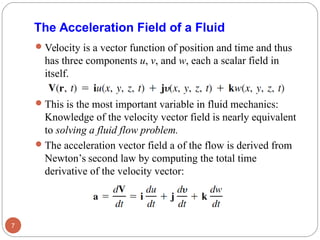
The acceleration vector field a of the flow is derived from
Newton’s second law by computing the total time
derivative of the velocity vector:
7
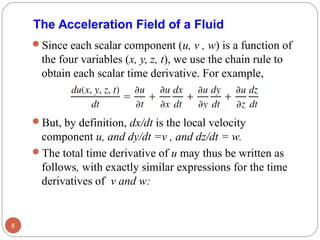
Since each scalar component (u, v , w) is a function of
the four variables (x, y, z, t), we use the chain rule to
obtain each scalar time derivative. For example,
But, by definition, dx/dt is the local velocity
component u, and dy/dt =v , and dz/dt = w.
The total time derivative of u may thus be written as
follows, with exactly similar expressions for the time
derivatives of v and w:
8
The Acceleration Field of a Fluid
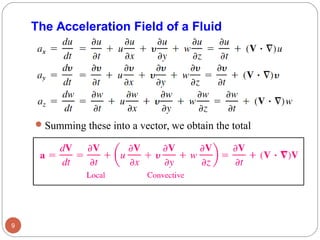
Summing these into a vector, we obtain the total
acceleration:
9
The Acceleration Field of a Fluid
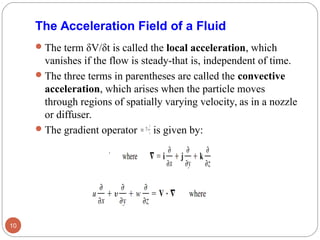
The term δV/δt is called the local acceleration, which
vanishes if the flow is steady-that is, independent of time.
The three terms in parentheses are called the convective
acceleration, which arises when the particle moves
through regions of spatially varying velocity, as in a nozzle
or diffuser.
The gradient operator is given by:
10
The Acceleration Field of a Fluid
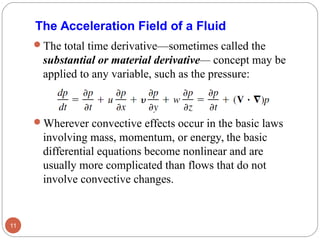
The total time derivative—sometimes called the
substantial or material derivative— concept may be
applied to any variable, such as the pressure:
Wherever convective effects occur in the basic laws
involving mass, momentum, or energy, the basic
differential equations become nonlinear and are
usually more complicated than flows that do not
involve convective changes.
11
The Acceleration Field of a Fluid
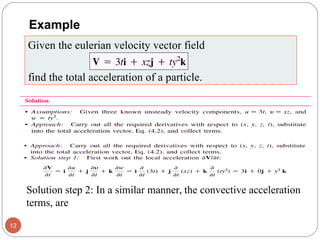
Example
Given the eulerian velocity vector field
find the total acceleration of a particle.
12
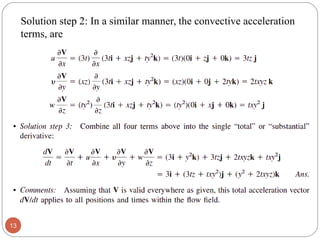
Solution step 2: In a similar manner, the convective acceleration
terms, are
13
Solution step 2: In a similar manner, the convective acceleration
terms, are
The Differential Equation of Mass Conservation
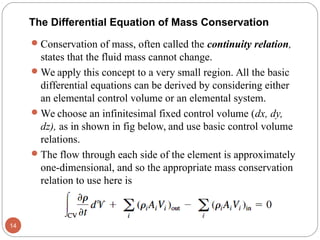
Conservation of mass, often called the continuity relation,
states that the fluid mass cannot change.
We apply this concept to a very small region. All the basic
differential equations can be derived by considering either
an elemental control volume or an elemental system.
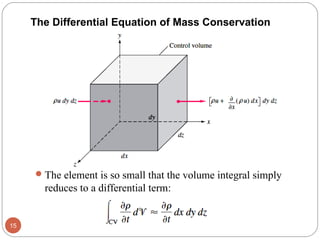
We choose an infinitesimal fixed control volume (dx, dy,
dz), as in shown in fig below, and use basic control volume
relations.
The flow through each side of the element is approximately
one-dimensional, and so the appropriate mass conservation
relation to use here is
14
The element is so small that the volume integral simply
reduces to a differential term:
15
The Differential Equation of Mass Conservation
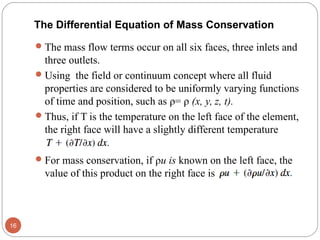
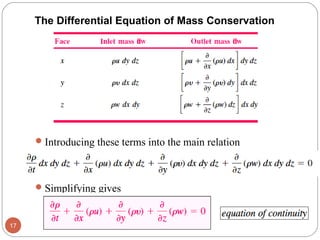
The mass flow terms occur on all six faces, three inlets and
three outlets.
Using the field or continuum concept where all fluid
properties are considered to be uniformly varying functions
of time and position, such as ρ= ρ (x, y, z, t).
Thus, if T is the temperature on the left face of the element,
the right face will have a slightly different temperature
For mass conservation, if ρu is known on the left face, the
value of this product on the right face is
16
The Differential Equation of Mass Conservation
Introducing these terms into the main relation
Simplifying gives
17
The Differential Equation of Mass Conservation
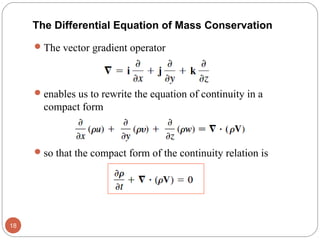
The vector gradient operator
enables us to rewrite the equation of continuity in a
compact form
so that the compact form of the continuity relation is
18
The Differential Equation of Mass Conservation
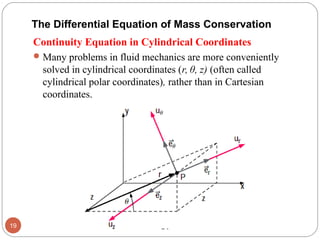
Continuity Equation in Cylindrical Coordinates
Many problems in fluid mechanics are more conveniently
solved in cylindrical coordinates (r, θ, z) (often called
cylindrical polar coordinates), rather than in Cartesian
coordinates.
19
The Differential Equation of Mass Conservation
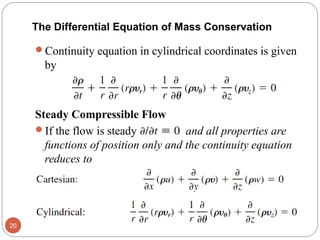
Continuity equation in cylindrical coordinates is given
by
Steady Compressible Flow
If the flow is steady , and all properties are
functions of position only and the continuity equation
reduces to
20
The Differential Equation of Mass Conservation
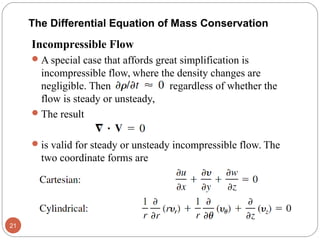
Incompressible Flow
A special case that affords great simplification is
incompressible flow, where the density changes are
negligible. Then regardless of whether the
flow is steady or unsteady,
The result
is valid for steady or unsteady incompressible flow. The
two coordinate forms are
21
The Differential Equation of Mass Conservation
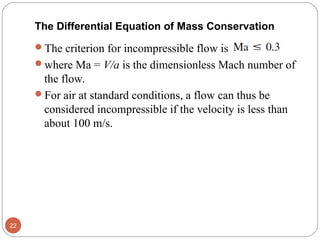
The criterion for incompressible flow is
where Ma = V/a is the dimensionless Mach number of
the flow.
For air at standard conditions, a flow can thus be
considered incompressible if the velocity is less than
about 100 m/s.
22
The Differential Equation of Mass Conservation
The Differential Equation of Linear Momentum
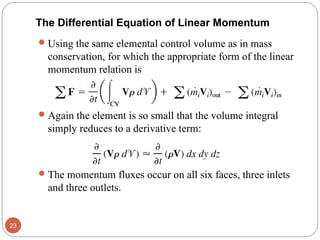
Using the same elemental control volume as in mass
conservation, for which the appropriate form of the linear
momentum relation is
Again the element is so small that the volume integral
simply reduces to a derivative term:
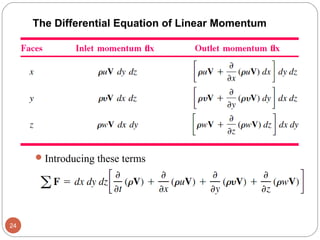
The momentum fluxes occur on all six faces, three inlets
and three outlets.
23
Introducing these terms
24
The Differential Equation of Linear Momentum
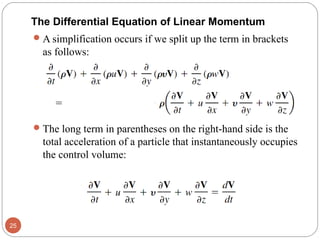
A simplification occurs if we split up the term in brackets
as follows:
The long term in parentheses on the right-hand side is the
total acceleration of a particle that instantaneously occupies
the control volume:
25
The Differential Equation of Linear Momentum
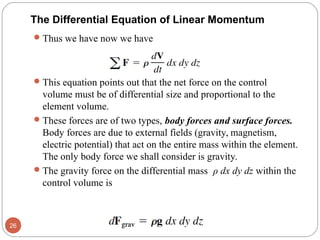
Thus we have now we have
This equation points out that the net force on the control
volume must be of differential size and proportional to the
element volume.
These forces are of two types, body forces and surface forces.
Body forces are due to external fields (gravity, magnetism,
electric potential) that act on the entire mass within the element.
The only body force we shall consider is gravity.
The gravity force on the differential mass ρ dx dy dz within the
control volume is
26
The Differential Equation of Linear Momentum
Newtonian Fluid: Navier-Stokes Equations
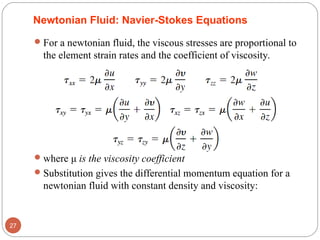
For a newtonian fluid, the viscous stresses are proportional to
the element strain rates and the coefficient of viscosity.
where μ is the viscosity coefficient
Substitution gives the differential momentum equation for a
newtonian fluid with constant density and viscosity:
27
Inviscid Flow
Shearing stresses develop in a moving fluid because of the
viscosity of the fluid.
We know that for some common fluids, such as air and water,
the viscosity is small, therefore it seems reasonable to assume
that under some circumstances we may be able to simply
neglect the effect of viscosity (and thus shearing stresses).
Flow fields in which the shearing stresses are assumed to be
negligible are said to be inviscid, nonviscous, or frictionless.
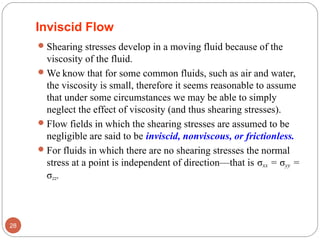
For fluids in which there are no shearing stresses the normal
stress at a point is independent of direction—that is σxx = σyy =
σzz.
28
Euler’s Equations of Motion
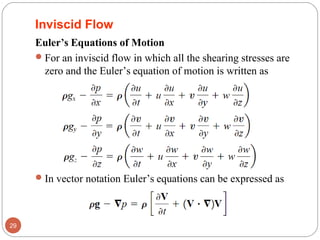
For an inviscid flow in which all the shearing stresses are
zero and the Euler’s equation of motion is written as
In vector notation Euler’s equations can be expressed as
29
Inviscid Flow
Vorticity and Irrotationality
The assumption of zero fluid angular velocity, or
irrotationality, is a very useful simplification.
Here we show that angular velocity is associated with the
curl of the local velocity vector.
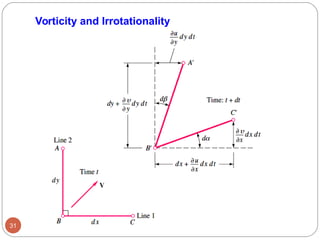
The differential relations for deformation of a fluid element
can be derived by examining the Fig. below.
Two fluid lines AB and BC, initially perpendicular at time t,
move and deform so that at t + dt they have slightly different
lengths A’B’ and B’C’ and are slightly off the perpendicular
by angles d and d.
30
31
Vorticity and Irrotationality
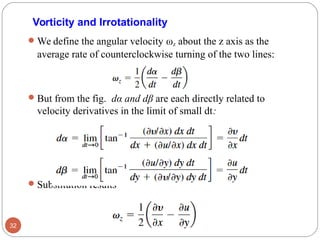
We define the angular velocity ωz about the z axis as the
average rate of counterclockwise turning of the two lines:
But from the fig. dα and dβ are each directly related to
velocity derivatives in the limit of small dt:
Substitution results
32
Vorticity and Irrotationality
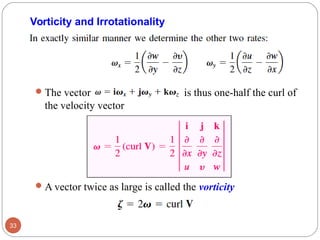
The vector is thus one-half the curl of
the velocity vector
A vector twice as large is called the vorticity
33
Vorticity and Irrotationality
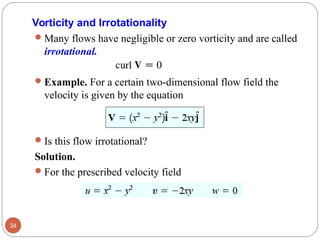
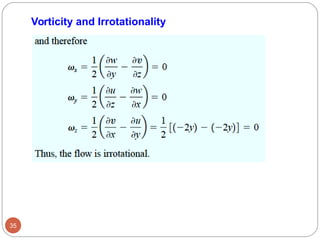
Many flows have negligible or zero vorticity and are called
irrotational.
Example. For a certain two-dimensional flow field the
velocity is given by the equation
Is this flow irrotational?
Solution.
For the prescribed velocity field
34
Vorticity and Irrotationality
35
Vorticity and Irrotationality
The Stream Function
Steady, incompressible, plane, two-dimensional flow represents
one of the simplest types of flow of practical importance.
By plane, two-dimensional flow we mean that there are only
two velocity components, such as u and v when the flow is
considered to be in the x–y plane.
 For this flow the continuity equation, reduces to
The stream function ψ is a clever device that allows us to
satisfy the continuity equation and then solve the momentum
equation directly for the single variable . Lines of constant ψ
are streamlines of the flow.
36
This equation is satisfied identically if a function ψ(x, y) is
defined such that the continuity equation becomes
This shows that this new function ψ must be defined such
that
or
37
The Stream Function
The stream function simplifies the analysis by having to
determine only one unknown function, rather than
the two functions
Another particular advantage of using the stream function
is related to the fact that lines along which ψ is constant are
streamlines.
Streamlines are lines in the flow field that are everywhere
tangent to the velocities. It follows from the definition of
the streamline that the slope at any point along a streamline
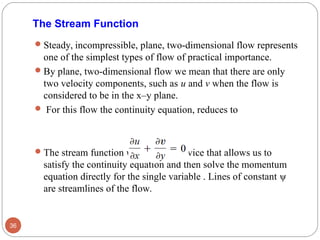
is given by
38
The Stream Function
The change in the value of ψ as
we move from one point (x, y) to
a nearby point (x + dx, y + dy) is
given by the relationship:
Along a line of constant ψ we
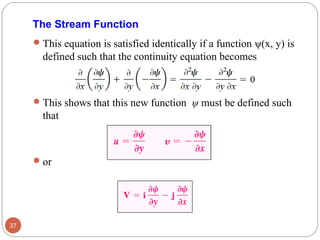
have dψ = 0 so that
and, therefore, along a line of
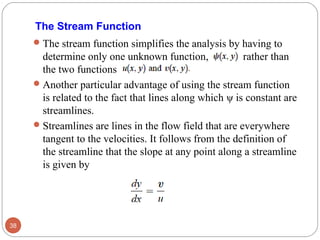
constant ψ
39
The Stream Function
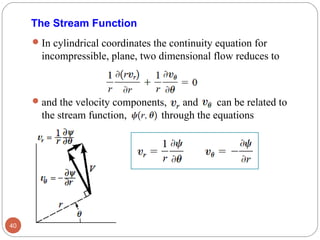
In cylindrical coordinates the continuity equation for
incompressible, plane, two dimensional flow reduces to
and the velocity components, and can be related to
the stream function, through the equations
40
The Stream Function
End of Chapter 4
41

Chapter 4. diffrential

  • 1.
    1 Differential Analysis ofFluid Flow Chapter 4 Technology College Mechanical Engineering Department
  • 2.
    Contents of theChapter  Introduction  Differential Analysis of Fluid Flow  The Stream Function 2
  • 3.
    Introduction All real fluidspossess viscosity, and are, to some degree, compressible. Nevertheless there are many instances in which the behavior of real fluids quite closely approaches that of an inviscid fluid. It has already been remarked that the flow of a real fluid may frequently be subdivided into two regions: one, adjacent to the solid boundaries of the flow, is a thin layer in which viscosity has a considerable effect; in the other region, constituting the remainder of the flow, the viscous effects are negligible. 3
  • 4.
    Introduction Most CFD (ComputationalFluid Dynamics) solvers use potential flow theory to approximate the flow solution outside the boundary layers in incompressible flows 4
  • 5.
    Differential Analysis ofFluid Flow In analyzing fluid motion, we might take one of two paths: 1. Seeking an estimate of gross effects (mass flow, induced force, energy change) over a finite region or control volume or 2. Seeking the point-by-point details of a flow pattern by analyzing an infinitesimal region of the flow. 5
  • 6.
    The control volumetechnique is useful when we are interested in the overall features of a flow, such as mass flow rate into and out of the control volume or net forces applied to bodies. Differential analysis, on the other hand, involves application of differential equations of fluid motion to any and every point in the flow field over a region called the flow domain. When solved, these differential equations yield details about the velocity, density, pressure, etc., at every point throughout the entire flow domain. 6 Differential Analysis of Fluid Flow
  • 7.
    The Acceleration Fieldof a Fluid Velocity is a vector function of position and time and thus has three components u, v, and w, each a scalar field in itself. This is the most important variable in fluid mechanics: Knowledge of the velocity vector field is nearly equivalent to solving a fluid flow problem. The acceleration vector field a of the flow is derived from Newton’s second law by computing the total time derivative of the velocity vector: 7
  • 8.
    Since each scalarcomponent (u, v , w) is a function of the four variables (x, y, z, t), we use the chain rule to obtain each scalar time derivative. For example, But, by definition, dx/dt is the local velocity component u, and dy/dt =v , and dz/dt = w. The total time derivative of u may thus be written as follows, with exactly similar expressions for the time derivatives of v and w: 8 The Acceleration Field of a Fluid
  • 9.
    Summing these intoa vector, we obtain the total acceleration: 9 The Acceleration Field of a Fluid
  • 10.
    The term δV/δtis called the local acceleration, which vanishes if the flow is steady-that is, independent of time. The three terms in parentheses are called the convective acceleration, which arises when the particle moves through regions of spatially varying velocity, as in a nozzle or diffuser. The gradient operator is given by: 10 The Acceleration Field of a Fluid
  • 11.
    The total timederivative—sometimes called the substantial or material derivative— concept may be applied to any variable, such as the pressure: Wherever convective effects occur in the basic laws involving mass, momentum, or energy, the basic differential equations become nonlinear and are usually more complicated than flows that do not involve convective changes. 11 The Acceleration Field of a Fluid
  • 12.
    Example Given the eulerianvelocity vector field find the total acceleration of a particle. 12 Solution step 2: In a similar manner, the convective acceleration terms, are
  • 13.
    13 Solution step 2:In a similar manner, the convective acceleration terms, are
  • 14.
    The Differential Equationof Mass Conservation Conservation of mass, often called the continuity relation, states that the fluid mass cannot change. We apply this concept to a very small region. All the basic differential equations can be derived by considering either an elemental control volume or an elemental system. We choose an infinitesimal fixed control volume (dx, dy, dz), as in shown in fig below, and use basic control volume relations. The flow through each side of the element is approximately one-dimensional, and so the appropriate mass conservation relation to use here is 14
  • 15.
    The element isso small that the volume integral simply reduces to a differential term: 15 The Differential Equation of Mass Conservation
  • 16.
    The mass flowterms occur on all six faces, three inlets and three outlets. Using the field or continuum concept where all fluid properties are considered to be uniformly varying functions of time and position, such as ρ= ρ (x, y, z, t). Thus, if T is the temperature on the left face of the element, the right face will have a slightly different temperature For mass conservation, if ρu is known on the left face, the value of this product on the right face is 16 The Differential Equation of Mass Conservation
  • 17.
    Introducing these termsinto the main relation Simplifying gives 17 The Differential Equation of Mass Conservation
  • 18.
    The vector gradientoperator enables us to rewrite the equation of continuity in a compact form so that the compact form of the continuity relation is 18 The Differential Equation of Mass Conservation
  • 19.
    Continuity Equation inCylindrical Coordinates Many problems in fluid mechanics are more conveniently solved in cylindrical coordinates (r, θ, z) (often called cylindrical polar coordinates), rather than in Cartesian coordinates. 19 The Differential Equation of Mass Conservation
  • 20.
    Continuity equation incylindrical coordinates is given by Steady Compressible Flow If the flow is steady , and all properties are functions of position only and the continuity equation reduces to 20 The Differential Equation of Mass Conservation
  • 21.
    Incompressible Flow A specialcase that affords great simplification is incompressible flow, where the density changes are negligible. Then regardless of whether the flow is steady or unsteady, The result is valid for steady or unsteady incompressible flow. The two coordinate forms are 21 The Differential Equation of Mass Conservation
  • 22.
    The criterion forincompressible flow is where Ma = V/a is the dimensionless Mach number of the flow. For air at standard conditions, a flow can thus be considered incompressible if the velocity is less than about 100 m/s. 22 The Differential Equation of Mass Conservation
  • 23.
    The Differential Equationof Linear Momentum Using the same elemental control volume as in mass conservation, for which the appropriate form of the linear momentum relation is Again the element is so small that the volume integral simply reduces to a derivative term: The momentum fluxes occur on all six faces, three inlets and three outlets. 23
  • 24.
    Introducing these terms 24 TheDifferential Equation of Linear Momentum
  • 25.
    A simplification occursif we split up the term in brackets as follows: The long term in parentheses on the right-hand side is the total acceleration of a particle that instantaneously occupies the control volume: 25 The Differential Equation of Linear Momentum
  • 26.
    Thus we havenow we have This equation points out that the net force on the control volume must be of differential size and proportional to the element volume. These forces are of two types, body forces and surface forces. Body forces are due to external fields (gravity, magnetism, electric potential) that act on the entire mass within the element. The only body force we shall consider is gravity. The gravity force on the differential mass ρ dx dy dz within the control volume is 26 The Differential Equation of Linear Momentum
  • 27.
    Newtonian Fluid: Navier-StokesEquations For a newtonian fluid, the viscous stresses are proportional to the element strain rates and the coefficient of viscosity. where μ is the viscosity coefficient Substitution gives the differential momentum equation for a newtonian fluid with constant density and viscosity: 27
  • 28.
    Inviscid Flow Shearing stressesdevelop in a moving fluid because of the viscosity of the fluid. We know that for some common fluids, such as air and water, the viscosity is small, therefore it seems reasonable to assume that under some circumstances we may be able to simply neglect the effect of viscosity (and thus shearing stresses). Flow fields in which the shearing stresses are assumed to be negligible are said to be inviscid, nonviscous, or frictionless. For fluids in which there are no shearing stresses the normal stress at a point is independent of direction—that is σxx = σyy = σzz. 28
  • 29.
    Euler’s Equations ofMotion For an inviscid flow in which all the shearing stresses are zero and the Euler’s equation of motion is written as In vector notation Euler’s equations can be expressed as 29 Inviscid Flow
  • 30.
    Vorticity and Irrotationality Theassumption of zero fluid angular velocity, or irrotationality, is a very useful simplification. Here we show that angular velocity is associated with the curl of the local velocity vector. The differential relations for deformation of a fluid element can be derived by examining the Fig. below. Two fluid lines AB and BC, initially perpendicular at time t, move and deform so that at t + dt they have slightly different lengths A’B’ and B’C’ and are slightly off the perpendicular by angles d and d. 30
  • 31.
  • 32.
    We define theangular velocity ωz about the z axis as the average rate of counterclockwise turning of the two lines: But from the fig. dα and dβ are each directly related to velocity derivatives in the limit of small dt: Substitution results 32 Vorticity and Irrotationality
  • 33.
    The vector isthus one-half the curl of the velocity vector A vector twice as large is called the vorticity 33 Vorticity and Irrotationality
  • 34.
    Many flows havenegligible or zero vorticity and are called irrotational. Example. For a certain two-dimensional flow field the velocity is given by the equation Is this flow irrotational? Solution. For the prescribed velocity field 34 Vorticity and Irrotationality
  • 35.
  • 36.
    The Stream Function Steady,incompressible, plane, two-dimensional flow represents one of the simplest types of flow of practical importance. By plane, two-dimensional flow we mean that there are only two velocity components, such as u and v when the flow is considered to be in the x–y plane.  For this flow the continuity equation, reduces to The stream function ψ is a clever device that allows us to satisfy the continuity equation and then solve the momentum equation directly for the single variable . Lines of constant ψ are streamlines of the flow. 36
  • 37.
    This equation issatisfied identically if a function ψ(x, y) is defined such that the continuity equation becomes This shows that this new function ψ must be defined such that or 37 The Stream Function
  • 38.
    The stream functionsimplifies the analysis by having to determine only one unknown function, rather than the two functions Another particular advantage of using the stream function is related to the fact that lines along which ψ is constant are streamlines. Streamlines are lines in the flow field that are everywhere tangent to the velocities. It follows from the definition of the streamline that the slope at any point along a streamline is given by 38 The Stream Function
  • 39.
    The change inthe value of ψ as we move from one point (x, y) to a nearby point (x + dx, y + dy) is given by the relationship: Along a line of constant ψ we have dψ = 0 so that and, therefore, along a line of constant ψ 39 The Stream Function
  • 40.
    In cylindrical coordinatesthe continuity equation for incompressible, plane, two dimensional flow reduces to and the velocity components, and can be related to the stream function, through the equations 40 The Stream Function
  • 41.