
Global Literacy Through Mandarin Immersion  and STEM Molly Wieland, Ph.D., Hopkins Public Schools Tara Fortune, Ph.D., CARLA - University of Minnesota
Presentation Overview Introduction to FLAP Grant Project Focus:  Immersion Curriculum Development Language, Culture, Content Integration (immersion education) Engineering is Elementary (our interdisciplinary curriculum base) Group Work and Debriefing What We’re Learning
Overview  of our FLAP Grant Project The Minnesota Mandarin Immersion Collaborative Hopkins Public Schools Minnetonka Public Schools St. Cloud Public Schools The University of Minnesota
The Impetus for the Project Lack of curricular materials in Mandarin for elementary immersion that align with local standards Inexperienced teaching staff Need for proficiency assessment to monitor progress
Why STEM? Need for articulated K-16 Mandarin immersion pipeline State of Minnesota’s new engineering standards
Why Mandarin Immersion? Goal of advanced proficiency in Mandarin by the end of grade 12 and superior level by the end of grade 16 Four pre-existing Mandarin immersion strand programs
Why LEA-IHE Partnership? Need for many kinds of expertise Established research-informed expertise in language immersion education at university  Successful history with collaboration between K-12 sector and university
Project Goals Curriculum Development Develop and implement two interdisciplinary units in Mandarin with a STEM focus for one grade level per year starting with grade 3 Staff Development Provide quality immersion-focused staff development for teachers Assessment Develop a system for assessing oral proficiency in K, grade 2, grade 5 Secondary Program Framework Develop a framework for continuation of Mandarin  immersion and STEM
Immersion Curriculum Development Integrating Content, Culture and Language Learning
Just Passing Through:  Designing Model Membranes Engineering is Elementary (EiE) (Boston Museum of Science) STEM:  Using science, technology and math to design solutions to real problems Overview of the  Membranes  Unit Interdisciplinary Connections FOSS Science:  Structures of Life Social Studies:  El Salvador, rainforest, cross-cultural connections Chinese Language Arts:  The story of  Juan Daniel Math
Adapting EiE Lesson 1 for the Immersion Context Group 1 Look through the original EiE version of Lesson 1.  What curricular and instructional adaptations would you need to make so that this lesson would work in a Mandarin immersion context? Group 2 Look through the redesigned lesson (5 or 6).  What lesson design features can you identify that help to make the lesson more appropriate for the immersion context?
The Process What We Have Learned
Lesson 1 It Takes a Village!
Form a strong curriculum team with members who bring: Expertise in curriculum, instruction and assessment practices for immersion contexts Proficiency in oral and written Mandarin and knowledge of cultural similarities and differences Mandarin/English proficiency and knowledge of vocabulary, structures, and functions that may pose problems for English speakers  Knowledge of STEM curriculum and standards
Form a strong curriculum team with members who bring: Experience with grade-level curriculum and standards in all content areas Mandarin immersion classroom teaching experience and familiarity with our students and programs Expertise in learning technologies, especially SMART Board
Lesson 2 Re-think Language and Literacy Expectations
EiE Lesson 1, Step 1:  “Read the story  Juan Daniel. ” That won’t work in the immersion context!
Lesson 3 Immersion Curriculum Development Begins with Content
Create a Curricular Map for the Unit Expand the unit into more lessons  Original unit: Four lessons:  The story + three engineering lessons Immersion unit: Fourteen interdisciplinary lessons with story chapters integrated throughout the unit
Create a Curricular Map for the Unit Include interdisciplinary connections to science, math, social studies/cross-cultural learning, Chinese language arts/literacy Develop standards-based lesson objectives for additional content areas
Lesson 4 “Interpreting” the Story  Juan Daniel   into Mandarin is a Balancing Act
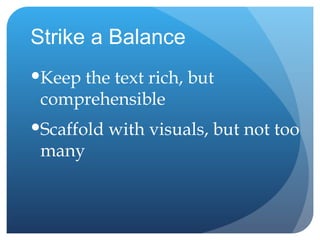
Strike a Balance Keep the text rich, but comprehensible Scaffold with visuals, but not too many
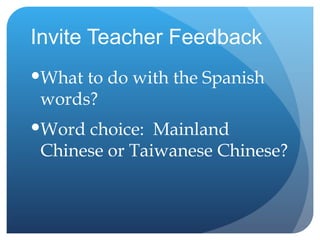
Invite Teacher Feedback What to do with the Spanish words? Word choice:  Mainland Chinese or Taiwanese Chinese?
Lesson 5 Use a Common Framework to  Design the Unit/Lessons
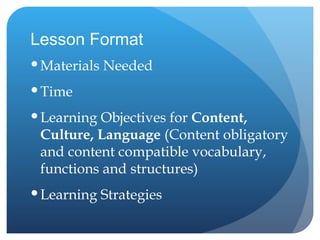
Lesson Format Materials Needed Time Learning Objectives for  Content, Culture, Language  (Content obligatory and content compatible vocabulary, functions and structures) Learning Strategies
Lesson Format 3 Lesson Phases, divided into learning activities: Pre/ “Into” Phase During/ “Through” Phase Post/ “Beyond” Phase Evidence of Learning
Lesson 6 Well-designed Lessons Can Be a Tool for Teacher Development
Components of Effective Immersion Instruction Cooperative pair and group activities  that give students opportunities to use vocabulary, functions and structures in all skill areas Numbered heads Four corners Describing a membrane with a small group Matching people and their jobs/functions Post-it story summary Role-play the story chapter Joint writing activities Matching cards (e.g., animal + environment)
Components of Effective Immersion Instruction Scaffolds for language and literacy development integrated throughout Oral interaction frames Language objectives:  CO and CC Highlighting characters/radicals for noticing/awareness raising Predicting with pictures, K-P-W-L Sequencing and “playing cards” to retell story
Components of Effective Immersion Instruction Use of visuals and graphic organizers to support learning New vocabulary with visual support, realia Frayer Model Concept Map for defining “membrane” Thinking Maps (National Urban Alliance)
Components of Effective Immersion Instruction: Culture integrated into the lesson Symbols of luck Greeting/leave-taking practices Food National bird, rainforest
Lesson 7 An Immersion Curriculum Developer’s Work is Never Done!
Content  Learning Activities  Language Next Step:  Language Objectives
We invite your feedback! [email_address] [email_address]

Q1 Global Literacy though Mandarin Immersion and STEM

  • 1.
    Global Literacy ThroughMandarin Immersion and STEM Molly Wieland, Ph.D., Hopkins Public Schools Tara Fortune, Ph.D., CARLA - University of Minnesota
  • 2.
    Presentation Overview Introductionto FLAP Grant Project Focus: Immersion Curriculum Development Language, Culture, Content Integration (immersion education) Engineering is Elementary (our interdisciplinary curriculum base) Group Work and Debriefing What We’re Learning
  • 3.
    Overview ofour FLAP Grant Project The Minnesota Mandarin Immersion Collaborative Hopkins Public Schools Minnetonka Public Schools St. Cloud Public Schools The University of Minnesota
  • 4.
    The Impetus forthe Project Lack of curricular materials in Mandarin for elementary immersion that align with local standards Inexperienced teaching staff Need for proficiency assessment to monitor progress
  • 5.
    Why STEM? Needfor articulated K-16 Mandarin immersion pipeline State of Minnesota’s new engineering standards
  • 6.
    Why Mandarin Immersion?Goal of advanced proficiency in Mandarin by the end of grade 12 and superior level by the end of grade 16 Four pre-existing Mandarin immersion strand programs
  • 7.
    Why LEA-IHE Partnership?Need for many kinds of expertise Established research-informed expertise in language immersion education at university Successful history with collaboration between K-12 sector and university
  • 8.
    Project Goals CurriculumDevelopment Develop and implement two interdisciplinary units in Mandarin with a STEM focus for one grade level per year starting with grade 3 Staff Development Provide quality immersion-focused staff development for teachers Assessment Develop a system for assessing oral proficiency in K, grade 2, grade 5 Secondary Program Framework Develop a framework for continuation of Mandarin immersion and STEM
  • 9.
    Immersion Curriculum DevelopmentIntegrating Content, Culture and Language Learning
  • 10.
    Just Passing Through: Designing Model Membranes Engineering is Elementary (EiE) (Boston Museum of Science) STEM: Using science, technology and math to design solutions to real problems Overview of the Membranes Unit Interdisciplinary Connections FOSS Science: Structures of Life Social Studies: El Salvador, rainforest, cross-cultural connections Chinese Language Arts: The story of Juan Daniel Math
  • 11.
    Adapting EiE Lesson1 for the Immersion Context Group 1 Look through the original EiE version of Lesson 1. What curricular and instructional adaptations would you need to make so that this lesson would work in a Mandarin immersion context? Group 2 Look through the redesigned lesson (5 or 6). What lesson design features can you identify that help to make the lesson more appropriate for the immersion context?
  • 12.
    The Process WhatWe Have Learned
  • 13.
    Lesson 1 ItTakes a Village!
  • 14.
    Form a strongcurriculum team with members who bring: Expertise in curriculum, instruction and assessment practices for immersion contexts Proficiency in oral and written Mandarin and knowledge of cultural similarities and differences Mandarin/English proficiency and knowledge of vocabulary, structures, and functions that may pose problems for English speakers Knowledge of STEM curriculum and standards
  • 15.
    Form a strongcurriculum team with members who bring: Experience with grade-level curriculum and standards in all content areas Mandarin immersion classroom teaching experience and familiarity with our students and programs Expertise in learning technologies, especially SMART Board
  • 16.
    Lesson 2 Re-thinkLanguage and Literacy Expectations
  • 17.
    EiE Lesson 1,Step 1: “Read the story Juan Daniel. ” That won’t work in the immersion context!
  • 18.
    Lesson 3 ImmersionCurriculum Development Begins with Content
  • 19.
    Create a CurricularMap for the Unit Expand the unit into more lessons Original unit: Four lessons: The story + three engineering lessons Immersion unit: Fourteen interdisciplinary lessons with story chapters integrated throughout the unit
  • 20.
    Create a CurricularMap for the Unit Include interdisciplinary connections to science, math, social studies/cross-cultural learning, Chinese language arts/literacy Develop standards-based lesson objectives for additional content areas
  • 21.
    Lesson 4 “Interpreting”the Story Juan Daniel into Mandarin is a Balancing Act
  • 22.
    Strike a BalanceKeep the text rich, but comprehensible Scaffold with visuals, but not too many
  • 23.
    Invite Teacher FeedbackWhat to do with the Spanish words? Word choice: Mainland Chinese or Taiwanese Chinese?
  • 24.
    Lesson 5 Usea Common Framework to Design the Unit/Lessons
  • 25.
    Lesson Format MaterialsNeeded Time Learning Objectives for Content, Culture, Language (Content obligatory and content compatible vocabulary, functions and structures) Learning Strategies
  • 26.
    Lesson Format 3Lesson Phases, divided into learning activities: Pre/ “Into” Phase During/ “Through” Phase Post/ “Beyond” Phase Evidence of Learning
  • 27.
    Lesson 6 Well-designedLessons Can Be a Tool for Teacher Development
  • 28.
    Components of EffectiveImmersion Instruction Cooperative pair and group activities that give students opportunities to use vocabulary, functions and structures in all skill areas Numbered heads Four corners Describing a membrane with a small group Matching people and their jobs/functions Post-it story summary Role-play the story chapter Joint writing activities Matching cards (e.g., animal + environment)
  • 29.
    Components of EffectiveImmersion Instruction Scaffolds for language and literacy development integrated throughout Oral interaction frames Language objectives: CO and CC Highlighting characters/radicals for noticing/awareness raising Predicting with pictures, K-P-W-L Sequencing and “playing cards” to retell story
  • 30.
    Components of EffectiveImmersion Instruction Use of visuals and graphic organizers to support learning New vocabulary with visual support, realia Frayer Model Concept Map for defining “membrane” Thinking Maps (National Urban Alliance)
  • 31.
    Components of EffectiveImmersion Instruction: Culture integrated into the lesson Symbols of luck Greeting/leave-taking practices Food National bird, rainforest
  • 32.
    Lesson 7 AnImmersion Curriculum Developer’s Work is Never Done!
  • 33.
    Content  LearningActivities  Language Next Step: Language Objectives
  • 34.
    We invite yourfeedback! [email_address] [email_address]

Editor's Notes

  • #2 To prepare globally literate citizens, today’s educators need to respond to national calls for increased proficiency in critical languages and subject matters such as Mandarin and Science, Technology, Engineering, Math (STEM). With USDE Foreign Language Assistance Program funding, Minnesota’s Mandarin Immersion Collaborative is leading the way by developing STEM-based curriculum for elementary Mandarin immersion programs.
  • #4 Four Mandarin immersion programs started in 2007 Among the first early-total Mandarin immersion programs in the US
  • #10 Best practice in language immersion education emphasizes the importance of integrating content, culture and language learning both at the lesson and unit level. We will use a sample content-culture-language integrated STEM lesson designed for Gr. 3 Mandarin immersion students to exemplify this practice. We will focus on how we have reinterpreted an Engineering is Elementary unit developed by the Science Museum of Boston so that it can be used with third graders in Mandarin immersion programs.
  • #11 We are translating some of the EiE materials into Chinese, but we are we are hoping to illustrate through this presentation that developing high quality immersion curriculum involves so much more than just translation.
  • #12 Procedure: Small groups of participants will analyze pre- and post-versions of a lesson. Using the original lesson, half of participants will discuss necessary curricular and instructional adaptations given the immersion setting; using the redesigned lesson, remaining participants will identify critical lesson design features for the immersion context. Following group reporting, we will invite feedback to inform our work. We will be collecting the EiE photocopies after the presentation due to copyright restrictions.
  • #29 The activities in yellow appear in the lesson that the group reviewed for this presentation
  • #30 The activities in yellow appear in the lesson that the group reviewed for this presentation
  • #31 The activities in yellow appear in the lesson that the group reviewed for this presentation
  • #32 The activities in yellow appear in the lesson that the group reviewed for this presentation