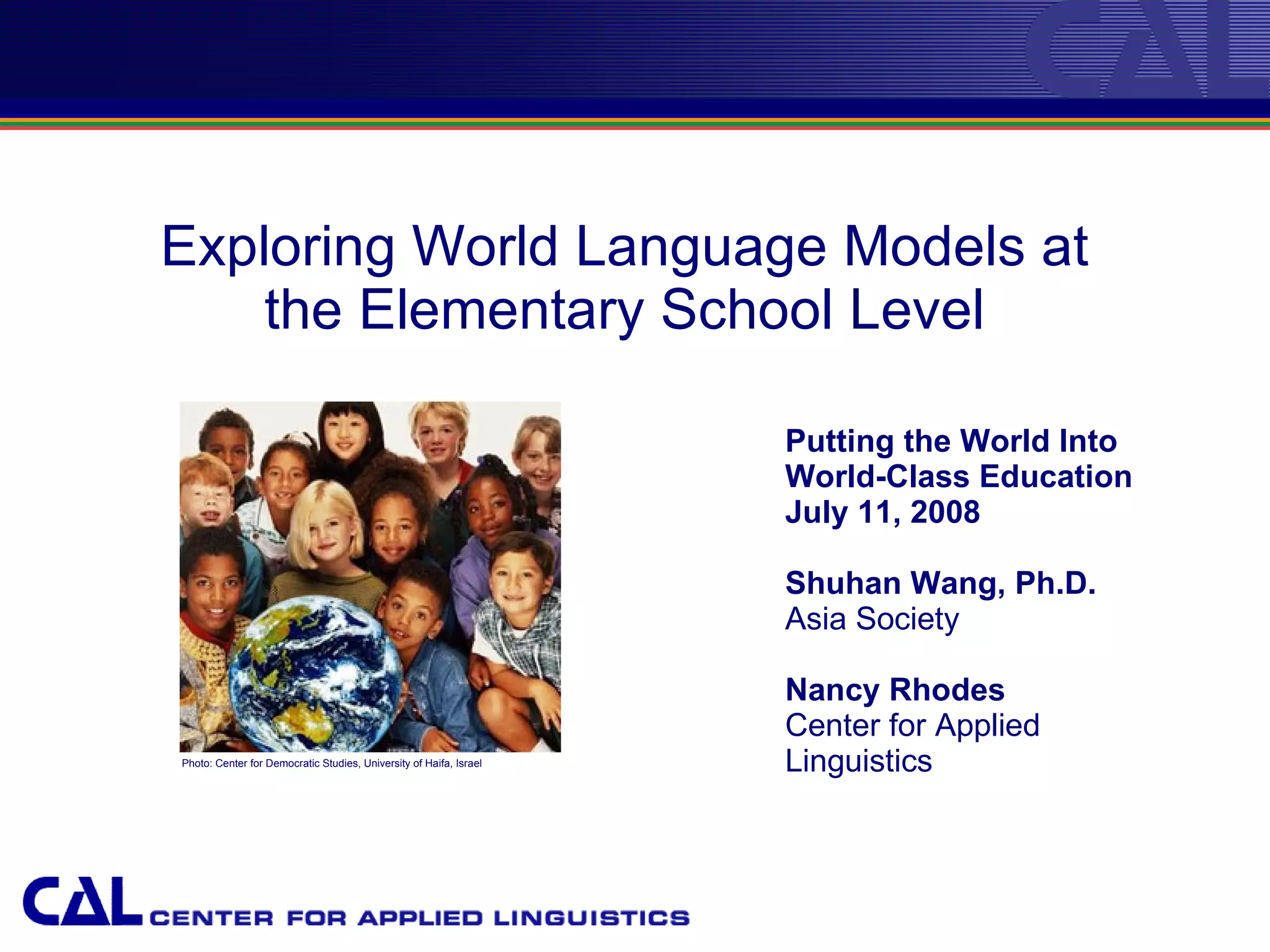
Exploring World Language Models at the Elementary School Level Putting the World Into World-Class Education July 11, 2008  Shuhan Wang, Ph.D. Asia Society Nancy Rhodes Center for Applied Linguistics Photo: Center for Democratic Studies, University of Haifa, Israel
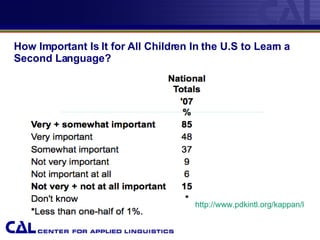
How Important Is It for All Children In the U.S to Learn a Second Language?  http://www.pdkintl.org/kappan/k_v89/k0709pol.htm
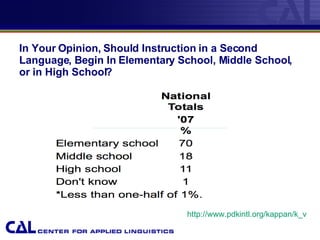
In Your Opinion, Should Instruction in a Second Language, Begin In Elementary School, Middle School, or in High School? http://www.pdkintl.org/kappan/k_v89/k0709pol.htm
National K-12 Foreign Language Survey National survey sample 2007-08: elementary and secondary schools, public and private Goal: collect comprehensive data on FL instruction; replicate 1987 and 1997 surveys More than 5,000 schools sampled; >60% response rate obtained Data currently being compiled; results available at ACTFL Conference 08
National K-12 Foreign Language Survey Preliminary observations (from “eye-balling” the data; not yet based on final results) Number of elementary schools offering FL does not appear to have increased in the last decade Of those elem. schools not offering FL, few are interested in offering FL in the next two years (while ten years ago, more than half of  schools not teaching FL were interested in offering it) Many schools comment that NCLB has had a major (negative) effect on their language programs Pockets of innovation around the country
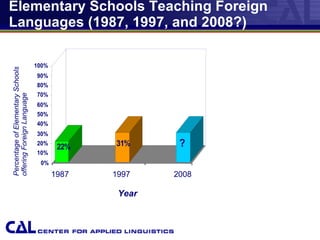
Elementary Schools   Teaching Foreign Languages (1987, 1997, and 2008?) Percentage of Elementary Schools offering Foreign Language Year 1987 1997 2008
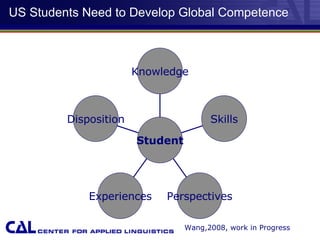
US Students Need to Develop Global Competence Wang,2008, work in Progress Disposition Experiences Perspectives Skills Knowledge Student
What Does it Take to Develop Speakers at  High Proficiency Levels?   High Proficiency Levels   Time matters:  for a native English speaker to reach native-like proficiency level:  --Commonly Taught Languages: 720 hours --Less Commonly Taught Languages: 1320 hours  (Omaggio-Hadley, 2001) (Malone, M. E.; Rifkin, B., Christian, D. & Johnson, D. E., 2005.  Attaining High Levels of Proficiency: Challenges for Foreign Language Education in the United States .  http://www.cal.org/resources/digest/attain.htm.
Recommended Pathways to Proficiency Build on the language background of heritage language speakers  Start language learning early  to build a strong base for second, third, and fourth language learning Provide intensive immersion experiences for students at the postsecondary level, including overseas study in a target-language culture (Malone, et al., 2005, p. 2, 10/26/05)
Why Is Early Language Learning Desirable?   Children learn through   PLAY P:   Peer socialization L: Learning by concrete examples A: Activity-based inquiry Y: Yeast for future development as a total person Advantages: Phonological window open Parameters for language learning expanded Content learning reinforced Cognitive skills activated and strengthened  Natural imitators and risk takers Enjoy show and tell and the fun to communicate for    meaning Time to go thorough articulated sequential learning
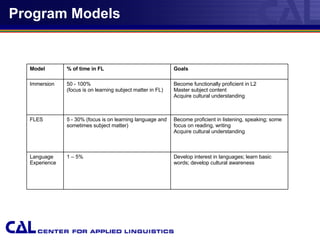
Three Differences in Program Models The  amount of time  spent per day in the study of foreign language The  language used  by the teacher in class The  subject matter  of the class
Program Models Develop interest in languages; learn basic words; develop cultural awareness  1 – 5%  Language Experience  Become proficient in listening, speaking; some focus on reading, writing  Acquire cultural understanding  5 - 30% (focus is on learning language and sometimes subject matter)  FLES  Become functionally proficient in L2  Master subject content  Acquire cultural understanding  50 - 100%  (focus is on learning subject matter in FL)  Immersion  Goals  % of time in FL  Model
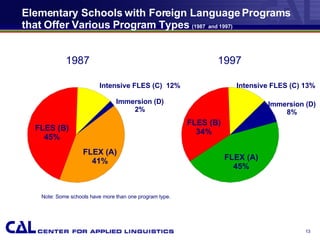
Elementary Schools   with Foreign Language Programs that Offer Various Program Types  (1987   and 1997) FLES (B) 45% Intensive FLES (C)  12% FLEX (A) 41% Immersion (D) 2% FLES (B) 34% Intensive FLES (C) 13% FLEX (A) 45% 1987 1997 Immersion (D) 8% Note: Some schools have more than one program type.
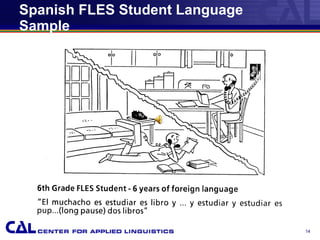
Spanish FLES Student Language Sample
Spanish Immersion Language Sample
  What resources are available? Funding Foreign Language Assistance Program (FLAP)  www.grants.ed.gov  Critical Language Flagship Programs  http://www.thelanguageflagship.org/funding_institutions.html STARTALK Critical Language Summer Programs for Teachers and Students  http://www.startalk@umd.edu   email:  [email_address] . edu
Curricular Resources New Jersey   www.state.nj.us/education/aps/cccs/wl/frameworks/wlo / . Ohio http://ims.ode.state.oh.us/ Grade 12, “Human Needs Know No Boundaries” National Council of State Supervisors for Languages http://www.ncssfl.org
Chinese Curricula Available for Sharing Chicago Public Schools K-3 Curriculum:   Center for Applied Linguistics and National Foreign Language Resource Center (Iowa State University):  http: //nflrc . iastate . edu/ PreK-AP Curriculum:  Chicago Public Schools ,  http://www.confuciusinstitute.chicago Minnesota Department of Education:  Chinese Language Programs Curriculum Development Project, Feb. 2007  http://education.state.mn.us Ohio K-4 Curriculum (FLAP)  http: //ims .ode.state.oh.us/ Oregon/Portland K-16:  http: //casls . uoregon . edu
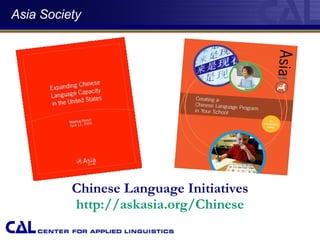
Asia Society Chinese Language Initiatives http://askasia.org/Chinese
http: //internationaled .org http: //AskAsia .org/Chinese
Websites Center for Applied Linguistics  www.cal.org CARLA Center for Advanced Research on Language Acquisition  www.carla.umn.edu NNELL  www.nnell.org
Contact Information Shuhan C. Wang, Ph.D.  Asia Society Tel: 212-327-9301 email: shuhanw@asiasoc.org Web site:  http: //Askasia .org/Chinese Nancy Rhodes Center for Applied Linguistics Tel:   202-362-0700 email:  [email_address] Web site:  www.cal.org
Thank you! 谢谢

Wang Language Learning at the Elementary Level

  • 1.
    Exploring World LanguageModels at the Elementary School Level Putting the World Into World-Class Education July 11, 2008 Shuhan Wang, Ph.D. Asia Society Nancy Rhodes Center for Applied Linguistics Photo: Center for Democratic Studies, University of Haifa, Israel
  • 2.
    How Important IsIt for All Children In the U.S to Learn a Second Language? http://www.pdkintl.org/kappan/k_v89/k0709pol.htm
  • 3.
    In Your Opinion,Should Instruction in a Second Language, Begin In Elementary School, Middle School, or in High School? http://www.pdkintl.org/kappan/k_v89/k0709pol.htm
  • 4.
    National K-12 ForeignLanguage Survey National survey sample 2007-08: elementary and secondary schools, public and private Goal: collect comprehensive data on FL instruction; replicate 1987 and 1997 surveys More than 5,000 schools sampled; >60% response rate obtained Data currently being compiled; results available at ACTFL Conference 08
  • 5.
    National K-12 ForeignLanguage Survey Preliminary observations (from “eye-balling” the data; not yet based on final results) Number of elementary schools offering FL does not appear to have increased in the last decade Of those elem. schools not offering FL, few are interested in offering FL in the next two years (while ten years ago, more than half of schools not teaching FL were interested in offering it) Many schools comment that NCLB has had a major (negative) effect on their language programs Pockets of innovation around the country
  • 6.
    Elementary Schools Teaching Foreign Languages (1987, 1997, and 2008?) Percentage of Elementary Schools offering Foreign Language Year 1987 1997 2008
  • 7.
    US Students Needto Develop Global Competence Wang,2008, work in Progress Disposition Experiences Perspectives Skills Knowledge Student
  • 8.
    What Does itTake to Develop Speakers at High Proficiency Levels? High Proficiency Levels Time matters: for a native English speaker to reach native-like proficiency level: --Commonly Taught Languages: 720 hours --Less Commonly Taught Languages: 1320 hours (Omaggio-Hadley, 2001) (Malone, M. E.; Rifkin, B., Christian, D. & Johnson, D. E., 2005. Attaining High Levels of Proficiency: Challenges for Foreign Language Education in the United States . http://www.cal.org/resources/digest/attain.htm.
  • 9.
    Recommended Pathways toProficiency Build on the language background of heritage language speakers Start language learning early to build a strong base for second, third, and fourth language learning Provide intensive immersion experiences for students at the postsecondary level, including overseas study in a target-language culture (Malone, et al., 2005, p. 2, 10/26/05)
  • 10.
    Why Is EarlyLanguage Learning Desirable? Children learn through PLAY P: Peer socialization L: Learning by concrete examples A: Activity-based inquiry Y: Yeast for future development as a total person Advantages: Phonological window open Parameters for language learning expanded Content learning reinforced Cognitive skills activated and strengthened Natural imitators and risk takers Enjoy show and tell and the fun to communicate for meaning Time to go thorough articulated sequential learning
  • 11.
    Three Differences inProgram Models The amount of time spent per day in the study of foreign language The language used by the teacher in class The subject matter of the class
  • 12.
    Program Models Developinterest in languages; learn basic words; develop cultural awareness 1 – 5% Language Experience Become proficient in listening, speaking; some focus on reading, writing Acquire cultural understanding 5 - 30% (focus is on learning language and sometimes subject matter) FLES Become functionally proficient in L2 Master subject content Acquire cultural understanding 50 - 100% (focus is on learning subject matter in FL) Immersion Goals % of time in FL Model
  • 13.
    Elementary Schools with Foreign Language Programs that Offer Various Program Types (1987 and 1997) FLES (B) 45% Intensive FLES (C) 12% FLEX (A) 41% Immersion (D) 2% FLES (B) 34% Intensive FLES (C) 13% FLEX (A) 45% 1987 1997 Immersion (D) 8% Note: Some schools have more than one program type.
  • 14.
    Spanish FLES StudentLanguage Sample
  • 15.
  • 16.
    Whatresources are available? Funding Foreign Language Assistance Program (FLAP) www.grants.ed.gov Critical Language Flagship Programs http://www.thelanguageflagship.org/funding_institutions.html STARTALK Critical Language Summer Programs for Teachers and Students http://www.startalk@umd.edu email: [email_address] . edu
  • 17.
    Curricular Resources NewJersey www.state.nj.us/education/aps/cccs/wl/frameworks/wlo / . Ohio http://ims.ode.state.oh.us/ Grade 12, “Human Needs Know No Boundaries” National Council of State Supervisors for Languages http://www.ncssfl.org
  • 18.
    Chinese Curricula Availablefor Sharing Chicago Public Schools K-3 Curriculum: Center for Applied Linguistics and National Foreign Language Resource Center (Iowa State University): http: //nflrc . iastate . edu/ PreK-AP Curriculum: Chicago Public Schools , http://www.confuciusinstitute.chicago Minnesota Department of Education: Chinese Language Programs Curriculum Development Project, Feb. 2007 http://education.state.mn.us Ohio K-4 Curriculum (FLAP) http: //ims .ode.state.oh.us/ Oregon/Portland K-16: http: //casls . uoregon . edu
  • 19.
    Asia Society ChineseLanguage Initiatives http://askasia.org/Chinese
  • 20.
    http: //internationaled .orghttp: //AskAsia .org/Chinese
  • 21.
    Websites Center forApplied Linguistics www.cal.org CARLA Center for Advanced Research on Language Acquisition www.carla.umn.edu NNELL www.nnell.org
  • 22.
    Contact Information ShuhanC. Wang, Ph.D. Asia Society Tel: 212-327-9301 email: shuhanw@asiasoc.org Web site: http: //Askasia .org/Chinese Nancy Rhodes Center for Applied Linguistics Tel: 202-362-0700 email: [email_address] Web site: www.cal.org
  • 23.