CONTENTS

 INTRODUCTION                         3

 DESCRIPTION                          5

 UNIT CREDIT                          7

 TIME ALLOTMENT                       7

 EXPECTANCIES                         8

 SCOPE AND SEQUENCE                   9

 SUGGESTED STRATEGIES AND MATERIALS   14

 GRADING SYSTEM                       15

 LEARNING COMPETENCIES                16

 SAMPLE LESSON PLANS                  42
INTRODUCTION
      This Handbook aims to provide the general public - parents, students, researchers, and other
stakeholders - an overview of the English program at the secondary level. Those in education, however,
may use it as a reference for implementing the 2002 secondary education curriculum, or as a source
document to inform policy and guide practice.

         For quick reference, the Handbook is outlined as follows:

     l    The description defines the focus and the emphasis of the learning area as well as the
          language of instruction used.

     l    The unit credit indicates the number of units assigned to a learning area computed
          on a 40-minute per unit credit basis and which shall be used to evaluate a student’s
          promotion to the next year level.

     l    The time allotment specifies the number of minutes allocated to a learning area on a
          daily (or weekly, as the case may be) basis.

     l    The expectancies refer to the general competencies that the learners are expected to
          demonstrate at the end of each year level.

     l    The scope and sequence outlines the content, or the coverage of the learning area in
          terms of concepts or themes, as the case may be.

     l    The suggested strategies are those that are typically employed to develop the content,
          build skills, and integrate learning.

     l    The materials include those that have been approved for classroom use. The application
          of information and communication technology is encouraged, where available.

     l    The grading system specifies how learning outcomes shall be evaluated and the aspects
          of student pertormance which shall be rated.

     l    The learning competencies are the knowledge, skills, attitudes and values that the
          students are expected to develop or acquire during the teaching-learning situations.
l   Lastly, sample lesson plans are provided to illustrate the mode of integration, where
         appropriate, the application of life skills and higher order thinking skills, the valuing
         process and the differentiated activities to address the learning needs of students.

        The Handbook is designed as a practical guide and is not intended to structure the operationalization
of the curriculum or impose restrictions on how the curriculum shall be implemented. Decisions on how
best to teach and how learning outcomes can be achieved most successfully rest with the school principals
and teachers. They know the direction they need to take and how best to get there.
DESCRIPTION
      The secondary English language curriculum for 2002 seeks to develop citizenship and to address
the communication needs (i.e. interpersonal, informative and aesthetic) of Filipino students for English,
which is emerging as the international lingua franca. In line with developments in applied linguistics
and pedagogy, and in consonance with the government thrusts and globalization, this emerging English
curriculum adopts a communicative-interactive collaborative approach to learning as well as reflection
and introspection with the aim in view of developing autonomous language learners aware of and able to
cope with global trends.


THEORETICAL FRAMEWORK
       Underlying the curriculum as its theoretical framework is the prevailing theory of language,
theory of language acquisition and current pedagogical thrusts enriched by other inputs to the
curriculum such as global trends and the concomitant requirements for global citizenship.
       Where the theory of language is concerned, language is viewed as a means of communication in
the real world. Hence, the goal is to develop the four competencies-linguistic, sociolinguistic, discoursal
and strategic with emphasis on cognitive academic language proficiency based on the students’ need for
the language.

        Both aforementioned theories of language and of language acquisition are in keeping with the
prevailing pedagogical emphasis on constructivism which is learner-centered and which underscores
reflection and collaboration to develop autonomy.

       Through the years, government thrusts have served as an additional input to the curriculum.
In the emerging secondary education English curriculum, however, other additional inputs have to be
considered in consonance with paradigm shifts that have taken place. These additional inputs mark the
difference between this curriculum and what preceded it.

        •   The advent of the information age necessitates computer literacy over and above
            functional literacy
        •   Globalization and what it entails calls for a scrutiny of global trends and the concomitant
            requirements of global citizenship
        •   Content-Based Instruction (CBI) underscores the need to develop higher order thinking
            skills which enables one to acquire academic as well as communicative competence
        •   The focus on developing learner autonomy has resulted in strategy training in addition
            to skills development.
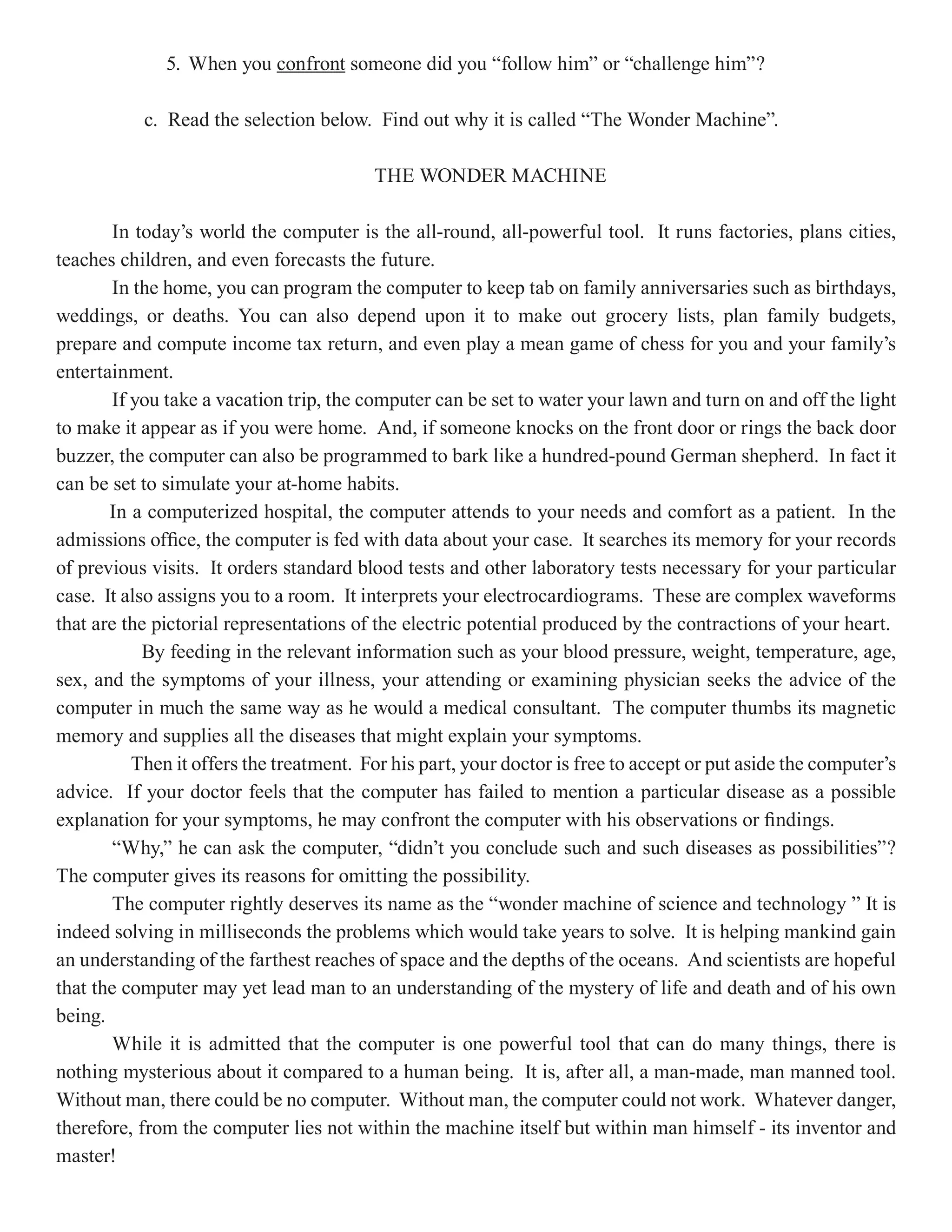
The schematic diagram, which follows, shows the inputs and outputs of the emerging secondary
English curriculum.

         |Communication goals                               Higher order thinking skills
         Information Exchange                                 Macro-language skills
          Affective Expression                             Competencies (communicative
                                                                  and academic)


                                                 -à
                                         à
                                    --
                                    --
                                    -- --
                                       --
                                       --


                                              ---
                                            ---
                                            ---
                                            ---

                                           ---
                              CURRICULUM


                                                    à
                                à
                                                    à
                                           à
  Global trends
Global citizenship                                                         Focus on Education
                                                                           (government thrust)


                                                                            Pillars of learning


                         Theoretical Basis
                         Theory of language
                    Theory of language acquisition
                     Current pedagogical thrusts


       As indicated in the diagram, the prevailing theory of language, language acquisition and
pedagogical thrusts provide the theoretical basis for the curriculum. The boxes on the sides of the figure
give other inputs to the curriculum and the boxes on the top show what the expected outputs are.
The English language curriculum provides for the development of language and language-related
skills in a meaningful purposeful and interesting manner. This is attained through the adoption of an
integrated approach in the teaching of language.

      Central to the framework of this curriculum is the need for language learning that is contextualized,
                                                                                            contextualized
interactive and integrated. This is achieved through the use of themes covering a wide range of topics to
                 integrated.
cater to the varied interests and maturity levels of students as they progress through their school years.

     Each of the themes, explored through meaningful tasks and activities, provides the context in which
grammar and other language and language related skills are taught and learned. Themes also provide the
means for the integration of the various language components. This integration makes language more
purposeful, meaningful and thus more motivating for the students.


UNIT CREDIT
     English in each year level shall be given 1.5 units each.


TIME ALLOTMENT
     English is given a period of one hour daily.
EXPECTANCIES
      At the end of the Fourth Year the student is expected to have acquired skills of assessing, evaluating
and using relevant information to meet their various needs, thereby enabling them to adapt and respond
flexibly to a rapidly changing world; and to have developed listening, speaking, reading, and writing
skills and appreciation of literature resulting in a deeper understanding of the ideas, experiences and
cultures of other people, customs and traditions as well as values.


                                                 ñ
      At the end of the Third Year, the student is expected to utilize a variety of sentences and expository
methods in persuasion and argumentations; break down complex sentences to get the message in
different text types: journalistic, scientific, literary and technical; and single out the devices employed in
fiction works and non-fiction works (foreshadowing, flashbacks, figurative language, etc.) used by authors
for intellectual, emotional and aesthetic purpose with emphasis on Philippine and British-American
literature.


                                                 ñ
     At the end of the Second Year, the student is expected to exhibit skills in utilizing the prosodic
features in oral texts and signals and cues in written texts to follow the development of ideas; show
understanding and appreciation of the different genres with emphasis on types contributed by Afro-
Asian and Philippine countries; and to manipulate formal devices used to combine sentences to create
continuous prose employing different rhetorical patterns.


                                                 ñ
     At the end of the First Year, the student is expected to determine how sentences are used to perform
communicative acts, such as describing, defining, classifying, etc; make use of real world knowledge and
experience with emphasis on cross-cultural items; work at the denotative meanings of a text; identify and
explain different literary types with emphasis on Philippine literature; and show appreciation of art forms
and familiarization with the more common mass media forms.
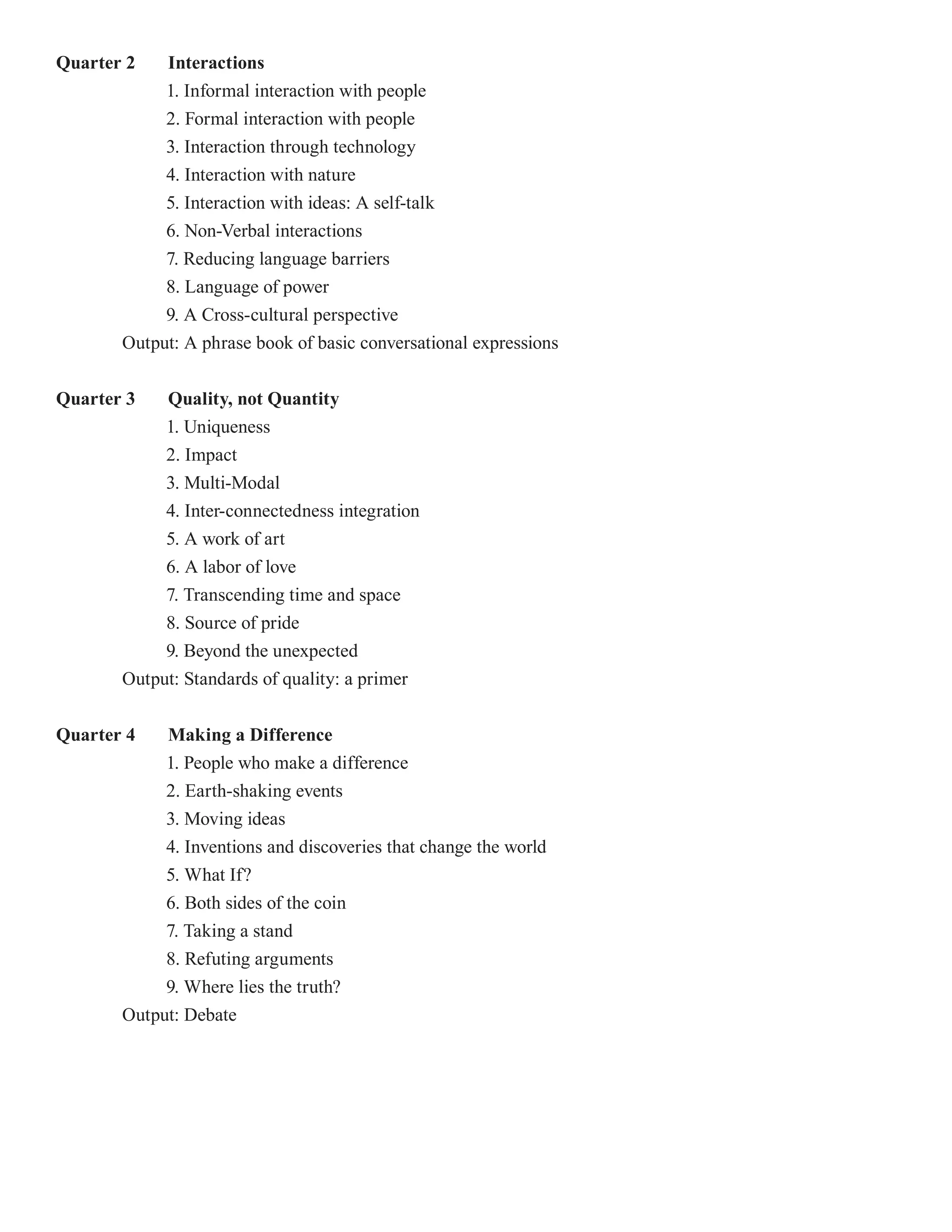
SCOPE AND SEQUENCE
FIRST YEAR
Quarter 1    Getting in Touch with Self and Others
             1. How do I see myself?
             2. How does my family see me?
             3. Through the eyes of my friends
             4. I, as a member of the community
             5. How informed and concerned am I about national and global issues?
             6. Reaching out to others
             7. Being open to contrary opinions
             8. Do I step on the right of others?
             9. My relationship with God
       Output: My profile: A thumbnail sketch (An autobiography, a collage or a self portrait)


Quarter 2   I, as a Learner
            1. I am a learner
            2. Making sense of what I’ve learned
            3. When communication bogs down
            4. When memory fails me
            5. Planning my learning activities
            6. Becoming a resourceful learner
            7. Working harmoniously with others
            8. Reflecting on what I’ve done
            9. Synthesizing my learning experiences
       Output: My portfolio as a learner

Quarter 3    My Relationship with Nature
             1. Learning from nature
             2. Bounties of nature
             3. Taking care of nature
             4. Coping with the wrath of nature
             5. The 3Rs of waste management
             6. Being a responsible steward of nature
            7. Communing with nature
            8. Nature in us
            9. Drawing inspiration from nature
       Output: A campaign for change: treating nature right
Quarter 4   Science and Technology: Friend? or Foe?
            1. Development in transportation
            2. Development in communications
            3. Medical breakthroughs
            4. Food for all
            5. Consumerism
            6. Science and technology master or slave?
            7. Our throw- away society
            8. Experiencing information overload
            9. Necessity: the mother of all inventions
       Output: Round table discussion on the topic: science and technology; friend or foe?


SECOND YEAR
Quarter 1   Learning to Know
            1. A wealth of knowledge
            2. Learning to learn
            3. Learning from experiences
            4. Learning from others
            5. Learning from events
            6. Learning from information technology
            7. An analytical learner
            8. Reflecting on what I learned
            9. Reflecting for an informative talk show
       Output: An informative talk show related to national and global issues


Quarter 2   Learning to Be
            1. Being true to ourselves
            2. Tracing our roots
            3. Being a nationalist
            4. Being an Asian citizen
            5. Being an open- minded but discerning global citizen
            6. Being a team player
            7. Being concerned about people
            8. Being concerned about nature
            9. Being responsible for one’s decisions
       Output: A peace book/wall or board
Quarter 3   Learning to Become
            1. Responding to differences of opinions and culture
            2. Responding to personal problems
            3. Responding to societal problems
            4. Responding to uncertainties
            5. Responding to changes
            6. Responding to media
            7. Taking risks
            8. Listening to events
            9. Time out for reflection
       Output: A showcase of growth, through colors, shapes, objects, sounds and language


Quarter 4    Learning to Do
             1. Viewing problems and issues from different vantage points
            2. Reading up on previous efforts
            3. Noting trends
            4. Drawing up plans
            5. Trying things out
            6. Analyzing results
            7. Reflecting and evaluating processes
            8. Creating new applications
            9. Presenting and sharing results
       Output: A project proposal and end-of-project reports


THIRD YEAR
Quarter 1   In the Realms of Thoughts
            1. Seeing patterns
            2. Perception versus reality
            3. Reconciling contradictions
            4. Breaking down walls
            5. Up-down and up again: The S-curve
            6. People change
            7. What’s new?
            8. Green housing ideas
            9. Looking back, looking forward
       Output: Making ideas take shape through songs, painting, collage, etc.
Quarter 2   Interactions
            1. Informal interaction with people
            2. Formal interaction with people
            3. Interaction through technology
            4. Interaction with nature
            5. Interaction with ideas: A self-talk
            6. Non-Verbal interactions
            7. Reducing language barriers
            8. Language of power
            9. A Cross-cultural perspective
       Output: A phrase book of basic conversational expressions


Quarter 3   Quality, not Quantity
            1. Uniqueness
            2. Impact
            3. Multi-Modal
            4. Inter-connectedness integration
            5. A work of art
            6. A labor of love
            7. Transcending time and space
            8. Source of pride
            9. Beyond the unexpected
       Output: Standards of quality: a primer


Quarter 4   Making a Difference
            1. People who make a difference
            2. Earth-shaking events
            3. Moving ideas
            4. Inventions and discoveries that change the world
            5. What If?
            6. Both sides of the coin
            7. Taking a stand
            8. Refuting arguments
            9. Where lies the truth?
       Output: Debate
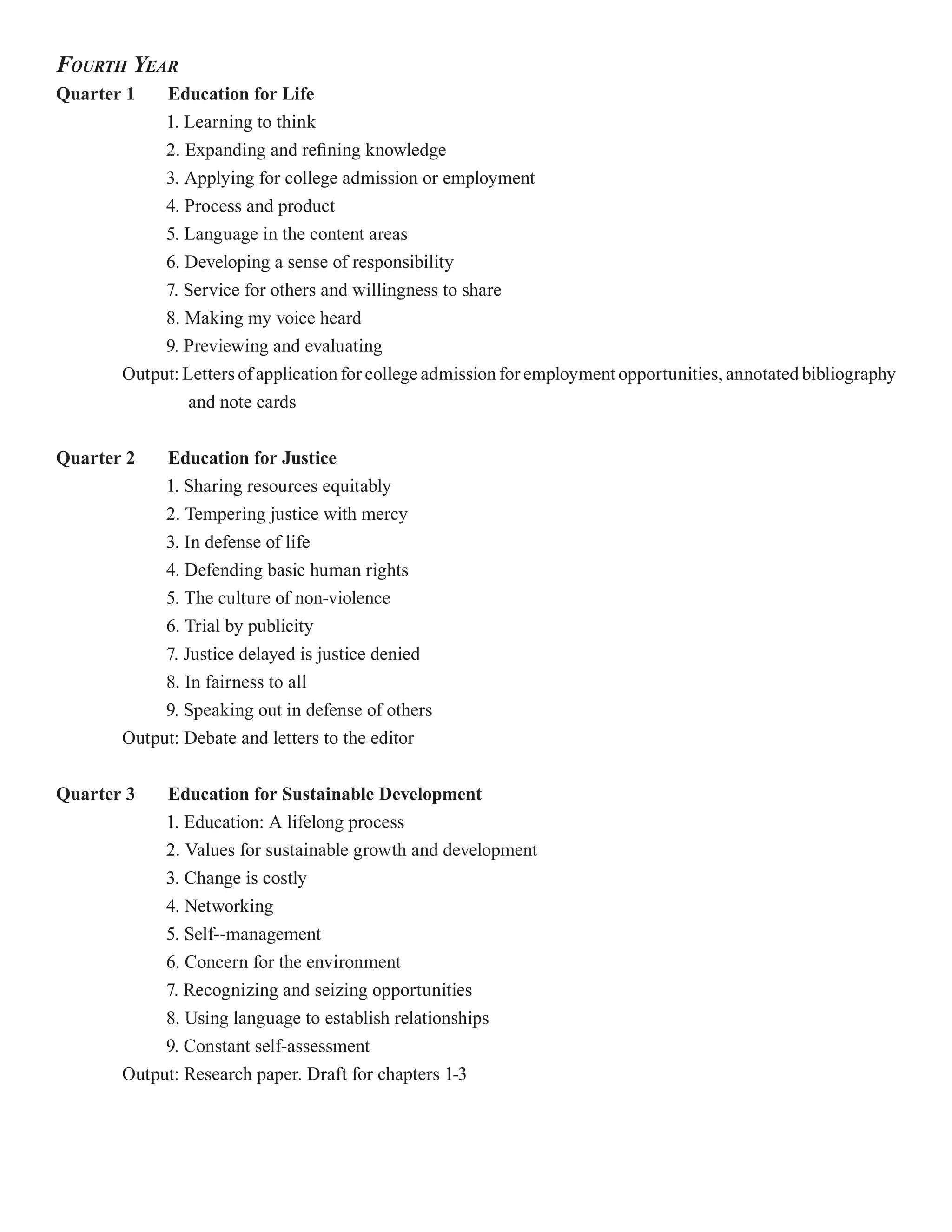
FOURTH YEAR
Quarter 1   Education for Life
            1. Learning to think
            2. Expanding and refining knowledge
            3. Applying for college admission or employment
            4. Process and product
            5. Language in the content areas
            6. Developing a sense of responsibility
            7. Service for others and willingness to share
            8. Making my voice heard
            9. Previewing and evaluating
       Output: Letters of application for college admission for employment opportunities, annotated bibliography
                and note cards

Quarter 2   Education for Justice
            1. Sharing resources equitably
            2. Tempering justice with mercy
            3. In defense of life
            4. Defending basic human rights
            5. The culture of non-violence
            6. Trial by publicity
            7. Justice delayed is justice denied
            8. In fairness to all
            9. Speaking out in defense of others
       Output: Debate and letters to the editor

Quarter 3   Education for Sustainable Development
            1. Education: A lifelong process
            2. Values for sustainable growth and development
            3. Change is costly
            4. Networking
            5. Self--management
            6. Concern for the environment
            7. Recognizing and seizing opportunities
            8. Using language to establish relationships
            9. Constant self-assessment
       Output: Research paper. Draft for chapters 1-3
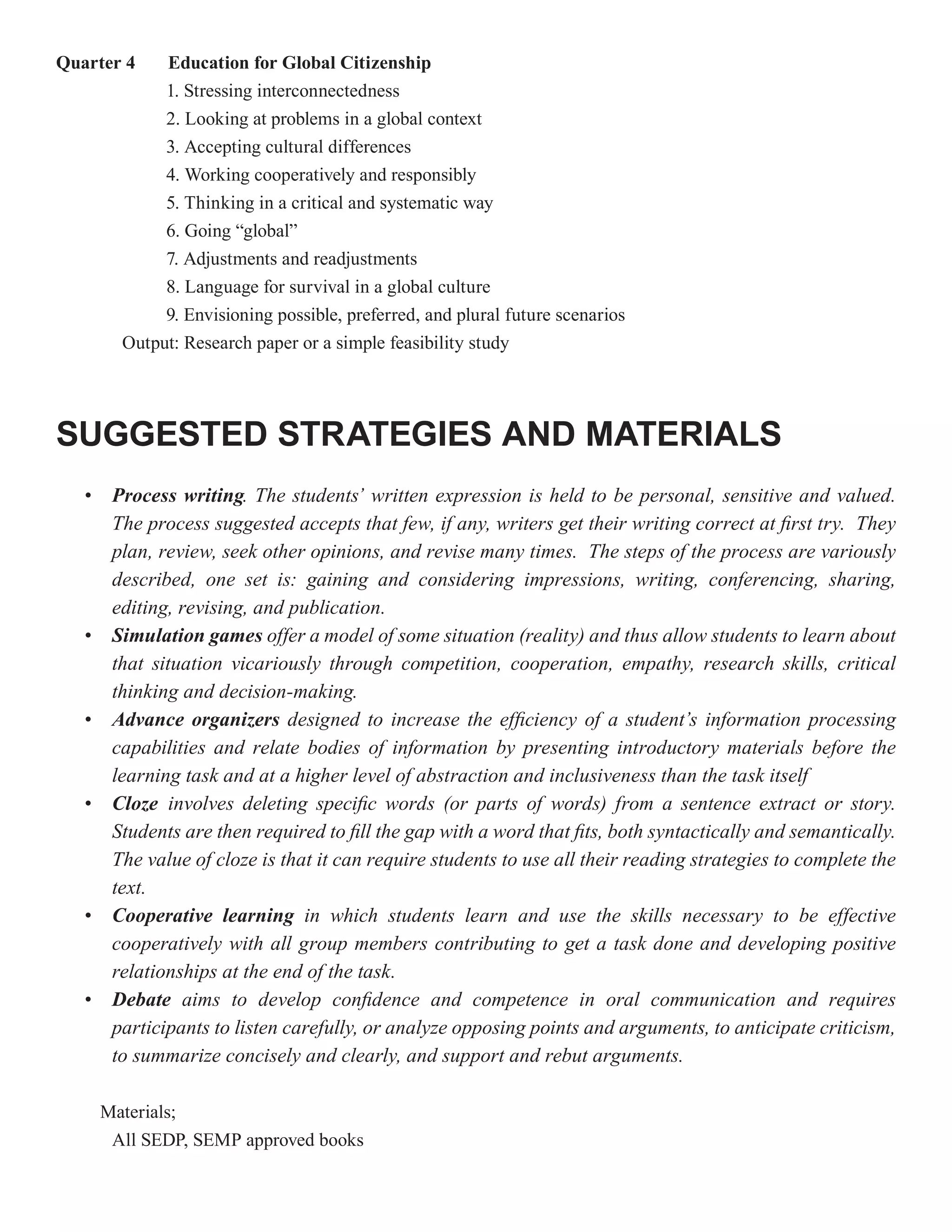
Quarter 4     Education for Global Citizenship
              1. Stressing interconnectedness
              2. Looking at problems in a global context
              3. Accepting cultural differences
              4. Working cooperatively and responsibly
              5. Thinking in a critical and systematic way
              6. Going “global”
              7. Adjustments and readjustments
              8. Language for survival in a global culture
              9. Envisioning possible, preferred, and plural future scenarios
         Output: Research paper or a simple feasibility study


SUGGESTED STRATEGIES AND MATERIALS
   •    Process writing. The students’ written expression is held to be personal, sensitive and valued.
                  writing
        The process suggested accepts that few, if any, writers get their writing correct at first try. They
        plan, review, seek other opinions, and revise many times. The steps of the process are variously
        described, one set is: gaining and considering impressions, writing, conferencing, sharing,
        editing, revising, and publication.
   •    Simulation games offer a model of some situation (reality) and thus allow students to learn about
        that situation vicariously through competition, cooperation, empathy, research skills, critical
        thinking and decision-making.
   •    Advance organizers designed to increase the efficiency of a student’s information processing
        capabilities and relate bodies of information by presenting introductory materials before the
        learning task and at a higher level of abstraction and inclusiveness than the task itself
   •    Cloze involves deleting specific words (or parts of words) from a sentence extract or story.
        Students are then required to fill the gap with a word that fits, both syntactically and semantically.
        The value of cloze is that it can require students to use all their reading strategies to complete the
        text.
   •    Cooperative learning in which students learn and use the skills necessary to be effective
        cooperatively with all group members contributing to get a task done and developing positive
        relationships at the end of the task.
   •    Debate aims to develop confidence and competence in oral communication and requires
        participants to listen carefully, or analyze opposing points and arguments, to anticipate criticism,
        to summarize concisely and clearly, and support and rebut arguments.

       Materials;
        All SEDP, SEMP approved books
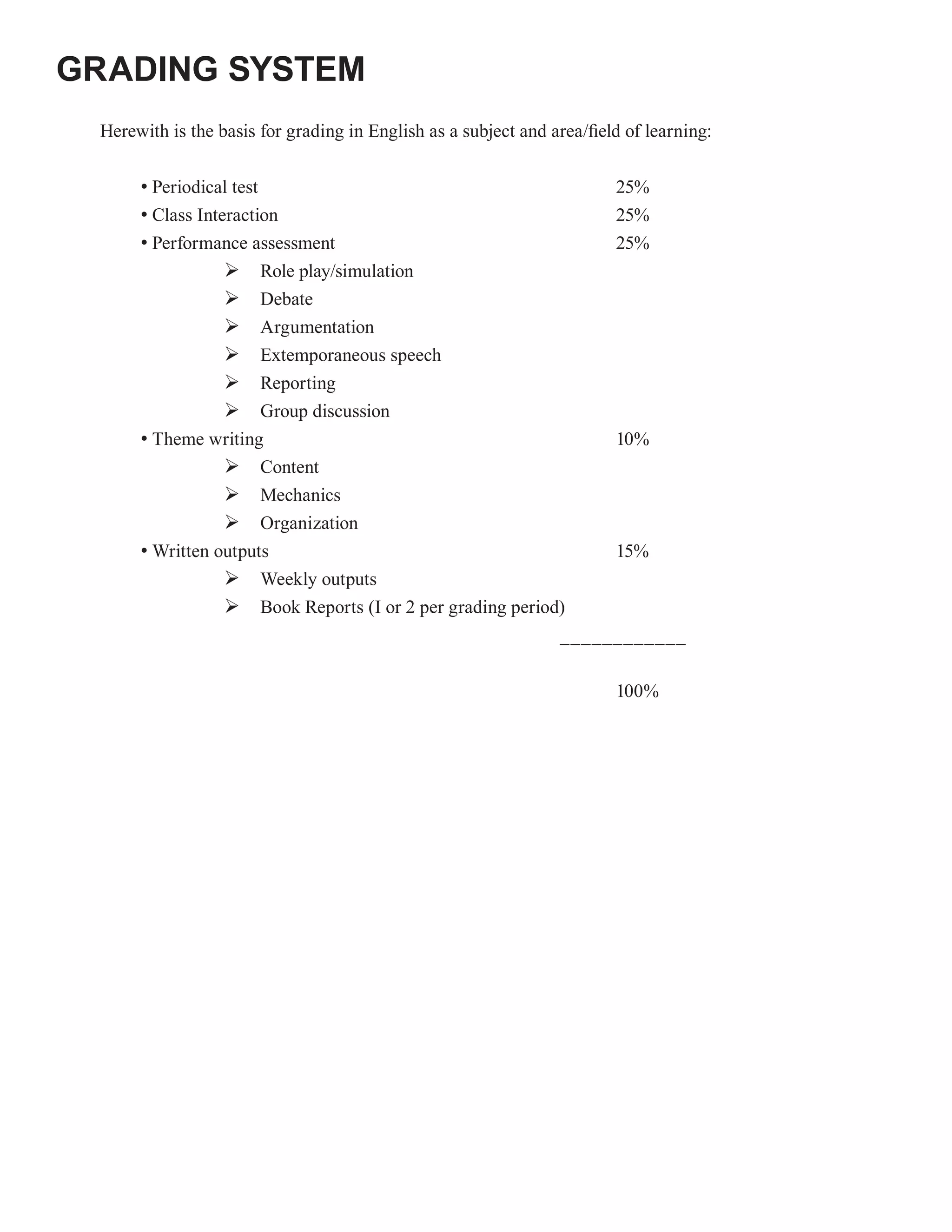
GRADING SYSTEM
 Herewith is the basis for grading in English as a subject and area/field of learning:


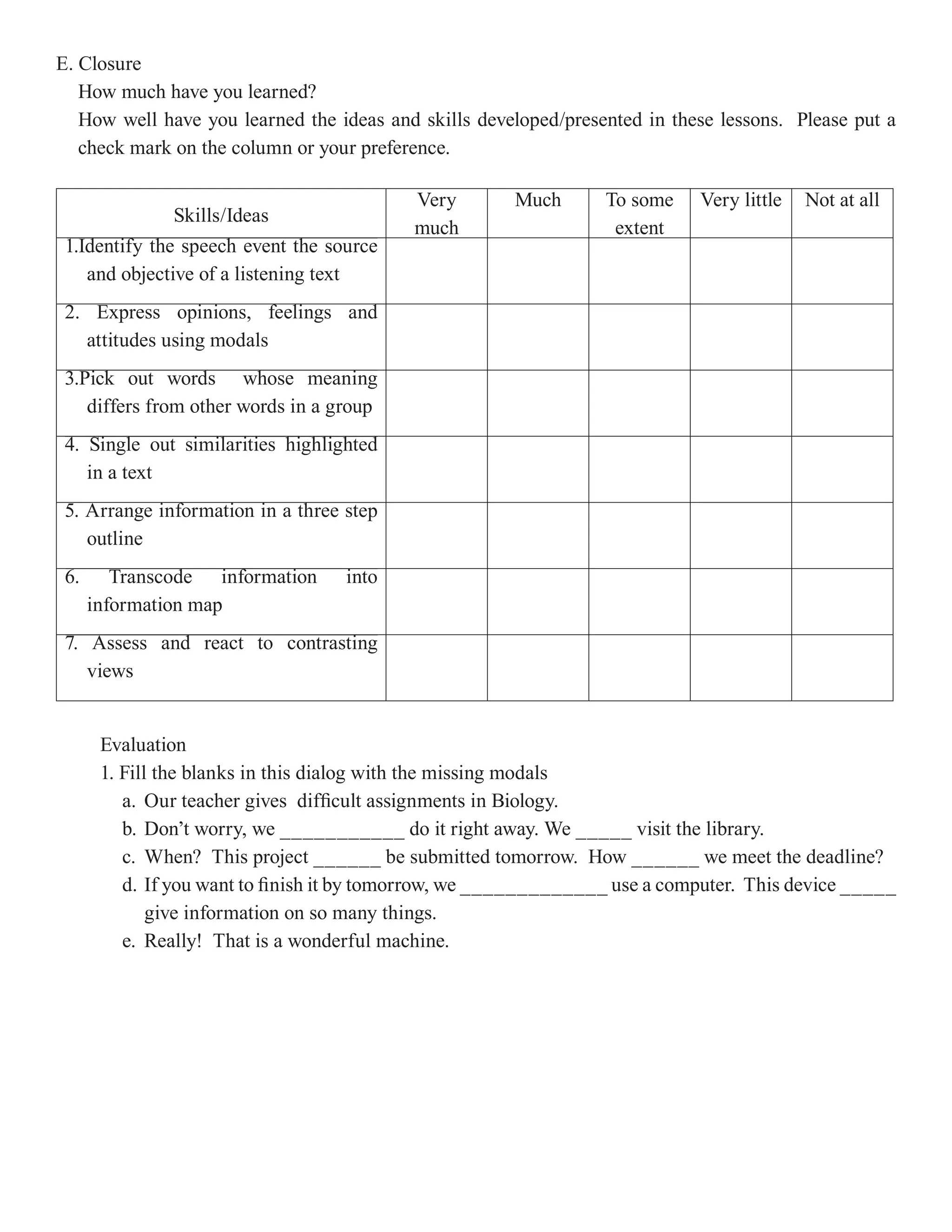
      • Periodical test                                                 25%
      • Class Interaction                                               25%
      • Performance assessment                                          25%
                  Ø Role play/simulation
                  Ø Debate
                  Ø Argumentation
                  Ø Extemporaneous speech
                  Ø Reporting
                  Ø Group discussion
      • Theme writing                                                   10%
                  Ø Content
                  Ø Mechanics
                  Ø Organization
      • Written outputs                                                 15%
                  Ø Weekly outputs
                  Ø Book Reports (I or 2 per grading period)
                                                                ____________


                                                                        100%
LEARNING COMPETENCIES
                                                   IN
              INTERACTIVE SECONDARY ENGLISH
                  LANGUAGE CURRICULUM
                           2002

FIRST YEAR
   At the end of the first year, the student shall have developed the following competencies:

LISTENING
     1.    Listen closely to determine what to do and what not to do in announcements, instructions
           or directions given orally
           1.1    Listen to instructions given in connection with classroom procedure
                  1.1.1 Note down details in instructions or directions given orally
                  1.1.2 Carry out instructions given orally

           1.2   Explore opportunities offered for speedy and economical access to information by
                 listening to broadcasts and weather bulletins
                 1.2.1 Distinguish what to do and what not to do in emergency situations (fire,
                             earthquake, etc.)
                 1.2.2 Listen closely to instructions and cautions pointed out
                 1.2.3 Listen for specific details and warnings in weather bulletins
     2.    Determine the content and feeling levels of utterances
           2.1   Identify the speech event, interlocutors and objective of the speaker
           2.2   Note the use of intonation to express feelings
           2.3   Identify attitudes and feelings signaled by prosodic features (e.g. intonation and
                 stress)

     3.    Adjust listening strategies (marginal, selective, attentive, critical) in relation to the main
           purposes of listening, one’s familiarity with the topic and level of difficulty of a text
           describing a process and narrating longer stories
           3.1    Determine the type of listening suited to a given text
                  3.1.1 Use TQLR (Tune in-Question-Listen-Respond) as a strategy to make sense
                             of listening texts
                  3.1.2 Employ selective strategies to find out answers to questions raised in a
                             listening text
3.2    Listen to informative texts specifically descriptions of processes
                3.2.1 Listen to determine steps in a process
                3.2.2 Transcode descriptions of a process using flowcharts
                3.2.3 Listen to explanations of specific processes noting cause-effect relationships

         3.3    Listen to narratives
                3.3.1 Infer links and connections between ideas
                3.3.2 Determine the information map suited to the type of narrative listened to
         3.4    Listen to issues pertaining to the home and the family
                3.4.1 Listen to class discussions on home and the family
                3.4.2 Identify the place and the person speaking
                3.4.3 Identify the stand of the speaker based on explicit statements made

    4.   Get information from rapid speech
         4.1    Listen to process speech including pauses, errors, corrections
                4.1.1 Get information from rapid and “distorted” speech
                4.1.2 Restate a commentary on a basketball game
         4.2    Make sense of broadcasts and telecasts
                4.2.1 Listen to get information on current events and issues aired over the radio
                           and television

    5.   Express appreciation for entertaining texts (anecdotes, jokes, fables, tales in sharing
         sessions)
         5.1    Listen to simple narratives to develop appreciative listening skills
                5.1.1 Point out the (situation-problem-attempted solution-result) discourse pattern
                            in tales
                5.1.2 Point out the distinctive features of tales, anecdotes, fables, etc. listened to
                5.1.3 Identify cause-effect relationships in anecdotes and tales
         5.2    Single out the punch lines in jokes


SPEAKING
    1.   Speak in clear correct English appropriate to situations and adjust rate, volume, and choice
         of register to suit the audience
         1.1     Observe correct pronunciation of critical vowel and consonant sounds
         1.2     Use correct pronunciation, intonation and stress patterns, pausing, and blending

    2.   Give information and express needs, opinions, feelings and attitudes in explicit terms
         2.1    Give short talks to entertain
2.2    Give and convey information obtained over the telephone and from radio
                 broadcasts
          2.3    Use visual aids (e.g. graphs, charts, etc.) when conveying information on topics
                 dealing with science and mathematics

    3.    Use English when offering things to classmates and teachers, and identify the functions
          of utterances taking into account the context of the situation (seeking information, giving
          directions, expressing approval/disapproval, etc.)
          3.1     Use gambits when offering things to classmates, teachers, etc.
                  3.1.1 Respond to offers made (accept, turn-down or negotiate changes in offers
                             made)
          3.2     Give clear commands, requests and directions to get things done
                  3.2.1 Give instructions, prohibitions, warnings

    4.    Ask and answer different types of questions (yes-no, wh- questions, core and follow-up)
          using the basic sentence structures and sound patterns of English

    5.    Arrive at a consensus by citing proof statements
          5.1    React to information shared in small group discussions
          5.2    Agree/disagree with assertions and observations made in radio broadcasts and when
                 sharing experiences on topics dealing with Science and Mathematics

    6.    Observe social and linguistic conventions in oral transactional discourse (e.g. interview,
          asking, and giving directions, etc.)
          6.1    Interview classmates to get to know them better
          6.2    Use communication strategies (e.g. paraphrase and translation) to make up for
                 inadequacies in the language
          6.3    Ask and give directions and instructions on specific processes


READING
    1.    Get information from the different parts of a book, current information from newspapers
          and data from general references in the library
          1.1    Use the card catalogue to locate reference materials in the library
          1.2    Use locational skills to derive data from general sources of information: encyclopedia,
                 dictionary
          1.3    Get information from the different parts of a book
          1.4    Get current information from newspapers
2.   Use different reading styles to suit the text and one’s purpose for reading
     2.1    Scan for specific information
     2.2    Skim rapidly for major ideas using headings as guide
     2.3    Read closely to find answers to specific questions, note sequence of events, etc.

3.   Use ideas and information gained from previous readings and personal experiences to
     better understand a text
     3.1     Use background knowledge or schema as basis for conjectures and hypothesis made
             while reading a text
     3.2     Recall ideas from previous readings to better understand a given text

4.   Explain non-linear visuals most commonly used in content texts
     4.1    Transcode orally and in writing the information presented in diagrams, charts, table,
            graphs, etc.
     4.2    Use illustrations to activate background knowledge and to get a pictorial
            representation of what is discussed in the text
     4.3    Give the meaning of signs and symbols used (e.g. road sign, prohibited signs, etc.)
            and evaluate their effectiveness
     4.4    Locate places and follow directions using a map
     4.5    Transcode information in linear texts into information maps

5.   Conduct a covert dialogue with the writer as a basis for predictions and formulating
     hypothesis about a text
     5.1   Interact with the writer by responding to statements made in the text and using this
           as basis for predictions and formulating hypothesis
     5.2   Formulate and modify hypothesis based on information given in the text
     5.3   Distinguish fact from opinion, fantasy from reality
     5.4   React to assertions made in the text
     5.5   Make predictions and anticipate outcomes

6.   Make generalizations and significant abstractions from different reading materials designed
     for information, pleasure and appreciation
     6.1     Show improvement of one’s command of the language as a result of reading
     6.2     Determine the concept or information map embedded in a text

7.   Use structural, lexical and contextual devices in deriving the meaning of unknown words
     and ambiguous and information-dense discourse
     7.1    Identify the sense and reference of words in reading texts for a better understanding
            of a selection
7.2    Show recognition of collocations and semantic relationships by arranging words in
                 clines and clusters
          7.3    Single out cohesive markers that signal relationships


WRITING
    1.    Effectively express thoughts and feelings in writing book reports and correspondence for
          specific social purposes
          1.1     Write personal letters
                  • friendly
                  • thank you
                  • excuse
                  • congratulatory
                  • condolence
          1.2     Make diary entries of significant events
          1.3     Write summaries in book reports

    2.    Give personal information in school forms and write announcements of school events
          2.1 Fill out forms needed for effective functioning in school
                  • library card
                  • enrollment/registration forms
                  • information sheet
                  • application form
          2.2     Write announcements of school events

    3.    Produce different text types, narrative (diary entries), expository (process explanation,
          interviews, etc.) and descriptive (comparison and contrast)
          3.1    Write well-constructed paragraphs utilizing the macro-discourse patterns (PSn)
                 Problem-Solution or (TRI) Topic-Restriction-Illustration suited to the discourse
                 type
          3.2    Use appropriate rhetorical functions and techniques to express one’s ideas, needs,
                 feelings and attitudes
          3.3    Expand ideas in writing using cohesive devices and employing different rhetorical
                 modes
          3.4    Use key idea sentences, support sentences, transition devices and restatements in
                 texts
4.   Present information in graphic and non-linear texts
         4.1    Take down notes utilizing information maps
                • linear and cyclical flowcharts
                • two-level tree diagrams
                • three columnar grids
         4.2    Use two-step word and phrasal outlines to organize ideas
         4.3    Make a write-up of charts and graphs

    5.   Edit one’s composition following guidelines concerning content, format and mechanics

    6.   Acknowledge resources used
         6.1  Use quotation marks to enclose direct quotations from resources
         6.2  Use expressions like “according to …” to indicate citations made


LITERATURE
    1.   Discover Philippine literature as a means of having a better understanding of man and his
         environment
         1.1    Express appreciation of one’s identity and cultural heritage
                1.1.1 Show appreciation for worthwhile local traditions and practices expressed in
                           Philippine literature and the values they represent
         1.2 Show appreciation of literature specifically Philippine literature as a means of
                highlighting human rights in varied genres
         1.3    Appreciate poetry and the essay expressive of the Filipino identity and pride as a
                nation

    2.   Discover through literature the need to work cooperatively and responsibility in today’s
         global village
         2.1    Infer motives, attitudes and values of a character from what he does (action/manner),
                says and what others say about him
         2.2    Anticipate events and outcomes from a series of details or acts

    3.   Show understanding and appreciation of various literary types/(with emphasis on Philippine
         literature) (i.e. legends, fables, myths, folktales)
         3.1     Identify the elements of a literary form which distinguishes it from other literary
                 forms; short story, poem, essay, drama/play
                 3.1.1 Explain the characteristics of fables, legends, myths, folktales
                 3.1.2 Single out events that form the plot of a short story
         3.2     Distinguish between the language of science and the language of literature
4.   Determine the conflicts presented in literature (man vs. man, man vs. himself, man vs.
     institutions) and the need to resolve those conflicts in a non-violent way

5.   State whether a literary piece affirms, modifies or changes one’s value system

6.   Edit one’s composition following guidelines concerning content, format, and mechanics
     6.1 Identify and explain poetic devices, use of local color, figurative language and
            sensory images in literary forms
     6.2 Point out the author’s technique for characterization
     6.3 Point out and express appreciation for sense image in poems
SECOND YEAR
    At the end of the second year, the student shall have developed the following competencies:

LISTENING
     1.   Determine the social issues addressed in an informative talk, the objective of the speaker
          and his attitude on the issues
          1.1    Listen for clues and links to show the speaker’s trend of thought
                 1.1.1 Describe the speaker’s attitude towards the subject
                 1.1.2 Arrive at conclusions regarding the attitude of the speaker toward his subject
                             by noting clues and links to show the speaker’s stand and assumptions
          1.2    Explore opportunities for speedy and economical access to information by listening
                 to talks, informative, political, religious

     2.   Identify prosodic features, stress, and intonation features as carriers of meaning that may
          aid or interfere in the delivery of the message in stories and informative texts
          2.1     Note prosodic features (e.g. stress, intonation, pauses) and rate of speech as carriers
                  of meaning
          2.2     Identify changes in meaning signaled by stress, intonation and juncture
          2.3     Listen for points the speaker emphasizes as important signaled by contrastive
                  sentence stress

     3.   Employ varied listening strategies (marginal, selective, attentive, critical) to suit the
          listening text and task
          3.1     Supply gaps in listening texts caused by acoustic disturbance
                  3.1.1 Predict what is to follow considering the text type and macro discourse
                              pattern
                  3.1.2 Use context to guess items not heard in a listening text
          3.2     Listen to longer stories
                  3.2.1 Employ projective listening strategies when listening to stories
                  3.2.2 Predict outcomes from events described in stories as they unfold
                  3.2.3 Listen to determine if one’s predictions are borne out
                  3.2.4 Listen to events and note developments in narratives as they unfold
                  3.2.5 Note the dramatic effect of sudden twists in surprise endings
          3.3 Listen to issues pertaining to the community
                  3.3.1 Identify the attitudes of the speaker on an issue
                  3.3.2 Determine if the speaker is neutral, for or against an issue
4.   Process speech at different rates by making inferences from what was said
         4.1   Use syntactic and lexical clues to supply items not heard in a listening text
               4.1.1 Anticipate what is to follow considering the function of the statements made
         4.2   Listen to determine conflicting information aired over the radio and television

    5.   Express appreciation for oral interpretations noting harmony, unison, and rhythm
         5.1   Listen to appreciate the tune and narrative structure of ballads
         5.2   Listen to appreciate harmony, unison, and rhythm in choric interpretations


SPEAKING
    1.   Give a short, informative talk using appropriate registers to suit the intended audience and
         variation in intonation and stress for emphasis and contrast
         1.1     Make use of stress and intonation for emphasis and contrast
         1.2     Express feelings and attitudes by utilizing contrastive stress and variations of tone
                 and tempo
         1.3     Use stress, intonation and juncture to signal changes in meaning

    2.   Give information and express needs, opinions, feelings and attitudes explicitly and implicitly
         in informative talk
         2.1     Formulate response to questions noting the types of questions raised (yes-no, wh-
                 questions alternative, modals, embedded)
         2.2     Use the telephone to make inquiries
         2.3     Give information obtained from mass media: newspapers, radio, television
         2.4     Use audio-visual aids to highlight important points in an informative talk

    3.   Infer the function of utterance and respond accordingly taking into account the context of
         the situation and the tone used (asking information, making suggestions, expressing wants,
         dislikes, approval, disapproval
         3.1     Respond orally to the ideas and needs expressed in face-to-face interviews in
                 accordance with the intended meaning of the speaker
         3.2 Include instructional information and constraints

    4.   Arrive at a consensus on community issues by assessing statements made
         4.1    React to information obtained from talks
                4.1.1 Agree/disagree with statements and observations made concerning
                            community issues
         4.2    Agree/disagree with statements, observations and responses made in political and
                religious talks when discussing issues affecting the community
         4.3    Interview persons to get their opinions about social issues affecting the community
5.    Use appropriate turn-taking strategies (topic nomination, topic development, topic shift,
          turn-getting, etc.) in extended conversation

    6.    Use communication strategies (e.g. paraphrase, translations, and circumlocution) to repair
          break down in communication


READING
    1.    Gather data using library resources consisting of general references, atlas, periodical index,
          and periodicals to locate information
          1.1    Use the periodical index to locate information in periodicals
                 1.1.1 Determine the content and stand of a newspaper
          1.2    Extract and organize information from different text types

    2.    Adjust and vary reading speed based on one’s purpose for reading and the type of materials
          read
          2.1 Use different reading styles to suit the text and one’s purpose for reading
          2.2    Scan rapidly for sequence signals or connectors as basis for determining the
                 rhetorical organization of texts

    3.    Demonstrate the ability to activate background knowledge (e.g. use advance organizers,
          illustrations, comprehension, questions, titles, etc.) to better understand a text
          3.1     Relate ideas from previous readings to a given text

    4.    Demonstrate the ability to interpret and if necessary reproduce in linear verbal forms and
          graphics relationships calling for inferential interpretations
          4.1 Interpret and compare orally or in writing information presented in tables, charts,
                 graphs, etc.
          4.2 Choose the chart (flow chart, tree diagram or grid) most suited to illustrate thought
                 relationships in a given text
          4.3 Organize information into a concept map

    5.    Utilize varied reading strategies (covert dialogue with the writer and the sectional approach)
          to process information in a text
          5.1     Note the function of statements made as the text unfolds and use it as the basis of
                  predicting what is to follow
          5.2     Suggest modifications to be made considering the context of the situation when the
                  text was written
          5.3     Distinguish between facts and opinion and note expressions that signal opinions
                  (seems, as I see it)
5.4    Identify propaganda strategies used in advertisements and other texts and consider
                 these when formulating hypothesis concerning claims made
          5.5    Abstract information from the text by noting both explicit and implicit signals used
                 by the writer to serve as directions on how the text is to be interpreted

    6.    Develop the ability and the desire to read different text types for information, pleasure and
          appreciation
          6.1    Derive from the written text varied ways of expressing an idea

    7.    Develop strategies to make sense of unfamiliar words, ambiguous sentence structures, and
          information-dense discourse
          7.1   Arrange words in a cline to differentiate between shades of meaning
          7.2   Guess the meaning of idiomatic expressions by noting keywords in expressions,
                context clues, collocations, clusters or related words, etc.
          7.3   Get the meaning of complex sentence structures by deleting expansions to come up
                with the kernel sentence


WRITING
    1.    Communicate thoughts, feelings, one’s needs in letters, journal entries, book reviews,
          interview write-ups, etc. using appropriate styles (formal and informal)
          1.1    Employ the interactional functions of language in pen-pal letters, letters of invitation,
                 “yes” and “no” letters
          1.2    Write reflections on learning experiences in diary and journal entries
          1.3    Summarize and write reactions to books read (book reviews) or movies seen (movie
                 review)
          1.4    Prepare interview guides and make a write-up of an interview

    2.    Accomplish forms (school, evaluation, survey) and order slips and prepare posters and
          captions calling attention to drives
          2.1    Fill out personal data sheets (school forms, bank forms, etc.)
          2.2 Accomplish order slips, telecom forms
          2.3    Call attention to school events and drives
                 2.3.1 Make captions for posters
                 2.3.2 Write slogans
                 2.3.3 Prepare advertisements for school drives
3.   Write different types of discourse: narration (personal experiences), exposition (book
         reviews) and description (apparatus, objects, etc.)
         3.1   Write well-constructed texts employing alternative forms of the overall macro
               discourse patterns
               P-Sn Situation, Problem, Attempted Solution-Result-Evaluation
               TRI Topic-Restriction, Topic-Illustration, and Topic-Restriction-Illustration
         3.2 Use appropriate modes of development to express one’s ideas, needs, feelings, and
               attitudes
         3.3 Expand ideas using a variety of and cohesive devices to make the flow of thought
               from one sentence to another smooth and effortless
         3.4 Write short personal narratives to support an assertion

    4.   Organize ideas in non-linear texts
         4.1   Use information maps and other concept maps as aids in note taking
               • Linear, branching, cyclical flow-charts
               • Three-level tree diagrams
               • Grids
         4.2   Use three-step word, phrasal and sentence outlines to organize ideas
         4.3   Explain in writing the data presented in non-linear texts

    5.   Do self and peer-editing using a set of criteria

    6.   Use writing conventions to indicate acknowledgement of resources


LITERATURE
    1.   Discover Philippine and Afro Asian literature as a means of expanding experiences and
         outlook and enhancing worthwhile universal human values
         1.1    Express appreciation for worthwhile Asian traditions and the values they represent
         1.2    Assess the Asian identity as presented in Asian literature
         1.3    Assess one’s self in the light of what makes an Asian
         1.4    Identify one’s self with other people through literature and note cultural differences
                so as to get to the heart of problems arising from them

    2.   Discover literature as a means of having a better understanding of man and the forces he
         has to contend with
         2.1     Discover through literature the symbiotic relationship between man and his
                 environment and the need of the former to protect the latter
         2.2     Demonstrate a heightened sensitivity to the needs of others for a better understanding
                 of man
2.3   Discover through literature the links between one’s life and the lives of the people
           throughout the world
     2.4   Highlight the need for a more just and equitable distribution of resources

3.   Show understanding and appreciation of the different genres with emphasis on types
     contributed by Asian countries (i.e. haiku, tanka etc.)
     3.1    Point out the elements of plays and playlets
     3.2    Determine the macro discourse patterns (PSNTRI) of essays and the micro discourse
            signals used to establish meaning relationships in the essay

4.   Point out the role of literature in enabling one to grow in personhood
     4.1    Note the values underscored by the writer in literary pieces
     4.2    Distinguish literature s a means of gaining vicarious experiences
     4.3    Discriminate what is worthwhile from what is not through literature
            4.3.1 Distinguish as a positive value the ability to look into oneself and to accept
                        one’s strengths and weaknesses
            4.3.2 Single out humility, resourcefulness and self-reliance

5.   Employ reading skills as an aid in comprehension and appreciation of a literary piece
     5.1   Select appropriate details from a selection (i.e. contrasts, illustration, etc.) used by
           an essayist to attain his objective (to persuade, to inform, to call attention, etc.)
     5.2   Point out how the choice of title space allotment, imagery, choice of words, figurative
           language, etc. contribute to the theme
          5.2.1 Single out and explain figurative language used
          5.2.2 Point out and express appreciation of sensory images in literary forms
     5.3 Show relationship between the man idea and significant details
     5.4   Draw conclusions and make inferences based on details/specific ideas
     5.5   Determine the author’s tone and purpose for writing a literary selection
     5.6   Paraphrase passages to demonstrate understanding
THIRD YEAR
    At the end of the third year, the student shall have developed the following competencies:


LISTENING
    1.    Show openness when listening to statements contrary to one’s beliefs
          1.1   Take into account the context and situations that gave rise to statements contrary to
                one’s stand
                1.1.1 Take note of cultural differences underlying contradictory views
          1.2   Explore opportunities for obtaining varied views on a given issue by listening to
                debates and talk shows
                1.2.1 Infer links and connections between ideas

     2.   Determine the claims, perspectives, assumptions, and the line of argumentation in oral
          presentations
          2.1    Listen for important points signaled by pausing and a slow rate of speech
          2.2    Identify explicit signals given by the speaker (e.g. “this is important…”) to
                 underscore a point
          2.3    Listen for clues to enable one to tune in to the topic discussed

     3.   Shift from one listening strategy to another depending on the text and one’s purpose for
          listening
          1.1     Shift from marginal to attentive listening depending on the topic listened to
                  1.1.1 Employ listening strategies suited to the type of text
                  1.1.2 Use attentive listening with informative texts and critical listening with
                             argumentative texts
                  1.1.3 Use TLQR (Tune-in to raise Questions, then Listen and Respond) when
                             listening to informative and argumentative texts
          1.2     Listen to argumentative discourse
                  1.2.1 Listen to single out reasons cited in argumentative texts
                  1.2.2 Determine the logic of arguments cited
                  1.2.3 Determine the stand of a speaker on a given issue
                  1.2.4 Determine the assumptions underlying the arguments of a speaker
                  1.2.5 Determine the effectiveness of closing statements in arguments
          1.3     Listen to social, moral and economic issues affecting the nation
                  1.3.1 Listen to get the different sides to an issue in panel discussions
                  1.3.2 Identify the speaker’s stand on an issue by noting explicit and implicit signals
                             (e.g. choice of words to highlight or downplay assertions made)
4.   Process speech at different rates when listening to informative and argumentative texts
         1.1   Determine what was left out and highlighted in informative and argumentative
               talks
               1.1.1 Listen to determine the worth of ideas based on a set of criteria
               1.1.2 Listen to determine whether conclusions are logical or illogical
               1.1.3 Determine inconsistencies
               1.1.4 Pick out discrepancies in supporting ideas
               1.1.5 Determine the information map suited to informative classificatory texts
                           (tree diagrams), informative process texts (flow charts), and contrastive
                           argumentative texts (grid)
         4.2   Compare the stand and attitudes of newscasters and panel discussants

    5.   Express appreciation of award-winning protest and patriotic songs and radio plays
         5.1   Listen to appreciate the sound effects and dramatic interpretations employed in
               radio plays
         5.2   Listen to appreciate the melody, rhythm, and words of award winning songs used as
               musical themes in movies


SPEAKING
    1.   Give a persuasive talk on an issue adjusting one’s rate/volume of speaking and register to
         suit the topic, audience and setting in a communication situation
         1.1     Use pausing and a slow rate of speech to signal important points in one’s talk
         1.2     Use explicit signals (e.g. ”This is important…”) to underscore or highlight a point in
                 one’s talk

    2.   Give information and express needs, opinions, feelings, and attitudes implicitly through
         analogy
         2.1    Elicit and give information using different types of questions and seek clarification
                and verification of responses made
         2.2    Present arguments in debates and argumentative texts
         2.3    Give information obtained from varied sources: talks, periodicals, mass media
         2.4    Use technological aids when conveying information (e.g. projectors)

    3.   Use form, function, and context to express one’s intended meaning

    4.   Arrive at a consensus by reconciling views
         4.1    React critically to issues raised in talk shows and discussions of issues affecting the
                nation
4.2    Agree/disagree with assertions made, justify one’s stand and suggest modifications
                  in open forums following informative talks, panel discussions and debates on
                  national issues

      5.   Use conversational gambits in face-to-face interactions to obtain information, express
           modified agreements, etc.
           5.1    Conduct ambush interviews to determine opinion on issues affecting the nation
           5.2    Use verbal (paraphrase, translation, circumlocution) as well as non-verbal
                  communication strategies and communication check to forestall and repair
                  breakdown in communication

 6.        Use verbal (paraphrase, translation, circumlocution) as well as non-verbal communication
           strategies in extended oral reports


READING
      1.   Gather data using library resources, newspapers, other print materials (periodicals,
           brochures, pamphlets) and non-print resources like audio and video tapes

      2.   Adjust and vary reading styles to suit the text, one’s background knowledge of the topic
           discussed and one’s purpose for reading
           1.1    Scan rapidly for sequence signals or connectors as basis for determining the macro
                  discourse pattern and rhetorical organization of the texts
           2.2 Suit one’s reading style to the different text types: informative, journalistic, and
                  literary

      3.   Demonstrate the ability to use titles and sub-titles as a means of getting an overview of the
           text and linking it with previous knowledge of the topic
           3.1 Assess a text in the light of previous readings
           3.2     Assess advance organizers, titles, sub-titles, illustrations, etc. in the light of
                  information given in a text

      4.   Demonstrate the ability to interpret and transcode information from linear to non-linear
           texts and vice versa
           4.1     Interpret and match information presented in diagrams with corresponding reading
                   texts
1.1    Demonstrate the ability to use varied ways of organizing information (outlining,
           graphic representation, etc.)
           1.1.1 Take down notes from a reading text using abbreviations, symbols, and
                      diagrams
2   Use varied approaches to make sense of and develop appreciation of different text types
    (covert dialogue with the writer, the sectional approach discourse analysis)
    2.1    Use genre analysis as a means of determining the written conventions of different
           text types
    2.2    Note the new data provided as the text unfolds and use them as basis for modifying
           expanding or affirming hypothesis made
    2.3    Re-structure original hypothesis to incorporate new information and avoid sweeping
           generalizations
    2.4    Note the use of emotion-laden terms to express opinions
    2.5    React critically to what is read by judging the relevance and worth of ideas,
           soundness of the author’s reasoning, and the effectiveness of the presentation
           2.5.1      Express emotional reactions to what is explicitly stated and implied in a
                      text

3   Choose from varied reading materials/designed to give information and pleasure, and to
    develop appreciation for reading
    3.1    Utilize reading as a means of developing language skills
    3.2    Express emotional reaction to what is explicitly stated and implied in the text

4   Employ varied strategies to make sense of unknown words (word derivations, context
    clues, word analysis, etc.) and ambiguous sentences (e.g. processing kernel and embedded
    clauses)
    4.1    Identify the derivation of words
    4.2    Arrive at the meaning of words through context clues, word analysis (root words,
           affixes, compounds)
    4.3    Use structural analysis on the word, sentence, and discourse levels to make sense of
           a text
    4.4    Note the strategies employed (restatements, definition, synonyms, antonyms) to
           clarify meanings in a given selection
    4.5    Identify the features of the written language that distinguish it from the spoken
           form (e.g. “according to”, “may we conclude”, “as previously stated”, “the following
           points to consider”, etc.)
    4.6    Pick out cohesive devices/discourse markers which introduce conclude topics
WRITING
    1.    Express opinion in writing (e.g. stand on certain issues, complaints, etc.) and write
          summaries of survey reports on a given issue
          1.1   Call attention in writing to good/objectionable practices in open letters, letters of
                commendation and complaint
          1.2   Express in writing satisfaction or dissatisfaction over services, performances, etc.
                (e.g. plays, movies, etc.) in journal entries, reviews
          1.3   Prepare survey forms and make a write-up of survey results
          1.4   Write a library research paper on a national issue

    2.    Fill out forms in line with business promotions and give information concerning group
          undertakings and activities
          2.1     Accomplish business promotion forms
                  • warranty return forms
                  • raffle contest forms
          2.2     Prepare notices, agendas and minutes of meetings
          2.3     Call attention to school events and drives

    3.    Demonstrate imagination in writing different text types: narratives both in text and script
          forms, description, definition, critiques of a movie or play
          3.1    Write texts with the overall text structure (P-Sn or TRI) and generic structure in
                 mind suited to the text type
          3.2    Suit the rhetorical techniques and functions to the objective and purpose of the
                 written discourse
          3.3    Produce a unified text by using cohesive devices, coordination and subordination
                 to enhance clarity of ideas, and the appropriate micro-discourse signals to establish
                 meaning relationships
          3.4    Provide examples and illustrations as well as non-examples to clarify definitions of
                 abstract concepts

    4.    Use maps and other non-linear texts to present information
          4.1   Use concept maps (linear, bubble, tree diagrams, grids) to show relationships
                between and among ideas abstracted from texts
          4.2   Use different types of outline (word, phrasal, clausal) to organize ideas
          4.3   Make a write-up of non-linear texts used to present information

    5.    Give and respond to feedback on how to revise compositions or refine ideas by citing
          details, giving explanations, examples where necessary

    6.    Use bibliographic and footnote entries to acknowledge citations made in a research paper
LITERATURE
    1.   Pick out worthwhile human experiences underscored in Philippine, English and American
         literature
         1.1     Single out the Eastern and Western cultural values evident in our heritage as a result
                 of historical development
                 1.1.1 Express appreciation for Filipino cultural values and its similarities to or
                             differences from English-American values
         1.2     Show appreciation for Western traditions, practices and the values they represent
                 1.2.1 Underscore the Western values of candid frankness and humor as presented
                             in British and American literature
                 1.2.2 Stress the importance of task-orientedness and efficiency as values worth
                             emulating

    2.   Discover literature as a means of understanding man and society (i.e. the bonds/links
         between man and society) as presented in Philippine, English and American literature
         2.1   Sow a keener sense of values that last in spite of changes brought about by science
               and technology
         2.2   React to experiences or actions of the characters in relation to real life situations
         2.3   Express the belief that people can change their ways depending on their motivation
               and determination as shown in literature
         2.4   React to the experiences of the characters in relation to real life situations
         2.5   Analyze and explain how the environment influences the person’s character and
               actions
         2.6   Deduce recurring themes underscored in literary pieces

    3.   Show understanding and appreciation of varied genres focusing on the contributions of
         British and America (i.e. sonnets, short stories, etc.)
         3.1     Note the form and functions of different types and sub-types of texts
         3.2     Differentiate comedy from tragedy, formal from informal essays
         3.3     Trace the development of character and conflict in narratives and dramas, and
                 discuss the devices used to achieve unity of effect
         3.4     Determine the objective of the essayist and the means employed to attain them

    4.   State the effect of a literary piece on one’s value system
         4.1     React to the values underlying responses to situations in literary pieces
         4.2     Single out worthwhile human values
         4.3     Point out one’s attitudes that contribute to a person’s values
5.   Single out the devices employed in fiction works and non-fiction works (foreshadowing,
     flashbacks, figurative language, etc.) used by the author for intellectual, emotional and
     aesthetic purposes
     5.1    Account for the devices used by a writer to highlight significant points in a text
            5.1.1 Interpret and explain figurative language used to achieve certain effects
                       and assess it in the light of its contributions to the overall theme of the
                       selection
            5.1.2 Point out and express appreciation for the author’s choice of words
            5.1.3 React to the figurative language used in the selection
     5.2    Point out relationships of time, place, cause-effect, general concepts, examples,
            analogy, etc. used by the writer to underscore the theme of the selection
     5.3    Point out the sequencing of details and account for such sequencing
FOURTH YEAR
    At the end of the fourth year, the student shall have developed the following competencies:


LISTENING
     1.   Show courtesy while listening to the ideas and feelings of others
          1.1   Listen attentively to what is uttered
          1.2   Allow the speaker to expound on the topic before reacting to what is said

     2.   Derive information that can be used in everyday life from news reports, speeches,
          informative talks, panel discussions, etc.
          2.1   Explore opportunities for obtaining comprehensive information and varying
                perspectives by listening to global television newscasts
          2.2   Point out the effectiveness of the devices used by the speaker to attract and hold the
                attention of the listener
          2.3   Identify the roles of discourse markers (e.g. conjunctions, gambits, adverbs) in
                signaling the functions of statements made
          2.4   Identify implicit and explicit signals-verbal as well as non-verbal used by a speaker-
                to-highlight important points
                2.4.1 Single out direct and indirect signals used by a speaker
          2.5   Respond to intonation used to signal information structure

     3.   Assess the effectiveness of listening strategies employed considering the text types, the
          listening task and one’s purpose for listening
          3.1     Match the strategy employed with the type of text, the objective of the listener and
                  the level of difficulty of the text
                  3.1.1 Demonstrate flexibility in switching from one strategy to another in
                              accordance with the situation and text type
                  3.1.2 Employ analytical listening in problem solving
                  3.1.3 Use varied approaches (e.g. selective listening TQLR, etc.) to process
                              listening tasks
          3.2     Listen to detailed reports, lecturettes and issues
                  3.2.1 Listen to take down notes from lecturettes or oral reports
                  3.2.2 Determine when to listen and when to take down notes in lecturettes or oral
                              reports
                  3.2.3 Listen to determine what further elucidation is needed in a report or a
                              lecture
                  3.2.4 Listen to supply items not heard in reports and lecturettes
3.2.5 Use prosodic as well as lexical clues to distinguish important points in a
                           lecture
                3.2.6 Determine the content and functions of statements in a lecture
         3.3    Listen to global issues
                3.3.1 Listen to get different viewpoints on global issues in talk shows
                3.3.2 Listen to get specific information from global television newscasts

    4.   Process speech at different rates when evaluating tasks and taking down notes
         4.1   Assess the effectiveness of a material listened to with a view of determining the
               speaker’s purpose and assessing whether it was achieved or not
               4.1.1 Give reactions to what was said
               4.1.2 Analyze what was heard on the bases of a given set of criteria
               4.1.3 Analyze and evaluate listening texts in point of accuracy, validity, adequacy
                           and relevance

    5.   Show appreciation for songs, poems, plays, etc.
         5.1   Listen to appreciate varies types of dramatic oral interpretations and songs with
               emphasis on protest songs
               5.1.1 Note the prosodic pattern used in dramatic readings
               5.1.2 Listen to chamber theater and reader’s theater presentations
               5.1.3 Describes the emotional appeal of a piece
         5.2   Give the theme/message of protest songs


SPEAKING
    1.   Speak clearly and spontaneously adapting one’s speech to situations, circumstances and
         people addressed
         1.1    Use accompanying non-verbal language clues (e.g. gestures) to highlight significant
                points in extended discourse

    2.   Use appropriate language, idioms, figurative language, analogy to express one’s feelings,
         thoughts and ideas
         2.1   Ask and respond to questions raised in different situations e.g. interviews, open
               forums, giving directions, etc.
         2.2   Express varied outlooks on a given issue
         2.3   Give information obtained from the internet and other sources
         2.4   Use interactive media as aids when conveying information
               2.4.1 Analyze and use sales psychology that underlies advertisements on radio and
                          television when conveying information
               2.4.2 Use idioms in expressing one’s feelings and attitudes
3.    Employ alternative ways of expressing speech acts and functions

    4.    Arrive at a consensus by resorting to varied strategies, assessment, negotiation and
          accommodation
          4.1   Analyze and react critically to ideas presented in speeches, news reports, discussed,
                etc.
          4.2   Indicate affirmation of and/or objections to ideas expressed in discussion on global
                issues
                4.2.1 Agree/disagree with panelists expressing varied outlooks on a given issue

    5.    Observe conversation strategies in face-to-face extended oral interactions
          5.1   Interview business and educational establishments to determine their policies and
                social orientation
          5.2   Use verbal and non-verbal communication strategies to forestall and repair
                communication breakdown

    6.    Analyze and react critically to ideas presented in speeches, news reports, discussions, etc.


READING
    1.    Derive information from various text types (journalistic, literary, scientific, practical,
          technical, etc.) and sources using the card catalogue, vertical file index, microfiche, CD-
          ROM, Internet, etc.
          1.1    Use locational skills to gather and synthesize information from general and first
                 hand sources of information
          1.2    Get information from websites through the Internet
          1.3    Distinguish between primary and secondary sources of information
          1.4    Extract accurately the required information from sources read and reject irrelevant
                 information

    2.    Adjust and vary reading speed and style to suit the text, one’s background knowledge and
          purpose in reading, and the constraints of the material read
          2.1    Employ different processing approaches (discourse analysis, genre analysis, SQ3R,
                 P2RST) best suited to a given text
          2.2    Scan for specific meanings and information

    3.    Demonstrate the ability to use previous experiences as a scaffold for processing information
          in a given text
          3.1     Test new insights against previous learnings
3.2    Synthesize previous learnings with new insights
              3.3    Note the effectiveness of textual aids like advance organizers, titles, sub-titles, non-
                     linear illustrations, etc. in activating background relevant to the selection

      4.      Explain visual-verbal relationships illustrated in tables, graphs, information maps
              commonly used in context area texts
              4.1 Transcode information from linear to non-linear texts and vice-versa
              4.2 Explain illustrations and schematic diagrams in Science and Technology texts

      5.      Show familiarity with the argumentation and rhetorical conventions of a discipline
              5.1 Note the functions of statement as they unfold
              5.2 Consider the data that might disconfirm hypothesis
              5.3 Examine opinions for bias
              5.4 Determine the validity and adequacy of proof statements to support assertions
              5.5 React critically to the devices employed by a writer to achieve his purpose
              5.6 React to assertions and proof statements made in a text and how they are presented

      6.      Show discrimination in the choice of reading materials designed to give information and
              pleasure and to develop appreciation for reading
              6.1 Utilize reading as a means of improving one’s language skills

      7.      Develop strategies for coping with unknown words and ambiguous sentence structures and
              discourse
              7.1   Identify the derivation of words
              7.2   Define words from context and through word analysis (prefix, roots, suffixes)
              7.3   Use collocations of difficult words as aids in unlocking vocabulary
              7.4   Arrive at the meaning of structurally complex and ambiguous sentences by kernel
                    sentences as from modification structures and expansions


WRITING
 1.        Organize one’s thoughts and adopt then appropriate writing style in letters, resumes, critiques,
           etc. with the addresses-audience in mind
               1.1    Write letters of application (job and/or admission to a university) and the
                      accompanying documents (e.g. resume)
               1.2    Use the interactional and transactional functions of language in letters of appeal,
                      inquiry, etc.
               1.3    Put down in writing in journal entries reflections and insights resulting from
                      “growth-in-personhood” experiences
1.4    Write a research paper on a global issue
               1.4.1 Analyze, choose and synthesize information from varied resources
               1.4.2 Employ varied strategies (condensing, deleting, combining, embedding)
                          when summarizing materials read

   2.   Fill out application forms (school, job, bank, etc.) and write project proposals
        2.1     Prepare school project proposals, on-going project evaluation and end-of-the-project
                reports

   3.   Produce different text types and sub-types (e.g. descriptions, essays, critique, reviews)
        3.1 Organize information in texts bearing in the mind the overall macro-discourse pattern
               and generic structure suited to the objective of the written discourse
        3.2 Utilize alternative forms that may be used with the different rhetorical functions and
               techniques (e.g. varied types of definitions; different micro-discourse signals for
               cause-effect)
        3.3 Expand ideas in well-constructed paragraphs observing cohesion, coherence and the
               appropriate modes of paragraph development

   4.   Transcode information from linear to non-linear texts and vice-versa
        4.1 Employ concept mapping (circle, bubble, bridge, linear, etc.) as aids in taking down
               notes and organizing ideas
        4.2 Use outlines to sum up ideas taken from or to be expanded into texts
        4.3 Use non-linear text outlines and notes as aids in the preparation of a research paper
        4.4 Make a write-up of the visuals used in texts (visual-verbal relationship)

   5.   Give and respond to feedback on one’s paper in the revision process
   6.   Show respect for intellectual property rights by acknowledging citations made in reports
        and research
        •      quotation marks or hanging indentions for direct quotes
        •      internal footnoting
        •      bibliographic entries of text cited from books and periodicals

LITERATURE
   1.   Show appreciation for the significant human experiences expressed in various types of
        literary genres in world literature
        1.1     Identify the values reflected in various text types in world literature
        1.2     Show value and respect for diversity evident in world literature
        1.3     Point out how writers build a system of values through their selection of words and
                details and the way they shape reality
2.    Express the belief that people can make a difference as highlighted in literature
      2.1   Abstract from literary works how local and global are inter-connected in our daily
            lives
      2.2   Respond to the idea of “cultural imperialism” in the global scenarios presented in
            literature
      2.3   Stress the universality of generosity and service to others as reflected in world
            literature

 3.   Show the difference in the generic structure of various literary types across cultures: for
      narratives, drama, essays, etc.
      3.1    Differentiate between journalistic literary, scientific texts where situations and text
             structures are concerned
      3.2    Point out the interdependence of plot, setting and characterization in narratives to
             achieve the author’s purpose
             3.2.1 Note the time line in narratives: historical, flashback, juxtaposition
             3.2.2 Describe the various types of conflict evident in the selection
             3.2.3 Deduce the themes from narratives
      3.3    Determine the information map used by an essayist in his essay
             3.3.1 Determine the rhetorical functions and techniques used in essays
      3.4    Pick out the elements that distinguish drama as a literary form and explain dramatic
             devices

 4.   Show a keener sense of value for what is worthwhile through exposure to literature
      4.1   Discriminate between positive and negative values
      4.2   Indicate commitment to social justice and equality as portrayed in world literature
      4.3   Show concern for the environment for sustainable development

 5.   Discuss and react to the literary techniques and styles (e.g. choice of symbols, imagery,
      juxtaposition) adapted by an author to achieve his purpose
      5.1    Single out imagery and poetic devices (e.g. figurative language, rhyme, etc.) used for
             unity of effect and express appreciation for its use
      5.2    Identify flashback, foreshadowing, juxtaposition and their contribution to the text
             structure
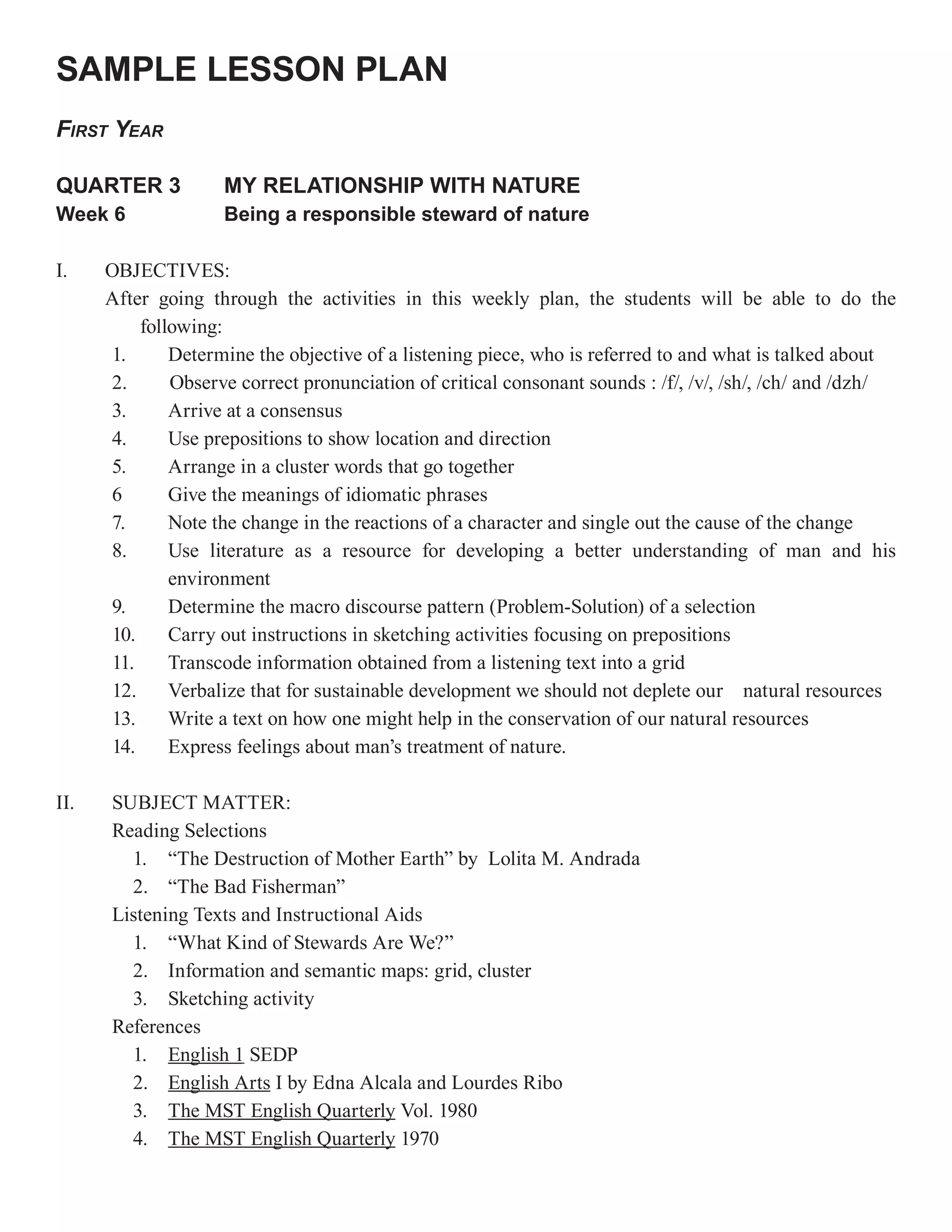
SAMPLE LESSON PLAN
FIRST YEAR

QUARTER 3           MY RELATIONSHIP WITH NATURE
Week 6              Being a responsible steward of nature

I.    OBJECTIVES:
      After going through the activities in this weekly plan, the students will be able to do the
          following:
      1.      Determine the objective of a listening piece, who is referred to and what is talked about
      2.      Observe correct pronunciation of critical consonant sounds : /f/, /v/, /sh/, /ch/ and /dzh/
      3.      Arrive at a consensus
      4.      Use prepositions to show location and direction
      5.      Arrange in a cluster words that go together
      6       Give the meanings of idiomatic phrases
      7.      Note the change in the reactions of a character and single out the cause of the change
      8.      Use literature as a resource for developing a better understanding of man and his
              environment
      9.      Determine the macro discourse pattern (Problem-Solution) of a selection
      10.     Carry out instructions in sketching activities focusing on prepositions
      11.     Transcode information obtained from a listening text into a grid
      12.     Verbalize that for sustainable development we should not deplete our natural resources
      13.     Write a text on how one might help in the conservation of our natural resources
      14.     Express feelings about man’s treatment of nature.

II.   SUBJECT MATTER:
      Reading Selections
        1. “The Destruction of Mother Earth” by Lolita M. Andrada
        2. “The Bad Fisherman”
      Listening Texts and Instructional Aids
        1. “What Kind of Stewards Are We?”
        2. Information and semantic maps: grid, cluster
        3. Sketching activity
      References
        1. English 1 SEDP
        2. English Arts I by Edna Alcala and Lourdes Ribo
        3. The MST English Quarterly Vol. 1980
        4. The MST English Quarterly 1970
III.        PROCEDURE:
            A. Preparation
               1. Pre-listening
                   a. Recall of previous lessons to tie them up with the current week’s theme.
                      1. What have you learned about our relationship with nature so far?
                      2 .Who should take care of nature?
                      3. What will happen if we do not take care of her?
                   b. Our lesson this week will center on how we can be “responsible stewards of nature”

               2. Listening (Depending on the ability of the class you may choose to take up one text a
                       day as the listening activity)
                   a . Listen to three texts and write down in column 2 of the chart the objective of the
                       speaker. Is it to call attention to a worthy cause or to a malpractice?

               Text no.               Objectives                Person/Company               Problem
                                                                   Referred to
       1.
       2
       3.

                  b. Listen again and determine the person or company referred to.
                     Enter your answer in column 3 of the chart.
                  c.Listen to the text a third time and enter in the chart the problem talked about.

            3. Post listening
                  a. What helped you determine the problem that was talked about?
                  b. How did you single out the person or company referred to?
                  c. How did you determine if the objective of the speaker was to call attention to a worthy
                      cause or a malpractice?

            4. Speaking (Pronunciation – the sets may be spread out, one set a day for the five days of the
                     week.)
               a. Critical sounds
                      Here are words taken from the texts you listened to or will read this week. These words
                     contain sounds difficult for Filipino learners of English because they may not be present
                     in our language. Say these words after me paying attention to the sound given to the
                     underlined letters.
- f-
fish                         flowed                   suffocated
                                                          ff
                                                          ffocated
f
found                        filings                  affected
                                                        ff
                                                        ffected
f
forests                      fishermen                testified
f
food                         Philippines              lifts
                                                        f
                                                        fts
f
fortunately                                           enough gh

-v-                          (dzh)                    - ch -
villagers                    judg
                               dge                    children
villain                      jobs                     rich
verdict                      imagine
                                 g                    inch
ha
have                         oxygen
                             oxyg                     much
river                        endangered
                                   g                  launched
conservation                 bridg
                                dge                   nature
livelihood                   general                  fortunately

                             - sh –

shot                         decision                 conservation
wash                         nation                   destruction
washing                      attention                popula
                                                      population
fish                                                  preven
                                                      prevention

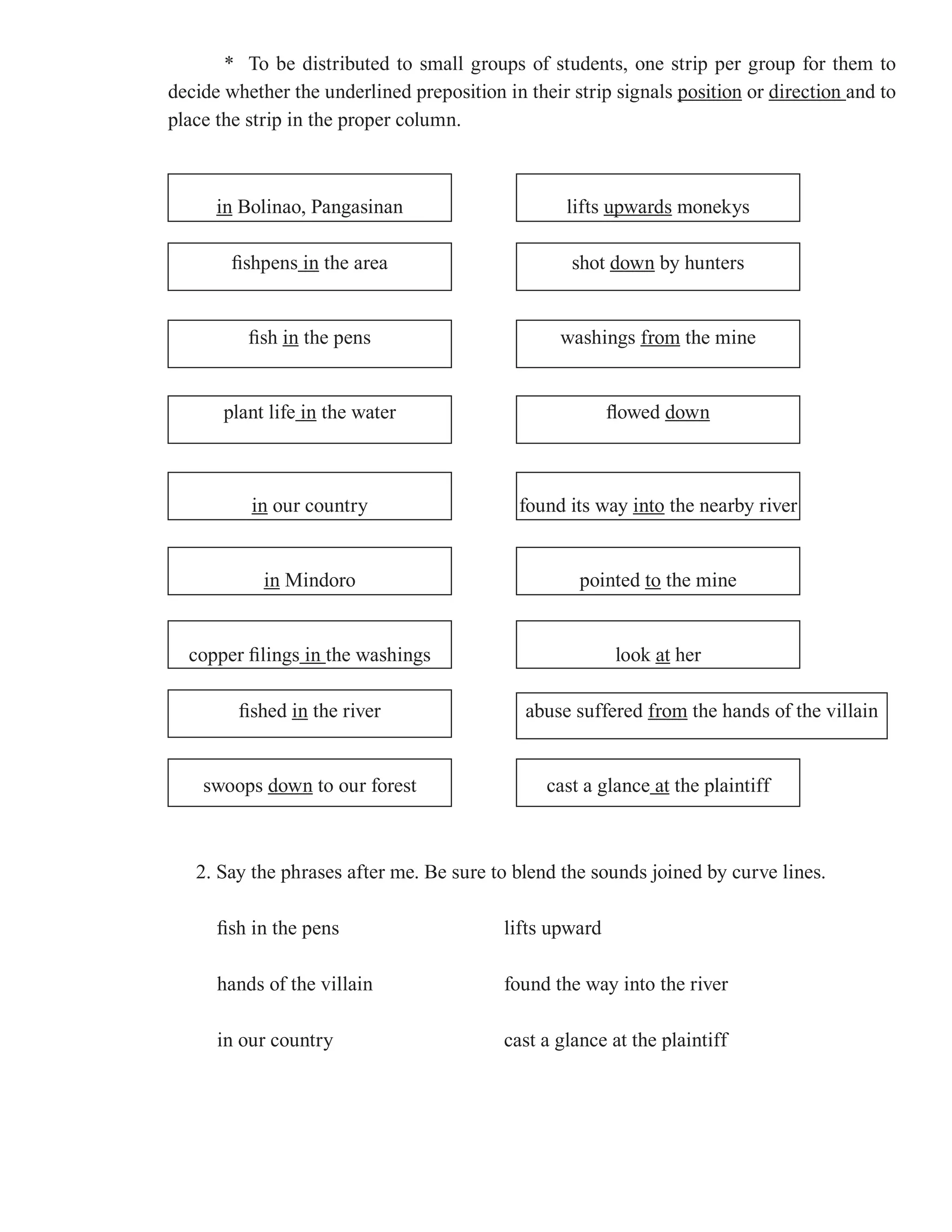
b. Blending and vocabulary (Phrase – strip activity and practice)
   1. Here are phrases taken from the texts listened to and other texts you will read.
   Place the strips containing the phrases under the column that show the relationship
   signaled by the underlined preposition in the phrase. Does it signal position that is
                                                                        position,
   location or direction specifically movement.

 * To be written on the board
    Prepositions showing                    Prepositions indicating
    ____________________                    _____________________
        position (location)                 direction (movement)
   _____________________                    _____________________
* To be distributed to small groups of students, one strip per group for them to
decide whether the underlined preposition in their strip signals position or direction and to
place the strip in the proper column.


      in Bolinao, Pangasinan                      lifts upwards monekys

        fishpens in the area                       shot down by hunters


          fish in the pens                        washings from the mine


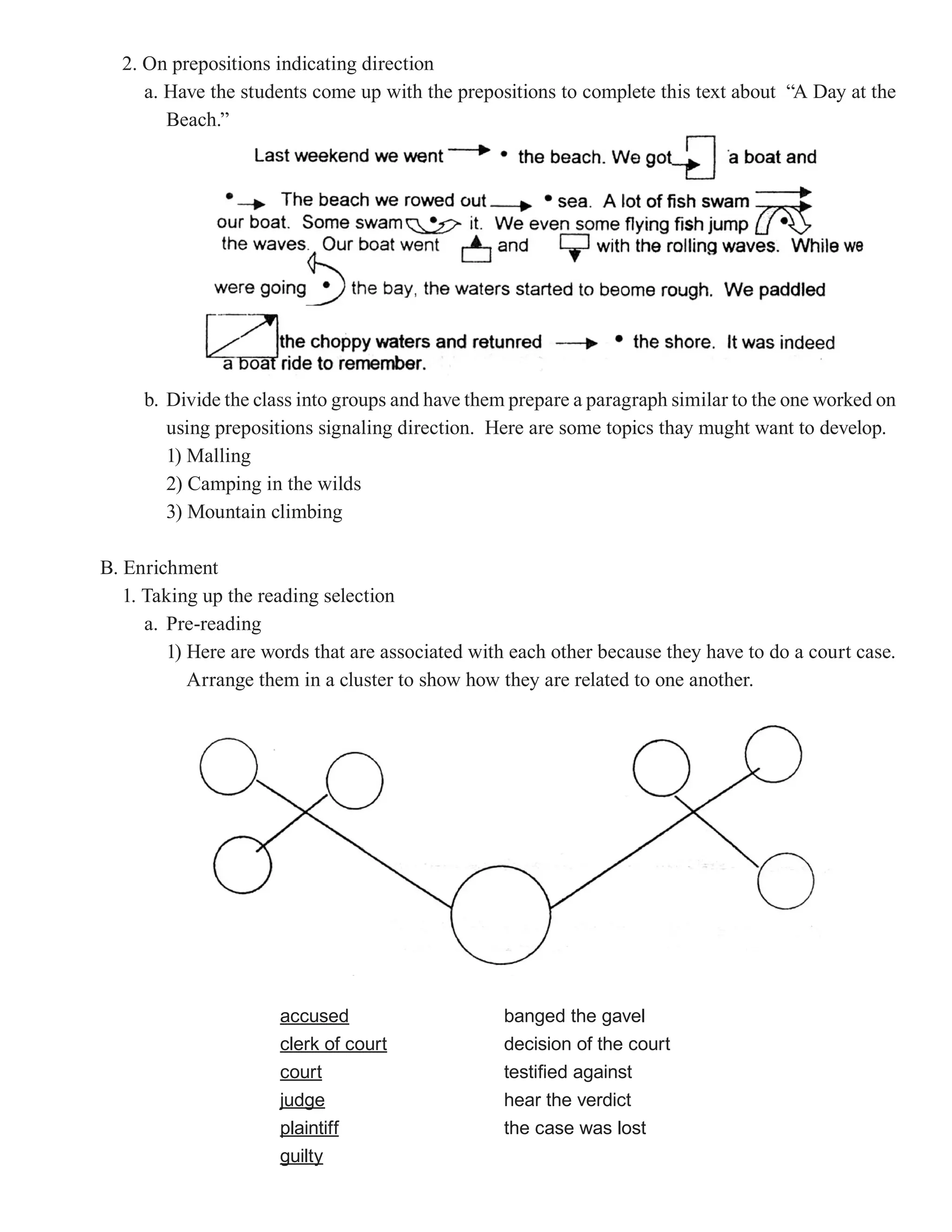
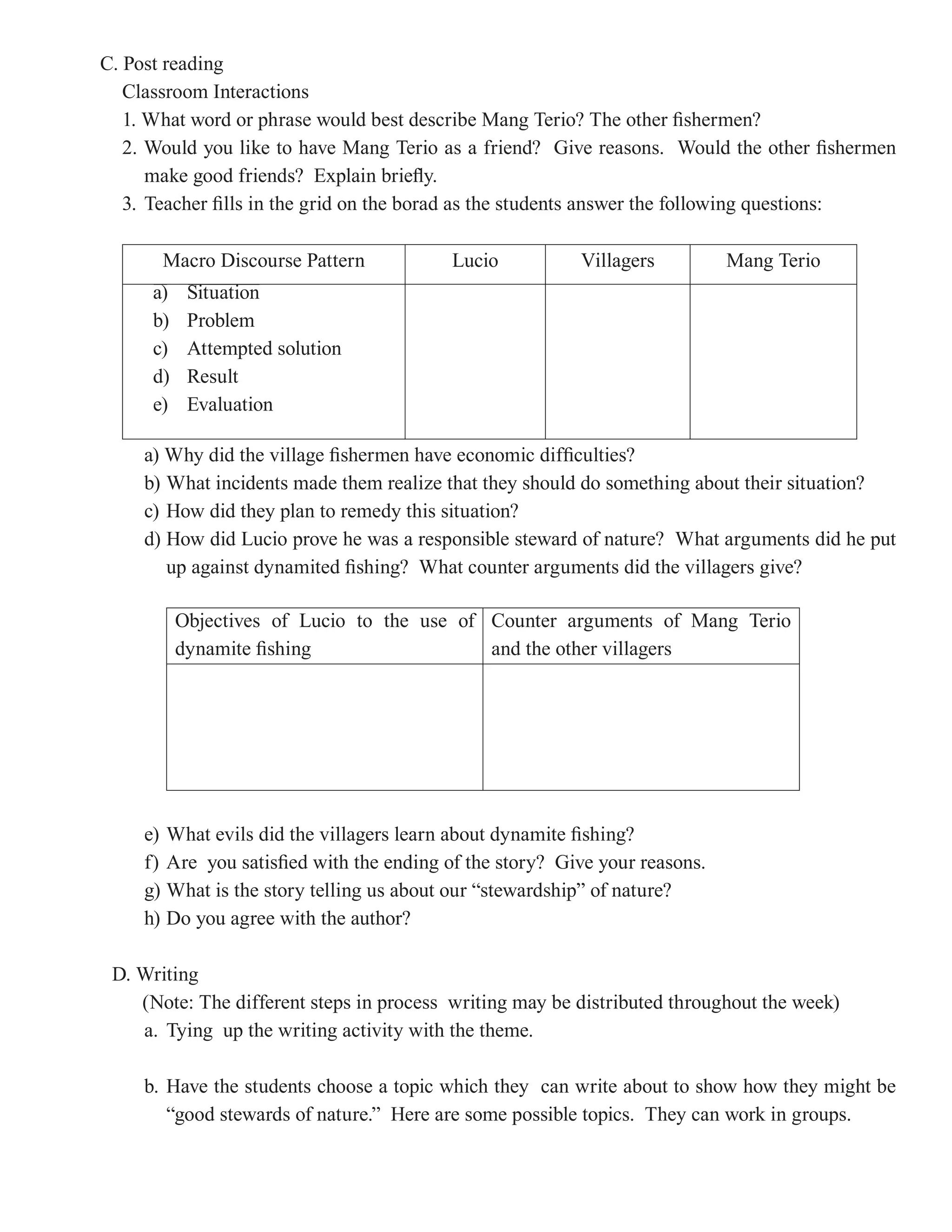
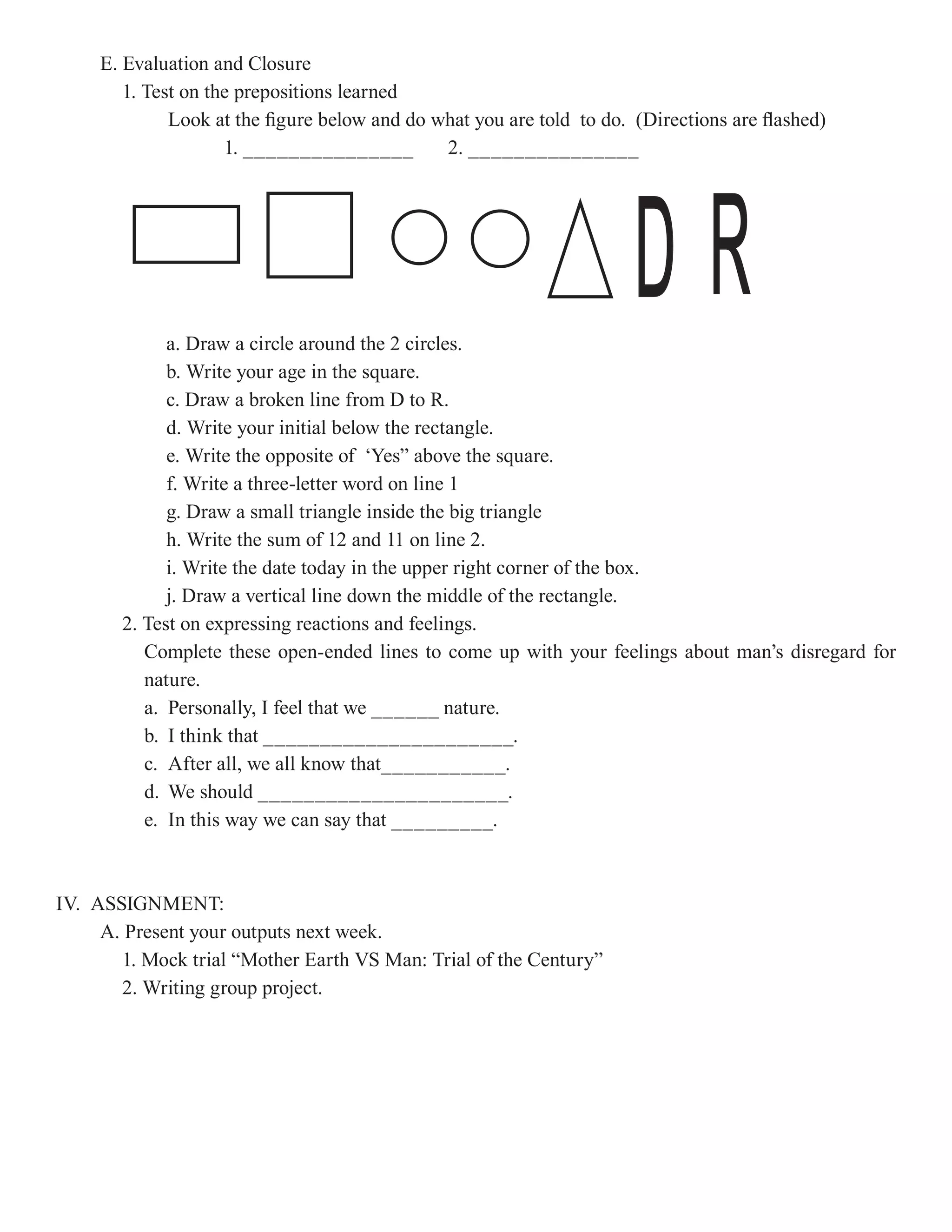
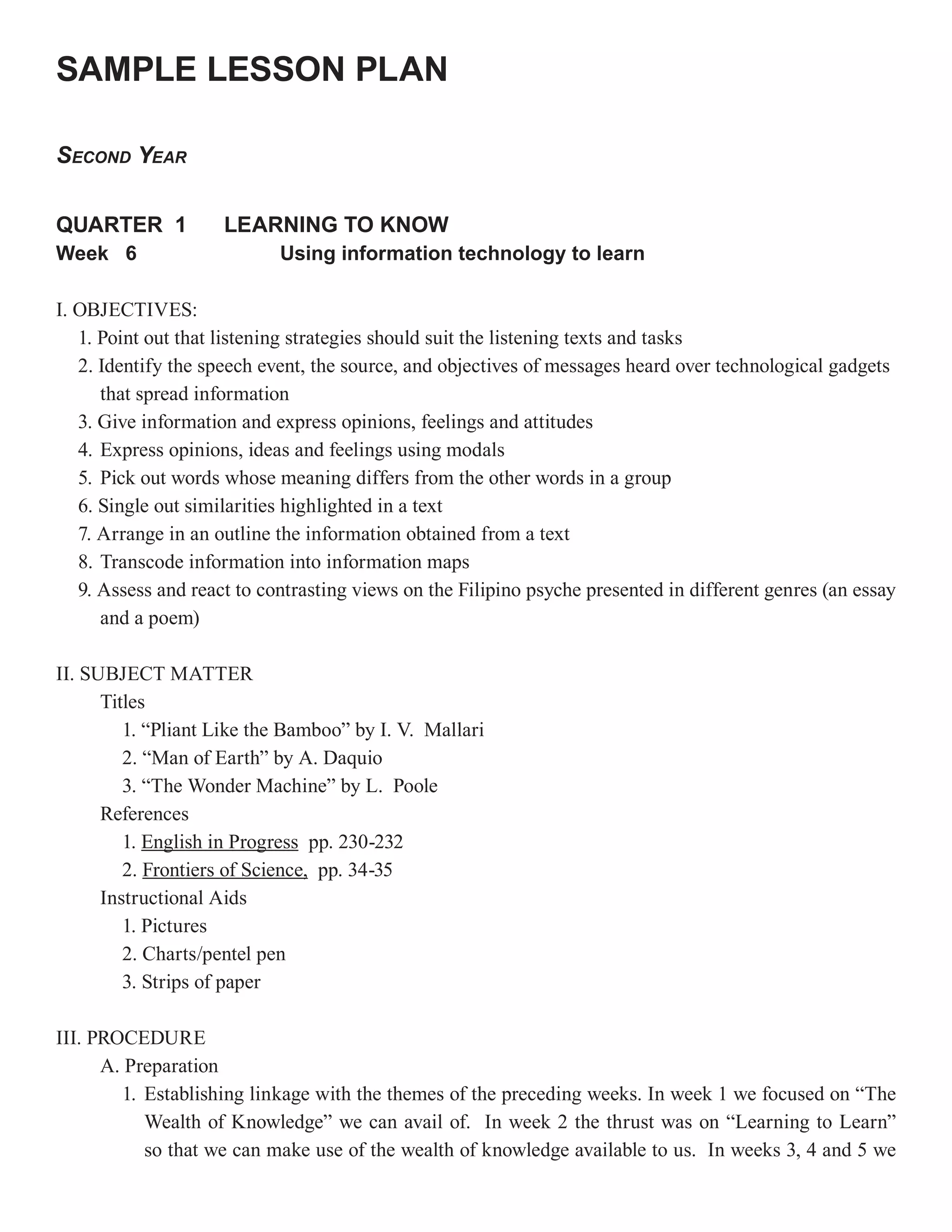
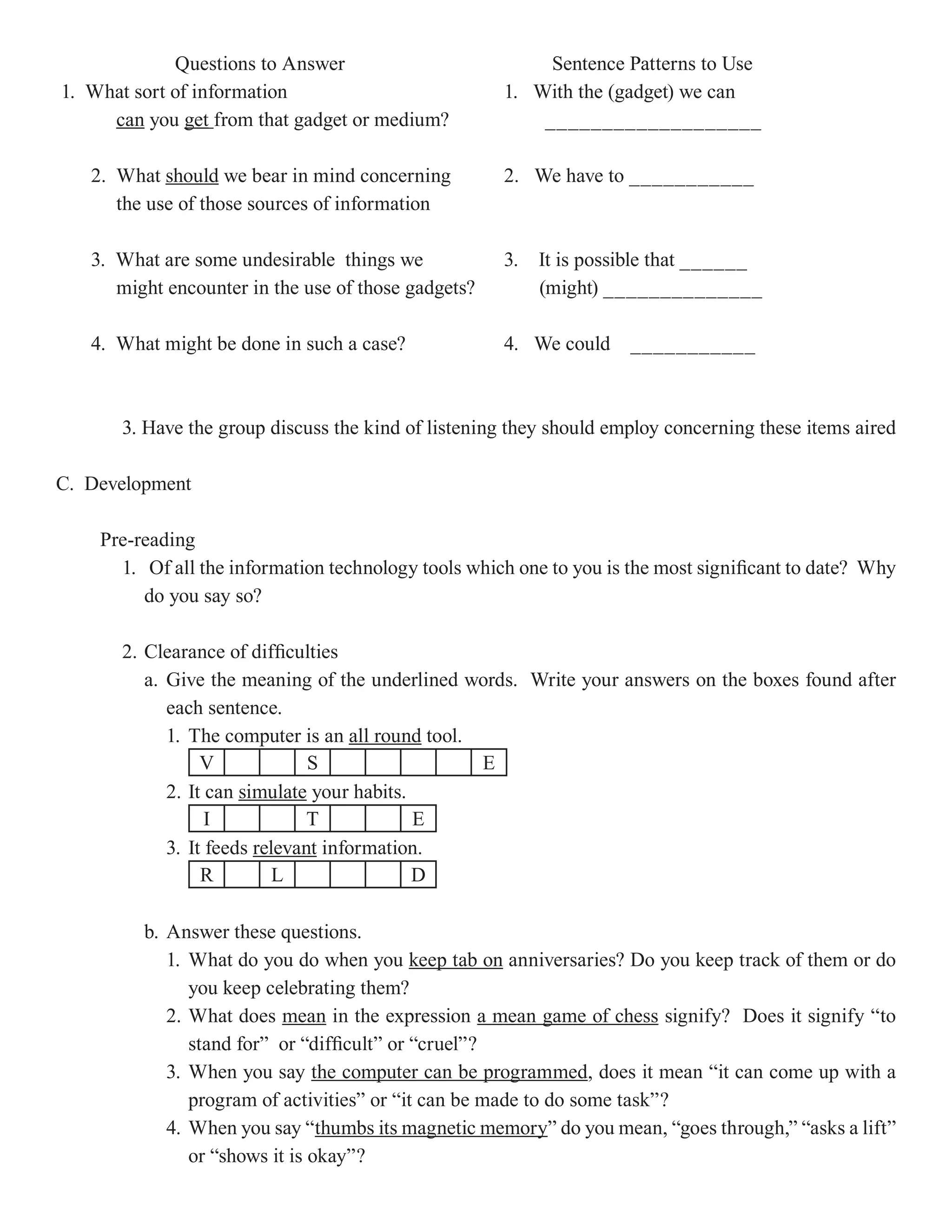
       plant life in the water                           flowed down


          in our country                    found its way into the nearby river


            in Mindoro                              pointed to the mine


  copper filings in the washings                         look at her

         fished in the river                 abuse suffered from the hands of the villain


    swoops down to our forest                   cast a glance at the plaintiff


   2. Say the phrases after me. Be sure to blend the sounds joined by curve lines.

      fish in the pens                    lifts upward

      hands of the villain                found the way into the river

      in our country                      cast a glance at the plaintiff
B.   Presentation

     2. Sketching Activity focusing on prepositions indicating position on location (in
        the form of a contest).
            a. A rectangle is sketched on the board to symbolize a box.


            b. These prepositions are written on strips of paper and distributed to some
               students.


                    in                   inside                        high above

                    on                   outside                       way below

                    under                beside (to the right)

                    between              next (to the left)

                    in between           by (not too close to it)

                                         adjacent to

           c. The students are to put a dot to show its location in relation to the rectangle.
              Feedback is given. Here are some possible representations.
                                             ●

            ●                                                                         ●


        in or inside             high above (also outside)             beside (to the right)
                                                                       or by (not too close)
=


                                                         =


                                     =                   next (to the left) or
       on or outside    way below under                  by ( not too close) or
                                                          adjacent to

                                     =


                            between or in between

2. Matching Activity focusing on prepositions indicating direction. These directions are
   written on strips and the sketches are placed on cards. This time the students are to look
   at the direction or movement indicated by the arrow in relation to the rectangle, the dot
   or another arrow.


                          }}
   Expessions

       up
       outward
                       upward             down
                                          into
                                                                downward
                                                                                  →
                                         →
       inward                             out of

       along        around                from


                                                                                  →
       alongside    through               away from
       side by side upon                  to                    towards

       over                               with
       under                              without


Sketches    Note: The expected responses are given under the sketches.


(up or upward
       upward)              (
                            (down or downward)           outwarsd or out of
inward or into              through                     along,
                                                                along alongside or side by side


            upon                    to or towards        from or away from

                                                         around


         over                 under                  with              without

C. Practice
  1. On prepositions indicating location
     Here are a number of possible exercises
     a. Distribute scenic views (calendar, postcards, etc.) to small groups. Have each group give
        sentences indicating what is found in the scene using the prepositions indicating location.
        They are to mention what might be seen in the background, in the middle ground and in
        the foreground.
     b. Have the students pair off and take turns indicating landmarks close to their homes. They
        are to use prepositions indicating location.
     c. Let the class play a guessing game. One student thinks of a notable place or building in the
        community. The class take turns asking yes-no and wh questions to find out what might be
        found in the vicinity of that place or building. After they have gathered enough clues,they
        are to guess what that place or building is.
2. On prepositions indicating direction
     a. Have the students come up with the prepositions to complete this text about “A Day at the
        Beach.”


     b. Divide the class into groups and have them prepare a paragraph similar to the one worked on
        using prepositions signaling direction. Here are some topics thay mught want to develop.
        1) Malling
        2) Camping in the wilds
        3) Mountain climbing

B. Enrichment
   1. Taking up the reading selection
      a. Pre-reading
         1) Here are words that are associated with each other because they have to do a court case.
            Arrange them in a cluster to show how they are related to one another.


                      accused                     banged the gavel
                      clerk of court              decision of the court
                      court                       testified against
                      judge                       hear the verdict
                      plaintiff                   the case was lost
                      guilty
2. Demonstrate these actions
         looked askance                      cleared his throat
         cast a glance                       banged the gavel
                 looked at the accused, no pity in his eyes

   3. Answer these questions
      a) Which of these two descriptions of a court case has a more negative meaning: sensitive
         case or sordid case?

     b) What does scoops mean in this sentence?

              The press have been pressuring him for scoops on the case

     c.) Do these sentences have similar, opposite or unrelated meanings:

                    His case was lost                        His fate was sealed

     b) Who was Pilate? Which famours case did he preside over? What did he show when
        he “washed his hands off the case”?

     e) When do you say a sight is horrendous? Are pockmarks pleasant or unpleasant to
        look at?

     c) When do you say a person would not “budge an inch”? Will he give
        In, stay put, or avoid taking sides?

b. Reading
   As you read the text, look for answers to these questions:
   1. What case is talked about?
   2. Who is the plaintiff?
   3. Who is the accused?
   4 .Who testified against the accused?
   5. The first paragraph talks about the feelings of the judge before the trial and the second
   paragraph shows how he felt during the trial. What did he feel during the pre-trial? What
   about during the trial? Pick out the expressions that show how and why he felt that way.
   What brought about the change?
The Destruction of Mother Earth
                                 Lolita M. Andrada

         The judge looked at the gathering crowd in the court. It was a highly sensitive
  case he was handling. The press had been pressuring him for scoops on the case, but
  he wouldn’t budge an inch for fear of criticism from the general public. He wanted to
  play Pilate and wash his hands off the sordid case, but moral guilt had made him stay
  on. And now comes that day when the decision had to be made.

          The judge cast a glance at the bedraggled face of the plnaintiff. It was Mother
  Earth, her whole body sdtill bearing the pockmarks of destruction. The judge couldn’t
  bear to look at her nor recall the abuse that she suffered from the hands of the villain.
  Mother Earth was a horrendous sight. The Judge then looked at the accused, no pity
  in his eyes. With a grim face, the Judge banged the gavel to silence the crowd. The
  clerk of court then cleared his throat to read the decision of the courth. The accused
  was called to hear the verdict. Nations had testified against him and the accused
  knew even before that his case was lost. The accused was Man and as he stood
  there waiting for the decision, he knew that his fate was sealed. He would be judged
  “Guilty!”

C. Post Reading
   1) Processing the answer to the questions raised earlier.
   2) In small groups, discuss your answers to these questiions.
          a)     If you were the lawyer of the accused, what defense would
                 you put up ?

                     If I were the lawyer of the accused,
                              I would say...
                              I would point out that ...


         b)     If you were the judge, would you have arrived at the same
                      decision?
                How would you feel about his decision?

                     I believe
                     feel
                                 }    that the judge was...
c)   What sentence would you pass on man?

                         Why?
                         I think I would ----------- because ...

              d)   What punishment would you mete out to him? Why?

                         Personally
                         As I see it   }         I would ___ because
                                                    _____________


        In bright classes, the students may role play a mock trial “Mother Earth VS. Man : Trial
of the Century”

        2. Taking up the literature selection
             A. Pre-reading
               1. Recalling the listening activity to tie it up with the literature lesson.
                   a) Recall the fish kill that took place in Bolinao, Pangasinan.
                   b) What caused the loss of fish in that incident?
                   c) Can we say that greed and dishonesty played a big role in the fish kill?
                   Explain.

              2. Vocabulary
                 Get the meaning of the underlined word from the sentence given.
                 What served as clues?
                  a) Each banca was equipped with outriggers, bamboo poles that extended to
                  their side in the form of a rectangle to keep the boat steady even in the roughest
                  sea.
                  b) Soon the nets were teeming with live fish.
                  c) Lucio, seeing that it was hopeless to try to dissuade the villagers, went sadly
                  back to his own hut.

             B. Reading the text
              The reading text may be assigned the day before.
THE BAD FISHERMEN
                                          AUTHOR UNKNOWN

        Lubay was a village situated along the east coast of Luzon. It was a sleepy little place made up
mostly of small, neat huts of nipa and bamboo. These huts were almost exactly like the other nipa huts
all over the Philippines. Under each of them there were huge brown fishing nets hung up for drying or
mending. These nets were the most valuable possession of each family in the village, because the men of
the village earned their living by fishing.

       Very early in the morning, so early that it was still dark, the lights went on in kerosene lamps all
over the village. Smoke curled up from fires cooking the fishermen’s breakfasts. The men of Lubay
always started out very early in their fishing boats and the women of the village were up earlier to feed
them and to help them get their fishing things ready.

       Before the sun was up, the fishermen were in their large bancas ready for a day of fishing. Each
banca was equipped with outriggers, bamboo poles that extended to their side in the form of a rectangle
to keep the boat steady even in the roughest sea. Each banca was also equipped with a large fishing net.
The men threw this net into the sea at certain places where they knew fish was plentiful. Soon the nets
were teeming with live fish. Then the men drew their nets up and emptied the fish into their boats.

        At the end of the day, when enough fish had been caught, the boats headed for home. On the
beach the women and children were waiting to see if the day’s catch had been good. Among the crowd
of women and children was Mang Terio, the only man in the village who did not go out in the fishing
boats.
        Mang Terio did not go out fishing with the other men because he was the owner of the only store
in the whole village of Lubay. The villagers bought all their supplies from his store. They bought the
rice that they ate with their fish, the salt that they seasoned their fish with, the clothes that they wore, the
lamps that they lighted, and the kerosene that they put in those lamps. They bought practically all their
needs from Mang Terio, and since they had very little money, they paid Mang Terio with the fish that they
caught.

       That was the reason Mang Terio waited on the beach with the moment and children to watch the
fishing boats come in. He was interested in the catch each fisherman brought home. Almost every man
owed him for something bought on credit from his store, and so he had a share in every catch that came
in.

       “Juan,” he said to one of the fishermen, “for the can of kerosene you got from me yesterday I will
take half of your catch.”

       To Pablo, he said, “You can give me one fourth of your catch in payment for the three yards of
cloth your wife used for her Sunday saya.”

       To Sinto, he said, “The khaki you got from me costs eight pesos. You will have to give me all your
catch I will let you keep a couple of fish for your supper,”he added thinking himself very generous.

         After collecting from each fisherman who owed him something, Mang Terio was able to gather
together a large quantity of fish. This he loaded in his carretela to take to the town nearby where he would
sell it to owner of a market stall. The market stall owner kept the fish on ice so it would not spoil. The
next morning he sold it in the market.

        Often the people of Lubay watched Mang Terio getting much of their catch. They said to
themselves, “We work hard all day to catch this fish, but Mang Terio gets most of it. Why can’t we sell
our fish ourselves?” But they all owed Mang Terio money and so were forced to pay him in fish. Besides,
they were all poor, simple folks. Mang Terio was the only one among them who could afford to keep a
horse and a carretela.

     So things went on the same way for many years. While they had their house and their bancas and
enough rice and fish, the villagers were satisfied.

       It was Mang Terio who was not satisfied. He had his store, his house and carretela and the money
that he got from the work of the villagers, but he wanted more. He thought to hiimself. “If these people
would only catch more fish, I could make more money. I could buy their catch from them very cheaply.
They will be satisfied with a few pesos. Then I could take the fish to town ansd sell it at a big profit.
Who knows if soon I could even buy a truck and take the fish to Manila to sell? My profit would be even
greater.”

       The more Mang Terio thought of the idea, the more he liked it. One evening when the men of the
village were sitting after supper on the benches in front of his store, Mang Terio asked them. “Is it not
possible for you to catch more fish? If you could catch more fish you would make more money.”

       “That would be good,” said Lucio, who was one of the best fishermen in the village. “But I don’t
see how we can catch more fish than we are catching now. We can only set our nets a few times a day.
Setting the nets and hauling them in takes a lot of time and work.”

      “That is right,” the other fishermen agreed. “After we make our first haul, the school of fisf
goes away. We could catch more if only we could catch the whole school at the same time. But that is
impossible.”

      “Why should it be impossible?” asked Mang Terio with a scheming look on his face. “There is a
way in which you can catch a whole school of fish all at the same time.”
“What way is that? chorused all the men. “If you can show us such a way, we will catch all the
fish you want.”

         “Why not use dynamite?” said Mang Terio.

         “Dynamite!” exclaimed the fishermen, “ but that is against the law.”

     “What of it?” Mang Terio asked with a shrug of his shoulders. Who will know that you are using
dynamite?”

         “That is right. Mang Terio is right; nobody will know.” All the men seemed convinced except
Lucio.

      “Nobody else will know, perhaps,” he said, “but we would know and we would know we were
breaking the law.”

       “Oh,” scoffed the other fishermen. “Don’t talk like a judge. Nobody would know and we can
catch a lot of fish and make a lot of money. Let us not talk of laws. What harm will the dynamite do to
anybody but the fish?”

         “When we fish with nets,” said Lucio, “we catch only the big ones. Soon there will be no fish
left.”

        “You are talking nonsense, Lucio,” said the other fishermen. “There are millions of fish in the sea.
There always will be, whether you fish with nets or with dynamite. The only difference is that dynamite
is easier and will get us more money.”

       The arguments flew back and forth. All the fishermen were in favor of dynamite fishing except
Lucio. Mang Terio was pleased that he had won over most of the fishermen to his way of thinking. “Are
you agreed then to try dynamite?” he asked.

         “Yes,” chorused all the men except Lucio, who kept quiet, knowing that he was outnumbered.

       “Tomorrow I will go to the city. I know a man there who can get us all the dynamite we need. In
two or three days I will be back with dynamite for all of you.”

       “Do not bring back any for me, Terio,” said Lucio. I will not break the law for all the money you
can offer me. And I will not destroy the livelihood of my children and grandchildren because of the
money I can get now.”
So saying, Lucio stood up and went home. The other fishermen went on discussing their new plans
and figuring out how much more money they would soon make.

        Mang Terio left the next day for the city where he was to buy the dynamite. While Mang Terio was
gone, Lucio went the rounds of all his friends in the village trying to convince them not to try the new
idea. “It is not good,” he told them. “It will kill all our fish. For generations the people in this village
have lived by fishing. Our fathers did, and their fathers before them. Before they were not greedy, they
left enough fish for us and for our sons to live on. If you use dynamite you will kill all the fish. Soon the
fish will be gone and there will be nothing left for our sons and those who come after them.”

        “Lucio, you are a fool,” the other men answered him. “Go ahead and fish the old way if you want
to, but do not try to keep us from earning more money.”

      Lucio, seeing that it was hopeless to try to dissuade his fellow villagers, went sadly back to his
own hut.

        In the meantime, Mang Terio had come back from the city. He was met by almost all the villagers.
The women and children stood by as the men helped him unload the heavy packing cases from the jitney
which he had hired to bring the dynamite from the city. When each packing case had been stowed away
in Mang terio’s bodega, Mang Terio announced, “Tomorrow we begin. Come here early in the morning
to get the stuff.”

        Early that morning, when it was still dark, all the fishermen were at Mang Terio’s store. All
the fishermen except Lucio who refused to go. Mang Terio distributed among them several sticks of
dynamite. Once out at sea where the fish was plentiful, they were supposed to light these sticks and throw
them into the sea. Weighed down by heavy stones the sticks would sink and soon explode. The explosion
would kill all the fish in the vicinity.

       When the fishermen came home that evening, their boats were loaded with fish and they were all jubilant
over the success of their new method. Their laughter and loud voices could be heard all over the village.
”It was the easiest boat load I ever hauled,” said one man. “After the explosionall you needed to do was
scoop the fish up from the water.”

        “You should have come with us.” said another to Lucio who was standing silently by. “It was a
sight to see! All the fish floating around us.”

      “Yes,” said Lucio, “all the fish, including the small ones that nobody can eat and that are now
wasted.
      “Are you still talking that way?” hooted the other fishermen. “Even after you have seen how
successful the new method is?”
“You are like greedy children who take more than they can eat,” said Lucio, “and then find that there
is no more food left when they are really hungry.”

        But the other fishermen did not even hear what he was saying. They were all too busy hauling their
fish to Mang Terio’s store to be weighed and sold. Mang Terio paid them as little as he could. “Dynamite
is very expensive,” he said, “and since I pay for it, I have to subtract the cost from the money I give you.
I have to hire a truck to take the fish to town; I have to think of that, too.”

       In the end, the fishermen got very little more for their catch, but since that was more than they ever
got before, they were happy.

       For months, the fishermen of Lubay fished with dynamite. They kept urging Lucio to join so he
could get some of the money but Lucio steadfastly refused. “I will fish the old way,” He said.

      “Stubborn Lucio,” every body said, and they went on using dynamite. Nothing that Lucio could
say would convince them that dynamite fishing was wrong and dangerous.

        Then one day an accident occurred. Mang Ipe was in charge of the dynamite that day. For some
reason or another, when he lighted the fuse and started to throw the dynamite, it exploded while he was
still holding it. The explosion blew off his whole arm.

       There was a big commotion as the other fishermen helped Mang Ipe ashore. He was taken to the
hospital in town in Mang Terio’s truck. He was bleeding so much that for a while it seemed that he was
going to die. But the doctors at the hospital were able to stop the bleeding, and he did not lose his life,
only his arm.

       The accident frightened the people of the village. For several weeks they refused to go out fishing
with dynamite. “It is dangerous,” they said. “Perhaps Lucio was right and the old way is really the
best.”

      But Mang Terio talked to them and told them, “It was just an accident. It would never have
happened if Mang Ipe had been careful. It will not happen again.”

        After a while, the fishermen were convinced and went out fishing again. They began saying to one
another, “That accident was only one in a million. It will never happen again.” But every time they went
out fishing they came back with less and less fish. “Why do you bring back so little fish?” Mang Terio
complained. “You used to bring back more when you were just fishing with nets.”
        “That is all the fish there is,” said the fishermen. “Maybe the fish have been frightened away by
the dynamite.”
“You have been killing the small ones, that is why,” said Lucio. “You have exhausted the supply
of fish. It will take years before they will be as plentiful as before.”

       The fishermen looked at each other and muttered, “Maybe he is right.”

      “He is a stupid fool,” said Mang Terio angrily, and you are stupid, too, if you believe him. It just
happened that there were very few fish the last few days. If you go out again, you will surely catch as
many as you did at first.”

        The fishermen were doubtful but they had to follow what Mang Terio told them to do because they
still owed him money. The next morning they went out to sea again.

       They were out at sea when it happened. All of a sudden they heard a loud explosion. They looked
towards the shore and saw a huge column of smoke and fire rising in the sky. “It is in the village!” they
cried.

       Each man thought of his family and his house. Hurriedly they rowed back to shore.

       As soon as their bancas touched the beach, they were out running towards their homes. Running
towards them came their wives and children, their faces pale with fright. “What happened?” the men
cried. “What was the explosion we heard?

        “It’s Mang Terio’s house,” the women gasped. “There was a loud noise and then it just flew into
the air.”

       “Where is Mang Terio?” the men asked.

       When the smoke had cleared, the villagers went to where Mang Terio’s house had been. A fearful
sight met their eyes. There was nothing left but a few stones and sticks. “It was the dynamite,” the
villagers said to one another in low, frightened voices. “He must have set fire to it by accident. There
was enough dynamite in his storehouse to blow up this whole village.”

       “We should never have used dynamite,” said the fishermen to each other. “Lucio,” they said, “you
were right. “The old way is the best way after all.”

       Lucio just nodded his head. “ I will help you mend your nets,” he said, “and as soon as the fish
comes back, we shall go out with our nets again. Besides, I have heard of newer and better ways of fishing
with nets. We shall learn them and make a little more money.”
C. Post reading
   Classroom Interactions
   1. What word or phrase would best describe Mang Terio? The other fishermen?
   2. Would you like to have Mang Terio as a friend? Give reasons. Would the other fishermen
      make good friends? Explain briefly.
   3. Teacher fills in the grid on the borad as the students answer the following questions:

       Macro Discourse Pattern            Lucio           Villagers          Mang Terio
      a)    Situation
      b)    Problem
      c)    Attempted solution
      d)    Result
      e)    Evaluation

     a) Why did the village fishermen have economic difficulties?
     b) What incidents made them realize that they should do something about their situation?
     c) How did they plan to remedy this situation?
     d) How did Lucio prove he was a responsible steward of nature? What arguments did he put
        up against dynamited fishing? What counter arguments did the villagers give?

           Objectives of Lucio to the use of Counter arguments of Mang Terio
           dynamite fishing                  and the other villagers


     e) What evils did the villagers learn about dynamite fishing?
     f) Are you satisfied with the ending of the story? Give your reasons.
     g) What is the story telling us about our “stewardship” of nature?
     h) Do you agree with the author?

 D. Writing
    (Note: The different steps in process writing may be distributed throughout the week)
    a. Tying up the writing activity with the theme.

     b. Have the students choose a topic which they can write about to show how they might be
        “good stewards of nature.” Here are some possible topics. They can work in groups.
Practical Ways of Conserving Water
  What Might Be Done to Save our Trees
  Recycling for Better Waste Management
  What We Can Do to Revive Dying Rivers
  Saving Endangered Animals

c. Ask them to brainstorm and write down everything they know about the topic.

d. Have them decide what their output will look like. Here are some possible forms their
   output could take. (Show samples of these different forms.)
   1. Posters
   2. Comments to send through the Internet to the program “Save Our Planet”
   3. Handbills to be distributed in the neighborhood
   4. Brochures to be made and displayed in school or in the Barangay Center especially
      during Earth Day
   5. Stickers for transports

e. Call attention to the features that might be emphasized
   1. Situation           Our river is dying or is already dead.
   2. Problem             It could be a source of marine life if it were not polluted.
   3. Solution            Let’s contribute to the “Save Our River” project.
   4. Result if nothing is done about this problem - We will have a smelly, dirty but oversized
      canal.
   5. Evaluation          Nature provides us with our needs. Let’s take care of her.

f. Editing
   The group does group editing of their work using these pointers as guidelines:
   1. Did you call attention to a problem?
   2. Did you suggest a solution?
   3. Did you focus on our stewardship of nature?
   4. Do you have any slips in grammar? In capitalization, spelling and punctuation?
   5. How do you think your reader will respond to your output?

g. Finalization of output
E. Evaluation and Closure
        1. Test on the prepositions learned
              Look at the figure below and do what you are told to do. (Directions are flashed)
                     1. _______________        2. _______________


             a. Draw a circle around the 2 circles.
                                                                       DR
             b. Write your age in the square.
             c. Draw a broken line from D to R.
             d. Write your initial below the rectangle.
             e. Write the opposite of ‘Yes” above the square.
             f. Write a three-letter word on line 1
             g. Draw a small triangle inside the big triangle
             h. Write the sum of 12 and 11 on line 2.
             i. Write the date today in the upper right corner of the box.
             j. Draw a vertical line down the middle of the rectangle.
       2. Test on expressing reactions and feelings.
          Complete these open-ended lines to come up with your feelings about man’s disregard for
          nature.
          a. Personally, I feel that we ______ nature.
          b. I think that ______________________.
          c. After all, we all know that___________.
          d. We should ______________________.
          e. In this way we can say that _________.


IV. ASSIGNMENT:
     A. Present your outputs next week.
       1. Mock trial “Mother Earth VS Man: Trial of the Century”
       2. Writing group project.
LISTENING
TEXT 1

         Have you heard about the fish kill that took place in Bolinao, Pangasinan? Imagine, a lot of fish
died- they suffocated to death. And who was responsible for this? We, the people of this town. We put
up so may fish pens in the area. And with so much fish in the pens, they competed with the other plant
life in the water. Soon there was not enough oxygen for them. They died.


TEXT 2

        One of the animals found only in our country is the Philippine Eagle. It is a monkey-eating eagle,
a big eagle that swoops down to the forests below and lifts upward monkeys that serve as its food. It helps
keep the balance of nature by preventing the monkey population from becoming too big. Sad to say, the
Philippine eagle is an endangered specie. They are shot down by hunters. Fortunately, lovers of nature
have called attention to the plight of the Philipine eagle. Laws have been passed to protect it and drives
have been launched to raise money for the conservation of the place where the eagles live.


TEXT 3

       A copper mining company has been operating for many years now in Mindoro, a province rich in
copper. For a time, this meant extra income for the community because of the jobs it offered to the people
there. But after a while, problems cropped up. The washing from the mine flowed down and found
its way into the nearby river. The lead and copper filings in the washings killed the fish, the villagers’
means of livelihood. Even the fishermen who fished in the river were affected. Sores that would not heal
covered their legs. Children who swam in the polluted river got sick and died. The citizens pointed to
the mine as the cause of the problem.
SAMPLE LESSON PLAN

SECOND YEAR

QUARTER 1            LEARNING TO KNOW
Week 6                      Using information technology to learn

I. OBJECTIVES:
   1. Point out that listening strategies should suit the listening texts and tasks
   2. Identify the speech event, the source, and objectives of messages heard over technological gadgets
      that spread information
   3. Give information and express opinions, feelings and attitudes
   4. Express opinions, ideas and feelings using modals
   5. Pick out words whose meaning differs from the other words in a group
   6. Single out similarities highlighted in a text
   7. Arrange in an outline the information obtained from a text
   8. Transcode information into information maps
   9. Assess and react to contrasting views on the Filipino psyche presented in different genres (an essay
      and a poem)

II. SUBJECT MATTER
      Titles
         1. “Pliant Like the Bamboo” by I. V. Mallari
         2. “Man of Earth” by A. Daquio
         3. “The Wonder Machine” by L. Poole
      References
         1. English in Progress pp. 230-232
         2. Frontiers of Science, pp. 34-35
      Instructional Aids
         1. Pictures
         2. Charts/pentel pen
         3. Strips of paper

III. PROCEDURE
      A. Preparation
        1. Establishing linkage with the themes of the preceding weeks. In week 1 we focused on “The
           Wealth of Knowledge” we can avail of. In week 2 the thrust was on “Learning to Learn”
           so that we can make use of the wealth of knowledge available to us. In weeks 3, 4 and 5 we
looked at how we can learn from our experiences, from others and events. This week, we
  examine how we might use technology to learn even as we review other sources of knowledge:
  experiences, other people and events

2. Motivation

     a. Will you mention some examples of information technology that we are enjoying at
        the present time. Use the diagram below. (Note: Some expected answers are given in
        parenthesis)
                                        computer


                                       Information
                radio                                                    cell phone
                                       Technology
                                                                         telephones


                                       television


     b. Look at this picture. What form of information technology is enjoyed by the secretary?
        How do these forms help her in her job?
B. Presentation
  1. Listen to some pre-recorded remarks heard over those gadgets. Identify the gadget and the
     objective of the message. Enter your answers in this grid

       Message No.                         Source                         Objectives


Listening Text
        Note: You may choose to tape authentic texts similar to these or you may say these texts
              aloud at normal speed pausing after each item to give the students time to enter their
              answers in the grid.

             1. Thank you from BPI. If you want to know your balance press D. If you want
                to pay your bills dial 1. If you need operator assistance dial 2.
             2. Your computer cannot communicate with your printer. Use your Printer
                User’s Guide.
             3. This is Station DZBB operating under License No.. . .
             4. This is CNN World News bringing to you breaking news worldwide. Stay
                tuned for Business News.
             5. Please load paper on the paper tray.

Speaking/Structure

  2. Divide the students into several groups with each group assigned a particular technological
     tool used to spread information. They are to discuss these questions in their respective groups
     for presentation to the class later on.

                                      Tools or Gadgets
         a. television              c. cell phones              e. print media
         b. radio                   d. computer
Questions to Answer                          Sentence Patterns to Use
1. What sort of information                          1. With the (gadget) we can
     can you get from that gadget or medium?             ___________________

   2. What should we bear in mind concerning         2. We have to ___________
      the use of those sources of information

   3. What are some undesirable things we            3.   It is possible that ______
      might encounter in the use of those gadgets?        (might) ______________

   4. What might be done in such a case?             4. We could     ___________


      3. Have the group discuss the kind of listening they should employ concerning these items aired

C. Development

    Pre-reading
      1. Of all the information technology tools which one to you is the most significant to date? Why
         do you say so?

      2. Clearance of difficulties
         a. Give the meaning of the underlined words. Write your answers on the boxes found after
            each sentence.
            1. The computer is an all round tool.
                 V             S                  E
            2. It can simulate your habits.
                  I            T            E
            3. It feeds relevant information.
                 R         L                D

         b. Answer these questions.
            1. What do you do when you keep tab on anniversaries? Do you keep track of them or do
               you keep celebrating them?
            2. What does mean in the expression a mean game of chess signify? Does it signify “to
               stand for” or “difficult” or “cruel”?
            3. When you say the computer can be programmed does it mean “it can come up with a
                                                     programmed,
               program of activities” or “it can be made to do some task”?
            4. When you say “thumbs its magnetic memory do you mean, “goes through,” “asks a lift”
                                thumbs               memory”
               or “shows it is okay”?
5. When you confront someone did you “follow him” or “challenge him”?

           c. Read the selection below. Find out why it is called “The Wonder Machine”.

                                          THE WONDER MACHINE

        In today’s world the computer is the all-round, all-powerful tool. It runs factories, plans cities,
teaches children, and even forecasts the future.
        In the home, you can program the computer to keep tab on family anniversaries such as birthdays,
weddings, or deaths. You can also depend upon it to make out grocery lists, plan family budgets,
prepare and compute income tax return, and even play a mean game of chess for you and your family’s
entertainment.
        If you take a vacation trip, the computer can be set to water your lawn and turn on and off the light
to make it appear as if you were home. And, if someone knocks on the front door or rings the back door
buzzer, the computer can also be programmed to bark like a hundred-pound German shepherd. In fact it
can be set to simulate your at-home habits.
       In a computerized hospital, the computer attends to your needs and comfort as a patient. In the
admissions office, the computer is fed with data about your case. It searches its memory for your records
of previous visits. It orders standard blood tests and other laboratory tests necessary for your particular
case. It also assigns you to a room. It interprets your electrocardiograms. These are complex waveforms
that are the pictorial representations of the electric potential produced by the contractions of your heart.
            By feeding in the relevant information such as your blood pressure, weight, temperature, age,
sex, and the symptoms of your illness, your attending or examining physician seeks the advice of the
computer in much the same way as he would a medical consultant. The computer thumbs its magnetic
memory and supplies all the diseases that might explain your symptoms.
           Then it offers the treatment. For his part, your doctor is free to accept or put aside the computer’s
advice. If your doctor feels that the computer has failed to mention a particular disease as a possible
explanation for your symptoms, he may confront the computer with his observations or findings.
        “Why,” he can ask the computer, “didn’t you conclude such and such diseases as possibilities”?
The computer gives its reasons for omitting the possibility.
        The computer rightly deserves its name as the “wonder machine of science and technology ” It is
indeed solving in milliseconds the problems which would take years to solve. It is helping mankind gain
an understanding of the farthest reaches of space and the depths of the oceans. And scientists are hopeful
that the computer may yet lead man to an understanding of the mystery of life and death and of his own
being.
        While it is admitted that the computer is one powerful tool that can do many things, there is
nothing mysterious about it compared to a human being. It is, after all, a man-made, man manned tool.
Without man, there could be no computer. Without man, the computer could not work. Whatever danger,
therefore, from the computer lies not within the machine itself but within man himself - its inventor and
master!
Questions to Ask                                   Patterns to Use
                                                   Note: The words in parenthesis may be replaced
      1. How can this wonder machine                  1. It can (provide the information we need
                                                                 provide                    need)
         develop and be successful?
      2. What should be done so we may                2. We should/must/have to (learn how to use it)
          enjoy the benefits of this machine?

      Here are the modals you have been using to express your opinions. Put a check mark on the column
that tells you the additional meaning expressed by these modals.


                 MODALS                                 Additional Meaning Signaled
                                         Ability              Possibility           Obligation
        1. can
        2. could
        3. may
        4. might
        5. should
        6. must
        7. have to

       Reading/Writing:         Organize in an outline the information presented in the text.

                                                “The Wonder Machine”

I.       Characteristics of a computer as a tool
         A. _____________________________
         B. _____________________________

II.      Uses of the Computer

         A. At   home
            1.   ____________________________
            2.   ____________________________
            3.   ____________________________
            4.   ____________________________
            5.   ____________________________
B. In computerized hospital
           1. ____________________________
           2. ____________________________
           3. ____________________________
           4. ____________________________
           5. ____________________________

III.    Reasons for its being a “wonder machine”
        A.
        B.


D. Enrichment

       1. Establishing a tie-up between this week’s thrust and the thrust of the preceding weeks (Weeks 3,
          4, and 5)

           While it is true that we can use information technology to get information, let us not forget the
         sources of information especially about ourselves, namely, recalling and reflecting on the past
         experiences as a people, on what others say and on events we go through.

           Here are two selections, an essay and a poem that show contrasting reactions to information
         about ourselves as a people. Which of these two reactions do you accept?

       2. Taking up the essay “Pliant Like the Bamboo” by I.V. Mallari
          a. Motivation
             1) If you were given a chance to become a tree what would you want to be? Here are five
                suggested trees (bamboo, narra, coconut, balete, acacia)
             2) Have students pair off and explain why they prefer to be that kind of tree.

         b. Vocabulary
                 You will find 6 boxes containing 4 words. Encircle the word which you think should not
              be kept in each drawer.

                 Box A                            Box B                               Box C

            a. robust                         a. yields                      a. rude
            b. gave way                       b. bends                       b. cruel
            c. strong                         c. bow                         c. benevolent
            d. sturdy                         d. stood fast                  d. relentless
Box D                             Box E                            Box F

        a. embrace                         a. onslaughts                  a. stoop
        b. welcome                         b. vicissitudes                b. carry on
        c. protest                         c. angrey blasts               c. pliant
        d. cooperate                       d. magnanimity                 d. flexibility


        c. Selection 1

                                       PLIANT LIKE THE BAMBOO
                                              (I. V. Mallari)

       There is a story in Philippine folklore about a mango tree and a bamboo tree. Not being able to
agree as to which was strongest of the two, they called upon the wind to make the decision.

        The winds blew its hardest. The mango tree stood fast. It would not yield. It knew it was strong
and sturdy. It would not sway. It was too proud. It was too sure of itself. But finally its roots gave way,
and it tumbled down.

        The bamboo tree was wiser. It knew it was not as robust as the mango tree. And so every time
the wind blew, it bent its head gracefully. It made loud protests, but it let the winds have its way. When
finally the wind got tired of blowing, the bamboo tree still stood in all its beauty and grace.

       The Filipino is like the bamboo. He knows that he is not strong enough to withstand the onslaughts
of superior forces. And so he yields. He bends his head gracefully with many loud protests.

     And he has survived. The Spaniards came and dominated him for more than three hundred years.
And when the Spaniards left, the Filipinos still stood – only much richer in experience and culture.

       The Americans took the place of the Spaniards. They used more subtle means of winning over the
Filipinos who embraced the American way of life more readily than the Spaniards’ vague promise of the
hereafter.
       Then the Japanese came like a storm, like a plague of locusts, like a pestilence rude, relentless
and cruel. The Filipino learned to bow his head low to “cooperate” with the Japanese in their “holy
mission of establishing the Co-Prosperity Sphere.” The Filipino had only hate and contempt for the
Japanese, but he learned to smile sweetly at them and to thank them graciously for their “benevolence and
magnanimity.”
       And now that the Americans have come back and driven away the Japanese, those Filipinos who
profited most from cooperating with the Japanese have been loudest in their protestations of innocence.
Everything is as if the Japanese had never been in the Philippines.
        For the Filipino will welcome any kind of life that the gods offer him. That is why he is contented,
happy and at peace. The sad plight of other peoples of the world is not his. To him, as to that ancient
Oriental poet, the past is already a dream and tomorrow is only a vision but today, well-lived makes
every yesterday a dream of happiness and every tomorrow, a vision of hope. In like manner, the Filipino
regards vicissitudes of fortune as the bamboo tree regards the angry blasts of the blustering wind.
        The Filipino is eminently suited to his romantic role. He is slender and wiry. He is nimble and
graceful in his movements. His voice is soft, and he has the gift of languages. In what other place in the
world can you find people who can carry on a fluent conversation in at least three languages?
        This gift is another means by which the Filipino has managed to survive. There is no
insurmountable barrier between him and any of the people who have come to live with him – Spanish,
Americans, Japanese. The foreigners do not have to learn his language. He easily manages to master
theirs.
        Verily, the Filipino is like the bamboo tree. In its grace, in its ability to adjust itself to the peculiar
and inexplicable whims to fate, the bamboo tree is his expressive and symbolic national tree. It will have
to be, not the molave nor the narra, but the bamboo.

      Questions to answers
        1. What dominant characters of the Filipinos are compared to those of a bamboo? Can you name
           some?
        2. How does a Filipino face the changes of life?
        3. Using the overlapping map, make a comparison between a bamboo and a Filipino.


                        Bamboo                     Filipino
4. Taking up the poem “Man of Earth” by A. Daguio

                                 MAN OF EARTH
                                 Amador T. Daguio

                              Pliant is the bamboo,
                              I am a man of earth;
                              They say that from the bamboo
                              We had our first birth.

                              Am I of the body,
                              Or of the green leaf?
                              Do I have to whisper
                              My every sin and grief?

                              If the wind passes by
                              Must I stoop and try
                              To measure fully
                              My flexibility?

                              I might have been the bamboo,
                              But I will be a man.
                              Bend me then, O Lord,
                              Bend me if you can.

         After You Read
         Answer the following questions.
         1. Which two words in the first stanza suggest an origin?
         2. Which two words in Stanza 3 suggest the same meaning as pliant
                in Stanza 1?
         3. Which word in Stanza 4 also suggests the same meaning as pliant?
         4. What do the underline modals in these lines suggest?
           a.     Do I have to whisper
                  My every sin and grief?
           b.     Must I stoop and try
                  To measure fully
           c.     I might have been the bamboo
                  But I will be a man,
           d.     Bend me if you can.
The ideas of a reading piece are linked one to another to form a web of some sort. Complete
the sketch below which shows the relationship of the ideas expressed in the poem. Use the
questions that follow as your guide. The numbers in the sketch correspond to the numbers of the
questions.
1. What two origins of man are indicated in Stanza 1?
2. What two possible parts could he have come from if he originated from a tree?
3. What qualities would he have and what would he do if he came from those parts?
4. What kind of man would these make him?
5. What qualities would he have and what would he do if he were the other sort of man?
6. What kind of man would these make him?
7. What transformation is hinted at?
8. Do you agree with the poet’s observation?
9. Whose stand do you subscribe to regarding the Filipino psyche that of Daguio or of Mallari?
10. Do you find any wrong statements made by Mallari? Point them out.
E. Closure
   How much have you learned?
   How well have you learned the ideas and skills developed/presented in these lessons. Please put a
   check mark on the column or your preference.

                                            Very        Much      To some    Very little   Not at all
               Skills/Ideas
                                            much                   extent
 1.Identify the speech event the source
    and objective of a listening text
 2. Express opinions, feelings and
   attitudes using modals
 3.Pick out words whose meaning
    differs from other words in a group
 4. Single out similarities highlighted
    in a text
 5. Arrange information in a three step
    outline
 6.      Transcode information      into
      information map
 7. Assess and react to contrasting
    views


       Evaluation
       1. Fill the blanks in this dialog with the missing modals
          a. Our teacher gives difficult assignments in Biology.
          b. Don’t worry, we ___________ do it right away. We _____ visit the library.
          c. When? This project ______ be submitted tomorrow. How ______ we meet the deadline?
          d. If you want to finish it by tomorrow, we _____________ use a computer. This device _____
              give information on so many things.
          e. Really! That is a wonderful machine.
2. Look for a partner. Make your own dialogue using the modals. Use the situation below. Present
       it in class.

                                              Situation
                                  You and your friend at are your home.
                              It is midnight you hear a noise. You dis-
                              cuss the noise. What may/might/must
                              can be the cause? What should be done


IV. ASSIGNMENT (For week 7)

  A. Vocabulary
         Read the following sentences carefully and take note of the underlined words. Encircle the
      words in each sentence that will help you get the meaning of the underlined words. Then give the
      meaning of each vocabulary word or expression. (Note to the Teacher: The clues are in italics.)
      1. The whole family stared and marveled at the books which differed from all other books they
         had seen before.
      2. The fact that the books would cost them so much became a cause for depression
                                                                               depression.
      3. The boy took his father’s instructions to heart so he studied very well and never played
         truant.
      4. The boy diligently did his work, carefully and conscientiously reading his book.

  B. Motivation Pre reading
      Here are two lines from the selection you will read. From these sentences, guess what the
      selection is about. (Note: teacher reads aloud the following lines.)

         “An official proclamation had been issued in the city to the effect that unless a boy six years
      of age is sent to school, some adult in the family will have to go to jail.”

        The boy’s father discharged a day laborer. The teacher marked the boy’s absence in the record
      book at school.

  C. Assignment
     1. Read “A Country Boy Quits School” by Lao Hsiang and find out if your guess is correct.
     2. Read up or interview an authority about the Philippine Law on compulsory education. Be able
        to compare it with the proclamation mentioned in the story.
SAMPLE LESSON PLAN

SECOND YEAR

QUARTER 1            LEARNING TO KNOW
Week 7               An Analytical Learner

I. OBJECTIVES:
     At the end of the week, the students should be able to:
     1. state the importance of education in meeting the needs of an individual, the role it plays in
        improving the quality of his life
     2. assess the relevance of what they learn in school to their development as individuals;
     3. identify the characteristics of a satire;
     4. a. give the meaning of vocabulary words through the use of contextual clues e.g. synonyms,
        collocation, etc.
        b. use expressions signaling personal opinions e.g. I think . . ., In my opinion . . . . , etc.
     5. distinguish facts from opinions expressed in a given text:
     6. use noun clauses correctly in expressing opinions and taking a stand about a problem or an
        issue:
     7. write a letter to the school paper editor asking for action that will address a current school
        problem or issue
     8. present facts and opinions and the ideas supporting them in table form
     9. point out the importance of voicing out one’s opinions and becoming instrumental to instituting
        positive changes in the community
     10. Discuss the reactions of characters in a selection

II. SUBJECT MATTER:
      A. Selections
        1. “A Country Boy Quits School” by Lao Hsiang
        2. An Excerpt From The 2002 Curriculum, Sept. 6, 2001
        3. “Unwise DECS Curriculum Merger Plan” by Antonio Calipjo Go
              (Letters to the Editor, Philippine Daily Inquirer, Nov. 2, 2001.)

     B. Function: Expressing opinions/Taking a stand
             Form: Noun clauses in complex sentences
             Output: A letter to the school paper editor
     C. Instructional Aids
             Newspapers from which current problems and issues may be identified
             (To be provided by the teacher)
D. References
             Laurente, Felipe T. 1976. Insights 2 Quezon City: JMC Press
                                                  2.
             Tayao, Ma. Lourdes G. et.al. 1999. Meeting My Needs for English I     II
                     Quezon City: Rex Printing Company Inc.
             Weiner, Harvey S. and Charles Bazerman. 1991. Basic Reading Skills
                     Handbook (2nd Ed). Boston: Houghton Miffin Company.
     E. Evaluation
        Writing a letter to the editor stating one’s opinions and stand on a school issue or problem using
        noun clauses in complex sentences

III. Procedure
      Literature
      A. Preparation
            Were you able to guess what the story is about based on the two lines I read to you yesterday?
         How did the title help you make the correct guess?

           Let us check if you can recall some of the details about the story you read.

           Check-up quiz (N.B. Expected answers are enclosed in parenthesis.)
                1. How old was the country boy? (9 years old)
                2. At what age were the children required to go to school? (6 & above)
                3. How many books did the boy bring home on his first day in school? (8)
                4. How much did the book cost? ($1.20)
                5-6 What were the first two lessons in the reader book?
                    (This is mama and This is papa)
                7. What things did the teacher say the book contained?
                         (make- believe things)
                8. What did the boy and some of his classmates decide to hold? (a tea party)
                9. Who among the boy’s relatives got so upset about the book’s leaving out comments
                    about grandparents?
                10. What was the final decision of the boy’s father? (have the boy stop going to school)

           Motivation
                1. In your notebook, list down at least three problems in your school.
                2. Rank them in a scale of 1 to 3 where 1 is the most serious and 3 is the least serious
                   problem.
                3. Pair off. In 5 minutes, share your answers with your partner and explain to him/her
                   your ranking
Speaking
B. Development
   Activity I. Group Discussion
               1. Let us divide the class into 6 groups with each group representing a particular
                  character in the story
               2. In 10 minutes, discuss with your groupmates the character’s reaction/s to the
                  proclamation as well as the lessons and activities the students had in school.
                  (By drawing lots, the teacher will assign these roles: grandfather, grandmother,
                  father, mother, the boy and the other schoolchildren as one, and the relatives of the
                  schoolchildren also as one. Instruct students to assign specific roles to each group
                  member, e.g. facilitator, recorder, summarizer, reporter, artist, etc.
               3. Record the proceedings of your group discussion in the form of reaction map. Do
                  this on a Manila paper
                     e.g.


                    Reaction                Character                     Reaction
                     #1                                                     #2

                    action 1                                       action 1
                    action 2, etc                                  action 2, etc.

                Legend:
                      Character      -       the target character
                      Reaction       -       a descriptive word or phrase specifying the
                                             character’s behavior or feeling
                       Action        -       a phrase of brief statement stating an action taken as
                                             an effect or a reaction

Speaking/Listening
Activity II. Group presentation
                Present your group output to the class.
                (Instruct students to listen carefully to the presentations and to take
                 note of similarities and differences in the characters’ reactions)

Activity III. Synthesis and Processing of Group Activity
              1. What is common in the reactions of the different characters?
              2. Was it a normal reaction? Explain your answer.
              3. Could the negative reaction of the characters have been avoided? How?
              4. What could the government and the school teacher have done?
5. In what way/s does education affect your life?
             6. How do you maximize the use of the things you learn in school to develop
                yourself?
             7. The story talks about a serious problem in the educational system. In what manner
                was this presented?
             8. In a scale of 1-5 with 5 as the highest, how would you rate the anecdotes or the little
                stories within the story that told us about the boy’s experiences, on the following
                points: a. humor; b. exaggeration
             9. Is the story just trying to entertain readers? What else is it trying to?
             10. What do you call that type of story that actually talks of a serious topic but presents
                it in a light and humorous manner?

C. Closure
        Let us make graffiti of your ideas about school and education. Add your honest idea to
     either of the following:
        1. School ______________________________________________
           e.g. School can be boring.

       2. Education __________________________________________
          e.g. Education makes a nation.

        (Teacher posts a manila paper on the wall and asks students to do the graffiti during their
     fee time.)


  Reading
  A. Preparation
    Distinguish Facts from Opinions
    Following is a list of statements taken from the selection. Put a check ( √ ) before the items that
    tell what really happened, the facts; and a cross (x) before the items that make them statements
    of belief, judgment or feeling, the opinions Underline the clue words in the statement of
                                            opinions.
    opinions.
    1. On his first day at school the boy came back with eight books.
    2. The books cost a dollar and twenty cents.
    3. A boy in the country gets to be at least half as useful as a grownup by the time he is 8 or 9
       years old
    4. Classes don’t start until nine. It’s only five thirty.
    5. One book ought to be enough to start with.
    6. The books cost so much considering that there are only 3 or 4 characters on a page.
    7. The boy came back from school at three thirty, just as his father was going back to work.
8. The price of the books had a great deal to do with the their temper.
    9. It couldn’t be said that the boy was not diligent.
    10. He reviewed his lesson every day after school.

 B. Development
      Read the following headlines and be able to tell which ones express a fact and which ones
    express an opinion. Underline the words which signal that the headline is an opinion.
      1. a. RP’s all-out support for US-led war pays off
                                                       off.
           b. RP supports US-led war.
      2. a. House approves 2002 budget
                                    budget.
           b. House approves bloated budget.
       3. a. Washington basilica looks like Quiapo.
           b. Faithful flock at Washington Basilica.
       4. a. Business should take a look at itself.
           b. Business grows by 5%.
       5. a. GMA reports to the nation.
           b. GMA gives positive report to the nation.

Remember
 Facts are statements that tell what really happened or what really is the case. It is based on
 direct evidence and shows by actual experience or observation

 Opinions are statements of belief, judgment, or feeling. They show what someone thinks
 about a subject. They are somebody’s views and are not facts.

    • Some words give an opinion by evaluating or making judgment, e.g. sage, clever, good,
      dangerous
    • Some expressions clearly state that an opinion will follow, e.g. I believe, I think, In my
      opinion, I feel, I suggest, etc.
    • Some words show that some doubt may exist about a statement. They show that a statement
      is not always true or that other opinions are possible, e.g. probably, likely, sometimes, etc.
Activity IV. Distinguishing facts from opinions in a text
     Read texts A and B. In your notebook, list down the facts and opinions expressed in them.
     Write only key ideas. Follow this format.

         Text                 FACTS                OPINIONS            Supporting Ideas
 A. Paragraph 1


                2


 B. Paragraph 1


                2


                3


                4


Text A: “An Excerpt from the 2002 Curriculum”
 1. The revised Philippine Development Plan of 2004 mandates the Department of Education,
     Culture and Sports to institute changes that will make the curriculum more relevant to
     students’ needs. These reforms are meant to address three objectives:
        1. to make the curriculum more-learner centered;
        2. to make it more responsive to developments in the field of education as well as to the
            demands of the market; and
        3. to ensure continuing evaluation.
 2. The 2002 curriculum includes only five subjects: Mathematics, Science, Filipino, English,
     and Makabayan which includes Sining, Kultura, Musika, Physical Education, Produktibong
     Pamumuhay, Edukasyong Pantahanan at Pangkabuhayan, Heograpiya, Kasaysayan, Sibika,
     Araling Panlipunan, Technology and Home Economics, Health, and Character Education.

                                                 Excerpted from: The 2002 Curriculum
                                                              Sept. 6, 2001
Text B: “Unwise DECS Curriculum Merger”

 1. The Department of Education, Culture and Sports plan to merge three non-core subjects into
    one in its New Basic Education Curriculum slated for implementation next year is both unwise
    and impractical. Relegating the teaching of values to what seems to be a token concession or
    a mere afterthought, at a time when it really needs to be reinforced and emphasized, sends
    the wrong message to our students that character and morality are not that important after all.
    We have seen the disastrous effect of too much learning on people without the concomitant
    tempering balm of compassion – they become politicians, they become corrupt, and then they
    become mad.

 2. There is in fact a greater need to lengthen the time a student is supposed to be in school, both
    in terms of extending the daily schedule and of changing, for example, the present four year
    high school course to five years. The solution really lies in the judicious management of the
    little time that is allotted to the student in the school.

 3. What is more important is the need to institute immediate and meaningful reforms in the area
    of textbooks, a large percentage of which I have discovered to be substantially defective. Faulty
    textbooks institutionalize mental mediocrity by teaching what are false or incorrect.

 4. The subject Values Education assumes the guiding and counseling role which many of today’s
    parents have relegated to the schools. It is the one redeeming factor in the present curriculum
    which tends to promote the ascendancy of mind over heart, mental acuity over spiritual
    fortitude. Keeping in mind that character is the end of life, we must lobby for the retention
    of Values Education as a full-time sovereign subject. We should also demand that reforms
    be made in the system of textbook development, evaluation and selection to ensure quality
    education for all schoolchildren.

                                                                 Antonio Calpjo Go
                                                                 Academic Supervisor
                                                                 Marian School for Q.C.
 Comprehension Questions
 1. What is the topic of Text A? of Text B?
 2. Which of the two texts is factual?
 3. Which one expresses opinion?
 4. What is the stand of the writer on the issue?
 5. What is the objective of the letter to the editor?
 6. What technique did the writer use to meet his objective?
 7. Does the series of causes and effects help the writer in proving his point?
 8. What other techniques can help you express and support your opinion?
Language
   There is a way by which opinions or ideas about a certain topic can be expressly indicated.
You can do this by following a pattern of putting together words in a sentence as shown in these
activities.

Activity V. Expressing personal views using opinion clue words and expressions

       1. Go back to the sentences identified as Opinions in Activity 1 of the Reading lesson
       2. Expand those sentences by adding a clause that will
             a. specify the person/s who has/have a particular opinion; and
            b. use appropriate words or expressions which signal an opinion, doubt, etc.
              e.g. A boy in the country gets to be at least half as useful as a grownups by the
                         time he is 8 or 9 years old.
              Answer: The elders believed that a boy gets to be at least half as useful as a
                         grownup by the time he is 8 or 9 years old.

               What did we add to the original statement?
               What pattern did we use to express an opinion?

                             S + V + that + Noun clause


 Using the same sample sentence, we can also say:
        I believed that a boy . . . . 8 or 9 years old.
        The family thought that a boy .. . . 8 to 9 years old.
        Grandmother’s opinion is that a boy. . . 8 or 9 years old.

 Activity VI.
        1. Pair off.
        2. Study and compare your lists of opinions in the table you did in f the Reading Lesson.
        3. Using the key ideas you listed down, construct sentences expressing opinions just like
           those you made in the previous activity. Try to vary the opinion clue words or expressions
           you use.

Pre-Writing
Activity VII. Expressing opinions about the school issues
        1. Form groups of 4.
        2. Get your notebook and go back to the list of problems and issues in our school which
           you identified and ranked before our discussion of the selection “A Country Boy Quits
           School.”
3. Share the ideas in your respective lists.
        4. Choose one and brainstorm on it. Be sure to take down notes as you discuss.
        5. Take turns in giving your personal views and opinions about your chosen issue or
           problem. Then make suggestions as to how the issue may be effectively addressed.

Writing
In the previous activities, we were able to do several things.
(N.B. Teacher should elicit the following from the students.)
         1. We went over and studied a sample letter to the editor.
         2. We distinguished facts from opinions.
         3. We studied a way of effectively expressing our opinions.
         4. We identified school issues, expressed our opinions about them, and suggested ways by
            which those issues may be addressed.

Activity VIII . Text analysis of a letter to the editor
        1. What is presented in the opening sentence of paragraph one?
        2. What do the other sentences in that paragraph express?
        3. What does the writer do in the 3rd paragraph?
        4. How does he bring his letter t a close in the 4th paragraph?

Activity IX. Writing a letter to the school paper editor
        1. Break your original group into 2 pairs.
        2. Work cooperatively with your partners. Use the notes you took down in the Activity 6 to
           develop a 3 to 4 paragraph letter to the editor of your school paper/
        3. Keep the following in mind.
           3.1 The issue or problem must be clearly presented in your opening paragraph
           3.2 Your opinions, strongly supported by facts, should all address the issue you
                presented.
           3.3 The development of your thoughts must be logical and clear. You can ensure
                this by using certain writing techniques like: giving examples, giving supporting
                details, showing cause-effect relations, etc.
III. EVALUATION
      1. Exchange works with the other pair in your original group.
      2. Read and rate their work according to the following criteria:

                                                                                   Points

                     The issue is clearly presented                                3

                    Opinions are clear, and supported by facts                     5

                    Ideas are developed one at a time in a logical manner          5

                    Use of the English language is correct and effective           5

                    Work follows the conventions of a letter to the editor         2
                    (There is no address, no date, no opening greetings nor
                    closing, but the name address or the letter writer are
                    provided)

                                                                                    20 points


IV. ASSIGMENT
       These past seven weeks we have been taking up how we learn to know things. Recall what you
     have found out about how we get to know things and list at least ten of them. Number them as the
     most important.
A COUNTRY BOY QUITS SCHOOL
                                              By Lao Hsiang
                                      Translated by Chin-Chen Wang

      A boy in the country gets to be at least half as useful as a grownup by the time he is nine years old.
He can weed in the spring or tie up harvest bundles in summer; he is able to pass bricks when a house is
built or open and shut the furrows to the irrigation ditches. That being the case, who’d want to send him
to school? But an official proclamation had been issued in the city to the effect that unless a boy over six
years of age is sent to school, some adult in the family will have to go to jail. This was how it happened
that the country boy of our story went to school.

      On his first day at school, the boy came back with eight books. His grandparents and his father and
mother all gathered around him and marveled at the pictures in the books; said Grandfather: “The Four
Books and the Five Classics never had any pictures like these.”
      “The people in the pictures are not Chinese!” Father suddenly exclaimed. “Look carefully and
you’ll see that none of them wear the kind of clothes we do. See, these are leather shoes, this is a foreign
costume, this is what is called a dog stick. They remind me of the old missionary who preaches at the
cross street in the city?

      “This woman at the spinning wheel is also a foreigner,” Grandmother said. “We use the right hand
to spin but she uses her left.”

    “If that makes her a foreigner, then this driver is not a Chinese, either. Look, have you ever seen a
Chinese driver standing on this side of the cart?” commented Grandfather.

      “The teacher says, the books costs a dollar and twenty cents,” the boy suddenly said, taking courage
in their absorption in the books. The statement stunned everyone like a sudden clap of thunder.

     Grandmother was the first to speak, “They certainly have nerve to make us pay for the books after
we give up the boy for them! He’s gone to school hardly a day and it costs us over a dollar already. Who
can afford to such school? We can’t save that much money if we go without light for half a year, and we’ll
have to sell at least eight bushels of corn to raise that much money.”

      “I should think one book ought to be enough to start with. They can get another after they have
finished that,” Grandfather said.

      “Moreover, why should it cost so much when there are only three or four characters on a page?”
Grandfather continued. “The almanac had both large and small characters and is closely printed and it
costs only five coopers. How could these be worth more than a dollar?”
The books which they had marveled at a few minutes before had mainly become a cause of
depression. The family discussed the matter at supper and all through the rest of the evening and finally
decided that they would accept this calamity and pay the amount required, since it was the first time. In
order to make up the sum, the boy’s mother had to contributes the proceeds from two pairs of earrings
that she had recently sold. His father gave him a solemn lecture saying, “You are now nine, no longer
so young. We’re sparing you from work and sending you to school, though we can’t afford it in our
circumstances. You’ll be very ungrateful if you don’t study hard and learn something.

      The boy took his father’s instructions to heart and set out for school the next day at dawn. When
he got home there, however, the porter said to him in a low voice, “Classes don’t start till nine. It’s now
only five thirty. You are too early. The teacher is asleep and the classroom isn’t unlocked. You had better
go home now.” The boy looked around the yard and found that he was indeed the only student there; he
listened outside the teacher’s window and heard him snoring; he walked around the lecture room and
found no open door. There was nothing for him to do but run back home. Grandfather was sweeping
the yard when he suddenly caught sight of the boy. He threw down his broom and said, “What is the use
of trying to make a scholar of a boy whom Heaven had intended for the hoe? Look at him. It’s only the
second day and he is playing truant already!” The boy was just about to explain when his mother gave
him two resounding slaps and made him tend the fire for breakfast. Needles to say, the price of the books
that they had to buy had a great deal to do with their temper.

      When the boy went to school again after breakfast, the teacher was already on the platform and was
holding fort on the subject of being late to school. To illustrate his point, he told a story about a little fairy
that waited by the wayside with a bag of gold to reward the earliest boy. Our boy was enchanted with the
story and the words “fairy” and “gold” but he could not figure out just what was meant by “earliest.”

     In the afternoon, our young hero came back from school at three thirty, just as his father was going
back to work after his midday nap. Luckily his father happened to see the other boys also coming home
from school and the teacher taking a stroll with his “dog stick,” and concluded that his son was not
playing truant. He kept wondering, however, about the strange ways of these foreign schools.

      The first six days of school were taken up with the first lesson in the reader with the text, “This is my
Mama.” It couldn’t be said that the boy was not diligent. He reviewed his lessons every day after school,
reading over and over again, “This is Mama,” until dusk. With his left hand holding the book open and
his right following the characters, he read on faithfully and conscientiously, as if afraid the characters,
would fly away if he did not fix his entire attention on them.

      But every time he read, “This is my Mama,” his mother’s heart would jump. On the sixth day of
school, she could stand it no longer. She snatched the book from him and said, “Let me see who your
mama is!“ Thinking that his mother was eager to learn, the boy pointed to the accompanying picture and
said, “This is Mama – the lady with leather shoes, bobbed hair, and long dress.” One glance at the picture
and Mother burst out crying. Grandfather, Grandmother, and Father were frightened, thinking that she
might have possessed by some evil spirits. At first, she only cried and would not say anything when they
asked her what the matter was, but they persisted, she said, “Where did that boy get that vampire-like
mama?”

   When they found the cause of her distress Father said, “We’ll have the boy ask his teacher whose
mama this really is. Maybe it is the teacher’s mama.

      The next morning before dawn, Mother woke up her son and made him go to school and ask the
teacher for a solution to the problem that had bothered her all night. Arriving at school, the boy found that
it was Sunday and that there would be no school. Moreover, the teacher had drunk more wine than was
good for him the night before and was still sound asleep. The boy told Mother the circumstances, which
made her curse the institution of Sunday.

      At general assembly on Monday, the teacher said gently to his charges, “One who wants to learn
must not be afraid to ask questions. Anyone who has any question should raise it at once, to his teacher
at school or to his parents at home.” They’re upon our hero stood up and asked. “The reader says, “This
is Mama.” Whose mama is she really?” The teacher answered even more gently than before. “It is the
Mama of anyone who happens to read the book. Do you understand now?

     “No,” the boy said. This embarrassed the teacher a little but he said patiently, “Why don’t you
understand?”

     “Baldy is also reading this, but his mama is not like this lady,” the boy said.

     Baldy’s mother is lame in one arm and had only one eye,” Hsiao Lin said.

     “And you have no mama at all. She died a long time ago,” Baldy said in self-defense.

     “Don’t talk among yourselves!” the teacher said, knocking at the blackboard with his ferule. “We
are going to have the second lesson today: “This is Papa, Look everyone. This is Papa, the man with
spectacles and parted hair.”

      After school, Mother was still worried about who the picture woman was, but when she heard his
son reiterating, ‘This is Papa,’ she did not dare to pursue the question, being afraid that her husband might
want to know when she’d found a new papa for their son. She was puzzled more than ever and wondered
why the book insisted on presenting people with papas and mamas when they had them already.

     A few days later, the boy learned two new sentences: “The ox tends the fire; the horse eats noodles.”
He read the text over thousands of times, but he could not get over the feeling that there was something
queer about the assertions. They had an ox and a horse and he had himself taken them over to graze in
the hills, but he had never once seen a horse eat noodles and he was sure that their ox could not tend to
fire. But could the book be wrong? Since he could not answer these questions, he obeyed his teacher’s
injunction of the week before and asked his father about it. Father said, “I once went to a foreign circus
in the city and saw a horse that could ring a bell and fire a gun. Perhaps the book is talking about such
horses and oxen.”

      Grandmother, however, did not agree with Father’s explanation. She said, “The ox must also a
demon. Don’t you see that they all wear human clothing? They haven’t changed their heads for human
heads yet, but that alone will take five hundred years.” The old lady than went to tell stories about demons
that could command the wind and summon rain; the result was that the boy dreamed that night of being
hazed by a winged-wolf demon and woke up crying.

      The following day, the boy asked his teacher, “Is this ox that can tend the fire a foreign ox?”
      The teacher laughed and said, “You are too literal! The book has only made those things up. It is not
true that oxen can really tend to fire or that horses really eat noodles.”

     The explanation cleared up at one stroke many things in the book that had puzzled the boy. He had
read about such things as bread, milk, park, ball, and the like which he had never seen and which had
made him wonder. It dawned upon him that the book dealt only with make believe things.

      One day, the boy and his schoolmates decided that they would play a tea party as they had read
about it in their reader. They agreed that each would contribute twenty cents so that they could send to the
city for oranges, apples, chocolates, and things. Our boy knew, of course that he would only be inviting a
beating to ask money for buying sweetmeats. Grandmother always mumbled that school would bankrupt
them yet, wherever he had to buy a sheet of writing paper. But he could not resist the glowing picture that
his book gave of the tea party, and decided to help himself to the money that his mother had just got from
selling more of her jewels and which she had set aside for buying cabbage seedlings.

      Grandfather had been suffering for a long time from a chronic cough, and someone had told him
that orange peels would give him a relief. He kept on asking what orange peels were like and where they
could be gotten. Thinking that this was a chance for him to ingratiate himself into his grandfather’s favor,
the boy said, “We are getting some oranges.”

     “You are getting some oranges?” Grandfather asked. “What are you getting oranges for?”

     “We want to hold a tea party,” the boy said.

     “What is a tea party?”
”It means to get together and eat things and drink tea,” the boy said. ”It is in the book.”

     “What kind of book is that which is either making animals talk or teaching people to eat and
play? No wonder the boys have become lazy and choosy about their food since they went to school!”
Grandmother said.

       “And it was always foreign food. There doesn’t seem to be any corn stew or bean curd with onions
in it,” Grandfather said.

     “Remember, Son, to bring back some orange peels for your grandfather’s cough,” said Mother.

     Where did you get the money to buy oranges?” asked Father.

     “The teacher – “ but before the boy could finish up his story, they heard Baldy, who lived in the next
dwelling to the east, suddenly begin to cry, Then they heard his father shout, “We can’t even afford salt,
and yet you want to buy candy.”

     This was followed by the voice of Hsiao Lin’s uncle who lived to the west. “I let you buy books with
my hard-earned money because it is for your good, but I haven’t any money for you to buy sweetmeats.
You can asked whoever wants you to hold tea parties for it.”

      The truth came out. The boy’s father aimed a kick at him, but fortunately the table intervened. He
only upset the table and broke a few rice bowls. Grandfather was of the opinion that it might be better to
take the boy out of school, but Grandmother did not want her son to go to jail. After a long argument, it
was decided that they would let the boy try school for a few more days.

      After this humiliation, our young scholar vowed to study harder and to recover his lost prestige in
the family. Every day after school, he read without stopping until it was dark. He did not realize that the
source of his troubles laid in the textbooks itself.

     For Grandmother had been feeling that her son was no longer as close to her as before his marriage
and that her position in the family had been gradually slipping. Now, as he listened to the boy reading
aloud his latest lessons, she heard him say, “In my family I have a papa, a mama, a brother, and a sister,”
but nothing about Grandfather and Grandmother. She became very indignant and shouted. “So this house
is now all yours and I have no longer a share in it!” She was mad with fury. She picked up a brick and
broke their iron pot into pieces.

     “Don’t be angry anymore!” the boy’s father said. “We won’t let him read this kind of book any
longer. I would rather go to jail.”
And so the next day, Father discharged a day laborer and the teacher marked the boy’s absence in
the record book at school.


Vocabulary
    Give the meaning of the italicized words:
       1. shut the furrows
       2. playing truant
       3. to ingratiate himself
       4. after this humiliation

Discussion
     1. Describe the setting of the story
     2. What prompted the country boy to go to school?

Bec english

  • 2.
    CONTENTS INTRODUCTION 3 DESCRIPTION 5 UNIT CREDIT 7 TIME ALLOTMENT 7 EXPECTANCIES 8 SCOPE AND SEQUENCE 9 SUGGESTED STRATEGIES AND MATERIALS 14 GRADING SYSTEM 15 LEARNING COMPETENCIES 16 SAMPLE LESSON PLANS 42
  • 3.
    INTRODUCTION This Handbook aims to provide the general public - parents, students, researchers, and other stakeholders - an overview of the English program at the secondary level. Those in education, however, may use it as a reference for implementing the 2002 secondary education curriculum, or as a source document to inform policy and guide practice. For quick reference, the Handbook is outlined as follows: l The description defines the focus and the emphasis of the learning area as well as the language of instruction used. l The unit credit indicates the number of units assigned to a learning area computed on a 40-minute per unit credit basis and which shall be used to evaluate a student’s promotion to the next year level. l The time allotment specifies the number of minutes allocated to a learning area on a daily (or weekly, as the case may be) basis. l The expectancies refer to the general competencies that the learners are expected to demonstrate at the end of each year level. l The scope and sequence outlines the content, or the coverage of the learning area in terms of concepts or themes, as the case may be. l The suggested strategies are those that are typically employed to develop the content, build skills, and integrate learning. l The materials include those that have been approved for classroom use. The application of information and communication technology is encouraged, where available. l The grading system specifies how learning outcomes shall be evaluated and the aspects of student pertormance which shall be rated. l The learning competencies are the knowledge, skills, attitudes and values that the students are expected to develop or acquire during the teaching-learning situations.
  • 4.
    l Lastly, sample lesson plans are provided to illustrate the mode of integration, where appropriate, the application of life skills and higher order thinking skills, the valuing process and the differentiated activities to address the learning needs of students. The Handbook is designed as a practical guide and is not intended to structure the operationalization of the curriculum or impose restrictions on how the curriculum shall be implemented. Decisions on how best to teach and how learning outcomes can be achieved most successfully rest with the school principals and teachers. They know the direction they need to take and how best to get there.
  • 5.
    DESCRIPTION The secondary English language curriculum for 2002 seeks to develop citizenship and to address the communication needs (i.e. interpersonal, informative and aesthetic) of Filipino students for English, which is emerging as the international lingua franca. In line with developments in applied linguistics and pedagogy, and in consonance with the government thrusts and globalization, this emerging English curriculum adopts a communicative-interactive collaborative approach to learning as well as reflection and introspection with the aim in view of developing autonomous language learners aware of and able to cope with global trends. THEORETICAL FRAMEWORK Underlying the curriculum as its theoretical framework is the prevailing theory of language, theory of language acquisition and current pedagogical thrusts enriched by other inputs to the curriculum such as global trends and the concomitant requirements for global citizenship. Where the theory of language is concerned, language is viewed as a means of communication in the real world. Hence, the goal is to develop the four competencies-linguistic, sociolinguistic, discoursal and strategic with emphasis on cognitive academic language proficiency based on the students’ need for the language. Both aforementioned theories of language and of language acquisition are in keeping with the prevailing pedagogical emphasis on constructivism which is learner-centered and which underscores reflection and collaboration to develop autonomy. Through the years, government thrusts have served as an additional input to the curriculum. In the emerging secondary education English curriculum, however, other additional inputs have to be considered in consonance with paradigm shifts that have taken place. These additional inputs mark the difference between this curriculum and what preceded it. • The advent of the information age necessitates computer literacy over and above functional literacy • Globalization and what it entails calls for a scrutiny of global trends and the concomitant requirements of global citizenship • Content-Based Instruction (CBI) underscores the need to develop higher order thinking skills which enables one to acquire academic as well as communicative competence • The focus on developing learner autonomy has resulted in strategy training in addition to skills development.
  • 6.
    The schematic diagram,which follows, shows the inputs and outputs of the emerging secondary English curriculum. |Communication goals Higher order thinking skills Information Exchange Macro-language skills Affective Expression Competencies (communicative and academic) -à à -- -- -- -- -- -- --- --- --- --- --- CURRICULUM à à à à Global trends Global citizenship Focus on Education (government thrust) Pillars of learning Theoretical Basis Theory of language Theory of language acquisition Current pedagogical thrusts As indicated in the diagram, the prevailing theory of language, language acquisition and pedagogical thrusts provide the theoretical basis for the curriculum. The boxes on the sides of the figure give other inputs to the curriculum and the boxes on the top show what the expected outputs are.
  • 7.
    The English languagecurriculum provides for the development of language and language-related skills in a meaningful purposeful and interesting manner. This is attained through the adoption of an integrated approach in the teaching of language. Central to the framework of this curriculum is the need for language learning that is contextualized, contextualized interactive and integrated. This is achieved through the use of themes covering a wide range of topics to integrated. cater to the varied interests and maturity levels of students as they progress through their school years. Each of the themes, explored through meaningful tasks and activities, provides the context in which grammar and other language and language related skills are taught and learned. Themes also provide the means for the integration of the various language components. This integration makes language more purposeful, meaningful and thus more motivating for the students. UNIT CREDIT English in each year level shall be given 1.5 units each. TIME ALLOTMENT English is given a period of one hour daily.
  • 8.
    EXPECTANCIES At the end of the Fourth Year the student is expected to have acquired skills of assessing, evaluating and using relevant information to meet their various needs, thereby enabling them to adapt and respond flexibly to a rapidly changing world; and to have developed listening, speaking, reading, and writing skills and appreciation of literature resulting in a deeper understanding of the ideas, experiences and cultures of other people, customs and traditions as well as values. ñ At the end of the Third Year, the student is expected to utilize a variety of sentences and expository methods in persuasion and argumentations; break down complex sentences to get the message in different text types: journalistic, scientific, literary and technical; and single out the devices employed in fiction works and non-fiction works (foreshadowing, flashbacks, figurative language, etc.) used by authors for intellectual, emotional and aesthetic purpose with emphasis on Philippine and British-American literature. ñ At the end of the Second Year, the student is expected to exhibit skills in utilizing the prosodic features in oral texts and signals and cues in written texts to follow the development of ideas; show understanding and appreciation of the different genres with emphasis on types contributed by Afro- Asian and Philippine countries; and to manipulate formal devices used to combine sentences to create continuous prose employing different rhetorical patterns. ñ At the end of the First Year, the student is expected to determine how sentences are used to perform communicative acts, such as describing, defining, classifying, etc; make use of real world knowledge and experience with emphasis on cross-cultural items; work at the denotative meanings of a text; identify and explain different literary types with emphasis on Philippine literature; and show appreciation of art forms and familiarization with the more common mass media forms.
  • 9.
    SCOPE AND SEQUENCE FIRSTYEAR Quarter 1 Getting in Touch with Self and Others 1. How do I see myself? 2. How does my family see me? 3. Through the eyes of my friends 4. I, as a member of the community 5. How informed and concerned am I about national and global issues? 6. Reaching out to others 7. Being open to contrary opinions 8. Do I step on the right of others? 9. My relationship with God Output: My profile: A thumbnail sketch (An autobiography, a collage or a self portrait) Quarter 2 I, as a Learner 1. I am a learner 2. Making sense of what I’ve learned 3. When communication bogs down 4. When memory fails me 5. Planning my learning activities 6. Becoming a resourceful learner 7. Working harmoniously with others 8. Reflecting on what I’ve done 9. Synthesizing my learning experiences Output: My portfolio as a learner Quarter 3 My Relationship with Nature 1. Learning from nature 2. Bounties of nature 3. Taking care of nature 4. Coping with the wrath of nature 5. The 3Rs of waste management 6. Being a responsible steward of nature 7. Communing with nature 8. Nature in us 9. Drawing inspiration from nature Output: A campaign for change: treating nature right
  • 10.
    Quarter 4 Science and Technology: Friend? or Foe? 1. Development in transportation 2. Development in communications 3. Medical breakthroughs 4. Food for all 5. Consumerism 6. Science and technology master or slave? 7. Our throw- away society 8. Experiencing information overload 9. Necessity: the mother of all inventions Output: Round table discussion on the topic: science and technology; friend or foe? SECOND YEAR Quarter 1 Learning to Know 1. A wealth of knowledge 2. Learning to learn 3. Learning from experiences 4. Learning from others 5. Learning from events 6. Learning from information technology 7. An analytical learner 8. Reflecting on what I learned 9. Reflecting for an informative talk show Output: An informative talk show related to national and global issues Quarter 2 Learning to Be 1. Being true to ourselves 2. Tracing our roots 3. Being a nationalist 4. Being an Asian citizen 5. Being an open- minded but discerning global citizen 6. Being a team player 7. Being concerned about people 8. Being concerned about nature 9. Being responsible for one’s decisions Output: A peace book/wall or board
  • 11.
    Quarter 3 Learning to Become 1. Responding to differences of opinions and culture 2. Responding to personal problems 3. Responding to societal problems 4. Responding to uncertainties 5. Responding to changes 6. Responding to media 7. Taking risks 8. Listening to events 9. Time out for reflection Output: A showcase of growth, through colors, shapes, objects, sounds and language Quarter 4 Learning to Do 1. Viewing problems and issues from different vantage points 2. Reading up on previous efforts 3. Noting trends 4. Drawing up plans 5. Trying things out 6. Analyzing results 7. Reflecting and evaluating processes 8. Creating new applications 9. Presenting and sharing results Output: A project proposal and end-of-project reports THIRD YEAR Quarter 1 In the Realms of Thoughts 1. Seeing patterns 2. Perception versus reality 3. Reconciling contradictions 4. Breaking down walls 5. Up-down and up again: The S-curve 6. People change 7. What’s new? 8. Green housing ideas 9. Looking back, looking forward Output: Making ideas take shape through songs, painting, collage, etc.
  • 12.
    Quarter 2 Interactions 1. Informal interaction with people 2. Formal interaction with people 3. Interaction through technology 4. Interaction with nature 5. Interaction with ideas: A self-talk 6. Non-Verbal interactions 7. Reducing language barriers 8. Language of power 9. A Cross-cultural perspective Output: A phrase book of basic conversational expressions Quarter 3 Quality, not Quantity 1. Uniqueness 2. Impact 3. Multi-Modal 4. Inter-connectedness integration 5. A work of art 6. A labor of love 7. Transcending time and space 8. Source of pride 9. Beyond the unexpected Output: Standards of quality: a primer Quarter 4 Making a Difference 1. People who make a difference 2. Earth-shaking events 3. Moving ideas 4. Inventions and discoveries that change the world 5. What If? 6. Both sides of the coin 7. Taking a stand 8. Refuting arguments 9. Where lies the truth? Output: Debate
  • 13.
    FOURTH YEAR Quarter 1 Education for Life 1. Learning to think 2. Expanding and refining knowledge 3. Applying for college admission or employment 4. Process and product 5. Language in the content areas 6. Developing a sense of responsibility 7. Service for others and willingness to share 8. Making my voice heard 9. Previewing and evaluating Output: Letters of application for college admission for employment opportunities, annotated bibliography and note cards Quarter 2 Education for Justice 1. Sharing resources equitably 2. Tempering justice with mercy 3. In defense of life 4. Defending basic human rights 5. The culture of non-violence 6. Trial by publicity 7. Justice delayed is justice denied 8. In fairness to all 9. Speaking out in defense of others Output: Debate and letters to the editor Quarter 3 Education for Sustainable Development 1. Education: A lifelong process 2. Values for sustainable growth and development 3. Change is costly 4. Networking 5. Self--management 6. Concern for the environment 7. Recognizing and seizing opportunities 8. Using language to establish relationships 9. Constant self-assessment Output: Research paper. Draft for chapters 1-3
  • 14.
    Quarter 4 Education for Global Citizenship 1. Stressing interconnectedness 2. Looking at problems in a global context 3. Accepting cultural differences 4. Working cooperatively and responsibly 5. Thinking in a critical and systematic way 6. Going “global” 7. Adjustments and readjustments 8. Language for survival in a global culture 9. Envisioning possible, preferred, and plural future scenarios Output: Research paper or a simple feasibility study SUGGESTED STRATEGIES AND MATERIALS • Process writing. The students’ written expression is held to be personal, sensitive and valued. writing The process suggested accepts that few, if any, writers get their writing correct at first try. They plan, review, seek other opinions, and revise many times. The steps of the process are variously described, one set is: gaining and considering impressions, writing, conferencing, sharing, editing, revising, and publication. • Simulation games offer a model of some situation (reality) and thus allow students to learn about that situation vicariously through competition, cooperation, empathy, research skills, critical thinking and decision-making. • Advance organizers designed to increase the efficiency of a student’s information processing capabilities and relate bodies of information by presenting introductory materials before the learning task and at a higher level of abstraction and inclusiveness than the task itself • Cloze involves deleting specific words (or parts of words) from a sentence extract or story. Students are then required to fill the gap with a word that fits, both syntactically and semantically. The value of cloze is that it can require students to use all their reading strategies to complete the text. • Cooperative learning in which students learn and use the skills necessary to be effective cooperatively with all group members contributing to get a task done and developing positive relationships at the end of the task. • Debate aims to develop confidence and competence in oral communication and requires participants to listen carefully, or analyze opposing points and arguments, to anticipate criticism, to summarize concisely and clearly, and support and rebut arguments. Materials; All SEDP, SEMP approved books
  • 15.
    GRADING SYSTEM Herewithis the basis for grading in English as a subject and area/field of learning: • Periodical test 25% • Class Interaction 25% • Performance assessment 25% Ø Role play/simulation Ø Debate Ø Argumentation Ø Extemporaneous speech Ø Reporting Ø Group discussion • Theme writing 10% Ø Content Ø Mechanics Ø Organization • Written outputs 15% Ø Weekly outputs Ø Book Reports (I or 2 per grading period) ____________ 100%
  • 16.
    LEARNING COMPETENCIES IN INTERACTIVE SECONDARY ENGLISH LANGUAGE CURRICULUM 2002 FIRST YEAR At the end of the first year, the student shall have developed the following competencies: LISTENING 1. Listen closely to determine what to do and what not to do in announcements, instructions or directions given orally 1.1 Listen to instructions given in connection with classroom procedure 1.1.1 Note down details in instructions or directions given orally 1.1.2 Carry out instructions given orally 1.2 Explore opportunities offered for speedy and economical access to information by listening to broadcasts and weather bulletins 1.2.1 Distinguish what to do and what not to do in emergency situations (fire, earthquake, etc.) 1.2.2 Listen closely to instructions and cautions pointed out 1.2.3 Listen for specific details and warnings in weather bulletins 2. Determine the content and feeling levels of utterances 2.1 Identify the speech event, interlocutors and objective of the speaker 2.2 Note the use of intonation to express feelings 2.3 Identify attitudes and feelings signaled by prosodic features (e.g. intonation and stress) 3. Adjust listening strategies (marginal, selective, attentive, critical) in relation to the main purposes of listening, one’s familiarity with the topic and level of difficulty of a text describing a process and narrating longer stories 3.1 Determine the type of listening suited to a given text 3.1.1 Use TQLR (Tune in-Question-Listen-Respond) as a strategy to make sense of listening texts 3.1.2 Employ selective strategies to find out answers to questions raised in a listening text
  • 17.
    3.2 Listen to informative texts specifically descriptions of processes 3.2.1 Listen to determine steps in a process 3.2.2 Transcode descriptions of a process using flowcharts 3.2.3 Listen to explanations of specific processes noting cause-effect relationships 3.3 Listen to narratives 3.3.1 Infer links and connections between ideas 3.3.2 Determine the information map suited to the type of narrative listened to 3.4 Listen to issues pertaining to the home and the family 3.4.1 Listen to class discussions on home and the family 3.4.2 Identify the place and the person speaking 3.4.3 Identify the stand of the speaker based on explicit statements made 4. Get information from rapid speech 4.1 Listen to process speech including pauses, errors, corrections 4.1.1 Get information from rapid and “distorted” speech 4.1.2 Restate a commentary on a basketball game 4.2 Make sense of broadcasts and telecasts 4.2.1 Listen to get information on current events and issues aired over the radio and television 5. Express appreciation for entertaining texts (anecdotes, jokes, fables, tales in sharing sessions) 5.1 Listen to simple narratives to develop appreciative listening skills 5.1.1 Point out the (situation-problem-attempted solution-result) discourse pattern in tales 5.1.2 Point out the distinctive features of tales, anecdotes, fables, etc. listened to 5.1.3 Identify cause-effect relationships in anecdotes and tales 5.2 Single out the punch lines in jokes SPEAKING 1. Speak in clear correct English appropriate to situations and adjust rate, volume, and choice of register to suit the audience 1.1 Observe correct pronunciation of critical vowel and consonant sounds 1.2 Use correct pronunciation, intonation and stress patterns, pausing, and blending 2. Give information and express needs, opinions, feelings and attitudes in explicit terms 2.1 Give short talks to entertain
  • 18.
    2.2 Give and convey information obtained over the telephone and from radio broadcasts 2.3 Use visual aids (e.g. graphs, charts, etc.) when conveying information on topics dealing with science and mathematics 3. Use English when offering things to classmates and teachers, and identify the functions of utterances taking into account the context of the situation (seeking information, giving directions, expressing approval/disapproval, etc.) 3.1 Use gambits when offering things to classmates, teachers, etc. 3.1.1 Respond to offers made (accept, turn-down or negotiate changes in offers made) 3.2 Give clear commands, requests and directions to get things done 3.2.1 Give instructions, prohibitions, warnings 4. Ask and answer different types of questions (yes-no, wh- questions, core and follow-up) using the basic sentence structures and sound patterns of English 5. Arrive at a consensus by citing proof statements 5.1 React to information shared in small group discussions 5.2 Agree/disagree with assertions and observations made in radio broadcasts and when sharing experiences on topics dealing with Science and Mathematics 6. Observe social and linguistic conventions in oral transactional discourse (e.g. interview, asking, and giving directions, etc.) 6.1 Interview classmates to get to know them better 6.2 Use communication strategies (e.g. paraphrase and translation) to make up for inadequacies in the language 6.3 Ask and give directions and instructions on specific processes READING 1. Get information from the different parts of a book, current information from newspapers and data from general references in the library 1.1 Use the card catalogue to locate reference materials in the library 1.2 Use locational skills to derive data from general sources of information: encyclopedia, dictionary 1.3 Get information from the different parts of a book 1.4 Get current information from newspapers
  • 19.
    2. Use different reading styles to suit the text and one’s purpose for reading 2.1 Scan for specific information 2.2 Skim rapidly for major ideas using headings as guide 2.3 Read closely to find answers to specific questions, note sequence of events, etc. 3. Use ideas and information gained from previous readings and personal experiences to better understand a text 3.1 Use background knowledge or schema as basis for conjectures and hypothesis made while reading a text 3.2 Recall ideas from previous readings to better understand a given text 4. Explain non-linear visuals most commonly used in content texts 4.1 Transcode orally and in writing the information presented in diagrams, charts, table, graphs, etc. 4.2 Use illustrations to activate background knowledge and to get a pictorial representation of what is discussed in the text 4.3 Give the meaning of signs and symbols used (e.g. road sign, prohibited signs, etc.) and evaluate their effectiveness 4.4 Locate places and follow directions using a map 4.5 Transcode information in linear texts into information maps 5. Conduct a covert dialogue with the writer as a basis for predictions and formulating hypothesis about a text 5.1 Interact with the writer by responding to statements made in the text and using this as basis for predictions and formulating hypothesis 5.2 Formulate and modify hypothesis based on information given in the text 5.3 Distinguish fact from opinion, fantasy from reality 5.4 React to assertions made in the text 5.5 Make predictions and anticipate outcomes 6. Make generalizations and significant abstractions from different reading materials designed for information, pleasure and appreciation 6.1 Show improvement of one’s command of the language as a result of reading 6.2 Determine the concept or information map embedded in a text 7. Use structural, lexical and contextual devices in deriving the meaning of unknown words and ambiguous and information-dense discourse 7.1 Identify the sense and reference of words in reading texts for a better understanding of a selection
  • 20.
    7.2 Show recognition of collocations and semantic relationships by arranging words in clines and clusters 7.3 Single out cohesive markers that signal relationships WRITING 1. Effectively express thoughts and feelings in writing book reports and correspondence for specific social purposes 1.1 Write personal letters • friendly • thank you • excuse • congratulatory • condolence 1.2 Make diary entries of significant events 1.3 Write summaries in book reports 2. Give personal information in school forms and write announcements of school events 2.1 Fill out forms needed for effective functioning in school • library card • enrollment/registration forms • information sheet • application form 2.2 Write announcements of school events 3. Produce different text types, narrative (diary entries), expository (process explanation, interviews, etc.) and descriptive (comparison and contrast) 3.1 Write well-constructed paragraphs utilizing the macro-discourse patterns (PSn) Problem-Solution or (TRI) Topic-Restriction-Illustration suited to the discourse type 3.2 Use appropriate rhetorical functions and techniques to express one’s ideas, needs, feelings and attitudes 3.3 Expand ideas in writing using cohesive devices and employing different rhetorical modes 3.4 Use key idea sentences, support sentences, transition devices and restatements in texts
  • 21.
    4. Present information in graphic and non-linear texts 4.1 Take down notes utilizing information maps • linear and cyclical flowcharts • two-level tree diagrams • three columnar grids 4.2 Use two-step word and phrasal outlines to organize ideas 4.3 Make a write-up of charts and graphs 5. Edit one’s composition following guidelines concerning content, format and mechanics 6. Acknowledge resources used 6.1 Use quotation marks to enclose direct quotations from resources 6.2 Use expressions like “according to …” to indicate citations made LITERATURE 1. Discover Philippine literature as a means of having a better understanding of man and his environment 1.1 Express appreciation of one’s identity and cultural heritage 1.1.1 Show appreciation for worthwhile local traditions and practices expressed in Philippine literature and the values they represent 1.2 Show appreciation of literature specifically Philippine literature as a means of highlighting human rights in varied genres 1.3 Appreciate poetry and the essay expressive of the Filipino identity and pride as a nation 2. Discover through literature the need to work cooperatively and responsibility in today’s global village 2.1 Infer motives, attitudes and values of a character from what he does (action/manner), says and what others say about him 2.2 Anticipate events and outcomes from a series of details or acts 3. Show understanding and appreciation of various literary types/(with emphasis on Philippine literature) (i.e. legends, fables, myths, folktales) 3.1 Identify the elements of a literary form which distinguishes it from other literary forms; short story, poem, essay, drama/play 3.1.1 Explain the characteristics of fables, legends, myths, folktales 3.1.2 Single out events that form the plot of a short story 3.2 Distinguish between the language of science and the language of literature
  • 22.
    4. Determine the conflicts presented in literature (man vs. man, man vs. himself, man vs. institutions) and the need to resolve those conflicts in a non-violent way 5. State whether a literary piece affirms, modifies or changes one’s value system 6. Edit one’s composition following guidelines concerning content, format, and mechanics 6.1 Identify and explain poetic devices, use of local color, figurative language and sensory images in literary forms 6.2 Point out the author’s technique for characterization 6.3 Point out and express appreciation for sense image in poems
  • 23.
    SECOND YEAR At the end of the second year, the student shall have developed the following competencies: LISTENING 1. Determine the social issues addressed in an informative talk, the objective of the speaker and his attitude on the issues 1.1 Listen for clues and links to show the speaker’s trend of thought 1.1.1 Describe the speaker’s attitude towards the subject 1.1.2 Arrive at conclusions regarding the attitude of the speaker toward his subject by noting clues and links to show the speaker’s stand and assumptions 1.2 Explore opportunities for speedy and economical access to information by listening to talks, informative, political, religious 2. Identify prosodic features, stress, and intonation features as carriers of meaning that may aid or interfere in the delivery of the message in stories and informative texts 2.1 Note prosodic features (e.g. stress, intonation, pauses) and rate of speech as carriers of meaning 2.2 Identify changes in meaning signaled by stress, intonation and juncture 2.3 Listen for points the speaker emphasizes as important signaled by contrastive sentence stress 3. Employ varied listening strategies (marginal, selective, attentive, critical) to suit the listening text and task 3.1 Supply gaps in listening texts caused by acoustic disturbance 3.1.1 Predict what is to follow considering the text type and macro discourse pattern 3.1.2 Use context to guess items not heard in a listening text 3.2 Listen to longer stories 3.2.1 Employ projective listening strategies when listening to stories 3.2.2 Predict outcomes from events described in stories as they unfold 3.2.3 Listen to determine if one’s predictions are borne out 3.2.4 Listen to events and note developments in narratives as they unfold 3.2.5 Note the dramatic effect of sudden twists in surprise endings 3.3 Listen to issues pertaining to the community 3.3.1 Identify the attitudes of the speaker on an issue 3.3.2 Determine if the speaker is neutral, for or against an issue
  • 24.
    4. Process speech at different rates by making inferences from what was said 4.1 Use syntactic and lexical clues to supply items not heard in a listening text 4.1.1 Anticipate what is to follow considering the function of the statements made 4.2 Listen to determine conflicting information aired over the radio and television 5. Express appreciation for oral interpretations noting harmony, unison, and rhythm 5.1 Listen to appreciate the tune and narrative structure of ballads 5.2 Listen to appreciate harmony, unison, and rhythm in choric interpretations SPEAKING 1. Give a short, informative talk using appropriate registers to suit the intended audience and variation in intonation and stress for emphasis and contrast 1.1 Make use of stress and intonation for emphasis and contrast 1.2 Express feelings and attitudes by utilizing contrastive stress and variations of tone and tempo 1.3 Use stress, intonation and juncture to signal changes in meaning 2. Give information and express needs, opinions, feelings and attitudes explicitly and implicitly in informative talk 2.1 Formulate response to questions noting the types of questions raised (yes-no, wh- questions alternative, modals, embedded) 2.2 Use the telephone to make inquiries 2.3 Give information obtained from mass media: newspapers, radio, television 2.4 Use audio-visual aids to highlight important points in an informative talk 3. Infer the function of utterance and respond accordingly taking into account the context of the situation and the tone used (asking information, making suggestions, expressing wants, dislikes, approval, disapproval 3.1 Respond orally to the ideas and needs expressed in face-to-face interviews in accordance with the intended meaning of the speaker 3.2 Include instructional information and constraints 4. Arrive at a consensus on community issues by assessing statements made 4.1 React to information obtained from talks 4.1.1 Agree/disagree with statements and observations made concerning community issues 4.2 Agree/disagree with statements, observations and responses made in political and religious talks when discussing issues affecting the community 4.3 Interview persons to get their opinions about social issues affecting the community
  • 25.
    5. Use appropriate turn-taking strategies (topic nomination, topic development, topic shift, turn-getting, etc.) in extended conversation 6. Use communication strategies (e.g. paraphrase, translations, and circumlocution) to repair break down in communication READING 1. Gather data using library resources consisting of general references, atlas, periodical index, and periodicals to locate information 1.1 Use the periodical index to locate information in periodicals 1.1.1 Determine the content and stand of a newspaper 1.2 Extract and organize information from different text types 2. Adjust and vary reading speed based on one’s purpose for reading and the type of materials read 2.1 Use different reading styles to suit the text and one’s purpose for reading 2.2 Scan rapidly for sequence signals or connectors as basis for determining the rhetorical organization of texts 3. Demonstrate the ability to activate background knowledge (e.g. use advance organizers, illustrations, comprehension, questions, titles, etc.) to better understand a text 3.1 Relate ideas from previous readings to a given text 4. Demonstrate the ability to interpret and if necessary reproduce in linear verbal forms and graphics relationships calling for inferential interpretations 4.1 Interpret and compare orally or in writing information presented in tables, charts, graphs, etc. 4.2 Choose the chart (flow chart, tree diagram or grid) most suited to illustrate thought relationships in a given text 4.3 Organize information into a concept map 5. Utilize varied reading strategies (covert dialogue with the writer and the sectional approach) to process information in a text 5.1 Note the function of statements made as the text unfolds and use it as the basis of predicting what is to follow 5.2 Suggest modifications to be made considering the context of the situation when the text was written 5.3 Distinguish between facts and opinion and note expressions that signal opinions (seems, as I see it)
  • 26.
    5.4 Identify propaganda strategies used in advertisements and other texts and consider these when formulating hypothesis concerning claims made 5.5 Abstract information from the text by noting both explicit and implicit signals used by the writer to serve as directions on how the text is to be interpreted 6. Develop the ability and the desire to read different text types for information, pleasure and appreciation 6.1 Derive from the written text varied ways of expressing an idea 7. Develop strategies to make sense of unfamiliar words, ambiguous sentence structures, and information-dense discourse 7.1 Arrange words in a cline to differentiate between shades of meaning 7.2 Guess the meaning of idiomatic expressions by noting keywords in expressions, context clues, collocations, clusters or related words, etc. 7.3 Get the meaning of complex sentence structures by deleting expansions to come up with the kernel sentence WRITING 1. Communicate thoughts, feelings, one’s needs in letters, journal entries, book reviews, interview write-ups, etc. using appropriate styles (formal and informal) 1.1 Employ the interactional functions of language in pen-pal letters, letters of invitation, “yes” and “no” letters 1.2 Write reflections on learning experiences in diary and journal entries 1.3 Summarize and write reactions to books read (book reviews) or movies seen (movie review) 1.4 Prepare interview guides and make a write-up of an interview 2. Accomplish forms (school, evaluation, survey) and order slips and prepare posters and captions calling attention to drives 2.1 Fill out personal data sheets (school forms, bank forms, etc.) 2.2 Accomplish order slips, telecom forms 2.3 Call attention to school events and drives 2.3.1 Make captions for posters 2.3.2 Write slogans 2.3.3 Prepare advertisements for school drives
  • 27.
    3. Write different types of discourse: narration (personal experiences), exposition (book reviews) and description (apparatus, objects, etc.) 3.1 Write well-constructed texts employing alternative forms of the overall macro discourse patterns P-Sn Situation, Problem, Attempted Solution-Result-Evaluation TRI Topic-Restriction, Topic-Illustration, and Topic-Restriction-Illustration 3.2 Use appropriate modes of development to express one’s ideas, needs, feelings, and attitudes 3.3 Expand ideas using a variety of and cohesive devices to make the flow of thought from one sentence to another smooth and effortless 3.4 Write short personal narratives to support an assertion 4. Organize ideas in non-linear texts 4.1 Use information maps and other concept maps as aids in note taking • Linear, branching, cyclical flow-charts • Three-level tree diagrams • Grids 4.2 Use three-step word, phrasal and sentence outlines to organize ideas 4.3 Explain in writing the data presented in non-linear texts 5. Do self and peer-editing using a set of criteria 6. Use writing conventions to indicate acknowledgement of resources LITERATURE 1. Discover Philippine and Afro Asian literature as a means of expanding experiences and outlook and enhancing worthwhile universal human values 1.1 Express appreciation for worthwhile Asian traditions and the values they represent 1.2 Assess the Asian identity as presented in Asian literature 1.3 Assess one’s self in the light of what makes an Asian 1.4 Identify one’s self with other people through literature and note cultural differences so as to get to the heart of problems arising from them 2. Discover literature as a means of having a better understanding of man and the forces he has to contend with 2.1 Discover through literature the symbiotic relationship between man and his environment and the need of the former to protect the latter 2.2 Demonstrate a heightened sensitivity to the needs of others for a better understanding of man
  • 28.
    2.3 Discover through literature the links between one’s life and the lives of the people throughout the world 2.4 Highlight the need for a more just and equitable distribution of resources 3. Show understanding and appreciation of the different genres with emphasis on types contributed by Asian countries (i.e. haiku, tanka etc.) 3.1 Point out the elements of plays and playlets 3.2 Determine the macro discourse patterns (PSNTRI) of essays and the micro discourse signals used to establish meaning relationships in the essay 4. Point out the role of literature in enabling one to grow in personhood 4.1 Note the values underscored by the writer in literary pieces 4.2 Distinguish literature s a means of gaining vicarious experiences 4.3 Discriminate what is worthwhile from what is not through literature 4.3.1 Distinguish as a positive value the ability to look into oneself and to accept one’s strengths and weaknesses 4.3.2 Single out humility, resourcefulness and self-reliance 5. Employ reading skills as an aid in comprehension and appreciation of a literary piece 5.1 Select appropriate details from a selection (i.e. contrasts, illustration, etc.) used by an essayist to attain his objective (to persuade, to inform, to call attention, etc.) 5.2 Point out how the choice of title space allotment, imagery, choice of words, figurative language, etc. contribute to the theme 5.2.1 Single out and explain figurative language used 5.2.2 Point out and express appreciation of sensory images in literary forms 5.3 Show relationship between the man idea and significant details 5.4 Draw conclusions and make inferences based on details/specific ideas 5.5 Determine the author’s tone and purpose for writing a literary selection 5.6 Paraphrase passages to demonstrate understanding
  • 29.
    THIRD YEAR At the end of the third year, the student shall have developed the following competencies: LISTENING 1. Show openness when listening to statements contrary to one’s beliefs 1.1 Take into account the context and situations that gave rise to statements contrary to one’s stand 1.1.1 Take note of cultural differences underlying contradictory views 1.2 Explore opportunities for obtaining varied views on a given issue by listening to debates and talk shows 1.2.1 Infer links and connections between ideas 2. Determine the claims, perspectives, assumptions, and the line of argumentation in oral presentations 2.1 Listen for important points signaled by pausing and a slow rate of speech 2.2 Identify explicit signals given by the speaker (e.g. “this is important…”) to underscore a point 2.3 Listen for clues to enable one to tune in to the topic discussed 3. Shift from one listening strategy to another depending on the text and one’s purpose for listening 1.1 Shift from marginal to attentive listening depending on the topic listened to 1.1.1 Employ listening strategies suited to the type of text 1.1.2 Use attentive listening with informative texts and critical listening with argumentative texts 1.1.3 Use TLQR (Tune-in to raise Questions, then Listen and Respond) when listening to informative and argumentative texts 1.2 Listen to argumentative discourse 1.2.1 Listen to single out reasons cited in argumentative texts 1.2.2 Determine the logic of arguments cited 1.2.3 Determine the stand of a speaker on a given issue 1.2.4 Determine the assumptions underlying the arguments of a speaker 1.2.5 Determine the effectiveness of closing statements in arguments 1.3 Listen to social, moral and economic issues affecting the nation 1.3.1 Listen to get the different sides to an issue in panel discussions 1.3.2 Identify the speaker’s stand on an issue by noting explicit and implicit signals (e.g. choice of words to highlight or downplay assertions made)
  • 30.
    4. Process speech at different rates when listening to informative and argumentative texts 1.1 Determine what was left out and highlighted in informative and argumentative talks 1.1.1 Listen to determine the worth of ideas based on a set of criteria 1.1.2 Listen to determine whether conclusions are logical or illogical 1.1.3 Determine inconsistencies 1.1.4 Pick out discrepancies in supporting ideas 1.1.5 Determine the information map suited to informative classificatory texts (tree diagrams), informative process texts (flow charts), and contrastive argumentative texts (grid) 4.2 Compare the stand and attitudes of newscasters and panel discussants 5. Express appreciation of award-winning protest and patriotic songs and radio plays 5.1 Listen to appreciate the sound effects and dramatic interpretations employed in radio plays 5.2 Listen to appreciate the melody, rhythm, and words of award winning songs used as musical themes in movies SPEAKING 1. Give a persuasive talk on an issue adjusting one’s rate/volume of speaking and register to suit the topic, audience and setting in a communication situation 1.1 Use pausing and a slow rate of speech to signal important points in one’s talk 1.2 Use explicit signals (e.g. ”This is important…”) to underscore or highlight a point in one’s talk 2. Give information and express needs, opinions, feelings, and attitudes implicitly through analogy 2.1 Elicit and give information using different types of questions and seek clarification and verification of responses made 2.2 Present arguments in debates and argumentative texts 2.3 Give information obtained from varied sources: talks, periodicals, mass media 2.4 Use technological aids when conveying information (e.g. projectors) 3. Use form, function, and context to express one’s intended meaning 4. Arrive at a consensus by reconciling views 4.1 React critically to issues raised in talk shows and discussions of issues affecting the nation
  • 31.
    4.2 Agree/disagree with assertions made, justify one’s stand and suggest modifications in open forums following informative talks, panel discussions and debates on national issues 5. Use conversational gambits in face-to-face interactions to obtain information, express modified agreements, etc. 5.1 Conduct ambush interviews to determine opinion on issues affecting the nation 5.2 Use verbal (paraphrase, translation, circumlocution) as well as non-verbal communication strategies and communication check to forestall and repair breakdown in communication 6. Use verbal (paraphrase, translation, circumlocution) as well as non-verbal communication strategies in extended oral reports READING 1. Gather data using library resources, newspapers, other print materials (periodicals, brochures, pamphlets) and non-print resources like audio and video tapes 2. Adjust and vary reading styles to suit the text, one’s background knowledge of the topic discussed and one’s purpose for reading 1.1 Scan rapidly for sequence signals or connectors as basis for determining the macro discourse pattern and rhetorical organization of the texts 2.2 Suit one’s reading style to the different text types: informative, journalistic, and literary 3. Demonstrate the ability to use titles and sub-titles as a means of getting an overview of the text and linking it with previous knowledge of the topic 3.1 Assess a text in the light of previous readings 3.2 Assess advance organizers, titles, sub-titles, illustrations, etc. in the light of information given in a text 4. Demonstrate the ability to interpret and transcode information from linear to non-linear texts and vice versa 4.1 Interpret and match information presented in diagrams with corresponding reading texts
  • 32.
    1.1 Demonstrate the ability to use varied ways of organizing information (outlining, graphic representation, etc.) 1.1.1 Take down notes from a reading text using abbreviations, symbols, and diagrams 2 Use varied approaches to make sense of and develop appreciation of different text types (covert dialogue with the writer, the sectional approach discourse analysis) 2.1 Use genre analysis as a means of determining the written conventions of different text types 2.2 Note the new data provided as the text unfolds and use them as basis for modifying expanding or affirming hypothesis made 2.3 Re-structure original hypothesis to incorporate new information and avoid sweeping generalizations 2.4 Note the use of emotion-laden terms to express opinions 2.5 React critically to what is read by judging the relevance and worth of ideas, soundness of the author’s reasoning, and the effectiveness of the presentation 2.5.1 Express emotional reactions to what is explicitly stated and implied in a text 3 Choose from varied reading materials/designed to give information and pleasure, and to develop appreciation for reading 3.1 Utilize reading as a means of developing language skills 3.2 Express emotional reaction to what is explicitly stated and implied in the text 4 Employ varied strategies to make sense of unknown words (word derivations, context clues, word analysis, etc.) and ambiguous sentences (e.g. processing kernel and embedded clauses) 4.1 Identify the derivation of words 4.2 Arrive at the meaning of words through context clues, word analysis (root words, affixes, compounds) 4.3 Use structural analysis on the word, sentence, and discourse levels to make sense of a text 4.4 Note the strategies employed (restatements, definition, synonyms, antonyms) to clarify meanings in a given selection 4.5 Identify the features of the written language that distinguish it from the spoken form (e.g. “according to”, “may we conclude”, “as previously stated”, “the following points to consider”, etc.) 4.6 Pick out cohesive devices/discourse markers which introduce conclude topics
  • 33.
    WRITING 1. Express opinion in writing (e.g. stand on certain issues, complaints, etc.) and write summaries of survey reports on a given issue 1.1 Call attention in writing to good/objectionable practices in open letters, letters of commendation and complaint 1.2 Express in writing satisfaction or dissatisfaction over services, performances, etc. (e.g. plays, movies, etc.) in journal entries, reviews 1.3 Prepare survey forms and make a write-up of survey results 1.4 Write a library research paper on a national issue 2. Fill out forms in line with business promotions and give information concerning group undertakings and activities 2.1 Accomplish business promotion forms • warranty return forms • raffle contest forms 2.2 Prepare notices, agendas and minutes of meetings 2.3 Call attention to school events and drives 3. Demonstrate imagination in writing different text types: narratives both in text and script forms, description, definition, critiques of a movie or play 3.1 Write texts with the overall text structure (P-Sn or TRI) and generic structure in mind suited to the text type 3.2 Suit the rhetorical techniques and functions to the objective and purpose of the written discourse 3.3 Produce a unified text by using cohesive devices, coordination and subordination to enhance clarity of ideas, and the appropriate micro-discourse signals to establish meaning relationships 3.4 Provide examples and illustrations as well as non-examples to clarify definitions of abstract concepts 4. Use maps and other non-linear texts to present information 4.1 Use concept maps (linear, bubble, tree diagrams, grids) to show relationships between and among ideas abstracted from texts 4.2 Use different types of outline (word, phrasal, clausal) to organize ideas 4.3 Make a write-up of non-linear texts used to present information 5. Give and respond to feedback on how to revise compositions or refine ideas by citing details, giving explanations, examples where necessary 6. Use bibliographic and footnote entries to acknowledge citations made in a research paper
  • 34.
    LITERATURE 1. Pick out worthwhile human experiences underscored in Philippine, English and American literature 1.1 Single out the Eastern and Western cultural values evident in our heritage as a result of historical development 1.1.1 Express appreciation for Filipino cultural values and its similarities to or differences from English-American values 1.2 Show appreciation for Western traditions, practices and the values they represent 1.2.1 Underscore the Western values of candid frankness and humor as presented in British and American literature 1.2.2 Stress the importance of task-orientedness and efficiency as values worth emulating 2. Discover literature as a means of understanding man and society (i.e. the bonds/links between man and society) as presented in Philippine, English and American literature 2.1 Sow a keener sense of values that last in spite of changes brought about by science and technology 2.2 React to experiences or actions of the characters in relation to real life situations 2.3 Express the belief that people can change their ways depending on their motivation and determination as shown in literature 2.4 React to the experiences of the characters in relation to real life situations 2.5 Analyze and explain how the environment influences the person’s character and actions 2.6 Deduce recurring themes underscored in literary pieces 3. Show understanding and appreciation of varied genres focusing on the contributions of British and America (i.e. sonnets, short stories, etc.) 3.1 Note the form and functions of different types and sub-types of texts 3.2 Differentiate comedy from tragedy, formal from informal essays 3.3 Trace the development of character and conflict in narratives and dramas, and discuss the devices used to achieve unity of effect 3.4 Determine the objective of the essayist and the means employed to attain them 4. State the effect of a literary piece on one’s value system 4.1 React to the values underlying responses to situations in literary pieces 4.2 Single out worthwhile human values 4.3 Point out one’s attitudes that contribute to a person’s values
  • 35.
    5. Single out the devices employed in fiction works and non-fiction works (foreshadowing, flashbacks, figurative language, etc.) used by the author for intellectual, emotional and aesthetic purposes 5.1 Account for the devices used by a writer to highlight significant points in a text 5.1.1 Interpret and explain figurative language used to achieve certain effects and assess it in the light of its contributions to the overall theme of the selection 5.1.2 Point out and express appreciation for the author’s choice of words 5.1.3 React to the figurative language used in the selection 5.2 Point out relationships of time, place, cause-effect, general concepts, examples, analogy, etc. used by the writer to underscore the theme of the selection 5.3 Point out the sequencing of details and account for such sequencing
  • 36.
    FOURTH YEAR At the end of the fourth year, the student shall have developed the following competencies: LISTENING 1. Show courtesy while listening to the ideas and feelings of others 1.1 Listen attentively to what is uttered 1.2 Allow the speaker to expound on the topic before reacting to what is said 2. Derive information that can be used in everyday life from news reports, speeches, informative talks, panel discussions, etc. 2.1 Explore opportunities for obtaining comprehensive information and varying perspectives by listening to global television newscasts 2.2 Point out the effectiveness of the devices used by the speaker to attract and hold the attention of the listener 2.3 Identify the roles of discourse markers (e.g. conjunctions, gambits, adverbs) in signaling the functions of statements made 2.4 Identify implicit and explicit signals-verbal as well as non-verbal used by a speaker- to-highlight important points 2.4.1 Single out direct and indirect signals used by a speaker 2.5 Respond to intonation used to signal information structure 3. Assess the effectiveness of listening strategies employed considering the text types, the listening task and one’s purpose for listening 3.1 Match the strategy employed with the type of text, the objective of the listener and the level of difficulty of the text 3.1.1 Demonstrate flexibility in switching from one strategy to another in accordance with the situation and text type 3.1.2 Employ analytical listening in problem solving 3.1.3 Use varied approaches (e.g. selective listening TQLR, etc.) to process listening tasks 3.2 Listen to detailed reports, lecturettes and issues 3.2.1 Listen to take down notes from lecturettes or oral reports 3.2.2 Determine when to listen and when to take down notes in lecturettes or oral reports 3.2.3 Listen to determine what further elucidation is needed in a report or a lecture 3.2.4 Listen to supply items not heard in reports and lecturettes
  • 37.
    3.2.5 Use prosodicas well as lexical clues to distinguish important points in a lecture 3.2.6 Determine the content and functions of statements in a lecture 3.3 Listen to global issues 3.3.1 Listen to get different viewpoints on global issues in talk shows 3.3.2 Listen to get specific information from global television newscasts 4. Process speech at different rates when evaluating tasks and taking down notes 4.1 Assess the effectiveness of a material listened to with a view of determining the speaker’s purpose and assessing whether it was achieved or not 4.1.1 Give reactions to what was said 4.1.2 Analyze what was heard on the bases of a given set of criteria 4.1.3 Analyze and evaluate listening texts in point of accuracy, validity, adequacy and relevance 5. Show appreciation for songs, poems, plays, etc. 5.1 Listen to appreciate varies types of dramatic oral interpretations and songs with emphasis on protest songs 5.1.1 Note the prosodic pattern used in dramatic readings 5.1.2 Listen to chamber theater and reader’s theater presentations 5.1.3 Describes the emotional appeal of a piece 5.2 Give the theme/message of protest songs SPEAKING 1. Speak clearly and spontaneously adapting one’s speech to situations, circumstances and people addressed 1.1 Use accompanying non-verbal language clues (e.g. gestures) to highlight significant points in extended discourse 2. Use appropriate language, idioms, figurative language, analogy to express one’s feelings, thoughts and ideas 2.1 Ask and respond to questions raised in different situations e.g. interviews, open forums, giving directions, etc. 2.2 Express varied outlooks on a given issue 2.3 Give information obtained from the internet and other sources 2.4 Use interactive media as aids when conveying information 2.4.1 Analyze and use sales psychology that underlies advertisements on radio and television when conveying information 2.4.2 Use idioms in expressing one’s feelings and attitudes
  • 38.
    3. Employ alternative ways of expressing speech acts and functions 4. Arrive at a consensus by resorting to varied strategies, assessment, negotiation and accommodation 4.1 Analyze and react critically to ideas presented in speeches, news reports, discussed, etc. 4.2 Indicate affirmation of and/or objections to ideas expressed in discussion on global issues 4.2.1 Agree/disagree with panelists expressing varied outlooks on a given issue 5. Observe conversation strategies in face-to-face extended oral interactions 5.1 Interview business and educational establishments to determine their policies and social orientation 5.2 Use verbal and non-verbal communication strategies to forestall and repair communication breakdown 6. Analyze and react critically to ideas presented in speeches, news reports, discussions, etc. READING 1. Derive information from various text types (journalistic, literary, scientific, practical, technical, etc.) and sources using the card catalogue, vertical file index, microfiche, CD- ROM, Internet, etc. 1.1 Use locational skills to gather and synthesize information from general and first hand sources of information 1.2 Get information from websites through the Internet 1.3 Distinguish between primary and secondary sources of information 1.4 Extract accurately the required information from sources read and reject irrelevant information 2. Adjust and vary reading speed and style to suit the text, one’s background knowledge and purpose in reading, and the constraints of the material read 2.1 Employ different processing approaches (discourse analysis, genre analysis, SQ3R, P2RST) best suited to a given text 2.2 Scan for specific meanings and information 3. Demonstrate the ability to use previous experiences as a scaffold for processing information in a given text 3.1 Test new insights against previous learnings
  • 39.
    3.2 Synthesize previous learnings with new insights 3.3 Note the effectiveness of textual aids like advance organizers, titles, sub-titles, non- linear illustrations, etc. in activating background relevant to the selection 4. Explain visual-verbal relationships illustrated in tables, graphs, information maps commonly used in context area texts 4.1 Transcode information from linear to non-linear texts and vice-versa 4.2 Explain illustrations and schematic diagrams in Science and Technology texts 5. Show familiarity with the argumentation and rhetorical conventions of a discipline 5.1 Note the functions of statement as they unfold 5.2 Consider the data that might disconfirm hypothesis 5.3 Examine opinions for bias 5.4 Determine the validity and adequacy of proof statements to support assertions 5.5 React critically to the devices employed by a writer to achieve his purpose 5.6 React to assertions and proof statements made in a text and how they are presented 6. Show discrimination in the choice of reading materials designed to give information and pleasure and to develop appreciation for reading 6.1 Utilize reading as a means of improving one’s language skills 7. Develop strategies for coping with unknown words and ambiguous sentence structures and discourse 7.1 Identify the derivation of words 7.2 Define words from context and through word analysis (prefix, roots, suffixes) 7.3 Use collocations of difficult words as aids in unlocking vocabulary 7.4 Arrive at the meaning of structurally complex and ambiguous sentences by kernel sentences as from modification structures and expansions WRITING 1. Organize one’s thoughts and adopt then appropriate writing style in letters, resumes, critiques, etc. with the addresses-audience in mind 1.1 Write letters of application (job and/or admission to a university) and the accompanying documents (e.g. resume) 1.2 Use the interactional and transactional functions of language in letters of appeal, inquiry, etc. 1.3 Put down in writing in journal entries reflections and insights resulting from “growth-in-personhood” experiences
  • 40.
    1.4 Write a research paper on a global issue 1.4.1 Analyze, choose and synthesize information from varied resources 1.4.2 Employ varied strategies (condensing, deleting, combining, embedding) when summarizing materials read 2. Fill out application forms (school, job, bank, etc.) and write project proposals 2.1 Prepare school project proposals, on-going project evaluation and end-of-the-project reports 3. Produce different text types and sub-types (e.g. descriptions, essays, critique, reviews) 3.1 Organize information in texts bearing in the mind the overall macro-discourse pattern and generic structure suited to the objective of the written discourse 3.2 Utilize alternative forms that may be used with the different rhetorical functions and techniques (e.g. varied types of definitions; different micro-discourse signals for cause-effect) 3.3 Expand ideas in well-constructed paragraphs observing cohesion, coherence and the appropriate modes of paragraph development 4. Transcode information from linear to non-linear texts and vice-versa 4.1 Employ concept mapping (circle, bubble, bridge, linear, etc.) as aids in taking down notes and organizing ideas 4.2 Use outlines to sum up ideas taken from or to be expanded into texts 4.3 Use non-linear text outlines and notes as aids in the preparation of a research paper 4.4 Make a write-up of the visuals used in texts (visual-verbal relationship) 5. Give and respond to feedback on one’s paper in the revision process 6. Show respect for intellectual property rights by acknowledging citations made in reports and research • quotation marks or hanging indentions for direct quotes • internal footnoting • bibliographic entries of text cited from books and periodicals LITERATURE 1. Show appreciation for the significant human experiences expressed in various types of literary genres in world literature 1.1 Identify the values reflected in various text types in world literature 1.2 Show value and respect for diversity evident in world literature 1.3 Point out how writers build a system of values through their selection of words and details and the way they shape reality
  • 41.
    2. Express the belief that people can make a difference as highlighted in literature 2.1 Abstract from literary works how local and global are inter-connected in our daily lives 2.2 Respond to the idea of “cultural imperialism” in the global scenarios presented in literature 2.3 Stress the universality of generosity and service to others as reflected in world literature 3. Show the difference in the generic structure of various literary types across cultures: for narratives, drama, essays, etc. 3.1 Differentiate between journalistic literary, scientific texts where situations and text structures are concerned 3.2 Point out the interdependence of plot, setting and characterization in narratives to achieve the author’s purpose 3.2.1 Note the time line in narratives: historical, flashback, juxtaposition 3.2.2 Describe the various types of conflict evident in the selection 3.2.3 Deduce the themes from narratives 3.3 Determine the information map used by an essayist in his essay 3.3.1 Determine the rhetorical functions and techniques used in essays 3.4 Pick out the elements that distinguish drama as a literary form and explain dramatic devices 4. Show a keener sense of value for what is worthwhile through exposure to literature 4.1 Discriminate between positive and negative values 4.2 Indicate commitment to social justice and equality as portrayed in world literature 4.3 Show concern for the environment for sustainable development 5. Discuss and react to the literary techniques and styles (e.g. choice of symbols, imagery, juxtaposition) adapted by an author to achieve his purpose 5.1 Single out imagery and poetic devices (e.g. figurative language, rhyme, etc.) used for unity of effect and express appreciation for its use 5.2 Identify flashback, foreshadowing, juxtaposition and their contribution to the text structure
  • 42.
    SAMPLE LESSON PLAN FIRSTYEAR QUARTER 3 MY RELATIONSHIP WITH NATURE Week 6 Being a responsible steward of nature I. OBJECTIVES: After going through the activities in this weekly plan, the students will be able to do the following: 1. Determine the objective of a listening piece, who is referred to and what is talked about 2. Observe correct pronunciation of critical consonant sounds : /f/, /v/, /sh/, /ch/ and /dzh/ 3. Arrive at a consensus 4. Use prepositions to show location and direction 5. Arrange in a cluster words that go together 6 Give the meanings of idiomatic phrases 7. Note the change in the reactions of a character and single out the cause of the change 8. Use literature as a resource for developing a better understanding of man and his environment 9. Determine the macro discourse pattern (Problem-Solution) of a selection 10. Carry out instructions in sketching activities focusing on prepositions 11. Transcode information obtained from a listening text into a grid 12. Verbalize that for sustainable development we should not deplete our natural resources 13. Write a text on how one might help in the conservation of our natural resources 14. Express feelings about man’s treatment of nature. II. SUBJECT MATTER: Reading Selections 1. “The Destruction of Mother Earth” by Lolita M. Andrada 2. “The Bad Fisherman” Listening Texts and Instructional Aids 1. “What Kind of Stewards Are We?” 2. Information and semantic maps: grid, cluster 3. Sketching activity References 1. English 1 SEDP 2. English Arts I by Edna Alcala and Lourdes Ribo 3. The MST English Quarterly Vol. 1980 4. The MST English Quarterly 1970
  • 43.
    III. PROCEDURE: A. Preparation 1. Pre-listening a. Recall of previous lessons to tie them up with the current week’s theme. 1. What have you learned about our relationship with nature so far? 2 .Who should take care of nature? 3. What will happen if we do not take care of her? b. Our lesson this week will center on how we can be “responsible stewards of nature” 2. Listening (Depending on the ability of the class you may choose to take up one text a day as the listening activity) a . Listen to three texts and write down in column 2 of the chart the objective of the speaker. Is it to call attention to a worthy cause or to a malpractice? Text no. Objectives Person/Company Problem Referred to 1. 2 3. b. Listen again and determine the person or company referred to. Enter your answer in column 3 of the chart. c.Listen to the text a third time and enter in the chart the problem talked about. 3. Post listening a. What helped you determine the problem that was talked about? b. How did you single out the person or company referred to? c. How did you determine if the objective of the speaker was to call attention to a worthy cause or a malpractice? 4. Speaking (Pronunciation – the sets may be spread out, one set a day for the five days of the week.) a. Critical sounds Here are words taken from the texts you listened to or will read this week. These words contain sounds difficult for Filipino learners of English because they may not be present in our language. Say these words after me paying attention to the sound given to the underlined letters.
  • 44.
    - f- fish flowed suffocated ff ffocated f found filings affected ff ffected f forests fishermen testified f food Philippines lifts f fts f fortunately enough gh -v- (dzh) - ch - villagers judg dge children villain jobs rich verdict imagine g inch ha have oxygen oxyg much river endangered g launched conservation bridg dge nature livelihood general fortunately - sh – shot decision conservation wash nation destruction washing attention popula population fish preven prevention b. Blending and vocabulary (Phrase – strip activity and practice) 1. Here are phrases taken from the texts listened to and other texts you will read. Place the strips containing the phrases under the column that show the relationship signaled by the underlined preposition in the phrase. Does it signal position that is position, location or direction specifically movement. * To be written on the board Prepositions showing Prepositions indicating ____________________ _____________________ position (location) direction (movement) _____________________ _____________________
  • 45.
    * To bedistributed to small groups of students, one strip per group for them to decide whether the underlined preposition in their strip signals position or direction and to place the strip in the proper column. in Bolinao, Pangasinan lifts upwards monekys fishpens in the area shot down by hunters fish in the pens washings from the mine plant life in the water flowed down in our country found its way into the nearby river in Mindoro pointed to the mine copper filings in the washings look at her fished in the river abuse suffered from the hands of the villain swoops down to our forest cast a glance at the plaintiff 2. Say the phrases after me. Be sure to blend the sounds joined by curve lines. fish in the pens lifts upward hands of the villain found the way into the river in our country cast a glance at the plaintiff
  • 46.
    B. Presentation 2. Sketching Activity focusing on prepositions indicating position on location (in the form of a contest). a. A rectangle is sketched on the board to symbolize a box. b. These prepositions are written on strips of paper and distributed to some students. in inside high above on outside way below under beside (to the right) between next (to the left) in between by (not too close to it) adjacent to c. The students are to put a dot to show its location in relation to the rectangle. Feedback is given. Here are some possible representations. ● ● ● in or inside high above (also outside) beside (to the right) or by (not too close)
  • 47.
    = = = next (to the left) or on or outside way below under by ( not too close) or adjacent to = between or in between 2. Matching Activity focusing on prepositions indicating direction. These directions are written on strips and the sketches are placed on cards. This time the students are to look at the direction or movement indicated by the arrow in relation to the rectangle, the dot or another arrow. }} Expessions up outward upward down into downward → → inward out of along around from → alongside through away from side by side upon to towards over with under without Sketches Note: The expected responses are given under the sketches. (up or upward upward) ( (down or downward) outwarsd or out of
  • 48.
    inward or into through along, along alongside or side by side upon to or towards from or away from around over under with without C. Practice 1. On prepositions indicating location Here are a number of possible exercises a. Distribute scenic views (calendar, postcards, etc.) to small groups. Have each group give sentences indicating what is found in the scene using the prepositions indicating location. They are to mention what might be seen in the background, in the middle ground and in the foreground. b. Have the students pair off and take turns indicating landmarks close to their homes. They are to use prepositions indicating location. c. Let the class play a guessing game. One student thinks of a notable place or building in the community. The class take turns asking yes-no and wh questions to find out what might be found in the vicinity of that place or building. After they have gathered enough clues,they are to guess what that place or building is.
  • 49.
    2. On prepositionsindicating direction a. Have the students come up with the prepositions to complete this text about “A Day at the Beach.” b. Divide the class into groups and have them prepare a paragraph similar to the one worked on using prepositions signaling direction. Here are some topics thay mught want to develop. 1) Malling 2) Camping in the wilds 3) Mountain climbing B. Enrichment 1. Taking up the reading selection a. Pre-reading 1) Here are words that are associated with each other because they have to do a court case. Arrange them in a cluster to show how they are related to one another. accused banged the gavel clerk of court decision of the court court testified against judge hear the verdict plaintiff the case was lost guilty
  • 50.
    2. Demonstrate theseactions looked askance cleared his throat cast a glance banged the gavel looked at the accused, no pity in his eyes 3. Answer these questions a) Which of these two descriptions of a court case has a more negative meaning: sensitive case or sordid case? b) What does scoops mean in this sentence? The press have been pressuring him for scoops on the case c.) Do these sentences have similar, opposite or unrelated meanings: His case was lost His fate was sealed b) Who was Pilate? Which famours case did he preside over? What did he show when he “washed his hands off the case”? e) When do you say a sight is horrendous? Are pockmarks pleasant or unpleasant to look at? c) When do you say a person would not “budge an inch”? Will he give In, stay put, or avoid taking sides? b. Reading As you read the text, look for answers to these questions: 1. What case is talked about? 2. Who is the plaintiff? 3. Who is the accused? 4 .Who testified against the accused? 5. The first paragraph talks about the feelings of the judge before the trial and the second paragraph shows how he felt during the trial. What did he feel during the pre-trial? What about during the trial? Pick out the expressions that show how and why he felt that way. What brought about the change?
  • 51.
    The Destruction ofMother Earth Lolita M. Andrada The judge looked at the gathering crowd in the court. It was a highly sensitive case he was handling. The press had been pressuring him for scoops on the case, but he wouldn’t budge an inch for fear of criticism from the general public. He wanted to play Pilate and wash his hands off the sordid case, but moral guilt had made him stay on. And now comes that day when the decision had to be made. The judge cast a glance at the bedraggled face of the plnaintiff. It was Mother Earth, her whole body sdtill bearing the pockmarks of destruction. The judge couldn’t bear to look at her nor recall the abuse that she suffered from the hands of the villain. Mother Earth was a horrendous sight. The Judge then looked at the accused, no pity in his eyes. With a grim face, the Judge banged the gavel to silence the crowd. The clerk of court then cleared his throat to read the decision of the courth. The accused was called to hear the verdict. Nations had testified against him and the accused knew even before that his case was lost. The accused was Man and as he stood there waiting for the decision, he knew that his fate was sealed. He would be judged “Guilty!” C. Post Reading 1) Processing the answer to the questions raised earlier. 2) In small groups, discuss your answers to these questiions. a) If you were the lawyer of the accused, what defense would you put up ? If I were the lawyer of the accused, I would say... I would point out that ... b) If you were the judge, would you have arrived at the same decision? How would you feel about his decision? I believe feel } that the judge was...
  • 52.
    c) What sentence would you pass on man? Why? I think I would ----------- because ... d) What punishment would you mete out to him? Why? Personally As I see it } I would ___ because _____________ In bright classes, the students may role play a mock trial “Mother Earth VS. Man : Trial of the Century” 2. Taking up the literature selection A. Pre-reading 1. Recalling the listening activity to tie it up with the literature lesson. a) Recall the fish kill that took place in Bolinao, Pangasinan. b) What caused the loss of fish in that incident? c) Can we say that greed and dishonesty played a big role in the fish kill? Explain. 2. Vocabulary Get the meaning of the underlined word from the sentence given. What served as clues? a) Each banca was equipped with outriggers, bamboo poles that extended to their side in the form of a rectangle to keep the boat steady even in the roughest sea. b) Soon the nets were teeming with live fish. c) Lucio, seeing that it was hopeless to try to dissuade the villagers, went sadly back to his own hut. B. Reading the text The reading text may be assigned the day before.
  • 53.
    THE BAD FISHERMEN AUTHOR UNKNOWN Lubay was a village situated along the east coast of Luzon. It was a sleepy little place made up mostly of small, neat huts of nipa and bamboo. These huts were almost exactly like the other nipa huts all over the Philippines. Under each of them there were huge brown fishing nets hung up for drying or mending. These nets were the most valuable possession of each family in the village, because the men of the village earned their living by fishing. Very early in the morning, so early that it was still dark, the lights went on in kerosene lamps all over the village. Smoke curled up from fires cooking the fishermen’s breakfasts. The men of Lubay always started out very early in their fishing boats and the women of the village were up earlier to feed them and to help them get their fishing things ready. Before the sun was up, the fishermen were in their large bancas ready for a day of fishing. Each banca was equipped with outriggers, bamboo poles that extended to their side in the form of a rectangle to keep the boat steady even in the roughest sea. Each banca was also equipped with a large fishing net. The men threw this net into the sea at certain places where they knew fish was plentiful. Soon the nets were teeming with live fish. Then the men drew their nets up and emptied the fish into their boats. At the end of the day, when enough fish had been caught, the boats headed for home. On the beach the women and children were waiting to see if the day’s catch had been good. Among the crowd of women and children was Mang Terio, the only man in the village who did not go out in the fishing boats. Mang Terio did not go out fishing with the other men because he was the owner of the only store in the whole village of Lubay. The villagers bought all their supplies from his store. They bought the rice that they ate with their fish, the salt that they seasoned their fish with, the clothes that they wore, the lamps that they lighted, and the kerosene that they put in those lamps. They bought practically all their needs from Mang Terio, and since they had very little money, they paid Mang Terio with the fish that they caught. That was the reason Mang Terio waited on the beach with the moment and children to watch the fishing boats come in. He was interested in the catch each fisherman brought home. Almost every man owed him for something bought on credit from his store, and so he had a share in every catch that came in. “Juan,” he said to one of the fishermen, “for the can of kerosene you got from me yesterday I will take half of your catch.” To Pablo, he said, “You can give me one fourth of your catch in payment for the three yards of
  • 54.
    cloth your wifeused for her Sunday saya.” To Sinto, he said, “The khaki you got from me costs eight pesos. You will have to give me all your catch I will let you keep a couple of fish for your supper,”he added thinking himself very generous. After collecting from each fisherman who owed him something, Mang Terio was able to gather together a large quantity of fish. This he loaded in his carretela to take to the town nearby where he would sell it to owner of a market stall. The market stall owner kept the fish on ice so it would not spoil. The next morning he sold it in the market. Often the people of Lubay watched Mang Terio getting much of their catch. They said to themselves, “We work hard all day to catch this fish, but Mang Terio gets most of it. Why can’t we sell our fish ourselves?” But they all owed Mang Terio money and so were forced to pay him in fish. Besides, they were all poor, simple folks. Mang Terio was the only one among them who could afford to keep a horse and a carretela. So things went on the same way for many years. While they had their house and their bancas and enough rice and fish, the villagers were satisfied. It was Mang Terio who was not satisfied. He had his store, his house and carretela and the money that he got from the work of the villagers, but he wanted more. He thought to hiimself. “If these people would only catch more fish, I could make more money. I could buy their catch from them very cheaply. They will be satisfied with a few pesos. Then I could take the fish to town ansd sell it at a big profit. Who knows if soon I could even buy a truck and take the fish to Manila to sell? My profit would be even greater.” The more Mang Terio thought of the idea, the more he liked it. One evening when the men of the village were sitting after supper on the benches in front of his store, Mang Terio asked them. “Is it not possible for you to catch more fish? If you could catch more fish you would make more money.” “That would be good,” said Lucio, who was one of the best fishermen in the village. “But I don’t see how we can catch more fish than we are catching now. We can only set our nets a few times a day. Setting the nets and hauling them in takes a lot of time and work.” “That is right,” the other fishermen agreed. “After we make our first haul, the school of fisf goes away. We could catch more if only we could catch the whole school at the same time. But that is impossible.” “Why should it be impossible?” asked Mang Terio with a scheming look on his face. “There is a way in which you can catch a whole school of fish all at the same time.”
  • 55.
    “What way isthat? chorused all the men. “If you can show us such a way, we will catch all the fish you want.” “Why not use dynamite?” said Mang Terio. “Dynamite!” exclaimed the fishermen, “ but that is against the law.” “What of it?” Mang Terio asked with a shrug of his shoulders. Who will know that you are using dynamite?” “That is right. Mang Terio is right; nobody will know.” All the men seemed convinced except Lucio. “Nobody else will know, perhaps,” he said, “but we would know and we would know we were breaking the law.” “Oh,” scoffed the other fishermen. “Don’t talk like a judge. Nobody would know and we can catch a lot of fish and make a lot of money. Let us not talk of laws. What harm will the dynamite do to anybody but the fish?” “When we fish with nets,” said Lucio, “we catch only the big ones. Soon there will be no fish left.” “You are talking nonsense, Lucio,” said the other fishermen. “There are millions of fish in the sea. There always will be, whether you fish with nets or with dynamite. The only difference is that dynamite is easier and will get us more money.” The arguments flew back and forth. All the fishermen were in favor of dynamite fishing except Lucio. Mang Terio was pleased that he had won over most of the fishermen to his way of thinking. “Are you agreed then to try dynamite?” he asked. “Yes,” chorused all the men except Lucio, who kept quiet, knowing that he was outnumbered. “Tomorrow I will go to the city. I know a man there who can get us all the dynamite we need. In two or three days I will be back with dynamite for all of you.” “Do not bring back any for me, Terio,” said Lucio. I will not break the law for all the money you can offer me. And I will not destroy the livelihood of my children and grandchildren because of the money I can get now.”
  • 56.
    So saying, Luciostood up and went home. The other fishermen went on discussing their new plans and figuring out how much more money they would soon make. Mang Terio left the next day for the city where he was to buy the dynamite. While Mang Terio was gone, Lucio went the rounds of all his friends in the village trying to convince them not to try the new idea. “It is not good,” he told them. “It will kill all our fish. For generations the people in this village have lived by fishing. Our fathers did, and their fathers before them. Before they were not greedy, they left enough fish for us and for our sons to live on. If you use dynamite you will kill all the fish. Soon the fish will be gone and there will be nothing left for our sons and those who come after them.” “Lucio, you are a fool,” the other men answered him. “Go ahead and fish the old way if you want to, but do not try to keep us from earning more money.” Lucio, seeing that it was hopeless to try to dissuade his fellow villagers, went sadly back to his own hut. In the meantime, Mang Terio had come back from the city. He was met by almost all the villagers. The women and children stood by as the men helped him unload the heavy packing cases from the jitney which he had hired to bring the dynamite from the city. When each packing case had been stowed away in Mang terio’s bodega, Mang Terio announced, “Tomorrow we begin. Come here early in the morning to get the stuff.” Early that morning, when it was still dark, all the fishermen were at Mang Terio’s store. All the fishermen except Lucio who refused to go. Mang Terio distributed among them several sticks of dynamite. Once out at sea where the fish was plentiful, they were supposed to light these sticks and throw them into the sea. Weighed down by heavy stones the sticks would sink and soon explode. The explosion would kill all the fish in the vicinity. When the fishermen came home that evening, their boats were loaded with fish and they were all jubilant over the success of their new method. Their laughter and loud voices could be heard all over the village. ”It was the easiest boat load I ever hauled,” said one man. “After the explosionall you needed to do was scoop the fish up from the water.” “You should have come with us.” said another to Lucio who was standing silently by. “It was a sight to see! All the fish floating around us.” “Yes,” said Lucio, “all the fish, including the small ones that nobody can eat and that are now wasted. “Are you still talking that way?” hooted the other fishermen. “Even after you have seen how successful the new method is?”
  • 57.
    “You are likegreedy children who take more than they can eat,” said Lucio, “and then find that there is no more food left when they are really hungry.” But the other fishermen did not even hear what he was saying. They were all too busy hauling their fish to Mang Terio’s store to be weighed and sold. Mang Terio paid them as little as he could. “Dynamite is very expensive,” he said, “and since I pay for it, I have to subtract the cost from the money I give you. I have to hire a truck to take the fish to town; I have to think of that, too.” In the end, the fishermen got very little more for their catch, but since that was more than they ever got before, they were happy. For months, the fishermen of Lubay fished with dynamite. They kept urging Lucio to join so he could get some of the money but Lucio steadfastly refused. “I will fish the old way,” He said. “Stubborn Lucio,” every body said, and they went on using dynamite. Nothing that Lucio could say would convince them that dynamite fishing was wrong and dangerous. Then one day an accident occurred. Mang Ipe was in charge of the dynamite that day. For some reason or another, when he lighted the fuse and started to throw the dynamite, it exploded while he was still holding it. The explosion blew off his whole arm. There was a big commotion as the other fishermen helped Mang Ipe ashore. He was taken to the hospital in town in Mang Terio’s truck. He was bleeding so much that for a while it seemed that he was going to die. But the doctors at the hospital were able to stop the bleeding, and he did not lose his life, only his arm. The accident frightened the people of the village. For several weeks they refused to go out fishing with dynamite. “It is dangerous,” they said. “Perhaps Lucio was right and the old way is really the best.” But Mang Terio talked to them and told them, “It was just an accident. It would never have happened if Mang Ipe had been careful. It will not happen again.” After a while, the fishermen were convinced and went out fishing again. They began saying to one another, “That accident was only one in a million. It will never happen again.” But every time they went out fishing they came back with less and less fish. “Why do you bring back so little fish?” Mang Terio complained. “You used to bring back more when you were just fishing with nets.” “That is all the fish there is,” said the fishermen. “Maybe the fish have been frightened away by the dynamite.”
  • 58.
    “You have beenkilling the small ones, that is why,” said Lucio. “You have exhausted the supply of fish. It will take years before they will be as plentiful as before.” The fishermen looked at each other and muttered, “Maybe he is right.” “He is a stupid fool,” said Mang Terio angrily, and you are stupid, too, if you believe him. It just happened that there were very few fish the last few days. If you go out again, you will surely catch as many as you did at first.” The fishermen were doubtful but they had to follow what Mang Terio told them to do because they still owed him money. The next morning they went out to sea again. They were out at sea when it happened. All of a sudden they heard a loud explosion. They looked towards the shore and saw a huge column of smoke and fire rising in the sky. “It is in the village!” they cried. Each man thought of his family and his house. Hurriedly they rowed back to shore. As soon as their bancas touched the beach, they were out running towards their homes. Running towards them came their wives and children, their faces pale with fright. “What happened?” the men cried. “What was the explosion we heard? “It’s Mang Terio’s house,” the women gasped. “There was a loud noise and then it just flew into the air.” “Where is Mang Terio?” the men asked. When the smoke had cleared, the villagers went to where Mang Terio’s house had been. A fearful sight met their eyes. There was nothing left but a few stones and sticks. “It was the dynamite,” the villagers said to one another in low, frightened voices. “He must have set fire to it by accident. There was enough dynamite in his storehouse to blow up this whole village.” “We should never have used dynamite,” said the fishermen to each other. “Lucio,” they said, “you were right. “The old way is the best way after all.” Lucio just nodded his head. “ I will help you mend your nets,” he said, “and as soon as the fish comes back, we shall go out with our nets again. Besides, I have heard of newer and better ways of fishing with nets. We shall learn them and make a little more money.”
  • 59.
    C. Post reading Classroom Interactions 1. What word or phrase would best describe Mang Terio? The other fishermen? 2. Would you like to have Mang Terio as a friend? Give reasons. Would the other fishermen make good friends? Explain briefly. 3. Teacher fills in the grid on the borad as the students answer the following questions: Macro Discourse Pattern Lucio Villagers Mang Terio a) Situation b) Problem c) Attempted solution d) Result e) Evaluation a) Why did the village fishermen have economic difficulties? b) What incidents made them realize that they should do something about their situation? c) How did they plan to remedy this situation? d) How did Lucio prove he was a responsible steward of nature? What arguments did he put up against dynamited fishing? What counter arguments did the villagers give? Objectives of Lucio to the use of Counter arguments of Mang Terio dynamite fishing and the other villagers e) What evils did the villagers learn about dynamite fishing? f) Are you satisfied with the ending of the story? Give your reasons. g) What is the story telling us about our “stewardship” of nature? h) Do you agree with the author? D. Writing (Note: The different steps in process writing may be distributed throughout the week) a. Tying up the writing activity with the theme. b. Have the students choose a topic which they can write about to show how they might be “good stewards of nature.” Here are some possible topics. They can work in groups.
  • 60.
    Practical Ways ofConserving Water What Might Be Done to Save our Trees Recycling for Better Waste Management What We Can Do to Revive Dying Rivers Saving Endangered Animals c. Ask them to brainstorm and write down everything they know about the topic. d. Have them decide what their output will look like. Here are some possible forms their output could take. (Show samples of these different forms.) 1. Posters 2. Comments to send through the Internet to the program “Save Our Planet” 3. Handbills to be distributed in the neighborhood 4. Brochures to be made and displayed in school or in the Barangay Center especially during Earth Day 5. Stickers for transports e. Call attention to the features that might be emphasized 1. Situation Our river is dying or is already dead. 2. Problem It could be a source of marine life if it were not polluted. 3. Solution Let’s contribute to the “Save Our River” project. 4. Result if nothing is done about this problem - We will have a smelly, dirty but oversized canal. 5. Evaluation Nature provides us with our needs. Let’s take care of her. f. Editing The group does group editing of their work using these pointers as guidelines: 1. Did you call attention to a problem? 2. Did you suggest a solution? 3. Did you focus on our stewardship of nature? 4. Do you have any slips in grammar? In capitalization, spelling and punctuation? 5. How do you think your reader will respond to your output? g. Finalization of output
  • 61.
    E. Evaluation andClosure 1. Test on the prepositions learned Look at the figure below and do what you are told to do. (Directions are flashed) 1. _______________ 2. _______________ a. Draw a circle around the 2 circles. DR b. Write your age in the square. c. Draw a broken line from D to R. d. Write your initial below the rectangle. e. Write the opposite of ‘Yes” above the square. f. Write a three-letter word on line 1 g. Draw a small triangle inside the big triangle h. Write the sum of 12 and 11 on line 2. i. Write the date today in the upper right corner of the box. j. Draw a vertical line down the middle of the rectangle. 2. Test on expressing reactions and feelings. Complete these open-ended lines to come up with your feelings about man’s disregard for nature. a. Personally, I feel that we ______ nature. b. I think that ______________________. c. After all, we all know that___________. d. We should ______________________. e. In this way we can say that _________. IV. ASSIGNMENT: A. Present your outputs next week. 1. Mock trial “Mother Earth VS Man: Trial of the Century” 2. Writing group project.
  • 62.
    LISTENING TEXT 1 Have you heard about the fish kill that took place in Bolinao, Pangasinan? Imagine, a lot of fish died- they suffocated to death. And who was responsible for this? We, the people of this town. We put up so may fish pens in the area. And with so much fish in the pens, they competed with the other plant life in the water. Soon there was not enough oxygen for them. They died. TEXT 2 One of the animals found only in our country is the Philippine Eagle. It is a monkey-eating eagle, a big eagle that swoops down to the forests below and lifts upward monkeys that serve as its food. It helps keep the balance of nature by preventing the monkey population from becoming too big. Sad to say, the Philippine eagle is an endangered specie. They are shot down by hunters. Fortunately, lovers of nature have called attention to the plight of the Philipine eagle. Laws have been passed to protect it and drives have been launched to raise money for the conservation of the place where the eagles live. TEXT 3 A copper mining company has been operating for many years now in Mindoro, a province rich in copper. For a time, this meant extra income for the community because of the jobs it offered to the people there. But after a while, problems cropped up. The washing from the mine flowed down and found its way into the nearby river. The lead and copper filings in the washings killed the fish, the villagers’ means of livelihood. Even the fishermen who fished in the river were affected. Sores that would not heal covered their legs. Children who swam in the polluted river got sick and died. The citizens pointed to the mine as the cause of the problem.
  • 63.
    SAMPLE LESSON PLAN SECONDYEAR QUARTER 1 LEARNING TO KNOW Week 6 Using information technology to learn I. OBJECTIVES: 1. Point out that listening strategies should suit the listening texts and tasks 2. Identify the speech event, the source, and objectives of messages heard over technological gadgets that spread information 3. Give information and express opinions, feelings and attitudes 4. Express opinions, ideas and feelings using modals 5. Pick out words whose meaning differs from the other words in a group 6. Single out similarities highlighted in a text 7. Arrange in an outline the information obtained from a text 8. Transcode information into information maps 9. Assess and react to contrasting views on the Filipino psyche presented in different genres (an essay and a poem) II. SUBJECT MATTER Titles 1. “Pliant Like the Bamboo” by I. V. Mallari 2. “Man of Earth” by A. Daquio 3. “The Wonder Machine” by L. Poole References 1. English in Progress pp. 230-232 2. Frontiers of Science, pp. 34-35 Instructional Aids 1. Pictures 2. Charts/pentel pen 3. Strips of paper III. PROCEDURE A. Preparation 1. Establishing linkage with the themes of the preceding weeks. In week 1 we focused on “The Wealth of Knowledge” we can avail of. In week 2 the thrust was on “Learning to Learn” so that we can make use of the wealth of knowledge available to us. In weeks 3, 4 and 5 we
  • 64.
    looked at howwe can learn from our experiences, from others and events. This week, we examine how we might use technology to learn even as we review other sources of knowledge: experiences, other people and events 2. Motivation a. Will you mention some examples of information technology that we are enjoying at the present time. Use the diagram below. (Note: Some expected answers are given in parenthesis) computer Information radio cell phone Technology telephones television b. Look at this picture. What form of information technology is enjoyed by the secretary? How do these forms help her in her job?
  • 65.
    B. Presentation 1. Listen to some pre-recorded remarks heard over those gadgets. Identify the gadget and the objective of the message. Enter your answers in this grid Message No. Source Objectives Listening Text Note: You may choose to tape authentic texts similar to these or you may say these texts aloud at normal speed pausing after each item to give the students time to enter their answers in the grid. 1. Thank you from BPI. If you want to know your balance press D. If you want to pay your bills dial 1. If you need operator assistance dial 2. 2. Your computer cannot communicate with your printer. Use your Printer User’s Guide. 3. This is Station DZBB operating under License No.. . . 4. This is CNN World News bringing to you breaking news worldwide. Stay tuned for Business News. 5. Please load paper on the paper tray. Speaking/Structure 2. Divide the students into several groups with each group assigned a particular technological tool used to spread information. They are to discuss these questions in their respective groups for presentation to the class later on. Tools or Gadgets a. television c. cell phones e. print media b. radio d. computer
  • 66.
    Questions to Answer Sentence Patterns to Use 1. What sort of information 1. With the (gadget) we can can you get from that gadget or medium? ___________________ 2. What should we bear in mind concerning 2. We have to ___________ the use of those sources of information 3. What are some undesirable things we 3. It is possible that ______ might encounter in the use of those gadgets? (might) ______________ 4. What might be done in such a case? 4. We could ___________ 3. Have the group discuss the kind of listening they should employ concerning these items aired C. Development Pre-reading 1. Of all the information technology tools which one to you is the most significant to date? Why do you say so? 2. Clearance of difficulties a. Give the meaning of the underlined words. Write your answers on the boxes found after each sentence. 1. The computer is an all round tool. V S E 2. It can simulate your habits. I T E 3. It feeds relevant information. R L D b. Answer these questions. 1. What do you do when you keep tab on anniversaries? Do you keep track of them or do you keep celebrating them? 2. What does mean in the expression a mean game of chess signify? Does it signify “to stand for” or “difficult” or “cruel”? 3. When you say the computer can be programmed does it mean “it can come up with a programmed, program of activities” or “it can be made to do some task”? 4. When you say “thumbs its magnetic memory do you mean, “goes through,” “asks a lift” thumbs memory” or “shows it is okay”?
  • 67.
    5. When youconfront someone did you “follow him” or “challenge him”? c. Read the selection below. Find out why it is called “The Wonder Machine”. THE WONDER MACHINE In today’s world the computer is the all-round, all-powerful tool. It runs factories, plans cities, teaches children, and even forecasts the future. In the home, you can program the computer to keep tab on family anniversaries such as birthdays, weddings, or deaths. You can also depend upon it to make out grocery lists, plan family budgets, prepare and compute income tax return, and even play a mean game of chess for you and your family’s entertainment. If you take a vacation trip, the computer can be set to water your lawn and turn on and off the light to make it appear as if you were home. And, if someone knocks on the front door or rings the back door buzzer, the computer can also be programmed to bark like a hundred-pound German shepherd. In fact it can be set to simulate your at-home habits. In a computerized hospital, the computer attends to your needs and comfort as a patient. In the admissions office, the computer is fed with data about your case. It searches its memory for your records of previous visits. It orders standard blood tests and other laboratory tests necessary for your particular case. It also assigns you to a room. It interprets your electrocardiograms. These are complex waveforms that are the pictorial representations of the electric potential produced by the contractions of your heart. By feeding in the relevant information such as your blood pressure, weight, temperature, age, sex, and the symptoms of your illness, your attending or examining physician seeks the advice of the computer in much the same way as he would a medical consultant. The computer thumbs its magnetic memory and supplies all the diseases that might explain your symptoms. Then it offers the treatment. For his part, your doctor is free to accept or put aside the computer’s advice. If your doctor feels that the computer has failed to mention a particular disease as a possible explanation for your symptoms, he may confront the computer with his observations or findings. “Why,” he can ask the computer, “didn’t you conclude such and such diseases as possibilities”? The computer gives its reasons for omitting the possibility. The computer rightly deserves its name as the “wonder machine of science and technology ” It is indeed solving in milliseconds the problems which would take years to solve. It is helping mankind gain an understanding of the farthest reaches of space and the depths of the oceans. And scientists are hopeful that the computer may yet lead man to an understanding of the mystery of life and death and of his own being. While it is admitted that the computer is one powerful tool that can do many things, there is nothing mysterious about it compared to a human being. It is, after all, a man-made, man manned tool. Without man, there could be no computer. Without man, the computer could not work. Whatever danger, therefore, from the computer lies not within the machine itself but within man himself - its inventor and master!
  • 68.
    Questions to Ask Patterns to Use Note: The words in parenthesis may be replaced 1. How can this wonder machine 1. It can (provide the information we need provide need) develop and be successful? 2. What should be done so we may 2. We should/must/have to (learn how to use it) enjoy the benefits of this machine? Here are the modals you have been using to express your opinions. Put a check mark on the column that tells you the additional meaning expressed by these modals. MODALS Additional Meaning Signaled Ability Possibility Obligation 1. can 2. could 3. may 4. might 5. should 6. must 7. have to Reading/Writing: Organize in an outline the information presented in the text. “The Wonder Machine” I. Characteristics of a computer as a tool A. _____________________________ B. _____________________________ II. Uses of the Computer A. At home 1. ____________________________ 2. ____________________________ 3. ____________________________ 4. ____________________________ 5. ____________________________
  • 69.
    B. In computerizedhospital 1. ____________________________ 2. ____________________________ 3. ____________________________ 4. ____________________________ 5. ____________________________ III. Reasons for its being a “wonder machine” A. B. D. Enrichment 1. Establishing a tie-up between this week’s thrust and the thrust of the preceding weeks (Weeks 3, 4, and 5) While it is true that we can use information technology to get information, let us not forget the sources of information especially about ourselves, namely, recalling and reflecting on the past experiences as a people, on what others say and on events we go through. Here are two selections, an essay and a poem that show contrasting reactions to information about ourselves as a people. Which of these two reactions do you accept? 2. Taking up the essay “Pliant Like the Bamboo” by I.V. Mallari a. Motivation 1) If you were given a chance to become a tree what would you want to be? Here are five suggested trees (bamboo, narra, coconut, balete, acacia) 2) Have students pair off and explain why they prefer to be that kind of tree. b. Vocabulary You will find 6 boxes containing 4 words. Encircle the word which you think should not be kept in each drawer. Box A Box B Box C a. robust a. yields a. rude b. gave way b. bends b. cruel c. strong c. bow c. benevolent d. sturdy d. stood fast d. relentless
  • 70.
    Box D Box E Box F a. embrace a. onslaughts a. stoop b. welcome b. vicissitudes b. carry on c. protest c. angrey blasts c. pliant d. cooperate d. magnanimity d. flexibility c. Selection 1 PLIANT LIKE THE BAMBOO (I. V. Mallari) There is a story in Philippine folklore about a mango tree and a bamboo tree. Not being able to agree as to which was strongest of the two, they called upon the wind to make the decision. The winds blew its hardest. The mango tree stood fast. It would not yield. It knew it was strong and sturdy. It would not sway. It was too proud. It was too sure of itself. But finally its roots gave way, and it tumbled down. The bamboo tree was wiser. It knew it was not as robust as the mango tree. And so every time the wind blew, it bent its head gracefully. It made loud protests, but it let the winds have its way. When finally the wind got tired of blowing, the bamboo tree still stood in all its beauty and grace. The Filipino is like the bamboo. He knows that he is not strong enough to withstand the onslaughts of superior forces. And so he yields. He bends his head gracefully with many loud protests. And he has survived. The Spaniards came and dominated him for more than three hundred years. And when the Spaniards left, the Filipinos still stood – only much richer in experience and culture. The Americans took the place of the Spaniards. They used more subtle means of winning over the Filipinos who embraced the American way of life more readily than the Spaniards’ vague promise of the hereafter. Then the Japanese came like a storm, like a plague of locusts, like a pestilence rude, relentless and cruel. The Filipino learned to bow his head low to “cooperate” with the Japanese in their “holy mission of establishing the Co-Prosperity Sphere.” The Filipino had only hate and contempt for the Japanese, but he learned to smile sweetly at them and to thank them graciously for their “benevolence and magnanimity.” And now that the Americans have come back and driven away the Japanese, those Filipinos who
  • 71.
    profited most fromcooperating with the Japanese have been loudest in their protestations of innocence. Everything is as if the Japanese had never been in the Philippines. For the Filipino will welcome any kind of life that the gods offer him. That is why he is contented, happy and at peace. The sad plight of other peoples of the world is not his. To him, as to that ancient Oriental poet, the past is already a dream and tomorrow is only a vision but today, well-lived makes every yesterday a dream of happiness and every tomorrow, a vision of hope. In like manner, the Filipino regards vicissitudes of fortune as the bamboo tree regards the angry blasts of the blustering wind. The Filipino is eminently suited to his romantic role. He is slender and wiry. He is nimble and graceful in his movements. His voice is soft, and he has the gift of languages. In what other place in the world can you find people who can carry on a fluent conversation in at least three languages? This gift is another means by which the Filipino has managed to survive. There is no insurmountable barrier between him and any of the people who have come to live with him – Spanish, Americans, Japanese. The foreigners do not have to learn his language. He easily manages to master theirs. Verily, the Filipino is like the bamboo tree. In its grace, in its ability to adjust itself to the peculiar and inexplicable whims to fate, the bamboo tree is his expressive and symbolic national tree. It will have to be, not the molave nor the narra, but the bamboo. Questions to answers 1. What dominant characters of the Filipinos are compared to those of a bamboo? Can you name some? 2. How does a Filipino face the changes of life? 3. Using the overlapping map, make a comparison between a bamboo and a Filipino. Bamboo Filipino
  • 72.
    4. Taking upthe poem “Man of Earth” by A. Daguio MAN OF EARTH Amador T. Daguio Pliant is the bamboo, I am a man of earth; They say that from the bamboo We had our first birth. Am I of the body, Or of the green leaf? Do I have to whisper My every sin and grief? If the wind passes by Must I stoop and try To measure fully My flexibility? I might have been the bamboo, But I will be a man. Bend me then, O Lord, Bend me if you can. After You Read Answer the following questions. 1. Which two words in the first stanza suggest an origin? 2. Which two words in Stanza 3 suggest the same meaning as pliant in Stanza 1? 3. Which word in Stanza 4 also suggests the same meaning as pliant? 4. What do the underline modals in these lines suggest? a. Do I have to whisper My every sin and grief? b. Must I stoop and try To measure fully c. I might have been the bamboo But I will be a man, d. Bend me if you can.
  • 73.
    The ideas ofa reading piece are linked one to another to form a web of some sort. Complete the sketch below which shows the relationship of the ideas expressed in the poem. Use the questions that follow as your guide. The numbers in the sketch correspond to the numbers of the questions. 1. What two origins of man are indicated in Stanza 1? 2. What two possible parts could he have come from if he originated from a tree? 3. What qualities would he have and what would he do if he came from those parts? 4. What kind of man would these make him? 5. What qualities would he have and what would he do if he were the other sort of man? 6. What kind of man would these make him? 7. What transformation is hinted at? 8. Do you agree with the poet’s observation? 9. Whose stand do you subscribe to regarding the Filipino psyche that of Daguio or of Mallari? 10. Do you find any wrong statements made by Mallari? Point them out.
  • 74.
    E. Closure How much have you learned? How well have you learned the ideas and skills developed/presented in these lessons. Please put a check mark on the column or your preference. Very Much To some Very little Not at all Skills/Ideas much extent 1.Identify the speech event the source and objective of a listening text 2. Express opinions, feelings and attitudes using modals 3.Pick out words whose meaning differs from other words in a group 4. Single out similarities highlighted in a text 5. Arrange information in a three step outline 6. Transcode information into information map 7. Assess and react to contrasting views Evaluation 1. Fill the blanks in this dialog with the missing modals a. Our teacher gives difficult assignments in Biology. b. Don’t worry, we ___________ do it right away. We _____ visit the library. c. When? This project ______ be submitted tomorrow. How ______ we meet the deadline? d. If you want to finish it by tomorrow, we _____________ use a computer. This device _____ give information on so many things. e. Really! That is a wonderful machine.
  • 75.
    2. Look fora partner. Make your own dialogue using the modals. Use the situation below. Present it in class. Situation You and your friend at are your home. It is midnight you hear a noise. You dis- cuss the noise. What may/might/must can be the cause? What should be done IV. ASSIGNMENT (For week 7) A. Vocabulary Read the following sentences carefully and take note of the underlined words. Encircle the words in each sentence that will help you get the meaning of the underlined words. Then give the meaning of each vocabulary word or expression. (Note to the Teacher: The clues are in italics.) 1. The whole family stared and marveled at the books which differed from all other books they had seen before. 2. The fact that the books would cost them so much became a cause for depression depression. 3. The boy took his father’s instructions to heart so he studied very well and never played truant. 4. The boy diligently did his work, carefully and conscientiously reading his book. B. Motivation Pre reading Here are two lines from the selection you will read. From these sentences, guess what the selection is about. (Note: teacher reads aloud the following lines.) “An official proclamation had been issued in the city to the effect that unless a boy six years of age is sent to school, some adult in the family will have to go to jail.” The boy’s father discharged a day laborer. The teacher marked the boy’s absence in the record book at school. C. Assignment 1. Read “A Country Boy Quits School” by Lao Hsiang and find out if your guess is correct. 2. Read up or interview an authority about the Philippine Law on compulsory education. Be able to compare it with the proclamation mentioned in the story.
  • 76.
    SAMPLE LESSON PLAN SECONDYEAR QUARTER 1 LEARNING TO KNOW Week 7 An Analytical Learner I. OBJECTIVES: At the end of the week, the students should be able to: 1. state the importance of education in meeting the needs of an individual, the role it plays in improving the quality of his life 2. assess the relevance of what they learn in school to their development as individuals; 3. identify the characteristics of a satire; 4. a. give the meaning of vocabulary words through the use of contextual clues e.g. synonyms, collocation, etc. b. use expressions signaling personal opinions e.g. I think . . ., In my opinion . . . . , etc. 5. distinguish facts from opinions expressed in a given text: 6. use noun clauses correctly in expressing opinions and taking a stand about a problem or an issue: 7. write a letter to the school paper editor asking for action that will address a current school problem or issue 8. present facts and opinions and the ideas supporting them in table form 9. point out the importance of voicing out one’s opinions and becoming instrumental to instituting positive changes in the community 10. Discuss the reactions of characters in a selection II. SUBJECT MATTER: A. Selections 1. “A Country Boy Quits School” by Lao Hsiang 2. An Excerpt From The 2002 Curriculum, Sept. 6, 2001 3. “Unwise DECS Curriculum Merger Plan” by Antonio Calipjo Go (Letters to the Editor, Philippine Daily Inquirer, Nov. 2, 2001.) B. Function: Expressing opinions/Taking a stand Form: Noun clauses in complex sentences Output: A letter to the school paper editor C. Instructional Aids Newspapers from which current problems and issues may be identified (To be provided by the teacher)
  • 77.
    D. References Laurente, Felipe T. 1976. Insights 2 Quezon City: JMC Press 2. Tayao, Ma. Lourdes G. et.al. 1999. Meeting My Needs for English I II Quezon City: Rex Printing Company Inc. Weiner, Harvey S. and Charles Bazerman. 1991. Basic Reading Skills Handbook (2nd Ed). Boston: Houghton Miffin Company. E. Evaluation Writing a letter to the editor stating one’s opinions and stand on a school issue or problem using noun clauses in complex sentences III. Procedure Literature A. Preparation Were you able to guess what the story is about based on the two lines I read to you yesterday? How did the title help you make the correct guess? Let us check if you can recall some of the details about the story you read. Check-up quiz (N.B. Expected answers are enclosed in parenthesis.) 1. How old was the country boy? (9 years old) 2. At what age were the children required to go to school? (6 & above) 3. How many books did the boy bring home on his first day in school? (8) 4. How much did the book cost? ($1.20) 5-6 What were the first two lessons in the reader book? (This is mama and This is papa) 7. What things did the teacher say the book contained? (make- believe things) 8. What did the boy and some of his classmates decide to hold? (a tea party) 9. Who among the boy’s relatives got so upset about the book’s leaving out comments about grandparents? 10. What was the final decision of the boy’s father? (have the boy stop going to school) Motivation 1. In your notebook, list down at least three problems in your school. 2. Rank them in a scale of 1 to 3 where 1 is the most serious and 3 is the least serious problem. 3. Pair off. In 5 minutes, share your answers with your partner and explain to him/her your ranking
  • 78.
    Speaking B. Development Activity I. Group Discussion 1. Let us divide the class into 6 groups with each group representing a particular character in the story 2. In 10 minutes, discuss with your groupmates the character’s reaction/s to the proclamation as well as the lessons and activities the students had in school. (By drawing lots, the teacher will assign these roles: grandfather, grandmother, father, mother, the boy and the other schoolchildren as one, and the relatives of the schoolchildren also as one. Instruct students to assign specific roles to each group member, e.g. facilitator, recorder, summarizer, reporter, artist, etc. 3. Record the proceedings of your group discussion in the form of reaction map. Do this on a Manila paper e.g. Reaction Character Reaction #1 #2 action 1 action 1 action 2, etc action 2, etc. Legend: Character - the target character Reaction - a descriptive word or phrase specifying the character’s behavior or feeling Action - a phrase of brief statement stating an action taken as an effect or a reaction Speaking/Listening Activity II. Group presentation Present your group output to the class. (Instruct students to listen carefully to the presentations and to take note of similarities and differences in the characters’ reactions) Activity III. Synthesis and Processing of Group Activity 1. What is common in the reactions of the different characters? 2. Was it a normal reaction? Explain your answer. 3. Could the negative reaction of the characters have been avoided? How? 4. What could the government and the school teacher have done?
  • 79.
    5. In whatway/s does education affect your life? 6. How do you maximize the use of the things you learn in school to develop yourself? 7. The story talks about a serious problem in the educational system. In what manner was this presented? 8. In a scale of 1-5 with 5 as the highest, how would you rate the anecdotes or the little stories within the story that told us about the boy’s experiences, on the following points: a. humor; b. exaggeration 9. Is the story just trying to entertain readers? What else is it trying to? 10. What do you call that type of story that actually talks of a serious topic but presents it in a light and humorous manner? C. Closure Let us make graffiti of your ideas about school and education. Add your honest idea to either of the following: 1. School ______________________________________________ e.g. School can be boring. 2. Education __________________________________________ e.g. Education makes a nation. (Teacher posts a manila paper on the wall and asks students to do the graffiti during their fee time.) Reading A. Preparation Distinguish Facts from Opinions Following is a list of statements taken from the selection. Put a check ( √ ) before the items that tell what really happened, the facts; and a cross (x) before the items that make them statements of belief, judgment or feeling, the opinions Underline the clue words in the statement of opinions. opinions. 1. On his first day at school the boy came back with eight books. 2. The books cost a dollar and twenty cents. 3. A boy in the country gets to be at least half as useful as a grownup by the time he is 8 or 9 years old 4. Classes don’t start until nine. It’s only five thirty. 5. One book ought to be enough to start with. 6. The books cost so much considering that there are only 3 or 4 characters on a page. 7. The boy came back from school at three thirty, just as his father was going back to work.
  • 80.
    8. The priceof the books had a great deal to do with the their temper. 9. It couldn’t be said that the boy was not diligent. 10. He reviewed his lesson every day after school. B. Development Read the following headlines and be able to tell which ones express a fact and which ones express an opinion. Underline the words which signal that the headline is an opinion. 1. a. RP’s all-out support for US-led war pays off off. b. RP supports US-led war. 2. a. House approves 2002 budget budget. b. House approves bloated budget. 3. a. Washington basilica looks like Quiapo. b. Faithful flock at Washington Basilica. 4. a. Business should take a look at itself. b. Business grows by 5%. 5. a. GMA reports to the nation. b. GMA gives positive report to the nation. Remember Facts are statements that tell what really happened or what really is the case. It is based on direct evidence and shows by actual experience or observation Opinions are statements of belief, judgment, or feeling. They show what someone thinks about a subject. They are somebody’s views and are not facts. • Some words give an opinion by evaluating or making judgment, e.g. sage, clever, good, dangerous • Some expressions clearly state that an opinion will follow, e.g. I believe, I think, In my opinion, I feel, I suggest, etc. • Some words show that some doubt may exist about a statement. They show that a statement is not always true or that other opinions are possible, e.g. probably, likely, sometimes, etc.
  • 81.
    Activity IV. Distinguishingfacts from opinions in a text Read texts A and B. In your notebook, list down the facts and opinions expressed in them. Write only key ideas. Follow this format. Text FACTS OPINIONS Supporting Ideas A. Paragraph 1 2 B. Paragraph 1 2 3 4 Text A: “An Excerpt from the 2002 Curriculum” 1. The revised Philippine Development Plan of 2004 mandates the Department of Education, Culture and Sports to institute changes that will make the curriculum more relevant to students’ needs. These reforms are meant to address three objectives: 1. to make the curriculum more-learner centered; 2. to make it more responsive to developments in the field of education as well as to the demands of the market; and 3. to ensure continuing evaluation. 2. The 2002 curriculum includes only five subjects: Mathematics, Science, Filipino, English, and Makabayan which includes Sining, Kultura, Musika, Physical Education, Produktibong Pamumuhay, Edukasyong Pantahanan at Pangkabuhayan, Heograpiya, Kasaysayan, Sibika, Araling Panlipunan, Technology and Home Economics, Health, and Character Education. Excerpted from: The 2002 Curriculum Sept. 6, 2001
  • 82.
    Text B: “UnwiseDECS Curriculum Merger” 1. The Department of Education, Culture and Sports plan to merge three non-core subjects into one in its New Basic Education Curriculum slated for implementation next year is both unwise and impractical. Relegating the teaching of values to what seems to be a token concession or a mere afterthought, at a time when it really needs to be reinforced and emphasized, sends the wrong message to our students that character and morality are not that important after all. We have seen the disastrous effect of too much learning on people without the concomitant tempering balm of compassion – they become politicians, they become corrupt, and then they become mad. 2. There is in fact a greater need to lengthen the time a student is supposed to be in school, both in terms of extending the daily schedule and of changing, for example, the present four year high school course to five years. The solution really lies in the judicious management of the little time that is allotted to the student in the school. 3. What is more important is the need to institute immediate and meaningful reforms in the area of textbooks, a large percentage of which I have discovered to be substantially defective. Faulty textbooks institutionalize mental mediocrity by teaching what are false or incorrect. 4. The subject Values Education assumes the guiding and counseling role which many of today’s parents have relegated to the schools. It is the one redeeming factor in the present curriculum which tends to promote the ascendancy of mind over heart, mental acuity over spiritual fortitude. Keeping in mind that character is the end of life, we must lobby for the retention of Values Education as a full-time sovereign subject. We should also demand that reforms be made in the system of textbook development, evaluation and selection to ensure quality education for all schoolchildren. Antonio Calpjo Go Academic Supervisor Marian School for Q.C. Comprehension Questions 1. What is the topic of Text A? of Text B? 2. Which of the two texts is factual? 3. Which one expresses opinion? 4. What is the stand of the writer on the issue? 5. What is the objective of the letter to the editor? 6. What technique did the writer use to meet his objective? 7. Does the series of causes and effects help the writer in proving his point? 8. What other techniques can help you express and support your opinion?
  • 83.
    Language There is a way by which opinions or ideas about a certain topic can be expressly indicated. You can do this by following a pattern of putting together words in a sentence as shown in these activities. Activity V. Expressing personal views using opinion clue words and expressions 1. Go back to the sentences identified as Opinions in Activity 1 of the Reading lesson 2. Expand those sentences by adding a clause that will a. specify the person/s who has/have a particular opinion; and b. use appropriate words or expressions which signal an opinion, doubt, etc. e.g. A boy in the country gets to be at least half as useful as a grownups by the time he is 8 or 9 years old. Answer: The elders believed that a boy gets to be at least half as useful as a grownup by the time he is 8 or 9 years old. What did we add to the original statement? What pattern did we use to express an opinion? S + V + that + Noun clause Using the same sample sentence, we can also say: I believed that a boy . . . . 8 or 9 years old. The family thought that a boy .. . . 8 to 9 years old. Grandmother’s opinion is that a boy. . . 8 or 9 years old. Activity VI. 1. Pair off. 2. Study and compare your lists of opinions in the table you did in f the Reading Lesson. 3. Using the key ideas you listed down, construct sentences expressing opinions just like those you made in the previous activity. Try to vary the opinion clue words or expressions you use. Pre-Writing Activity VII. Expressing opinions about the school issues 1. Form groups of 4. 2. Get your notebook and go back to the list of problems and issues in our school which you identified and ranked before our discussion of the selection “A Country Boy Quits School.”
  • 84.
    3. Share theideas in your respective lists. 4. Choose one and brainstorm on it. Be sure to take down notes as you discuss. 5. Take turns in giving your personal views and opinions about your chosen issue or problem. Then make suggestions as to how the issue may be effectively addressed. Writing In the previous activities, we were able to do several things. (N.B. Teacher should elicit the following from the students.) 1. We went over and studied a sample letter to the editor. 2. We distinguished facts from opinions. 3. We studied a way of effectively expressing our opinions. 4. We identified school issues, expressed our opinions about them, and suggested ways by which those issues may be addressed. Activity VIII . Text analysis of a letter to the editor 1. What is presented in the opening sentence of paragraph one? 2. What do the other sentences in that paragraph express? 3. What does the writer do in the 3rd paragraph? 4. How does he bring his letter t a close in the 4th paragraph? Activity IX. Writing a letter to the school paper editor 1. Break your original group into 2 pairs. 2. Work cooperatively with your partners. Use the notes you took down in the Activity 6 to develop a 3 to 4 paragraph letter to the editor of your school paper/ 3. Keep the following in mind. 3.1 The issue or problem must be clearly presented in your opening paragraph 3.2 Your opinions, strongly supported by facts, should all address the issue you presented. 3.3 The development of your thoughts must be logical and clear. You can ensure this by using certain writing techniques like: giving examples, giving supporting details, showing cause-effect relations, etc.
  • 85.
    III. EVALUATION 1. Exchange works with the other pair in your original group. 2. Read and rate their work according to the following criteria: Points The issue is clearly presented 3 Opinions are clear, and supported by facts 5 Ideas are developed one at a time in a logical manner 5 Use of the English language is correct and effective 5 Work follows the conventions of a letter to the editor 2 (There is no address, no date, no opening greetings nor closing, but the name address or the letter writer are provided) 20 points IV. ASSIGMENT These past seven weeks we have been taking up how we learn to know things. Recall what you have found out about how we get to know things and list at least ten of them. Number them as the most important.
  • 86.
    A COUNTRY BOYQUITS SCHOOL By Lao Hsiang Translated by Chin-Chen Wang A boy in the country gets to be at least half as useful as a grownup by the time he is nine years old. He can weed in the spring or tie up harvest bundles in summer; he is able to pass bricks when a house is built or open and shut the furrows to the irrigation ditches. That being the case, who’d want to send him to school? But an official proclamation had been issued in the city to the effect that unless a boy over six years of age is sent to school, some adult in the family will have to go to jail. This was how it happened that the country boy of our story went to school. On his first day at school, the boy came back with eight books. His grandparents and his father and mother all gathered around him and marveled at the pictures in the books; said Grandfather: “The Four Books and the Five Classics never had any pictures like these.” “The people in the pictures are not Chinese!” Father suddenly exclaimed. “Look carefully and you’ll see that none of them wear the kind of clothes we do. See, these are leather shoes, this is a foreign costume, this is what is called a dog stick. They remind me of the old missionary who preaches at the cross street in the city? “This woman at the spinning wheel is also a foreigner,” Grandmother said. “We use the right hand to spin but she uses her left.” “If that makes her a foreigner, then this driver is not a Chinese, either. Look, have you ever seen a Chinese driver standing on this side of the cart?” commented Grandfather. “The teacher says, the books costs a dollar and twenty cents,” the boy suddenly said, taking courage in their absorption in the books. The statement stunned everyone like a sudden clap of thunder. Grandmother was the first to speak, “They certainly have nerve to make us pay for the books after we give up the boy for them! He’s gone to school hardly a day and it costs us over a dollar already. Who can afford to such school? We can’t save that much money if we go without light for half a year, and we’ll have to sell at least eight bushels of corn to raise that much money.” “I should think one book ought to be enough to start with. They can get another after they have finished that,” Grandfather said. “Moreover, why should it cost so much when there are only three or four characters on a page?” Grandfather continued. “The almanac had both large and small characters and is closely printed and it costs only five coopers. How could these be worth more than a dollar?”
  • 87.
    The books whichthey had marveled at a few minutes before had mainly become a cause of depression. The family discussed the matter at supper and all through the rest of the evening and finally decided that they would accept this calamity and pay the amount required, since it was the first time. In order to make up the sum, the boy’s mother had to contributes the proceeds from two pairs of earrings that she had recently sold. His father gave him a solemn lecture saying, “You are now nine, no longer so young. We’re sparing you from work and sending you to school, though we can’t afford it in our circumstances. You’ll be very ungrateful if you don’t study hard and learn something. The boy took his father’s instructions to heart and set out for school the next day at dawn. When he got home there, however, the porter said to him in a low voice, “Classes don’t start till nine. It’s now only five thirty. You are too early. The teacher is asleep and the classroom isn’t unlocked. You had better go home now.” The boy looked around the yard and found that he was indeed the only student there; he listened outside the teacher’s window and heard him snoring; he walked around the lecture room and found no open door. There was nothing for him to do but run back home. Grandfather was sweeping the yard when he suddenly caught sight of the boy. He threw down his broom and said, “What is the use of trying to make a scholar of a boy whom Heaven had intended for the hoe? Look at him. It’s only the second day and he is playing truant already!” The boy was just about to explain when his mother gave him two resounding slaps and made him tend the fire for breakfast. Needles to say, the price of the books that they had to buy had a great deal to do with their temper. When the boy went to school again after breakfast, the teacher was already on the platform and was holding fort on the subject of being late to school. To illustrate his point, he told a story about a little fairy that waited by the wayside with a bag of gold to reward the earliest boy. Our boy was enchanted with the story and the words “fairy” and “gold” but he could not figure out just what was meant by “earliest.” In the afternoon, our young hero came back from school at three thirty, just as his father was going back to work after his midday nap. Luckily his father happened to see the other boys also coming home from school and the teacher taking a stroll with his “dog stick,” and concluded that his son was not playing truant. He kept wondering, however, about the strange ways of these foreign schools. The first six days of school were taken up with the first lesson in the reader with the text, “This is my Mama.” It couldn’t be said that the boy was not diligent. He reviewed his lessons every day after school, reading over and over again, “This is Mama,” until dusk. With his left hand holding the book open and his right following the characters, he read on faithfully and conscientiously, as if afraid the characters, would fly away if he did not fix his entire attention on them. But every time he read, “This is my Mama,” his mother’s heart would jump. On the sixth day of school, she could stand it no longer. She snatched the book from him and said, “Let me see who your mama is!“ Thinking that his mother was eager to learn, the boy pointed to the accompanying picture and said, “This is Mama – the lady with leather shoes, bobbed hair, and long dress.” One glance at the picture
  • 88.
    and Mother burstout crying. Grandfather, Grandmother, and Father were frightened, thinking that she might have possessed by some evil spirits. At first, she only cried and would not say anything when they asked her what the matter was, but they persisted, she said, “Where did that boy get that vampire-like mama?” When they found the cause of her distress Father said, “We’ll have the boy ask his teacher whose mama this really is. Maybe it is the teacher’s mama. The next morning before dawn, Mother woke up her son and made him go to school and ask the teacher for a solution to the problem that had bothered her all night. Arriving at school, the boy found that it was Sunday and that there would be no school. Moreover, the teacher had drunk more wine than was good for him the night before and was still sound asleep. The boy told Mother the circumstances, which made her curse the institution of Sunday. At general assembly on Monday, the teacher said gently to his charges, “One who wants to learn must not be afraid to ask questions. Anyone who has any question should raise it at once, to his teacher at school or to his parents at home.” They’re upon our hero stood up and asked. “The reader says, “This is Mama.” Whose mama is she really?” The teacher answered even more gently than before. “It is the Mama of anyone who happens to read the book. Do you understand now? “No,” the boy said. This embarrassed the teacher a little but he said patiently, “Why don’t you understand?” “Baldy is also reading this, but his mama is not like this lady,” the boy said. Baldy’s mother is lame in one arm and had only one eye,” Hsiao Lin said. “And you have no mama at all. She died a long time ago,” Baldy said in self-defense. “Don’t talk among yourselves!” the teacher said, knocking at the blackboard with his ferule. “We are going to have the second lesson today: “This is Papa, Look everyone. This is Papa, the man with spectacles and parted hair.” After school, Mother was still worried about who the picture woman was, but when she heard his son reiterating, ‘This is Papa,’ she did not dare to pursue the question, being afraid that her husband might want to know when she’d found a new papa for their son. She was puzzled more than ever and wondered why the book insisted on presenting people with papas and mamas when they had them already. A few days later, the boy learned two new sentences: “The ox tends the fire; the horse eats noodles.” He read the text over thousands of times, but he could not get over the feeling that there was something
  • 89.
    queer about theassertions. They had an ox and a horse and he had himself taken them over to graze in the hills, but he had never once seen a horse eat noodles and he was sure that their ox could not tend to fire. But could the book be wrong? Since he could not answer these questions, he obeyed his teacher’s injunction of the week before and asked his father about it. Father said, “I once went to a foreign circus in the city and saw a horse that could ring a bell and fire a gun. Perhaps the book is talking about such horses and oxen.” Grandmother, however, did not agree with Father’s explanation. She said, “The ox must also a demon. Don’t you see that they all wear human clothing? They haven’t changed their heads for human heads yet, but that alone will take five hundred years.” The old lady than went to tell stories about demons that could command the wind and summon rain; the result was that the boy dreamed that night of being hazed by a winged-wolf demon and woke up crying. The following day, the boy asked his teacher, “Is this ox that can tend the fire a foreign ox?” The teacher laughed and said, “You are too literal! The book has only made those things up. It is not true that oxen can really tend to fire or that horses really eat noodles.” The explanation cleared up at one stroke many things in the book that had puzzled the boy. He had read about such things as bread, milk, park, ball, and the like which he had never seen and which had made him wonder. It dawned upon him that the book dealt only with make believe things. One day, the boy and his schoolmates decided that they would play a tea party as they had read about it in their reader. They agreed that each would contribute twenty cents so that they could send to the city for oranges, apples, chocolates, and things. Our boy knew, of course that he would only be inviting a beating to ask money for buying sweetmeats. Grandmother always mumbled that school would bankrupt them yet, wherever he had to buy a sheet of writing paper. But he could not resist the glowing picture that his book gave of the tea party, and decided to help himself to the money that his mother had just got from selling more of her jewels and which she had set aside for buying cabbage seedlings. Grandfather had been suffering for a long time from a chronic cough, and someone had told him that orange peels would give him a relief. He kept on asking what orange peels were like and where they could be gotten. Thinking that this was a chance for him to ingratiate himself into his grandfather’s favor, the boy said, “We are getting some oranges.” “You are getting some oranges?” Grandfather asked. “What are you getting oranges for?” “We want to hold a tea party,” the boy said. “What is a tea party?”
  • 90.
    ”It means toget together and eat things and drink tea,” the boy said. ”It is in the book.” “What kind of book is that which is either making animals talk or teaching people to eat and play? No wonder the boys have become lazy and choosy about their food since they went to school!” Grandmother said. “And it was always foreign food. There doesn’t seem to be any corn stew or bean curd with onions in it,” Grandfather said. “Remember, Son, to bring back some orange peels for your grandfather’s cough,” said Mother. Where did you get the money to buy oranges?” asked Father. “The teacher – “ but before the boy could finish up his story, they heard Baldy, who lived in the next dwelling to the east, suddenly begin to cry, Then they heard his father shout, “We can’t even afford salt, and yet you want to buy candy.” This was followed by the voice of Hsiao Lin’s uncle who lived to the west. “I let you buy books with my hard-earned money because it is for your good, but I haven’t any money for you to buy sweetmeats. You can asked whoever wants you to hold tea parties for it.” The truth came out. The boy’s father aimed a kick at him, but fortunately the table intervened. He only upset the table and broke a few rice bowls. Grandfather was of the opinion that it might be better to take the boy out of school, but Grandmother did not want her son to go to jail. After a long argument, it was decided that they would let the boy try school for a few more days. After this humiliation, our young scholar vowed to study harder and to recover his lost prestige in the family. Every day after school, he read without stopping until it was dark. He did not realize that the source of his troubles laid in the textbooks itself. For Grandmother had been feeling that her son was no longer as close to her as before his marriage and that her position in the family had been gradually slipping. Now, as he listened to the boy reading aloud his latest lessons, she heard him say, “In my family I have a papa, a mama, a brother, and a sister,” but nothing about Grandfather and Grandmother. She became very indignant and shouted. “So this house is now all yours and I have no longer a share in it!” She was mad with fury. She picked up a brick and broke their iron pot into pieces. “Don’t be angry anymore!” the boy’s father said. “We won’t let him read this kind of book any longer. I would rather go to jail.”
  • 91.
    And so thenext day, Father discharged a day laborer and the teacher marked the boy’s absence in the record book at school. Vocabulary Give the meaning of the italicized words: 1. shut the furrows 2. playing truant 3. to ingratiate himself 4. after this humiliation Discussion 1. Describe the setting of the story 2. What prompted the country boy to go to school?