












Asking the Right Questions: Crafting a Plan for an Elementary School Chinese Program Marcia Rosenbusch • Carol Ann Dahlberg Betsy Lueth • Luyi Lien • Janna Chiang NCLC Chicago, 2009
Why? Lessons from the Past and Risks in the Future
 
Our profession in the past…. Wave of Immigrants: 1850-1900
Our profession in the past…. Chinese Immigrants: 1849-1882
Chinese Language Schools, aka Chinese Heritage Schools Date back to 1848 By 1997 there were 82,675 students, 634 schools In the 1930s schools in Los Angeles, San Diego, Washington, D.C., New Orleans, Minneapolis, Oakland--among others Goal:  keep language and culture alive!
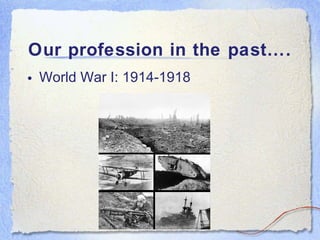
Our profession in the past…. World War I: 1914-1918
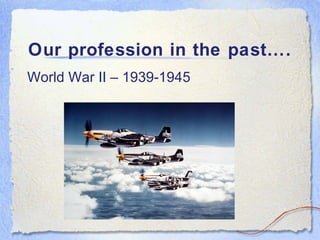
Our profession in the past…. World War II – 1939-1945
Our profession in the past…. Sputnik October 4, 1957 Wake-up call for Math Sciences Languages (especially  Russian!)
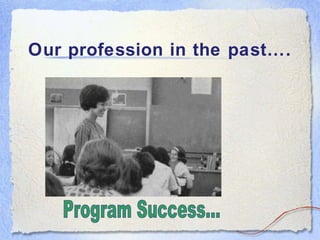
Our profession in the past…. Program Success...
Our profession in the past…. Program Failure... Lack of qualified teachers Inappropriate goals Lack of articulation Inappropriate instruction and/or delivery
What factors have impacted our profession in recent times?
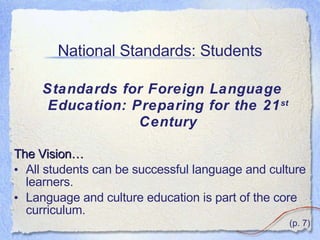
National Standards: Students Standards for Foreign Language Education: Preparing for the 21 st  Century The Vision… All students can be successful language and culture learners. Language and culture education is part of the core curriculum. (p. 7)
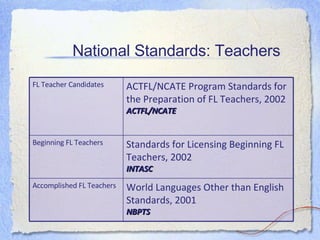
National Standards: Teachers FL Teacher Candidates ACTFL/NCATE Program Standards for the Preparation of FL Teachers, 2002  ACTFL/NCATE Beginning FL Teachers Standards for Licensing Beginning FL Teachers, 2002   INTASC   Accomplished FL Teachers World Languages Other than English Standards, 2001   NBPTS
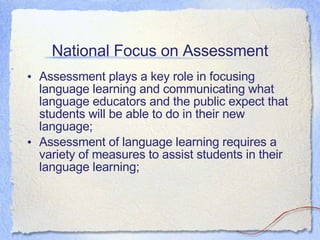
National Focus on Assessment Assessment plays a key role in focusing language learning and communicating what language educators and the public expect that students will be able to do in their new language; Assessment of language learning requires a variety of measures to assist students in their language learning;
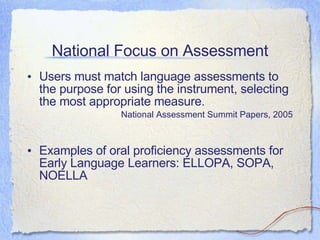
National Focus on Assessment Users must match language assessments to the purpose for using the instrument, selecting the most appropriate measure. National Assessment Summit Papers, 2005 Examples of oral proficiency assessments for Early Language Learners: ELLOPA, SOPA, NOELLA
September 11, 2001
National Language Conference (2005) Develop language and cultural competency; Engage federal, state, and local government in solutions; Integrate language training across career fields; Develop critical language skills; Strengthen teaching capabilities in foreign languages and cultures; (Continued)
National Language Conference (2005) Integrate language into education system requirements; Develop and provide instructional materials and technological tools.
Education for Global Leadership The Importance of International Studies and Foreign Language Education for U.S. Economic and National Security Policy Statement Committee for Economic Development, 2006
Education for Global Leadership Recommendations: International content should be taught across the curriculum at all levels of learning, to expand American students’ knowledge of other countries and cultures; Expand the training pipeline at every level of education to address the paucity of Americans fluent in foreign languages, especially critical, less-commonly taught languages.
National Security Language Initiative (2006) Collaborative Effort: Secretary of State  Secretary of Education Secretary of Defense Director of National Intelligence $114 million in 2007 budget
National Security Language Initiative (2006) Goals: Expand the number of Americans mastering critical need languages (e.g.,  Arabic, Chinese, Russian, Hindi, Farsi, and others) ;  Increase advanced-level speakers of languages, with an emphasis on critical languages through K-16 language study pipelines; Increase the number of teachers of critical language and the resources for them.
K-16 Flagships NSEP funded Goal: Graduate students with superior-level proficiency in critical languages who will become global professionals Form partnerships with universities and school systems to develop K-16 pipeline programs in Chinese and Arabic.
STARTALK NSLI funded multi-year initiative Goal:  Expand critical language education by funding new and existing K-16 programs;  Provide incentives and rewards for foreign language learning and use in the work force.
World Class Education To succeed in this new global era, we need not only to increase the number of high school graduates and improve the rigor of our math and science curriculum, but also to ensure that our graduates are globally competent. http://asiasociety.org
World Class Education Knowledge of other world regions, cultures, economies, and global issues; Skills to communicate in languages other than English, to work in cross-cultural teams, and to assess information from different sources around the world; and Values of respect for other cultures.
Putting the World into World-Class Education:  A National Imperative  and a State and Local Responsibility  Signatories Asia Society Alliance for Excellent Education Committee for Economic Development Council of Chief State School Officers National Association of Secondary Schools Principal National Education Association National Middle School Association
Why Start Early?
Language Learning Capability Young children appear to learn to speak a new language more easily than adults; A child’s language learning advantage is greatest in the area of pronunciation. AERA Research  Points . 2006. Vol. 4, 1
Cognitive Benefits Sixth grade students in a non-intensive program outperform a control group in  metacognitive processing in the highest levels of cognitive processing in Bloom’s taxonomy . Foster & Reeves, 1989.
Cognitive Benefits Immersion students demonstrate  greater cognitive flexibility  than students in control group Bruck, Lambert, & Tucker, 1974 2 nd  grade immersion students demonstrate  significantly greater growth in nonverbal problem-solving ability  than control group  Bamford, 1991
Academic Achievement 3 rd , 4 th , and 5 th  grade students in a non-intensive language program had  significantly higher academic achievement, especially in English language arts,  than control students. Rafferty, 1986
Academic Achievement K and 1 st  grade students in an immersion program  performed as well or better than English-only peers on tests of achievement in English Swain, 1981, 1984 3 rd  grade students in a non-intensive program  had  significant gains in math and language . Armstrong & Rogers, 1997
Academic Achievement Immersion students consistently demonstrated  comparable or better performance in subject matter content  than students in English-only programs. Genesee, 1987; Swain, 1984
Attitude 14-year-olds are less receptive to learning about people from other cultures than 10-year-olds. Younger children are more open and friendly toward people they view as different from themselves. Lambert & Klineberg, 1967
Attitude Significant findings from comparing:  Schools with a non-intensive Chinese kindergarten program and  Schools with no foreign language program in kindergarten…
Attitude Kindergarten students Like learning Chinese and  Believe that learning to speak Chinese is important. Parents/Guardians Believe that it is important for their child to speak, read, and write Chinese fluently. Rosenbusch, Navarro-Villarroel, Zhang, Kaptain, & Shelley,  2009
Why Teach Chinese in Early Elementary School? Chinese is the most widely spoken first language in the world; China is: Politically important in the Asia-Pacific region; An immense market for U.S. goods and services; One of the most enduring world civilizations. Creating a Chinese Language Program in Your School, Asia Society
Questions  and  Discussion
 
What? Program Models for Early Language Learning Overview and Case Studies
What Matters Most? Time allotted for the program/classes Intensity of program and instruction Continuity of the program Teacher effectiveness
Time  + Intensity of Instruction =>  (Potential) Rate of Language Acquisition and Learning Time  = number of minutes  hours  years  spent learning and acquiring language
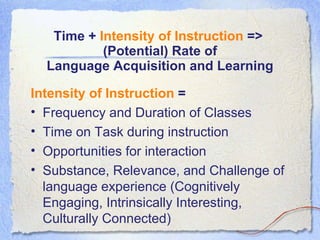
Time +  Intensity of Instruction  =>  (Potential) Rate of Language Acquisition and Learning Intensity of Instruction  =  Frequency and Duration of Classes Time on Task during instruction Opportunities for interaction  Substance, Relevance, and Challenge of language experience (Cognitively Engaging, Intrinsically Interesting, Culturally Connected)
PLUS
Uninterrupted study of the same language across grade levels and institutions Continuity:
Teachers  who are:  Teacher  Effectiveness: •  well-prepared • enthusiastic and dedicated  • knowledgeable about students • knowledgeable about language and    culture  • knowledgeable about best practices in   world language education.
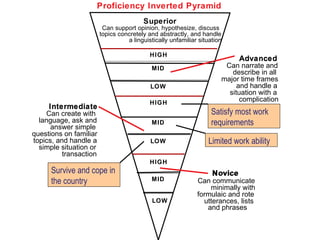
What are the goals of our programs? Proficiency!
Superior Proficiency Inverted Pyramid LOW LOW LOW MID MID MID HIGH HIGH HIGH Novice Advanced Intermediate Can support opinion, hypothesize, discuss topics concretely and abstractly, and handle a linguistically unfamiliar situation Novice Can communicate minimally with formulaic and rote  utterances, lists and phrases Intermediate Can create with  language, ask and  answer simple  questions on familiar  topics, and handle a  simple situation or  transaction Advanced Can narrate and  describe in all  major time frames  and handle a  situation with a  complication Survive and cope in the country Limited work ability Satisfy most work requirements
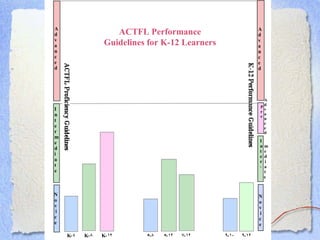
ACTFL Performance Guidelines for K-12 Learners
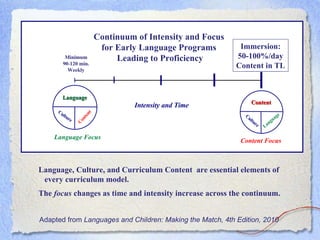
Adapted from  Languages and Children: Making the Match, 4th Edition, 2010  Language, Culture, and Curriculum Content  are essential elements of every curriculum model.  The  focus  changes as time and intensity increase across the continuum.  Minimum 90-120 min. Weekly Maximum Full Day Full Immersion Intensity and Time Continuum of Intensity and Focus  for Early Language Programs  Leading to Proficiency Immersion: 50-100%/day Content in TL Content Focus Content Language Culture Language Focus Language Content Culture
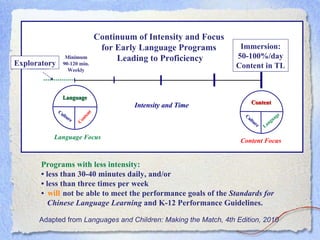
Adapted from  Languages and Children: Making the Match, 4th Edition, 2010  Minimum 90-120 min. Weekly Maximum Full Day Full Immersion Intensity and Time Less than Minimum Programs with less intensity: •  less than 30-40 minutes daily, and/or  •  less than three times per week  •  may not be able to meet the performance goals of the  Standards for Chinese Language Learning  and K-12 Performance Guidelines. Continuum of Intensity and Focus  for Early Language Programs  Leading to Proficiency Immersion: 50-100%/day Content in TL Exploratory will Content Focus Content Language Culture Language Focus Language Content Culture
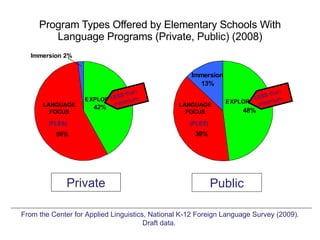
Program Types Offered by Elementary Schools With Language Programs (Private, Public) (2008) Private From the Center for Applied Linguistics, National K-12 Foreign Language Survey (2009). Draft data.  I m m e r s i o n 2 % 4 2 % I m m e r s i o n 1 3 % 4 8 % Public LANGUAGE FOCUS LANGUAGE FOCUS (FLES) (FLES) LESS  than  minimum LESS  than  minimum 5 6 % E XPLORATORY 3 9 % E XPLORATORY
What Matters Most? Time allotted for the program/classes Intensity of program and instruction Continuity of the program Teacher effectiveness
Perspectives from a Chinese Immersion Program:  Yinghua Academy  By Betsy  Lueth, Director Dr. Luyi Lien, Academic Director April 30, 2009 National Chinese Conference, Chicago, IL
History of Yinghua Academy  - Opened in 2006 with 76 students in K to 3 rd  grade  - in 2007-2008 school year, we doubled our student sizes  - in 2008-2009 school year, we have 239 students - in 2009-2010 school year, we have waiting list with every  grade and will move to a bigger building
Y inghua Academy: Early Total Immersion Program - 100% of Chinese instructional time in K & Grade 1 -  90% of Chinese instructional time in Grade 2  -  80% of Chinese instructional time in Grade 3 -  70 % of Chinese instructional time in Grade 4  -  60% of Chinese instructional time in Grade 5   -  Provide special classes (PE class, art class, and  music class) also in Chinese
Perspectives from a Chinese Immersion Programs: Challenge 1 Community and Parents FAQ’s Why immersion? Why Chinese? Where do you get your teachers? Is it o.k. for any student? What if they are special ed.? How can I help with homework if I don’t speak Chinese? How will they learn English – math-science? How will they do on state tests?
Perspectives from a Chinese Immersion Programs: Challenge 2 Curriculum and Instruction FAQ’s What text book do you use? Do you use simplified or full-form characters? When do you teach pinyin? How do you teach content? Are students taught in the “Chinese” way or “American” way?
Perspectives from a Chinese Immersion Programs: Challenge 3 Immersion Teachers (Language and Content Combined) Recruit, Retain, and Develop FAQ’s Where do you find your teachers? How do you get your teachers licensed? How do you keep your teachers? How do you develop your teachers? How do you evaluate your teachers?
Perspectives from a Chinese Immersion Programs: Challenge 4 Daily Teaching Challenges “ The full-service administrator perspective” How do we support teacher’s in the classroom? How do we support parent communication? How do we support teacher’s personal life? How do we support school law understanding? How do you open the door to cultural understanding and communication with staff?
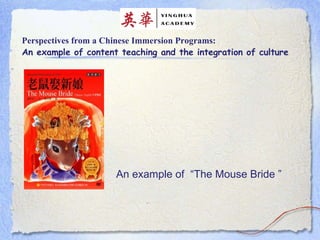
Perspectives from a Chinese Immersion Programs: An example of content teaching and the integration of culture An example of  “The Mouse Bride ”
Perspectives from a Chinese Immersion Programs: An example of content teaching and the integration of culture Content Area with Cultures: Chinese Language Arts:   Poems/Rhythm/folk stories/drama and play From writing characters to learn cultures, e.g., marriage ideas in Chinese thoughts  Science:   mice and other live  animals’ habitats and common behaviors   Social Studies: Comparisons of the traditional wedding and modern weddings in China The custom of Chinese new year
Perspectives from a Chinese Immersion Programs: An example of content teaching and the integration of culture
Perspectives from a Chinese Immersion Program:  Yinghua Academy  Questions: Betsy  Lueth, Director [email_address] Dr. Luyi Lien, Academic Director [email_address] Phone: 651-379-4112
 
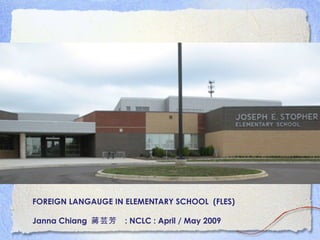
FOREIGN LANGAUGE IN ELEMENTARY SCHOOL  (FLES) Janna Chiang  蔣芸芳   : NCLC : April / May 2009
Only one school (2005) FLAP grant in 2006 Program expanded due to funding 6 instructors 2 Certified teachers Model : 3 times a week : 30 mins
K – 2 nd  Grade  40 mins, once a week Pre-School 20 mins, once a week 3 rd  – 5 th  – Chinese club 30 mins, twice a week
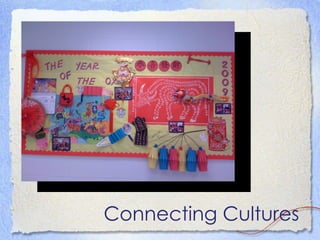
Connecting Cultures
Real Life Connections
 
Classroom activities
Assessment strategies
: Grade 1
 
Expand the program Higher frequency  Additional teachers Core-content collaboration Next move ?
Questions? Janna Chiang 蔣芸芳 [email_address] 502-727-8820
“ Planning for Success:  Pitfalls in the Planning of Early Foreign Language Programs” •  Scheduling the foreign language  too infrequently  and/or in class sessions that are  too short .
“… accomplishment of such content standards required students to be enrolled in elementary programs that meet from  3-5 days per week for no less than 30-40 minutes per class. 3-5 days per week 30-40 minutes per class
“ Remember, these are samples--not supper!”
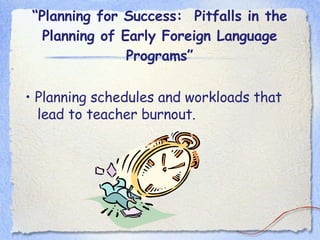
“ Planning for Success:  Pitfalls in the Planning of Early Foreign Language Programs” •  Planning schedules and workloads that lead to teacher burnout.
Many Additional Responsibilities of a FLES Teacher: •  interacting with numerous classroom teachers •  developing curriculum and materials •  communicating with parents and community •  building public relations
Many Additional Responsibilities of an Immersion Teacher: •  responsibility for content areas and language development •  developing curriculum and materials •  communicating with parents and community •  building public relations
“ Planning for Success:  Pitfalls in the Planning of Early Foreign Language Programs” •  Launching an early language program without sufficient planning --not enough time --not enough involvement of the rest of the school community
“ Planning for Success:  Pitfalls in the Planning of Early Foreign Language Programs” •  Treating foreign languages differently from other academic subjects.
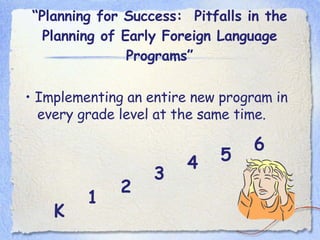
“ Planning for Success:  Pitfalls in the Planning of Early Foreign Language Programs” •  Implementing an entire new program in every grade level at the same time. 1 K 2 3 4 5 6
“ Planning for Success:  Pitfalls in the Planning of Early Foreign Language Programs” •  Leaving critical articulation issues to be dealt with later.
“ Planning for Success:  Pitfalls in the Planning of Early Foreign Language Programs” •  Planning and scheduling the foreign language curriculum in  isolation from the  general curriculum.
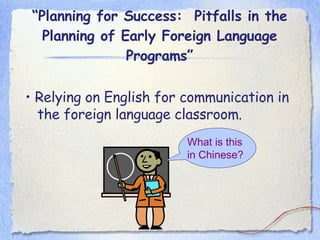
“ Planning for Success:  Pitfalls in the Planning of Early Foreign Language Programs” •  Relying on English for communication in the foreign language classroom. What is this  in Chinese?
“ Planning for Success:  Pitfalls in the Planning of Early Foreign Language Programs” •  Making a language choice based on popularity, without attention to other important factors.
“ Planning for Success:  Pitfalls in the Planning of Early Foreign Language Programs” •  Ignoring the needs of students who enter the program in later grades.
“ Planning for Success:  Pitfalls in the Planning of Early Foreign Language Programs” •  Hiring teachers for the program who do not have both language and teaching skills.
Building an Action Plan
Defining a Planning  Committee and a Timeline
Identifying the  Chinese Teacher
Defining/Developing the Curriculum
Defining Instructional Strategies
Selecting Teaching Materials
Assessing Students
Integrating the Program into the Wider School Context
Evaluating the Program
Sustaining the Quality and Longevity of the Program
What are the first steps in YOUR Action Plan?
Asking the Right Questions: Crafting a Plan for an Elementary School Chinese Program Marcia Rosenbusch • Carol Ann Dahlberg Betsy Lueth • Luyi Lien • Janna Chiang NCLC Chicago, 2009

Rosenbusch Dahlberg Lueth Lien Chiang Elementary School Chinese Programs

  • 1.
    Asking the RightQuestions: Crafting a Plan for an Elementary School Chinese Program Marcia Rosenbusch • Carol Ann Dahlberg Betsy Lueth • Luyi Lien • Janna Chiang NCLC Chicago, 2009
  • 2.
    Why? Lessons fromthe Past and Risks in the Future
  • 3.
  • 4.
    Our profession inthe past…. Wave of Immigrants: 1850-1900
  • 5.
    Our profession inthe past…. Chinese Immigrants: 1849-1882
  • 6.
    Chinese Language Schools,aka Chinese Heritage Schools Date back to 1848 By 1997 there were 82,675 students, 634 schools In the 1930s schools in Los Angeles, San Diego, Washington, D.C., New Orleans, Minneapolis, Oakland--among others Goal: keep language and culture alive!
  • 7.
    Our profession inthe past…. World War I: 1914-1918
  • 8.
    Our profession inthe past…. World War II – 1939-1945
  • 9.
    Our profession inthe past…. Sputnik October 4, 1957 Wake-up call for Math Sciences Languages (especially Russian!)
  • 10.
    Our profession inthe past…. Program Success...
  • 11.
    Our profession inthe past…. Program Failure... Lack of qualified teachers Inappropriate goals Lack of articulation Inappropriate instruction and/or delivery
  • 12.
    What factors haveimpacted our profession in recent times?
  • 13.
    National Standards: StudentsStandards for Foreign Language Education: Preparing for the 21 st Century The Vision… All students can be successful language and culture learners. Language and culture education is part of the core curriculum. (p. 7)
  • 14.
    National Standards: TeachersFL Teacher Candidates ACTFL/NCATE Program Standards for the Preparation of FL Teachers, 2002 ACTFL/NCATE Beginning FL Teachers Standards for Licensing Beginning FL Teachers, 2002 INTASC Accomplished FL Teachers World Languages Other than English Standards, 2001 NBPTS
  • 15.
    National Focus onAssessment Assessment plays a key role in focusing language learning and communicating what language educators and the public expect that students will be able to do in their new language; Assessment of language learning requires a variety of measures to assist students in their language learning;
  • 16.
    National Focus onAssessment Users must match language assessments to the purpose for using the instrument, selecting the most appropriate measure. National Assessment Summit Papers, 2005 Examples of oral proficiency assessments for Early Language Learners: ELLOPA, SOPA, NOELLA
  • 17.
  • 18.
    National Language Conference(2005) Develop language and cultural competency; Engage federal, state, and local government in solutions; Integrate language training across career fields; Develop critical language skills; Strengthen teaching capabilities in foreign languages and cultures; (Continued)
  • 19.
    National Language Conference(2005) Integrate language into education system requirements; Develop and provide instructional materials and technological tools.
  • 20.
    Education for GlobalLeadership The Importance of International Studies and Foreign Language Education for U.S. Economic and National Security Policy Statement Committee for Economic Development, 2006
  • 21.
    Education for GlobalLeadership Recommendations: International content should be taught across the curriculum at all levels of learning, to expand American students’ knowledge of other countries and cultures; Expand the training pipeline at every level of education to address the paucity of Americans fluent in foreign languages, especially critical, less-commonly taught languages.
  • 22.
    National Security LanguageInitiative (2006) Collaborative Effort: Secretary of State  Secretary of Education Secretary of Defense Director of National Intelligence $114 million in 2007 budget
  • 23.
    National Security LanguageInitiative (2006) Goals: Expand the number of Americans mastering critical need languages (e.g., Arabic, Chinese, Russian, Hindi, Farsi, and others) ;  Increase advanced-level speakers of languages, with an emphasis on critical languages through K-16 language study pipelines; Increase the number of teachers of critical language and the resources for them.
  • 24.
    K-16 Flagships NSEPfunded Goal: Graduate students with superior-level proficiency in critical languages who will become global professionals Form partnerships with universities and school systems to develop K-16 pipeline programs in Chinese and Arabic.
  • 25.
    STARTALK NSLI fundedmulti-year initiative Goal: Expand critical language education by funding new and existing K-16 programs; Provide incentives and rewards for foreign language learning and use in the work force.
  • 26.
    World Class EducationTo succeed in this new global era, we need not only to increase the number of high school graduates and improve the rigor of our math and science curriculum, but also to ensure that our graduates are globally competent. http://asiasociety.org
  • 27.
    World Class EducationKnowledge of other world regions, cultures, economies, and global issues; Skills to communicate in languages other than English, to work in cross-cultural teams, and to assess information from different sources around the world; and Values of respect for other cultures.
  • 28.
    Putting the Worldinto World-Class Education: A National Imperative and a State and Local Responsibility Signatories Asia Society Alliance for Excellent Education Committee for Economic Development Council of Chief State School Officers National Association of Secondary Schools Principal National Education Association National Middle School Association
  • 29.
  • 30.
    Language Learning CapabilityYoung children appear to learn to speak a new language more easily than adults; A child’s language learning advantage is greatest in the area of pronunciation. AERA Research Points . 2006. Vol. 4, 1
  • 31.
    Cognitive Benefits Sixthgrade students in a non-intensive program outperform a control group in metacognitive processing in the highest levels of cognitive processing in Bloom’s taxonomy . Foster & Reeves, 1989.
  • 32.
    Cognitive Benefits Immersionstudents demonstrate greater cognitive flexibility than students in control group Bruck, Lambert, & Tucker, 1974 2 nd grade immersion students demonstrate significantly greater growth in nonverbal problem-solving ability than control group Bamford, 1991
  • 33.
    Academic Achievement 3rd , 4 th , and 5 th grade students in a non-intensive language program had significantly higher academic achievement, especially in English language arts, than control students. Rafferty, 1986
  • 34.
    Academic Achievement Kand 1 st grade students in an immersion program performed as well or better than English-only peers on tests of achievement in English Swain, 1981, 1984 3 rd grade students in a non-intensive program had significant gains in math and language . Armstrong & Rogers, 1997
  • 35.
    Academic Achievement Immersionstudents consistently demonstrated comparable or better performance in subject matter content than students in English-only programs. Genesee, 1987; Swain, 1984
  • 36.
    Attitude 14-year-olds areless receptive to learning about people from other cultures than 10-year-olds. Younger children are more open and friendly toward people they view as different from themselves. Lambert & Klineberg, 1967
  • 37.
    Attitude Significant findingsfrom comparing: Schools with a non-intensive Chinese kindergarten program and Schools with no foreign language program in kindergarten…
  • 38.
    Attitude Kindergarten studentsLike learning Chinese and Believe that learning to speak Chinese is important. Parents/Guardians Believe that it is important for their child to speak, read, and write Chinese fluently. Rosenbusch, Navarro-Villarroel, Zhang, Kaptain, & Shelley, 2009
  • 39.
    Why Teach Chinesein Early Elementary School? Chinese is the most widely spoken first language in the world; China is: Politically important in the Asia-Pacific region; An immense market for U.S. goods and services; One of the most enduring world civilizations. Creating a Chinese Language Program in Your School, Asia Society
  • 40.
    Questions and Discussion
  • 41.
  • 42.
    What? Program Modelsfor Early Language Learning Overview and Case Studies
  • 43.
    What Matters Most?Time allotted for the program/classes Intensity of program and instruction Continuity of the program Teacher effectiveness
  • 44.
    Time +Intensity of Instruction => (Potential) Rate of Language Acquisition and Learning Time = number of minutes hours years spent learning and acquiring language
  • 45.
    Time + Intensity of Instruction => (Potential) Rate of Language Acquisition and Learning Intensity of Instruction = Frequency and Duration of Classes Time on Task during instruction Opportunities for interaction Substance, Relevance, and Challenge of language experience (Cognitively Engaging, Intrinsically Interesting, Culturally Connected)
  • 46.
  • 47.
    Uninterrupted study ofthe same language across grade levels and institutions Continuity:
  • 48.
    Teachers whoare: Teacher Effectiveness: • well-prepared • enthusiastic and dedicated • knowledgeable about students • knowledgeable about language and culture • knowledgeable about best practices in world language education.
  • 49.
    What are thegoals of our programs? Proficiency!
  • 50.
    Superior Proficiency InvertedPyramid LOW LOW LOW MID MID MID HIGH HIGH HIGH Novice Advanced Intermediate Can support opinion, hypothesize, discuss topics concretely and abstractly, and handle a linguistically unfamiliar situation Novice Can communicate minimally with formulaic and rote utterances, lists and phrases Intermediate Can create with language, ask and answer simple questions on familiar topics, and handle a simple situation or transaction Advanced Can narrate and describe in all major time frames and handle a situation with a complication Survive and cope in the country Limited work ability Satisfy most work requirements
  • 51.
  • 52.
    Adapted from Languages and Children: Making the Match, 4th Edition, 2010 Language, Culture, and Curriculum Content are essential elements of every curriculum model. The focus changes as time and intensity increase across the continuum. Minimum 90-120 min. Weekly Maximum Full Day Full Immersion Intensity and Time Continuum of Intensity and Focus for Early Language Programs Leading to Proficiency Immersion: 50-100%/day Content in TL Content Focus Content Language Culture Language Focus Language Content Culture
  • 53.
    Adapted from Languages and Children: Making the Match, 4th Edition, 2010 Minimum 90-120 min. Weekly Maximum Full Day Full Immersion Intensity and Time Less than Minimum Programs with less intensity: • less than 30-40 minutes daily, and/or • less than three times per week • may not be able to meet the performance goals of the Standards for Chinese Language Learning and K-12 Performance Guidelines. Continuum of Intensity and Focus for Early Language Programs Leading to Proficiency Immersion: 50-100%/day Content in TL Exploratory will Content Focus Content Language Culture Language Focus Language Content Culture
  • 54.
    Program Types Offeredby Elementary Schools With Language Programs (Private, Public) (2008) Private From the Center for Applied Linguistics, National K-12 Foreign Language Survey (2009). Draft data. I m m e r s i o n 2 % 4 2 % I m m e r s i o n 1 3 % 4 8 % Public LANGUAGE FOCUS LANGUAGE FOCUS (FLES) (FLES) LESS than minimum LESS than minimum 5 6 % E XPLORATORY 3 9 % E XPLORATORY
  • 55.
    What Matters Most?Time allotted for the program/classes Intensity of program and instruction Continuity of the program Teacher effectiveness
  • 56.
    Perspectives from aChinese Immersion Program: Yinghua Academy By Betsy Lueth, Director Dr. Luyi Lien, Academic Director April 30, 2009 National Chinese Conference, Chicago, IL
  • 57.
    History of YinghuaAcademy - Opened in 2006 with 76 students in K to 3 rd grade - in 2007-2008 school year, we doubled our student sizes - in 2008-2009 school year, we have 239 students - in 2009-2010 school year, we have waiting list with every grade and will move to a bigger building
  • 58.
    Y inghua Academy:Early Total Immersion Program - 100% of Chinese instructional time in K & Grade 1 - 90% of Chinese instructional time in Grade 2 - 80% of Chinese instructional time in Grade 3 - 70 % of Chinese instructional time in Grade 4 - 60% of Chinese instructional time in Grade 5 - Provide special classes (PE class, art class, and music class) also in Chinese
  • 59.
    Perspectives from aChinese Immersion Programs: Challenge 1 Community and Parents FAQ’s Why immersion? Why Chinese? Where do you get your teachers? Is it o.k. for any student? What if they are special ed.? How can I help with homework if I don’t speak Chinese? How will they learn English – math-science? How will they do on state tests?
  • 60.
    Perspectives from aChinese Immersion Programs: Challenge 2 Curriculum and Instruction FAQ’s What text book do you use? Do you use simplified or full-form characters? When do you teach pinyin? How do you teach content? Are students taught in the “Chinese” way or “American” way?
  • 61.
    Perspectives from aChinese Immersion Programs: Challenge 3 Immersion Teachers (Language and Content Combined) Recruit, Retain, and Develop FAQ’s Where do you find your teachers? How do you get your teachers licensed? How do you keep your teachers? How do you develop your teachers? How do you evaluate your teachers?
  • 62.
    Perspectives from aChinese Immersion Programs: Challenge 4 Daily Teaching Challenges “ The full-service administrator perspective” How do we support teacher’s in the classroom? How do we support parent communication? How do we support teacher’s personal life? How do we support school law understanding? How do you open the door to cultural understanding and communication with staff?
  • 63.
    Perspectives from aChinese Immersion Programs: An example of content teaching and the integration of culture An example of “The Mouse Bride ”
  • 64.
    Perspectives from aChinese Immersion Programs: An example of content teaching and the integration of culture Content Area with Cultures: Chinese Language Arts: Poems/Rhythm/folk stories/drama and play From writing characters to learn cultures, e.g., marriage ideas in Chinese thoughts Science: mice and other live animals’ habitats and common behaviors Social Studies: Comparisons of the traditional wedding and modern weddings in China The custom of Chinese new year
  • 65.
    Perspectives from aChinese Immersion Programs: An example of content teaching and the integration of culture
  • 66.
    Perspectives from aChinese Immersion Program: Yinghua Academy Questions: Betsy Lueth, Director [email_address] Dr. Luyi Lien, Academic Director [email_address] Phone: 651-379-4112
  • 67.
  • 68.
    FOREIGN LANGAUGE INELEMENTARY SCHOOL (FLES) Janna Chiang 蔣芸芳 : NCLC : April / May 2009
  • 69.
    Only one school(2005) FLAP grant in 2006 Program expanded due to funding 6 instructors 2 Certified teachers Model : 3 times a week : 30 mins
  • 70.
    K – 2nd Grade 40 mins, once a week Pre-School 20 mins, once a week 3 rd – 5 th – Chinese club 30 mins, twice a week
  • 71.
  • 72.
  • 73.
  • 74.
  • 75.
  • 76.
  • 77.
  • 78.
    Expand the programHigher frequency Additional teachers Core-content collaboration Next move ?
  • 79.
    Questions? Janna Chiang蔣芸芳 [email_address] 502-727-8820
  • 80.
    “ Planning forSuccess: Pitfalls in the Planning of Early Foreign Language Programs” • Scheduling the foreign language too infrequently and/or in class sessions that are too short .
  • 81.
    “… accomplishment ofsuch content standards required students to be enrolled in elementary programs that meet from 3-5 days per week for no less than 30-40 minutes per class. 3-5 days per week 30-40 minutes per class
  • 82.
    “ Remember, theseare samples--not supper!”
  • 83.
    “ Planning forSuccess: Pitfalls in the Planning of Early Foreign Language Programs” • Planning schedules and workloads that lead to teacher burnout.
  • 84.
    Many Additional Responsibilitiesof a FLES Teacher: • interacting with numerous classroom teachers • developing curriculum and materials • communicating with parents and community • building public relations
  • 85.
    Many Additional Responsibilitiesof an Immersion Teacher: • responsibility for content areas and language development • developing curriculum and materials • communicating with parents and community • building public relations
  • 86.
    “ Planning forSuccess: Pitfalls in the Planning of Early Foreign Language Programs” • Launching an early language program without sufficient planning --not enough time --not enough involvement of the rest of the school community
  • 87.
    “ Planning forSuccess: Pitfalls in the Planning of Early Foreign Language Programs” • Treating foreign languages differently from other academic subjects.
  • 88.
    “ Planning forSuccess: Pitfalls in the Planning of Early Foreign Language Programs” • Implementing an entire new program in every grade level at the same time. 1 K 2 3 4 5 6
  • 89.
    “ Planning forSuccess: Pitfalls in the Planning of Early Foreign Language Programs” • Leaving critical articulation issues to be dealt with later.
  • 90.
    “ Planning forSuccess: Pitfalls in the Planning of Early Foreign Language Programs” • Planning and scheduling the foreign language curriculum in isolation from the general curriculum.
  • 91.
    “ Planning forSuccess: Pitfalls in the Planning of Early Foreign Language Programs” • Relying on English for communication in the foreign language classroom. What is this in Chinese?
  • 92.
    “ Planning forSuccess: Pitfalls in the Planning of Early Foreign Language Programs” • Making a language choice based on popularity, without attention to other important factors.
  • 93.
    “ Planning forSuccess: Pitfalls in the Planning of Early Foreign Language Programs” • Ignoring the needs of students who enter the program in later grades.
  • 94.
    “ Planning forSuccess: Pitfalls in the Planning of Early Foreign Language Programs” • Hiring teachers for the program who do not have both language and teaching skills.
  • 95.
  • 96.
    Defining a Planning Committee and a Timeline
  • 97.
    Identifying the Chinese Teacher
  • 98.
  • 99.
  • 100.
  • 101.
  • 102.
    Integrating the Programinto the Wider School Context
  • 103.
  • 104.
    Sustaining the Qualityand Longevity of the Program
  • 105.
    What are thefirst steps in YOUR Action Plan?
  • 106.
    Asking the RightQuestions: Crafting a Plan for an Elementary School Chinese Program Marcia Rosenbusch • Carol Ann Dahlberg Betsy Lueth • Luyi Lien • Janna Chiang NCLC Chicago, 2009