Fostering
Global
Citizenship
through
Elementary
Spanish
Distance
Learning


Cindy
Murphy­Elisa
Tishmack­Angélica
Arias
Origin
of
the
Elementary
Spanish
Distance
            Learning
Program


   Mill
levy

   Pilot
program

   Leveled
program
Objectives


   Based
on
World
Language
Standards

   Range
level
expectation‐
Novice
Low

   To
reach
all
students
at
the
elementary
level
Goals


   Exposure
to
Spanish
language
and
culture

   Basic
Spanish
communication
skills

   Students will develop insight into their own
    language and culture
Why
Spanish?

   Cognitive
advantages

   Used
in
business
and
education
‐
global
market

   Improves
employment
opportunities
in
the
US

   Change
attitudes
and
beliefs
Content
and
Components
Use
of
videos
   Once
a
week,
20
minutes
each
for
three
weeks
of
    each
month.

   Input
is
facilitated
through
immersion

   Sections
include:

Songs,
interaction
(guessing),
    themed
skits,
geography,
culture,
food
and
    numbers
   Videos
cover
themes
that
students
are
familiar
    with
(e.g.,
family,
community,
animals,
feelings
and
    weather).
Classroom
visits
   Each
classroom
once
a
month

   We
visit
45+
classrooms
=
1000+
students

   Focus
is
on
oral
delivery
and
interaction

   Four
different
dynamics;
whole
and
small
group
    instruction,
pair
work,
and
individual
work.
   Ongoing
assessment:
We
talk
to
teachers,
check
how
    students
are
doing
on
activities.
Teaching
guides
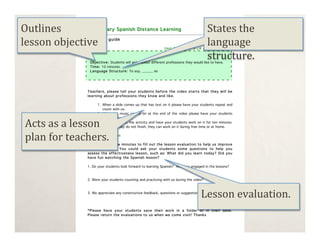
Outlines              States
the
lesson
objective      language
                      structure.


Acts
as
a
lesson
plan
for
teachers.


                     Lesson
evaluation.
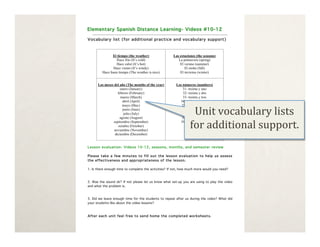
Unit
vocabulary
lists
for
additional
support.
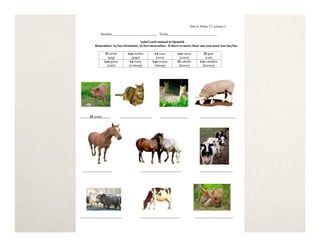
Complementary
activities
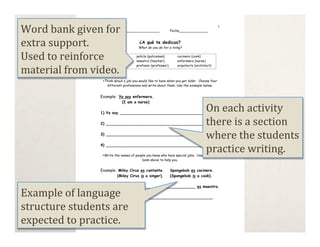
Word
bank
given
for
extra
support.
Used
to
reinforce
material
from
video.


                         On
each
activity
                         there
is
a
section
                         where
the
students
                         practice
writing.


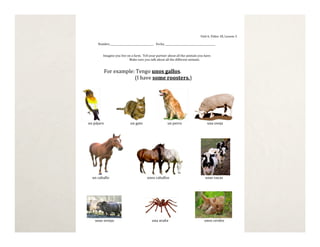
Example
of
language
structure
students
are
expected
to
practice.
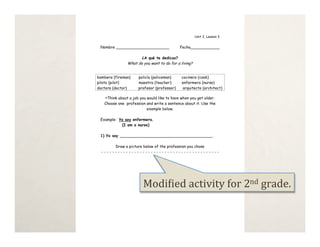
ModiYied
activity
for
2nd
grade.
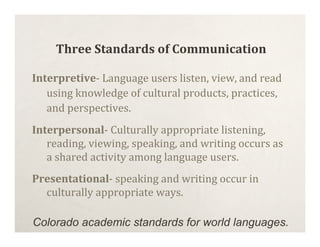
Three
Standards
of
Communication

Interpretive‐
Language
users
listen,
view,
and
read
   using
knowledge
of
cultural
products,
practices,
   and
perspectives.
Interpersonal‐
Culturally
appropriate
listening,
   reading,
viewing,
speaking,
and
writing
occurs
as
   a
shared
activity
among
language
users.
Presentational‐
speaking
and
writing
occur
in
  culturally
appropriate
ways.

Colorado academic standards for world languages.
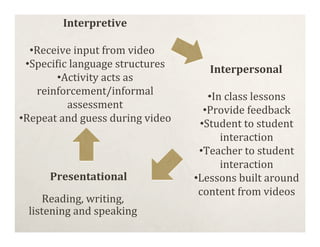
Interpretive

  •Receive
input
from
video
 •SpeciYic
language
structures      Interpersonal
        •Activity
acts
as
   reinforcement/informal           •In
class
lessons
          assessment               •Provide
feedback
•Repeat
and
guess
during
video    •Student
to
student
                                       interaction
                                  •Teacher
to
student
                                       interaction
      Presentational             •Lessons
built
around
                                  content
from
videos
    Reading,
writing,
 listening
and
speaking
Instructional
approach
Based on the communicative method
   Language
as
a
medium
of
communication.
   Communicative
ability
from
early
stage.
   Use
of
target
language:
immersion.
   Meaningful,
functional
and
spontaneous
    communication:
active
versus
static.
   Authentic
resources
and
inspiration.
   Diverse
learning
dynamics.
   Student‐centered:
adapts
to
students
needs.
   Emphasis
on
oral
skill
but
not
limited
to
it.
   Errors
as
part
of
learning
a
language.
   Use
of
visual
stimuli.
Content-based language instruction

   The content is based on student interests, is
    cognitively engaging, and teaches across the
    curriculum.
   Familiar topics and authentic materials motivate
    students and lead to more active participation.
   Students learn science, math, geography, art,
    literature, grammar and history through themes
    such as Star Wars, Pirates, Cowboys, etc.
Learner­focused
instruction

   Promoting
interaction
to
make
students
take
an
    active
role
and
be
receptive.

   Choosing
appealing
themes
in
order
to
motivate
    students.

   Creating
a
good
rapport
with
students.

   Using
continuous
assessment
to
adapt
instruction
to
    students
needs:
hearing
their
voices.
Immersion


   To
reflect naturalistic language acquisition.

   To expose students to as much input as possible
    given our limited contact time.

   To encourage students to be proactive and use
    learning strategies such as induction and
    prediction.
Scaffolding
to
Support
Immersion
1.Visual
stimuli


  •   Gestures
  •   Staging
  •   Characterization:
animated
and
familiar
      characters
and
puppets
  •   Images:
reused
in
multiple
videos
and
constantly
      associated
with
the
same
concepts
  •   A
minimal
use
of
subtitles
in
Spanish/English
2.   Familiar
themes
3.   Music
and
sound
4.   Humor
5.   Narrative

6. Contextualization,
sequencing
and
repetition.
Culture

   To
change attitudes and beliefs so students will be
    motivated to learn Spanish.

   To promote positive attitudes towards
    multiculturalism and multilingualism.

   To promote learning across the curriculum by
    teaching geography, history, science, etc.

   To emotionally benefit multicultural students.
Continuous assessment

   To improve pedagogical strategies.

   To hear student voices so we can work towards
    toward fulfilling their needs and interests as
    language learners.
Challenges
and
achievements
Challenges

   To
change attitudes and beliefs of students,
    teachers and the community: towards learning
    Spanish and towards the teaching approach.

   To give as much opportunity for learning as
    possible through a distance learning program with
    such limited contact time.

   To keep students engaged in lessons that are
    delivered through a virtual medium.
Achievements

   Through continuous assessment we have realized
    that students are learning Spanish and becoming
    more aware of Spanish speaking cultures.

   Some teachers are better understanding our
    teaching approach and becoming more involved.

   With experience we are becoming more proficient
    in the use of the technology and are able to take
    advantage of it to meet our instructional goals.
Future goals

   More assessment to hear student voices and
    measure their progress.

   Incorporate computer and Web based activities.

   Make instruction even more learner-centered.

CCFLT 2011 Loveland elem. program presentation

  • 1.
  • 2.
    Origin
of
the
Elementary
Spanish
Distance Learning
Program  Mill
levy  Pilot
program  Leveled
program
  • 3.
    Objectives  Based
on
World
Language
Standards  Range
level
expectation‐
Novice
Low  To
reach
all
students
at
the
elementary
level
  • 4.
    Goals  Exposure
to
Spanish
language
and
culture  Basic
Spanish
communication
skills  Students will develop insight into their own language and culture
  • 5.
    Why
Spanish?  Cognitive
advantages  Used
in
business
and
education
‐
global
market  Improves
employment
opportunities
in
the
US  Change
attitudes
and
beliefs
  • 6.
  • 7.
    Use
of
videos  Once
a
week,
20
minutes
each
for
three
weeks
of each
month.  Input
is
facilitated
through
immersion  Sections
include:

Songs,
interaction
(guessing), themed
skits,
geography,
culture,
food
and numbers  Videos
cover
themes
that
students
are
familiar with
(e.g.,
family,
community,
animals,
feelings
and weather).
  • 8.
    Classroom
visits  Each
classroom
once
a
month  We
visit
45+
classrooms
=
1000+
students  Focus
is
on
oral
delivery
and
interaction  Four
different
dynamics;
whole
and
small
group instruction,
pair
work,
and
individual
work.  Ongoing
assessment:
We
talk
to
teachers,
check
how students
are
doing
on
activities.
  • 9.
  • 10.
    Outlines States
the lesson
objective language structure. Acts
as
a
lesson plan
for
teachers. Lesson
evaluation.
  • 11.
  • 12.
  • 13.
    Word
bank
given
for extra
support. Used
to
reinforce material
from
video. On
each
activity there
is
a
section where
the
students practice
writing. Example
of
language structure
students
are expected
to
practice.
  • 14.
  • 16.
    Three
Standards
of
Communication Interpretive‐
Language
users
listen,
view,
and
read using
knowledge
of
cultural
products,
practices, and
perspectives. Interpersonal‐
Culturally
appropriate
listening, reading,
viewing,
speaking,
and
writing
occurs
as a
shared
activity
among
language
users. Presentational‐
speaking
and
writing
occur
in culturally
appropriate
ways. Colorado academic standards for world languages.
  • 17.
    Interpretive •Receive
input
from
video •SpeciYic
language
structures Interpersonal •Activity
acts
as reinforcement/informal •In
class
lessons assessment •Provide
feedback •Repeat
and
guess
during
video •Student
to
student interaction •Teacher
to
student interaction Presentational •Lessons
built
around content
from
videos Reading,
writing, listening
and
speaking
  • 20.
  • 21.
    Based on thecommunicative method  Language
as
a
medium
of
communication.  Communicative
ability
from
early
stage.  Use
of
target
language:
immersion.  Meaningful,
functional
and
spontaneous communication:
active
versus
static.  Authentic
resources
and
inspiration.  Diverse
learning
dynamics.  Student‐centered:
adapts
to
students
needs.  Emphasis
on
oral
skill
but
not
limited
to
it.  Errors
as
part
of
learning
a
language.  Use
of
visual
stimuli.
  • 22.
    Content-based language instruction  The content is based on student interests, is cognitively engaging, and teaches across the curriculum.  Familiar topics and authentic materials motivate students and lead to more active participation.  Students learn science, math, geography, art, literature, grammar and history through themes such as Star Wars, Pirates, Cowboys, etc.
  • 23.
    Learner­focused
instruction  Promoting
interaction
to
make
students
take
an active
role
and
be
receptive.  Choosing
appealing
themes
in
order
to
motivate students.  Creating
a
good
rapport
with
students.  Using
continuous
assessment
to
adapt
instruction
to students
needs:
hearing
their
voices.
  • 24.
    Immersion  To
reflect naturalistic language acquisition.  To expose students to as much input as possible given our limited contact time.  To encourage students to be proactive and use learning strategies such as induction and prediction.
  • 25.
    Scaffolding
to
Support
Immersion 1.Visual
stimuli • Gestures • Staging • Characterization:
animated
and
familiar characters
and
puppets • Images:
reused
in
multiple
videos
and
constantly associated
with
the
same
concepts • A
minimal
use
of
subtitles
in
Spanish/English
  • 26.
    2. Familiar
themes 3. Music
and
sound 4. Humor 5. Narrative 6. Contextualization,
sequencing
and
repetition.
  • 27.
    Culture  To
change attitudes and beliefs so students will be motivated to learn Spanish.  To promote positive attitudes towards multiculturalism and multilingualism.  To promote learning across the curriculum by teaching geography, history, science, etc.  To emotionally benefit multicultural students.
  • 28.
    Continuous assessment  To improve pedagogical strategies.  To hear student voices so we can work towards toward fulfilling their needs and interests as language learners.
  • 29.
  • 30.
    Challenges  To
change attitudes and beliefs of students, teachers and the community: towards learning Spanish and towards the teaching approach.  To give as much opportunity for learning as possible through a distance learning program with such limited contact time.  To keep students engaged in lessons that are delivered through a virtual medium.
  • 31.
    Achievements  Through continuous assessment we have realized that students are learning Spanish and becoming more aware of Spanish speaking cultures.  Some teachers are better understanding our teaching approach and becoming more involved.  With experience we are becoming more proficient in the use of the technology and are able to take advantage of it to meet our instructional goals.
  • 32.
    Future goals  More assessment to hear student voices and measure their progress.  Incorporate computer and Web based activities.  Make instruction even more learner-centered.