ALLPPT.com _ Free PowerPoint Templates, Diagrams and Charts
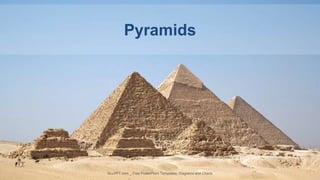
Pyramids
Contents
1 Design process
2 Means of expression
3 Perception of Design process
Design process
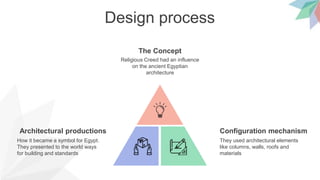
Design process
How it became a symbol for Egypt.
They presented to the world ways
for building and standards
Architectural productions
They used architectural elements
like columns, walls, roofs and
materials
Configuration mechanism
Religious Creed had an influence
on the ancient Egyptian
architecture
The Concept
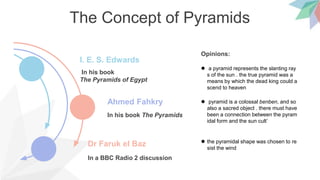
The Concept of Pyramids
In his book
The Pyramids of Egypt
I. E. S. Edwards
In his book The Pyramids
Ahmed Fahkry
In a BBC Radio 2 discussion
Dr Faruk el Baz  the pyramidal shape was chosen to re
sist the wind
Opinions:
 a pyramid represents the slanting ray
s of the sun . the true pyramid was a
means by which the dead king could a
scend to heaven
 pyramid is a colossal benben, and so
also a sacred object . there must have
been a connection between the pyram
idal form and the sun cult’
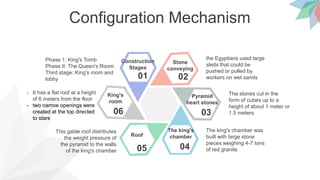
Configuration Mechanism
01 02
03
0405
06
Construction
Stages
Stone
conveying
Pyramid
heart stones
The king's
chamberRoof
King's
room
Phase 1: King's Tomb
Phase II: The Queen's Room
Third stage: King's room and
lobby
- It has a flat roof at a height
of 6 meters from the floor
- two narrow openings were
created at the top directed
to stars
This gable roof distributes
the weight pressure of
the pyramid to the walls
of the king's chamber
the Egyptians used large
sleds that could be
pushed or pulled by
workers on wet sands
The stones cut in the
form of cubes up to a
height of about 1 meter or
1.5 meters
The king's chamber was
built with large stone
pieces weighing 4-7 tons
of red granite
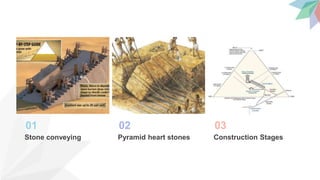
01
Stone conveying
02
Pyramid heart stones
03
Construction Stages
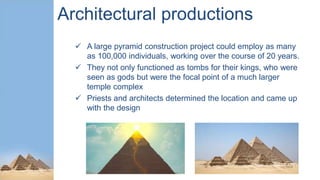
Architectural productions
 A large pyramid construction project could employ as many
as 100,000 individuals, working over the course of 20 years.
 They not only functioned as tombs for their kings, who were
seen as gods but were the focal point of a much larger
temple complex
 Priests and architects determined the location and came up
with the design
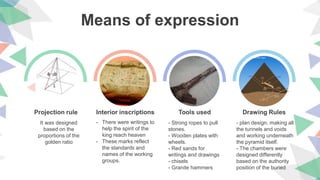
Means of expression
Means of expression
Projection rule
It was designed
based on the
proportions of the
golden ratio
Interior inscriptions
- There were writings to
help the spirit of the
king reach heaven
- These marks reflect
the standards and
names of the working
groups.
Tools used
- Strong ropes to pull
stones.
- Wooden plates with
wheels.
- Red sands for
writings and drawings
- chisels
- Granite hammers
Drawing Rules
- plan design, making all
the tunnels and voids
and working underneath
the pyramid itself.
- The chambers were
designed differently
based on the authority
position of the buried
Perception of
Design process
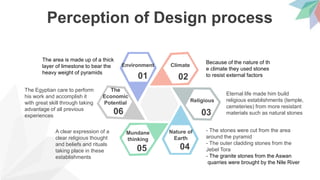
Perception of Design process
01 02
03
0405
06
Environment Climate
Religious
Nature of
Earth
Mundane
thinking
The
Economic
Potential
The area is made up of a thick
layer of limestone to bear the
heavy weight of pyramids
The Egyptian care to perform
his work and accomplish it
with great skill through taking
advantage of all previous
experiences
A clear expression of a
clear religious thought
and beliefs and rituals
taking place in these
establishments
Because of the nature of th
e climate they used stones
to resist external factors
Eternal life made him build
religious establishments (temple,
cemeteries) from more resistant
materials such as natural stones
- The stones were cut from the area
around the pyramid
- The outer cladding stones from the
Jebel Tora
- The granite stones from the Aswan
quarries were brought by the Nile River
Thank you
Group members
Omar Hamdy Eid
Mohamed Samir
Mahmoud Fayed
Ahmed Elshirbeny
Noran Abo El-enen
Noran Abo El-azm
Yara Khalifa
Nada Tarek
Nourhan El-sayed
Nourhan Megahed
Mariam Hossam
Yara Khaled
Yasmine Muhamed

Pyramids Design Concept

  • 1.
    ALLPPT.com _ FreePowerPoint Templates, Diagrams and Charts Pyramids
  • 2.
    Contents 1 Design process 2Means of expression 3 Perception of Design process
  • 3.
  • 4.
    Design process How itbecame a symbol for Egypt. They presented to the world ways for building and standards Architectural productions They used architectural elements like columns, walls, roofs and materials Configuration mechanism Religious Creed had an influence on the ancient Egyptian architecture The Concept
  • 5.
    The Concept ofPyramids In his book The Pyramids of Egypt I. E. S. Edwards In his book The Pyramids Ahmed Fahkry In a BBC Radio 2 discussion Dr Faruk el Baz  the pyramidal shape was chosen to re sist the wind Opinions:  a pyramid represents the slanting ray s of the sun . the true pyramid was a means by which the dead king could a scend to heaven  pyramid is a colossal benben, and so also a sacred object . there must have been a connection between the pyram idal form and the sun cult’
  • 6.
    Configuration Mechanism 01 02 03 0405 06 Construction Stages Stone conveying Pyramid heartstones The king's chamberRoof King's room Phase 1: King's Tomb Phase II: The Queen's Room Third stage: King's room and lobby - It has a flat roof at a height of 6 meters from the floor - two narrow openings were created at the top directed to stars This gable roof distributes the weight pressure of the pyramid to the walls of the king's chamber the Egyptians used large sleds that could be pushed or pulled by workers on wet sands The stones cut in the form of cubes up to a height of about 1 meter or 1.5 meters The king's chamber was built with large stone pieces weighing 4-7 tons of red granite
  • 7.
    01 Stone conveying 02 Pyramid heartstones 03 Construction Stages
  • 8.
    Architectural productions  Alarge pyramid construction project could employ as many as 100,000 individuals, working over the course of 20 years.  They not only functioned as tombs for their kings, who were seen as gods but were the focal point of a much larger temple complex  Priests and architects determined the location and came up with the design
  • 9.
  • 10.
    Means of expression Projectionrule It was designed based on the proportions of the golden ratio Interior inscriptions - There were writings to help the spirit of the king reach heaven - These marks reflect the standards and names of the working groups. Tools used - Strong ropes to pull stones. - Wooden plates with wheels. - Red sands for writings and drawings - chisels - Granite hammers Drawing Rules - plan design, making all the tunnels and voids and working underneath the pyramid itself. - The chambers were designed differently based on the authority position of the buried
  • 11.
  • 12.
    Perception of Designprocess 01 02 03 0405 06 Environment Climate Religious Nature of Earth Mundane thinking The Economic Potential The area is made up of a thick layer of limestone to bear the heavy weight of pyramids The Egyptian care to perform his work and accomplish it with great skill through taking advantage of all previous experiences A clear expression of a clear religious thought and beliefs and rituals taking place in these establishments Because of the nature of th e climate they used stones to resist external factors Eternal life made him build religious establishments (temple, cemeteries) from more resistant materials such as natural stones - The stones were cut from the area around the pyramid - The outer cladding stones from the Jebel Tora - The granite stones from the Aswan quarries were brought by the Nile River
  • 13.
  • 14.
    Group members Omar HamdyEid Mohamed Samir Mahmoud Fayed Ahmed Elshirbeny Noran Abo El-enen Noran Abo El-azm Yara Khalifa Nada Tarek Nourhan El-sayed Nourhan Megahed Mariam Hossam Yara Khaled Yasmine Muhamed