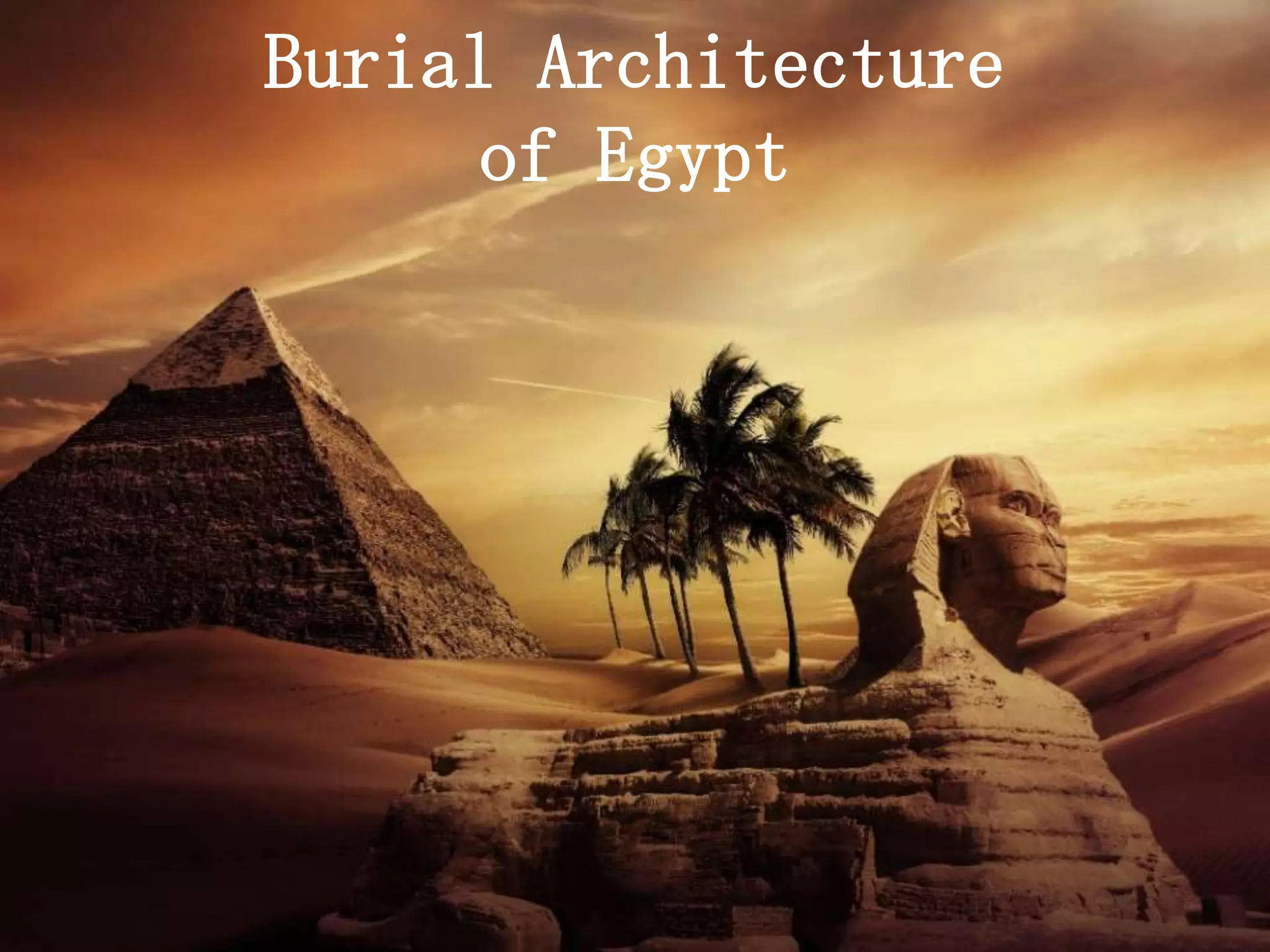
Burial Architecture
of Egypt
Content
1. Introduction
2. Evolution of Pyramid
3. Pyramids at Giza
4. Pyramid Construction
5. Rock hewn Tombs
Introduction
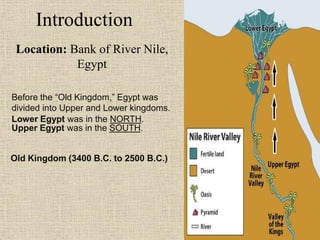
Location: Bank of River Nile,
Egypt
Before the “Old Kingdom,” Egypt was
divided into Upper and Lower kingdoms.
Lower Egypt was in the NORTH.
Upper Egypt was in the SOUTH.
Old Kingdom (3400 B.C. to 2500 B.C.)
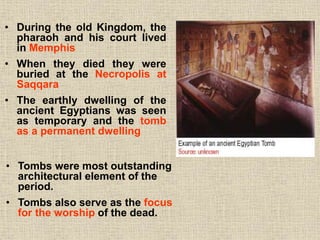
• During the old Kingdom, the
pharaoh and his court lived
in Memphis
• When they died they were
buried at the Necropolis at
Saqqara
• The earthly dwelling of the
ancient Egyptians was seen
as temporary and the tomb
as a permanent dwelling
• Tombs were most outstanding
architectural element of the
period.
• Tombs also serve as the focus
for the worship of the dead.
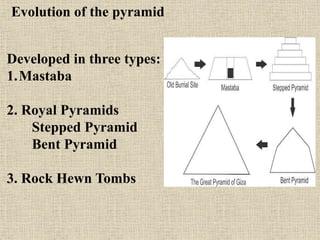
Evolution of the pyramid
Developed in three types:
1.Mastaba
2. Royal Pyramids
Stepped Pyramid
Bent Pyramid
3. Rock Hewn Tombs
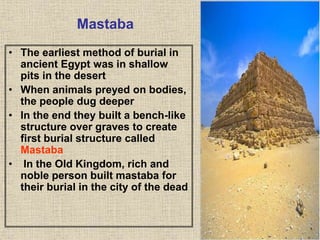
Mastaba
• The earliest method of burial in
ancient Egypt was in shallow
pits in the desert
• When animals preyed on bodies,
the people dug deeper
• In the end they built a bench-like
structure over graves to create
first burial structure called
Mastaba
• In the Old Kingdom, rich and
noble person built mastaba for
their burial in the city of the dead
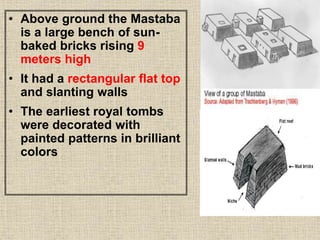
• Above ground the Mastaba
is a large bench of sun-
baked bricks rising 9
meters high
• It had a rectangular flat top
and slanting walls
• The earliest royal tombs
were decorated with
painted patterns in brilliant
colors
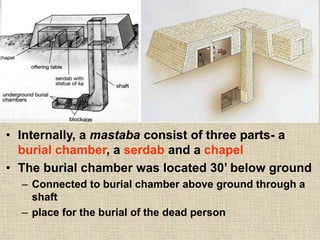
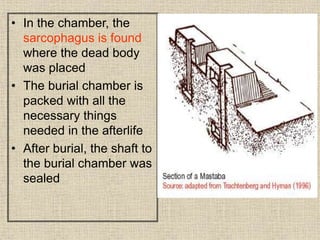
• Internally, a mastaba consist of three parts- a
burial chamber, a serdab and a chapel
• The burial chamber was located 30’ below ground
– Connected to burial chamber above ground through a
shaft
– place for the burial of the dead person
• In the chamber, the
sarcophagus is found
where the dead body
was placed
• The burial chamber is
packed with all the
necessary things
needed in the afterlife
• After burial, the shaft to
the burial chamber was
sealed
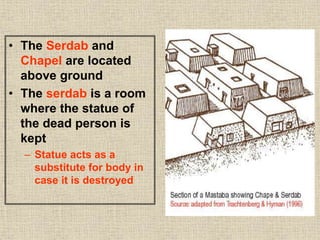
• The Serdab and
Chapel are located
above ground
• The serdab is a room
where the statue of
the dead person is
kept
– Statue acts as a
substitute for body in
case it is destroyed
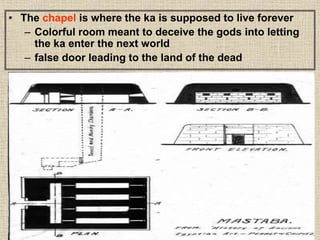
• The chapel is where the ka is supposed to live forever
– Colorful room meant to deceive the gods into letting
the ka enter the next world
– false door leading to the land of the dead
Stepped Pyramid
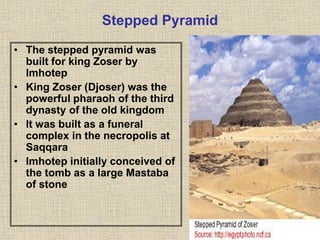
• The stepped pyramid was
built for king Zoser by
Imhotep
• King Zoser (Djoser) was the
powerful pharaoh of the third
dynasty of the old kingdom
• It was built as a funeral
complex in the necropolis at
Saqqara
• Imhotep initially conceived of
the tomb as a large Mastaba
of stone
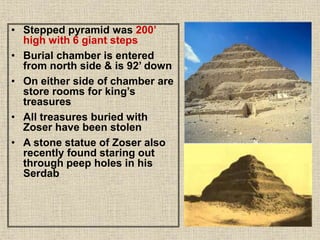
• Stepped pyramid was 200’
high with 6 giant steps
• Burial chamber is entered
from north side & is 92’ down
• On either side of chamber are
store rooms for king’s
treasures
• All treasures buried with
Zoser have been stolen
• A stone statue of Zoser also
recently found staring out
through peep holes in his
Serdab
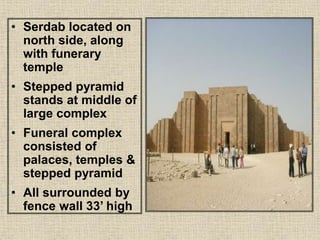
• Serdab located on
north side, along
with funerary
temple
• Stepped pyramid
stands at middle of
large complex
• Funeral complex
consisted of
palaces, temples &
stepped pyramid
• All surrounded by
fence wall 33’ high
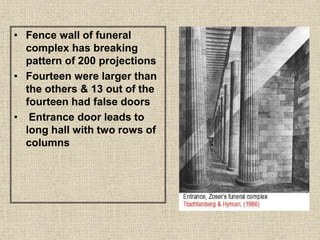
• Fence wall of funeral
complex has breaking
pattern of 200 projections
• Fourteen were larger than
the others & 13 out of the
fourteen had false doors
• Entrance door leads to
long hall with two rows of
columns
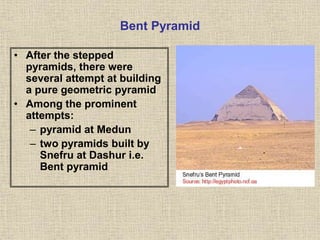
Bent Pyramid
• After the stepped
pyramids, there were
several attempt at building
a pure geometric pyramid
• Among the prominent
attempts:
– pyramid at Medun
– two pyramids built by
Snefru at Dashur i.e.
Bent pyramid
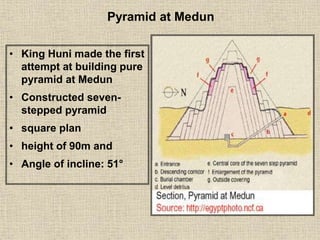
• King Huni made the first
attempt at building pure
pyramid at Medun
• Constructed seven-
stepped pyramid
• square plan
• height of 90m and
• Angle of incline: 51°
Pyramid at Medun
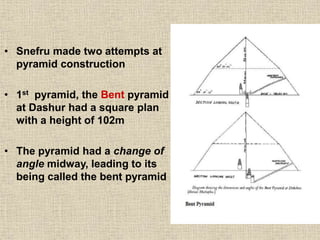
• Snefru made two attempts at
pyramid construction
• 1st pyramid, the Bent pyramid
at Dashur had a square plan
with a height of 102m
• The pyramid had a change of
angle midway, leading to its
being called the bent pyramid
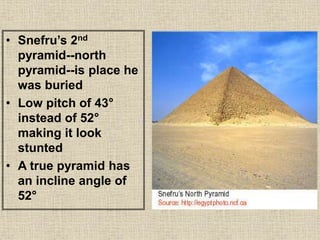
• Snefru’s 2nd
pyramid--north
pyramid--is place he
was buried
• Low pitch of 43°
instead of 52°
making it look
stunted
• A true pyramid has
an incline angle of
52°
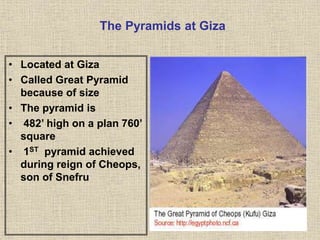
The Pyramids at Giza
• Located at Giza
• Called Great Pyramid
because of size
• The pyramid is
• 482’ high on a plan 760’
square
• 1ST pyramid achieved
during reign of Cheops,
son of Snefru
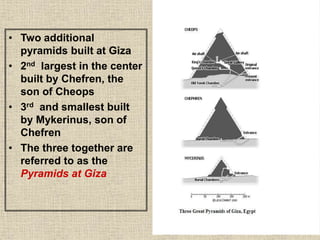
• Two additional
pyramids built at Giza
• 2nd largest in the center
built by Chefren, the
son of Cheops
• 3rd and smallest built
by Mykerinus, son of
Chefren
• The three together are
referred to as the
Pyramids at Giza
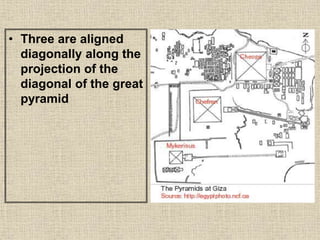
• Three are aligned
diagonally along the
projection of the
diagonal of the great
pyramid
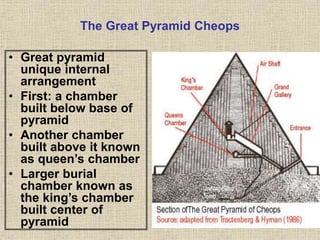
The Great Pyramid Cheops
• Great pyramid
unique internal
arrangement
• First: a chamber
built below base of
pyramid
• Another chamber
built above it known
as queen’s chamber
• Larger burial
chamber known as
the king’s chamber
built center of
pyramid
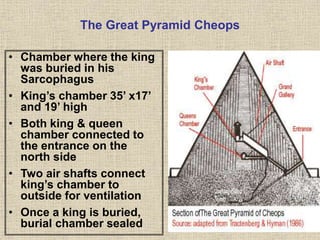
The Great Pyramid Cheops
• Chamber where the king
was buried in his
Sarcophagus
• King’s chamber 35’ x17’
and 19’ high
• Both king & queen
chamber connected to
the entrance on the
north side
• Two air shafts connect
king’s chamber to
outside for ventilation
• Once a king is buried,
burial chamber sealed
Pyramid Complex
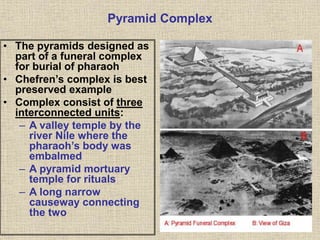
• The pyramids designed as
part of a funeral complex
for burial of pharaoh
• Chefren’s complex is best
preserved example
• Complex consist of three
interconnected units:
– A valley temple by the
river Nile where the
pharaoh’s body was
embalmed
– A pyramid mortuary
temple for rituals
– A long narrow
causeway connecting
the two
Pyramid Construction
• No accurate knowledge about the method of
construction of the pyramids
• Estimates vary: 20,000 men worked 3-4
months each year for 20 years to build the
pyramids.
• Limestone quarried from nearby --
transported by lever action
• Built by the farmers - Paid in food, clothing
and drinks
• All their monuments including the pyramids
were built by hand.
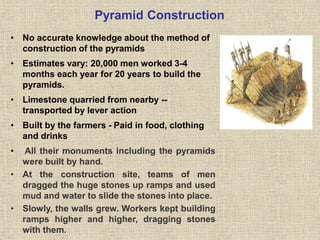
• At the construction site, teams of men
dragged the huge stones up ramps and used
mud and water to slide the stones into place.
• Slowly, the walls grew. Workers kept building
ramps higher and higher, dragging stones
with them.
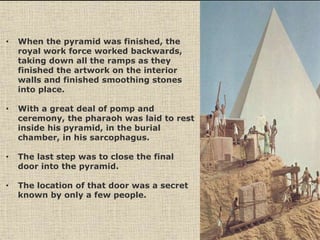
• When the pyramid was finished, the
royal work force worked backwards,
taking down all the ramps as they
finished the artwork on the interior
walls and finished smoothing stones
into place.
• With a great deal of pomp and
ceremony, the pharaoh was laid to rest
inside his pyramid, in the burial
chamber, in his sarcophagus.
• The last step was to close the final
door into the pyramid.
• The location of that door was a secret
known by only a few people.
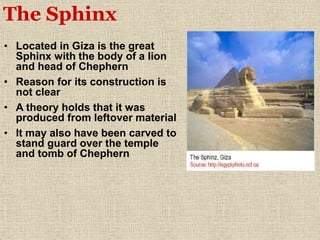
• Located in Giza is the great
Sphinx with the body of a lion
and head of Chephern
• Reason for its construction is
not clear
• A theory holds that it was
produced from leftover material
• It may also have been carved to
stand guard over the temple
and tomb of Chephern
The Sphinx
The Sphinx
Dimensions of the Sphinx
Paws: 50’ long (15m)
Head: 30’ long (10m) 14’ wide (4m)
Entire Body: 150’ (45m)
Originally commissioned by Chefren (a son of Cheops)
Constructed from a single piece of stone <bedrock>
weighing hundreds of tons bedrock found within the Valley
of Giza.
Age of the Sphinx: ~5,000 years old
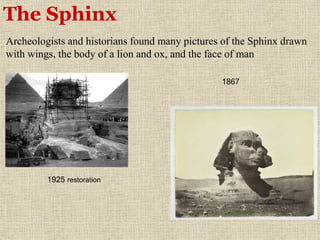
The Sphinx
Archeologists and historians found many pictures of the Sphinx drawn
with wings, the body of a lion and ox, and the face of man
1867
1925 restoration
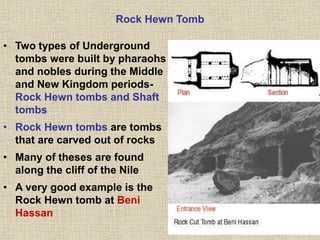
Rock Hewn Tomb
• Two types of Underground
tombs were built by pharaohs
and nobles during the Middle
and New Kingdom periods-
Rock Hewn tombs and Shaft
tombs
• Rock Hewn tombs are tombs
that are carved out of rocks
• Many of theses are found
along the cliff of the Nile
• A very good example is the
Rock Hewn tomb at Beni
Hassan
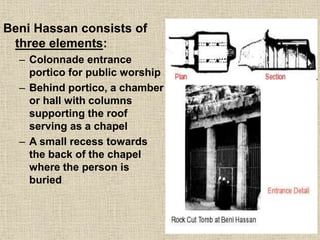
Beni Hassan consists of
three elements:
– Colonnade entrance
portico for public worship
– Behind portico, a chamber
or hall with columns
supporting the roof
serving as a chapel
– A small recess towards
the back of the chapel
where the person is
buried
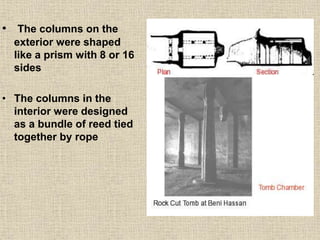
• The columns on the
exterior were shaped
like a prism with 8 or 16
sides
• The columns in the
interior were designed
as a bundle of reed tied
together by rope
CONCLUSION
Major Works
Old Kingdom
1. Mastabas
2. Stepped Pyramid of Zozer @ Saqqara by Imhotep
3. Great Pyramids @ Giza Cheops (Khufu)
Chephren (Kafra)
Mykerinus (Menkaura)
Middle Kingdom
4. Rock Cut Tombs @ Beni Hasan
3200 - 2258 BC
2650 BC
2575 BC
2530 BC
2500 BC
2134 - 1570 BC
1975 - 1800 BC
• https://www.slideshare.net
• https://www.historymuseum.ca
REFERENCE
• http://www.historyshistories.com
THANK YOU

Burial architecture

  • 1.
  • 2.
    Content 1. Introduction 2. Evolutionof Pyramid 3. Pyramids at Giza 4. Pyramid Construction 5. Rock hewn Tombs
  • 3.
    Introduction Location: Bank ofRiver Nile, Egypt Before the “Old Kingdom,” Egypt was divided into Upper and Lower kingdoms. Lower Egypt was in the NORTH. Upper Egypt was in the SOUTH. Old Kingdom (3400 B.C. to 2500 B.C.)
  • 4.
    • During theold Kingdom, the pharaoh and his court lived in Memphis • When they died they were buried at the Necropolis at Saqqara • The earthly dwelling of the ancient Egyptians was seen as temporary and the tomb as a permanent dwelling • Tombs were most outstanding architectural element of the period. • Tombs also serve as the focus for the worship of the dead.
  • 5.
    Evolution of thepyramid Developed in three types: 1.Mastaba 2. Royal Pyramids Stepped Pyramid Bent Pyramid 3. Rock Hewn Tombs
  • 6.
    Mastaba • The earliestmethod of burial in ancient Egypt was in shallow pits in the desert • When animals preyed on bodies, the people dug deeper • In the end they built a bench-like structure over graves to create first burial structure called Mastaba • In the Old Kingdom, rich and noble person built mastaba for their burial in the city of the dead
  • 7.
    • Above groundthe Mastaba is a large bench of sun- baked bricks rising 9 meters high • It had a rectangular flat top and slanting walls • The earliest royal tombs were decorated with painted patterns in brilliant colors
  • 8.
    • Internally, amastaba consist of three parts- a burial chamber, a serdab and a chapel • The burial chamber was located 30’ below ground – Connected to burial chamber above ground through a shaft – place for the burial of the dead person
  • 9.
    • In thechamber, the sarcophagus is found where the dead body was placed • The burial chamber is packed with all the necessary things needed in the afterlife • After burial, the shaft to the burial chamber was sealed
  • 10.
    • The Serdaband Chapel are located above ground • The serdab is a room where the statue of the dead person is kept – Statue acts as a substitute for body in case it is destroyed
  • 11.
    • The chapelis where the ka is supposed to live forever – Colorful room meant to deceive the gods into letting the ka enter the next world – false door leading to the land of the dead
  • 12.
    Stepped Pyramid • Thestepped pyramid was built for king Zoser by Imhotep • King Zoser (Djoser) was the powerful pharaoh of the third dynasty of the old kingdom • It was built as a funeral complex in the necropolis at Saqqara • Imhotep initially conceived of the tomb as a large Mastaba of stone
  • 13.
    • Stepped pyramidwas 200’ high with 6 giant steps • Burial chamber is entered from north side & is 92’ down • On either side of chamber are store rooms for king’s treasures • All treasures buried with Zoser have been stolen • A stone statue of Zoser also recently found staring out through peep holes in his Serdab
  • 14.
    • Serdab locatedon north side, along with funerary temple • Stepped pyramid stands at middle of large complex • Funeral complex consisted of palaces, temples & stepped pyramid • All surrounded by fence wall 33’ high
  • 15.
    • Fence wallof funeral complex has breaking pattern of 200 projections • Fourteen were larger than the others & 13 out of the fourteen had false doors • Entrance door leads to long hall with two rows of columns
  • 16.
    Bent Pyramid • Afterthe stepped pyramids, there were several attempt at building a pure geometric pyramid • Among the prominent attempts: – pyramid at Medun – two pyramids built by Snefru at Dashur i.e. Bent pyramid
  • 17.
    • King Hunimade the first attempt at building pure pyramid at Medun • Constructed seven- stepped pyramid • square plan • height of 90m and • Angle of incline: 51° Pyramid at Medun
  • 18.
    • Snefru madetwo attempts at pyramid construction • 1st pyramid, the Bent pyramid at Dashur had a square plan with a height of 102m • The pyramid had a change of angle midway, leading to its being called the bent pyramid
  • 19.
    • Snefru’s 2nd pyramid--north pyramid--isplace he was buried • Low pitch of 43° instead of 52° making it look stunted • A true pyramid has an incline angle of 52°
  • 20.
    The Pyramids atGiza • Located at Giza • Called Great Pyramid because of size • The pyramid is • 482’ high on a plan 760’ square • 1ST pyramid achieved during reign of Cheops, son of Snefru
  • 21.
    • Two additional pyramidsbuilt at Giza • 2nd largest in the center built by Chefren, the son of Cheops • 3rd and smallest built by Mykerinus, son of Chefren • The three together are referred to as the Pyramids at Giza
  • 22.
    • Three arealigned diagonally along the projection of the diagonal of the great pyramid
  • 23.
    The Great PyramidCheops • Great pyramid unique internal arrangement • First: a chamber built below base of pyramid • Another chamber built above it known as queen’s chamber • Larger burial chamber known as the king’s chamber built center of pyramid
  • 24.
    The Great PyramidCheops • Chamber where the king was buried in his Sarcophagus • King’s chamber 35’ x17’ and 19’ high • Both king & queen chamber connected to the entrance on the north side • Two air shafts connect king’s chamber to outside for ventilation • Once a king is buried, burial chamber sealed
  • 25.
    Pyramid Complex • Thepyramids designed as part of a funeral complex for burial of pharaoh • Chefren’s complex is best preserved example • Complex consist of three interconnected units: – A valley temple by the river Nile where the pharaoh’s body was embalmed – A pyramid mortuary temple for rituals – A long narrow causeway connecting the two
  • 26.
    Pyramid Construction • Noaccurate knowledge about the method of construction of the pyramids • Estimates vary: 20,000 men worked 3-4 months each year for 20 years to build the pyramids. • Limestone quarried from nearby -- transported by lever action • Built by the farmers - Paid in food, clothing and drinks • All their monuments including the pyramids were built by hand. • At the construction site, teams of men dragged the huge stones up ramps and used mud and water to slide the stones into place. • Slowly, the walls grew. Workers kept building ramps higher and higher, dragging stones with them.
  • 27.
    • When thepyramid was finished, the royal work force worked backwards, taking down all the ramps as they finished the artwork on the interior walls and finished smoothing stones into place. • With a great deal of pomp and ceremony, the pharaoh was laid to rest inside his pyramid, in the burial chamber, in his sarcophagus. • The last step was to close the final door into the pyramid. • The location of that door was a secret known by only a few people.
  • 28.
    • Located inGiza is the great Sphinx with the body of a lion and head of Chephern • Reason for its construction is not clear • A theory holds that it was produced from leftover material • It may also have been carved to stand guard over the temple and tomb of Chephern The Sphinx
  • 29.
    The Sphinx Dimensions ofthe Sphinx Paws: 50’ long (15m) Head: 30’ long (10m) 14’ wide (4m) Entire Body: 150’ (45m) Originally commissioned by Chefren (a son of Cheops) Constructed from a single piece of stone <bedrock> weighing hundreds of tons bedrock found within the Valley of Giza. Age of the Sphinx: ~5,000 years old
  • 30.
    The Sphinx Archeologists andhistorians found many pictures of the Sphinx drawn with wings, the body of a lion and ox, and the face of man 1867 1925 restoration
  • 31.
    Rock Hewn Tomb •Two types of Underground tombs were built by pharaohs and nobles during the Middle and New Kingdom periods- Rock Hewn tombs and Shaft tombs • Rock Hewn tombs are tombs that are carved out of rocks • Many of theses are found along the cliff of the Nile • A very good example is the Rock Hewn tomb at Beni Hassan
  • 32.
    Beni Hassan consistsof three elements: – Colonnade entrance portico for public worship – Behind portico, a chamber or hall with columns supporting the roof serving as a chapel – A small recess towards the back of the chapel where the person is buried
  • 33.
    • The columnson the exterior were shaped like a prism with 8 or 16 sides • The columns in the interior were designed as a bundle of reed tied together by rope
  • 34.
    CONCLUSION Major Works Old Kingdom 1.Mastabas 2. Stepped Pyramid of Zozer @ Saqqara by Imhotep 3. Great Pyramids @ Giza Cheops (Khufu) Chephren (Kafra) Mykerinus (Menkaura) Middle Kingdom 4. Rock Cut Tombs @ Beni Hasan 3200 - 2258 BC 2650 BC 2575 BC 2530 BC 2500 BC 2134 - 1570 BC 1975 - 1800 BC
  • 35.
  • 36.