INDIAN ARCHITECT
AR. SATISH GUJRAL
SUBJECT: HISTORY
PRESENTED BY: RITU GOSAVI
INTRODUCTION
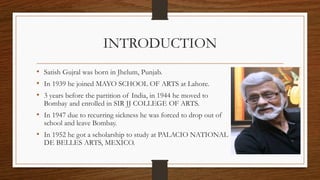
• Satish Gujral was born in Jhelum, Punjab.
• In 1939 he joined MAYO SCHOOL OF ARTS at Lahore.
• 3 years before the partition of India, in 1944 he moved to
Bombay and enrolled in SIR JJ COLLEGE OF ARTS.
• In 1947 due to recurring sickness he was forced to drop out of
school and leave Bombay.
• In 1952 he got a scholarship to study at PALACIO NATIONAL
DE BELLES ARTS, MEXICO.
TRANSFORMATION IN MEDIUM
• His search was on for what was living and life giving in the traditional arts and crafts of
India.
• Then he diversified his sculpture materials with machined industrial objects in steel,
copper, glass.
• Satish Gujral’s sculptures in burnt wood have came with a kind of visceral exposure of
forms human.
• He executed commissions to make large murals mostly in mosaic and ceramic tiles.
Later in the machined steel elements simulated his interest in their immediate
architectural context.
PAINTINGS
SCULPTURE
MURALS
PHILOSOPHY
• He used sculptural form, especially from the outside, moving inside is like
moving through sculptural space. For example Belgium embassy.
• His work in art and craft inspires his project.
• Satish Gujral says “ Modern architectural is built for nowhere and speaks of
nowhere. But building is like a human being, it has its own identity and
provides an identity to its inhabitants.”
WORKS
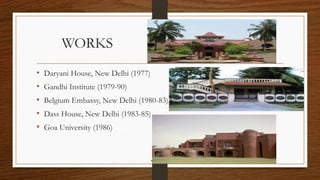
• Daryani House, New Delhi (1977)
• Gandhi Institute (1979-90)
• Belgium Embassy, New Delhi (1980-83)
• Dass House, New Delhi (1983-85)
• Goa University (1986)
CASE STUDY
EMBASSY OF BELGIUM NEW DELHI
EMBASSY OF BELGIUM NEW
DELHI
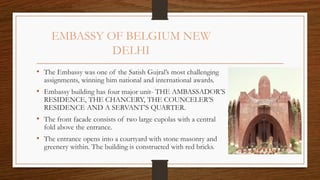
• The Embassy was one of the Satish Gujral’s most challenging
assignments, winning him national and international awards.
• Embassy building has four major unit- THE AMBASSADOR’S
RESIDENCE, THE CHANCERY, THE COUNCELER’S
RESIDENCE AND A SERVANT’S QUARTER.
• The front facade consists of two large cupolas with a central
fold above the entrance.
• The entrance opens into a courtyard with stone masonry and
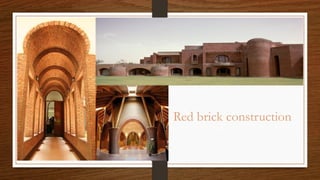
greenery within. The building is constructed with red bricks.
Red brick construction
PLANNING
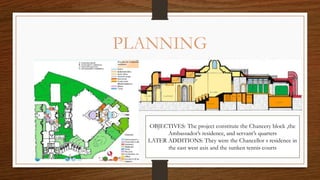
OBJECTIVES: The project constitute the Chancery block ,the
Ambassador’s residence, and servant’s quarters
LATER ADDITIONS: They were the Chancellor s residence in
the east west axis and the sunken tennis courts

Ar. satish gujral indian architect

  • 1.
    INDIAN ARCHITECT AR. SATISHGUJRAL SUBJECT: HISTORY PRESENTED BY: RITU GOSAVI
  • 2.
    INTRODUCTION • Satish Gujralwas born in Jhelum, Punjab. • In 1939 he joined MAYO SCHOOL OF ARTS at Lahore. • 3 years before the partition of India, in 1944 he moved to Bombay and enrolled in SIR JJ COLLEGE OF ARTS. • In 1947 due to recurring sickness he was forced to drop out of school and leave Bombay. • In 1952 he got a scholarship to study at PALACIO NATIONAL DE BELLES ARTS, MEXICO.
  • 3.
    TRANSFORMATION IN MEDIUM •His search was on for what was living and life giving in the traditional arts and crafts of India. • Then he diversified his sculpture materials with machined industrial objects in steel, copper, glass. • Satish Gujral’s sculptures in burnt wood have came with a kind of visceral exposure of forms human. • He executed commissions to make large murals mostly in mosaic and ceramic tiles. Later in the machined steel elements simulated his interest in their immediate architectural context.
  • 4.
  • 5.
  • 6.
  • 7.
    PHILOSOPHY • He usedsculptural form, especially from the outside, moving inside is like moving through sculptural space. For example Belgium embassy. • His work in art and craft inspires his project. • Satish Gujral says “ Modern architectural is built for nowhere and speaks of nowhere. But building is like a human being, it has its own identity and provides an identity to its inhabitants.”
  • 8.
    WORKS • Daryani House,New Delhi (1977) • Gandhi Institute (1979-90) • Belgium Embassy, New Delhi (1980-83) • Dass House, New Delhi (1983-85) • Goa University (1986)
  • 9.
    CASE STUDY EMBASSY OFBELGIUM NEW DELHI
  • 10.
    EMBASSY OF BELGIUMNEW DELHI • The Embassy was one of the Satish Gujral’s most challenging assignments, winning him national and international awards. • Embassy building has four major unit- THE AMBASSADOR’S RESIDENCE, THE CHANCERY, THE COUNCELER’S RESIDENCE AND A SERVANT’S QUARTER. • The front facade consists of two large cupolas with a central fold above the entrance. • The entrance opens into a courtyard with stone masonry and greenery within. The building is constructed with red bricks.
  • 11.
  • 12.
    PLANNING OBJECTIVES: The projectconstitute the Chancery block ,the Ambassador’s residence, and servant’s quarters LATER ADDITIONS: They were the Chancellor s residence in the east west axis and the sunken tennis courts