en love da Homoeopathy
PYOGENIC
ABSCESS
PYOGENIC
ABSCESS
ABSCESS
DEFINITION
• An Abscessis a
circumscribedarea of
inflammationor an
abnormal cavity that cntains
pus if matured
TYPES
• Pyogenicabscess
• Pyaemic Abscess
• Metastatic abscess
• Cold abscessdue to chronic
infectionlike tuberculosis
PYOGENICABSCESS
DEFINITION
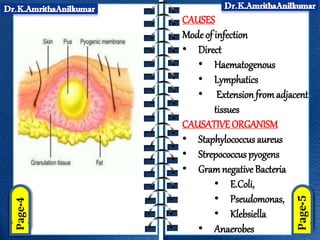
• It is localized collection
of pus in a cavity lined
by granulationtissue,
covered by pyogenic
membrane
• It contains pus in loculi
CAUSES
Modeof infection
• Direct
• Haematogenous
• Lymphatics
• Extension fromadjacent
tissues
CAUSATIVEORGANISM
• Staphylococcus aureus
• Strepococcus pyogens
• Gramnegative Bacteria
• E.Coli,
• Pseudomonas,
• Klebsiella
• Anaerobes
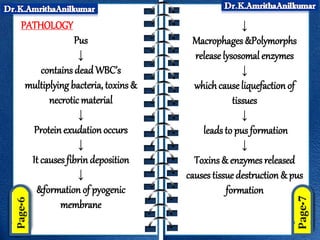
PATHOLOGY
Pus
↓
contains dead WBC’s
multiplying bacteria, toxins &
necrotic material
↓
Proteinexudationoccurs
↓
It causes fibrindeposition
↓
&formation of pyogenic
membrane
↓
Macrophages &Polymorphs
release lysosomal enzymes
↓
whichcauseliquefaction of
tissues
↓
leads to pus formation
↓
Toxins & enzymes released
causes tissue destruction & pus
formation
PRECIPITATINGFACTORS
• General condition of
the patient
• Nutrition
• Anaemia
• Age of the patient
• Associateddiseases
• Diabetes
• HIV
• Immunosup
pression
• Types & Virulence
of the organisms
• Trauma
• Hematoma
• Road TrafficAccidents
CLINICALFACTORS
• Fever oftenchills &
Rigors
• Localized Swelling
whichis smooth, soft,
& fluctuant
• Viable (pointing) pus
• Throbbing pain
• pointing Tenderness
• Brawny induration
around
• Redness & warmthwith
restrictedmovement
arounda joint
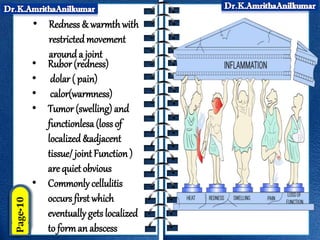
• Rubor (redness)
• dolar ( pain)
• calor(warmness)
• Tumor (swelling) and
functionlesa(lossof
localized&adjacent
tissue/ jointFunction)
are quiet obvious
• Commonly cellulitis
occurs first which
eventually gets localized
to forman abscess
COMMONSITES
Site of abscess
External sites
• Fingers & hand
• Thigh– here it is deeply
situatedwithbrawny
induration
• Ischiorectal & perianal
region
• Abdominal wall
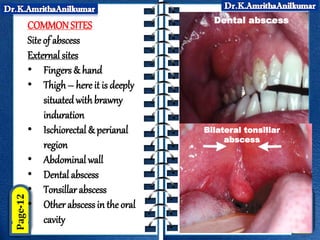
• Dental abscess
• Tonsillar abscess
• Other abscessin the oral
cavity
Dental abscess
Bilateral tonsillar
abscess
Internal sites
• Internal abscess
• Abdominal
• Sub-phrenic
• Pelvic
• Paracolic
• AmoebicLiver Abscess
• Pyogenicabscess of liver
• Splenic abscess
• PancreaticAbscess
• PerinephricAbscess
• Retroperitoneal
Abscess
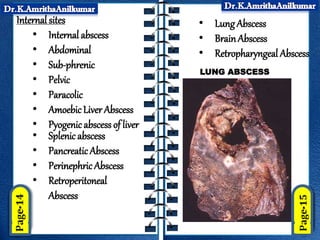
• Lung Abscess
• BrainAbscess
• Retropharyngeal Abscess
LUNG ABSCESS
INVESTIGATIONS
• Total countis increased
• Urine
• Sugar
• Blood sugar is done to rule
out diabetes
• USGof the part or
abdomen/other regionis
donewhen Required
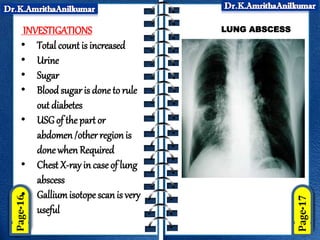
• Chest X-ray in case of lung
abscess
• Galliumisotope scanis very
useful
LUNG ABSCESS
COMPLICATION
• Bacteriaemia
• Septicaemia
• Pyaemia
• Multiple abscess
formation
• Metastatic Abscess
• Destruction of tissues
• Once abscessforms
,Thickfibrous tissue
develops aroundabscess
cavity because of
antibiotics
• Cavitycontains sterile
pus as Thick Plaques
• It is non – tender,
localizedsmooth, hard
swelling which may
mimiccarcinoma
• Large abscess may erode
into adjacent vessels & cause
life –threatening torrential
haemorrhage
• Eg., as in pancreatic abscess
• Brainabscess –
intracranial
hypertension, epilepsy,
neurological deficit
• Liver Abscess- cause
hepaticfailure, rupture
jaundice
• Lung Abscess –
Bronchopleural fistula
or septicemia, or
respiratory failureor
AIDS
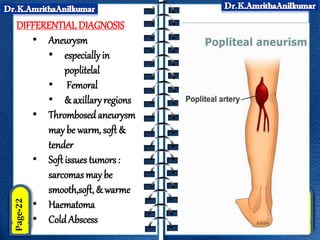
DIFFERENTIAL DIAGNOSIS
• Aneurysm
• especiallyin
poplitelal
• Femoral
• & axillaryregions
• Thrombosedaneurysm
may be warm, soft &
tender
• Soft issues tumors :
sarcomasmay be
smooth,soft, & warme
• Haematoma
• Cold Abscess
TREATMENT
• Abscessshould be formed
before draining ,
• except ParotidAbscess
• Breast Abscess
• Axillary Abscess
• ThighAbscess
• Ischiorectal Abscess
• Initially broad spectrum
antibiotics are started
(depending uponseverity,
extent & site of the abscess)
Hilton’s method of draining an
abscess
Under general anaesthesia or
regional blockanaesthesia
↓
after cleaning & draping
↓
Abscessis aspiratedand
presence of pus is confirmed
↓
Skin is incisedadequately, in the
line parallel to neurovascular
bundle in the most dependent
position
↓
Next pyogenicmembrane is
openedusing sinus Forceps & all
loculi are broken up
↓
Abscesscavity is cleared of pus &
washed withsaline
↓
A drain( either gauze drain or
corrugatedrubber drain) is
placed
↓
Wound is not closed. woundis
allowed to granulate & heal
↓
Pus is sent for culture &
sensitivity
↓
Biopsy should be donein case of
suspectedmalignancy
↓
Sometimes secondary suturing
or skingrafting is required
↓
Treating the cause is
important
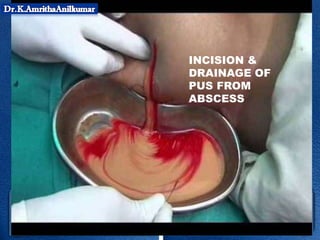
INCISION &
DRAINAGE OF
PUS FROM
ABSCESS
REFERENCE
1. SRB's Manual of Surgery
by SriramBhat M
2. A Manual on Clinical
Surgeryby Das
3. A Concise textbookof
Surgeryby Das
A
Special Thanks
To A Very
Special Doctor

Pyogenic abscess by Dr.K.AmrithaAnilkumar

  • 1.
    en love daHomoeopathy PYOGENIC ABSCESS
  • 2.
  • 3.
    ABSCESS DEFINITION • An Abscessisa circumscribedarea of inflammationor an abnormal cavity that cntains pus if matured TYPES • Pyogenicabscess • Pyaemic Abscess • Metastatic abscess • Cold abscessdue to chronic infectionlike tuberculosis PYOGENICABSCESS DEFINITION • It is localized collection of pus in a cavity lined by granulationtissue, covered by pyogenic membrane • It contains pus in loculi
  • 4.
    CAUSES Modeof infection • Direct •Haematogenous • Lymphatics • Extension fromadjacent tissues CAUSATIVEORGANISM • Staphylococcus aureus • Strepococcus pyogens • Gramnegative Bacteria • E.Coli, • Pseudomonas, • Klebsiella • Anaerobes
  • 5.
    PATHOLOGY Pus ↓ contains dead WBC’s multiplyingbacteria, toxins & necrotic material ↓ Proteinexudationoccurs ↓ It causes fibrindeposition ↓ &formation of pyogenic membrane ↓ Macrophages &Polymorphs release lysosomal enzymes ↓ whichcauseliquefaction of tissues ↓ leads to pus formation ↓ Toxins & enzymes released causes tissue destruction & pus formation
  • 6.
    PRECIPITATINGFACTORS • General conditionof the patient • Nutrition • Anaemia • Age of the patient • Associateddiseases • Diabetes • HIV • Immunosup pression • Types & Virulence of the organisms • Trauma • Hematoma • Road TrafficAccidents CLINICALFACTORS • Fever oftenchills & Rigors • Localized Swelling whichis smooth, soft, & fluctuant • Viable (pointing) pus • Throbbing pain • pointing Tenderness • Brawny induration around
  • 7.
    • Redness &warmthwith restrictedmovement arounda joint • Rubor (redness) • dolar ( pain) • calor(warmness) • Tumor (swelling) and functionlesa(lossof localized&adjacent tissue/ jointFunction) are quiet obvious • Commonly cellulitis occurs first which eventually gets localized to forman abscess
  • 8.
    COMMONSITES Site of abscess Externalsites • Fingers & hand • Thigh– here it is deeply situatedwithbrawny induration • Ischiorectal & perianal region • Abdominal wall • Dental abscess • Tonsillar abscess • Other abscessin the oral cavity Dental abscess Bilateral tonsillar abscess
  • 9.
    Internal sites • Internalabscess • Abdominal • Sub-phrenic • Pelvic • Paracolic • AmoebicLiver Abscess • Pyogenicabscess of liver • Splenic abscess • PancreaticAbscess • PerinephricAbscess • Retroperitoneal Abscess • Lung Abscess • BrainAbscess • Retropharyngeal Abscess LUNG ABSCESS
  • 10.
    INVESTIGATIONS • Total countisincreased • Urine • Sugar • Blood sugar is done to rule out diabetes • USGof the part or abdomen/other regionis donewhen Required • Chest X-ray in case of lung abscess • Galliumisotope scanis very useful LUNG ABSCESS
  • 11.
    COMPLICATION • Bacteriaemia • Septicaemia •Pyaemia • Multiple abscess formation • Metastatic Abscess • Destruction of tissues • Once abscessforms ,Thickfibrous tissue develops aroundabscess cavity because of antibiotics • Cavitycontains sterile pus as Thick Plaques • It is non – tender, localizedsmooth, hard swelling which may mimiccarcinoma
  • 12.
    • Large abscessmay erode into adjacent vessels & cause life –threatening torrential haemorrhage • Eg., as in pancreatic abscess • Brainabscess – intracranial hypertension, epilepsy, neurological deficit • Liver Abscess- cause hepaticfailure, rupture jaundice • Lung Abscess – Bronchopleural fistula or septicemia, or respiratory failureor AIDS
  • 13.
    DIFFERENTIAL DIAGNOSIS • Aneurysm •especiallyin poplitelal • Femoral • & axillaryregions • Thrombosedaneurysm may be warm, soft & tender • Soft issues tumors : sarcomasmay be smooth,soft, & warme • Haematoma • Cold Abscess
  • 14.
    TREATMENT • Abscessshould beformed before draining , • except ParotidAbscess • Breast Abscess • Axillary Abscess • ThighAbscess • Ischiorectal Abscess • Initially broad spectrum antibiotics are started (depending uponseverity, extent & site of the abscess) Hilton’s method of draining an abscess Under general anaesthesia or regional blockanaesthesia ↓ after cleaning & draping ↓ Abscessis aspiratedand presence of pus is confirmed ↓ Skin is incisedadequately, in the line parallel to neurovascular bundle in the most dependent position
  • 15.
    ↓ Next pyogenicmembrane is openedusingsinus Forceps & all loculi are broken up ↓ Abscesscavity is cleared of pus & washed withsaline ↓ A drain( either gauze drain or corrugatedrubber drain) is placed ↓ Wound is not closed. woundis allowed to granulate & heal ↓ Pus is sent for culture & sensitivity ↓ Biopsy should be donein case of suspectedmalignancy ↓ Sometimes secondary suturing or skingrafting is required ↓ Treating the cause is important
  • 16.
  • 17.
    REFERENCE 1. SRB's Manualof Surgery by SriramBhat M 2. A Manual on Clinical Surgeryby Das 3. A Concise textbookof Surgeryby Das
  • 18.
    A Special Thanks To AVery Special Doctor