PYELONEPHRITIS 10/2010
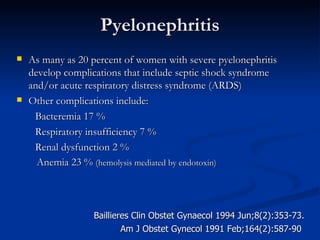
Pyelonephritis As many as 20 percent of women with severe pyelonephritis develop complications that include septic shock syndrome and/or acute respiratory distress syndrome (ARDS)  Other complications include: Bacteremia 17 % Respiratory insufficiency 7 % Renal dysfunction 2 %  Anemia 23 %  (hemolysis mediated by endotoxin) Am J Obstet Gynecol 1991 Feb;164(2):587-90 Baillieres Clin Obstet Gynaecol 1994 Jun;8(2):353-73.
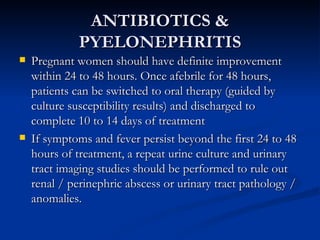
ANTIBIOTICS & PYELONEPHRITIS Pregnant women should have definite improvement within 24 to 48 hours. Once afebrile for 48 hours, patients can be switched to oral therapy (guided by culture susceptibility results) and discharged to complete 10 to 14 days of treatment If symptoms and fever persist beyond the first 24 to 48 hours of treatment, a repeat urine culture and urinary tract imaging studies should be performed to rule out renal / perinephric abscess or urinary tract pathology / anomalies.
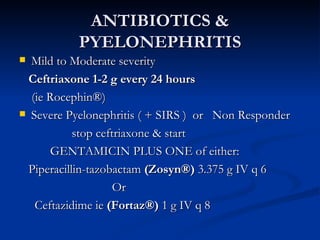
ANTIBIOTICS & PYELONEPHRITIS Mild to Moderate severity  Ceftriaxone 1-2 g every 24 hours   (ie Rocephin®) Severe Pyelonephritis ( + SIRS )  or  Non Responder stop ceftriaxone & start  GENTAMICIN PLUS ONE of either: Piperacillin-tazobactam  (Zosyn®)  3.375 g IV q 6  Or Ceftazidime ie  (Fortaz®)  1 g IV q 8
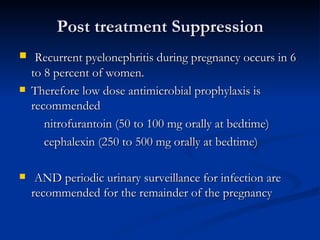
Post treatment Suppression   Recurrent pyelonephritis during pregnancy occurs in 6 to 8 percent of women.  Therefore low dose antimicrobial prophylaxis is recommended  nitrofurantoin (50 to 100 mg orally at bedtime)  cephalexin (250 to 500 mg orally at bedtime) AND periodic urinary surveillance for infection are recommended for the remainder of the pregnancy

Pyelonephritis

  • 1.
  • 2.
    Pyelonephritis As manyas 20 percent of women with severe pyelonephritis develop complications that include septic shock syndrome and/or acute respiratory distress syndrome (ARDS) Other complications include: Bacteremia 17 % Respiratory insufficiency 7 % Renal dysfunction 2 % Anemia 23 % (hemolysis mediated by endotoxin) Am J Obstet Gynecol 1991 Feb;164(2):587-90 Baillieres Clin Obstet Gynaecol 1994 Jun;8(2):353-73.
  • 3.
    ANTIBIOTICS & PYELONEPHRITISPregnant women should have definite improvement within 24 to 48 hours. Once afebrile for 48 hours, patients can be switched to oral therapy (guided by culture susceptibility results) and discharged to complete 10 to 14 days of treatment If symptoms and fever persist beyond the first 24 to 48 hours of treatment, a repeat urine culture and urinary tract imaging studies should be performed to rule out renal / perinephric abscess or urinary tract pathology / anomalies.
  • 4.
    ANTIBIOTICS & PYELONEPHRITISMild to Moderate severity Ceftriaxone 1-2 g every 24 hours (ie Rocephin®) Severe Pyelonephritis ( + SIRS ) or Non Responder stop ceftriaxone & start GENTAMICIN PLUS ONE of either: Piperacillin-tazobactam (Zosyn®) 3.375 g IV q 6 Or Ceftazidime ie (Fortaz®) 1 g IV q 8
  • 5.
    Post treatment Suppression  Recurrent pyelonephritis during pregnancy occurs in 6 to 8 percent of women. Therefore low dose antimicrobial prophylaxis is recommended nitrofurantoin (50 to 100 mg orally at bedtime) cephalexin (250 to 500 mg orally at bedtime) AND periodic urinary surveillance for infection are recommended for the remainder of the pregnancy