UTI are the most common medical
complications of pregnancy


                    Gilstreple III
                    Obstet-Gynecol Cln
                    North America 2001
UTI during pregnancy is independently
associated with preterm delivery, IUGR,
preeclampsia, and Cesarian deliveries


                     Efray Major-Dray
                     The Internal of Maternal-Fetal and
                     Neonatal Medicine
                     February 2009
UTI GUIDELINES IN PREGNANCY
URINARY TRACT INFECTION IN
PREGNANCY
• Asymptomatic Bacteriuria in Pregnancy
• Acute Cystitis in Pregnancy
• Acute Pyelonephritis in Pregnancy
ASYMPTOMATIC BACTERIURIA IN
PREGNANCY
DIAGNOSIS

• Presence of > 100,000 cfu/ml of one or more
  uropathogens in two consecutive midstream
  urine specimens or one catheterized urine
  specimen, in the absence of symptoms
  attributable to a urinary tract infection.
ASYMPTOMATIC BACTERIURIA IN
PREGNANCY
SCREENING

• All pregnant women must be screened for ASB
  on their first prenatal visit between the 9th to
  17th weeks, preferably on the 16th week age of
  gestation (Grade A).
ASYMPTOMATIC BACTERIURIA IN
PREGNANCY
OPTIMAL SCREENING TEST

• A standard urine culture of clean-catch
  midstream urine is the test of choice in
  screening for ASB (Grade A).
ASYMPTOMATIC BACTERIURIA IN
PREGNANCY
OPTIMAL SCREENING TEST

• In areas where urine culture is not available, the
  following can be used for screening: an initial
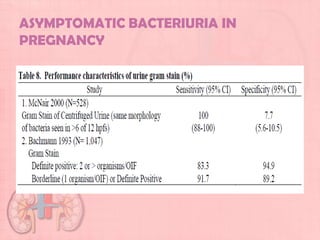
  gram stain of centrifuged urine (cut-off: same
  morphology of bacteria seen in >6 of 12 hpfs in
  centrifuged urine sample). If positive, this must
  be followed by a urinalysis to determine pyuria.
  A cut-off level of >5 wbc/hpf suggests ASB
  (Grade C).
ASYMPTOMATIC BACTERIURIA IN
PREGNANCY
OPTIMAL SCREENING TEST

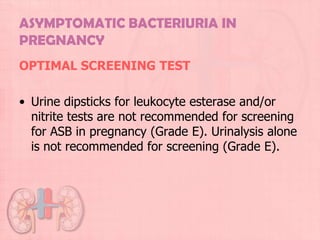
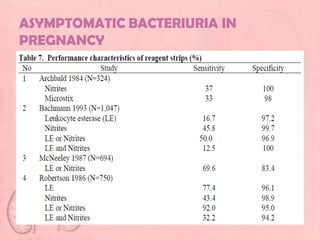
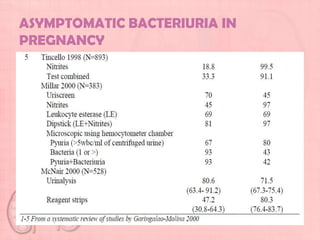
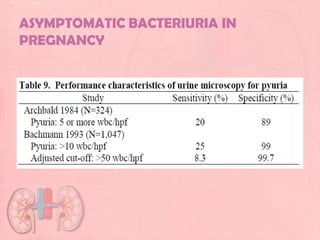
• Urine dipsticks for leukocyte esterase and/or
  nitrite tests are not recommended for screening
  for ASB in pregnancy (Grade E). Urinalysis alone
  is not recommended for screening (Grade E).
ASYMPTOMATIC BACTERIURIA IN
PREGNANCY
ASYMPTOMATIC BACTERIURIA IN
PREGNANCY
ASYMPTOMATIC BACTERIURIA IN
PREGNANCY
ASYMPTOMATIC BACTERIURIA IN
PREGNANCY
ASYMPTOMATIC BACTERIURIA IN
PREGNANCY
EFFECTIVE TREATMENT IN PREGNANCY

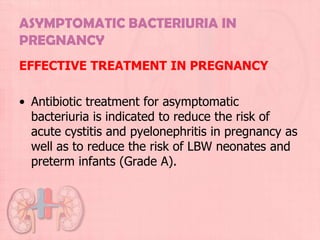
• Antibiotic treatment for asymptomatic
  bacteriuria is indicated to reduce the risk of
  acute cystitis and pyelonephritis in pregnancy as
  well as to reduce the risk of LBW neonates and
  preterm infants (Grade A).
ASYMPTOMATIC BACTERIURIA IN
PREGNANCY
EFFECTIVE TREATMENT IN PREGNANCY

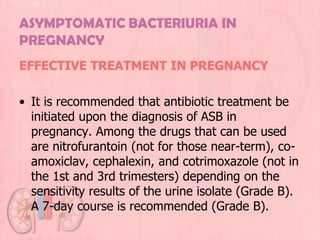
• It is recommended that antibiotic treatment be
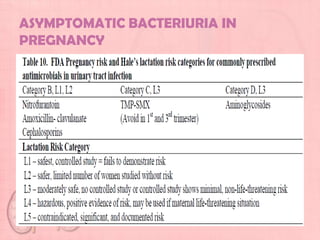
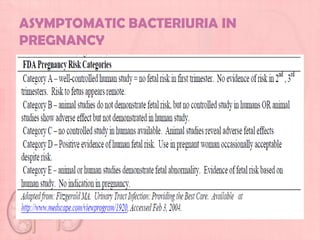
  initiated upon the diagnosis of ASB in
  pregnancy. Among the drugs that can be used
  are nitrofurantoin (not for those near-term), co-
  amoxiclav, cephalexin, and cotrimoxazole (not in
  the 1st and 3rd trimesters) depending on the
  sensitivity results of the urine isolate (Grade B).
  A 7-day course is recommended (Grade B).
ASYMPTOMATIC BACTERIURIA IN
PREGNANCY
EFFECTIVE TREATMENT IN PREGNANCY

• Do follow-up cultures one week after completing
  the course of treatment (Grade C).
ASYMPTOMATIC BACTERIURIA IN
PREGNANCY
ASYMPTOMATIC BACTERIURIA IN
PREGNANCY
ACUTE CYSTITIS IN PREGNANCY
When do you suspect acute cystitis in
 pregnancy?

• Acute cystitis is characterized by urinary
  frequency, urgency, dysuria and bacteriuria
  without fever and costovertebral angle
  enderness. Gross hematuria may also be present
  [Harris 1984].
ACUTE CYSTITIS IN PREGNANCY
Is a pretreatment diagnostic test required in
  acute cystitis in pregnancy?

• In pregnant women suspected to have acute
  uncomplicated cystitis, obtain a urine culture
  and sensitivity test of a midstream clean catch
  urine specimen (Grade B).
ACUTE CYSTITIS IN PREGNANCY
Is a pretreatment diagnostic test required in
  acute cystitis in pregnancy?

• In the absence of a urine culture, the laboratory
  diagnosis of acute cystitis can be determined by
  the presence of significant pyuria defined as a)
  > 8 pus cells/mm3 of uncentrifuged urine OR b)
  > 5 pus cells/hpf of centrifuged urine, and c) a
  positive leukocyte esterase and nitrite test
  (Grade C).
ACUTE CYSTITIS IN PREGNANCY
What is the treatment for acute cystitis in
 pregnancy?

• Treatment of acute cystitis in pregnancy should
  be instituted immediately to prevent the spread
  of the infection to the kidney (Grade A).
ACUTE CYSTITIS IN PREGNANCY
What is the treatment for acute cystitis in
 pregnancy?

• Since E. coli remains to be the most common organism
  isolated, antibiotics to which this organism is most
  sensitive and which are safe to give during pregnancy
  should be used (Grade A). TMP-SMX and
  fluoroquinolones are relatively contraindicated during
  pregnancy because of their potential teratogenicity and
  the third trimester risk of kernicterus with TMP-SMX. A
  7- day course is recommended (Grade C).
ACUTE CYSTITIS IN PREGNANCY
What is the treatment for acute cystitis in
 pregnancy?

• In the absence of a urine culture and sensitivity,
  empiric therapy should be based on local
  susceptibility patterns of uropathogens (Grade
  C).
ACUTE CYSTITIS IN PREGNANCY
In cases where the result of a urine culture
  shows an organism resistant to the
  emperically started antibiotic in a clinically
  improving patient, should the antibiotic be
  changed based on susceptibility report?

• Adjust antibiotic therapy based on urine culture
  results (Grade C).
ACUTE CYSTITIS IN PREGNANCY
In cases where the result of a urine culture shows an organism
   resistant to the emperically started antibiotic in a clinically
   improving patient, should the antibiotic be changed based
   on susceptibility report?


• Alternatively, repeat the urine culture. If sterile,
  continue with the same antibiotic. If bacteriuria
  persists, switch regimen based on culture result
  (Grade C).
ACUTE CYSTITIS IN PREGNANCY
What is the clinical utility of a post-
 treatment urine culture?

• Post-treatment urine culture should be obtained
  to confirm eradication of bacteriuria and
  resolution of infection in pregnant women
  (Grade C).
ACUTE CYSTITIS IN PREGNANCY
What is the clinical utility of a post-
 treatment urine culture?

• Pregnant patients with pyelonephritis, recurrent
  UTIs, concurrent gestational DM, concurrent
  nephrolithiasis or urolithiasis, and pre-eclampsia,
  should be monitored at monthly intervals until
  delivery to ensure that urine remains sterile
  during pregnancy (Grade C).
ACUTE PYELONEPHRITIS IN PREGNANCY
When is acute pyelonephritis in pregnancy
 suspected?

• Acute pyelonephritis is characterized by shaking
  chills, fever (T>38 C), flank pain, nausea and
  vomiting, with or without signs and symptoms of
  lower urinary tract infections and physical
  finding of costovertebral angle tenderness.
ACUTE PYELONEPHRITIS IN PREGNANCY
When is acute pyelonephritis in pregnancy
 suspected?

• Urinalysis shows pyuria of > 5 wbc/hpf of
  centrifuged urine and bacteriuria of > 10,000 cfu
  of a uropathogen/ml of urine [Harris, 1984,
  Roberts 1986, Rubin 1992].
ACUTE PYELONEPHRITIS IN PREGNANCY
What is the appropriate diagnostic test to
 establish an etiologic diagnosis?

• Gram stain of uncentrifuged urine is
  recommended to differentiate gram positive
  from gram-negative bacteriuria, the result of
  which can guide the choice of empiric antibiotic
  therapy (Grade B).
ACUTE PYELONEPHRITIS IN PREGNANCY
What is the appropriate diagnostic test to
 establish an etiologic diagnosis?

• Urine culture and sensitivity test should also be
  performed routinely to guide the choice of
  antimicrobial agents because of the potential for
  serious sequelae if inappropriate antimicrobial
  regimen is used (Grade B).
ACUTE PYELONEPHRITIS IN PREGNANCY
What is the appropriate diagnostic test to
 establish an etiologic diagnosis?

• Blood cultures are not routinely recommended
  for all pregnant patients with acute
  pyelonephritis (Grade D).
ACUTE PYELONEPHRITIS IN PREGNANCY
What antimicrobials are recommended for
 acute pyelonephritis in pregnant women?

• All pregnant patients with acute pyelonephritis
  should be hospitalized and immediate
  antimicrobial therapy instituted (Grade B).
  Treatment duration is 10-14 days (Grade B).
ACUTE PYELONEPHRITIS IN PREGNANCY
What antimicrobials are recommended for
 acute pyelonephritis in pregnant women?

• Any of the antibiotics for acute uncomplicated
  pyelonephritis can be used except for fluoroquinolones
  and aminoglycosides, which are relatively
  contraindicated in pregnancy (Grade B). In the absence
  of urine culture and sensitivity tests, empiric choice of
  antibiotic should be based on local susceptibility patterns
  of uropathogens (Grade C).
ACUTE PYELONEPHRITIS IN PREGNANCY
What antimicrobials are recommended for
 acute pyelonephritis in pregnant women?

• For pregnant patients with no signs and
  symptoms of sepsis and are able to take
  medications by mouth, consider outpatient
  therapy (Grade B).
ACUTE PYELONEPHRITIS IN PREGNANCY
What is the clinical utility of a post-
 treatment urine culture in acute
 pyelonephritis in pregnancy?

• Post-treatment urine culture should be obtained
  to confirm resolution of the infection. Patient
  should be monitored at intervals until delivery to
  confirm continued urine sterility during
  pregnancy. (Grade C)
Thank You!

UTI in Pregnancy

  • 1.
    UTI are themost common medical complications of pregnancy Gilstreple III Obstet-Gynecol Cln North America 2001
  • 2.
    UTI during pregnancyis independently associated with preterm delivery, IUGR, preeclampsia, and Cesarian deliveries Efray Major-Dray The Internal of Maternal-Fetal and Neonatal Medicine February 2009
  • 3.
  • 4.
    URINARY TRACT INFECTIONIN PREGNANCY • Asymptomatic Bacteriuria in Pregnancy • Acute Cystitis in Pregnancy • Acute Pyelonephritis in Pregnancy
  • 5.
    ASYMPTOMATIC BACTERIURIA IN PREGNANCY DIAGNOSIS •Presence of > 100,000 cfu/ml of one or more uropathogens in two consecutive midstream urine specimens or one catheterized urine specimen, in the absence of symptoms attributable to a urinary tract infection.
  • 6.
    ASYMPTOMATIC BACTERIURIA IN PREGNANCY SCREENING •All pregnant women must be screened for ASB on their first prenatal visit between the 9th to 17th weeks, preferably on the 16th week age of gestation (Grade A).
  • 7.
    ASYMPTOMATIC BACTERIURIA IN PREGNANCY OPTIMALSCREENING TEST • A standard urine culture of clean-catch midstream urine is the test of choice in screening for ASB (Grade A).
  • 8.
    ASYMPTOMATIC BACTERIURIA IN PREGNANCY OPTIMALSCREENING TEST • In areas where urine culture is not available, the following can be used for screening: an initial gram stain of centrifuged urine (cut-off: same morphology of bacteria seen in >6 of 12 hpfs in centrifuged urine sample). If positive, this must be followed by a urinalysis to determine pyuria. A cut-off level of >5 wbc/hpf suggests ASB (Grade C).
  • 9.
    ASYMPTOMATIC BACTERIURIA IN PREGNANCY OPTIMALSCREENING TEST • Urine dipsticks for leukocyte esterase and/or nitrite tests are not recommended for screening for ASB in pregnancy (Grade E). Urinalysis alone is not recommended for screening (Grade E).
  • 10.
  • 11.
  • 12.
  • 13.
  • 14.
    ASYMPTOMATIC BACTERIURIA IN PREGNANCY EFFECTIVETREATMENT IN PREGNANCY • Antibiotic treatment for asymptomatic bacteriuria is indicated to reduce the risk of acute cystitis and pyelonephritis in pregnancy as well as to reduce the risk of LBW neonates and preterm infants (Grade A).
  • 15.
    ASYMPTOMATIC BACTERIURIA IN PREGNANCY EFFECTIVETREATMENT IN PREGNANCY • It is recommended that antibiotic treatment be initiated upon the diagnosis of ASB in pregnancy. Among the drugs that can be used are nitrofurantoin (not for those near-term), co- amoxiclav, cephalexin, and cotrimoxazole (not in the 1st and 3rd trimesters) depending on the sensitivity results of the urine isolate (Grade B). A 7-day course is recommended (Grade B).
  • 16.
    ASYMPTOMATIC BACTERIURIA IN PREGNANCY EFFECTIVETREATMENT IN PREGNANCY • Do follow-up cultures one week after completing the course of treatment (Grade C).
  • 17.
  • 18.
  • 19.
    ACUTE CYSTITIS INPREGNANCY When do you suspect acute cystitis in pregnancy? • Acute cystitis is characterized by urinary frequency, urgency, dysuria and bacteriuria without fever and costovertebral angle enderness. Gross hematuria may also be present [Harris 1984].
  • 20.
    ACUTE CYSTITIS INPREGNANCY Is a pretreatment diagnostic test required in acute cystitis in pregnancy? • In pregnant women suspected to have acute uncomplicated cystitis, obtain a urine culture and sensitivity test of a midstream clean catch urine specimen (Grade B).
  • 21.
    ACUTE CYSTITIS INPREGNANCY Is a pretreatment diagnostic test required in acute cystitis in pregnancy? • In the absence of a urine culture, the laboratory diagnosis of acute cystitis can be determined by the presence of significant pyuria defined as a) > 8 pus cells/mm3 of uncentrifuged urine OR b) > 5 pus cells/hpf of centrifuged urine, and c) a positive leukocyte esterase and nitrite test (Grade C).
  • 22.
    ACUTE CYSTITIS INPREGNANCY What is the treatment for acute cystitis in pregnancy? • Treatment of acute cystitis in pregnancy should be instituted immediately to prevent the spread of the infection to the kidney (Grade A).
  • 23.
    ACUTE CYSTITIS INPREGNANCY What is the treatment for acute cystitis in pregnancy? • Since E. coli remains to be the most common organism isolated, antibiotics to which this organism is most sensitive and which are safe to give during pregnancy should be used (Grade A). TMP-SMX and fluoroquinolones are relatively contraindicated during pregnancy because of their potential teratogenicity and the third trimester risk of kernicterus with TMP-SMX. A 7- day course is recommended (Grade C).
  • 24.
    ACUTE CYSTITIS INPREGNANCY What is the treatment for acute cystitis in pregnancy? • In the absence of a urine culture and sensitivity, empiric therapy should be based on local susceptibility patterns of uropathogens (Grade C).
  • 25.
    ACUTE CYSTITIS INPREGNANCY In cases where the result of a urine culture shows an organism resistant to the emperically started antibiotic in a clinically improving patient, should the antibiotic be changed based on susceptibility report? • Adjust antibiotic therapy based on urine culture results (Grade C).
  • 26.
    ACUTE CYSTITIS INPREGNANCY In cases where the result of a urine culture shows an organism resistant to the emperically started antibiotic in a clinically improving patient, should the antibiotic be changed based on susceptibility report? • Alternatively, repeat the urine culture. If sterile, continue with the same antibiotic. If bacteriuria persists, switch regimen based on culture result (Grade C).
  • 27.
    ACUTE CYSTITIS INPREGNANCY What is the clinical utility of a post- treatment urine culture? • Post-treatment urine culture should be obtained to confirm eradication of bacteriuria and resolution of infection in pregnant women (Grade C).
  • 28.
    ACUTE CYSTITIS INPREGNANCY What is the clinical utility of a post- treatment urine culture? • Pregnant patients with pyelonephritis, recurrent UTIs, concurrent gestational DM, concurrent nephrolithiasis or urolithiasis, and pre-eclampsia, should be monitored at monthly intervals until delivery to ensure that urine remains sterile during pregnancy (Grade C).
  • 29.
    ACUTE PYELONEPHRITIS INPREGNANCY When is acute pyelonephritis in pregnancy suspected? • Acute pyelonephritis is characterized by shaking chills, fever (T>38 C), flank pain, nausea and vomiting, with or without signs and symptoms of lower urinary tract infections and physical finding of costovertebral angle tenderness.
  • 30.
    ACUTE PYELONEPHRITIS INPREGNANCY When is acute pyelonephritis in pregnancy suspected? • Urinalysis shows pyuria of > 5 wbc/hpf of centrifuged urine and bacteriuria of > 10,000 cfu of a uropathogen/ml of urine [Harris, 1984, Roberts 1986, Rubin 1992].
  • 31.
    ACUTE PYELONEPHRITIS INPREGNANCY What is the appropriate diagnostic test to establish an etiologic diagnosis? • Gram stain of uncentrifuged urine is recommended to differentiate gram positive from gram-negative bacteriuria, the result of which can guide the choice of empiric antibiotic therapy (Grade B).
  • 32.
    ACUTE PYELONEPHRITIS INPREGNANCY What is the appropriate diagnostic test to establish an etiologic diagnosis? • Urine culture and sensitivity test should also be performed routinely to guide the choice of antimicrobial agents because of the potential for serious sequelae if inappropriate antimicrobial regimen is used (Grade B).
  • 33.
    ACUTE PYELONEPHRITIS INPREGNANCY What is the appropriate diagnostic test to establish an etiologic diagnosis? • Blood cultures are not routinely recommended for all pregnant patients with acute pyelonephritis (Grade D).
  • 34.
    ACUTE PYELONEPHRITIS INPREGNANCY What antimicrobials are recommended for acute pyelonephritis in pregnant women? • All pregnant patients with acute pyelonephritis should be hospitalized and immediate antimicrobial therapy instituted (Grade B). Treatment duration is 10-14 days (Grade B).
  • 35.
    ACUTE PYELONEPHRITIS INPREGNANCY What antimicrobials are recommended for acute pyelonephritis in pregnant women? • Any of the antibiotics for acute uncomplicated pyelonephritis can be used except for fluoroquinolones and aminoglycosides, which are relatively contraindicated in pregnancy (Grade B). In the absence of urine culture and sensitivity tests, empiric choice of antibiotic should be based on local susceptibility patterns of uropathogens (Grade C).
  • 36.
    ACUTE PYELONEPHRITIS INPREGNANCY What antimicrobials are recommended for acute pyelonephritis in pregnant women? • For pregnant patients with no signs and symptoms of sepsis and are able to take medications by mouth, consider outpatient therapy (Grade B).
  • 37.
    ACUTE PYELONEPHRITIS INPREGNANCY What is the clinical utility of a post- treatment urine culture in acute pyelonephritis in pregnancy? • Post-treatment urine culture should be obtained to confirm resolution of the infection. Patient should be monitored at intervals until delivery to confirm continued urine sterility during pregnancy. (Grade C)
  • 38.