Acute Pyelonephritis and Chronic Pyelonephritis
Urinary tract infection
• Commonly involves lower urinary tract .
• Occurs more commonly in female
• Two types;
1. Complicated UTI
2. Uncomplicated UTI
• Complicated UTI is defined as an episodes of infection with an increased risk of serious
complication or treatment failure.
• Uncomplicated UTI is episodes of infection with less risk of serious complication
• Pyelonephritis is defined as inflammation affecting the
tubules,interstitium and renal pelvis.
Two forms - Acute pyelonephritis
-Chronic pyelonephritis
Acute pyelonephritis;
suppurative inflammation of the kidney caused by bacterial
infection.
Etiology and Pathogenesis
• More than 85% of cases of UTI are caused by the gram negative bacilli that are normal
inhabitant of intestinal tract.
• Most common organism involved are E. Coli, Proteus, klebsiella, and Enterobacter.
• Routes of infection;
1.Hematogenous route( primary site in the tonsils, teeth caries , boils,carbuncle)
2.Ascending infection ( urinary stasis in presence of calculi)
Pathogenesis;
• Colonization by coliform bacteria of distal urethra and introitus(In Female)
• From urethra to the bladder during urethral catheterization or other
instrumentation.
• From bladder to kidney;
• Urinary tract obstruction and stasis of urine.
• Vesico-ureteral reflux (incompetence of vesicoureteral valve)
• Intrarenal reflux
Clinical feature
• More common in females especially during childhood,
• At puberty after intercourse and during pregnancy.
• Symptoms;
• Fever with chills and rigors
• Flank pain, Nausea and vomiting
• Cystitis symptom may or may not be present
Sign;
• Costovertebral angle tenderness
• Flank fullness
• Symptoms may vary from a mild illness to a severe illness with septic shock, renal failure
and threat to life
Investigation;
• Blood – Hb%, CBC ( leukocytosis), Differential count
• Urine – Routine and microscopic examination, culture and sensitivity
Pyuria is almost always present.
• RFT- Serum Creatinine, Serum Urea
• USG Abdomen and pelvis- To rule out pyonephrosis , Perirenal
abscess, and obstruction of collecting system by renal calculi .
• CECT- decreased opacification of affected Parenchyma, typically in
patchy, wedge shaped or linear distribution
Management;
• Plenty of fluid intake
• Antipyretic and Analgesic can be given for fever and lower abdominal pain
• Antibiotic are recommended in all case of proven UTI
• If urine culture has been performed treatment may be started while awaiting the result.
• Initially broad spectrum antibiotic coverage using Cefalexin , Ciprofloxacin can be used.
• Later Antibiotic can be switched according to culture and sensitivity report.
.
Acute Pyelonephritis in children
• In the age group <3 month, it is more common in boys.
• In the age group >1 year , it is more common in girls.
Underlying causes are;
• Urinary stasis due to Vesico-ureter reflux,
• detrusor-sphincter dyssynergia ,
• poor bladder emptying habit
• Outlet obstruction ,
• Neurological disorder secondary to spina bifida
.
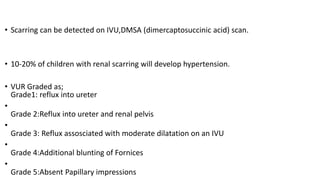
• Scarring can be detected on IVU,DMSA (dimercaptosuccinic acid) scan.
• 10-20% of children with renal scarring will develop hypertension.
• VUR Graded as;
Grade1: reflux into ureter
•
Grade 2:Reflux into ureter and renal pelvis
•
Grade 3: Reflux assosciated with moderate dilatation on an IVU
•
Grade 4:Additional blunting of Fornices
•
Grade 5:Absent Papillary impressions
• VUR is confirmed by micturating Cystogram
• Grade 1-3 generally resolves spontaneously.
• Ureteric re-implantation, peri-ureteric injection of Teflon should be considered
if episode of acute pyelonephritis recur despite antibiotic therapy.
Pyelonephritis complicating pregnancy
• most often presents between 20 and 28 week of gestation.
• Pyelonephritis is more common in pregnant women with underlying urological
abnormality or diabetes.
• Malaise, fever, loin pain and rigors are major complaints.
• Pyonephrosis and perirenal abscess are rare complication but should be
suspected when treatment fails.
Emphysematous Pyelonephritis
• Emphysematous pyelonephritis is a fulminant , necrotising, life-threatening , variant of acute
Pyelonephritis.
• Caused by E.coli, Klebsiella pneumonia , Pseudomonas aeruginosa and Proteus Mirabilis.
•
• Up to 90% cases occur in diabetic patients and urinary tract obstruction may be present.
• Symptoms are similar of acute pyelonephritis, and there may be loin
mass.
• Gas can be detected on a plain film, on USG,
and CT scan.
• IV broad spectrum antibiotic and percutaneous nephrostomy tube
with DJ stenting
• Nephrectomy may be needed in most severely ill patient
Renal cortical Abscess ,Corticomedullary abscess
• Caused by Staph. Aureus via hematogenous route.
• Commonly seen in Diabetics, IV drug abusers, acquired immunodeficiency
• Corticomedullary abscess – results from ascending UTI
Clinical feature
• Insidious and non specific
• Fever ,abdominal pain, costovertebral tenderness
• There may be no urinary symptom if abscess doesnot communicate
with collecting system
Management;
• CT scan is investigation of choice.
• Empirical antibiotic
• For Small abscess- Antibiotic without drainage is effective
• In Many case two percutaneous drain needed ;
1. To drain perirenal collection
2. To decompress the collecting system
Xanthogranulomatous pyelonephritis (XGP)
• Uncommon
• Severe chronic ,destructive granulomatous inflammation of renal Parenchyma.
• Typically seen in middle aged women.
• Chronic symptom- Flank pain ,pyrexia, malaise
• Flank tenderness , a palpable mass, voiding symptoms are common.
• Urine culture is positive for E.coli or other gram negative Bacilli.
• CT scan - an enlarged ,non-functioning kidney,
- presence of calculi,
-low density masses (xanthomatous tissue)
Nephrectomy is definitive treatment.
Chronic Pyelonephritis
It is a disorder in which chronic tubulointerstitial inflammation and scarring
involve the calyces and pelvis.
Important cause of kidney destruction in children with severe lower urinary tract
abnormalities.
Two form;
• Reflux Nephropathy
• Chronic obstructive Pyelonephritis
Clinical feature
• Gradual onset
• Present with acute recurrent pyelonephritis such as loin pain, fever, pyuria and
bacteriuria
• Reflux nephropathy causes hypertension in children .
• Imaging studies ;
shows asymmetrically contracted kidneys with coarse scars, blunting and
deformity of calyceal system.
Investigation;
• Complete blood profile
• Urinalysis - pyuria.
• Urine culture- E. coli, Proteus species
• Serum Creatinine and Blood urea nitrogen level.
• IVU- calceal dilatation and blunting with cortical scars.
• Voiding cystourethrogram- reflux of urine to renal pelvis and ureteral dilatation
• DMSA Scan-detect renal scars
Management;
Goal of management are
1.Prevent recurrent febrile Urinary tract infection.
2.Prevent Renal injury
3.Minimize Morbidity of treatment and follow up
Preventive strategies -prophylactic antibiotic.
Medical care- Antibiotic , fluid and electrolyte management
Surgical care- Ureteral Re-implantation
Thank you

Acute Pyelonephritis.pptx

  • 1.
    Acute Pyelonephritis andChronic Pyelonephritis
  • 2.
    Urinary tract infection •Commonly involves lower urinary tract . • Occurs more commonly in female • Two types; 1. Complicated UTI 2. Uncomplicated UTI • Complicated UTI is defined as an episodes of infection with an increased risk of serious complication or treatment failure. • Uncomplicated UTI is episodes of infection with less risk of serious complication
  • 3.
    • Pyelonephritis isdefined as inflammation affecting the tubules,interstitium and renal pelvis. Two forms - Acute pyelonephritis -Chronic pyelonephritis Acute pyelonephritis; suppurative inflammation of the kidney caused by bacterial infection.
  • 4.
    Etiology and Pathogenesis •More than 85% of cases of UTI are caused by the gram negative bacilli that are normal inhabitant of intestinal tract. • Most common organism involved are E. Coli, Proteus, klebsiella, and Enterobacter. • Routes of infection; 1.Hematogenous route( primary site in the tonsils, teeth caries , boils,carbuncle) 2.Ascending infection ( urinary stasis in presence of calculi)
  • 5.
    Pathogenesis; • Colonization bycoliform bacteria of distal urethra and introitus(In Female) • From urethra to the bladder during urethral catheterization or other instrumentation. • From bladder to kidney; • Urinary tract obstruction and stasis of urine. • Vesico-ureteral reflux (incompetence of vesicoureteral valve) • Intrarenal reflux
  • 6.
    Clinical feature • Morecommon in females especially during childhood, • At puberty after intercourse and during pregnancy. • Symptoms; • Fever with chills and rigors • Flank pain, Nausea and vomiting • Cystitis symptom may or may not be present Sign; • Costovertebral angle tenderness • Flank fullness • Symptoms may vary from a mild illness to a severe illness with septic shock, renal failure and threat to life
  • 7.
    Investigation; • Blood –Hb%, CBC ( leukocytosis), Differential count • Urine – Routine and microscopic examination, culture and sensitivity Pyuria is almost always present. • RFT- Serum Creatinine, Serum Urea
  • 8.
    • USG Abdomenand pelvis- To rule out pyonephrosis , Perirenal abscess, and obstruction of collecting system by renal calculi . • CECT- decreased opacification of affected Parenchyma, typically in patchy, wedge shaped or linear distribution
  • 9.
    Management; • Plenty offluid intake • Antipyretic and Analgesic can be given for fever and lower abdominal pain • Antibiotic are recommended in all case of proven UTI • If urine culture has been performed treatment may be started while awaiting the result. • Initially broad spectrum antibiotic coverage using Cefalexin , Ciprofloxacin can be used. • Later Antibiotic can be switched according to culture and sensitivity report. .
  • 10.
    Acute Pyelonephritis inchildren • In the age group <3 month, it is more common in boys. • In the age group >1 year , it is more common in girls. Underlying causes are; • Urinary stasis due to Vesico-ureter reflux, • detrusor-sphincter dyssynergia , • poor bladder emptying habit • Outlet obstruction , • Neurological disorder secondary to spina bifida .
  • 11.
    • Scarring canbe detected on IVU,DMSA (dimercaptosuccinic acid) scan. • 10-20% of children with renal scarring will develop hypertension. • VUR Graded as; Grade1: reflux into ureter • Grade 2:Reflux into ureter and renal pelvis • Grade 3: Reflux assosciated with moderate dilatation on an IVU • Grade 4:Additional blunting of Fornices • Grade 5:Absent Papillary impressions
  • 12.
    • VUR isconfirmed by micturating Cystogram • Grade 1-3 generally resolves spontaneously. • Ureteric re-implantation, peri-ureteric injection of Teflon should be considered if episode of acute pyelonephritis recur despite antibiotic therapy.
  • 13.
    Pyelonephritis complicating pregnancy •most often presents between 20 and 28 week of gestation. • Pyelonephritis is more common in pregnant women with underlying urological abnormality or diabetes. • Malaise, fever, loin pain and rigors are major complaints. • Pyonephrosis and perirenal abscess are rare complication but should be suspected when treatment fails.
  • 14.
    Emphysematous Pyelonephritis • Emphysematouspyelonephritis is a fulminant , necrotising, life-threatening , variant of acute Pyelonephritis. • Caused by E.coli, Klebsiella pneumonia , Pseudomonas aeruginosa and Proteus Mirabilis. • • Up to 90% cases occur in diabetic patients and urinary tract obstruction may be present.
  • 15.
    • Symptoms aresimilar of acute pyelonephritis, and there may be loin mass. • Gas can be detected on a plain film, on USG, and CT scan. • IV broad spectrum antibiotic and percutaneous nephrostomy tube with DJ stenting • Nephrectomy may be needed in most severely ill patient
  • 16.
    Renal cortical Abscess,Corticomedullary abscess • Caused by Staph. Aureus via hematogenous route. • Commonly seen in Diabetics, IV drug abusers, acquired immunodeficiency • Corticomedullary abscess – results from ascending UTI
  • 17.
    Clinical feature • Insidiousand non specific • Fever ,abdominal pain, costovertebral tenderness • There may be no urinary symptom if abscess doesnot communicate with collecting system
  • 18.
    Management; • CT scanis investigation of choice. • Empirical antibiotic • For Small abscess- Antibiotic without drainage is effective • In Many case two percutaneous drain needed ; 1. To drain perirenal collection 2. To decompress the collecting system
  • 19.
    Xanthogranulomatous pyelonephritis (XGP) •Uncommon • Severe chronic ,destructive granulomatous inflammation of renal Parenchyma. • Typically seen in middle aged women. • Chronic symptom- Flank pain ,pyrexia, malaise • Flank tenderness , a palpable mass, voiding symptoms are common.
  • 20.
    • Urine cultureis positive for E.coli or other gram negative Bacilli. • CT scan - an enlarged ,non-functioning kidney, - presence of calculi, -low density masses (xanthomatous tissue) Nephrectomy is definitive treatment.
  • 21.
    Chronic Pyelonephritis It isa disorder in which chronic tubulointerstitial inflammation and scarring involve the calyces and pelvis. Important cause of kidney destruction in children with severe lower urinary tract abnormalities. Two form; • Reflux Nephropathy • Chronic obstructive Pyelonephritis
  • 22.
    Clinical feature • Gradualonset • Present with acute recurrent pyelonephritis such as loin pain, fever, pyuria and bacteriuria • Reflux nephropathy causes hypertension in children . • Imaging studies ; shows asymmetrically contracted kidneys with coarse scars, blunting and deformity of calyceal system.
  • 23.
    Investigation; • Complete bloodprofile • Urinalysis - pyuria. • Urine culture- E. coli, Proteus species • Serum Creatinine and Blood urea nitrogen level. • IVU- calceal dilatation and blunting with cortical scars. • Voiding cystourethrogram- reflux of urine to renal pelvis and ureteral dilatation • DMSA Scan-detect renal scars
  • 24.
    Management; Goal of managementare 1.Prevent recurrent febrile Urinary tract infection. 2.Prevent Renal injury 3.Minimize Morbidity of treatment and follow up Preventive strategies -prophylactic antibiotic. Medical care- Antibiotic , fluid and electrolyte management Surgical care- Ureteral Re-implantation
  • 25.