Chromatic Sparse Learning
Vlad Feinberg
Sisu Data
vlad@sisu.ai
Outline
Introduction
Methodology
Datasets
Implementation
Results
Conclusion
Technique for sparse data in classification settings.
Not done inside of Spark, but lots of Spark-relevant takeaways.
Introduction
Data Expectations
Hashing Trick as a Fair Baseline
Contribution
Related Work
Data Expectations
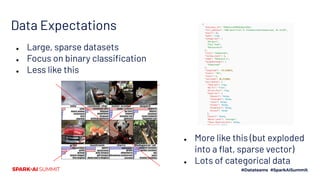
● Large, sparse datasets
● Focus on binary classification
● Less like this
● More like this (but exploded
into a flat, sparse vector)
● Lots of categorical data
Data Trends
● JSONB in databases
● Segment, Heap, Fivetran create large analytics tables
● Variable-length set-valued features (lists of posts I liked, things I
retweeted, people I follow, etc.)
● Schema changes often, may not even be fully known
● Schema is large if normalized
● Manual ETL for ML = lots of domain-specific “field work”
Structures for your sparse data
● Low-width design matrix
○ Preferably 100s to 1000s of active bits per row (= “nnz”)
● Simplifications
○ Categorical → One-hot “is_CA, is_NV, …”
○ Small counts → unary one-hot “bat [1 time]” “bat [2 times]”
○ Sparse and continuous → bin, one-hot “10K-1M followers”
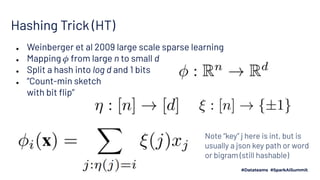
Hashing Trick (HT)
● Weinberger et al 2009 large scale sparse learning
● Mapping 𝜙 from large n to small d
● Split a hash into log d and 1 bits
● “Count-min sketch
with bit flip”
Note “key” j here is int, but is
usually a json key path or word
or bigram (still hashable)
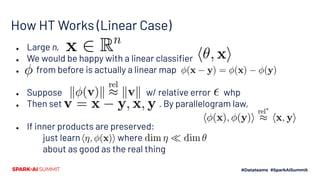
How HT Works (Linear Case)
● Large n,
● We would be happy with a linear classifier
● from before is actually a linear map
● Suppose w/ relative error whp
● Then set . By parallelogram law,
● If inner products are preserved:
just learn where
about as good as the real thing
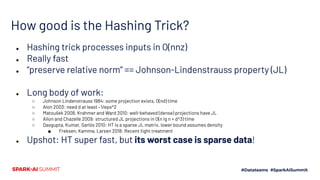
How good is the Hashing Trick?
● Hashing trick processes inputs in O(nnz)
● Really fast
● “preserve relative norm” == Johnson-Lindenstrauss property (JL)
● Long body of work:
○ Johnson Lindenstrauss 1984: some projection exists, O(nd) time
○ Alon 2003: need d at least ~1/eps^2
○ Matoušek 2008, Krahmer and Ward 2010: well-behaved (dense) projections have JL
○ Ailon and Chazelle 2009: structured JL projections in O(n lg n + d^3) time
○ Dasgupta, Kumar, Sarlós 2010: HT is a sparse JL matrix, lower bound assumes density
■ Freksen, Kamma, Larsen 2018: Recent tight treatment
● Upshot: HT super fast, but its worst case is sparse data!
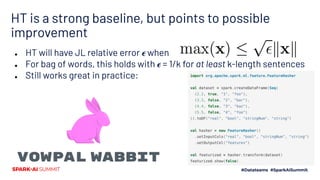
HT is a strong baseline, but points to possible
improvement
● HT will have JL relative error 𝝐 when
● For bag of words, this holds with 𝝐 = 1/k for at least k-length sentences
● Still works great in practice:
Motivation
● Can we take advantage of datasets where nnz per point is small?
● Can this be done in a way that:
#1 does not impact classifier quality?
#2 scales linearly with parallel processing?
● We’ll propose a workflow for handling such datasets and evaluate on
common benchmarks.
Contribution
Use an efficient graph construction technique and graph coloring
[1] to shrink datasets from millions of sparse features to 100s of
columns.
Extend a mechanism [2] for categorical feature compression to
featurize effectively. Avoiding so-called target leakage [3] allows high
accuracy with few features.
Related Work
● Many individual lines of work are called upon, but these solve more
specific problems and can’t be applied to a general sparse binary
problem:
○ [1] Exclusive Feature Bundling from LGBM (Ke et al 2017)
○ [2] Categorical Feature Compression via Submodular Optimization (Bateni et al 2019)
○ [3] Target leakage from Catboost (Prokhorenkova et al 2018)
● Ultimately, we depend on
the chromatic number of the graph we construct
and submodularity approximations.
● As data-dependent properties
using them enables improvement over HT, which is oblivious.
Methodology
Bird’s eye view
Coloring
Submodularity
Intuition
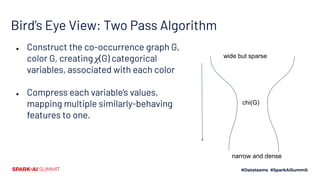
Bird’s Eye View: Two Pass Algorithm
● Construct the co-occurrence graph G,
color G, creating 𝜒(G) categorical
variables, associated with each color
● Compress each variable’s values,
mapping multiple similarly-behaving
features to one.
wide but sparse
chi(G)
narrow and dense
Coloring
● Sparse data, with low nnz, tends to be mutually exclusive
● Consider a hypothetical medical survey:
○ Multiple-choice questions (“How long ago was your most recent surgery?”) might be represented as binary columns
(surgery_3mo, surgery_12mo, never_had_surgery).
○ All conditional survey sections (“Skip the next section if you are under 65 years old”) will be null when their corresponding
predicates (“Are you under 65 years old?”) are false.
○ And, natural dichotomies may occur: “Who is your employer?” and “Do you use COBRA?”
● Build the graph G with
vertices V for each feature value two vertices are
adjacent if they appear in an example together
(co-occur).
Coloring Example:
co-occurrence
graph
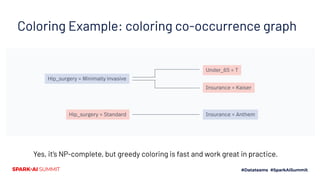
Coloring Example: coloring co-occurrence graph
Yes, it’s NP-complete, but greedy coloring is fast and work great in practice.
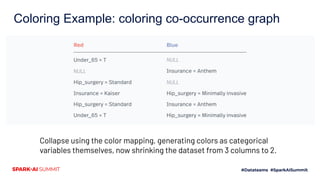
Collapse using the color mapping, generating colors as categorical
variables themselves, now shrinking the dataset from 3 columns to 2.
Coloring Example: coloring co-occurrence graph
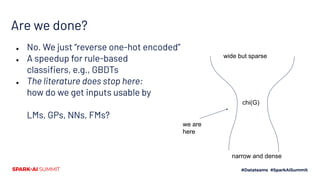
Are we done?
● No. We just “reverse one-hot encoded”
● A speedup for rule-based
classifiers, e.g., GBDTs
● The literature does stop here:
how do we get inputs usable by
LMs, GPs, NNs, FMs?
wide but sparse
chi(G)
narrow and dense
we are
here
Submodular Feature Compression
Detour to Kurkoski and Yagi 2014
View data points as a channel
Encode binary X with multivalue code Y
that “transmits” the label as a message.
But Y might take on lots (M) values. If we
quantize it into a slimmer Z with just K
values, preserve label info with
max_Z I(Z(Y) ; X) [after this slide we’ll go
back to normal lettering, Y is label]
Warning… their X and Y are
flipped from typical ML use
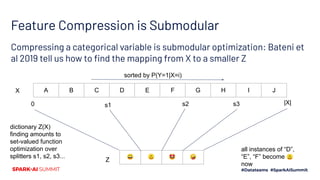
Feature Compression is Submodular
Compressing a categorical variable is submodular optimization: Bateni et
al 2019 tell us how to find the mapping from X to a smaller Z
sorted by P(Y=1|X=i)
A B C D E F G H I JX
dictionary Z(X)
finding amounts to
set-valued function
optimization over
splitters s1, s2, s3... 😀 🙃 🤩 🤪
0 |X|s1 s2 s3
Z
all instances of “D”,
“E”, “F” become 🙃
now
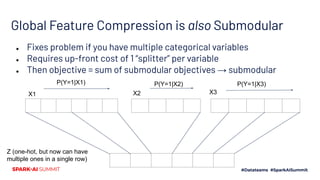
Global Feature Compression is also Submodular
● Fixes problem if you have multiple categorical variables
● Requires up-front cost of 1 “splitter” per variable
● Then objective = sum of submodular objectives → submodular
X1 X2 X3
Z (one-hot, but now can have
multiple ones in a single row)
P(Y=1|X1) P(Y=1|X2) P(Y=1|X3)
Warning: Double Dipping
● Submodular Feature Compression looks at the label
● High-P(Y=1|X) feature values get collapsed together
● If you try to learn on such a feature, you’ll be overconfident
● We propose a quick fix: split the dataset in two!
● Pass 1: Graph structure and coloring
● Pass 2: On half the data, estimate P(Y=1|X). Then compress and learn
on the other half.
Intuition
● Why do we expect this to work?
● Erdos-Renyi model: doesn’t require many colors
● G(n, p) random graph with n vertices and edge b/w two vertices wp p
● Achlioptas and Naor 2004: 𝜒(G(n, p)) ~ np log (np)
● Erdos-Renyi isn’t an amazing proxy for the co-occurrence graph but
serves as a baseline where we can approximately equate np with nnz.
Datasets
Sparse datasets assessed (thank you to libsvm for curation)
If your feature appears <10%, consider it “sparse”, else “dense”.
For chromatic sparse learning, ignore sparse feature values (implicit
value is just 1.0 for all sparse features). For baseline, keep the
information.
If this worries you, you can use the aforementioned unary encoding.
URL
● Ma et al 2009
● Sequential data, so train on early days, predict on late [all datasets will
be like this]
● Input: lexical and host-based features of url
● Output: is this a malicious website?
KDDA + KDDB
● Yu et al 2010 featurization, Niculescu-Mizil et al 2010 data
● Student interactions in courses (A) and (B) with teaching software
● Input: flattened sequence
of interactions with the
software.
● Output: was the student
able to get the right
answer on their first
attempt?
KDD12
● Tencent Weibo is a Twitter-like platform
● Input: User information (who they follow, what they
retweet, what topics they subscribe to)
● Output: Whether the user will follow a recommended topic
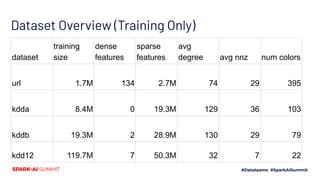
Dataset Overview (Training Only)
dataset
training
size
dense
features
sparse
features
avg
degree avg nnz num colors
url 1.7M 134 2.7M 74 29 395
kdda 8.4M 0 19.3M 129 36 103
kddb 19.3M 2 28.9M 130 29 79
kdd12 119.7M 7 50.3M 32 7 22
Implementation
Top-level overview
Implementation nuggets
Top-level Implementation
● Input format: SVMlight-ish
○ newline-separated [(feature, value)] records
● Coloring
○ Each record is a co-occurence clique
○ Union these into a dataset co-occurence graph
● Color the graph (data-independent)
● Collect P(Y=1|feature)
○ Just some counts for each feature
● Run feature compression (data-independent)
● Recode data
● Note: data-independent != free
wide but sparse
chi(G)
narrow and dense
u64 -> u32 Systems Hashing Trick
● Features can be long strings. High memory to track.
● “Systems” HT: Use a u64 hash as the key, map to feature counter u32
● 1B features ~ 2^30
● p(any colliding birthdays) ~ 1 - exp(-2^(-1 - 64 + 30 * 2)) < 3%
● Swiss hash table u64 -> u32 is pretty lean and data-independent
● Do a cheap map-reduce pass to get feature indices going forward
Graph Unions
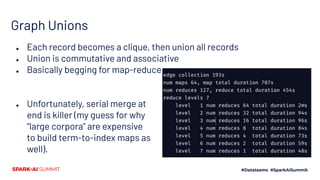
● Each record becomes a clique, then union all records
● Union is commutative and associative
● Basically begging for map-reduce
● Unfortunately, serial merge at
end is killer (my guess for why
“large corpora” are expensive
to build term-to-index maps as
well).
Sharded Unions
● Don’t build a single dictionary with map reduce
○ For P processors, E edges, this will have
○ O(P * E) memory usage total
○ O(E * log P) lower bound on runtime due to tree depth of reduce
● Instead, hash join
○ Split hash space (of edges) into P parts
○ Mappers build edges, send to a writer owning that edge’s hash space
○ Writers keep disjoint sets of edges, mutex-guarded
○ Expected contention for a writer is negligible if it’s faster to add to a set than
generate (it is)
● Now O(E + P^2) memory, O(E/P) runtime
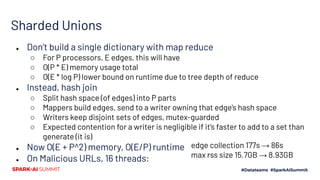
● On Malicious URLs, 16 threads:
edge collection 177s → 86s
max rss size 15.7GB → 8.93GB
Dataset Splitting
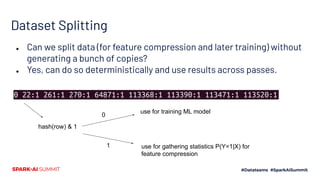
● Can we split data (for feature compression and later training) without
generating a bunch of copies?
● Yes, can do so deterministically and use results across passes.
hash(row) & 1
use for gathering statistics P(Y=1|X) for
feature compression
1
0
use for training ML model
Results
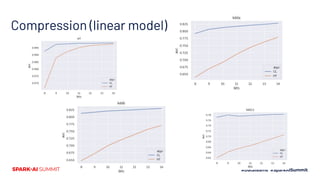
● End-to-end compression
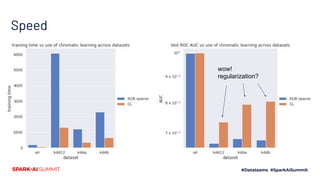
● Speed
Compression (linear model)
Speed
wow!
regularization?
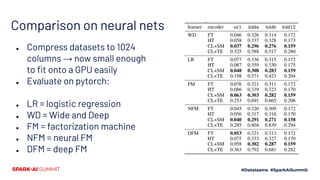
Comparison on neural nets
● Compress datasets to 1024
columns → now small enough
to fit onto a GPU easily
● Evaluate on pytorch:
● LR = logistic regression
● WD = Wide and Deep
● FM = factorization machine
● NFM = neural FM
● DFM = deep FM
Conclusion
For datasets with a low 𝜒(G), can greatly contract data!
Learned nice nuggets along the way
Systems HT
Sharded Unions / Hash-join reduce
Online Data Splitting to avoid double dip
This is probably just the tip of the iceberg
co-occurrence graph G can be weighted,
promising for deeper exploratory analysis

Chromatic Sparse Learning

  • 2.
    Chromatic Sparse Learning VladFeinberg Sisu Data vlad@sisu.ai
  • 3.
    Outline Introduction Methodology Datasets Implementation Results Conclusion Technique for sparsedata in classification settings. Not done inside of Spark, but lots of Spark-relevant takeaways.
  • 4.
    Introduction Data Expectations Hashing Trickas a Fair Baseline Contribution Related Work
  • 5.
    Data Expectations ● Large,sparse datasets ● Focus on binary classification ● Less like this ● More like this (but exploded into a flat, sparse vector) ● Lots of categorical data
  • 6.
    Data Trends ● JSONBin databases ● Segment, Heap, Fivetran create large analytics tables ● Variable-length set-valued features (lists of posts I liked, things I retweeted, people I follow, etc.) ● Schema changes often, may not even be fully known ● Schema is large if normalized ● Manual ETL for ML = lots of domain-specific “field work”
  • 7.
    Structures for yoursparse data ● Low-width design matrix ○ Preferably 100s to 1000s of active bits per row (= “nnz”) ● Simplifications ○ Categorical → One-hot “is_CA, is_NV, …” ○ Small counts → unary one-hot “bat [1 time]” “bat [2 times]” ○ Sparse and continuous → bin, one-hot “10K-1M followers”
  • 8.
    Hashing Trick (HT) ●Weinberger et al 2009 large scale sparse learning ● Mapping 𝜙 from large n to small d ● Split a hash into log d and 1 bits ● “Count-min sketch with bit flip” Note “key” j here is int, but is usually a json key path or word or bigram (still hashable)
  • 9.
    How HT Works(Linear Case) ● Large n, ● We would be happy with a linear classifier ● from before is actually a linear map ● Suppose w/ relative error whp ● Then set . By parallelogram law, ● If inner products are preserved: just learn where about as good as the real thing
  • 10.
    How good isthe Hashing Trick? ● Hashing trick processes inputs in O(nnz) ● Really fast ● “preserve relative norm” == Johnson-Lindenstrauss property (JL) ● Long body of work: ○ Johnson Lindenstrauss 1984: some projection exists, O(nd) time ○ Alon 2003: need d at least ~1/eps^2 ○ Matoušek 2008, Krahmer and Ward 2010: well-behaved (dense) projections have JL ○ Ailon and Chazelle 2009: structured JL projections in O(n lg n + d^3) time ○ Dasgupta, Kumar, Sarlós 2010: HT is a sparse JL matrix, lower bound assumes density ■ Freksen, Kamma, Larsen 2018: Recent tight treatment ● Upshot: HT super fast, but its worst case is sparse data!
  • 11.
    HT is astrong baseline, but points to possible improvement ● HT will have JL relative error 𝝐 when ● For bag of words, this holds with 𝝐 = 1/k for at least k-length sentences ● Still works great in practice:
  • 12.
    Motivation ● Can wetake advantage of datasets where nnz per point is small? ● Can this be done in a way that: #1 does not impact classifier quality? #2 scales linearly with parallel processing? ● We’ll propose a workflow for handling such datasets and evaluate on common benchmarks.
  • 13.
    Contribution Use an efficientgraph construction technique and graph coloring [1] to shrink datasets from millions of sparse features to 100s of columns. Extend a mechanism [2] for categorical feature compression to featurize effectively. Avoiding so-called target leakage [3] allows high accuracy with few features.
  • 14.
    Related Work ● Manyindividual lines of work are called upon, but these solve more specific problems and can’t be applied to a general sparse binary problem: ○ [1] Exclusive Feature Bundling from LGBM (Ke et al 2017) ○ [2] Categorical Feature Compression via Submodular Optimization (Bateni et al 2019) ○ [3] Target leakage from Catboost (Prokhorenkova et al 2018) ● Ultimately, we depend on the chromatic number of the graph we construct and submodularity approximations. ● As data-dependent properties using them enables improvement over HT, which is oblivious.
  • 15.
  • 16.
    Bird’s Eye View:Two Pass Algorithm ● Construct the co-occurrence graph G, color G, creating 𝜒(G) categorical variables, associated with each color ● Compress each variable’s values, mapping multiple similarly-behaving features to one. wide but sparse chi(G) narrow and dense
  • 17.
    Coloring ● Sparse data,with low nnz, tends to be mutually exclusive ● Consider a hypothetical medical survey: ○ Multiple-choice questions (“How long ago was your most recent surgery?”) might be represented as binary columns (surgery_3mo, surgery_12mo, never_had_surgery). ○ All conditional survey sections (“Skip the next section if you are under 65 years old”) will be null when their corresponding predicates (“Are you under 65 years old?”) are false. ○ And, natural dichotomies may occur: “Who is your employer?” and “Do you use COBRA?” ● Build the graph G with vertices V for each feature value two vertices are adjacent if they appear in an example together (co-occur).
  • 18.
  • 19.
    Coloring Example: coloringco-occurrence graph Yes, it’s NP-complete, but greedy coloring is fast and work great in practice.
  • 20.
    Collapse using thecolor mapping, generating colors as categorical variables themselves, now shrinking the dataset from 3 columns to 2. Coloring Example: coloring co-occurrence graph
  • 21.
    Are we done? ●No. We just “reverse one-hot encoded” ● A speedup for rule-based classifiers, e.g., GBDTs ● The literature does stop here: how do we get inputs usable by LMs, GPs, NNs, FMs? wide but sparse chi(G) narrow and dense we are here
  • 22.
    Submodular Feature Compression Detourto Kurkoski and Yagi 2014 View data points as a channel Encode binary X with multivalue code Y that “transmits” the label as a message. But Y might take on lots (M) values. If we quantize it into a slimmer Z with just K values, preserve label info with max_Z I(Z(Y) ; X) [after this slide we’ll go back to normal lettering, Y is label] Warning… their X and Y are flipped from typical ML use
  • 23.
    Feature Compression isSubmodular Compressing a categorical variable is submodular optimization: Bateni et al 2019 tell us how to find the mapping from X to a smaller Z sorted by P(Y=1|X=i) A B C D E F G H I JX dictionary Z(X) finding amounts to set-valued function optimization over splitters s1, s2, s3... 😀 🙃 🤩 🤪 0 |X|s1 s2 s3 Z all instances of “D”, “E”, “F” become 🙃 now
  • 24.
    Global Feature Compressionis also Submodular ● Fixes problem if you have multiple categorical variables ● Requires up-front cost of 1 “splitter” per variable ● Then objective = sum of submodular objectives → submodular X1 X2 X3 Z (one-hot, but now can have multiple ones in a single row) P(Y=1|X1) P(Y=1|X2) P(Y=1|X3)
  • 25.
    Warning: Double Dipping ●Submodular Feature Compression looks at the label ● High-P(Y=1|X) feature values get collapsed together ● If you try to learn on such a feature, you’ll be overconfident ● We propose a quick fix: split the dataset in two! ● Pass 1: Graph structure and coloring ● Pass 2: On half the data, estimate P(Y=1|X). Then compress and learn on the other half.
  • 26.
    Intuition ● Why dowe expect this to work? ● Erdos-Renyi model: doesn’t require many colors ● G(n, p) random graph with n vertices and edge b/w two vertices wp p ● Achlioptas and Naor 2004: 𝜒(G(n, p)) ~ np log (np) ● Erdos-Renyi isn’t an amazing proxy for the co-occurrence graph but serves as a baseline where we can approximately equate np with nnz.
  • 27.
    Datasets Sparse datasets assessed(thank you to libsvm for curation) If your feature appears <10%, consider it “sparse”, else “dense”. For chromatic sparse learning, ignore sparse feature values (implicit value is just 1.0 for all sparse features). For baseline, keep the information. If this worries you, you can use the aforementioned unary encoding.
  • 28.
    URL ● Ma etal 2009 ● Sequential data, so train on early days, predict on late [all datasets will be like this] ● Input: lexical and host-based features of url ● Output: is this a malicious website?
  • 29.
    KDDA + KDDB ●Yu et al 2010 featurization, Niculescu-Mizil et al 2010 data ● Student interactions in courses (A) and (B) with teaching software ● Input: flattened sequence of interactions with the software. ● Output: was the student able to get the right answer on their first attempt?
  • 30.
    KDD12 ● Tencent Weibois a Twitter-like platform ● Input: User information (who they follow, what they retweet, what topics they subscribe to) ● Output: Whether the user will follow a recommended topic
  • 31.
    Dataset Overview (TrainingOnly) dataset training size dense features sparse features avg degree avg nnz num colors url 1.7M 134 2.7M 74 29 395 kdda 8.4M 0 19.3M 129 36 103 kddb 19.3M 2 28.9M 130 29 79 kdd12 119.7M 7 50.3M 32 7 22
  • 32.
  • 33.
    Top-level Implementation ● Inputformat: SVMlight-ish ○ newline-separated [(feature, value)] records ● Coloring ○ Each record is a co-occurence clique ○ Union these into a dataset co-occurence graph ● Color the graph (data-independent) ● Collect P(Y=1|feature) ○ Just some counts for each feature ● Run feature compression (data-independent) ● Recode data ● Note: data-independent != free wide but sparse chi(G) narrow and dense
  • 34.
    u64 -> u32Systems Hashing Trick ● Features can be long strings. High memory to track. ● “Systems” HT: Use a u64 hash as the key, map to feature counter u32 ● 1B features ~ 2^30 ● p(any colliding birthdays) ~ 1 - exp(-2^(-1 - 64 + 30 * 2)) < 3% ● Swiss hash table u64 -> u32 is pretty lean and data-independent ● Do a cheap map-reduce pass to get feature indices going forward
  • 35.
    Graph Unions ● Eachrecord becomes a clique, then union all records ● Union is commutative and associative ● Basically begging for map-reduce ● Unfortunately, serial merge at end is killer (my guess for why “large corpora” are expensive to build term-to-index maps as well).
  • 36.
    Sharded Unions ● Don’tbuild a single dictionary with map reduce ○ For P processors, E edges, this will have ○ O(P * E) memory usage total ○ O(E * log P) lower bound on runtime due to tree depth of reduce ● Instead, hash join ○ Split hash space (of edges) into P parts ○ Mappers build edges, send to a writer owning that edge’s hash space ○ Writers keep disjoint sets of edges, mutex-guarded ○ Expected contention for a writer is negligible if it’s faster to add to a set than generate (it is) ● Now O(E + P^2) memory, O(E/P) runtime ● On Malicious URLs, 16 threads: edge collection 177s → 86s max rss size 15.7GB → 8.93GB
  • 37.
    Dataset Splitting ● Canwe split data (for feature compression and later training) without generating a bunch of copies? ● Yes, can do so deterministically and use results across passes. hash(row) & 1 use for gathering statistics P(Y=1|X) for feature compression 1 0 use for training ML model
  • 38.
  • 39.
  • 40.
  • 41.
    Comparison on neuralnets ● Compress datasets to 1024 columns → now small enough to fit onto a GPU easily ● Evaluate on pytorch: ● LR = logistic regression ● WD = Wide and Deep ● FM = factorization machine ● NFM = neural FM ● DFM = deep FM
  • 42.
    Conclusion For datasets witha low 𝜒(G), can greatly contract data! Learned nice nuggets along the way Systems HT Sharded Unions / Hash-join reduce Online Data Splitting to avoid double dip This is probably just the tip of the iceberg co-occurrence graph G can be weighted, promising for deeper exploratory analysis