TEMPLATE MATCHING
TEMPLATE MATCHING
The Goal: Given a set of reference patterns
known as TEMPLATES, find to which one an
unknown pattern matches best. That is, each
class is represented by a single typical pattern.
The crucial point is to adopt an appropriate
“measure” to quantify similarity or matching.
These measures must accommodate, in an
efficient way, deviations between the
template and the test pattern. For example
the word beauty may have been read a
beeauty or beuty, etc., due to errors.
1
2.
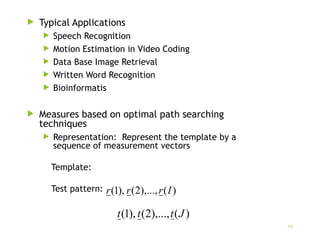
Typical Applications
Speech Recognition
Motion Estimation in Video Coding
Data Base Image Retrieval
Written Word Recognition
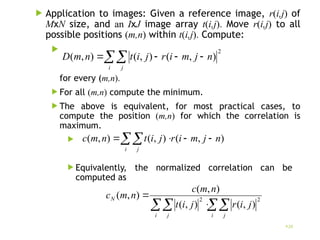
Bioinformatis
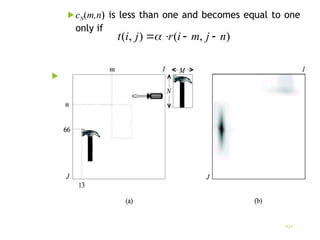
Measures based on optimal path searching
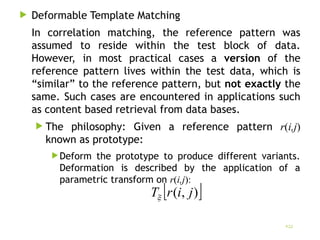
techniques
Representation: Represent the template by a
sequence of measurement vectors
Template:
Test pattern: )
(
),...,
2
(
),
1
( I
r
r
r
)
(
),...,
2
(
),
1
( J
t
t
t
2
3.
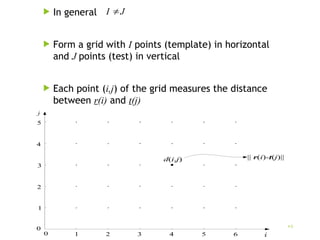
In general
Form a grid with I points (template) in horizontal
and J points (test) in vertical
Each point (i,j) of the grid measures the distance
between r(i) and t(j)
J
I
3
4.
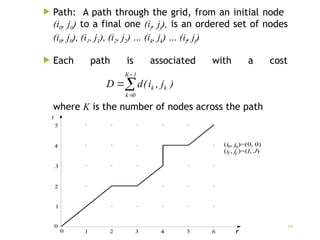
Path: Apath through the grid, from an initial node
(i0, j0) to a final one (if, jf), is an ordered set of nodes
(i0, j0), (i1, j1), (i2, j2) … (ik, jk) … (if, jf)
Each path is associated with a cost
where K is the number of nodes across the path
1
K
0
k
k
k )
j
,
i
(
d
D
4
5.
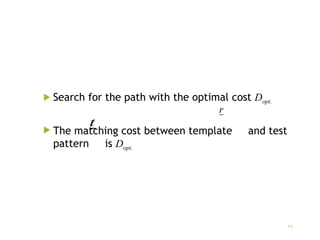
Search forthe path with the optimal cost Dopt.
The matching cost between template and test
pattern is Dopt.
r
5
t
6.
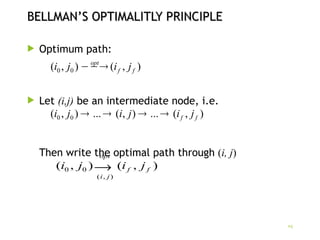
BELLMAN’S OPTIMALITLY PRINCIPLE
BELLMAN’SOPTIMALITLY PRINCIPLE
Optimum path:
Let (i,j) be an intermediate node, i.e.
Then write the optimal path through (i, j)
)
,
(
)
,
( 0
0 f
f
opt
j
i
j
i
)
,
(
...
)
,
(
...
)
,
( 0
0 f
f j
i
j
i
j
i
6
)
,
(
)
,
(
)
,
(
0
0 f
f
opt
j
i
j
i
j
i
7.
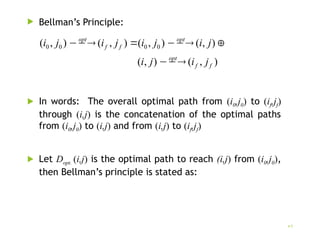
Bellman’s Principle:
In words: The overall optimal path from (i0,j0) to (if,jf)
through (i,j) is the concatenation of the optimal paths
from (i0,j0) to (i,j) and from (i,j) to (if,jf)
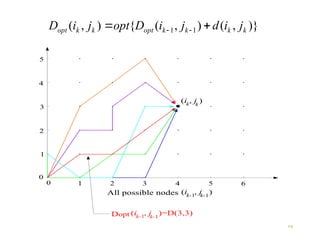
Let Dopt. (i,j) is the optimal path to reach (i,j) from (i0,j0),
then Bellman’s principle is stated as:
7
)
,
(
)
,
(
)
,
(
)
,
(
)
,
(
)
,
( 0
0
0
0
f
f
opt
opt
f
f
opt
j
i
j
i
j
i
j
i
j
i
j
i
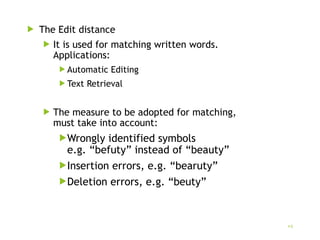
The Editdistance
It is used for matching written words.
Applications:
Automatic Editing
Text Retrieval
The measure to be adopted for matching,
must take into account:
Wrongly identified symbols
e.g. “befuty” instead of “beauty”
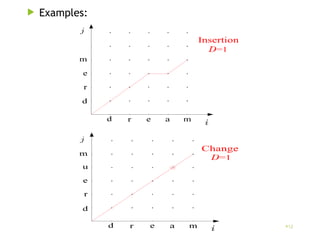
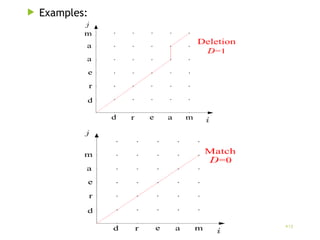
Insertion errors, e.g. “bearuty”
Deletion errors, e.g. “beuty”
9
10.
The costis based on the philosophy behind the
so-called variational similarity, i.e.,
Measure the cost associated with converting one
pattern to the other
Edit distance: Minimal total number of changes,
C, insertions I and deletions R, required to
change pattern A into pattern B,
where j runs over All possible variations of
symbols, in order to convert A B
)]
(
)
(
)
(
[
min
)
,
( j
R
j
I
j
C
B
A
D
j
10
11.
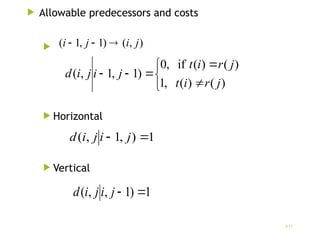
Allowable predecessorsand costs
Horizontal
Vertical
)
,
(
)
1
,
1
( j
i
j
i
11
)
(
)
(
,
1
)
(
)
(
if
,
0
)
1
,
1
,
(
j
r
i
t
j
r
i
t
j
i
j
i
d
1
)
,
1
,
(
j
i
j
i
d
1
)
1
,
,
(
j
i
j
i
d
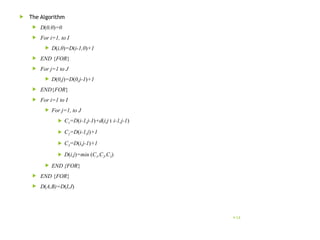
The Algorithm
D(0,0)=0
For i=1, to I
D(i,0)=D(i-1,0)+1
END {FOR}
For j=1 to J
D(0,j)=D(0,j-1)+1
END{FOR}
For i=1 to I
For j=1, to J
C1=D(i-1,j-1)+d(i,j ׀ i-1,j-1)
C2=D(i-1,j)+1
C3=D(i,j-1)+1
D(i,j)=min (C1,C2,C3)
END {FOR}
END {FOR}
D(A,B)=D(I,J)
14
15.
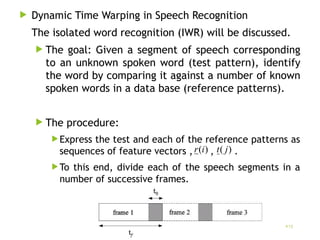
Dynamic TimeWarping in Speech Recognition
The isolated word recognition (IWR) will be discussed.
The goal: Given a segment of speech corresponding
to an unknown spoken word (test pattern), identify
the word by comparing it against a number of known
spoken words in a data base (reference patterns).
The procedure:
Express the test and each of the reference patterns as
sequences of feature vectors , , .
To this end, divide each of the speech segments in a
number of successive frames.
15
)
(i
r )
( j
t
16.
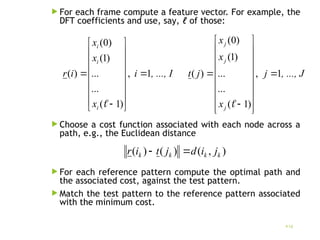
For eachframe compute a feature vector. For example, the
DFT coefficients and use, say, ℓ of those:
Choοse a cost function associated with each node across a
path, e.g., the Euclidean distance
For each reference pattern compute the optimal path and
the associated cost, against the test pattern.
Match the test pattern to the reference pattern associated
with the minimum cost.
16
, ..., I
i
x
x
x
i
r
i
i
i
1
,
)
1
(
...
...
)
1
(
)
0
(
)
(
, ..., J
j
x
x
x
j
t
j
j
j
1
,
)
1
(
...
...
)
1
(
)
0
(
)
(
)
,
(
)
(
)
( k
k
k
k j
i
d
j
t
i
r
17.
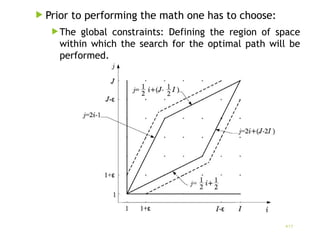
Prior toperforming the math one has to choose:
The global constraints: Defining the region of space
within which the search for the optimal path will be
performed.
17
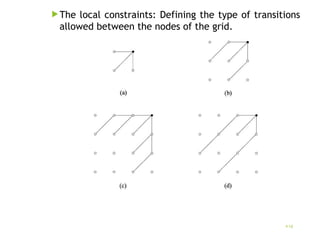
18.
The local constraints:Defining the type of transitions
allowed between the nodes of the grid.
18
19.
Measures basedon Correlations: The major task here is
to find whether a specific known reference pattern
resides within a given block of data. Such problems
arise in problems such as target detection, robot vision,
video coding. There are two basic steps in such a
procedure:
Step 1: Move the reference pattern to all possible
positions within the block of data. For each position,
compute the “similarity” between the reference
pattern and the respective part of the block of data.
Step 2: Compute the best matching value.
19
20.
Application toimages: Given a reference image, r(i,j) of
MxN size, and an IxJ image array t(i,j). Move r(i,j) to all
possible positions (m,n) within t(i,j). Compute:
for every (m,n).
For all (m,n) compute the minimum.
The above is equivalent, for most practical cases, to
compute the position (m,n) for which the correlation is
maximum.
Equivalently, the normalized correlation can be
computed as
20
i j
n
j
m
i
r
j
i
t
n
m
D
2
)
,
(
)
,
(
)
,
(
i j
n
j
m
i
r
j
i
t
n
m
c )
,
(
)
,
(
)
,
(
i j
i j
N
j
i
r
j
i
t
n
m
c
n
m
c 2
2
)
,
(
)
,
(
)
,
(
)
,
(
21.
cN(m,n) is lessthan one and becomes equal to one
only if
21
)
,
(
)
,
( n
j
m
i
r
j
i
t
22.
Deformable TemplateMatching
In correlation matching, the reference pattern was
assumed to reside within the test block of data.
However, in most practical cases a version of the
reference pattern lives within the test data, which is
“similar” to the reference pattern, but not exactly the
same. Such cases are encountered in applications such
as content based retrieval from data bases.
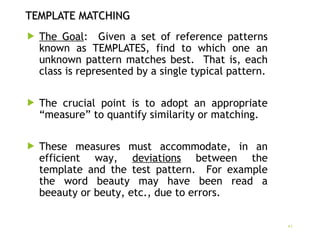
The philosophy: Given a reference pattern r(i,j)
known as prototype:
Deform the prototype to produce different variants.
Deformation is described by the application of a
parametric transform on r(i,j):
22
)
,
( j
i
r
T
23.
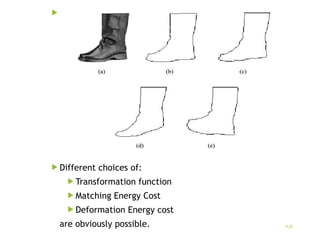
For different valuesof the parameter vector the
goodness of fit with the test pattern is given by the
matching energy:
However, the higher the deformation, the higher the
deviation from the prototype. This is quantified by a
cost known as deformation energy:
In deformable template matching compute , so
that
Ideally, one should like to have both terms low: small
deformation and small matching energy. This means
that one can retrieve a pattern very similar to the
prototype.
23
m
E
d
E
)
(
)
(
min
:
d
m E
E
24.
.
Differentchoices of:
Transformation function
Matching Energy Cost
Deformation Energy cost
are obviously possible. 24
![ The cost is based on the philosophy behind the
so-called variational similarity, i.e.,
Measure the cost associated with converting one
pattern to the other
Edit distance: Minimal total number of changes,
C, insertions I and deletions R, required to
change pattern A into pattern B,
where j runs over All possible variations of
symbols, in order to convert A B
)]
(
)
(
)
(
[
min
)
,
( j
R
j
I
j
C
B
A
D
j
10](https://image.slidesharecdn.com/templatematchingpatternrecognition-250526065235-4710dfc7/85/Template_Matching-pattern-recognition-ppt-10-320.jpg)