Bleeding in
Early Pregnancy
Presented by
Dr. Ahmed Ali Zein El-Abdein El-Nizamy
Lecturer of Obstetrics and Gynecology
Faculty of Medicine
Suez University
Bleeding in Early
Pregnancy
Objectives:
All medical student by the end of this lecture supposed to :
• 1- List causes of obstetrics hemorrhage.
• 2- Demonstrate the difference between types of Miscarriage.
• 3- Illustrate the management of recurrent pregnancy loss.
• 4- Distinguish the ectopic pregnancy and its management.
Bleeding in Early
Pregnancy
• Items to be covered: Part 1:
• 1- Causes of obstetric hemorrhage:
• 2- Definition of miscarriage.
• 3- Types of Miscarriage.
• 4- Risk factors.
• 5- Etiology.
• 6- Pathogenesis.
• 7- Clinical picture of each type of Miscarriage.
• 8- Investigations.
• 9- Treatment of each type.
• 10- Recurrent Pregnancy Loss.
Bleeding in Early
Pregnancy
• Items to be covered:
Part 2: Ectopic Pregnancy
• 1- Definition & Incidence of Ectopic Pregnancy.
• 2- Site.
• 3- Etiology.
• 4- Pathology.
• 5- Fate and types of ectopic pregnancy.
• 6- Clinical Picture.
• 7- Investigations.
• 8- Treatment modalities of Ectopic Pregnancy.
Part 1
Abortion & Miscariage
Bleeding in Early
Pregnancy
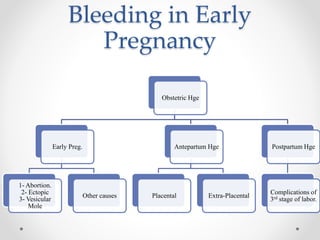
Obstetric Hge
Early Preg.
1- Abortion.
2- Ectopic
3- Vesicular
Mole
Other causes
Antepartum Hge
Placental Extra-Placental
Postpartum Hge
Complications of
3rd stage of labor.
Bleeding in Early
Pregnancy
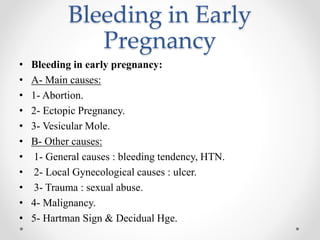
• Bleeding in early pregnancy:
• A- Main causes:
• 1- Abortion.
• 2- Ectopic Pregnancy.
• 3- Vesicular Mole.
• B- Other causes:
• 1- General causes : bleeding tendency, HTN.
• 2- Local Gynecological causes : ulcer.
• 3- Trauma : sexual abuse.
• 4- Malignancy.
• 5- Hartman Sign & Decidual Hge.
Abortion & Miscarriage
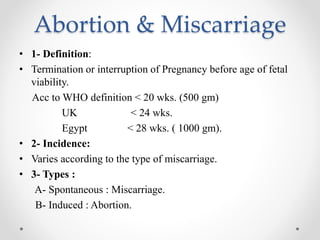
• 1- Definition:
• Termination or interruption of Pregnancy before age of fetal
viability.
Acc to WHO definition < 20 wks. (500 gm)
UK < 24 wks.
Egypt < 28 wks. ( 1000 gm).
• 2- Incidence:
• Varies according to the type of miscarriage.
• 3- Types :
A- Spontaneous : Miscarriage.
B- Induced : Abortion.
Abortion & Miscarriage
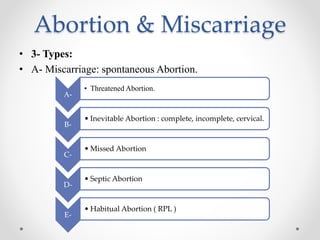
• 3- Types:
• A- Miscarriage: spontaneous Abortion.
A-
• Threatened Abortion.
B-
• Inevitable Abortion : complete, incomplete, cervical.
C-
• Missed Abortion
D-
• Septic Abortion
E-
• Habitual Abortion ( RPL )
Abortion & Miscarriage
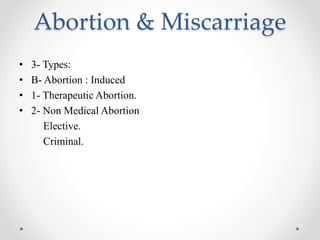
• 3- Types:
• B- Abortion : Induced
• 1- Therapeutic Abortion.
• 2- Non Medical Abortion
Elective.
Criminal.
Spontaneous Miscarriage
• 1- Incidence: 15 %
• 80% in the 1st trimester esp. < 8 wks “Window Gap”
• Incidence may be more than that due to subclinical miscarriage
or deficient notification “ illegal abortion ”
• 2- Risk factors for Miscarriage:
• A. Patient factors: ↑ age & Parity , extremes in BMI , low
socio-economic class, heavy smoking, Alcohol consumption
and low plasma Folate Level.
• B. Obstetric factors:
• Past history of miscarriage, CFMF, long time infertility due to
underlying cause.
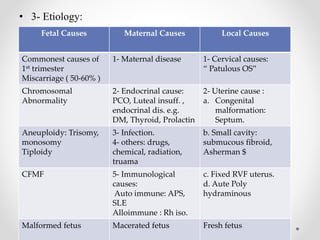
• 3- Etiology:
Fetal Causes Maternal Causes Local Causes
Commonest causes of
1st trimester
Miscarriage ( 50-60% )
1- Maternal disease 1- Cervical causes:
“ Patulous OS”
Chromosomal
Abnormality
2- Endocrinal cause:
PCO, Luteal insuff. ,
endocrinal dis. e.g.
DM, Thyroid, Prolactin
2- Uterine cause :
a. Congenital
malformation:
Septum.
Aneuploidy: Trisomy,
monosomy
Tiploidy
3- Infection.
4- others: drugs,
chemical, radiation,
truama
b. Small cavity:
submucous fibroid,
Asherman $
CFMF 5- Immunological
causes:
Auto immune: APS,
SLE
Alloimmune : Rh iso.
c. Fixed RVF uterus.
d. Aute Poly
hydraminous
Malformed fetus Macerated fetus Fresh fetus
Spontaneous Miscarriage
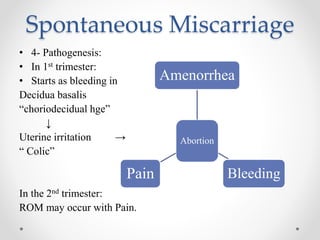
• 4- Pathogenesis:
• In 1st trimester:
• Starts as bleeding in
Decidua basalis
“choriodecidual hge”
↓
Uterine irritation →
“ Colic”
In the 2nd trimester:
ROM may occur with Pain.
Abortion
Amenorrhea
Bleeding
Pain
Spontaneous Miscarriage
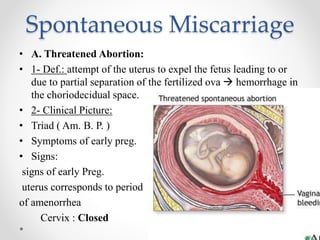
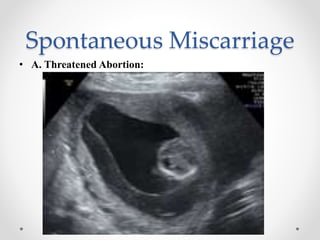
• A. Threatened Abortion:
• 1- Def.: attempt of the uterus to expel the fetus leading to or
due to partial separation of the fertilized ova  hemorrhage in
the choriodecidual space.
• 2- Clinical Picture:
• Triad ( Am. B. P. )
• Symptoms of early preg.
• Signs:
signs of early Preg.
uterus corresponds to period
of amenorrhea
Cervix : Closed
Spontaneous Miscarriage
• A. Threatened Abortion:
• 3- investigations:
• For Diagnosis:
U/S ± β HCG titer
• For the cause : D.M , CL insufficiency, thyroid disease
• 4- FATE:
• 70-80% of cases  pregnancy continues but ↑ incidence of
PTL, IUGR, PPROM, APHge.
• Bleeding increased  inevitable Abortion.
• Loss of cardiac pulsations  Missed miscarriage.
• Infections occurs  septic Abortion.
Spontaneous Miscarriage
• A. Threatened Abortion:
Spontaneous Miscarriage
• A. Threatened Abortion:
• 5- Treatment: either Conservative Vs. Termination of Preg.
• a. Conservative management:
• i. REST : Physical & Sexual
• ii. Progesterone : beneficial only in CL insufficiency
Prontogest 100mg 1x2 for 5-7 days.
• iii. Antispasmodics
• iv. Anti D ( 250 IU ) > 13 wks
• b. Termination of Pregnancy:
• i. Proven CFMF ii. TURN inevitable iii. Turn Septic
• D&C will done.
Spontaneous Miscarriage
• B- Inevitable Abortion:
• 1- Def.: complete separation of the fertilized ova or placenta
with progressive cervical dilatation and fetal expulsion.
• 2- Clinical Picture:
• Symptoms:
• Triad + moderate to sever bleeding + sever Pain
• Signs:
• Generally : according to bleeding  Pallor & shock.
• Abdominally : uterus = period of amenorrhea
• Locally: CX is OPEN
• 3- Investigations:
• General : CBC , PT, PTT
• Specific: U/S
Spontaneous Miscarriage
• B- Inevitable Abortion:
• 4- Treatment:
• i. RESUSITATION:
IV Fluids ± Blood transfusion
• ii. Evacuation:
• 1st Trimester: surgical evacuation.
• 2nd Trimester: misoprostol or oxytocin then evacuation if
remnant of conception or sever bleeding.
• iii. Ecbolics and Antibiotics
• iv. Anti D in Rh –ve Patients. Especially if surgical evacuation
done or if > 12 wks.
Spontaneous Miscarriage
• Complete Abortion:
• 1- Def.: all products of conception have been expelled.
• 2- Clinical Picture:
• Symptoms: Triad + expulsion of the conception  ↓ bleeding
& Pain
• Signs: the same as inevitable abortion but the CX is CLOSED
• 3- Investigations:
• General investigations: CBC , PT, PTT
• U/S  Empty Uterus.
• 4- Treatment:
• Ecbolics + Antibiotic
Spontaneous Miscarriage
• Incomplete Abortion:
• As inevitable Abortion but part of the product of conception is
still in the uterus  confirmed by U/S
• Treatment: as inevitable Abortion.
• Cervical Abortion:
• 1- Def.: arrest of gestational sac in the cervical canal.
• 2- Clinical Picture:
• Sever, Sever Pain + Bleeding + OPENED & Swollen CX +
Part of product of conception may be felt during P.V ex.
• 3- Treatment:
• EVACUATION + Ecbolics + Antibiotics
Spontaneous Miscarriage
• c. Missed Abortion: “ Carneous, bloody , fleshy Mole”
• 1- Definition:
• Retention of dead or non viable product of conception within
the uterine cavity.
• 2- Clinical Picture:
• Symptoms: Triad but
• Bleeding may be mild dark brown discharge
• Milk discharge but it may occur normally in pregnancy.
• Pain is usually Absent. + Absent fetal kicks
• Signs:
• CX is CLOSED
• Uterus is < period of amenorrhea ± no sign of Preg.
Spontaneous Miscarriage
• c. Missed Abortion: “ Carneous, bloody , fleshy Mole”
• 3- Investigations:
• For diagnosis:
• a. U/S: i. collapsed sac
ii. –ve cardiac Puslations. CRL ≥ 6 mm
iii. Gestational sac ≥ 25mm with no fetal pole “Blighted ovum”
• b. β-HCG & repeated after 48hs : plateau or decreasing
• For complications:
• Serum fibrinogen level : decreased by 50mg/wk , repeated
weekly, if < 100mg/dl  DIC.
• 4- Complications:
Infection , DIC after 4-6 wks.
Spontaneous Miscarriage
• c. Missed Abortion: “ Carneous, bloody , fleshy Mole”
• 5- Treatment:
• A. Expectant Management: spontaneous expulsion within 2 wks
• B. Termination of Pregnancy according to gestational age:
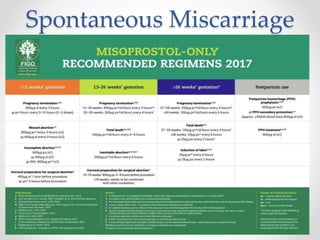
• Either induction by misoprostol alone or induction followed by
D&C.
• C. in cases of ↓ fibrinogen  correct fibrinogen 1st by FFP,
Fresh blood, Fibrinogen then termination of pregnancy.
• D. Anti D in Rh -ve patient if evacuation was done .
Spontaneous Miscarriage
• D. Septic Abortion:
• 1- Definition: superimposed infection on any type of abortion
• 2- Causative organism:
• Gram +ve  staph, strept (GBS)
• Gram –ve  E.coli, Pseudomonas
• Anareobic Bacteroids, an.strept, Clostridium.
• 3- Source of infection:
• Exogenous, Endogenous or hematogenous.
• 4- Clinical Picture:
• Symptoms: Triad of Abortion + symptoms of infection ( fever,
headache, malaise, lower Abd.Pain ) + offensive Vaginal
Discharge.
Spontaneous Miscarriage
• D. Septic Abortion:
• 4- Clinical Picture:
• Signs:
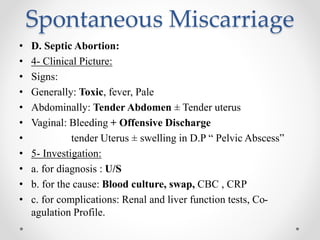
• Generally: Toxic, fever, Pale
• Abdominally: Tender Abdomen ± Tender uterus
• Vaginal: Bleeding + Offensive Discharge
• tender Uterus ± swelling in D.P “ Pelvic Abscess”
• 5- Investigation:
• a. for diagnosis : U/S
• b. for the cause: Blood culture, swap, CBC , CRP
• c. for complications: Renal and liver function tests, Co-
agulation Profile.
Spontaneous Miscarriage
• 6- Complications:
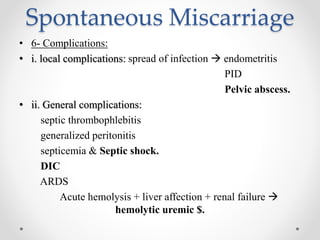
• i. local complications: spread of infection  endometritis
PID
Pelvic abscess.
• ii. General complications:
septic thrombophlebitis
generalized peritonitis
septicemia & Septic shock.
DIC
ARDS
Acute hemolysis + liver affection + renal failure 
hemolytic uremic $.
Spontaneous Miscarriage
• D. Septic Abortion:
• 7- Treatment:
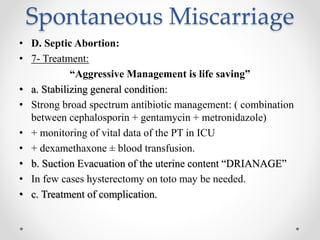
“Aggressive Management is life saving”
• a. Stabilizing general condition:
• Strong broad spectrum antibiotic management: ( combination
between cephalosporin + gentamycin + metronidazole)
• + monitoring of vital data of the PT in ICU
• + dexamethaxone ± blood transfusion.
• b. Suction Evacuation of the uterine content “DRIANAGE”
• In few cases hysterectomy on toto may be needed.
• c. Treatment of complication.
Spontaneous Miscarriage
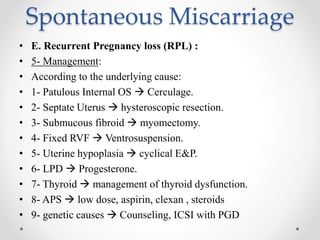
• E. Recurrent Pregnancy loss (RPL) : Habitual Abortion
• 1- Definition:
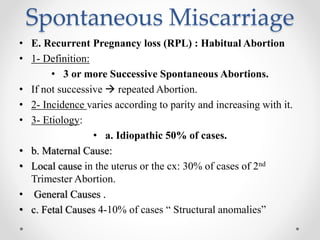
• 3 or more Successive Spontaneous Abortions.
• If not successive  repeated Abortion.
• 2- Incidence varies according to parity and increasing with it.
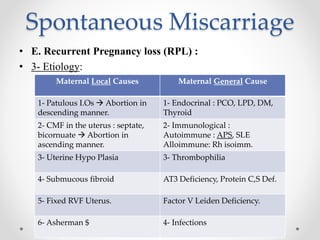
• 3- Etiology:
• a. Idiopathic 50% of cases.
• b. Maternal Cause:
• Local cause in the uterus or the cx: 30% of cases of 2nd
Trimester Abortion.
• General Causes .
• c. Fetal Causes 4-10% of cases “ Structural anomalies”
Spontaneous Miscarriage
• E. Recurrent Pregnancy loss (RPL) :
• 3- Etiology:
Maternal Local Causes Maternal General Cause
1- Patulous I.Os  Abortion in
descending manner.
1- Endocrinal : PCO, LPD, DM,
Thyroid
2- CMF in the uterus : septate,
bicornuate  Abortion in
ascending manner.
2- Immunological :
Autoimmune : APS, SLE
Alloimmune: Rh isoimm.
3- Uterine Hypo Plasia 3- Thrombophilia
4- Submucous fibroid AT3 Deficiency, Protein C,S Def.
5- Fixed RVF Uterus. Factor V Leiden Deficiency.
6- Asherman $ 4- Infections
Spontaneous Miscarriage
• E. Recurrent Pregnancy loss (RPL) :
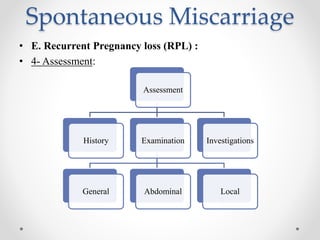
• 4- Assessment:
Assessment
History Examination
General Abdominal Local
Investigations
Spontaneous Miscarriage
• E. Recurrent Pregnancy loss (RPL) :
• 4- Assessment:
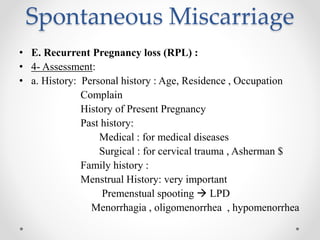
• a. History: Personal history : Age, Residence , Occupation
Complain
History of Present Pregnancy
Past history:
Medical : for medical diseases
Surgical : for cervical trauma , Asherman $
Family history :
Menstrual History: very important
Premenstual spooting  LPD
Menorrhagia , oligomenorrhea , hypomenorrhea
Spontaneous Miscarriage
• E. Recurrent Pregnancy loss (RPL) :
• 4- Assessment:
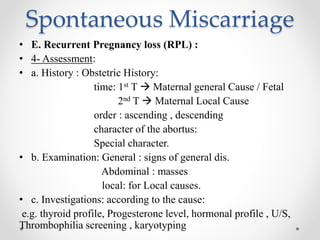
• a. History : Obstetric History:
time: 1st T  Maternal general Cause / Fetal
2nd T  Maternal Local Cause
order : ascending , descending
character of the abortus:
Special character.
• b. Examination: General : signs of general dis.
Abdominal : masses
local: for Local causes.
• c. Investigations: according to the cause:
e.g. thyroid profile, Progesterone level, hormonal profile , U/S,
Thrombophilia screening , karyotyping
Spontaneous Miscarriage
• E. Recurrent Pregnancy loss (RPL) :
• 5- Management:
• According to the underlying cause:
• 1- Patulous Internal OS  Cerculage.
• 2- Septate Uterus  hysteroscopic resection.
• 3- Submucous fibroid  myomectomy.
• 4- Fixed RVF  Ventrosuspension.
• 5- Uterine hypoplasia  cyclical E&P.
• 6- LPD  Progesterone.
• 7- Thyroid  management of thyroid dysfunction.
• 8- APS  low dose, aspirin, clexan , steroids
• 9- genetic causes  Counseling, ICSI with PGD
Spontaneous Miscarriage
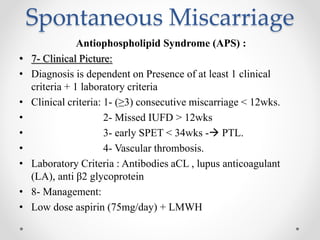
Antiophospholipid Syndrome (APS) :
• 1- Definition:
• 2- Antigens:
• 3- Pathophysiology:
• 4-incidence:
• 5- Types:
• 6- Morbidity:
• 7- Clinical Picture and diagnosis
• 8- Complications : Maternal & Fetal
• 9- Management.
Spontaneous Miscarriage
Antiophospholipid Syndrome (APS) :
• 1- Defintion:
• Auto immune disease forming antibodies against phospholipid
proteins and Plasma Proteins.
• 2- Antigens:
• β2 glycoprotein + Prothrombin + LA + Anti Cardiolipin.
• 3- Pathophysiology:
• Auto Antibodies attacks targeted antigens leading to multiple
venous and arterial thrombosis by several ways:
• As : direct cellular effect , activation of platelet , endothelial
cell activation, reduction of fibrinolysis, resistance to protein C
Spontaneous Miscarriage
Antiophospholipid Syndrome (APS) :
• 4- Types:
• 1ry APS
• 2ry APS : with SLE
• Catastrophic antiphospholipid syndrome  multiple organ
failure & death.
• 5- Incidence: & 6- Mobidity
• 2-12% of general population
• 30-40% of cases of SLE
• 10-15% of cases of RPL
• 30% of cases with stoke.
• 15-20% of cases with DVT.
Spontaneous Miscarriage
Antiophospholipid Syndrome (APS) :
• 7- Clinical Picture:
• Diagnosis is dependent on Presence of at least 1 clinical
criteria + 1 laboratory criteria
• Clinical criteria: 1- (≥3) consecutive miscarriage < 12wks.
• 2- Missed IUFD > 12wks
• 3- early SPET < 34wks - PTL.
• 4- Vascular thrombosis.
• Laboratory Criteria : Antibodies aCL , lupus anticoagulant
(LA), anti β2 glycoprotein
• 8- Management:
• Low dose aspirin (75mg/day) + LMWH
Spontaneous Miscarriage
Antiophospholipid Syndrome (APS) :
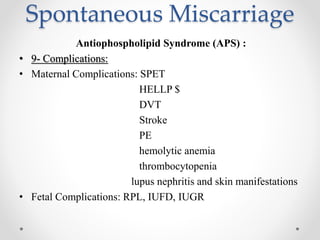
• 9- Complications:
• Maternal Complications: SPET
HELLP $
DVT
Stroke
PE
hemolytic anemia
thrombocytopenia
lupus nephritis and skin manifestations
• Fetal Complications: RPL, IUFD, IUGR
Break
Part 2
Ectopic Pregnancy
Ectopic Pregnancy
• 1- Introduction.
• 2- Definition.
• 3- Incidence.
• 4- Sites.
• 5- Etiology
• 6- Pathology
• 7- Fate.
• 8- Clinical Picture.
• 9- Investigations.
• 10- Treatment.
• 11- Deferential Diagnosis.
Ectopic Pregnancy
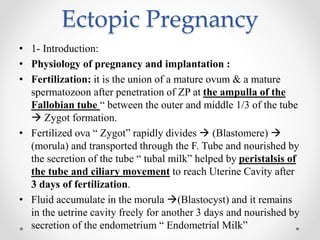
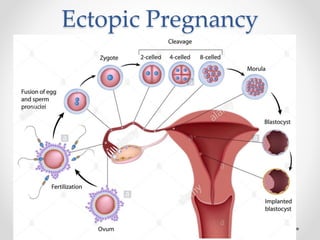
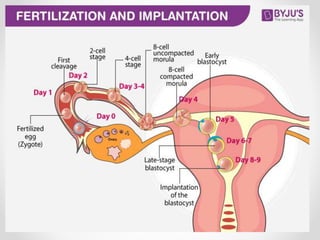
• 1- Introduction:
• Physiology of pregnancy and implantation :
• Fertilization: it is the union of a mature ovum & a mature
spermatozoon after penetration of ZP at the ampulla of the
Fallobian tube “ between the outer and middle 1/3 of the tube
 Zygot formation.
• Fertilized ova “ Zygot” rapidly divides  (Blastomere) 
(morula) and transported through the F. Tube and nourished by
the secretion of the tube “ tubal milk” helped by peristalsis of
the tube and ciliary movement to reach Uterine Cavity after
3 days of fertilization.
• Fluid accumulate in the morula (Blastocyst) and it remains
in the uetrine cavity freely for another 3 days and nourished by
secretion of the endometrium “ Endometrial Milk”
Ectopic Pregnancy
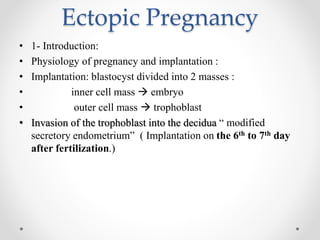
• 1- Introduction:
• Physiology of pregnancy and implantation :
• Implantation: blastocyst divided into 2 masses :
• inner cell mass  embryo
• outer cell mass  trophoblast
• Invasion of the trophoblast into the decidua “ modified
secretory endometrium” ( Implantation on the 6th to 7th day
after fertilization.)
Ectopic Pregnancy
• 1- Introduction:
• Physiology of pregnancy and implantation :
Ectopic Pregnancy
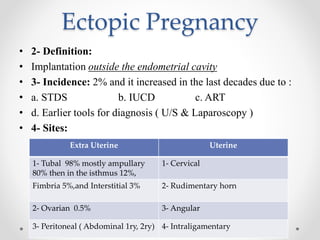
• 2- Definition:
• Implantation outside the endometrial cavity
• 3- Incidence: 2% and it increased in the last decades due to :
• a. STDS b. IUCD c. ART
• d. Earlier tools for diagnosis ( U/S & Laparoscopy )
• 4- Sites:
Extra Uterine Uterine
1- Tubal 98% mostly ampullary
80% then in the isthmus 12%,
1- Cervical
Fimbria 5%,and Interstitial 3% 2- Rudimentary horn
2- Ovarian 0.5% 3- Angular
3- Peritoneal ( Abdominal 1ry, 2ry) 4- Intraligamentary
Ectopic Pregnancy
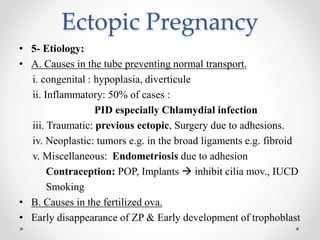
• 5- Etiology:
• A. Causes in the tube preventing normal transport.
i. congenital : hypoplasia, diverticule
ii. Inflammatory: 50% of cases :
PID especially Chlamydial infection
iii. Traumatic: previous ectopic, Surgery due to adhesions.
iv. Neoplastic: tumors e.g. in the broad ligaments e.g. fibroid
v. Miscellaneous: Endometriosis due to adhesion
Contraception: POP, Implants  inhibit cilia mov., IUCD
Smoking
• B. Causes in the fertilized ova.
• Early disappearance of ZP & Early development of trophoblast
Ectopic Pregnancy
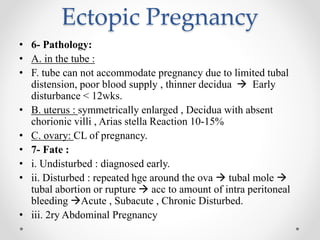
• 6- Pathology:
• A. in the tube :
• F. tube can not accommodate pregnancy due to limited tubal
distension, poor blood supply , thinner decidua  Early
disturbance < 12wks.
• B. uterus : symmetrically enlarged , Decidua with absent
chorionic villi , Arias stella Reaction 10-15%
• C. ovary: CL of pregnancy.
• 7- Fate :
• i. Undisturbed : diagnosed early.
• ii. Disturbed : repeated hge around the ova  tubal mole 
tubal abortion or rupture  acc to amount of intra peritoneal
bleeding Acute , Subacute , Chronic Disturbed.
• iii. 2ry Abdominal Pregnancy
Ectopic Pregnancy
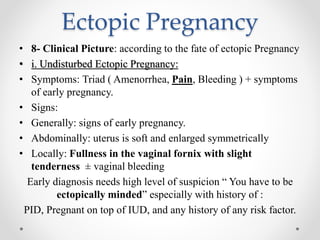
• 8- Clinical Picture: according to the fate of ectopic Pregnancy
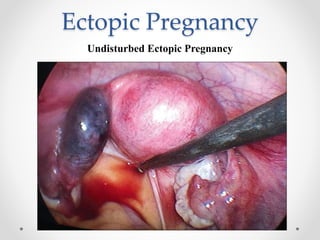
• i. Undisturbed Ectopic Pregnancy:
• Symptoms: Triad ( Amenorrhea, Pain, Bleeding ) + symptoms
of early pregnancy.
• Signs:
• Generally: signs of early pregnancy.
• Abdominally: uterus is soft and enlarged symmetrically
• Locally: Fullness in the vaginal fornix with slight
tenderness ± vaginal bleeding
Early diagnosis needs high level of suspicion “ You have to be
ectopically minded” especially with history of :
PID, Pregnant on top of IUD, and any history of any risk factor.
Ectopic Pregnancy
Undisturbed Ectopic Pregnancy
Ectopic Pregnancy
• ii. Disturbed Ectopic Pregnancy:
• a. Sub Acute Disturbed Ectopic Pregnancy: 60% of cases
• Symptoms: Triad + History of predisposing factor
Sudden sever PAIN may be: Dull aching dt. Tubal distension
Sharp stabbing dt. Tubal rupture
Colicky dt. Tubal abortion.
+ slight dark brown Discharge.
• Signs:
• Generally: various degree of shock
• Abdominally: Tenderness, Rigidity, Rebound Tenderness.
• Locally: Cervix : Tender on movement ( Jumping Sign )
“Cervical Motion Tenderness”
• Fullness in the vaginal fornix.
Ectopic Pregnancy
• ii. Disturbed Ectopic Pregnancy:
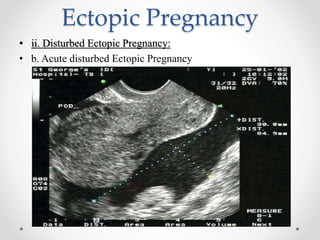
• b. Acute disturbed Ectopic Pregnancy
Ectopic Pregnancy
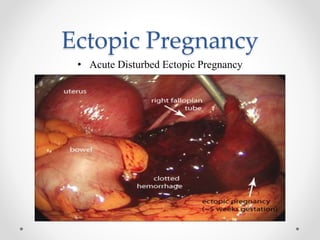
• Acute Disturbed Ectopic Pregnancy
Ectopic Pregnancy
• ii. Disturbed Ectopic Pregnancy:
• b. Acute disturbed Ectopic Pregnancy:
• Symptoms:
• Triad + Sever Abdominal Pain followed by massive
intraperitoneal hge with shock & collapse ± Shoulder Pain
• Signs:
• Generally: Shock not proportional to external Hge.
• Abdominally: Tenderness, Rigidity , R.Tend .
• Locally: difficult esp. if the pt is comatosed
Ectopic Pregnancy
• ii. Disturbed Ectopic Pregnancy:
• b. Chronic Disturbed Ectopic Pregnancy:
• Symptoms:
• History of Predisposing factor ± Triad
• Blood collected gradually in the DP with Pelvic hematocele
formation leading to : pressure symptoms :4Ds
Dorsal pain, Dysuria, Dyschazia, Dyspareunia
• Signs:
• Generally: pallor ± Pyrexia ± Jaundice
• Abdominally: mild tenderness.
• Locally: as before
• Diagnosis: by laparoscopy.
Ectopic Pregnancy
• ii. Disturbed Ectopic Pregnancy:
• c. 2ry Abdominal Pregnancy:
• Rare condition. Started as a tubal pregnancy  aborted from
the F.Tube  re-imblanted in any abdominal organ.
• Signs: Abnormal lie with easy palpation of the fetal parts.
• Diagnosed by U/S, MRI => fetus and the placenta is out side
the uterine cavity.
• Treatment: by laparotomy and if the placenta is attached to one
of the great vessels  leave the placenta and give
methotrexate for helping the absorption.
Ectopic Pregnancy
• 9- Investigations:
• A. General investigations: CBC, PT, PTT, Liver function tests
• B. Specific investigations:
• T.V U/S + Q.β-HCG Titer
• 1- quantitative β-HCG titer (Pregnancy test) and repeated after
48 hs  i. if increased > 66%  normal pregnancy.
• ii. If increased < 66%  ectopic Pregnancy.
• 2- T.V U/S : more sensitive than Abd. U/S:
• Gestational sac seen intrauterine at the age around 5 wks and
fetal cardiac pulsation seen at the age around 6 wks.
• Empty U/S by T.V U/S ± Adnexal mass with β-HCG titer >
1500 mIU/ml is diagnostic for Ectopic Pregnancy.
• Laparoscopy is used for diagnosis and management
Ectopic Pregnancy
• 10- Treatment:
• A. Expectant Management.
• B. Medical Management.
• C. Surgical Management: either Laparoscopy or Laparotomy
• D. Anti D in Rh –ve Patients specially in surgical
management.
• A. Expectant management: in case of low β-HCG < 200 & T.V
U/s is –ve  follow up with repetition of the titer after 48hs.
• B. Medical Management:
If : 1- undisturbed ectopic pregnancy
2- adnexal mass < 3cm
3- -ve Cardiac Pulsations.
4- β-HCG titer < 3000 mIU/ml.
Ectopic Pregnancy
• 10- Treatment:
• B. Medical Management:
• Methotrexate 50mg/m2 IM with follow up:
• Serial U/S & β-HCG titer done on Day 0: Date of injection
• Day 4
• Day 7
• There may be mild increase in β-HCG titre on day 4 but to
comment as successful medical management there is should
decrease >15% in β-HCG Titer between Day 4 and Day 7.
• Serial CBC should be done.
• If decrease is < 15 % repetition of methotrexate dose could be
used for another 2 doses  if failed  Surgical Management.
Ectopic Pregnancy
• 10- Treatment:
• C. Sugical Management:
• if : 1- Failed Medical Management
• 2- Disturbed Ectopic Pregnancy.
• 3- Unsuitable medical Management.
• In Disturbed Ectopic pregnancy:
• RESUSITATION + Laparoscopy if the pt is
hemodynamically stable or laparotomy if pt is
hemodynamically unstable  Peritoneal toilet +
Salpengectomy if the other tube is healthy or Salpengotomy
or Salpengostomy if the other tube is not healthy.
• In undisturbed Ectopic pregnancy : Laparoscopy is gold
standard as a diagnostic and treatment tool .
Ectopic Pregnancy
• 10- Treatment:
• Contra indications of methotrexate management:
• 1- Patient is hemodynamicaly unstable , sever pain
• 2- β-HCG titer > 3000 mIU/ml
• 3- Adnexal mass > 3-4 cm or free fluid in DP > 300ml
• 4- C0-Existant intrauterine living pregnancy ( heterotropic
Pregnancy).
• 5- intolerability to methotrexate therapy as in hepatic, renal or
blood disease patients.
• Contraception after ectopic pregnancy avoid IUCD & POP
 use COC unless contraindicated.
• Recurrence rate 15% and infertility or subfertility 30%
Ectopic Pregnancy
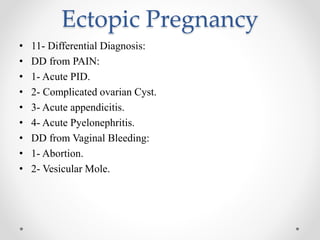
• 11- Differential Diagnosis:
• DD from PAIN:
• 1- Acute PID.
• 2- Complicated ovarian Cyst.
• 3- Acute appendicitis.
• 4- Acute Pyelonephritis.
• DD from Vaginal Bleeding:
• 1- Abortion.
• 2- Vesicular Mole.
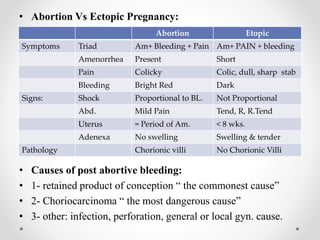
• Abortion Vs Ectopic Pregnancy:
• Causes of post abortive bleeding:
• 1- retained product of conception “ the commonest cause”
• 2- Choriocarcinoma “ the most dangerous cause”
• 3- other: infection, perforation, general or local gyn. cause.
Abortion Etopic
Symptoms Triad Am+ Bleeding + Pain Am+ PAIN + bleeding
Amenorrhea Present Short
Pain Colicky Colic, dull, sharp stab
Bleeding Bright Red Dark
Signs: Shock Proportional to BL. Not Proportional
Abd. Mild Pain Tend, R, R.Tend
Uterus = Period of Am. < 8 wks.
Adenexa No swelling Swelling & tender
Pathology Chorionic villi No Chorionic Villi
Thank You
For Contact:
E-mail: ahmedalizein@gmail.com

Bleeding in Early Pregnancy-1.pptx

  • 1.
    Bleeding in Early Pregnancy Presentedby Dr. Ahmed Ali Zein El-Abdein El-Nizamy Lecturer of Obstetrics and Gynecology Faculty of Medicine Suez University
  • 2.
    Bleeding in Early Pregnancy Objectives: Allmedical student by the end of this lecture supposed to : • 1- List causes of obstetrics hemorrhage. • 2- Demonstrate the difference between types of Miscarriage. • 3- Illustrate the management of recurrent pregnancy loss. • 4- Distinguish the ectopic pregnancy and its management.
  • 3.
    Bleeding in Early Pregnancy •Items to be covered: Part 1: • 1- Causes of obstetric hemorrhage: • 2- Definition of miscarriage. • 3- Types of Miscarriage. • 4- Risk factors. • 5- Etiology. • 6- Pathogenesis. • 7- Clinical picture of each type of Miscarriage. • 8- Investigations. • 9- Treatment of each type. • 10- Recurrent Pregnancy Loss.
  • 4.
    Bleeding in Early Pregnancy •Items to be covered: Part 2: Ectopic Pregnancy • 1- Definition & Incidence of Ectopic Pregnancy. • 2- Site. • 3- Etiology. • 4- Pathology. • 5- Fate and types of ectopic pregnancy. • 6- Clinical Picture. • 7- Investigations. • 8- Treatment modalities of Ectopic Pregnancy.
  • 5.
  • 6.
    Bleeding in Early Pregnancy ObstetricHge Early Preg. 1- Abortion. 2- Ectopic 3- Vesicular Mole Other causes Antepartum Hge Placental Extra-Placental Postpartum Hge Complications of 3rd stage of labor.
  • 7.
    Bleeding in Early Pregnancy •Bleeding in early pregnancy: • A- Main causes: • 1- Abortion. • 2- Ectopic Pregnancy. • 3- Vesicular Mole. • B- Other causes: • 1- General causes : bleeding tendency, HTN. • 2- Local Gynecological causes : ulcer. • 3- Trauma : sexual abuse. • 4- Malignancy. • 5- Hartman Sign & Decidual Hge.
  • 8.
    Abortion & Miscarriage •1- Definition: • Termination or interruption of Pregnancy before age of fetal viability. Acc to WHO definition < 20 wks. (500 gm) UK < 24 wks. Egypt < 28 wks. ( 1000 gm). • 2- Incidence: • Varies according to the type of miscarriage. • 3- Types : A- Spontaneous : Miscarriage. B- Induced : Abortion.
  • 9.
    Abortion & Miscarriage •3- Types: • A- Miscarriage: spontaneous Abortion. A- • Threatened Abortion. B- • Inevitable Abortion : complete, incomplete, cervical. C- • Missed Abortion D- • Septic Abortion E- • Habitual Abortion ( RPL )
  • 10.
    Abortion & Miscarriage •3- Types: • B- Abortion : Induced • 1- Therapeutic Abortion. • 2- Non Medical Abortion Elective. Criminal.
  • 11.
    Spontaneous Miscarriage • 1-Incidence: 15 % • 80% in the 1st trimester esp. < 8 wks “Window Gap” • Incidence may be more than that due to subclinical miscarriage or deficient notification “ illegal abortion ” • 2- Risk factors for Miscarriage: • A. Patient factors: ↑ age & Parity , extremes in BMI , low socio-economic class, heavy smoking, Alcohol consumption and low plasma Folate Level. • B. Obstetric factors: • Past history of miscarriage, CFMF, long time infertility due to underlying cause.
  • 12.
    • 3- Etiology: FetalCauses Maternal Causes Local Causes Commonest causes of 1st trimester Miscarriage ( 50-60% ) 1- Maternal disease 1- Cervical causes: “ Patulous OS” Chromosomal Abnormality 2- Endocrinal cause: PCO, Luteal insuff. , endocrinal dis. e.g. DM, Thyroid, Prolactin 2- Uterine cause : a. Congenital malformation: Septum. Aneuploidy: Trisomy, monosomy Tiploidy 3- Infection. 4- others: drugs, chemical, radiation, truama b. Small cavity: submucous fibroid, Asherman $ CFMF 5- Immunological causes: Auto immune: APS, SLE Alloimmune : Rh iso. c. Fixed RVF uterus. d. Aute Poly hydraminous Malformed fetus Macerated fetus Fresh fetus
  • 13.
    Spontaneous Miscarriage • 4-Pathogenesis: • In 1st trimester: • Starts as bleeding in Decidua basalis “choriodecidual hge” ↓ Uterine irritation → “ Colic” In the 2nd trimester: ROM may occur with Pain. Abortion Amenorrhea Bleeding Pain
  • 14.
    Spontaneous Miscarriage • A.Threatened Abortion: • 1- Def.: attempt of the uterus to expel the fetus leading to or due to partial separation of the fertilized ova  hemorrhage in the choriodecidual space. • 2- Clinical Picture: • Triad ( Am. B. P. ) • Symptoms of early preg. • Signs: signs of early Preg. uterus corresponds to period of amenorrhea Cervix : Closed
  • 15.
    Spontaneous Miscarriage • A.Threatened Abortion: • 3- investigations: • For Diagnosis: U/S ± β HCG titer • For the cause : D.M , CL insufficiency, thyroid disease • 4- FATE: • 70-80% of cases  pregnancy continues but ↑ incidence of PTL, IUGR, PPROM, APHge. • Bleeding increased  inevitable Abortion. • Loss of cardiac pulsations  Missed miscarriage. • Infections occurs  septic Abortion.
  • 16.
    Spontaneous Miscarriage • A.Threatened Abortion:
  • 17.
    Spontaneous Miscarriage • A.Threatened Abortion: • 5- Treatment: either Conservative Vs. Termination of Preg. • a. Conservative management: • i. REST : Physical & Sexual • ii. Progesterone : beneficial only in CL insufficiency Prontogest 100mg 1x2 for 5-7 days. • iii. Antispasmodics • iv. Anti D ( 250 IU ) > 13 wks • b. Termination of Pregnancy: • i. Proven CFMF ii. TURN inevitable iii. Turn Septic • D&C will done.
  • 18.
    Spontaneous Miscarriage • B-Inevitable Abortion: • 1- Def.: complete separation of the fertilized ova or placenta with progressive cervical dilatation and fetal expulsion. • 2- Clinical Picture: • Symptoms: • Triad + moderate to sever bleeding + sever Pain • Signs: • Generally : according to bleeding  Pallor & shock. • Abdominally : uterus = period of amenorrhea • Locally: CX is OPEN • 3- Investigations: • General : CBC , PT, PTT • Specific: U/S
  • 19.
    Spontaneous Miscarriage • B-Inevitable Abortion: • 4- Treatment: • i. RESUSITATION: IV Fluids ± Blood transfusion • ii. Evacuation: • 1st Trimester: surgical evacuation. • 2nd Trimester: misoprostol or oxytocin then evacuation if remnant of conception or sever bleeding. • iii. Ecbolics and Antibiotics • iv. Anti D in Rh –ve Patients. Especially if surgical evacuation done or if > 12 wks.
  • 20.
    Spontaneous Miscarriage • CompleteAbortion: • 1- Def.: all products of conception have been expelled. • 2- Clinical Picture: • Symptoms: Triad + expulsion of the conception  ↓ bleeding & Pain • Signs: the same as inevitable abortion but the CX is CLOSED • 3- Investigations: • General investigations: CBC , PT, PTT • U/S  Empty Uterus. • 4- Treatment: • Ecbolics + Antibiotic
  • 21.
    Spontaneous Miscarriage • IncompleteAbortion: • As inevitable Abortion but part of the product of conception is still in the uterus  confirmed by U/S • Treatment: as inevitable Abortion. • Cervical Abortion: • 1- Def.: arrest of gestational sac in the cervical canal. • 2- Clinical Picture: • Sever, Sever Pain + Bleeding + OPENED & Swollen CX + Part of product of conception may be felt during P.V ex. • 3- Treatment: • EVACUATION + Ecbolics + Antibiotics
  • 22.
    Spontaneous Miscarriage • c.Missed Abortion: “ Carneous, bloody , fleshy Mole” • 1- Definition: • Retention of dead or non viable product of conception within the uterine cavity. • 2- Clinical Picture: • Symptoms: Triad but • Bleeding may be mild dark brown discharge • Milk discharge but it may occur normally in pregnancy. • Pain is usually Absent. + Absent fetal kicks • Signs: • CX is CLOSED • Uterus is < period of amenorrhea ± no sign of Preg.
  • 23.
    Spontaneous Miscarriage • c.Missed Abortion: “ Carneous, bloody , fleshy Mole” • 3- Investigations: • For diagnosis: • a. U/S: i. collapsed sac ii. –ve cardiac Puslations. CRL ≥ 6 mm iii. Gestational sac ≥ 25mm with no fetal pole “Blighted ovum” • b. β-HCG & repeated after 48hs : plateau or decreasing • For complications: • Serum fibrinogen level : decreased by 50mg/wk , repeated weekly, if < 100mg/dl  DIC. • 4- Complications: Infection , DIC after 4-6 wks.
  • 24.
    Spontaneous Miscarriage • c.Missed Abortion: “ Carneous, bloody , fleshy Mole” • 5- Treatment: • A. Expectant Management: spontaneous expulsion within 2 wks • B. Termination of Pregnancy according to gestational age: • Either induction by misoprostol alone or induction followed by D&C. • C. in cases of ↓ fibrinogen  correct fibrinogen 1st by FFP, Fresh blood, Fibrinogen then termination of pregnancy. • D. Anti D in Rh -ve patient if evacuation was done .
  • 25.
  • 26.
    Spontaneous Miscarriage • D.Septic Abortion: • 1- Definition: superimposed infection on any type of abortion • 2- Causative organism: • Gram +ve  staph, strept (GBS) • Gram –ve  E.coli, Pseudomonas • Anareobic Bacteroids, an.strept, Clostridium. • 3- Source of infection: • Exogenous, Endogenous or hematogenous. • 4- Clinical Picture: • Symptoms: Triad of Abortion + symptoms of infection ( fever, headache, malaise, lower Abd.Pain ) + offensive Vaginal Discharge.
  • 27.
    Spontaneous Miscarriage • D.Septic Abortion: • 4- Clinical Picture: • Signs: • Generally: Toxic, fever, Pale • Abdominally: Tender Abdomen ± Tender uterus • Vaginal: Bleeding + Offensive Discharge • tender Uterus ± swelling in D.P “ Pelvic Abscess” • 5- Investigation: • a. for diagnosis : U/S • b. for the cause: Blood culture, swap, CBC , CRP • c. for complications: Renal and liver function tests, Co- agulation Profile.
  • 28.
    Spontaneous Miscarriage • 6-Complications: • i. local complications: spread of infection  endometritis PID Pelvic abscess. • ii. General complications: septic thrombophlebitis generalized peritonitis septicemia & Septic shock. DIC ARDS Acute hemolysis + liver affection + renal failure  hemolytic uremic $.
  • 29.
    Spontaneous Miscarriage • D.Septic Abortion: • 7- Treatment: “Aggressive Management is life saving” • a. Stabilizing general condition: • Strong broad spectrum antibiotic management: ( combination between cephalosporin + gentamycin + metronidazole) • + monitoring of vital data of the PT in ICU • + dexamethaxone ± blood transfusion. • b. Suction Evacuation of the uterine content “DRIANAGE” • In few cases hysterectomy on toto may be needed. • c. Treatment of complication.
  • 30.
    Spontaneous Miscarriage • E.Recurrent Pregnancy loss (RPL) : Habitual Abortion • 1- Definition: • 3 or more Successive Spontaneous Abortions. • If not successive  repeated Abortion. • 2- Incidence varies according to parity and increasing with it. • 3- Etiology: • a. Idiopathic 50% of cases. • b. Maternal Cause: • Local cause in the uterus or the cx: 30% of cases of 2nd Trimester Abortion. • General Causes . • c. Fetal Causes 4-10% of cases “ Structural anomalies”
  • 31.
    Spontaneous Miscarriage • E.Recurrent Pregnancy loss (RPL) : • 3- Etiology: Maternal Local Causes Maternal General Cause 1- Patulous I.Os  Abortion in descending manner. 1- Endocrinal : PCO, LPD, DM, Thyroid 2- CMF in the uterus : septate, bicornuate  Abortion in ascending manner. 2- Immunological : Autoimmune : APS, SLE Alloimmune: Rh isoimm. 3- Uterine Hypo Plasia 3- Thrombophilia 4- Submucous fibroid AT3 Deficiency, Protein C,S Def. 5- Fixed RVF Uterus. Factor V Leiden Deficiency. 6- Asherman $ 4- Infections
  • 32.
    Spontaneous Miscarriage • E.Recurrent Pregnancy loss (RPL) : • 4- Assessment: Assessment History Examination General Abdominal Local Investigations
  • 33.
    Spontaneous Miscarriage • E.Recurrent Pregnancy loss (RPL) : • 4- Assessment: • a. History: Personal history : Age, Residence , Occupation Complain History of Present Pregnancy Past history: Medical : for medical diseases Surgical : for cervical trauma , Asherman $ Family history : Menstrual History: very important Premenstual spooting  LPD Menorrhagia , oligomenorrhea , hypomenorrhea
  • 34.
    Spontaneous Miscarriage • E.Recurrent Pregnancy loss (RPL) : • 4- Assessment: • a. History : Obstetric History: time: 1st T  Maternal general Cause / Fetal 2nd T  Maternal Local Cause order : ascending , descending character of the abortus: Special character. • b. Examination: General : signs of general dis. Abdominal : masses local: for Local causes. • c. Investigations: according to the cause: e.g. thyroid profile, Progesterone level, hormonal profile , U/S, Thrombophilia screening , karyotyping
  • 35.
    Spontaneous Miscarriage • E.Recurrent Pregnancy loss (RPL) : • 5- Management: • According to the underlying cause: • 1- Patulous Internal OS  Cerculage. • 2- Septate Uterus  hysteroscopic resection. • 3- Submucous fibroid  myomectomy. • 4- Fixed RVF  Ventrosuspension. • 5- Uterine hypoplasia  cyclical E&P. • 6- LPD  Progesterone. • 7- Thyroid  management of thyroid dysfunction. • 8- APS  low dose, aspirin, clexan , steroids • 9- genetic causes  Counseling, ICSI with PGD
  • 36.
    Spontaneous Miscarriage Antiophospholipid Syndrome(APS) : • 1- Definition: • 2- Antigens: • 3- Pathophysiology: • 4-incidence: • 5- Types: • 6- Morbidity: • 7- Clinical Picture and diagnosis • 8- Complications : Maternal & Fetal • 9- Management.
  • 37.
    Spontaneous Miscarriage Antiophospholipid Syndrome(APS) : • 1- Defintion: • Auto immune disease forming antibodies against phospholipid proteins and Plasma Proteins. • 2- Antigens: • β2 glycoprotein + Prothrombin + LA + Anti Cardiolipin. • 3- Pathophysiology: • Auto Antibodies attacks targeted antigens leading to multiple venous and arterial thrombosis by several ways: • As : direct cellular effect , activation of platelet , endothelial cell activation, reduction of fibrinolysis, resistance to protein C
  • 38.
    Spontaneous Miscarriage Antiophospholipid Syndrome(APS) : • 4- Types: • 1ry APS • 2ry APS : with SLE • Catastrophic antiphospholipid syndrome  multiple organ failure & death. • 5- Incidence: & 6- Mobidity • 2-12% of general population • 30-40% of cases of SLE • 10-15% of cases of RPL • 30% of cases with stoke. • 15-20% of cases with DVT.
  • 39.
    Spontaneous Miscarriage Antiophospholipid Syndrome(APS) : • 7- Clinical Picture: • Diagnosis is dependent on Presence of at least 1 clinical criteria + 1 laboratory criteria • Clinical criteria: 1- (≥3) consecutive miscarriage < 12wks. • 2- Missed IUFD > 12wks • 3- early SPET < 34wks - PTL. • 4- Vascular thrombosis. • Laboratory Criteria : Antibodies aCL , lupus anticoagulant (LA), anti β2 glycoprotein • 8- Management: • Low dose aspirin (75mg/day) + LMWH
  • 40.
    Spontaneous Miscarriage Antiophospholipid Syndrome(APS) : • 9- Complications: • Maternal Complications: SPET HELLP $ DVT Stroke PE hemolytic anemia thrombocytopenia lupus nephritis and skin manifestations • Fetal Complications: RPL, IUFD, IUGR
  • 41.
  • 42.
  • 43.
    Ectopic Pregnancy • 1-Introduction. • 2- Definition. • 3- Incidence. • 4- Sites. • 5- Etiology • 6- Pathology • 7- Fate. • 8- Clinical Picture. • 9- Investigations. • 10- Treatment. • 11- Deferential Diagnosis.
  • 44.
    Ectopic Pregnancy • 1-Introduction: • Physiology of pregnancy and implantation : • Fertilization: it is the union of a mature ovum & a mature spermatozoon after penetration of ZP at the ampulla of the Fallobian tube “ between the outer and middle 1/3 of the tube  Zygot formation. • Fertilized ova “ Zygot” rapidly divides  (Blastomere)  (morula) and transported through the F. Tube and nourished by the secretion of the tube “ tubal milk” helped by peristalsis of the tube and ciliary movement to reach Uterine Cavity after 3 days of fertilization. • Fluid accumulate in the morula (Blastocyst) and it remains in the uetrine cavity freely for another 3 days and nourished by secretion of the endometrium “ Endometrial Milk”
  • 45.
    Ectopic Pregnancy • 1-Introduction: • Physiology of pregnancy and implantation : • Implantation: blastocyst divided into 2 masses : • inner cell mass  embryo • outer cell mass  trophoblast • Invasion of the trophoblast into the decidua “ modified secretory endometrium” ( Implantation on the 6th to 7th day after fertilization.)
  • 46.
    Ectopic Pregnancy • 1-Introduction: • Physiology of pregnancy and implantation :
  • 48.
    Ectopic Pregnancy • 2-Definition: • Implantation outside the endometrial cavity • 3- Incidence: 2% and it increased in the last decades due to : • a. STDS b. IUCD c. ART • d. Earlier tools for diagnosis ( U/S & Laparoscopy ) • 4- Sites: Extra Uterine Uterine 1- Tubal 98% mostly ampullary 80% then in the isthmus 12%, 1- Cervical Fimbria 5%,and Interstitial 3% 2- Rudimentary horn 2- Ovarian 0.5% 3- Angular 3- Peritoneal ( Abdominal 1ry, 2ry) 4- Intraligamentary
  • 49.
    Ectopic Pregnancy • 5-Etiology: • A. Causes in the tube preventing normal transport. i. congenital : hypoplasia, diverticule ii. Inflammatory: 50% of cases : PID especially Chlamydial infection iii. Traumatic: previous ectopic, Surgery due to adhesions. iv. Neoplastic: tumors e.g. in the broad ligaments e.g. fibroid v. Miscellaneous: Endometriosis due to adhesion Contraception: POP, Implants  inhibit cilia mov., IUCD Smoking • B. Causes in the fertilized ova. • Early disappearance of ZP & Early development of trophoblast
  • 50.
    Ectopic Pregnancy • 6-Pathology: • A. in the tube : • F. tube can not accommodate pregnancy due to limited tubal distension, poor blood supply , thinner decidua  Early disturbance < 12wks. • B. uterus : symmetrically enlarged , Decidua with absent chorionic villi , Arias stella Reaction 10-15% • C. ovary: CL of pregnancy. • 7- Fate : • i. Undisturbed : diagnosed early. • ii. Disturbed : repeated hge around the ova  tubal mole  tubal abortion or rupture  acc to amount of intra peritoneal bleeding Acute , Subacute , Chronic Disturbed. • iii. 2ry Abdominal Pregnancy
  • 51.
    Ectopic Pregnancy • 8-Clinical Picture: according to the fate of ectopic Pregnancy • i. Undisturbed Ectopic Pregnancy: • Symptoms: Triad ( Amenorrhea, Pain, Bleeding ) + symptoms of early pregnancy. • Signs: • Generally: signs of early pregnancy. • Abdominally: uterus is soft and enlarged symmetrically • Locally: Fullness in the vaginal fornix with slight tenderness ± vaginal bleeding Early diagnosis needs high level of suspicion “ You have to be ectopically minded” especially with history of : PID, Pregnant on top of IUD, and any history of any risk factor.
  • 52.
  • 53.
    Ectopic Pregnancy • ii.Disturbed Ectopic Pregnancy: • a. Sub Acute Disturbed Ectopic Pregnancy: 60% of cases • Symptoms: Triad + History of predisposing factor Sudden sever PAIN may be: Dull aching dt. Tubal distension Sharp stabbing dt. Tubal rupture Colicky dt. Tubal abortion. + slight dark brown Discharge. • Signs: • Generally: various degree of shock • Abdominally: Tenderness, Rigidity, Rebound Tenderness. • Locally: Cervix : Tender on movement ( Jumping Sign ) “Cervical Motion Tenderness” • Fullness in the vaginal fornix.
  • 54.
    Ectopic Pregnancy • ii.Disturbed Ectopic Pregnancy: • b. Acute disturbed Ectopic Pregnancy
  • 55.
    Ectopic Pregnancy • AcuteDisturbed Ectopic Pregnancy
  • 56.
    Ectopic Pregnancy • ii.Disturbed Ectopic Pregnancy: • b. Acute disturbed Ectopic Pregnancy: • Symptoms: • Triad + Sever Abdominal Pain followed by massive intraperitoneal hge with shock & collapse ± Shoulder Pain • Signs: • Generally: Shock not proportional to external Hge. • Abdominally: Tenderness, Rigidity , R.Tend . • Locally: difficult esp. if the pt is comatosed
  • 57.
    Ectopic Pregnancy • ii.Disturbed Ectopic Pregnancy: • b. Chronic Disturbed Ectopic Pregnancy: • Symptoms: • History of Predisposing factor ± Triad • Blood collected gradually in the DP with Pelvic hematocele formation leading to : pressure symptoms :4Ds Dorsal pain, Dysuria, Dyschazia, Dyspareunia • Signs: • Generally: pallor ± Pyrexia ± Jaundice • Abdominally: mild tenderness. • Locally: as before • Diagnosis: by laparoscopy.
  • 58.
    Ectopic Pregnancy • ii.Disturbed Ectopic Pregnancy: • c. 2ry Abdominal Pregnancy: • Rare condition. Started as a tubal pregnancy  aborted from the F.Tube  re-imblanted in any abdominal organ. • Signs: Abnormal lie with easy palpation of the fetal parts. • Diagnosed by U/S, MRI => fetus and the placenta is out side the uterine cavity. • Treatment: by laparotomy and if the placenta is attached to one of the great vessels  leave the placenta and give methotrexate for helping the absorption.
  • 59.
    Ectopic Pregnancy • 9-Investigations: • A. General investigations: CBC, PT, PTT, Liver function tests • B. Specific investigations: • T.V U/S + Q.β-HCG Titer • 1- quantitative β-HCG titer (Pregnancy test) and repeated after 48 hs  i. if increased > 66%  normal pregnancy. • ii. If increased < 66%  ectopic Pregnancy. • 2- T.V U/S : more sensitive than Abd. U/S: • Gestational sac seen intrauterine at the age around 5 wks and fetal cardiac pulsation seen at the age around 6 wks. • Empty U/S by T.V U/S ± Adnexal mass with β-HCG titer > 1500 mIU/ml is diagnostic for Ectopic Pregnancy. • Laparoscopy is used for diagnosis and management
  • 60.
    Ectopic Pregnancy • 10-Treatment: • A. Expectant Management. • B. Medical Management. • C. Surgical Management: either Laparoscopy or Laparotomy • D. Anti D in Rh –ve Patients specially in surgical management. • A. Expectant management: in case of low β-HCG < 200 & T.V U/s is –ve  follow up with repetition of the titer after 48hs. • B. Medical Management: If : 1- undisturbed ectopic pregnancy 2- adnexal mass < 3cm 3- -ve Cardiac Pulsations. 4- β-HCG titer < 3000 mIU/ml.
  • 61.
    Ectopic Pregnancy • 10-Treatment: • B. Medical Management: • Methotrexate 50mg/m2 IM with follow up: • Serial U/S & β-HCG titer done on Day 0: Date of injection • Day 4 • Day 7 • There may be mild increase in β-HCG titre on day 4 but to comment as successful medical management there is should decrease >15% in β-HCG Titer between Day 4 and Day 7. • Serial CBC should be done. • If decrease is < 15 % repetition of methotrexate dose could be used for another 2 doses  if failed  Surgical Management.
  • 62.
    Ectopic Pregnancy • 10-Treatment: • C. Sugical Management: • if : 1- Failed Medical Management • 2- Disturbed Ectopic Pregnancy. • 3- Unsuitable medical Management. • In Disturbed Ectopic pregnancy: • RESUSITATION + Laparoscopy if the pt is hemodynamically stable or laparotomy if pt is hemodynamically unstable  Peritoneal toilet + Salpengectomy if the other tube is healthy or Salpengotomy or Salpengostomy if the other tube is not healthy. • In undisturbed Ectopic pregnancy : Laparoscopy is gold standard as a diagnostic and treatment tool .
  • 63.
    Ectopic Pregnancy • 10-Treatment: • Contra indications of methotrexate management: • 1- Patient is hemodynamicaly unstable , sever pain • 2- β-HCG titer > 3000 mIU/ml • 3- Adnexal mass > 3-4 cm or free fluid in DP > 300ml • 4- C0-Existant intrauterine living pregnancy ( heterotropic Pregnancy). • 5- intolerability to methotrexate therapy as in hepatic, renal or blood disease patients. • Contraception after ectopic pregnancy avoid IUCD & POP  use COC unless contraindicated. • Recurrence rate 15% and infertility or subfertility 30%
  • 64.
    Ectopic Pregnancy • 11-Differential Diagnosis: • DD from PAIN: • 1- Acute PID. • 2- Complicated ovarian Cyst. • 3- Acute appendicitis. • 4- Acute Pyelonephritis. • DD from Vaginal Bleeding: • 1- Abortion. • 2- Vesicular Mole.
  • 65.
    • Abortion VsEctopic Pregnancy: • Causes of post abortive bleeding: • 1- retained product of conception “ the commonest cause” • 2- Choriocarcinoma “ the most dangerous cause” • 3- other: infection, perforation, general or local gyn. cause. Abortion Etopic Symptoms Triad Am+ Bleeding + Pain Am+ PAIN + bleeding Amenorrhea Present Short Pain Colicky Colic, dull, sharp stab Bleeding Bright Red Dark Signs: Shock Proportional to BL. Not Proportional Abd. Mild Pain Tend, R, R.Tend Uterus = Period of Am. < 8 wks. Adenexa No swelling Swelling & tender Pathology Chorionic villi No Chorionic Villi
  • 66.
    Thank You For Contact: E-mail:ahmedalizein@gmail.com