Theory of Computation
Pushdown Automata
Basic Structure of PDA
• A pushdown automaton is a way to implement a context-free grammar
in a similar way we design DFA for a regular grammar. A DFA can
remember a finite amount of information, but a PDA can remember an
infinite amount of information.
• Basically a pushdown automaton is −
"Finite state machine" + "a stack"
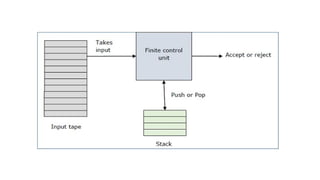
• A pushdown automaton has three components −
an input tape,
a control unit, and
a stack with infinite size.
Cont.
The stack head scans the top symbol of the stack.
A stack does two operations −
• Push − a new symbol is added at the top.
• Pop − the top symbol is read and removed.
• A PDA may or may not read an input symbol, but it has to read
the top of the stack in every transition.
Formal Definition
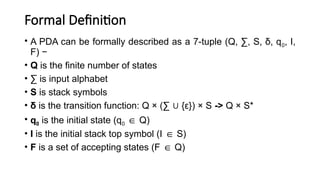
• A PDA can be formally described as a 7-tuple (Q, ∑, S, δ, q0, I,
F) −
• Q is the finite number of states
• ∑ is input alphabet
• S is stack symbols
• δ is the transition function: Q × (∑ {ε}) × S
∪ -> Q × S*
• q0 is the initial state (q0 Q)
∈
• I is the initial stack top symbol (I S)
∈
• F is a set of accepting states (F Q)
∈
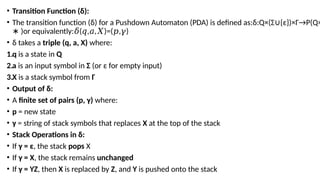
• Transition Function (δ):
• The transition function (δ) for a Pushdown Automaton (PDA) is defined as:δ:Q×(Σ {ε})×Γ→
∪ P(Q×
)
∗ or equivalently: ( , , )=( , )
𝛿 𝑞 𝑎 𝑋 𝑝 𝛾
• δ takes a triple (q, a, X) where:
1.q is a state in Q
2.a is an input symbol in Σ (or ε for empty input)
3.X is a stack symbol from Γ
• Output of δ:
• A finite set of pairs (p, γ) where:
• p = new state
• γ = string of stack symbols that replaces X at the top of the stack
• Stack Operations in δ:
• If γ = ε, the stack pops X
• If γ = X, the stack remains unchanged
• If γ = YZ, then X is replaced by Z, and Y is pushed onto the stack
Transition Function
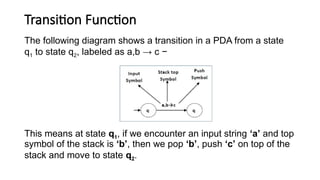
The following diagram shows a transition in a PDA from a state
q1 to state q2, labeled as a,b → c −
This means at state q1, if we encounter an input string ‘a’ and top
symbol of the stack is ‘b’, then we pop ‘b’, push ‘c’ on top of the
stack and move to state q2.
PDA Construction
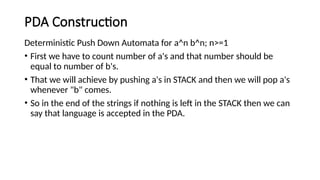
Deterministic Push Down Automata for a^n b^n; n>=1
• First we have to count number of a's and that number should be
equal to number of b's.
• That we will achieve by pushing a's in STACK and then we will pop a's
whenever "b" comes.
• So in the end of the strings if nothing is left in the STACK then we can
say that language is accepted in the PDA.
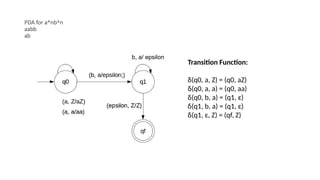
PDA for a^nb^n
aabb
ab
b, a/ epsilon
Transition Function:
δ(q0, a, Z) = (q0, aZ)
δ(q0, a, a) = (q0, aa)
δ(q0, b, a) = (q1, ε)
δ(q1, b, a) = (q1, ε)
δ(q1, ε, Z) = (qf, Z)
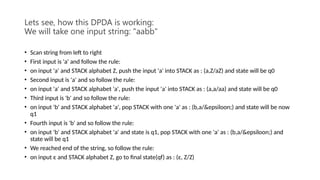
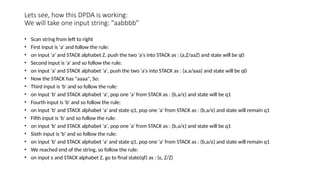
Lets see, how this DPDA is working:
We will take one input string: "aabb"
• Scan string from left to right
• First input is 'a' and follow the rule:
• on input 'a' and STACK alphabet Z, push the input 'a' into STACK as : (a,Z/aZ) and state will be q0
• Second input is 'a' and so follow the rule:
• on input 'a' and STACK alphabet 'a', push the input 'a' into STACK as : (a,a/aa) and state will be q0
• Third input is 'b' and so follow the rule:
• on input 'b' and STACK alphabet 'a', pop STACK with one 'a' as : (b,a/&epsiloon;) and state will be now
q1
• Fourth input is 'b' and so follow the rule:
• on input 'b' and STACK alphabet 'a' and state is q1, pop STACK with one 'a' as : (b,a/&epsiloon;) and
state will be q1
• We reached end of the string, so follow the rule:
• on input ε and STACK alphabet Z, go to final state(qf) as : (ε, Z/Z)
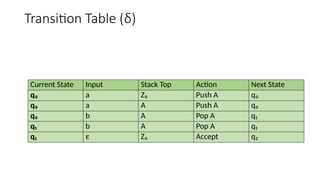
Transition Table (δ)
Current State Input Stack Top Action Next State
q₀ a Z₀ Push A q₀
q₀ a A Push A q₀
q₀ b A Pop A q₁
q₁ b A Pop A q₁
q₁ ε Z₀ Accept q₂
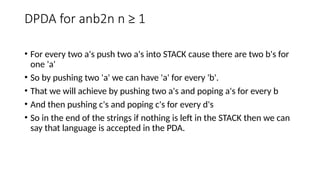
DPDA for anb2n n ≥ 1
• For every two a's push two a's into STACK cause there are two b's for
one 'a'
• So by pushing two 'a' we can have 'a' for every 'b'.
• That we will achieve by pushing two a's and poping a's for every b
• And then pushing c's and poping c's for every d's
• So in the end of the strings if nothing is left in the STACK then we can
say that language is accepted in the PDA.
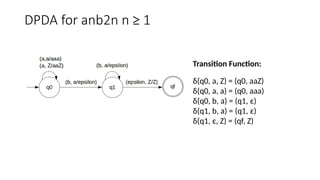
DPDA for anb2n n ≥ 1
Transition Function:
δ(q0, a, Z) = (q0, aaZ)
δ(q0, a, a) = (q0, aaa)
δ(q0, b, a) = (q1, ε)
δ(q1, b, a) = (q1, ε)
δ(q1, ε, Z) = (qf, Z)
Lets see, how this DPDA is working:
We will take one input string: "aabbbb"
• Scan string from left to right
• First input is 'a' and follow the rule:
• on input 'a' and STACK alphabet Z, push the two 'a's into STACK as : (a,Z/aaZ) and state will be q0
• Second input is 'a' and so follow the rule:
• on input 'a' and STACK alphabet 'a', push the two 'a's into STACK as : (a,a/aaa) and state will be q0
• Now the STACK has "aaaa", So:
• Third input is 'b' and so follow the rule:
• on input 'b' and STACK alphabet 'a', pop one 'a' from STACK as : (b,a/ε) and state will be q1
• Fourth input is 'b' and so follow the rule:
• on input 'b' and STACK alphabet 'a' and state q1, pop one 'a' from STACK as : (b,a/ε) and state will remain q1
• Fifth input is 'b' and so follow the rule:
• on input 'b' and STACK alphabet 'a', pop one 'a' from STACK as : (b,a/ε) and state will be q1
• Sixth input is 'b' and so follow the rule:
• on input 'b' and STACK alphabet 'a' and state q1, pop one 'a' from STACK as : (b,a/ε) and state will remain q1
• We reached end of the string, so follow the rule:
• on input ε and STACK alphabet Z, go to final state(qf) as : (ε, Z/Z)
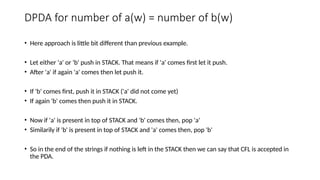
DPDA for number of a(w) = number of b(w)
• Here approach is little bit different than previous example.
• Let either 'a' or 'b' push in STACK. That means if 'a' comes first let it push.
• After 'a' if again 'a' comes then let push it.
• If 'b' comes first, push it in STACK ('a' did not come yet)
• If again 'b' comes then push it in STACK.
• Now if 'a' is present in top of STACK and 'b' comes then, pop 'a'
• Similarily if 'b' is present in top of STACK and 'a' comes then, pop 'b'
• So in the end of the strings if nothing is left in the STACK then we can say that CFL is accepted in
the PDA.
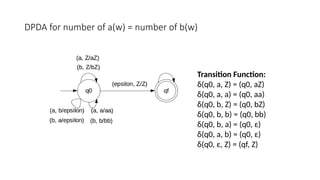
DPDA for number of a(w) = number of b(w)
Transition Function:
δ(q0, a, Z) = (q0, aZ)
δ(q0, a, a) = (q0, aa)
δ(q0, b, Z) = (q0, bZ)
δ(q0, b, b) = (q0, bb)
δ(q0, b, a) = (q0, ε)
δ(q0, a, b) = (q0, ε)
δ(q0, ε, Z) = (qf, Z)
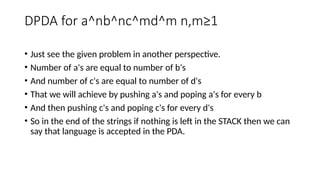
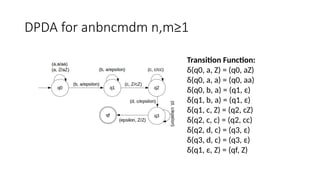
DPDA for a^nb^nc^md^m n,m≥1
• Just see the given problem in another perspective.
• Number of a's are equal to number of b's
• And number of c's are equal to number of d's
• That we will achieve by pushing a's and poping a's for every b
• And then pushing c's and poping c's for every d's
• So in the end of the strings if nothing is left in the STACK then we can
say that language is accepted in the PDA.
DPDA for anbncmdm n,m≥1
Transition Function:
δ(q0, a, Z) = (q0, aZ)
δ(q0, a, a) = (q0, aa)
δ(q0, b, a) = (q1, ε)
δ(q1, b, a) = (q1, ε)
δ(q1, c, Z) = (q2, cZ)
δ(q2, c, c) = (q2, cc)
δ(q2, d, c) = (q3, ε)
δ(q3, d, c) = (q3, ε)
δ(q1, ε, Z) = (qf, Z)
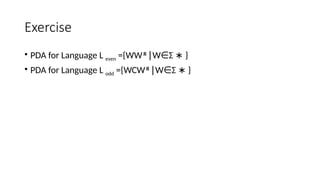
Exercise
• PDA for Language L even​={WWR W
∣ ∈Σ }
∗
• PDA for Language L odd​={WCWR W
∣ ∈Σ }
∗

Pushdown Automata toc presentation 2025.pptx

  • 1.
  • 2.
    Basic Structure ofPDA • A pushdown automaton is a way to implement a context-free grammar in a similar way we design DFA for a regular grammar. A DFA can remember a finite amount of information, but a PDA can remember an infinite amount of information. • Basically a pushdown automaton is − "Finite state machine" + "a stack" • A pushdown automaton has three components − an input tape, a control unit, and a stack with infinite size.
  • 4.
    Cont. The stack headscans the top symbol of the stack. A stack does two operations − • Push − a new symbol is added at the top. • Pop − the top symbol is read and removed. • A PDA may or may not read an input symbol, but it has to read the top of the stack in every transition.
  • 5.
    Formal Definition • APDA can be formally described as a 7-tuple (Q, ∑, S, δ, q0, I, F) − • Q is the finite number of states • ∑ is input alphabet • S is stack symbols • δ is the transition function: Q × (∑ {ε}) × S ∪ -> Q × S* • q0 is the initial state (q0 Q) ∈ • I is the initial stack top symbol (I S) ∈ • F is a set of accepting states (F Q) ∈
  • 6.
    • Transition Function(δ): • The transition function (δ) for a Pushdown Automaton (PDA) is defined as:δ:Q×(Σ {ε})×Γ→ ∪ P(Q× ) ∗ or equivalently: ( , , )=( , ) 𝛿 𝑞 𝑎 𝑋 𝑝 𝛾 • δ takes a triple (q, a, X) where: 1.q is a state in Q 2.a is an input symbol in Σ (or ε for empty input) 3.X is a stack symbol from Γ • Output of δ: • A finite set of pairs (p, γ) where: • p = new state • γ = string of stack symbols that replaces X at the top of the stack • Stack Operations in δ: • If γ = ε, the stack pops X • If γ = X, the stack remains unchanged • If γ = YZ, then X is replaced by Z, and Y is pushed onto the stack
  • 7.
    Transition Function The followingdiagram shows a transition in a PDA from a state q1 to state q2, labeled as a,b → c − This means at state q1, if we encounter an input string ‘a’ and top symbol of the stack is ‘b’, then we pop ‘b’, push ‘c’ on top of the stack and move to state q2.
  • 8.
    PDA Construction Deterministic PushDown Automata for a^n b^n; n>=1 • First we have to count number of a's and that number should be equal to number of b's. • That we will achieve by pushing a's in STACK and then we will pop a's whenever "b" comes. • So in the end of the strings if nothing is left in the STACK then we can say that language is accepted in the PDA.
  • 9.
    PDA for a^nb^n aabb ab b,a/ epsilon Transition Function: δ(q0, a, Z) = (q0, aZ) δ(q0, a, a) = (q0, aa) δ(q0, b, a) = (q1, ε) δ(q1, b, a) = (q1, ε) δ(q1, ε, Z) = (qf, Z)
  • 10.
    Lets see, howthis DPDA is working: We will take one input string: "aabb" • Scan string from left to right • First input is 'a' and follow the rule: • on input 'a' and STACK alphabet Z, push the input 'a' into STACK as : (a,Z/aZ) and state will be q0 • Second input is 'a' and so follow the rule: • on input 'a' and STACK alphabet 'a', push the input 'a' into STACK as : (a,a/aa) and state will be q0 • Third input is 'b' and so follow the rule: • on input 'b' and STACK alphabet 'a', pop STACK with one 'a' as : (b,a/&epsiloon;) and state will be now q1 • Fourth input is 'b' and so follow the rule: • on input 'b' and STACK alphabet 'a' and state is q1, pop STACK with one 'a' as : (b,a/&epsiloon;) and state will be q1 • We reached end of the string, so follow the rule: • on input ε and STACK alphabet Z, go to final state(qf) as : (ε, Z/Z)
  • 11.
    Transition Table (δ) CurrentState Input Stack Top Action Next State q₀ a Z₀ Push A q₀ q₀ a A Push A q₀ q₀ b A Pop A q₁ q₁ b A Pop A q₁ q₁ ε Z₀ Accept q₂
  • 12.
    DPDA for anb2nn ≥ 1 • For every two a's push two a's into STACK cause there are two b's for one 'a' • So by pushing two 'a' we can have 'a' for every 'b'. • That we will achieve by pushing two a's and poping a's for every b • And then pushing c's and poping c's for every d's • So in the end of the strings if nothing is left in the STACK then we can say that language is accepted in the PDA.
  • 13.
    DPDA for anb2nn ≥ 1 Transition Function: δ(q0, a, Z) = (q0, aaZ) δ(q0, a, a) = (q0, aaa) δ(q0, b, a) = (q1, ε) δ(q1, b, a) = (q1, ε) δ(q1, ε, Z) = (qf, Z)
  • 14.
    Lets see, howthis DPDA is working: We will take one input string: "aabbbb" • Scan string from left to right • First input is 'a' and follow the rule: • on input 'a' and STACK alphabet Z, push the two 'a's into STACK as : (a,Z/aaZ) and state will be q0 • Second input is 'a' and so follow the rule: • on input 'a' and STACK alphabet 'a', push the two 'a's into STACK as : (a,a/aaa) and state will be q0 • Now the STACK has "aaaa", So: • Third input is 'b' and so follow the rule: • on input 'b' and STACK alphabet 'a', pop one 'a' from STACK as : (b,a/ε) and state will be q1 • Fourth input is 'b' and so follow the rule: • on input 'b' and STACK alphabet 'a' and state q1, pop one 'a' from STACK as : (b,a/ε) and state will remain q1 • Fifth input is 'b' and so follow the rule: • on input 'b' and STACK alphabet 'a', pop one 'a' from STACK as : (b,a/ε) and state will be q1 • Sixth input is 'b' and so follow the rule: • on input 'b' and STACK alphabet 'a' and state q1, pop one 'a' from STACK as : (b,a/ε) and state will remain q1 • We reached end of the string, so follow the rule: • on input ε and STACK alphabet Z, go to final state(qf) as : (ε, Z/Z)
  • 15.
    DPDA for numberof a(w) = number of b(w) • Here approach is little bit different than previous example. • Let either 'a' or 'b' push in STACK. That means if 'a' comes first let it push. • After 'a' if again 'a' comes then let push it. • If 'b' comes first, push it in STACK ('a' did not come yet) • If again 'b' comes then push it in STACK. • Now if 'a' is present in top of STACK and 'b' comes then, pop 'a' • Similarily if 'b' is present in top of STACK and 'a' comes then, pop 'b' • So in the end of the strings if nothing is left in the STACK then we can say that CFL is accepted in the PDA.
  • 16.
    DPDA for numberof a(w) = number of b(w) Transition Function: δ(q0, a, Z) = (q0, aZ) δ(q0, a, a) = (q0, aa) δ(q0, b, Z) = (q0, bZ) δ(q0, b, b) = (q0, bb) δ(q0, b, a) = (q0, ε) δ(q0, a, b) = (q0, ε) δ(q0, ε, Z) = (qf, Z)
  • 17.
    DPDA for a^nb^nc^md^mn,m≥1 • Just see the given problem in another perspective. • Number of a's are equal to number of b's • And number of c's are equal to number of d's • That we will achieve by pushing a's and poping a's for every b • And then pushing c's and poping c's for every d's • So in the end of the strings if nothing is left in the STACK then we can say that language is accepted in the PDA.
  • 18.
    DPDA for anbncmdmn,m≥1 Transition Function: δ(q0, a, Z) = (q0, aZ) δ(q0, a, a) = (q0, aa) δ(q0, b, a) = (q1, ε) δ(q1, b, a) = (q1, ε) δ(q1, c, Z) = (q2, cZ) δ(q2, c, c) = (q2, cc) δ(q2, d, c) = (q3, ε) δ(q3, d, c) = (q3, ε) δ(q1, ε, Z) = (qf, Z)
  • 19.
    Exercise • PDA forLanguage L even​={WWR W ∣ ∈Σ } ∗ • PDA for Language L odd​={WCWR W ∣ ∈Σ } ∗