 Push Down Automata
8/14/2017 2
 Koushik das (152-35-1270)
 Md. Sohag ali (152-35-1271)
 Md. Mehedi hasan (152-35-1274)
8/14/2017 3
 Informally:
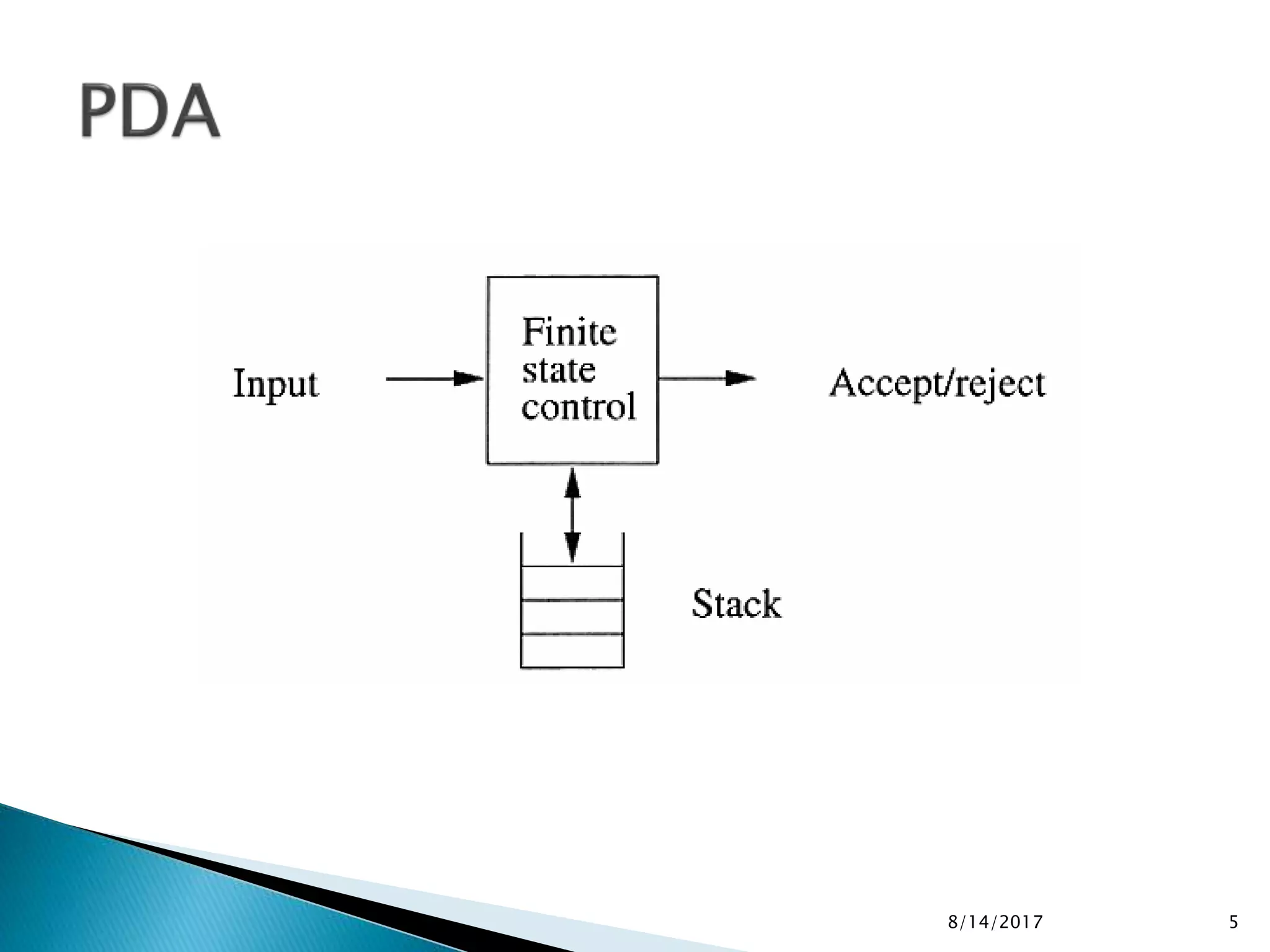
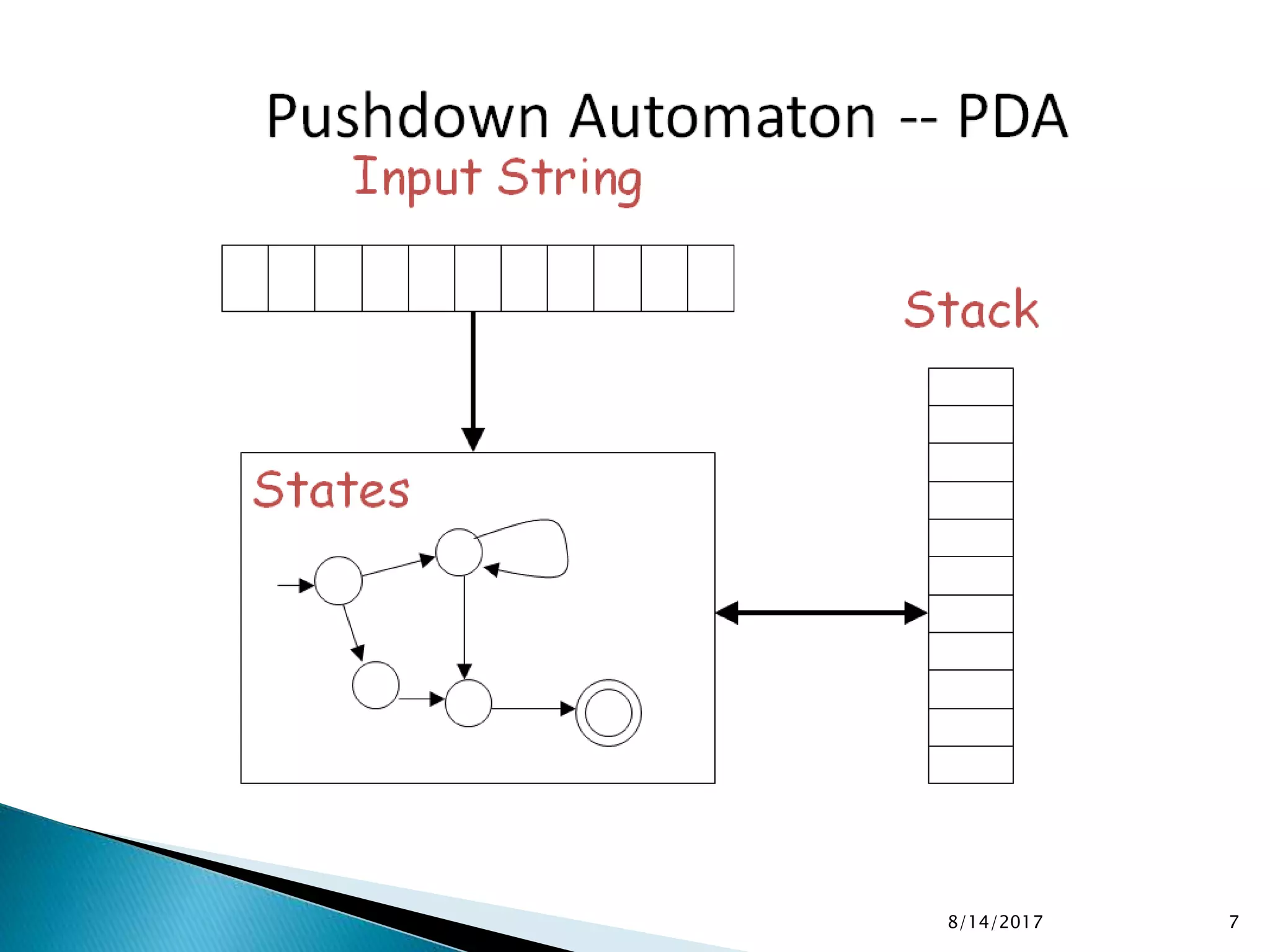
◦ A PDA is an ε-NFA with a stack.
◦ Transitions are modified to accommodate stack
operations.
 A DFA can “remember” only a finite amount
of information, whereas a PDA can
“remember” an infinite amount of (certain
types of) information.
8/14/2017 4
8/14/2017 5
8/14/2017 6
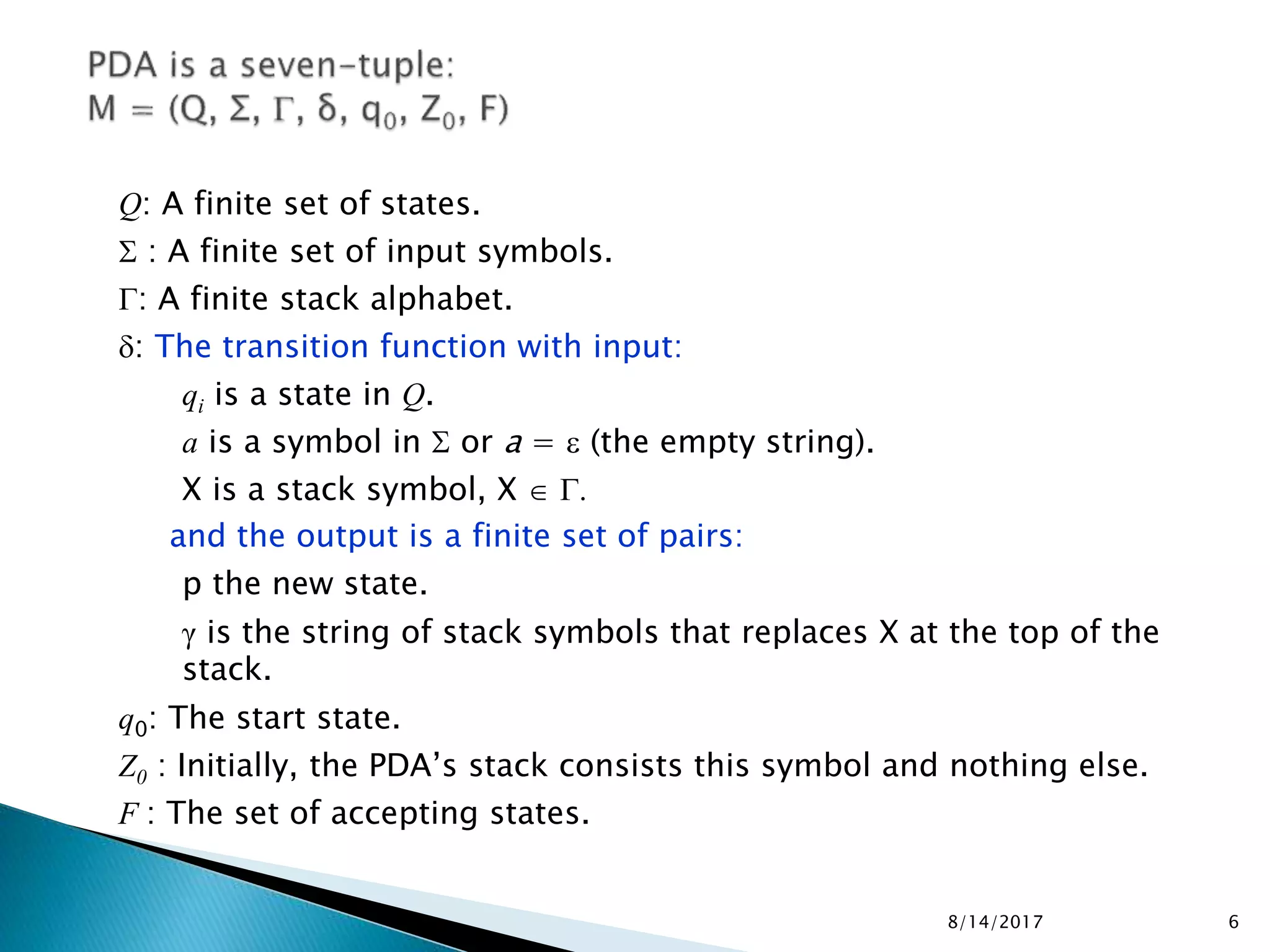
Q: A finite set of states.
S : A finite set of input symbols.
G: A finite stack alphabet.
d: The transition function with input:
qi is a state in Q.
a is a symbol in S or a = e (the empty string).
X is a stack symbol, X  G.
and the output is a finite set of pairs:
p the new state.
γ is the string of stack symbols that replaces X at the top of the
stack.
q0: The start state.
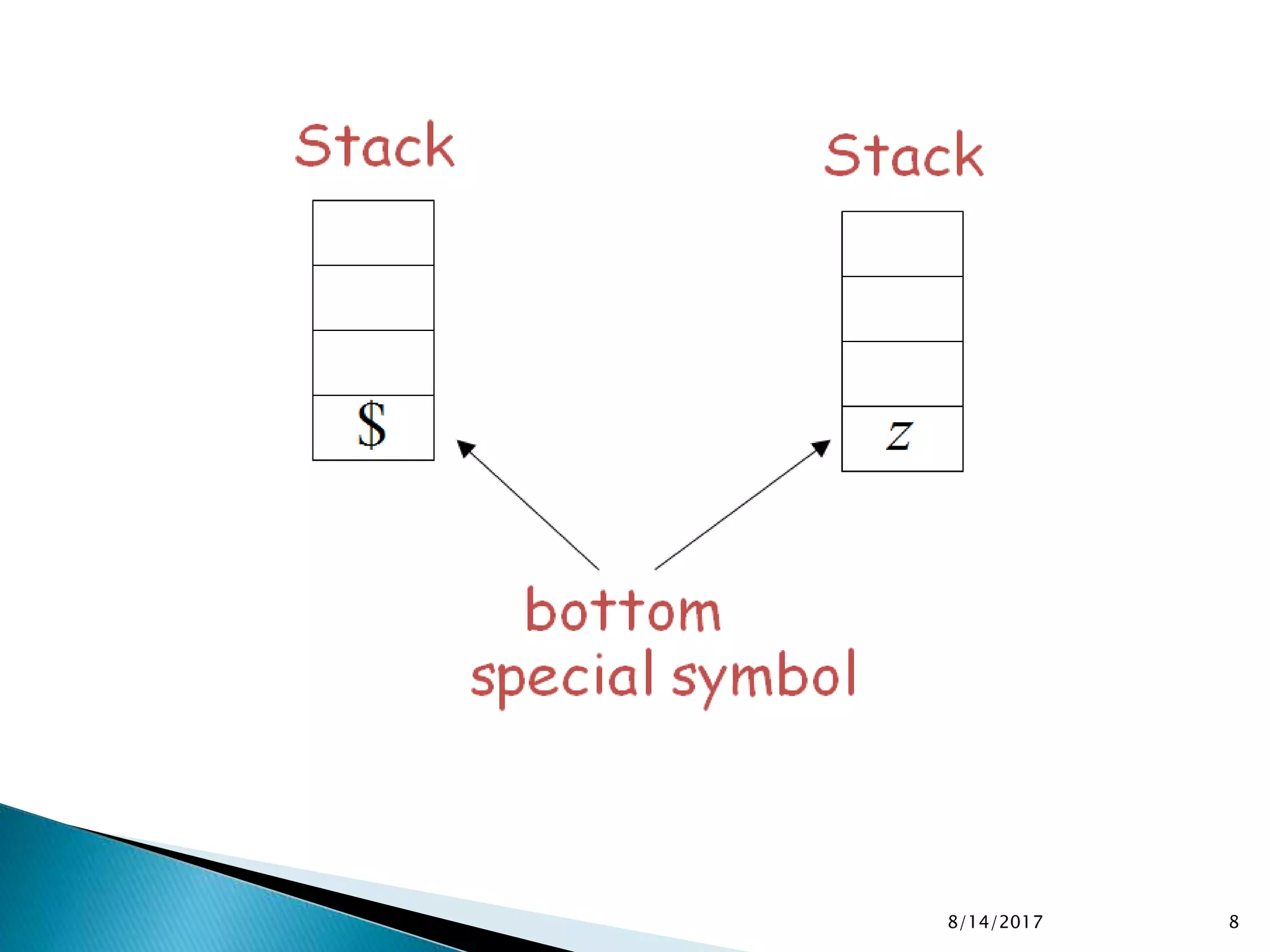
Z0 : Initially, the PDA’s stack consists this symbol and nothing else.
F : The set of accepting states.
8/14/2017 7
8/14/2017 8
8/14/2017 9
8/14/2017 10
8/14/2017 11
8/14/2017 12
8/14/2017 13
8/14/2017 14
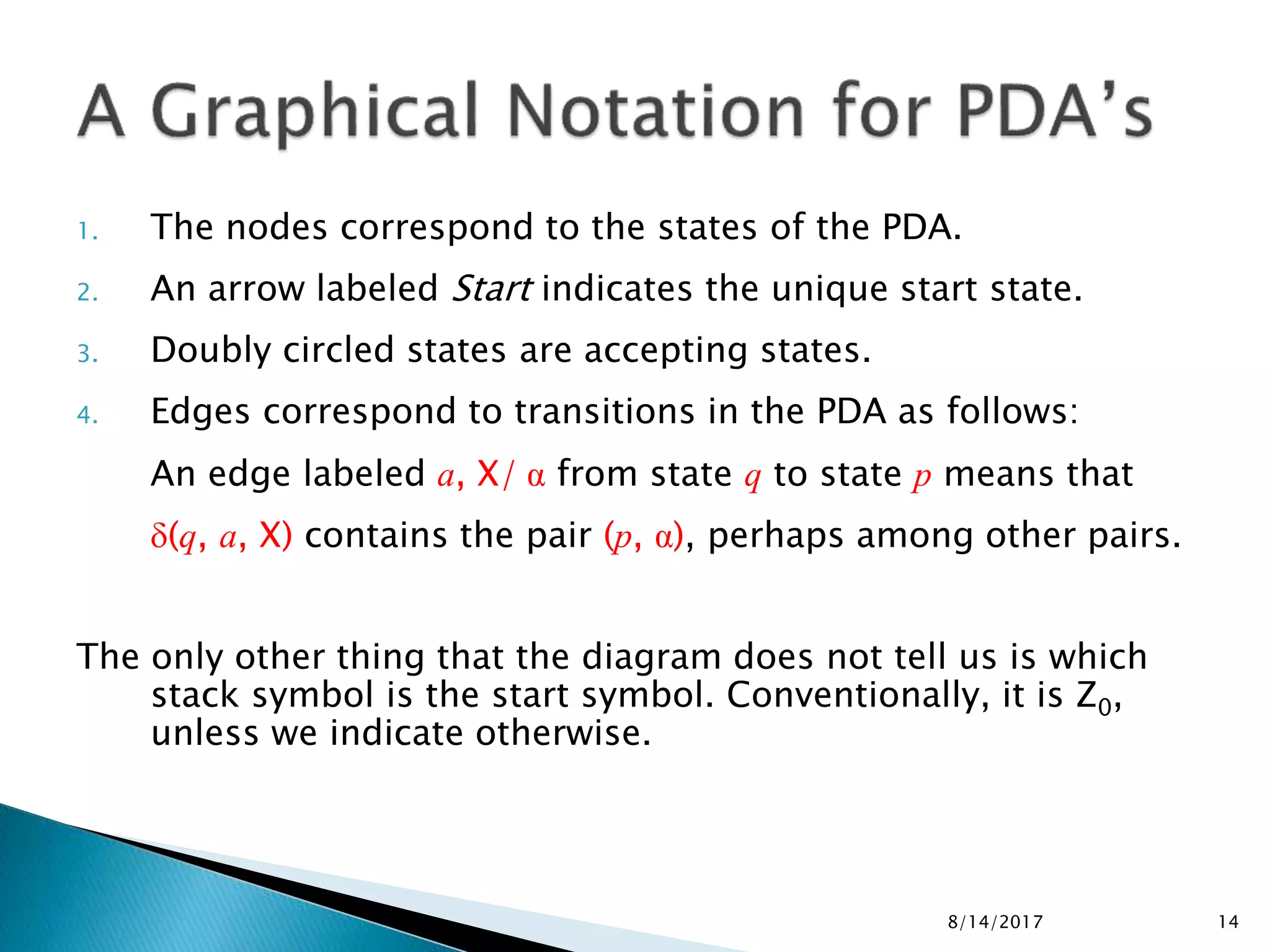
1. The nodes correspond to the states of the PDA.
2. An arrow labeled Start indicates the unique start state.
3. Doubly circled states are accepting states.
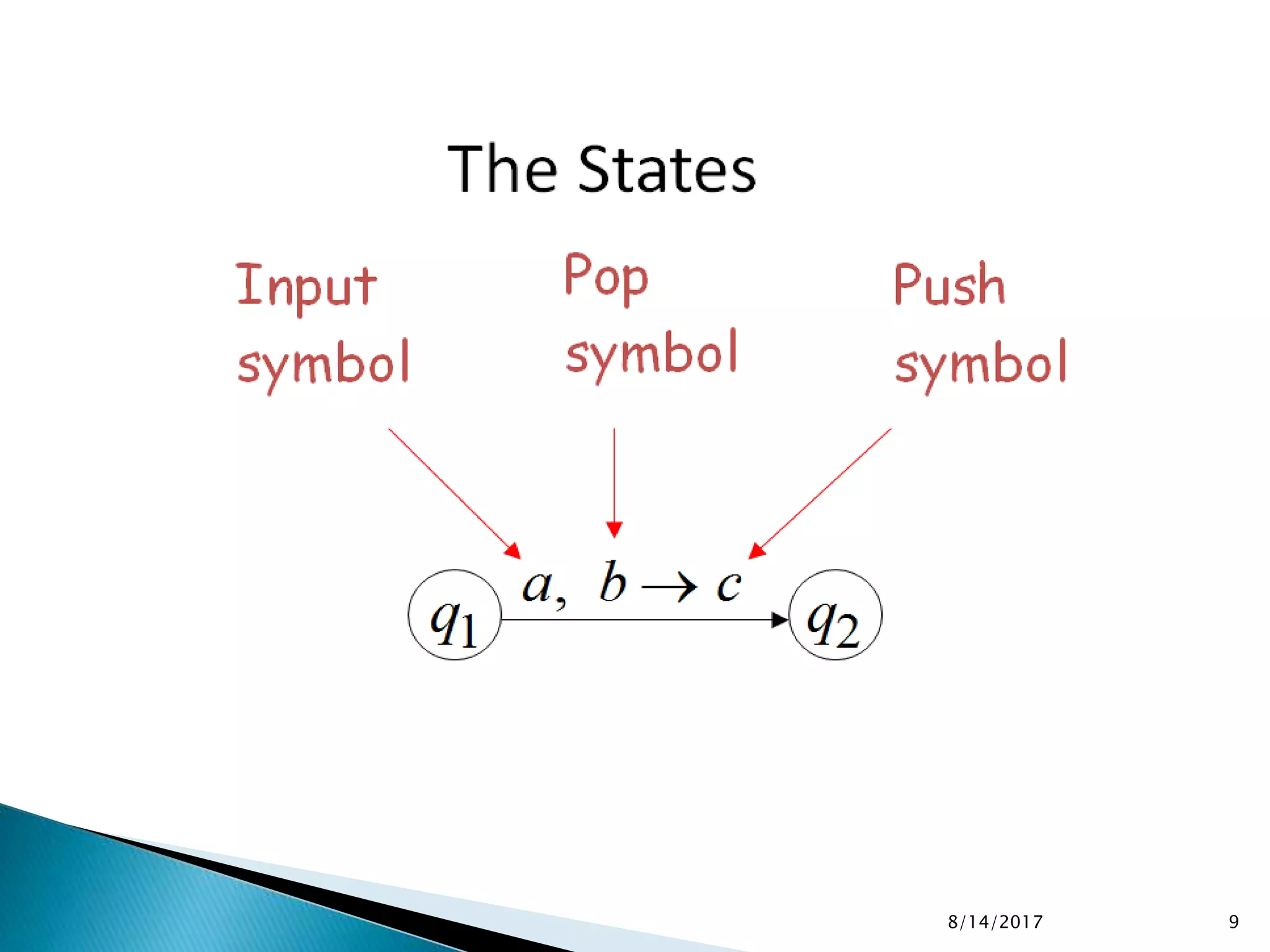
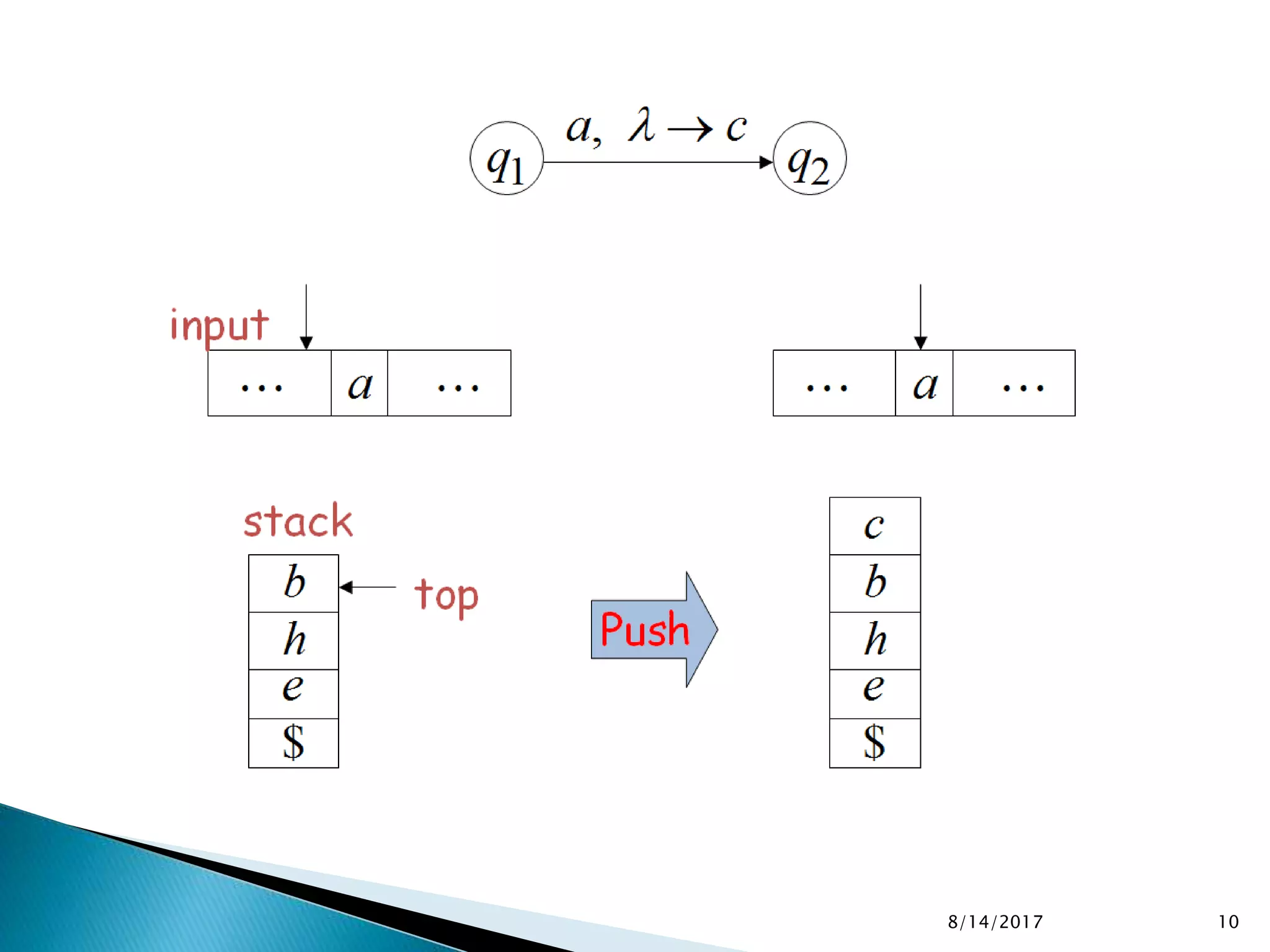
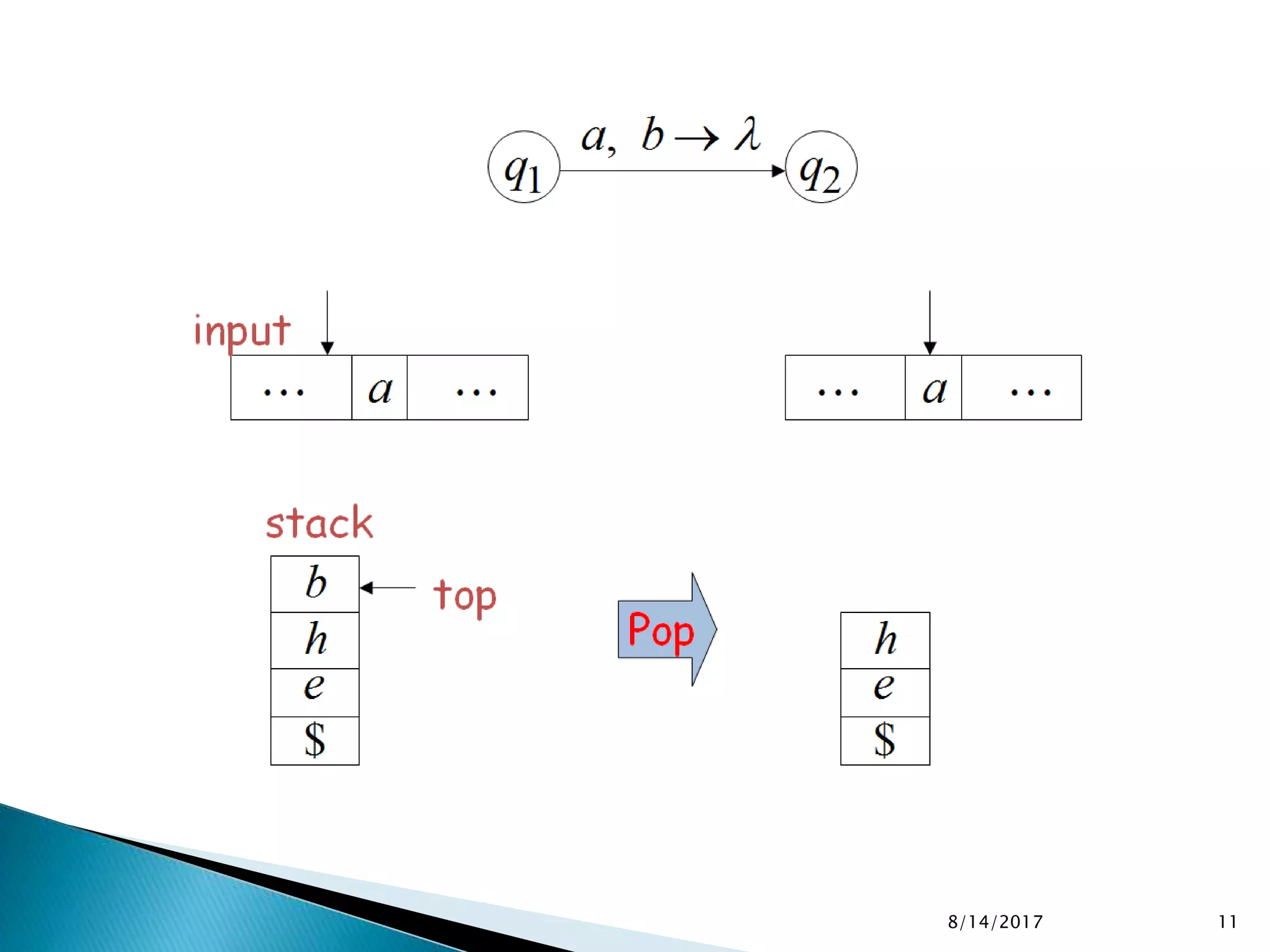
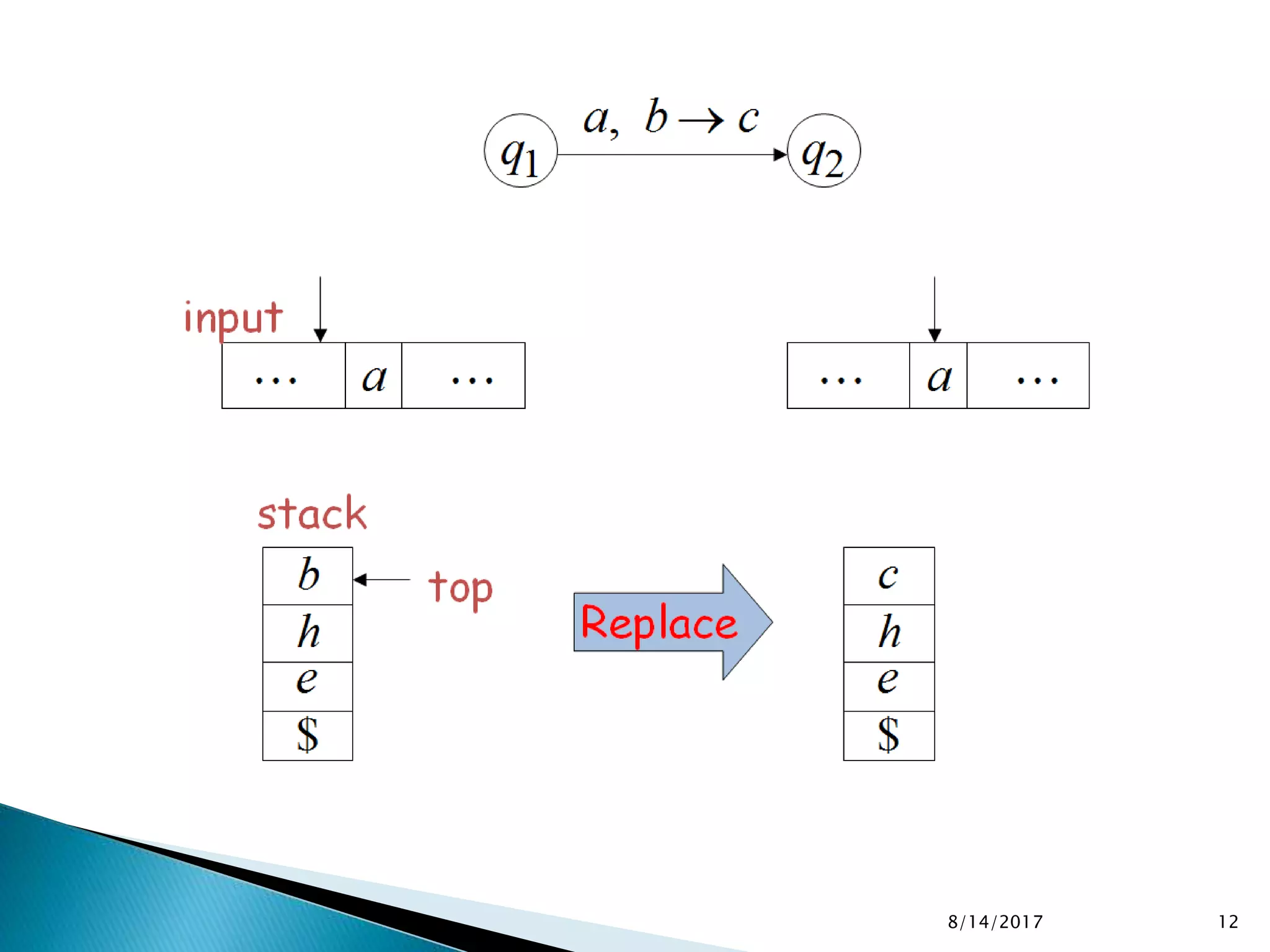
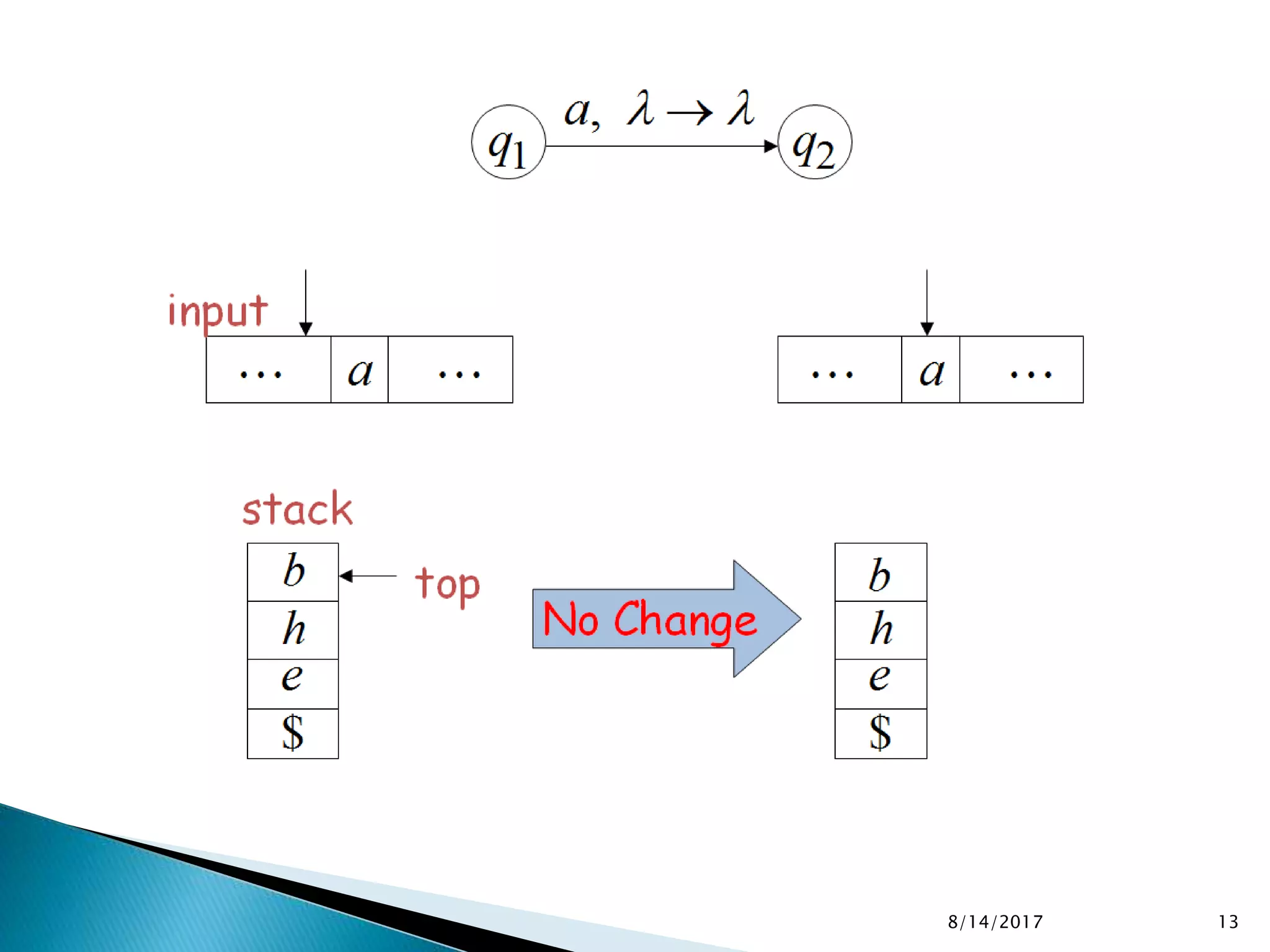
4. Edges correspond to transitions in the PDA as follows:
An edge labeled a, X/ α from state q to state p means that
d(q, a, X) contains the pair (p, α), perhaps among other pairs.
The only other thing that the diagram does not tell us is which
stack symbol is the start symbol. Conventionally, it is Z0,
unless we indicate otherwise.
Thank you
8/14/2017 15

Push down automata

  • 2.
     Push DownAutomata 8/14/2017 2
  • 3.
     Koushik das(152-35-1270)  Md. Sohag ali (152-35-1271)  Md. Mehedi hasan (152-35-1274) 8/14/2017 3
  • 4.
     Informally: ◦ APDA is an ε-NFA with a stack. ◦ Transitions are modified to accommodate stack operations.  A DFA can “remember” only a finite amount of information, whereas a PDA can “remember” an infinite amount of (certain types of) information. 8/14/2017 4
  • 5.
  • 6.
    8/14/2017 6 Q: Afinite set of states. S : A finite set of input symbols. G: A finite stack alphabet. d: The transition function with input: qi is a state in Q. a is a symbol in S or a = e (the empty string). X is a stack symbol, X  G. and the output is a finite set of pairs: p the new state. γ is the string of stack symbols that replaces X at the top of the stack. q0: The start state. Z0 : Initially, the PDA’s stack consists this symbol and nothing else. F : The set of accepting states.
  • 7.
  • 8.
  • 9.
  • 10.
  • 11.
  • 12.
  • 13.
  • 14.
    8/14/2017 14 1. Thenodes correspond to the states of the PDA. 2. An arrow labeled Start indicates the unique start state. 3. Doubly circled states are accepting states. 4. Edges correspond to transitions in the PDA as follows: An edge labeled a, X/ α from state q to state p means that d(q, a, X) contains the pair (p, α), perhaps among other pairs. The only other thing that the diagram does not tell us is which stack symbol is the start symbol. Conventionally, it is Z0, unless we indicate otherwise.
  • 15.