Pushdown_Automata_Presentation in Automata theory and compiler design
1.
Pushdown Automata (PDA)
•A detailed overview of concepts, structure,
and applications
• Presented by: [Your Name]
2.
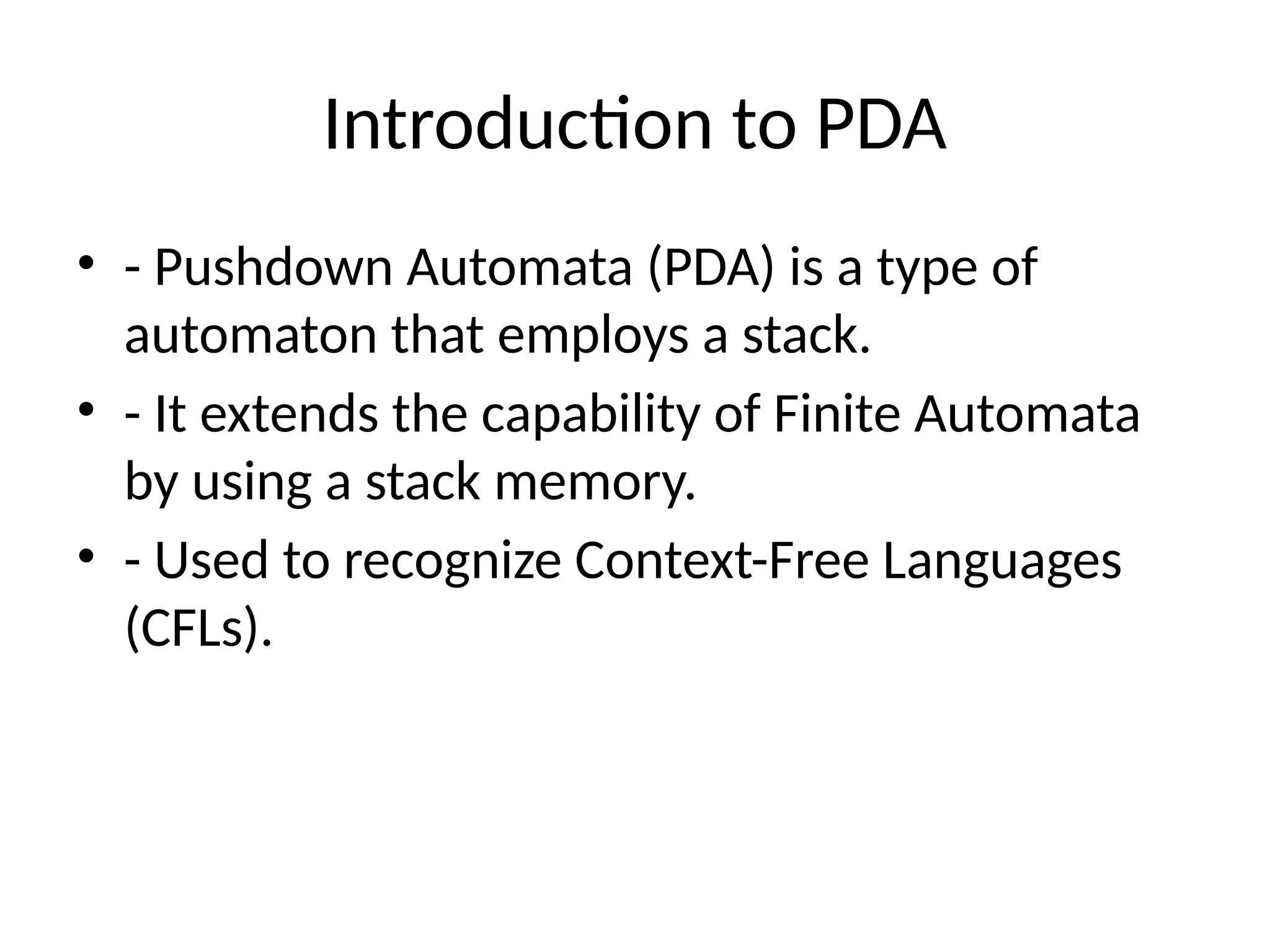
Introduction to PDA
•- Pushdown Automata (PDA) is a type of
automaton that employs a stack.
• - It extends the capability of Finite Automata
by using a stack memory.
• - Used to recognize Context-Free Languages
(CFLs).
3.
Why PDA?
• -Finite Automata cannot handle nested
structures (like parentheses).
• - PDA is capable of handling such recursive
patterns due to its stack.
• - Example: Recognizing strings like a^n b^n.
4.
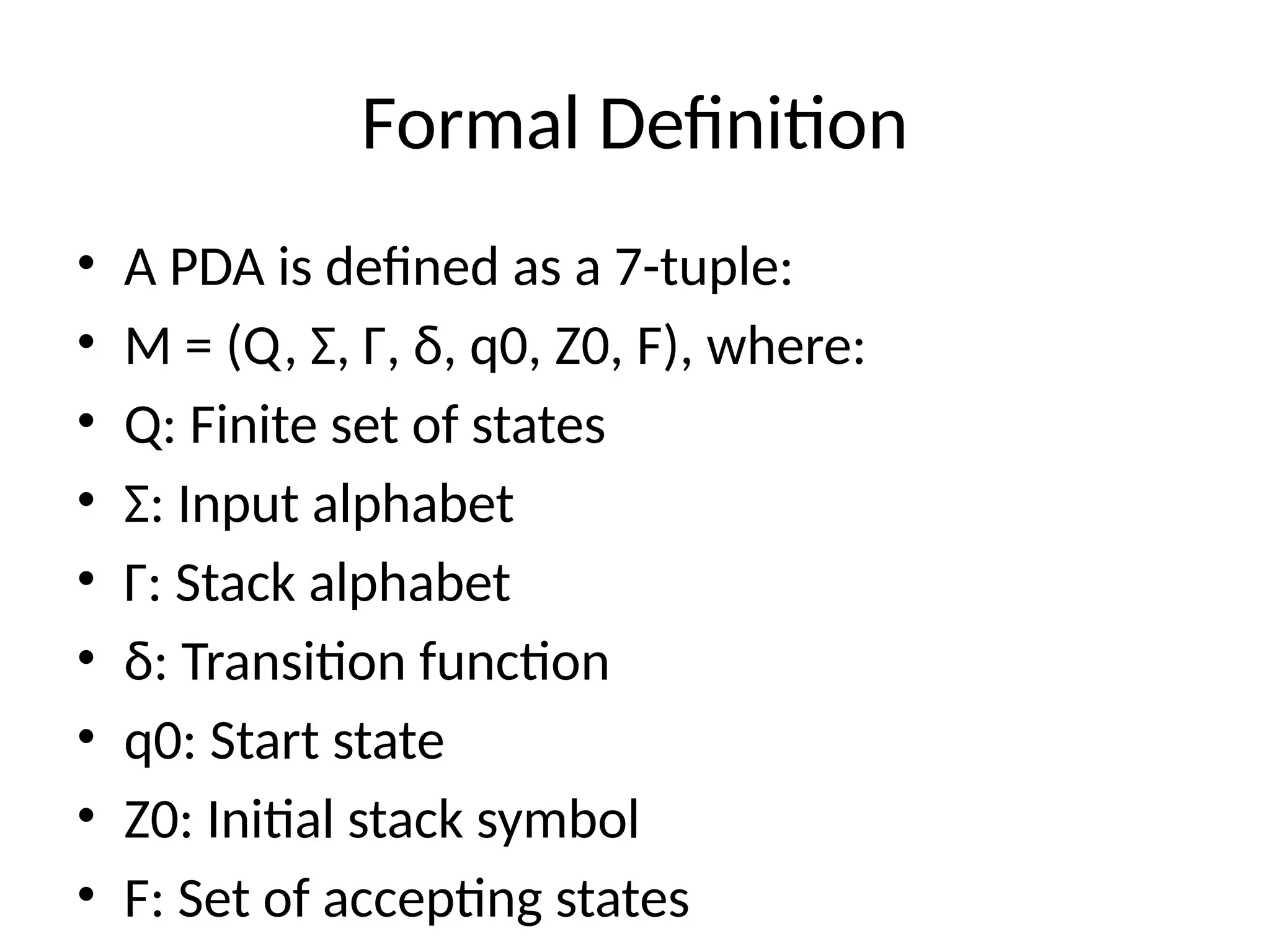
Formal Definition
• APDA is defined as a 7-tuple:
• M = (Q, Σ, Γ, δ, q0, Z0, F), where:
• Q: Finite set of states
• Σ: Input alphabet
• Γ: Stack alphabet
• δ: Transition function
• q0: Start state
• Z0: Initial stack symbol
• F: Set of accepting states
5.
PDA Transitions
• Atransition is of the form:
• δ(q, a, X) = {(p, γ)}
• - q: current state
• - a: input symbol (or ε)
• - X: top of the stack
• - p: next state
• - γ: string to replace X on stack
6.
Types of Acceptance
•- PDA can accept input in two ways:
• 1. Acceptance by Final State
• 2. Acceptance by Empty Stack
• - Both types are equivalent in terms of the
class of languages they recognize.
7.
Instantaneous Description (ID)
•An ID is a snapshot of PDA:
• (q, w, γ)
• - q: current state
• - w: unread input
• - γ: current stack contents
• Example: (q0, abb, Z0)
8.
Designing PDA –General Approach
• 1. Understand the language
• 2. Design transitions based on stack behavior
• 3. Handle inputs and matching stack
operations
• 4. Define accepting condition (final state or
empty stack)
9.
Example: L ={ a^n b^n | n ≥ 0 }
• 1. Push 'a' onto stack for each 'a' in input.
• 2. For each 'b', pop 'a' from stack.
• 3. Accept when input ends and stack has initial
symbol.
10.
Example: PDA forPalindromes
• - Input: Palindromes like 'abba', 'abcba'
• - Strategy:
• 1. Push first half onto stack
• 2. Skip middle if odd length
• 3. Match and pop second half
11.
Deterministic vs Non-deterministic
PDA
•- Deterministic PDA (DPDA):
• * At most one possible move for a given
input and stack
• - Non-deterministic PDA (NPDA):
• * Multiple possible transitions
• * More powerful than DPDA
12.
Applications of PDA
•- Syntax analysis in compilers
• - Parsing of programming languages
• - Recognizing nested structures like
parentheses
• - Model for context-free grammar (CFG)
evaluation
13.
Limitations of PDA
•- Cannot recognize context-sensitive or
recursive languages
• - Stack allows only limited memory access
(LIFO)
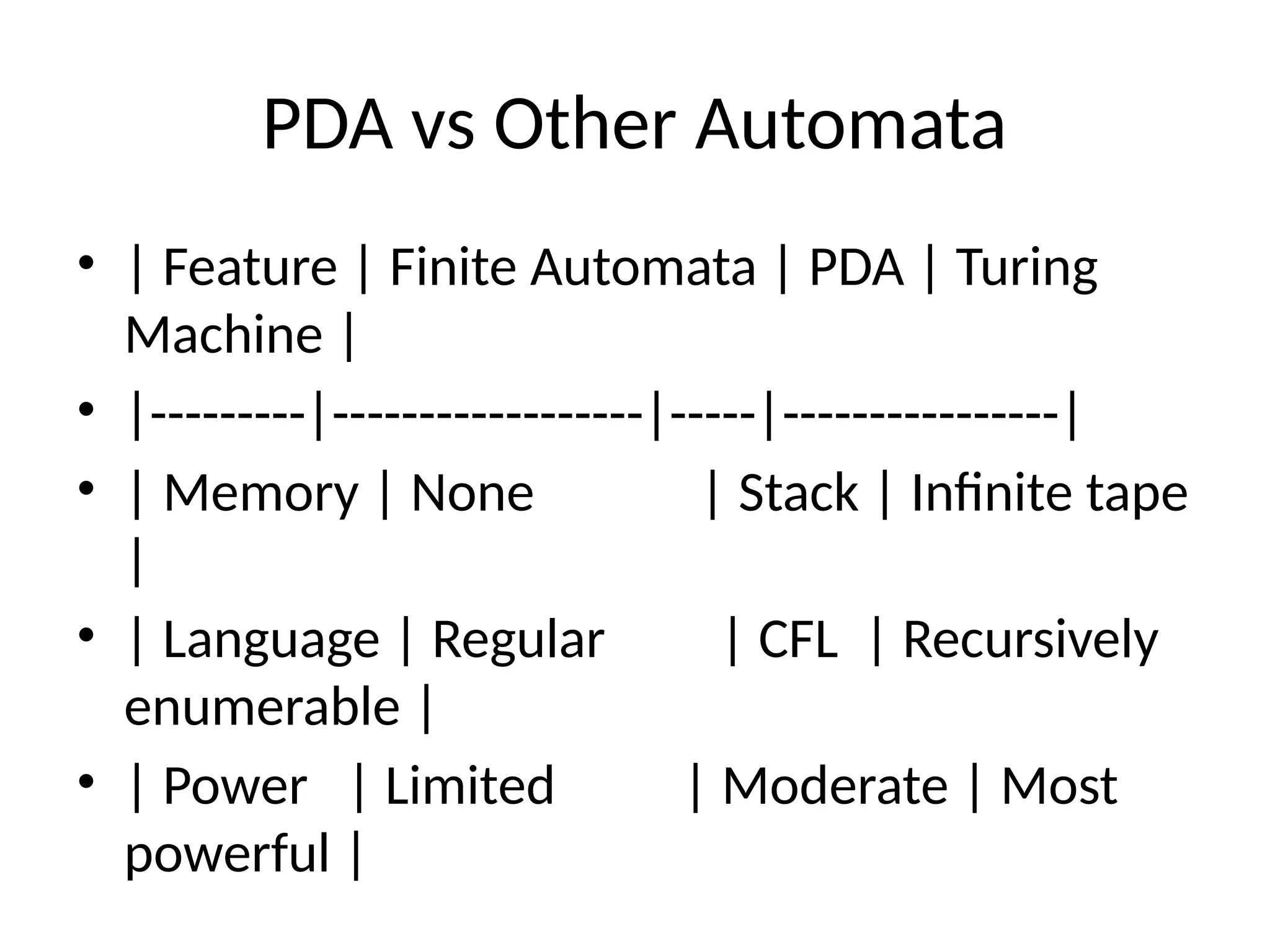
• - Less powerful than Turing Machines
Summary
• - PDA= Finite Automaton + Stack
• - Useful for recognizing Context-Free
Languages
• - Important in theoretical computer science
and compilers
![Pushdown Automata (PDA)
• A detailed overview of concepts, structure,
and applications
• Presented by: [Your Name]](https://image.slidesharecdn.com/pushdownautomatapresentation-250616015931-83ced3d6/75/Pushdown_Automata_Presentation-in-Automata-theory-and-compiler-design-1-2048.jpg)