Angelin Thomas, Felipe Augusto Santos, Rodrigo Aparecido Pena da Silva,
Victoria Ferreira Teixeira, Dongyang Bai, Andrew Jay Howard
Department of Biology
ABSTRACT
INTRODUCTION
METHODS AND RESULTS
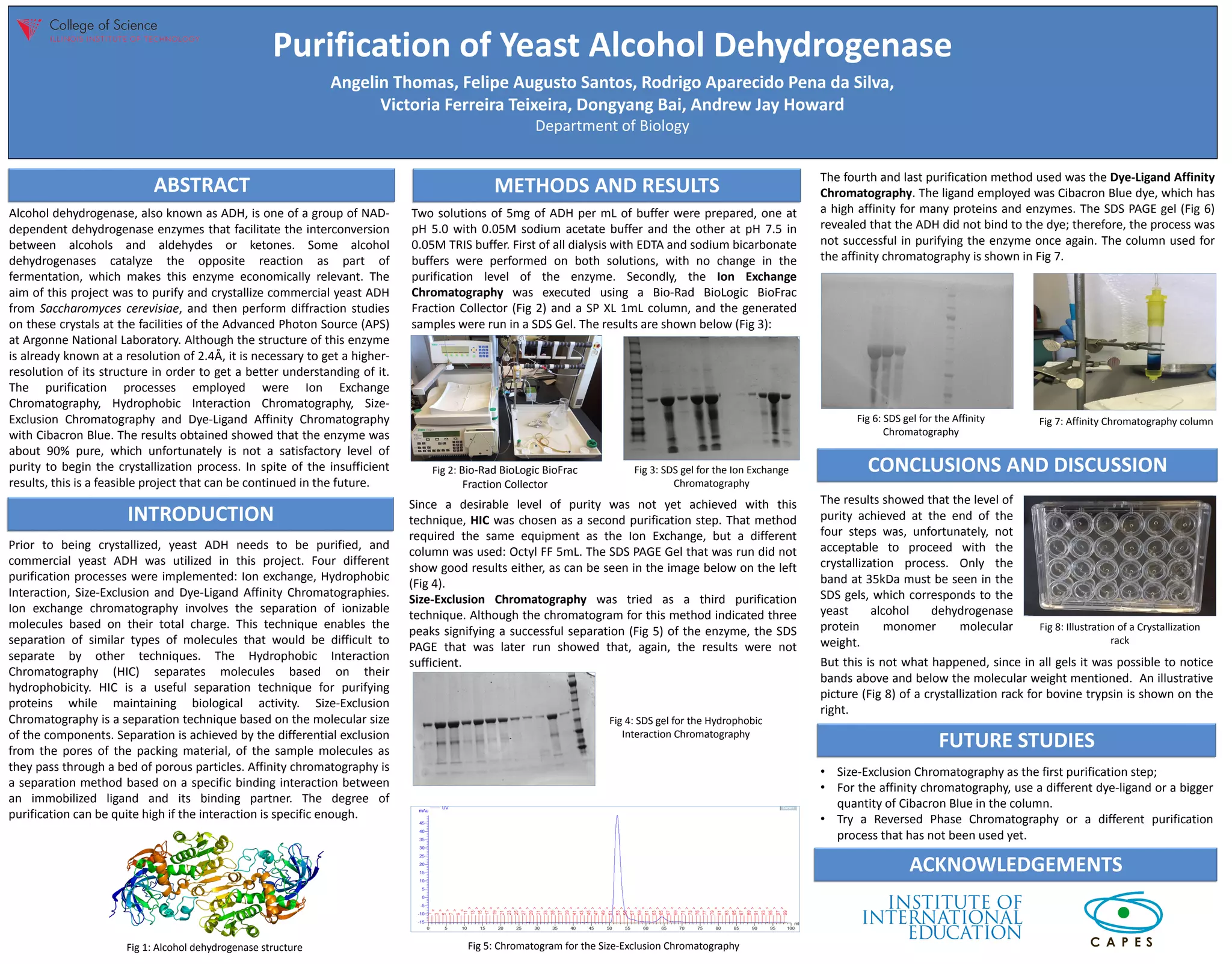
Fig 3: SDS gel for the Ion Exchange
Chromatography
Fig 4: SDS gel for the Hydrophobic
Interaction Chromatography
ACKNOWLEDGEMENTS
CONCLUSIONS AND DISCUSSION
FUTURE STUDIES
Alcohol dehydrogenase, also known as ADH, is one of a group of NAD-
dependent dehydrogenase enzymes that facilitate the interconversion
between alcohols and aldehydes or ketones. Some alcohol
dehydrogenases catalyze the opposite reaction as part of
fermentation, which makes this enzyme economically relevant. The
aim of this project was to purify and crystallize commercial yeast ADH
from Saccharomyces cerevisiae, and then perform diffraction studies
on these crystals at the facilities of the Advanced Photon Source (APS)
at Argonne National Laboratory. Although the structure of this enzyme
is already known at a resolution of 2.4Ă…, it is necessary to get a higher-
resolution of its structure in order to get a better understanding of it.
The purification processes employed were Ion Exchange
Chromatography, Hydrophobic Interaction Chromatography, Size-
Exclusion Chromatography and Dye-Ligand Affinity Chromatography
with Cibacron Blue. The results obtained showed that the enzyme was
about 90% pure, which unfortunately is not a satisfactory level of
purity to begin the crystallization process. In spite of the insufficient
results, this is a feasible project that can be continued in the future.
Prior to being crystallized, yeast ADH needs to be purified, and
commercial yeast ADH was utilized in this project. Four different
purification processes were implemented: Ion exchange, Hydrophobic
Interaction, Size-Exclusion and Dye-Ligand Affinity Chromatographies.
Ion exchange chromatography involves the separation of ionizable
molecules based on their total charge. This technique enables the
separation of similar types of molecules that would be difficult to
separate by other techniques. The Hydrophobic Interaction
Chromatography (HIC) separates molecules based on their
hydrophobicity. HIC is a useful separation technique for purifying
proteins while maintaining biological activity. Size-Exclusion
Chromatography is a separation technique based on the molecular size
of the components. Separation is achieved by the differential exclusion
from the pores of the packing material, of the sample molecules as
they pass through a bed of porous particles. Affinity chromatography is
a separation method based on a specific binding interaction between
an immobilized ligand and its binding partner. The degree of
purification can be quite high if the interaction is specific enough.
Purification of Yeast Alcohol Dehydrogenase
Angelin Thomas, Felipe Augusto Santos, Rodrigo Aparecido Pena da Silva,
Victoria Ferreira Teixeira, Dongyang Bai, Andrew Jay Howard
Department of Biology
Fig 1: Alcohol dehydrogenase structure
Two solutions of 5mg of ADH per mL of buffer were prepared, one at
pH 5.0 with 0.05M sodium acetate buffer and the other at pH 7.5 in
0.05M TRIS buffer. First of all dialysis with EDTA and sodium bicarbonate
buffers were performed on both solutions, with no change in the
purification level of the enzyme. Secondly, the Ion Exchange
Chromatography was executed using a Bio-Rad BioLogic BioFrac
Fraction Collector (Fig 2) and a SP XL 1mL column, and the generated
samples were run in a SDS Gel. The results are shown below (Fig 3):
Since a desirable level of purity was not yet achieved with this
technique, HIC was chosen as a second purification step. That method
required the same equipment as the Ion Exchange, but a different
column was used: Octyl FF 5mL. The SDS PAGE Gel that was run did not
show good results either, as can be seen in the image below on the left
(Fig 4).
Size-Exclusion Chromatography was tried as a third purification
technique. Although the chromatogram for this method indicated three
peaks signifying a successful separation (Fig 5) of the enzyme, the SDS
PAGE that was later run showed that, again, the results were not
sufficient.
Fig 5: Chromatogram for the Size-Exclusion Chromatography
Fig 2: Bio-Rad BioLogic BioFrac
Fraction Collector
The fourth and last purification method used was the Dye-Ligand Affinity
Chromatography. The ligand employed was Cibacron Blue dye, which has
a high affinity for many proteins and enzymes. The SDS PAGE gel (Fig 6)
revealed that the ADH did not bind to the dye; therefore, the process was
not successful in purifying the enzyme once again. The column used for
the affinity chromatography is shown in Fig 7.
Fig 6: SDS gel for the Affinity
Chromatography
Fig 7: Affinity Chromatography column
The results showed that the level of
purity achieved at the end of the
four steps was, unfortunately, not
acceptable to proceed with the
crystallization process. Only the
band at 35kDa must be seen in the
SDS gels, which corresponds to the
yeast alcohol dehydrogenase
protein monomer molecular
weight.
• Size-Exclusion Chromatography as the first purification step;
• For the affinity chromatography, use a different dye-ligand or a bigger
quantity of Cibacron Blue in the column.
• Try a Reversed Phase Chromatography or a different purification
process that has not been used yet.
Fig 8: Illustration of a Crystallization
rack
But this is not what happened, since in all gels it was possible to notice
bands above and below the molecular weight mentioned. An illustrative
picture (Fig 8) of a crystallization rack for bovine trypsin is shown on the
right.

PurificationAH

  • 1.
    Angelin Thomas, FelipeAugusto Santos, Rodrigo Aparecido Pena da Silva, Victoria Ferreira Teixeira, Dongyang Bai, Andrew Jay Howard Department of Biology ABSTRACT INTRODUCTION METHODS AND RESULTS Fig 3: SDS gel for the Ion Exchange Chromatography Fig 4: SDS gel for the Hydrophobic Interaction Chromatography ACKNOWLEDGEMENTS CONCLUSIONS AND DISCUSSION FUTURE STUDIES Alcohol dehydrogenase, also known as ADH, is one of a group of NAD- dependent dehydrogenase enzymes that facilitate the interconversion between alcohols and aldehydes or ketones. Some alcohol dehydrogenases catalyze the opposite reaction as part of fermentation, which makes this enzyme economically relevant. The aim of this project was to purify and crystallize commercial yeast ADH from Saccharomyces cerevisiae, and then perform diffraction studies on these crystals at the facilities of the Advanced Photon Source (APS) at Argonne National Laboratory. Although the structure of this enzyme is already known at a resolution of 2.4Å, it is necessary to get a higher- resolution of its structure in order to get a better understanding of it. The purification processes employed were Ion Exchange Chromatography, Hydrophobic Interaction Chromatography, Size- Exclusion Chromatography and Dye-Ligand Affinity Chromatography with Cibacron Blue. The results obtained showed that the enzyme was about 90% pure, which unfortunately is not a satisfactory level of purity to begin the crystallization process. In spite of the insufficient results, this is a feasible project that can be continued in the future. Prior to being crystallized, yeast ADH needs to be purified, and commercial yeast ADH was utilized in this project. Four different purification processes were implemented: Ion exchange, Hydrophobic Interaction, Size-Exclusion and Dye-Ligand Affinity Chromatographies. Ion exchange chromatography involves the separation of ionizable molecules based on their total charge. This technique enables the separation of similar types of molecules that would be difficult to separate by other techniques. The Hydrophobic Interaction Chromatography (HIC) separates molecules based on their hydrophobicity. HIC is a useful separation technique for purifying proteins while maintaining biological activity. Size-Exclusion Chromatography is a separation technique based on the molecular size of the components. Separation is achieved by the differential exclusion from the pores of the packing material, of the sample molecules as they pass through a bed of porous particles. Affinity chromatography is a separation method based on a specific binding interaction between an immobilized ligand and its binding partner. The degree of purification can be quite high if the interaction is specific enough. Purification of Yeast Alcohol Dehydrogenase Angelin Thomas, Felipe Augusto Santos, Rodrigo Aparecido Pena da Silva, Victoria Ferreira Teixeira, Dongyang Bai, Andrew Jay Howard Department of Biology Fig 1: Alcohol dehydrogenase structure Two solutions of 5mg of ADH per mL of buffer were prepared, one at pH 5.0 with 0.05M sodium acetate buffer and the other at pH 7.5 in 0.05M TRIS buffer. First of all dialysis with EDTA and sodium bicarbonate buffers were performed on both solutions, with no change in the purification level of the enzyme. Secondly, the Ion Exchange Chromatography was executed using a Bio-Rad BioLogic BioFrac Fraction Collector (Fig 2) and a SP XL 1mL column, and the generated samples were run in a SDS Gel. The results are shown below (Fig 3): Since a desirable level of purity was not yet achieved with this technique, HIC was chosen as a second purification step. That method required the same equipment as the Ion Exchange, but a different column was used: Octyl FF 5mL. The SDS PAGE Gel that was run did not show good results either, as can be seen in the image below on the left (Fig 4). Size-Exclusion Chromatography was tried as a third purification technique. Although the chromatogram for this method indicated three peaks signifying a successful separation (Fig 5) of the enzyme, the SDS PAGE that was later run showed that, again, the results were not sufficient. Fig 5: Chromatogram for the Size-Exclusion Chromatography Fig 2: Bio-Rad BioLogic BioFrac Fraction Collector The fourth and last purification method used was the Dye-Ligand Affinity Chromatography. The ligand employed was Cibacron Blue dye, which has a high affinity for many proteins and enzymes. The SDS PAGE gel (Fig 6) revealed that the ADH did not bind to the dye; therefore, the process was not successful in purifying the enzyme once again. The column used for the affinity chromatography is shown in Fig 7. Fig 6: SDS gel for the Affinity Chromatography Fig 7: Affinity Chromatography column The results showed that the level of purity achieved at the end of the four steps was, unfortunately, not acceptable to proceed with the crystallization process. Only the band at 35kDa must be seen in the SDS gels, which corresponds to the yeast alcohol dehydrogenase protein monomer molecular weight. • Size-Exclusion Chromatography as the first purification step; • For the affinity chromatography, use a different dye-ligand or a bigger quantity of Cibacron Blue in the column. • Try a Reversed Phase Chromatography or a different purification process that has not been used yet. Fig 8: Illustration of a Crystallization rack But this is not what happened, since in all gels it was possible to notice bands above and below the molecular weight mentioned. An illustrative picture (Fig 8) of a crystallization rack for bovine trypsin is shown on the right.