PULSE
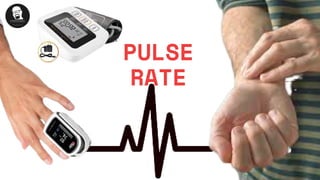
RATE
Pulse
Rate of Pulse
Normal Pulse
Heart Rate Vs Pulse Rate
1.
2.
3.
4.
KEY DISCUSSION POINTS
A pulse represents the tactile arterial
palpation of the heartbeat by trained
fingertips.
WHAT?
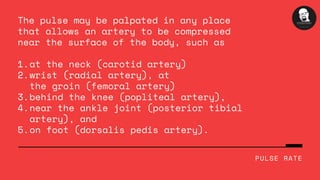
at the neck (carotid artery)
wrist (radial artery), at
the groin (femoral artery)
behind the knee (popliteal artery),
near the ankle joint (posterior tibial
artery), and
on foot (dorsalis pedis artery).
The pulse may be palpated in any place
that allows an artery to be compressed
near the surface of the body, such as
1.
2.
3.
4.
5.
PULSE RATE
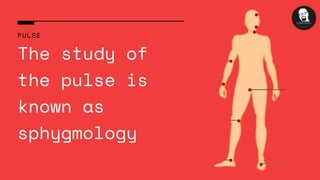
PULSE
The study of
the pulse is
known as
sphygmology
The rate of the pulse is observed
and measured by tactile or visual
means on the outside of an artery
and is recorded as beats per minute
or BPM.
RATE OF PULSE
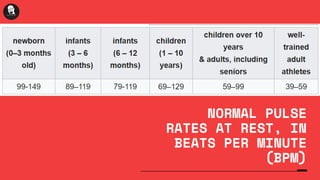
NORMAL PULSE
RATES AT REST, IN
BEATS PER MINUTE
(BPM)
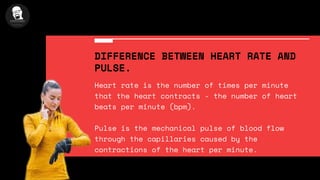
Heart rate is the number of times per minute
that the heart contracts - the number of heart
beats per minute (bpm).
Pulse is the mechanical pulse of blood flow
through the capillaries caused by the
contractions of the heart per minute.
DIFFERENCE BETWEEN HEART RATE AND
PULSE.
Back of the knees
Groin
Neck
Temple
Top or inner side of
the foot
Wrist
The pulse can be measured
at areas where an artery
passes close to the skin.
These areas include the
1.
2.
3.
4.
5.
6.
How the Test is
Performed?
MEASUREMENT AT WRIST
To measure the pulse at
the wrist,
place the index and
middle finger over the
underside of the opposite
wrist,
below the base of the
thumb.
Press with flat fingers
until you feel the pulse.
1.
2.
3.
4.
MEASUREMENT AT
NECK
To measure the pulse on
the neck,
place the index and
middle fingers just to
the side of the Adam's
apple, in the soft,
hollow area.
Press gently until you
locate the pulse.
1.
2.
3.
GOOD LUCK

Pulse rate of Human - Basics

  • 1.
  • 2.
    Pulse Rate of Pulse NormalPulse Heart Rate Vs Pulse Rate 1. 2. 3. 4. KEY DISCUSSION POINTS
  • 3.
    A pulse representsthe tactile arterial palpation of the heartbeat by trained fingertips. WHAT?
  • 4.
    at the neck (carotid artery) wrist (radialartery), at the groin (femoral artery) behind the knee (popliteal artery), near the ankle joint (posterior tibial artery), and on foot (dorsalis pedis artery). The pulse may be palpated in any place that allows an artery to be compressed near the surface of the body, such as 1. 2. 3. 4. 5. PULSE RATE
  • 5.
    PULSE The study of thepulse is known as sphygmology
  • 6.
    The rate ofthe pulse is observed and measured by tactile or visual means on the outside of an artery and is recorded as beats per minute or BPM. RATE OF PULSE
  • 7.
    NORMAL PULSE RATES AT REST,IN BEATS PER MINUTE (BPM)
  • 8.
    Heart rate is thenumber of times per minute that the heart contracts - the number of heart beats per minute (bpm). Pulse is the mechanical pulse of blood flow through the capillaries caused by the contractions of the heart per minute. DIFFERENCE BETWEEN HEART RATE AND PULSE.
  • 9.
    Back of theknees Groin Neck Temple Top or inner side of the foot Wrist The pulse can be measured at areas where an artery passes close to the skin. These areas include the 1. 2. 3. 4. 5. 6. How the Test is Performed?
  • 10.
    MEASUREMENT AT WRIST Tomeasure the pulse at the wrist, place the index and middle finger over the underside of the opposite wrist, below the base of the thumb. Press with flat fingers until you feel the pulse. 1. 2. 3. 4. MEASUREMENT AT NECK To measure the pulse on the neck, place the index and middle fingers just to the side of the Adam's apple, in the soft, hollow area. Press gently until you locate the pulse. 1. 2. 3.
  • 11.