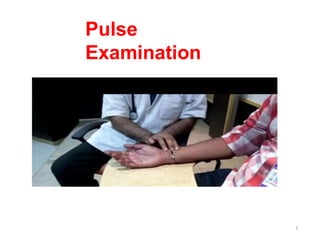
Pulse
Examination
1
2
What is
Pulse ?
• Pulse is a wave generated at the base of
Aorta & spreading along the arterial wall
to the peripheral arteries
• Wave is generated due to pumping of
blood by heart
• Pulse is not due to blood flow under the
vessel
3
Pulse
Examination
• Pulse is examined at superficial arteries
• Most common site is Radial Artery
• It can be compressed against the bone
,that is why it is commonly selected
4
Pulse
Examination
• Done with 3 fingers – Index ,Middle & Ring
• Index finger should be kept proximal to heart &
Ring finger should be distal from heart
• Proximal finger will check the force of pulse
• Purpose of distal finger is to obliterate the back
flow coming from Ulnar artery .Light pressure is
given by ring finger to obliterate
• Rest all parameters of pulse are judged
by middle finger
5
Clinical Examination of
Pulse
• 1) Rate
• 2) Rhythm
• 3) Volume
• 4) Force
• 5) Tension
• 6) Equality on both
sides
• 7) Condition of vessel
wall
• 8) Peripheral Pulsations
9/18/2016 Prof.Dr.R.R.Deshpan
de
6
1)
Rate
• Count Pulsations with watch for full 1
minute
• Minimum 3 readings are essential
• When consecutive 2 readings are same
,that is correct pulse
• Tachycardia & Bradycardia can be
diagnosed
Counting pulse rate in full one
minute
7
8
2)
Rhythm
• Whether beats are coming at regular
interval ?
•
• In healthy individual ,we get
regular or rhythmic pulse
• Irrgular pulse is obtained in Cardiac
Arrythmias
9
2)
Rhythm
• Rarely in children ,we get regularly
irregular pulse .This is called as Sinus
Arrythmia
• During Inspiration ,pulse rate
increases & during expiration ,pulse
rate decreases
• As age increases ,Vagal tone improves &
Sinus Arrythmia goes away
10
3)
Volume
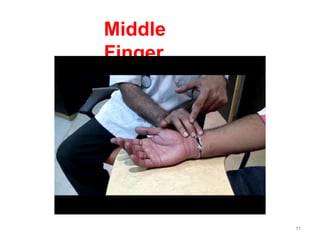
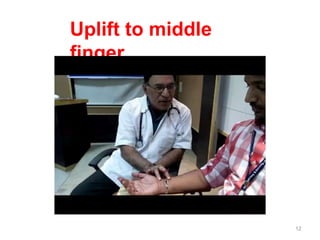
• Uplift to middle finger
• It denotes Pulse Pressure
•
• Pulse Pressure = SBP – DBP
• If patient has high Systolic & low
Diastolic BP
,then Pulse pressure is more
.Therefore Volume will be more
Middle
Finger
11
Uplift to middle
finger
12
13
4)
Force
• Put pressure on Index finger ,to
obliterate the blood flow & stop
pulsations
• The amount of pressure required to be
applied to obliterate or stop the blood flow
indicates Force of pulse
• It gives rough idea of Systolic Blood
Pressure
Pressure by Index
finger to
Obliterate flow
14
15
5)
Tension
• Feel of the Pulse ,between 2 uplifts
• It gives rough idea about Diastolic
Blood Pressure
16
6) Equality of
Pulse
• Pulse of right & left side , should be
examined simultaneously
• Normally pulsations on both sides are
felt at one & the same time
Pulse equality on both
sides
9/18/2016 Prof.Dr.R.R.Deshpan
de
17
9/18/2016 Prof.Dr.R.R.Deshpan
de
18
7) Condition of vessel
wall
• Roll artery under the fingers
• Normally it is elastic
• In old age ,due to atherosclerosis ,it
gives wire or cord like feeling
Rolling of
fingers
9/18/2016 Prof.Dr.R.R.Deshpan
de
19
9/18/2016 Prof.Dr.R.R.Deshpan
de
20
8) Pulse examination at other places
• 1) Superficial Temporal Artery
• 2) Facial Artery ( Anterior border of
Masseter muscle)
• 3) Carotid Artery ( Medial to
Sternocleido mastoid muscle)
• 4) Brachial Artery ( Medial to Bicep
Tendon)
Temporal
artery
9/18/2016 Prof.Dr.R.R.Deshpan
de
21
Facial
Artery
9/18/2016 Prof.Dr.R.R.Deshpan
de
22
Carotid
artery
9/18/2016 Prof.Dr.R.R.Deshpan
de
23
Brachial
Artery
9/18/2016 Prof.Dr.R.R.Deshpan
de
24
9/18/2016 Prof.Dr.R.R.Deshpan
de
25
8) Pulse examination at other places
• 5) Femoral Artery ( Inguinal region)
• 6) Popliteal Artery ( Behind knees)
• 7) Dorsalis Pedis Artery ( 1st Intertarsal
space)
• This examination is IMP to diagnose
Peripheral vascular diseases like TAO (
Thrombo Agitans Obliterans)
Popliteal
Artery
9/18/2016 Prof.Dr.R.R.Deshpan
de
26
Dorsalis pedis
artery
9/18/2016 Prof.Dr.R.R.Deshpan
de
27
9/18/2016 Prof.Dr.R.R.Deshpan
de
28
9) Apex Pulse
ratio
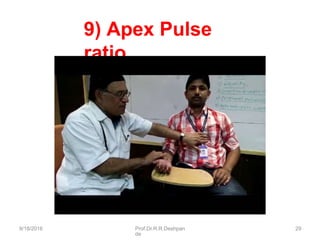
• Corelate beating of heart with pulse
• One hand is put on pulse & 2nd hand is
put on heart ,at Apex beat
• Apex beat will be felt first ,followed by
pulse beat
• One to one relation indicates HR = PR
• If HR > PR – This is Pulsus Deficit
,indicating Cardiac Arrythmias
9) Apex Pulse
ratio
9/18/2016 Prof.Dr.R.R.Deshpan
de
29
9/18/2016 Prof.Dr.R.R.Deshpan
de
30
Sphymogra
ph
• Examination of pulse = Mirror of heart
• Pulse can be recorded in a Graph ,with
computerized instrument ,called as
Sphymograph
• It will show positive wave or Anacrotic wave
,indicating Ventricular systole
• Down stroke is called as Catacrotic wave
,indicating Ventricular Diastole
• There is Dicrotic notch between 2 waves
,Dicrotic notch ,due to closure of Aortic
semilunar valves
Pulse wave
tracing
9/18/2016 Prof.Dr.R.R.Deshpan
de
31
9/18/2016 Prof.Dr.R.R.Deshpan
de
32
Sphymogra
ph
• Whatever wediagnose by clinical
pulse examination can be
diagnosed by Sphygmograph
• Ayurvedic diagnosis of Vata ,Pitta ,Kapha
Nadi
can be objectively compared by
Sphymograph
9/18/2016 Prof.Dr.R.R.Deshpan
de
33
Please see also
Videos
• Copy ,Paste Link as URL
• Pulse Examination
--
By
Prof.Dr.R.R.deshpand
e
• https://youtu.be/mATZjnD9b
F8
Prof.Dr.R.R.Deshpa
nde • Sharing of
Knowledge
• FOR
• Propagating
Ayurved
9/18/2016 Prof.Dr.R.R.Deshpan
de
34

pulseexamination.pptx