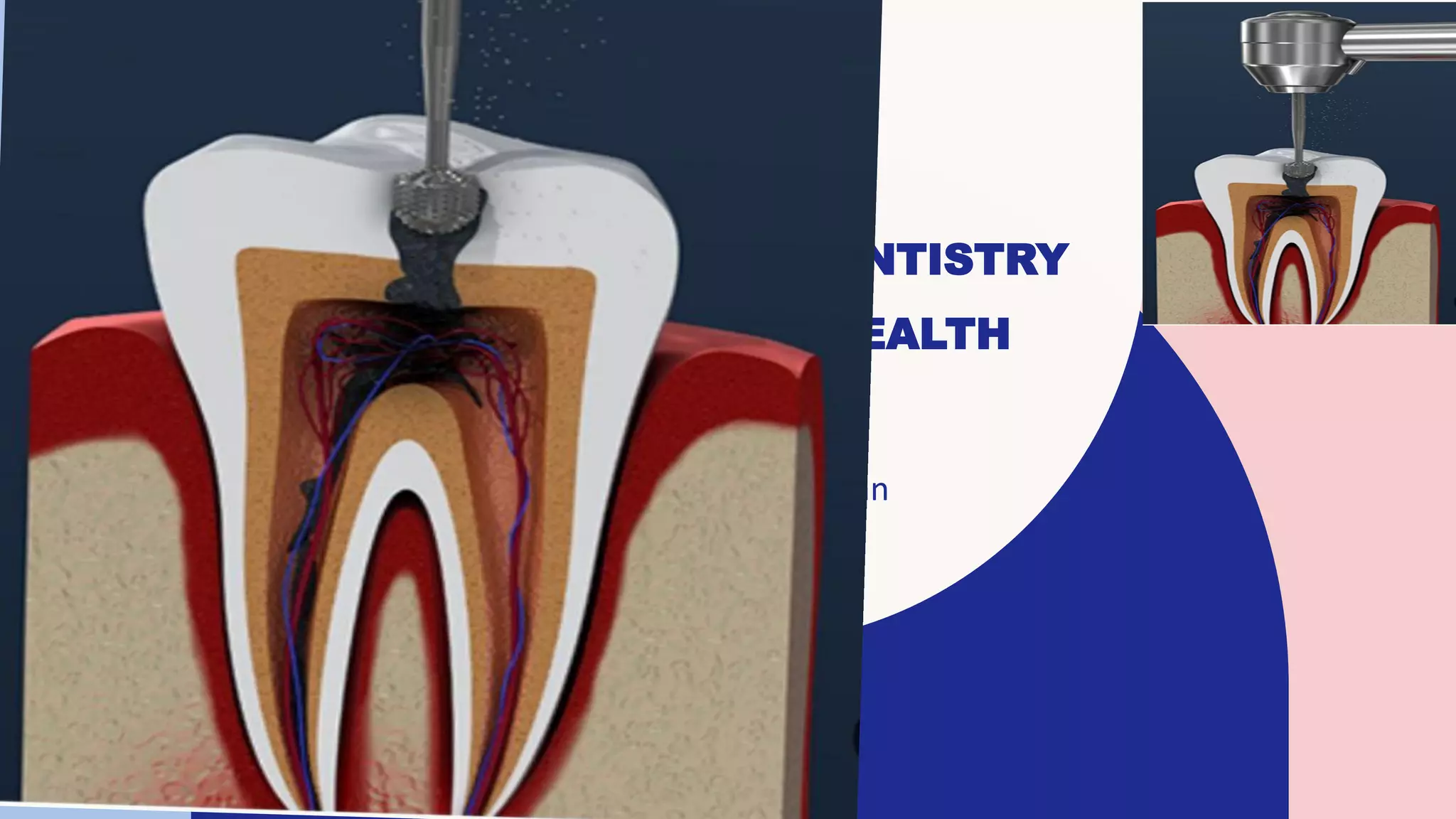
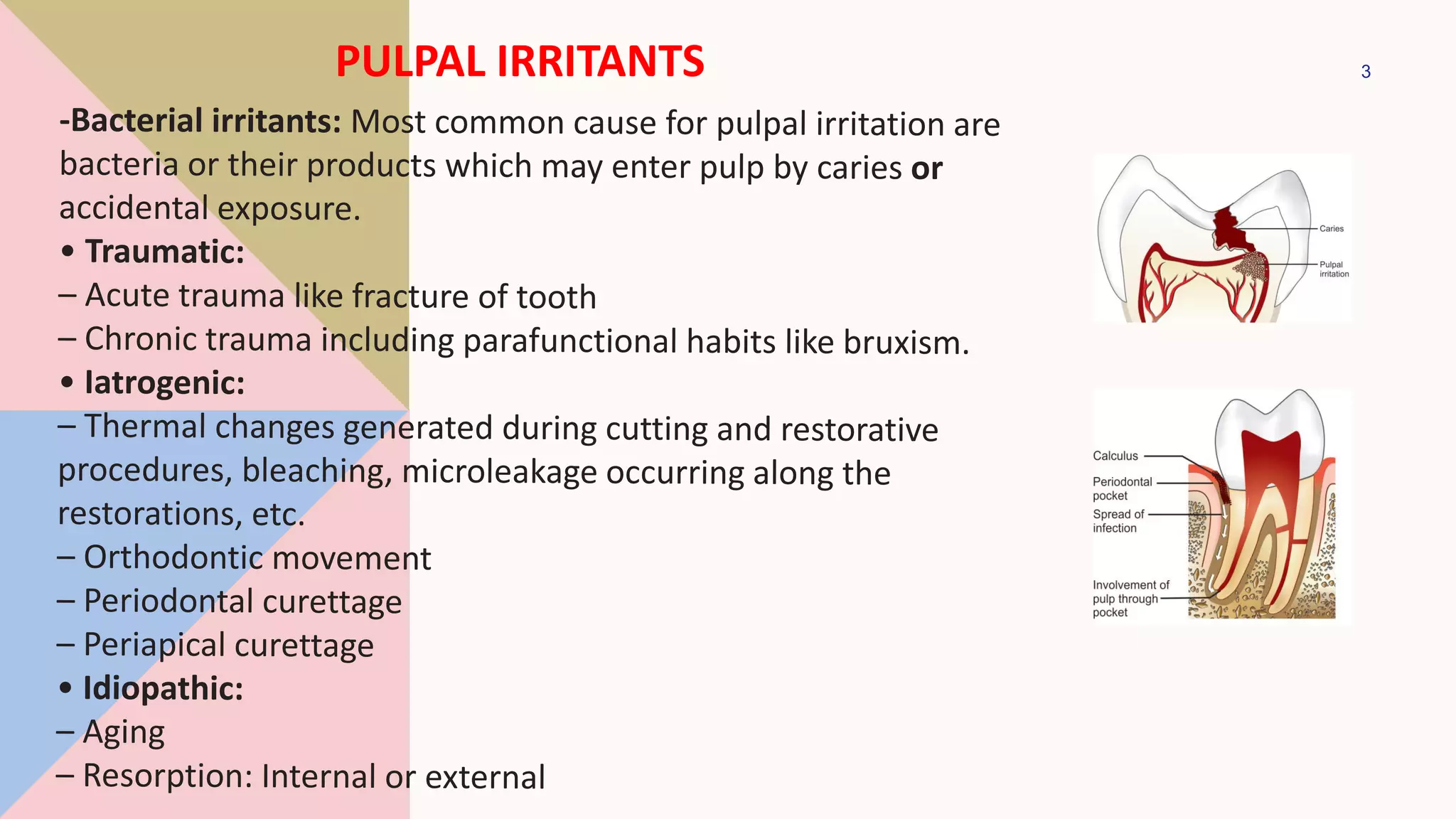
RESTORATIVE DENTISTRY
AND PULPAL HEALTH
By:
Dr. ibtehal M. Hussian
PULP
Is loose specialized connective tissues located in the
center of the tooth, consist of collagen fibers and
ground substance supporting the vital cellular, vascular,
and nerve structures of the tooth.
. Pulp can get irritated by various restorative
materials and dental procedures
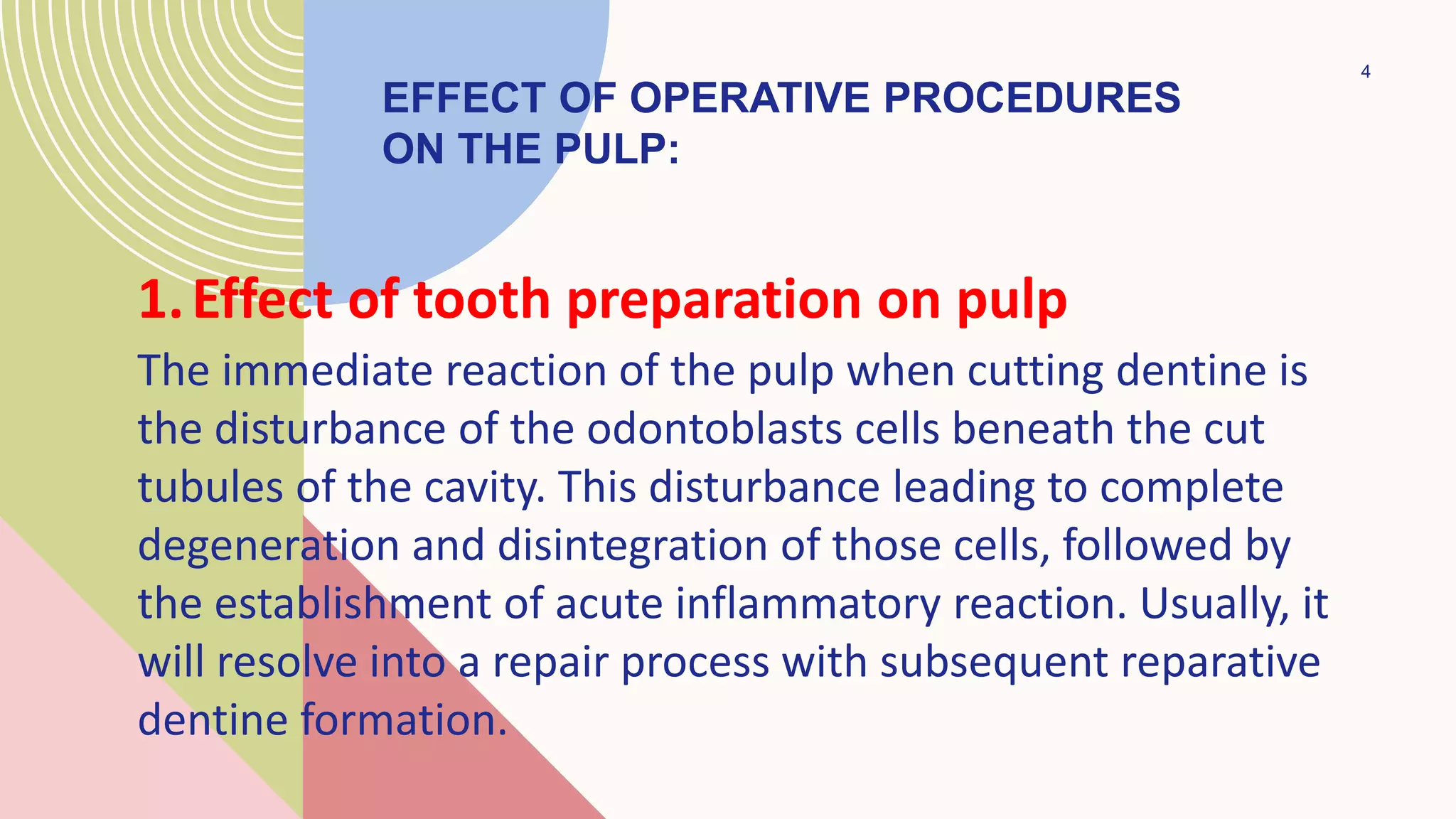
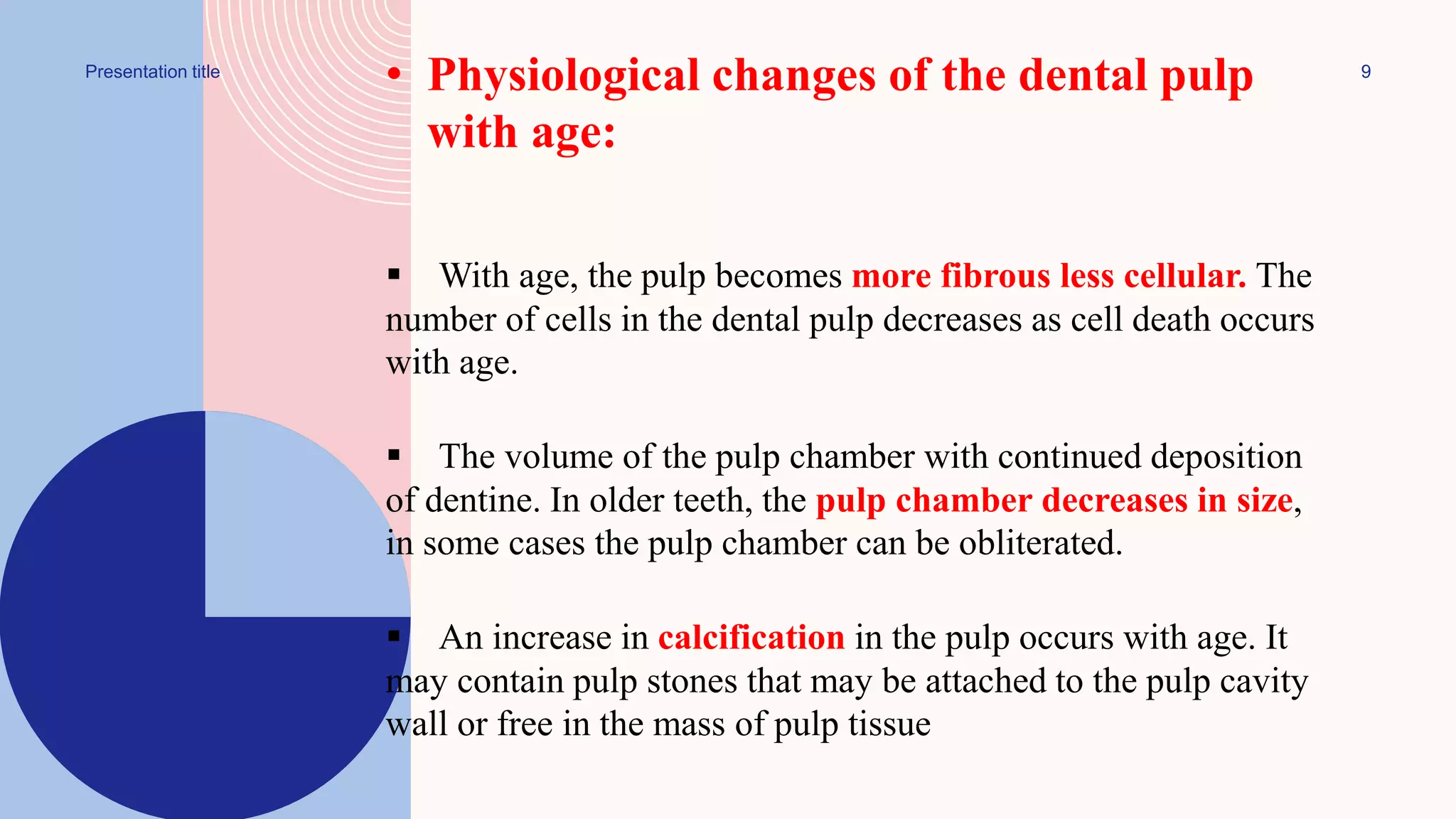
PULPAL IRRITANTS 3
EFFECT OF OPERATIVE PROCEDURES
ON THE PULP:
1.Effect of tooth preparation on pulp
The immediate reaction of the pulp when cutting dentine is
the disturbance of the odontoblasts cells beneath the cut
tubules of the cavity. This disturbance leading to complete
degeneration and disintegration of those cells, followed by
the establishment of acute inflammatory reaction. Usually, it
will resolve into a repair process with subsequent reparative
dentine formation.
4
This will depend on many factors:
a. The depth of the cavity, the deeper the cavity the
more the damage to the pulp.
Remaining Dentin Thickness
Remaining dentin thickness (RDT) is the dentin present
between floor of the tooth preparation and pulp
chamber.
Generally, 2 mm of dentin thickness between will provide
an adequate insulting barrier against irritants. As dentin
thickness decreases, the pulpal response increases
5
B- Speed of Rotation: Ultra high-speed should be used for removal of
enamel and superficial dentin. A speed of 3,000 to 30,000 rpm without
coolant can cause pulpal damage.
C- Heat Production:. Amount of heat produced depends on speed of
rotation, size and shape of the cutting instrument, length of time in
contact with dentin, amount of pressure exerted on hand piece, if
water coolant is or not used.
D- Vibration: Vibrations are an indication of eccentricity in rotary
instruments. Higher the amplitude, more destructive is the pulp
response.
E- Nature of Cutting Instrument: Use of dull instruments can cause
vibration and reduced cutting efficiency. Their use encourages the
clinician to apply excessive operating pressure, which results in increased
temperature .This can result in thermal injury to pulp.
EFFECT OF RESTORATIVE MATERIALS ON
PULP:
Properties of a material that could cause pulpal injury are its
cytotoxic nature, acidity, heat evolved during setting and
marginal leakage.
Factors Influencing the Effect of
Restorative Materials on Pulp
• Acidity
• Absorption of water from dentin during setting
• Heat generated during setting
• Poor marginal adaptation leads to bacterial penetration
• Cytotoxicity of material
8
Presentation title 9
• Physiological changes of the dental pulp
with age:
▪ With age, the pulp becomes more fibrous less cellular. The
number of cells in the dental pulp decreases as cell death occurs
with age.
▪ The volume of the pulp chamber with continued deposition
of dentine. In older teeth, the pulp chamber decreases in size,
in some cases the pulp chamber can be obliterated.
▪ An increase in calcification in the pulp occurs with age. It
may contain pulp stones that may be attached to the pulp cavity
wall or free in the mass of pulp tissue
• PULP PROTECTION PROCEDURES
Pulp Needs Protection Against Various Irritants as the Following:
• Thermal protection
• Electrical protection
• Mechanical protection
• Chemical protection
• Protection from microleakage interface between tooth and
the restoration.
10
Pulp Protection in Shallow and
Moderate Carious Lesions
may involve one half of the dentin, but not to
the extent
of endangering the pulp. In these cases, to
protect the pulp,
liner is applied to cover the axial and/or pulpal
wall. Then,
base is placed over the liner. After the base
material hardens,
permanent restoration is done .
Pulp Protection in Deep Carious
Lesions
caries can reach very near or up to the pulp, so
treatment of deep carious lesion requires precautions
because of postoperative pulpal response.
Depending upon the condition, following methods for
pulpal protection are employed
Pulp Capping: defined as treatment
designed to maintain the vitality of the pulp.
Several favorable conditions must be present before
considering direct or indirect pulp capping:
1. The tooth must have a vital pulp and no history of
spontaneous pain.
2. Pain elicited during pulp testing with a hot or cold
stimulus should not longer after stimulus removal.
3. A periapical radiograph should show no evidence
of a periradicular lesion of endodontic origin.
4. Bacteria must be excluded from the site by the
permanent restoration
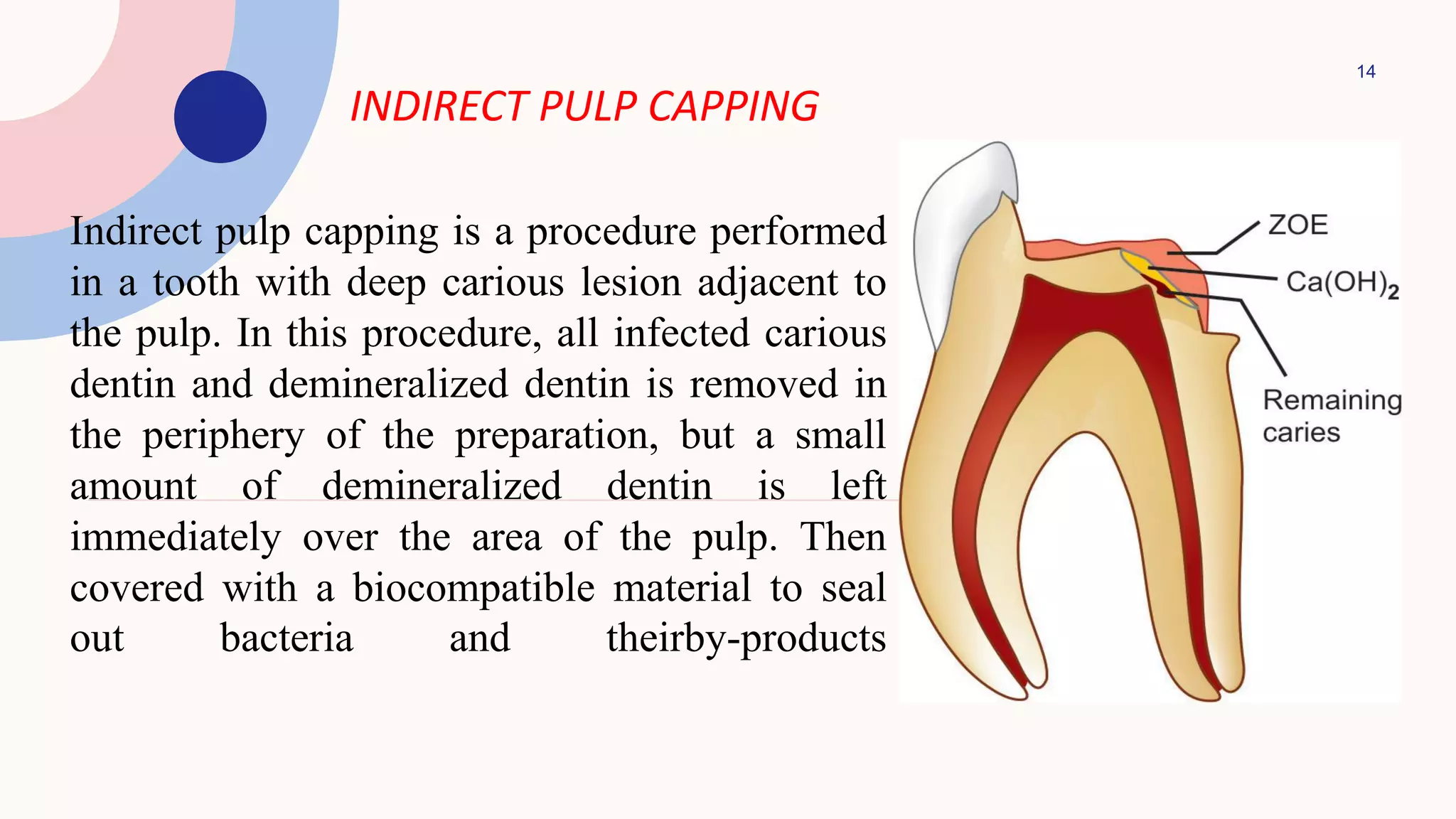
INDIRECT PULP CAPPING
14
Indirect pulp capping is a procedure performed
in a tooth with deep carious lesion adjacent to
the pulp. In this procedure, all infected carious
dentin and demineralized dentin is removed in
the periphery of the preparation, but a small
amount of demineralized dentin is left
immediately over the area of the pulp. Then
covered with a biocompatible material to seal
out bacteria and theirby-products
Presentation title 15
Success of indirect pulp capping depends
on the age of the patient, size of the
exposure, restorative procedure and
evidence of pulp vitality.
In young patients, the potential for
success is more due to large volume of
pulp tissue and abundant vascularity
.
Direct Pulp Capping
it involves the placement of biocompatible material over the
site of pulp exposure during tooth preparation or following a
trauma, to maintain vitality and promote healing.
Indications
• Small mechanical exposure of pulp during tooth preparation
or traumatic injury.
• No or minimal bleeding at the exposure site
Contraindications
• Wide pulp exposure
• Radiographic evidence of pulp pathology
• History of spontaneous pain
• Presence of bleeding at exposure site
17
• Clinical procedure
1. Administer local anesthesia /Isolate the tooth with rubber dam.
2. When vital and healthy pulp is exposed, check the fresh bleeding (bright red)
at exposure site.
3. Clean the area with distilled water or saline solution and then dry it with a
cotton pellet.
4. Apply calcium hydroxide over the exposed area.
5. Give interim restoration such as zinc oxide eugenol for 6 to 8 weeks.
6. After 2 to 3 months, evaluate the tooth. If secondary dentin formation takes
place over the exposed site, restore the tooth permanently. If favorable
prognosis is not there, then it indicated for root canal treatment.
Presentation title 18
19
Factors affecting success of direct pulp capping:
• Age of the patient: Due to vascularity of the pulp, young patients have
greater potential for success than older ones.
• Type of exposure: Mechanically done pulpal exposure has better
prognosis than exposure caused by caries, due to less pulpal inflammation .
• Size of the exposure: In large exposures, it is difficult to control the
hemorrhage. Small pinpoint exposures are easy to manage and have a
greater
potential for success.
• History of pain: If previously pain has not occurred in the tooth, the
potential for success is more.
MATERIALS USED FOR PULP PROTECTION
20
These materials help to:
• Insulate the pulp
• Protect the pulp in case of deep carious
lesion
• Act as barriers to microleakage
• Prevent bacteria and toxins from affecting
the pulp
Classification of Pulp Protective Agents
1. Cavity sealers
• Varnish
• Resin bonding agents
2. Liners
3. Bases
CLASSIFICATION OF PULP PROTECTIVE AGENTS
21
1. CAVITY SEALERS
• VARNISH
INDICATIONS FOR USE OF VARNISH
• TO SEAL THE DENTINAL TUBULES
• TO REDUCE MICROLEAKAGE AROUND RESTORATIONS
• RESIN BONDING AGENTS
INDICATIONS
• TO SEAL DENTINAL TUBULES
• TO TREAT DENTIN HYPERSENSITIVITY.
22
Materials used as Liners
1-Zinc oxide eugenol liners
2-Calcium hydroxide
3-Flowable composites
4-Glass ionomer cements (GIC)
5-Light-cured resin-modified glass ionomers (RMGIs)
1 2 3 5
are used as pulp protective materials to provide
thermal insulation, encourage recovery of injured
pulp from thermal, mechanical or chemical trauma,
galvanic shock and microleakage.
• Bases have sufficient strength so as to withstand
forces of mastication and condensation of
permanent restorations
Materials Used as Bases
1-Zinc oxide eugenol
2-Zinc phosphate cement
3-Polycarboxylate cement
4-Glass ionomer cement
THANK YOU

pulp.pdf

  • 1.
    RESTORATIVE DENTISTRY AND PULPALHEALTH By: Dr. ibtehal M. Hussian
  • 2.
    PULP Is loose specializedconnective tissues located in the center of the tooth, consist of collagen fibers and ground substance supporting the vital cellular, vascular, and nerve structures of the tooth. . Pulp can get irritated by various restorative materials and dental procedures
  • 3.
  • 4.
    EFFECT OF OPERATIVEPROCEDURES ON THE PULP: 1.Effect of tooth preparation on pulp The immediate reaction of the pulp when cutting dentine is the disturbance of the odontoblasts cells beneath the cut tubules of the cavity. This disturbance leading to complete degeneration and disintegration of those cells, followed by the establishment of acute inflammatory reaction. Usually, it will resolve into a repair process with subsequent reparative dentine formation. 4
  • 5.
    This will dependon many factors: a. The depth of the cavity, the deeper the cavity the more the damage to the pulp. Remaining Dentin Thickness Remaining dentin thickness (RDT) is the dentin present between floor of the tooth preparation and pulp chamber. Generally, 2 mm of dentin thickness between will provide an adequate insulting barrier against irritants. As dentin thickness decreases, the pulpal response increases 5
  • 6.
    B- Speed ofRotation: Ultra high-speed should be used for removal of enamel and superficial dentin. A speed of 3,000 to 30,000 rpm without coolant can cause pulpal damage. C- Heat Production:. Amount of heat produced depends on speed of rotation, size and shape of the cutting instrument, length of time in contact with dentin, amount of pressure exerted on hand piece, if water coolant is or not used.
  • 7.
    D- Vibration: Vibrationsare an indication of eccentricity in rotary instruments. Higher the amplitude, more destructive is the pulp response. E- Nature of Cutting Instrument: Use of dull instruments can cause vibration and reduced cutting efficiency. Their use encourages the clinician to apply excessive operating pressure, which results in increased temperature .This can result in thermal injury to pulp.
  • 8.
    EFFECT OF RESTORATIVEMATERIALS ON PULP: Properties of a material that could cause pulpal injury are its cytotoxic nature, acidity, heat evolved during setting and marginal leakage. Factors Influencing the Effect of Restorative Materials on Pulp • Acidity • Absorption of water from dentin during setting • Heat generated during setting • Poor marginal adaptation leads to bacterial penetration • Cytotoxicity of material 8
  • 9.
    Presentation title 9 •Physiological changes of the dental pulp with age: ▪ With age, the pulp becomes more fibrous less cellular. The number of cells in the dental pulp decreases as cell death occurs with age. ▪ The volume of the pulp chamber with continued deposition of dentine. In older teeth, the pulp chamber decreases in size, in some cases the pulp chamber can be obliterated. ▪ An increase in calcification in the pulp occurs with age. It may contain pulp stones that may be attached to the pulp cavity wall or free in the mass of pulp tissue
  • 10.
    • PULP PROTECTIONPROCEDURES Pulp Needs Protection Against Various Irritants as the Following: • Thermal protection • Electrical protection • Mechanical protection • Chemical protection • Protection from microleakage interface between tooth and the restoration. 10
  • 11.
    Pulp Protection inShallow and Moderate Carious Lesions may involve one half of the dentin, but not to the extent of endangering the pulp. In these cases, to protect the pulp, liner is applied to cover the axial and/or pulpal wall. Then, base is placed over the liner. After the base material hardens, permanent restoration is done .
  • 12.
    Pulp Protection inDeep Carious Lesions caries can reach very near or up to the pulp, so treatment of deep carious lesion requires precautions because of postoperative pulpal response. Depending upon the condition, following methods for pulpal protection are employed
  • 13.
    Pulp Capping: definedas treatment designed to maintain the vitality of the pulp. Several favorable conditions must be present before considering direct or indirect pulp capping: 1. The tooth must have a vital pulp and no history of spontaneous pain. 2. Pain elicited during pulp testing with a hot or cold stimulus should not longer after stimulus removal. 3. A periapical radiograph should show no evidence of a periradicular lesion of endodontic origin. 4. Bacteria must be excluded from the site by the permanent restoration
  • 14.
    INDIRECT PULP CAPPING 14 Indirectpulp capping is a procedure performed in a tooth with deep carious lesion adjacent to the pulp. In this procedure, all infected carious dentin and demineralized dentin is removed in the periphery of the preparation, but a small amount of demineralized dentin is left immediately over the area of the pulp. Then covered with a biocompatible material to seal out bacteria and theirby-products
  • 15.
  • 16.
    Success of indirectpulp capping depends on the age of the patient, size of the exposure, restorative procedure and evidence of pulp vitality. In young patients, the potential for success is more due to large volume of pulp tissue and abundant vascularity .
  • 17.
    Direct Pulp Capping itinvolves the placement of biocompatible material over the site of pulp exposure during tooth preparation or following a trauma, to maintain vitality and promote healing. Indications • Small mechanical exposure of pulp during tooth preparation or traumatic injury. • No or minimal bleeding at the exposure site Contraindications • Wide pulp exposure • Radiographic evidence of pulp pathology • History of spontaneous pain • Presence of bleeding at exposure site 17
  • 18.
    • Clinical procedure 1.Administer local anesthesia /Isolate the tooth with rubber dam. 2. When vital and healthy pulp is exposed, check the fresh bleeding (bright red) at exposure site. 3. Clean the area with distilled water or saline solution and then dry it with a cotton pellet. 4. Apply calcium hydroxide over the exposed area. 5. Give interim restoration such as zinc oxide eugenol for 6 to 8 weeks. 6. After 2 to 3 months, evaluate the tooth. If secondary dentin formation takes place over the exposed site, restore the tooth permanently. If favorable prognosis is not there, then it indicated for root canal treatment. Presentation title 18
  • 19.
    19 Factors affecting successof direct pulp capping: • Age of the patient: Due to vascularity of the pulp, young patients have greater potential for success than older ones. • Type of exposure: Mechanically done pulpal exposure has better prognosis than exposure caused by caries, due to less pulpal inflammation . • Size of the exposure: In large exposures, it is difficult to control the hemorrhage. Small pinpoint exposures are easy to manage and have a greater potential for success. • History of pain: If previously pain has not occurred in the tooth, the potential for success is more.
  • 20.
    MATERIALS USED FORPULP PROTECTION 20 These materials help to: • Insulate the pulp • Protect the pulp in case of deep carious lesion • Act as barriers to microleakage • Prevent bacteria and toxins from affecting the pulp Classification of Pulp Protective Agents 1. Cavity sealers • Varnish • Resin bonding agents 2. Liners 3. Bases
  • 21.
    CLASSIFICATION OF PULPPROTECTIVE AGENTS 21 1. CAVITY SEALERS • VARNISH INDICATIONS FOR USE OF VARNISH • TO SEAL THE DENTINAL TUBULES • TO REDUCE MICROLEAKAGE AROUND RESTORATIONS • RESIN BONDING AGENTS INDICATIONS • TO SEAL DENTINAL TUBULES • TO TREAT DENTIN HYPERSENSITIVITY.
  • 22.
    22 Materials used asLiners 1-Zinc oxide eugenol liners 2-Calcium hydroxide 3-Flowable composites 4-Glass ionomer cements (GIC) 5-Light-cured resin-modified glass ionomers (RMGIs) 1 2 3 5
  • 23.
    are used aspulp protective materials to provide thermal insulation, encourage recovery of injured pulp from thermal, mechanical or chemical trauma, galvanic shock and microleakage. • Bases have sufficient strength so as to withstand forces of mastication and condensation of permanent restorations Materials Used as Bases 1-Zinc oxide eugenol 2-Zinc phosphate cement 3-Polycarboxylate cement 4-Glass ionomer cement
  • 24.