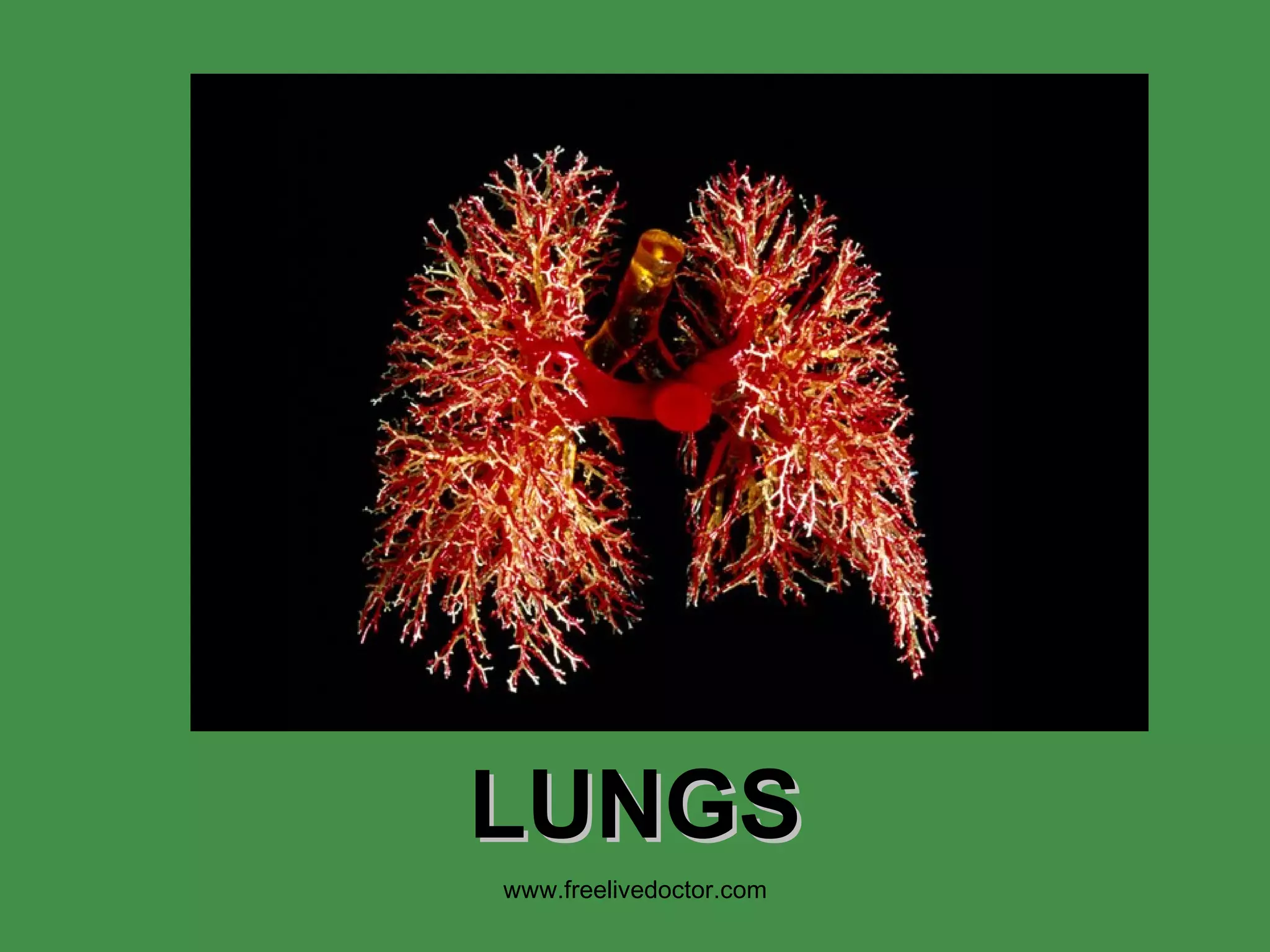
LUNGS www.freelivedoctor.com
LUNG “ Degenerative” Inflammatory Neoplastic and Pleura LAB: (Review, Cases, and/or Virtual Microscopy) www.freelivedoctor.com
OVERVIEW Normal Anatomy and Histology Pathology Congenital Atalectasis Acute Pulmonary Injury Obstructive vs. Restrictive (infiltrative) concepts O bstructive  P ulmonary  D isease (C OPD ) Restrictive (Infiltrative) Pulmonary Disease Vascular Pulmonary Diseases www.freelivedoctor.com
OVERVIEW INFECTIONS NEOPLASMS   and PLEURA (effusions, pneumothorax, tumors) www.freelivedoctor.com
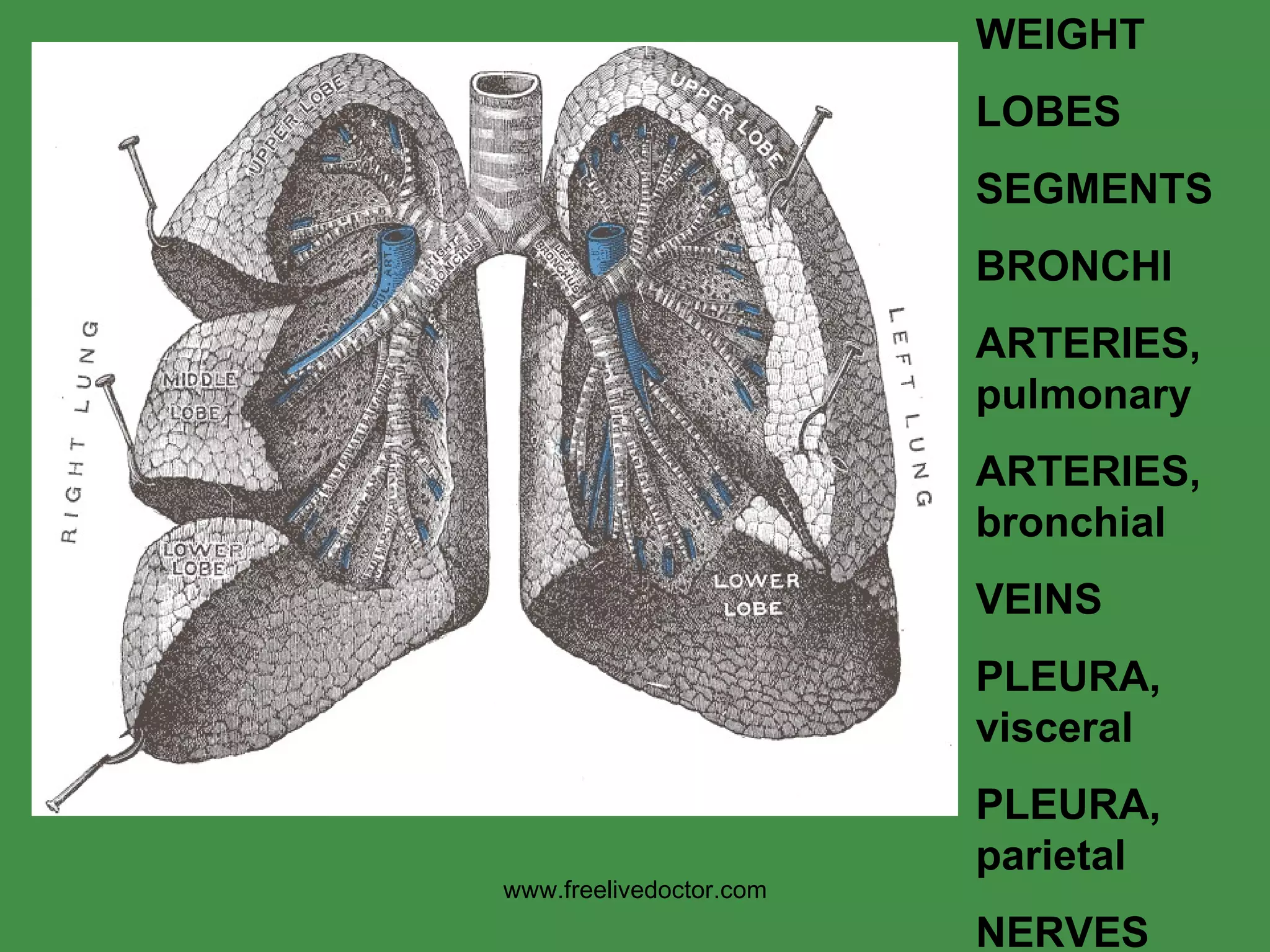
WEIGHT LOBES SEGMENTS BRONCHI ARTERIES, pulmonary ARTERIES, bronchial VEINS PLEURA, visceral PLEURA, parietal NERVES www.freelivedoctor.com
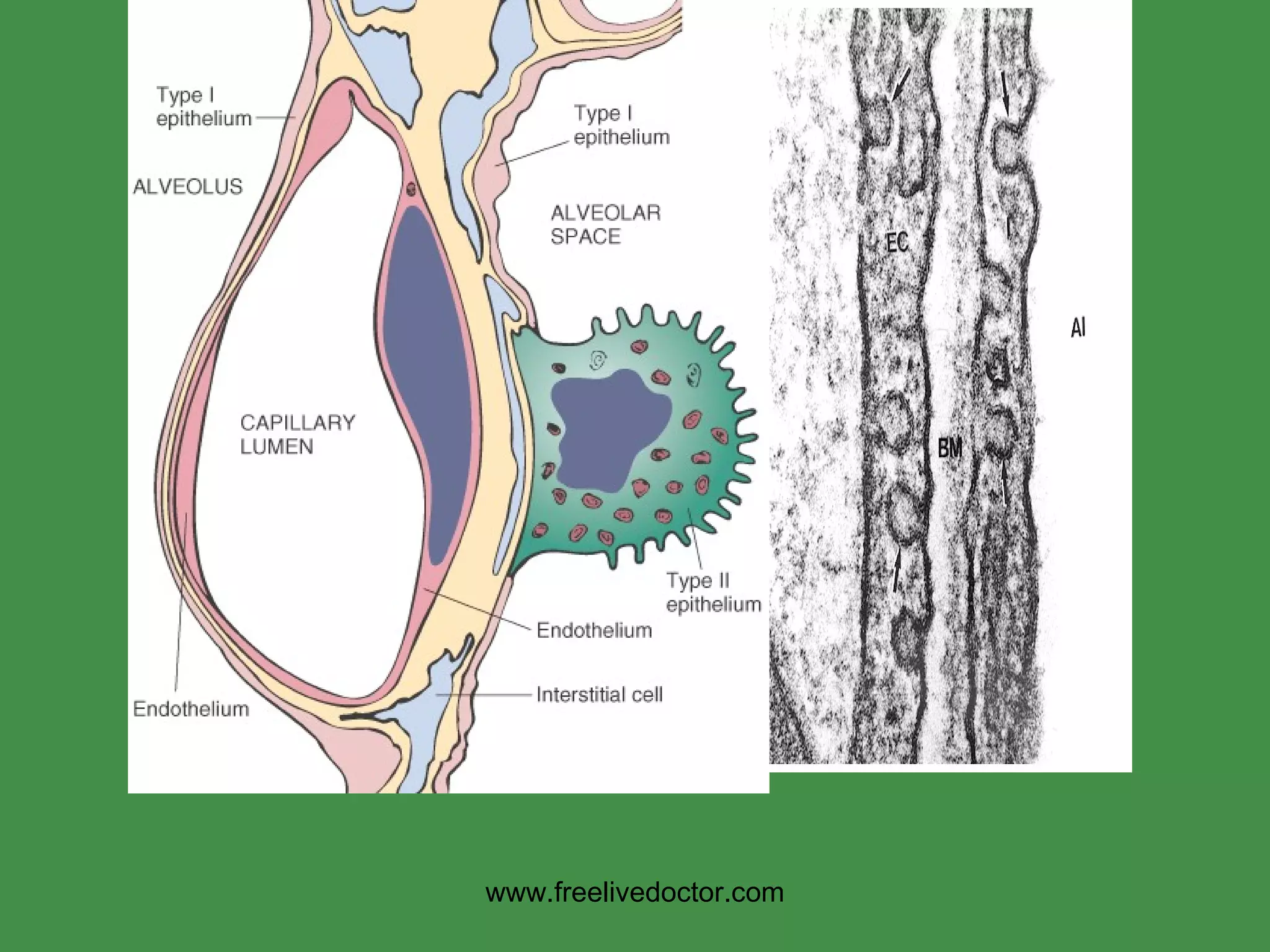
Bronchi Bronchioles Terminal bronchioles Alveolar ducts Alveoli Type 1 pneumocytes Type 2 pneumocytes Macrophages Capillaries www.freelivedoctor.com
www.freelivedoctor.com
www.freelivedoctor.com NORMAL” chest X-Ray [CXR]
Pathology CONGENITAL Atalectasis Acute Pulmonary Injury Obstructive vs. Restrictive (infiltrative) concepts O bstructive  P ulmonary  D isease (C OPD ) Restrictive (Infiltrative) Pulmonary Disease Vascular Pulmonary Diseases www.freelivedoctor.com
CONGENITAL Agenesis/Hypoplasia Tracheal/bronchial anomalies, i.e., Tracheo-Esophageal (TE) fistula Vascular anomalies Congenital Emphysema Foregut cysts Pulmonary Artery Malformations (CPAM) Sequestration (no connection to airways) www.freelivedoctor.com
www.freelivedoctor.com
OVERVIEW Pathology Congenital ATALECTASIS Acute Pulmonary Injury Obstructive vs. Restrictive (infiltrative) concepts O bstructive  P ulmonary  D isease (C OPD ) Restrictive Pulmonary Disease Vascular Pulmonary Diseases www.freelivedoctor.com
ATALECTASIS INCOMPLETE EXPANSION COLLAPSE www.freelivedoctor.com
OVERVIEW Pathology Congenital Atalectasis ACUTE PULMONARY INJURY Pulmonary Edema ARDS ( D iffuse A lveolar D amage) Acute Interstitial Pneumonia Obstructive vs. Restrictive (infiltrative) concepts O bstructive  P ulmonary  D isease (C OPD ) Restrictive (Infiltrative) Pulmonary Disease Vascular Pulmonary Diseases www.freelivedoctor.com
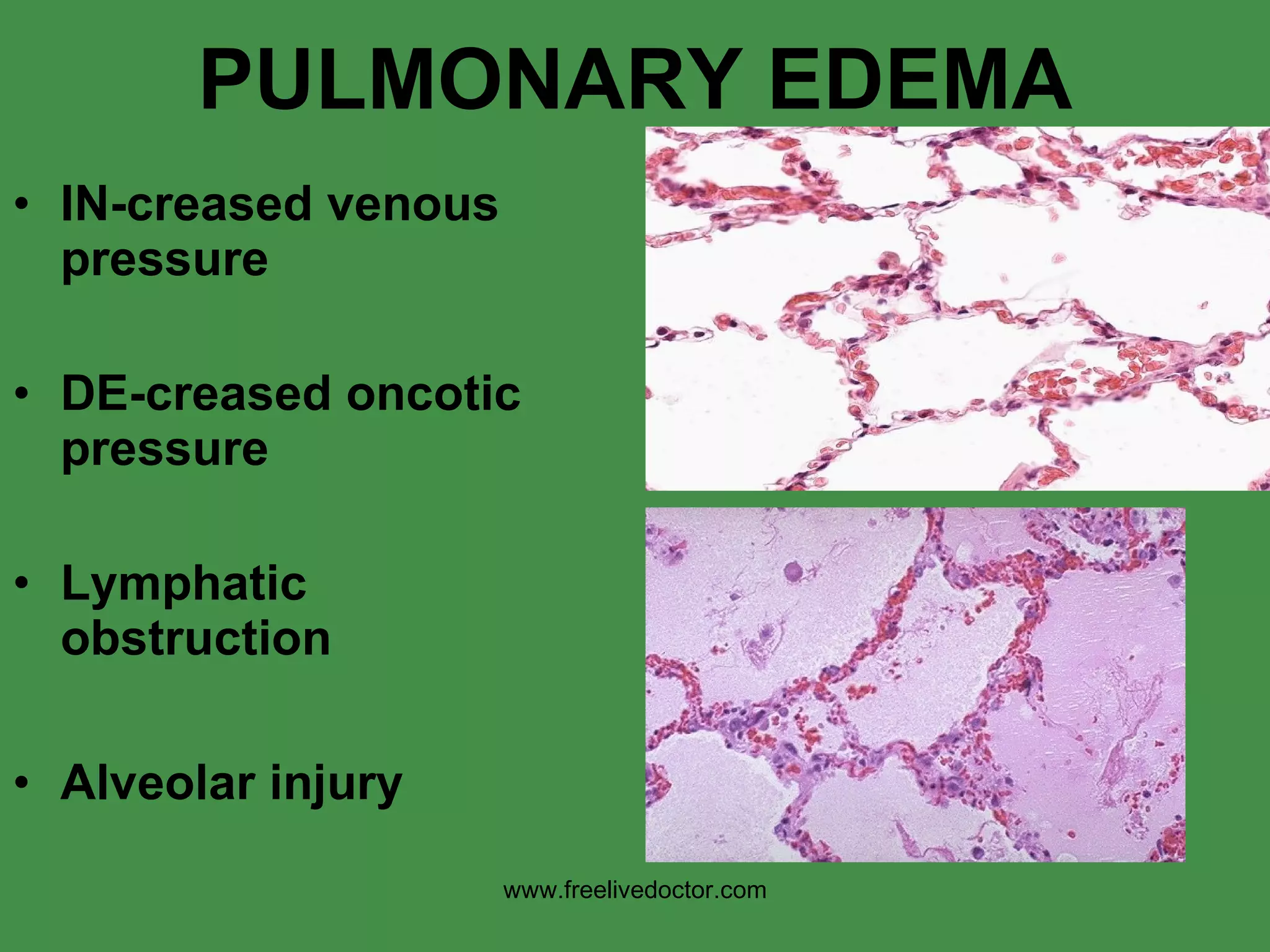
PULMONARY EDEMA IN-creased venous pressure DE-creased oncotic pressure Lymphatic obstruction Alveolar injury www.freelivedoctor.com
ACUTE RESPIRATORY DISTRESS SYNDROME (ARDS or D.A.D., i.e., Diffuse Alveolar damage) (aka, “SHOCK” lung) NON-specific pattern of lung injury INFECTION PHYSICAL INJURY TOXIC CHEMICAL DIC ETC www.freelivedoctor.com
ARDS www.freelivedoctor.com
ACUTE INTERSTITIAL PNEUMONIA Think of it as ARDS with NO known etiology! www.freelivedoctor.com
OVERVIEW Pathology Congenital Atalectasis Acute Pulmonary Injury OBSTRUCTION vs. RESTRICTION O bstructive  P ulmonary  D isease (C OPD ) Restrictive (Infiltrative) Pulmonary Disease Vascular Pulmonary Diseases www.freelivedoctor.com
OBSTRUCTION v. RESTRICTION OBSTRUCTION Air or blood? Large or small? Inspiration or Expiration? Obstruction is SMALL AIRWAY EXPIRATION  obstruction, i.e., wheezing HYPEREXPANSION on CXR RESTRICTION “ Compliance” “ Infiltrative” REDUCED lung VOLUME, DYSPNEA, CYANOSIS REDUCED GAS TRANSFER “ GROUND GLASS” on CXR www.freelivedoctor.com
OVERVIEW Pathology Congenital Atalectasis Acute Pulmonary Injury Obstruction vs. Restriction OBSTRUCTIVE Pulmonary Diseases (COPD) Restrictive (Infiltrative) Pulmonary Disease Vascular Pulmonary Diseases www.freelivedoctor.com
OBSTRUCTION (cOPD) EMPHYSEMA  (almost always chronic) CHRONIC BRONCHITIS   emphysema ASTHMA BRONCHIECTASIS www.freelivedoctor.com
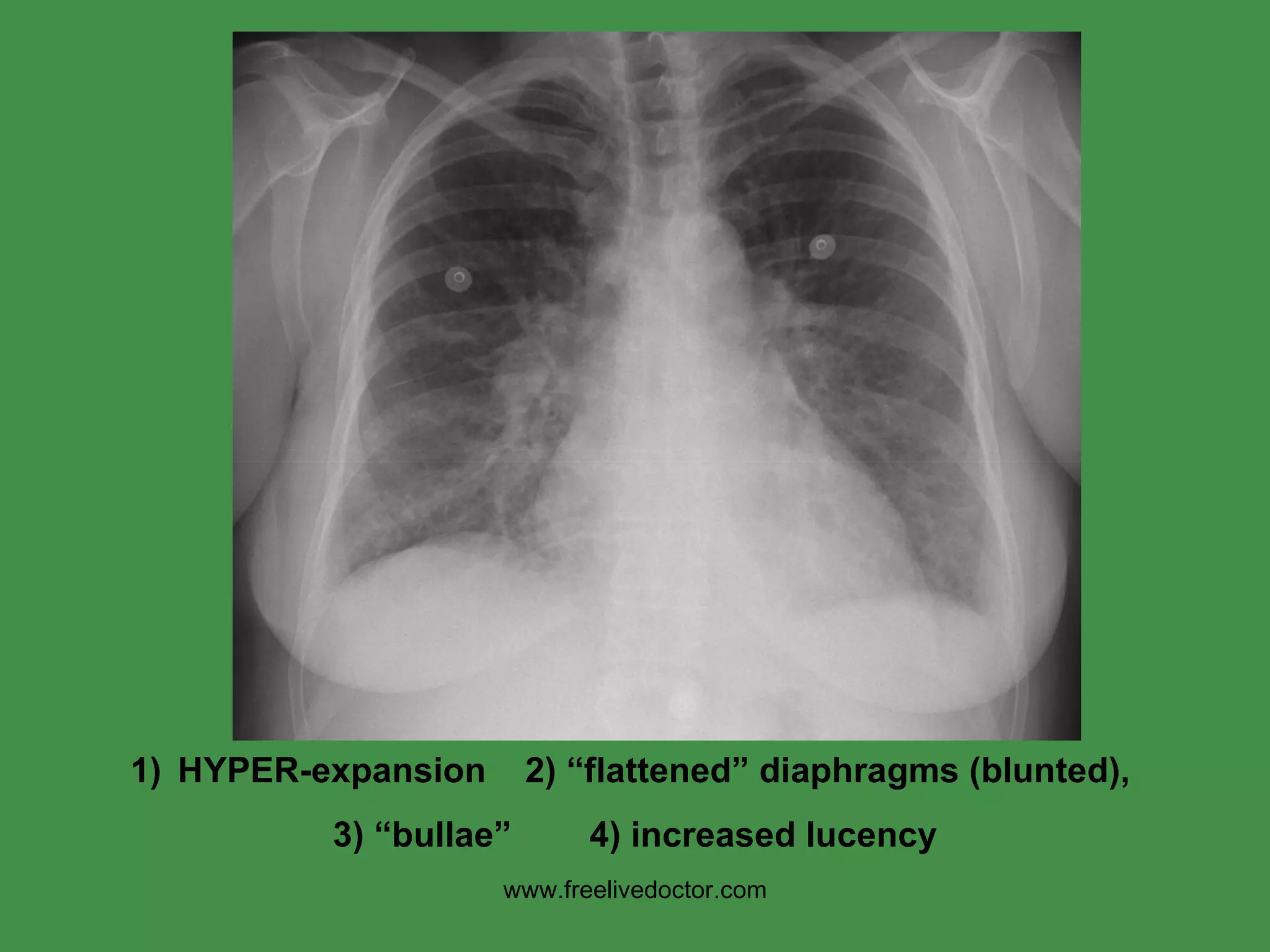
EMPHYSEMA COPD, or “END-STAGE” lung disease Centri-acinar, Pan-acinar, Paraseptal, Irregular Like cirrhosis, thought of as END-STAGE of multiple chronic small airway obstructive etiologies NON-specific IN-creased crepitance, BULLAE  (BLEBS) Clinically linked to recurrent pneumonias, and progressive failure www.freelivedoctor.com
CENTRO-acinar PAN-acinar www.freelivedoctor.com
www.freelivedoctor.com Bullae, or “peripheral blebs” are hallmarks of chronic obstructive lung disease, COPD.
HYPER-expansion  2) “flattened” diaphragms (blunted),  3) “bullae”  4) increased lucency www.freelivedoctor.com
CHRONIC BRONCHITIS INHALANTS, POLLUTION, CIGARETTES CHRONIC COUGH CAN OFTEN PROGRESS TO EMPHYSEMA MUCUS hypersecretion, early, i.e. goblet cell increase CHRONIC bronchial inflammatory infiltrate www.freelivedoctor.com
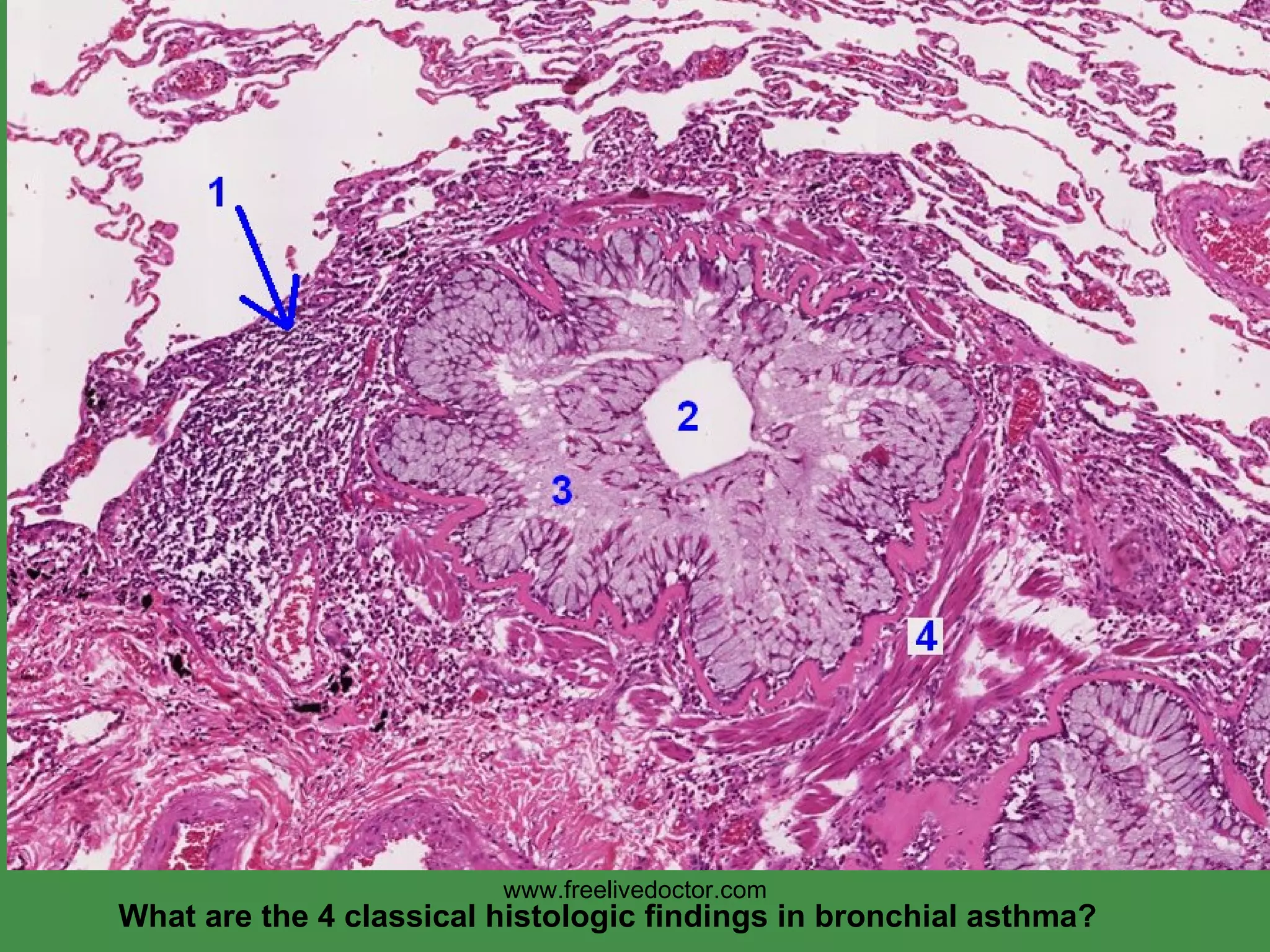
ASTHMA Similar to chronic bronchitis but: Wheezing is hallmark (bronchospasm, i.e. “wheezing”) STRONG allergic role, i.e., eosinophils, IgE, allergens Often starting in CHILDHOOD ATOPIC (allergic) or NON-ATOPIC (infection) Chronic small airway obstruction and infection 1) Mucus hypersecretion with plugging, 2) lymphocytes/eosinophils, 3) lumen narrowing, 4) smooth muscle hypertrophy www.freelivedoctor.com
www.freelivedoctor.com Note the heavy inflammatory cell infiltrate around bronchioles and small bronchi.
What are the 4 classical histologic findings in bronchial asthma? www.freelivedoctor.com
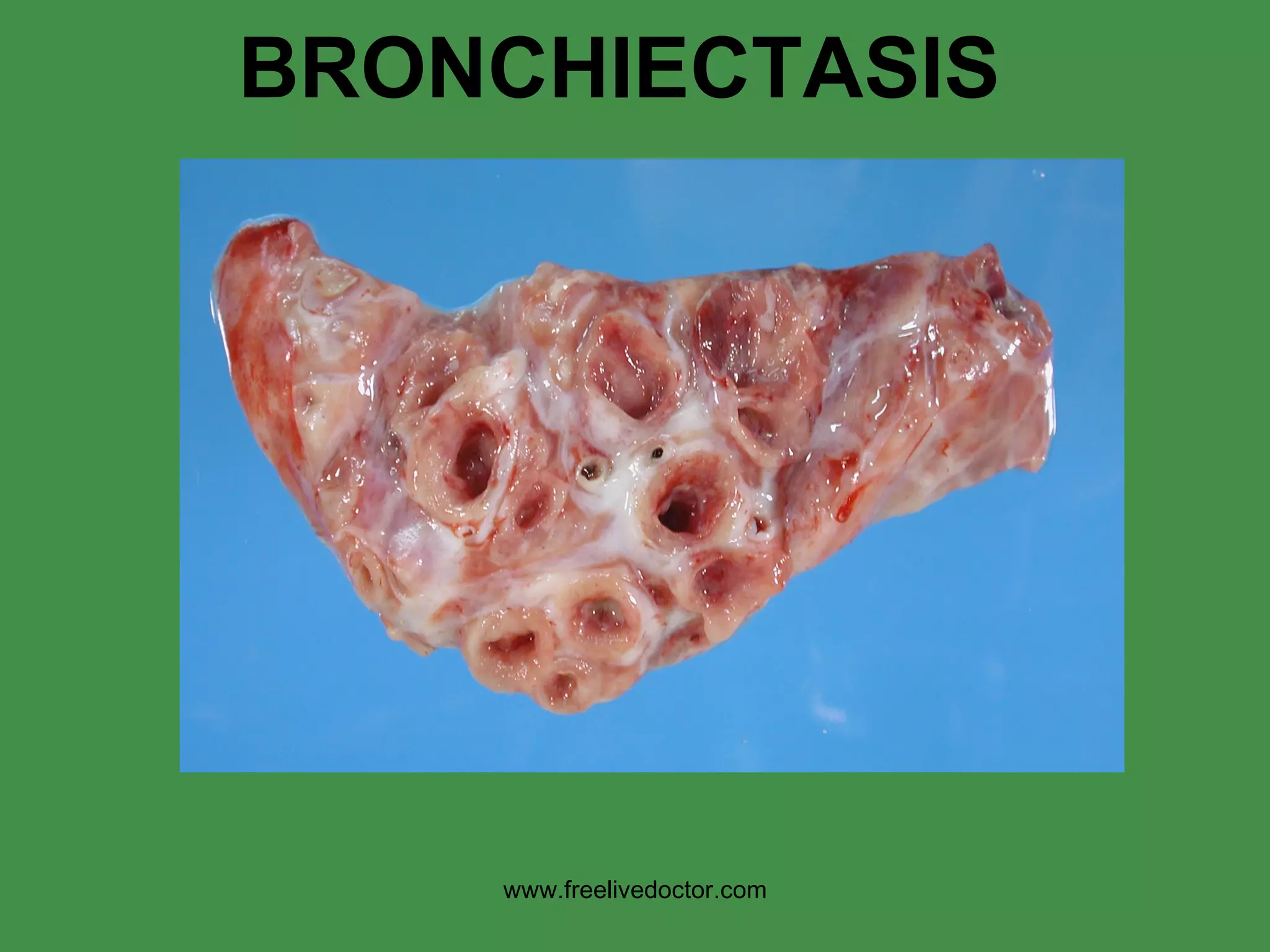
BRONCHIECTASIS DILATATION of the BRONCHUS, associated with, often, necrotizing inflammation CONGENITAL TB , other bacteria, many viruses BRONCHIAL OBSTRUCTION (i.e., LARGE AIRWAY, NOT SMALL AIRWAY) Rheumatoid Arthritis, SLE, IBD (Inflammatory Bowel Disease) www.freelivedoctor.com
BRONCHIECTASIS www.freelivedoctor.com
OVERVIEW Pathology Congenital Atalectasis Acute Pulmonary Injury Obstruction vs. Restriction Obstructive Pulmonary Diseases (COPD) RESTRICTIVE (INFILTRATIVE) PULMONARY DISEASES Vascular Pulmonary Diseases www.freelivedoctor.com
RESTRICTIVE (INFILTRATIVE) REDUCED COMPLIANCE, reduced gas exchange) Are also DIFFUSE HETEROGENEOUS FIBROSING GRANULOMATOUS EOSINOPHILIC SMOKING RELATED PAP [Pulmonary Alveolar Proteinosis] www.freelivedoctor.com
FIBROSING “ IDIOPATHIC” PULMONARY FIBROSIS (IPF) NONSPECIFIC INTERSTITIAL FIBROSIS “ CRYPTOGENIC” ORGANIZING PNEUMONIA “ COLLAGEN” VASCULAR DISEASES PNEUMOCONIOSES DRUG REACTIONS RADIATION CHANGES www.freelivedoctor.com
IPF (UIP) IDIOPATHIC, i.e., not from any usual caused, like lupus, scleroderma FIBROSIS www.freelivedoctor.com
NON-SPECIFIC INTERSTITIAL PNEUMONIA WASTEBASKET DIAGNOSIS, of ANY pneumonia (pneumonitis) of any known or unknown etiology FIBROSIS CELLULAR INFILTRATE (LYMPHS & PLASMA CELLS) www.freelivedoctor.com
CRYPTOGENIC ORGANIZING PNEUMONIA (COP) IDIOPATHIC “ BRONCHIOLITIS OBLITERANS” www.freelivedoctor.com
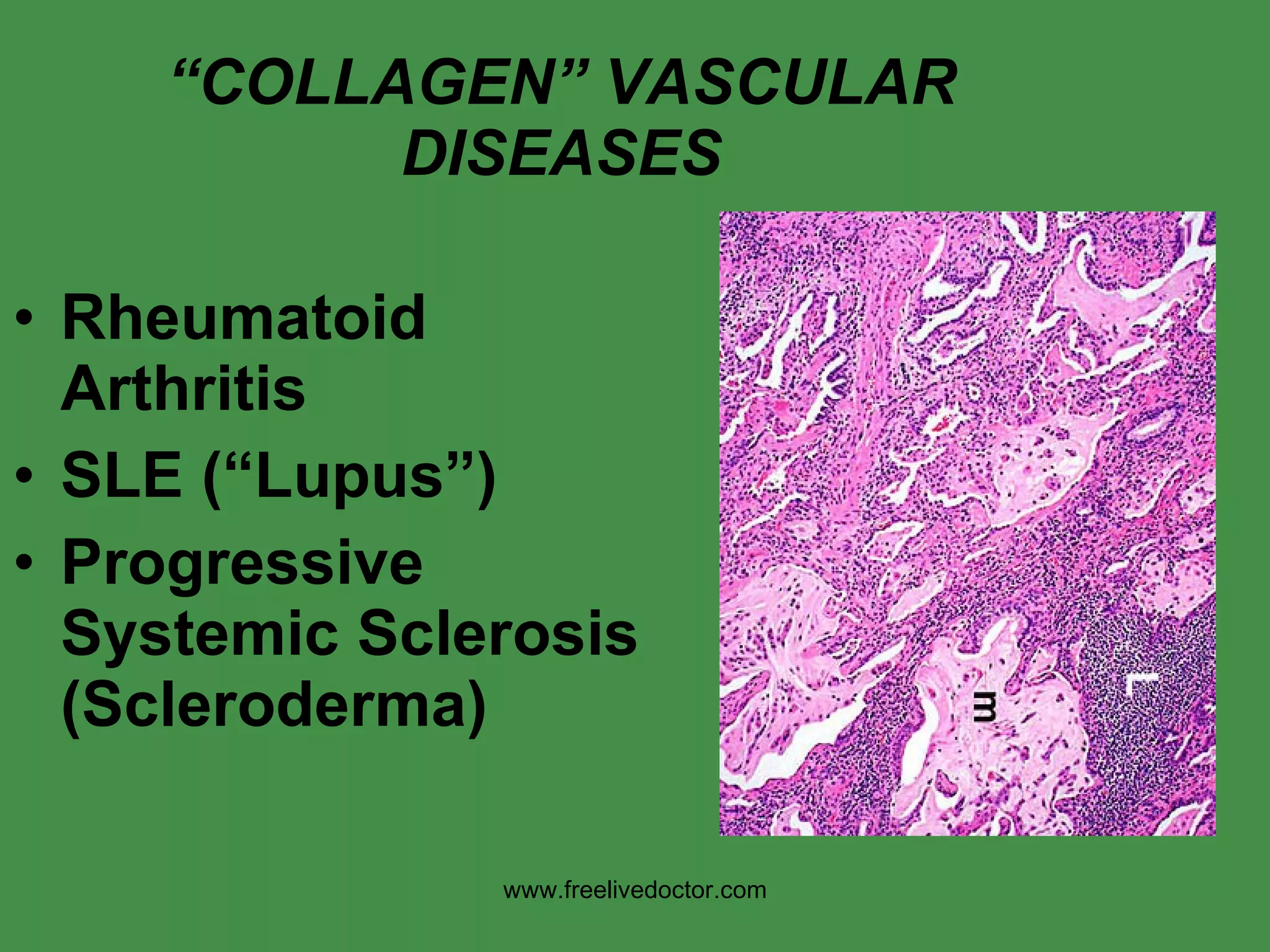
“ COLLAGEN” VASCULAR DISEASES Rheumatoid Arthritis SLE (“Lupus”) Progressive Systemic Sclerosis (Scleroderma) www.freelivedoctor.com
PNEUMOCONIOSES “ OCCUPATIONAL” “ COAL MINERS LUNG” DUST OR CHEMICALS OR ORGANIC MATERIALS Coal (anthracosis) Silica Asbestos Be, FeO, BaSO4,  CHEMO HAY, FLAX, BAGASSE, INSECTICIDES, etc. www.freelivedoctor.com
GRANULOMATOUS SARCOIDOSIS , i.e., NON-caseating granulomas (IDIOPATHIC) HYPERSENSITIVITY  (DUSTS, bacteria, fungi,  Farmer’s  Lung,  Pigeon Breeder’s  Lung) www.freelivedoctor.com
SARCOIDOSIS Mainly LUNG, but eye, skin or ANYWHERE UNKNOWN ETIOLOGY IMMUNE, GENETIC factors F>>M B>>W YOUNG ADULT BLACK WOMEN www.freelivedoctor.com
NON-Caseating Granulomas are the RULE “ Asteroid” bodies within these granulomas are virtually diagnostic www.freelivedoctor.com
www.freelivedoctor.com
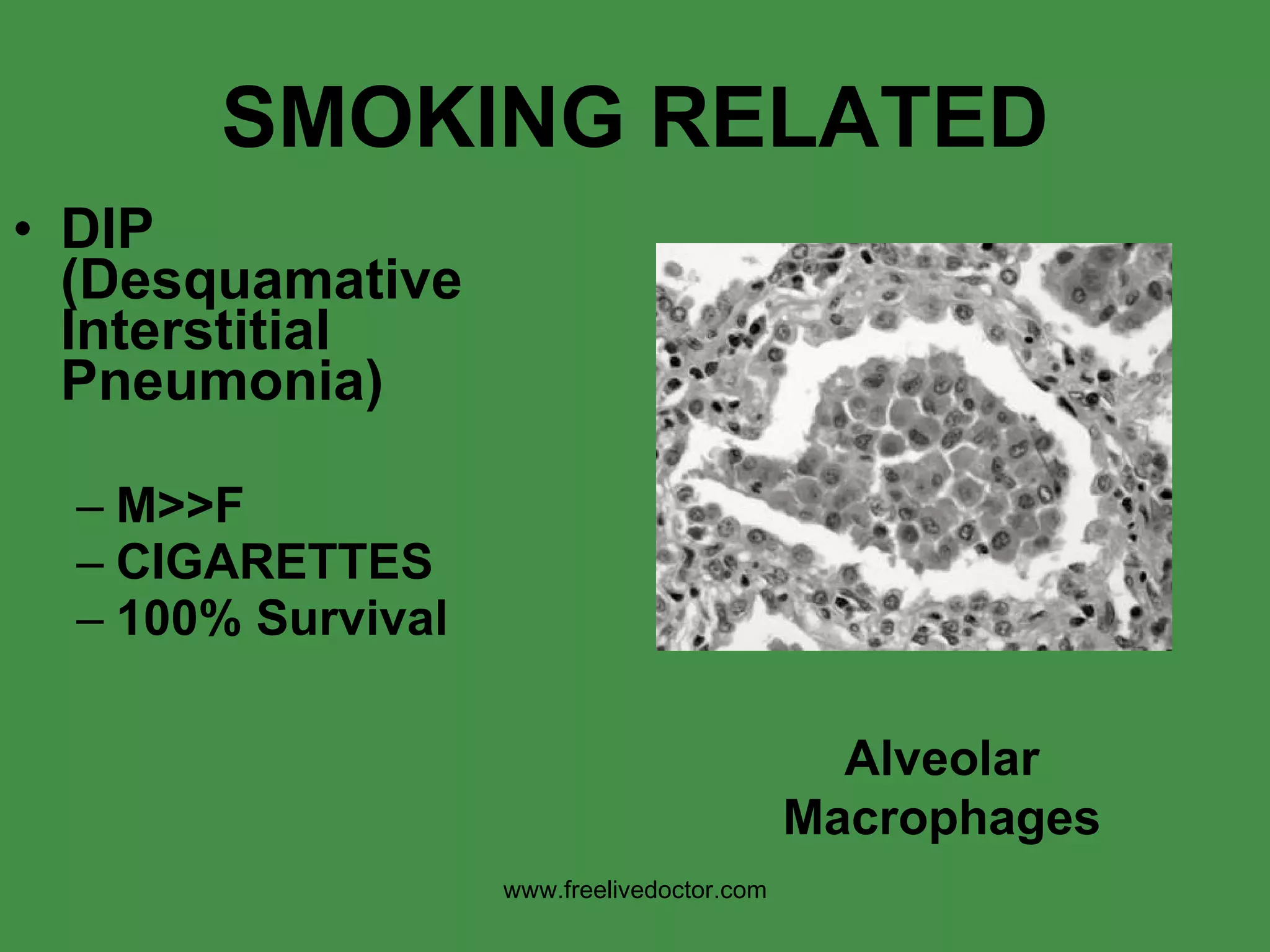
SMOKING RELATED DIP (Desquamative Interstitial Pneumonia) M>>F CIGARETTES 100% Survival Alveolar Macrophages www.freelivedoctor.com
PAP (Pulmonary Alveolar Proteinosis) Very RARE, usually acquired Proteinaceous Material in Alveoli MINIMAL cellular infiltrate Like Pulmonary Edema, but MUCH Protein www.freelivedoctor.com
OVERVIEW Pathology Congenital Atalectasis Acute Pulmonary Injury Obstruction vs. Restriction Obstructive Pulmonary Diseases (COPD) Restrictive (Infiltrative) Pulmonary Diseases VASCULAR PULMONARY DISEASES www.freelivedoctor.com
VASCULAR PULMONARY DISEASES PULMONARY EMBOLISM  (with or usually WITHOUT infarction) PULMONARY HYPERTENSION , leading to cor pulmonale HEMORRHAGIC SYNDROMES GOODPASTURE   SYNDROME HEMOSIDEROSIS , idiopathic WEGENER GRANULOMATOSIS www.freelivedoctor.com
P.E. Usually secondary to debilitated states with immobilization, or following surgery Usually deep leg and deep pelvic veins (DVT), NOT superficial veins Follows Virchow’s triad, i.e., 1) flow problems, 2) endothelial disruption, 3) hypercoagulabilty Usually do NOT infarct, usually ventilate When they DO infarct, the infarct is hemorrhagic Decreased PO2, acute chest pain, V/Q MIS-match DX: Chest CT, V/Q scan, angiogram RX: short term heparin, then long term coumadin www.freelivedoctor.com
PULMONARY HYPERTENSION COPD, C”I”PD (vicious cycle) CHD (Congenital HD, increased left atrial pressure) Recurrent PEs Autoimmune, e.g., PSS (Scleroderma), i.e., fibrotic pulmonary vasculature www.freelivedoctor.com
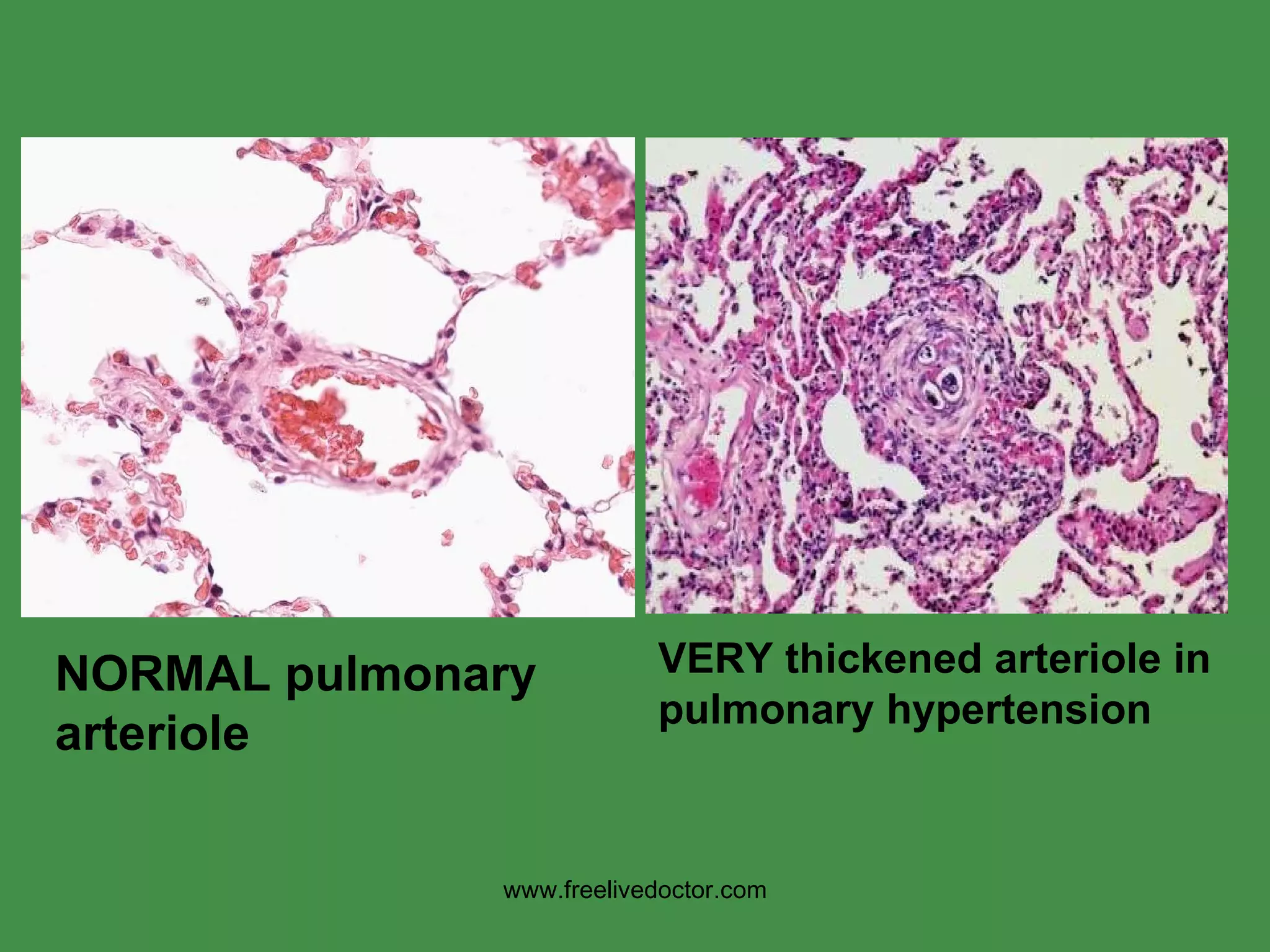
VERY thickened arteriole in pulmonary hypertension NORMAL pulmonary arteriole www.freelivedoctor.com
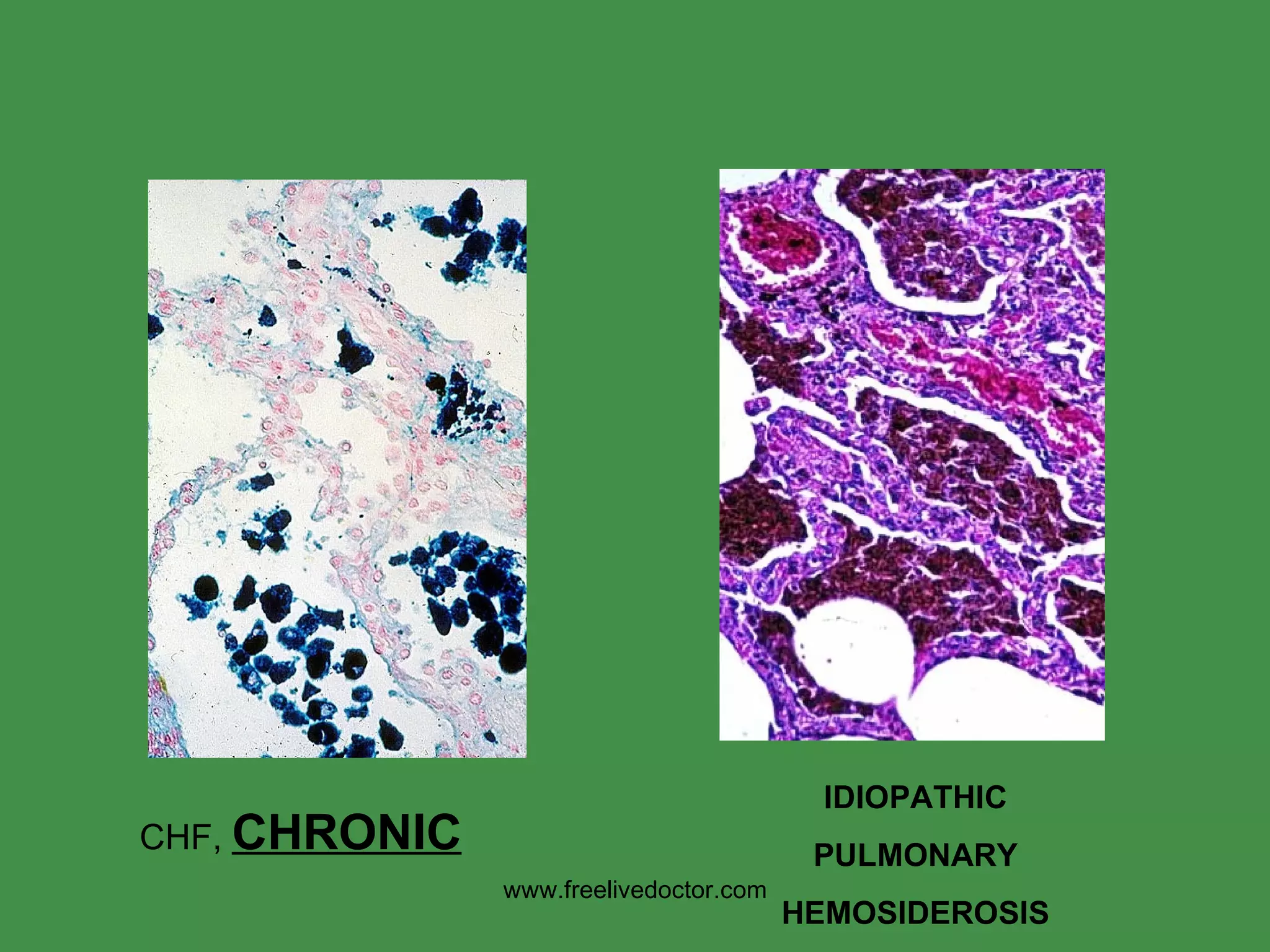
HEMORRHAGIC SYNDROMES GOODPASTURE Syndrome: Ab’s to the alpha-3 chains of collagen IV, GBM deposits too! IDIOPATHIC PULMONARY HEMOSIDEROSIS, to be differentiated from chronic CHF WEGENER GRANULOMATOSIS www.freelivedoctor.com
CHF,  CHRONIC IDIOPATHIC PULMONARY HEMOSIDEROSIS www.freelivedoctor.com
PNEUMONIA www.freelivedoctor.com
  COMM UNITY-ACQUIRED BACTERIAL ACUTE PNEUMONIAS Streptococcus Pneumoniae Haemophilus Influenzae Moraxella Catarrhalis Staphylococcus Aureus Klebsiella Pneumoniae Pseudomonas Aeruginosa Legionella Pneumophila COMMUNITY-ACQUIRED ATYPICAL (VIRAL AND MYCOPLASMAL) PNEUMONIAS Morphology. Clinical Course. Influenza Infections Severe Acute Respiratory Syndrome (SARS) NOSOCOMIAL PNEUMONIA ASPIRATION PNEUMONIA LUNG ABSCESS Etiology and Pathogenesis. CHRONIC PNEUMONIA Histoplasmosis, Morphology Blastomycosis, Morphology Coccidioidomycosis, Morphology PNEUMONIA IN THE IMMUNOCOMPROMISED HOST PULMONARY DISEASE IN HUMAN IMMUNODEFICIENCY VIRUS INFECTION PULMONARY INFECTIONS www.freelivedoctor.com
BASIC CONSIDERATIONS PNEUMONIA vs. PNEUMONITIS DIFFERENTIATION from INJURIES, OBSTRUCTIVE DISEASES, RESTRICTIVE DISEASES, VASCULAR DISEASES DIFFERENTIATION FROM NEOPLASMS CLASSICAL STAGES of INFLAMMATION LOBAR-  vs.  BRONCHO- INTERSTITIAL vs. ALVEOLAR COMMUNITY vs. NOSOCOMIAL ETIOLOGIC AGENTS vs. HOST IMMUNITY 2 PRESENTING SYMPTOMS  2 DIAGNOSTIC METHODS ANY ORGANISM CAN CAUSE PNEUMONIA!!! www.freelivedoctor.com
PREDISPOSING FACTORS LOSS OF COUGH REFLEX DIMINISHED MUCIN or CILIA FUNCTION ALVEOLAR MACROPHAGE INTERFERENCE VASCULAR FLOW IMPAIRMENTS BRONCHIAL FLOW IMPAIRMENTS www.freelivedoctor.com
Although pneumonia is one of the most common causes of death, it usually does  NOT  occur in healthy people spontaneously www.freelivedoctor.com
Classifications of PNEUMONIAS COMMUNITY ACQUIRED COMMUNITY ACQUIRED, ATYPICAL NOSOCOMIAL ASPIRATION CHRONIC NECROTIZING/ABSCESS FORMATION PNEUMONIAS in IMMUNOCOMPROMISED HOSTS www.freelivedoctor.com
COMMUNITY ACQUIRED STREPTOCOCCUS PNEUMONIAE (i.e., “diplococcus”) HAEMOPHILUS INFLUENZAE (“H-Flu”) MORAXELLA STAPHYLOCOCCUS (STAPH) KLEBSIELLA PNEUMONIAE  PSEUDOMONAS AERUGINOSA LEGIONELLA PNEUMOPHILIA www.freelivedoctor.com
STREPTOCOCCUS The classic LOBAR pneumonia Normal flora in 20% of adults Only 20% of victims have  +  blood cultures “ Penicillins” are often 100% curative Vaccines are often 100% preventive www.freelivedoctor.com
HAEMOPHILUS PNEUMONIA Commonest in CHILDREN <2, with otitis, URI, meningitis, cellulitis, osteomyelitis PNEUMONIAS in CHILDREN <2 are often thought of as being H Flu until proven otherwise, otitis, meningitis too Most common pneumonia from COPD in adults BACTRIM (Trimethoprim-Sulfa) most common treatment www.freelivedoctor.com
MORAXELLA CATARRHALIS 2nd most common COPD pneumonia, after haemophilus Gram NEGATIVE coccobacillus www.freelivedoctor.com
STAPH aureus Most common pneumonia following viral pneumonias M.R.S.A., of course, is usually NOT “community” acquired www.freelivedoctor.com
KLEBSIELLA PNEUMONIAE DEBILITATED MALNOURISHED PEOPLE ALCOHOLICS  with pneumonia are often thought of as having Klebsiella until proven otherwise www.freelivedoctor.com
PSEUDOMONAS Aeruginosa Usually NOT community acquired but nosocomial CYSTIC FIBROSIS patients with pneumonia are presumed to have PSEUDOMONAS until proven otherwise www.freelivedoctor.com
LEGIONELLA  (pneumophila) Often in OUTBREAKS Often LOBAR Spread by water “droplets” Often immunosuppressed patients, but remember……….. www.freelivedoctor.com
Although pneumonia is one of the most common causes of death, it usually does  NOT  occur in healthy people spontaneously www.freelivedoctor.com
MORPHOLOGY ACUTE ORGANIZING CHRONIC FIBROSIS vs. FULL RESOLUTION “ HEPATIZATION”, RED vs. GREY CONSOLIDATION “ INFILTRATE ”, XRAY  vs. HISTOPATH Loss of “CREPITANCE” www.freelivedoctor.com
Classifications of PNEUMONIAS COMMUNITY ACQUIRED COMMUNITY ACQUIRED,   ATYPICAL NOSOCOMIAL ASPIRATION CHRONIC NECROTIZING/ABSCESS FORMATION PNEUMONIAS in IMMUNOCOMPROMISED HOSTS www.freelivedoctor.com
COMMUNITY ACQUIRED , (atypical) VIRAL (INFLUENZA) MYCOPLASMAL (MYCOPLASMA PNEUMONIAE (obligate intracellular)) NOT BACTERIAL CULTURES NOT HELPFUL www.freelivedoctor.com
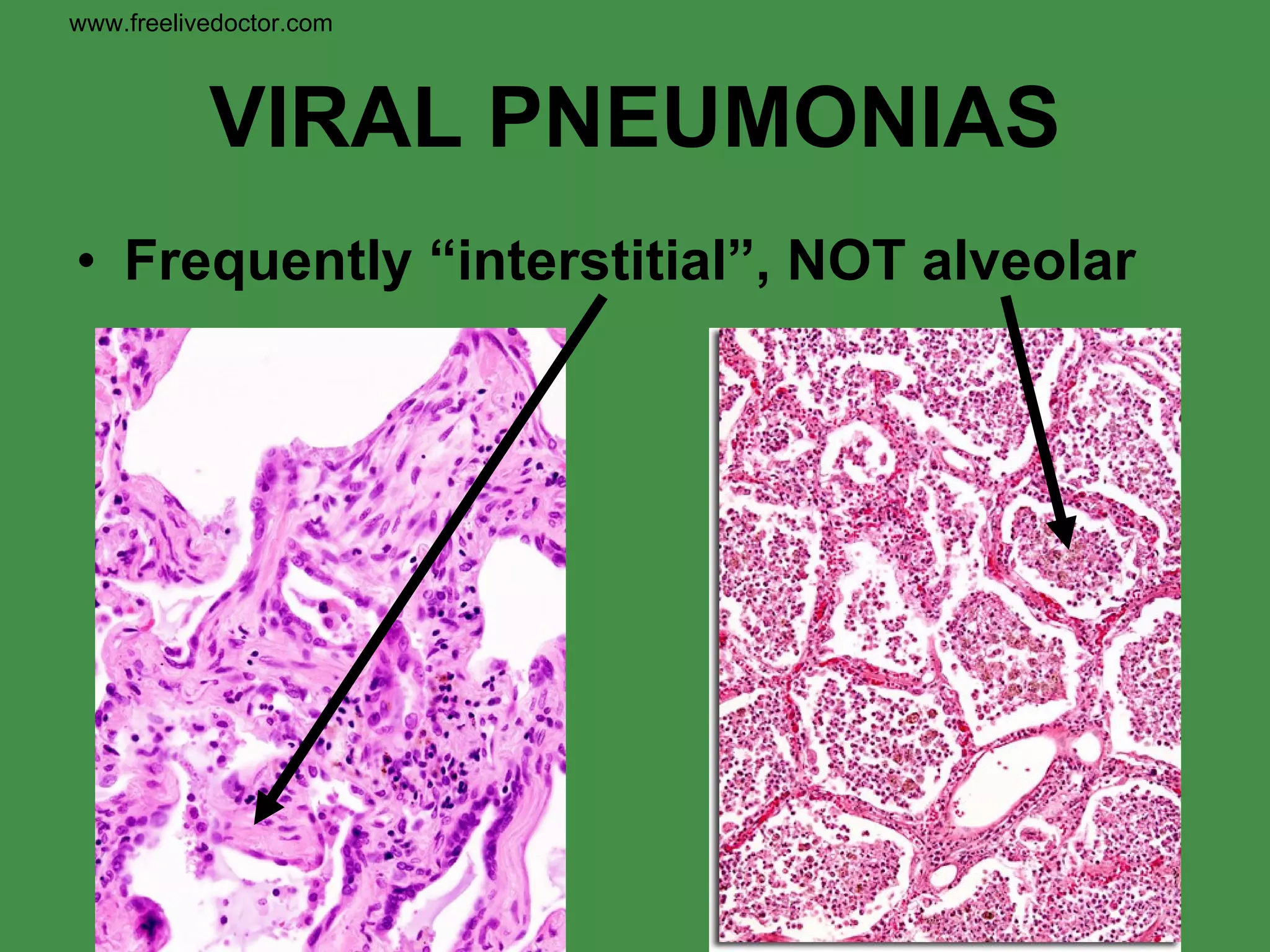
VIRAL PNEUMONIAS Frequently “interstitial”, NOT alveolar www.freelivedoctor.com
INFLUENZA VIRUS A,B,C 1915, 1918, PAN-demics, type A Has MUTATED throughout history, many STRAINS, avian swine, etc. B and C in children Exact strains can be ID’s by PCR www.freelivedoctor.com
www.freelivedoctor.com
SARS   (Severe Acute Respiratry Syndrome) CORONA-VIRUS 2002 China outbreak Spread CHIEFLY in Asia Like most other NON-bacterial pneumonias confirmed by PCR Like most viral pneumonias, interstitium infiltrated, some giant cells often present www.freelivedoctor.com
S A R S www.freelivedoctor.com
Classifications of PNEUMONIAS COMMUNITY ACQUIRED COMMUNITY ACQUIRED,   ATYPICAL NOSOCOMIAL ASPIRATION CHRONIC NECROTIZING/ABSCESS FORMATION PNEUMONIAS in  IMMUNOCOMPROMISED HOSTS www.freelivedoctor.com
NOSOCOMIAL Acquired in HOSPITALS, also called “hospital acquired”, versus “community acquired” pneumonias. DEBILITATION CATHETERS, VENTILATORS ENTEROBACTER, PSEUDOMONAS STAPH (MRSA) MRSA (MR=Methicillin  R esistant) OTHER Common causes of Noso. Pneum. P. aeruginosa Klebsiella E. coli S. pneumoniae H. influenzae   www.freelivedoctor.com
Classifications of PNEUMONIAS COMMUNITY ACQUIRED COMMUNITY ACQUIRED,   ATYPICAL NOSOCOMIAL ASPIRATION CHRONIC (often granulomatous) NECROTIZING/ABSCESS FORMATION PNEUMONIAS in IMMUNOCOMPROMISED HOSTS www.freelivedoctor.com
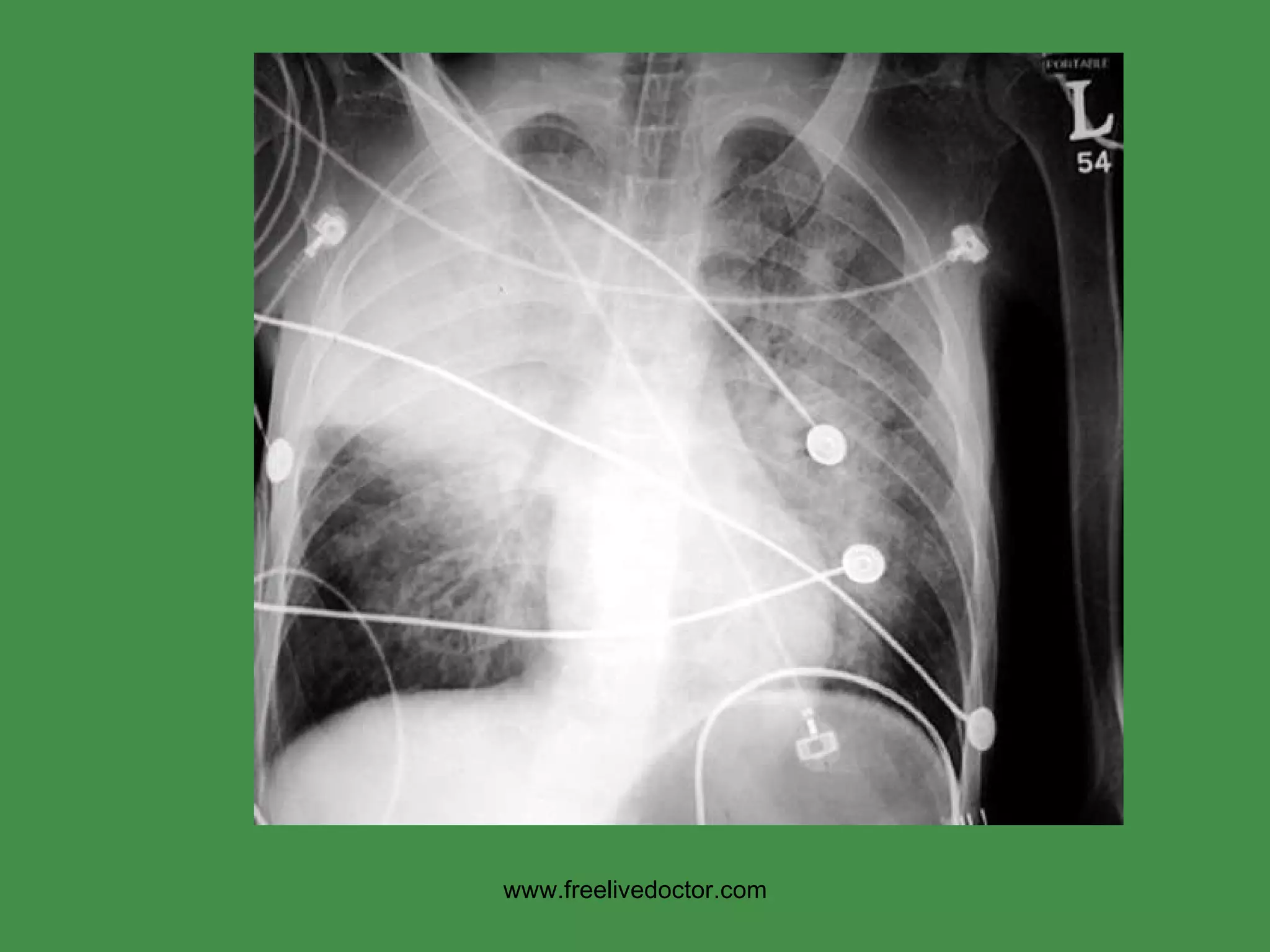
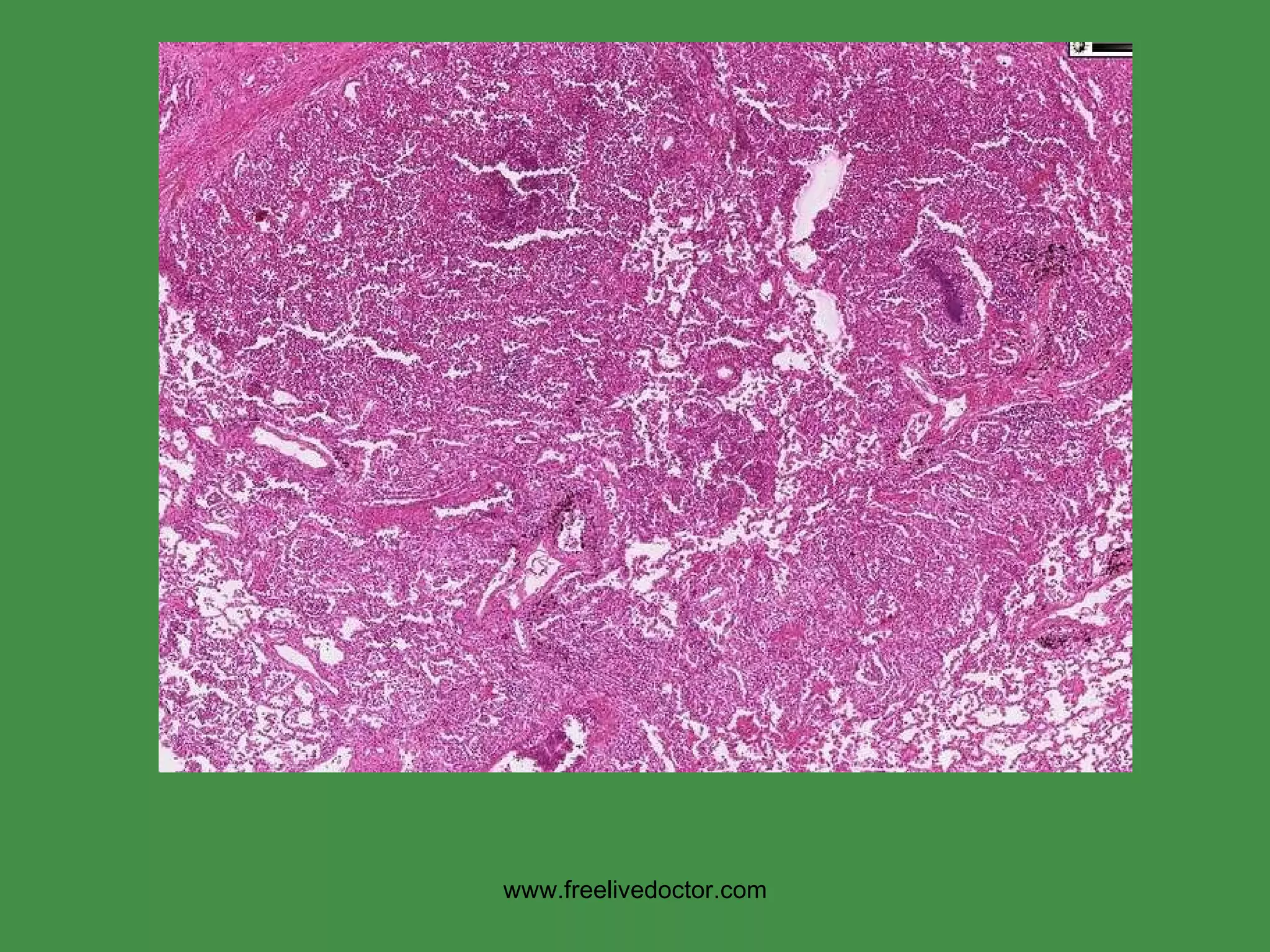
ASPIRATION PNEUMONIAS UNCONSCIOUS PATIENTS PATIENTS IN PROLONGED BEDREST LACK OF ABILITY TO SWALLOW OR GAG USUALLY CAUSED BY ASPIRATION OF GASTRIC CONTENTS POSTERIOR LOBES (gravity dependent) MOST COMMONLY INVOLVED, ESPECIALLY THE SUPERIOR SEGMENTS of the LOWER LOBES Often lead to  ABSCESSES www.freelivedoctor.com
www.freelivedoctor.com
LUNG ABSCESSES ASPIRATION SEPTIC EMBOLIZATION NEOPLASIA From NEIGHBORING structures: ESOPHAGUS SPINE PLEURA DIAPHRAGM ANY pneumonia which is severe and destructive, and UN-treated enough www.freelivedoctor.com
www.freelivedoctor.com
Classifications of PNEUMONIAS COMMUNITY ACQUIRED COMMUNITY ACQUIRED,   ATYPICAL NOSOCOMIAL ASPIRATION CHRONIC NECROTIZING/ABSCESS FORMATION PNEUMONIAS in IMMUNOCOMPROMISED HOSTS www.freelivedoctor.com
CHRONIC Pneumonias USUALLY NOT persistences of the community or nosocomial bacterial infections, but CAN BE, at least histologically Often SYNONYMOUS with the 4 classic fungal or  granulomatous  pulmonary infections infections, i.e., TB, Histo-, Blasto-, Coccidio- If you see pulmonary granulomas, think of a CHRONIC process, often years www.freelivedoctor.com
CHRONIC Pneumonias TB HISTO-PLASMOSIS BLASTO-MYCOSIS COCCIDIO-MYCOSIS www.freelivedoctor.com
HISTOPLASMOSIS Spores in bird or bat droppings Mimics TB  Histoplasma CAPSULATUM Pulmonary granulomas, often large and calcified Tiny organisms live in macrophages Ohio, Mississippi valley MANY other organs can be affected www.freelivedoctor.com
www.freelivedoctor.com
BLASTOMYCOSIS Spores in soil Mimics TB, like ALL the granulomatous lung dideases do.  Blastomyces DERMATIDIS Pulmonary granulomas, often large and calcified Large distinct SPHERULES Ohio, Mississippi valley, Great Lakes, WORLDWIDE MANY other organs can be affected,  especially SKIN www.freelivedoctor.com
COCCIDIOMYCOSIS Spores in soil Mimics TB  Coccidioides IMMITIS Pulmonary granulomas, often large and calcified Tiny organisms live in macrophages American SOUTHWEST MANY other organs can be affected www.freelivedoctor.com
GRANULOMA www.freelivedoctor.com
COMPROMISED HOSTS PNEUMOCYSTIS CARINII CYTOMEGALOVIRUS (CMV) FUNGI www.freelivedoctor.com
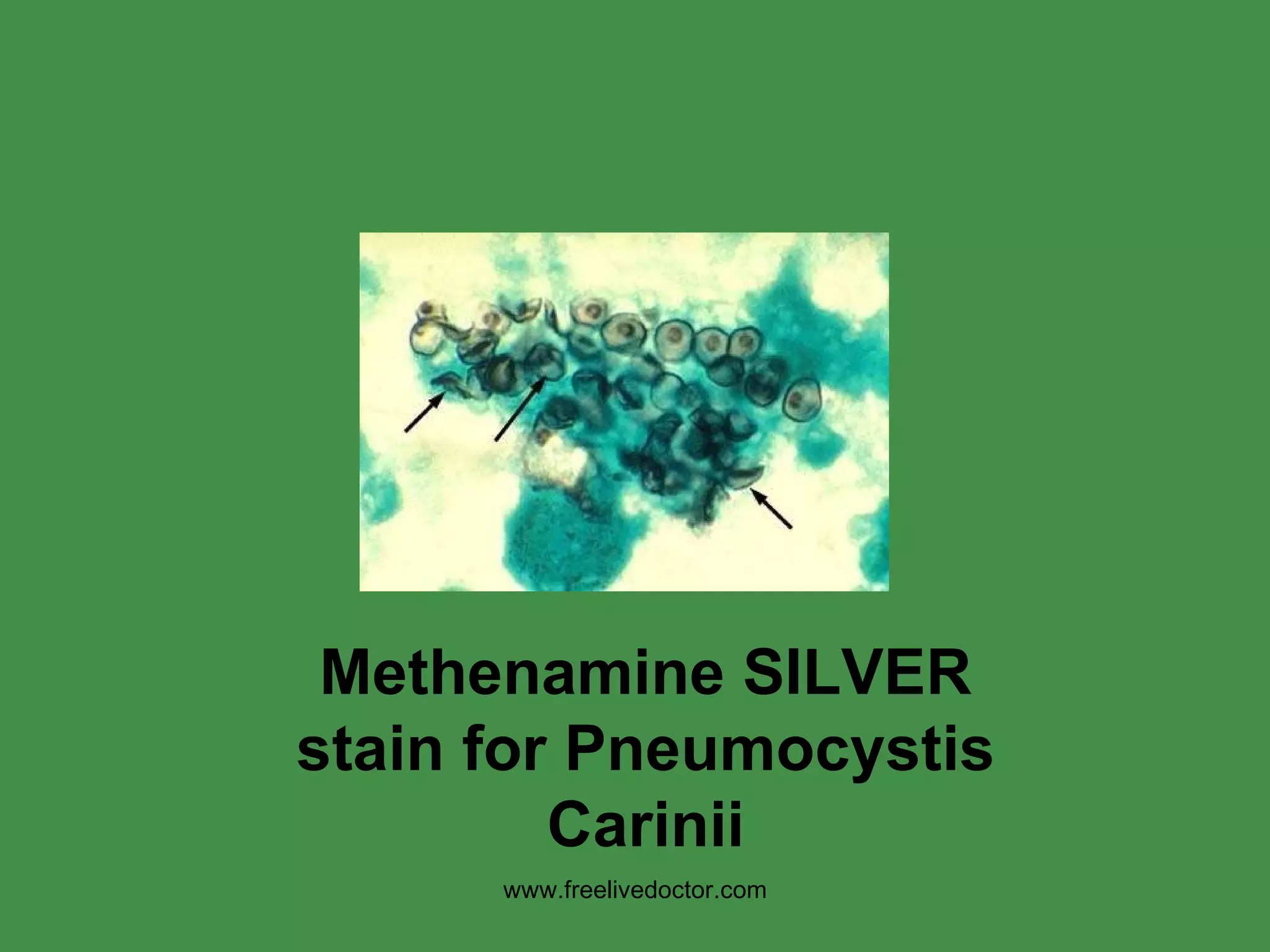
PCP www.freelivedoctor.com
Methenamine SILVER stain for Pneumocystis Carinii www.freelivedoctor.com
LUNG TRANSPLANTATION EMPHYSEMA Pulmonary Fibrosis Cystic Fibrosis Pulmonary Hypertension Any end-stage lung disease in which the patient can tolerate long term immunosuppression, and often just ONE lung is enough, donors very SCARCE! www.freelivedoctor.com
Lung Transplant Pathology  Infections (immunocompromised patients) Bacterial Viral (CMV) Fungal PCP ACUTE rejection, pneumonias, usually weeks to months CHRONIC rejection, HALF of all patients by 3-5 years, “bronchiolitis obliterans” www.freelivedoctor.com
www.freelivedoctor.com
LUNG TUMORS Benign, malignant, epithelial, mesenchymal, but 90% are CARCINOMAS BIGGEST USA killer. Why? Ans: Prevalence not as high as prostate or breast but mortality higher. Only 15%  5 year survival. TOBACCO  has polycyclic aromatic hydrocarbons, such as benzopyrene, anthracenes, radioactive isotopes Radiation, asbestos, radon C-MYC, K-RAS, EGFR, HER-2/neu www.freelivedoctor.com
PATHOGENESIS NORMAL BRONCHIAL MUCOSA METAPLASTIC/DYSPLASTIC MUCOSA CARCINOMA-IN-SITU (squamous, adeno) INFILTRATING (i.e., “INVASIVE”) cancer www.freelivedoctor.com
TWO TYPES NON-SMALL CELL SQUAMOUS CELL CARCINOMA ADENOCARCINOMA LARGE CELL CARCINOMA SMALL CELL CARCINOMA www.freelivedoctor.com
The BIG list Squamous cell carcinoma Small cell carcinoma Combined small cell carcinoma   Adenocarcinoma: Acinar, papillary, bronchioloalveolar, solid, mixed subtypes Large cell carcinoma Large cell neuroendocrine carcinoma Adenosquamous carcinoma Carcinomas with pleomorphic, sarcomatoid, or sarcomatous elements Carcinoid tumor: Typical, atypical   Carcinomas of salivary gland type Unclassified carcinoma www.freelivedoctor.com
OTHER TUMORS www.freelivedoctor.com
www.freelivedoctor.com
TNM, Lung www.freelivedoctor.com T1 Tumor <3 cm without pleural or main stem bronchus involvement T2 Tumor >3 cm or involvement of main stem bronchus 2 cm from carina, visceral pleural involvement, or lobar atelectasis T3 Tumor with involvement of chest wall (including superior sulcus tumors), diaphragm, mediastinal pleura, pericardium, main stem bronchus 2 cm from carina, or entire lung atelectasis T4 Tumor with invasion of mediastinum, heart, great vessels, trachea, esophagus, vertebral body, or carina or with a malignant pleural effusion N0 No demonstrable metastasis to regional lymph nodes N1 Ipsilateral hilar or peribronchial nodal involvement N2 Metastasis to ipsilateral mediastinal or subcarinal lymph nodes N3 Metastasis to contralateral mediastinal or hilar lymph nodes, ipsilateral or contralateral scalene, or supraclavicular lymph nodes M0 No (known) distant metastasis M1 Distant metastasis present
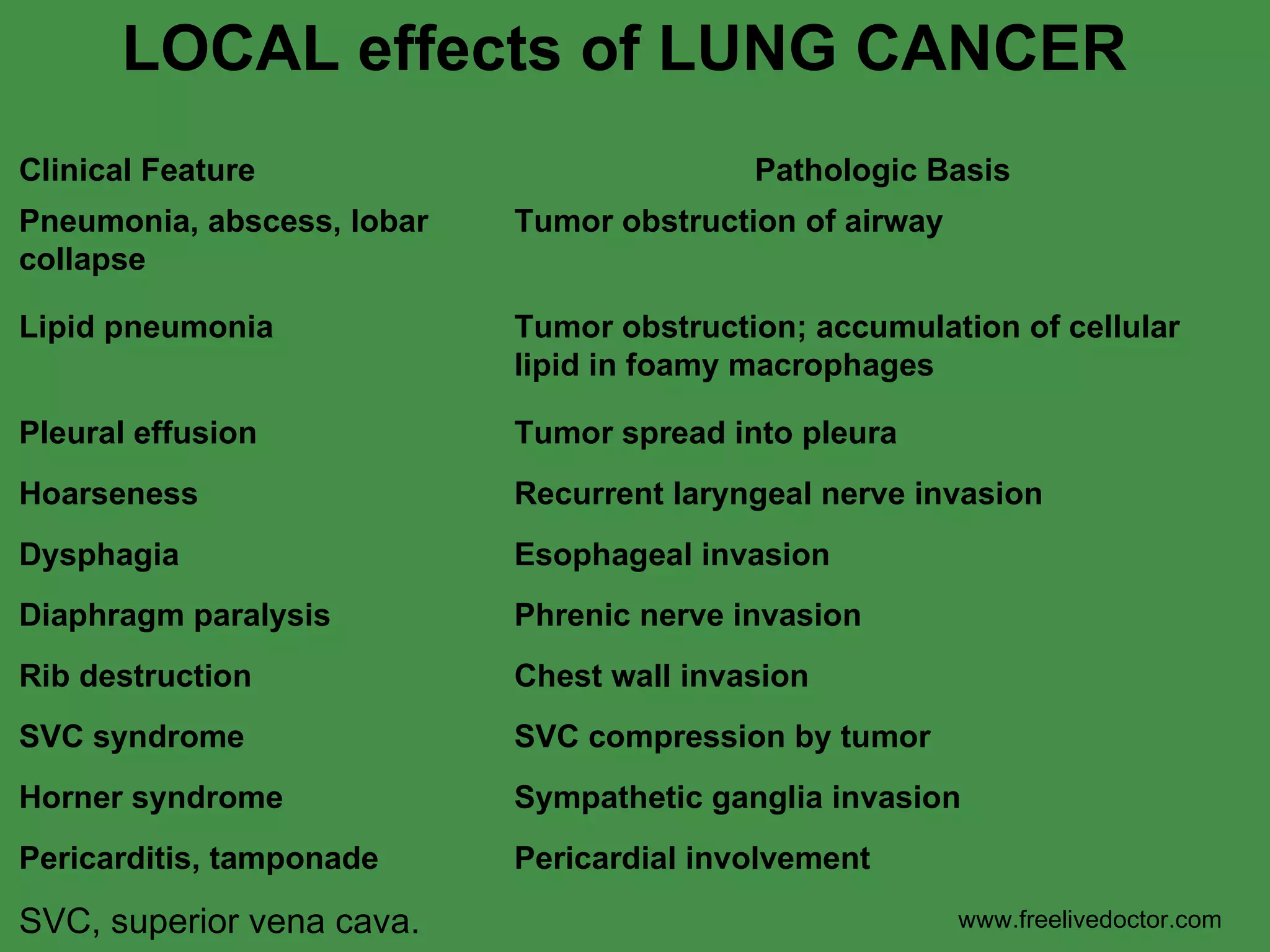
LOCAL effects of LUNG CANCER www.freelivedoctor.com Clinical Feature Pathologic Basis Pneumonia, abscess, lobar collapse Tumor obstruction of airway Lipid pneumonia Tumor obstruction; accumulation of cellular lipid in foamy macrophages Pleural effusion Tumor spread into pleura Hoarseness Recurrent laryngeal nerve invasion Dysphagia Esophageal invasion Diaphragm paralysis Phrenic nerve invasion Rib destruction Chest wall invasion SVC syndrome SVC compression by tumor Horner syndrome Sympathetic ganglia invasion Pericarditis, tamponade Pericardial involvement SVC, superior vena cava.
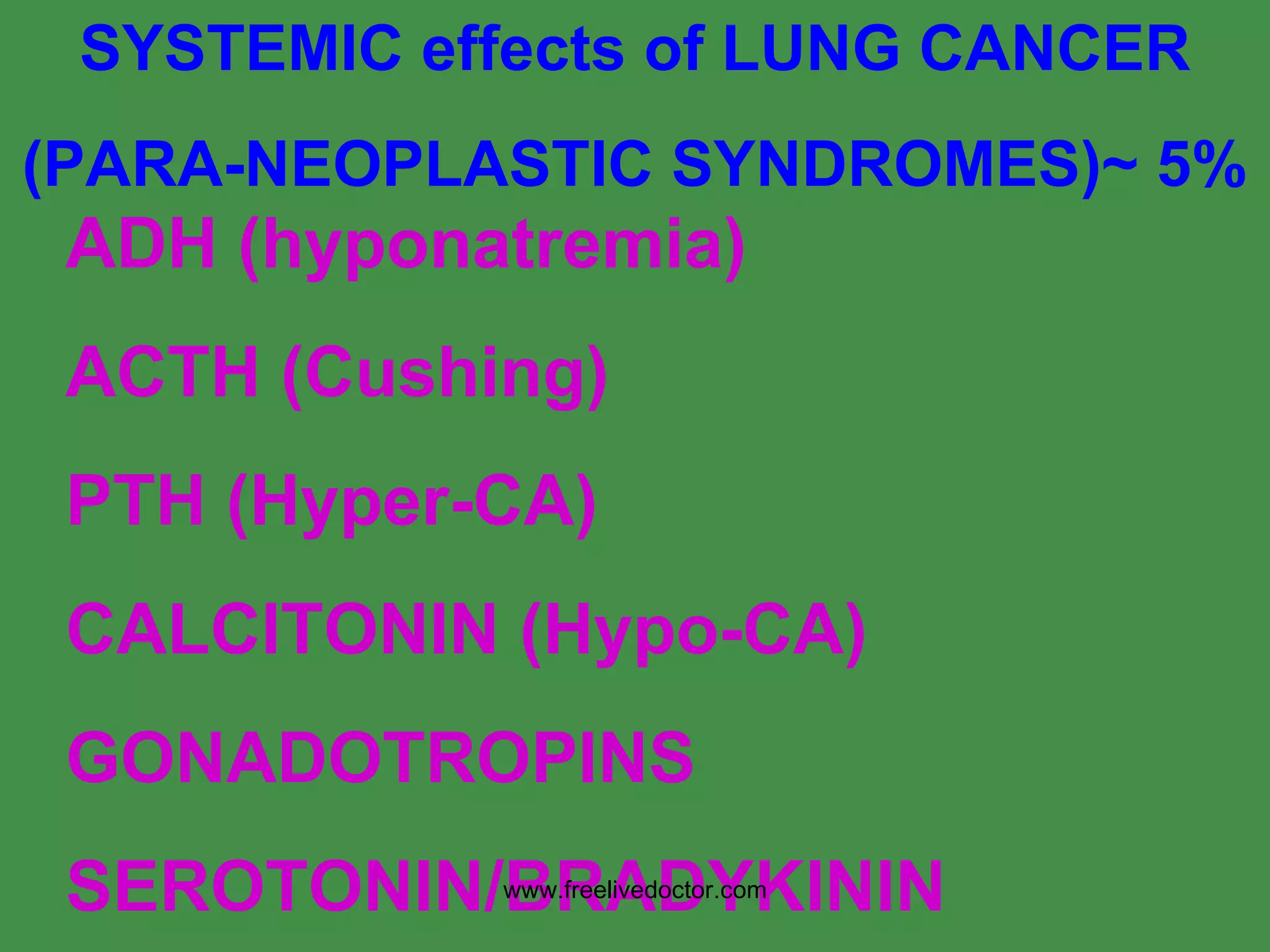
SYSTEMIC effects of LUNG CANCER (PARA-NEOPLASTIC SYNDROMES)~ 5% ADH (hyponatremia) ACTH (Cushing) PTH (Hyper-CA) CALCITONIN (Hypo-CA) GONADOTROPINS SEROTONIN/BRADYKININ www.freelivedoctor.com
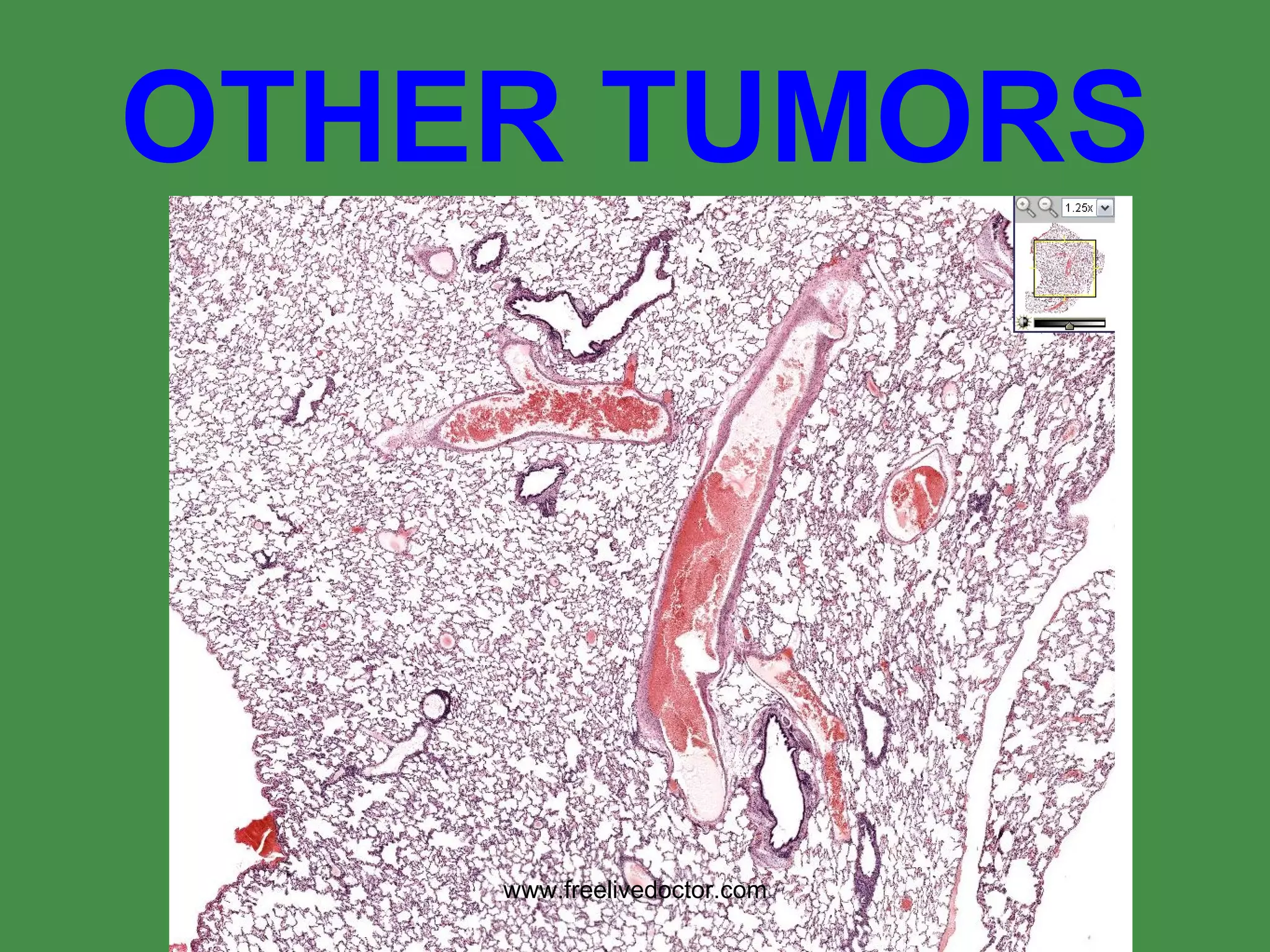
OTHER TUMORS www.freelivedoctor.com
METASTATIC TUMORS LUNG is the  MOST COMMON  site for all metastatic tumors, regardless of site of origin It is the site of  FIRST CHOICE for metastatic sarcomas  for purely anatomic reasons! www.freelivedoctor.com
PLEURA PLEURITIS PNEUMOTHORAX EFFUSIONS HYDRO-THORAX (Peric-, Perito-) HEMO-THORAX (Peric-, Perito-) CHYLO-THORAX (Peric-, Perito-) MESOTHELIOMAS www.freelivedoctor.com
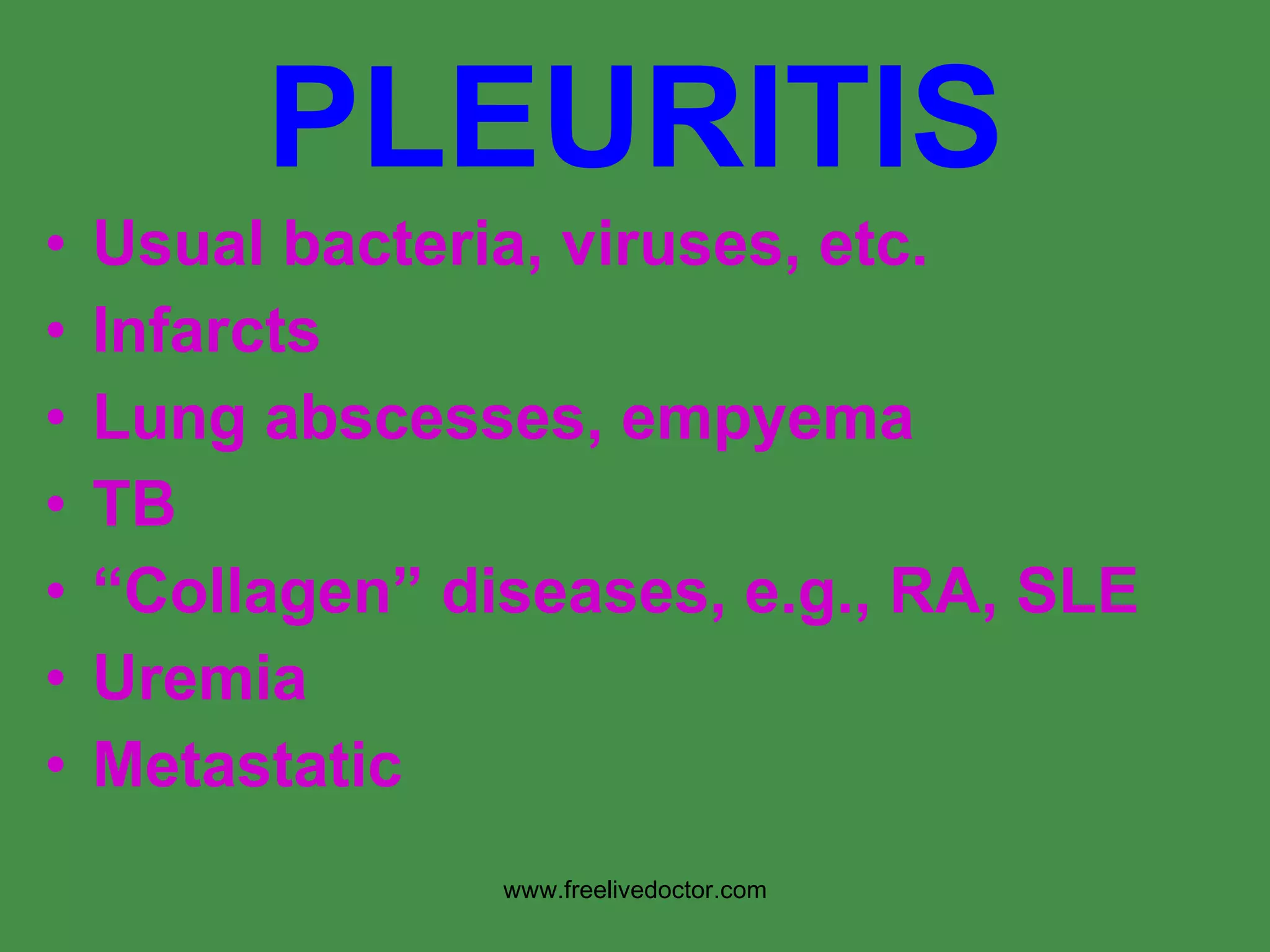
PLEURITIS Usual bacteria, viruses, etc. Infarcts Lung abscesses, empyema TB “ Collagen” diseases, e.g., RA, SLE Uremia Metastatic www.freelivedoctor.com
PNEUMOTHORAX SPONTANEOUS, TRAUMATIC, THERAPEUTIC OPEN or CLOSED “ TENSION” pneumothorax, “valvular” effect “ Bleb” rupture Perforating injuries Post needle biopsy www.freelivedoctor.com
EFFUSIONS TRANSUDATE (HYDROTHORAX) EXUDATE (HYDROTHORAX) BLOOD (HEMOTHORAX) LYMPH (CHYLOTHORAX) www.freelivedoctor.com
MESOTHELIOMAS “ Benign” vs. “Malignant” differentiation does not matter, but a self limited localized nodule can be regarded as benign, and a spreading tumor can be regarded as malignant Visceral or parietal pleura, pericardium, or peritoneum Most are regarded as asbestos caused or asbestos “related” www.freelivedoctor.com
www.freelivedoctor.com
   EM H&E, IMMUNOCHEMISTRY www.freelivedoctor.com

Pulmonary pathology

  • 1.
  • 2.
    LUNG “ Degenerative”Inflammatory Neoplastic and Pleura LAB: (Review, Cases, and/or Virtual Microscopy) www.freelivedoctor.com
  • 3.
    OVERVIEW Normal Anatomyand Histology Pathology Congenital Atalectasis Acute Pulmonary Injury Obstructive vs. Restrictive (infiltrative) concepts O bstructive P ulmonary D isease (C OPD ) Restrictive (Infiltrative) Pulmonary Disease Vascular Pulmonary Diseases www.freelivedoctor.com
  • 4.
    OVERVIEW INFECTIONS NEOPLASMS and PLEURA (effusions, pneumothorax, tumors) www.freelivedoctor.com
  • 5.
    WEIGHT LOBES SEGMENTSBRONCHI ARTERIES, pulmonary ARTERIES, bronchial VEINS PLEURA, visceral PLEURA, parietal NERVES www.freelivedoctor.com
  • 6.
    Bronchi Bronchioles Terminalbronchioles Alveolar ducts Alveoli Type 1 pneumocytes Type 2 pneumocytes Macrophages Capillaries www.freelivedoctor.com
  • 7.
  • 8.
  • 9.
  • 10.
    Pathology CONGENITAL AtalectasisAcute Pulmonary Injury Obstructive vs. Restrictive (infiltrative) concepts O bstructive P ulmonary D isease (C OPD ) Restrictive (Infiltrative) Pulmonary Disease Vascular Pulmonary Diseases www.freelivedoctor.com
  • 11.
    CONGENITAL Agenesis/Hypoplasia Tracheal/bronchialanomalies, i.e., Tracheo-Esophageal (TE) fistula Vascular anomalies Congenital Emphysema Foregut cysts Pulmonary Artery Malformations (CPAM) Sequestration (no connection to airways) www.freelivedoctor.com
  • 12.
  • 13.
    OVERVIEW Pathology CongenitalATALECTASIS Acute Pulmonary Injury Obstructive vs. Restrictive (infiltrative) concepts O bstructive P ulmonary D isease (C OPD ) Restrictive Pulmonary Disease Vascular Pulmonary Diseases www.freelivedoctor.com
  • 14.
    ATALECTASIS INCOMPLETE EXPANSIONCOLLAPSE www.freelivedoctor.com
  • 15.
    OVERVIEW Pathology CongenitalAtalectasis ACUTE PULMONARY INJURY Pulmonary Edema ARDS ( D iffuse A lveolar D amage) Acute Interstitial Pneumonia Obstructive vs. Restrictive (infiltrative) concepts O bstructive P ulmonary D isease (C OPD ) Restrictive (Infiltrative) Pulmonary Disease Vascular Pulmonary Diseases www.freelivedoctor.com
  • 16.
    PULMONARY EDEMA IN-creasedvenous pressure DE-creased oncotic pressure Lymphatic obstruction Alveolar injury www.freelivedoctor.com
  • 17.
    ACUTE RESPIRATORY DISTRESSSYNDROME (ARDS or D.A.D., i.e., Diffuse Alveolar damage) (aka, “SHOCK” lung) NON-specific pattern of lung injury INFECTION PHYSICAL INJURY TOXIC CHEMICAL DIC ETC www.freelivedoctor.com
  • 18.
  • 19.
    ACUTE INTERSTITIAL PNEUMONIAThink of it as ARDS with NO known etiology! www.freelivedoctor.com
  • 20.
    OVERVIEW Pathology CongenitalAtalectasis Acute Pulmonary Injury OBSTRUCTION vs. RESTRICTION O bstructive P ulmonary D isease (C OPD ) Restrictive (Infiltrative) Pulmonary Disease Vascular Pulmonary Diseases www.freelivedoctor.com
  • 21.
    OBSTRUCTION v. RESTRICTIONOBSTRUCTION Air or blood? Large or small? Inspiration or Expiration? Obstruction is SMALL AIRWAY EXPIRATION obstruction, i.e., wheezing HYPEREXPANSION on CXR RESTRICTION “ Compliance” “ Infiltrative” REDUCED lung VOLUME, DYSPNEA, CYANOSIS REDUCED GAS TRANSFER “ GROUND GLASS” on CXR www.freelivedoctor.com
  • 22.
    OVERVIEW Pathology CongenitalAtalectasis Acute Pulmonary Injury Obstruction vs. Restriction OBSTRUCTIVE Pulmonary Diseases (COPD) Restrictive (Infiltrative) Pulmonary Disease Vascular Pulmonary Diseases www.freelivedoctor.com
  • 23.
    OBSTRUCTION (cOPD) EMPHYSEMA (almost always chronic) CHRONIC BRONCHITIS  emphysema ASTHMA BRONCHIECTASIS www.freelivedoctor.com
  • 24.
    EMPHYSEMA COPD, or“END-STAGE” lung disease Centri-acinar, Pan-acinar, Paraseptal, Irregular Like cirrhosis, thought of as END-STAGE of multiple chronic small airway obstructive etiologies NON-specific IN-creased crepitance, BULLAE (BLEBS) Clinically linked to recurrent pneumonias, and progressive failure www.freelivedoctor.com
  • 25.
  • 26.
    www.freelivedoctor.com Bullae, or“peripheral blebs” are hallmarks of chronic obstructive lung disease, COPD.
  • 27.
    HYPER-expansion 2)“flattened” diaphragms (blunted), 3) “bullae” 4) increased lucency www.freelivedoctor.com
  • 28.
    CHRONIC BRONCHITIS INHALANTS,POLLUTION, CIGARETTES CHRONIC COUGH CAN OFTEN PROGRESS TO EMPHYSEMA MUCUS hypersecretion, early, i.e. goblet cell increase CHRONIC bronchial inflammatory infiltrate www.freelivedoctor.com
  • 29.
    ASTHMA Similar tochronic bronchitis but: Wheezing is hallmark (bronchospasm, i.e. “wheezing”) STRONG allergic role, i.e., eosinophils, IgE, allergens Often starting in CHILDHOOD ATOPIC (allergic) or NON-ATOPIC (infection) Chronic small airway obstruction and infection 1) Mucus hypersecretion with plugging, 2) lymphocytes/eosinophils, 3) lumen narrowing, 4) smooth muscle hypertrophy www.freelivedoctor.com
  • 30.
    www.freelivedoctor.com Note theheavy inflammatory cell infiltrate around bronchioles and small bronchi.
  • 31.
    What are the4 classical histologic findings in bronchial asthma? www.freelivedoctor.com
  • 32.
    BRONCHIECTASIS DILATATION ofthe BRONCHUS, associated with, often, necrotizing inflammation CONGENITAL TB , other bacteria, many viruses BRONCHIAL OBSTRUCTION (i.e., LARGE AIRWAY, NOT SMALL AIRWAY) Rheumatoid Arthritis, SLE, IBD (Inflammatory Bowel Disease) www.freelivedoctor.com
  • 33.
  • 34.
    OVERVIEW Pathology CongenitalAtalectasis Acute Pulmonary Injury Obstruction vs. Restriction Obstructive Pulmonary Diseases (COPD) RESTRICTIVE (INFILTRATIVE) PULMONARY DISEASES Vascular Pulmonary Diseases www.freelivedoctor.com
  • 35.
    RESTRICTIVE (INFILTRATIVE) REDUCEDCOMPLIANCE, reduced gas exchange) Are also DIFFUSE HETEROGENEOUS FIBROSING GRANULOMATOUS EOSINOPHILIC SMOKING RELATED PAP [Pulmonary Alveolar Proteinosis] www.freelivedoctor.com
  • 36.
    FIBROSING “ IDIOPATHIC”PULMONARY FIBROSIS (IPF) NONSPECIFIC INTERSTITIAL FIBROSIS “ CRYPTOGENIC” ORGANIZING PNEUMONIA “ COLLAGEN” VASCULAR DISEASES PNEUMOCONIOSES DRUG REACTIONS RADIATION CHANGES www.freelivedoctor.com
  • 37.
    IPF (UIP) IDIOPATHIC,i.e., not from any usual caused, like lupus, scleroderma FIBROSIS www.freelivedoctor.com
  • 38.
    NON-SPECIFIC INTERSTITIAL PNEUMONIAWASTEBASKET DIAGNOSIS, of ANY pneumonia (pneumonitis) of any known or unknown etiology FIBROSIS CELLULAR INFILTRATE (LYMPHS & PLASMA CELLS) www.freelivedoctor.com
  • 39.
    CRYPTOGENIC ORGANIZING PNEUMONIA(COP) IDIOPATHIC “ BRONCHIOLITIS OBLITERANS” www.freelivedoctor.com
  • 40.
    “ COLLAGEN” VASCULARDISEASES Rheumatoid Arthritis SLE (“Lupus”) Progressive Systemic Sclerosis (Scleroderma) www.freelivedoctor.com
  • 41.
    PNEUMOCONIOSES “ OCCUPATIONAL”“ COAL MINERS LUNG” DUST OR CHEMICALS OR ORGANIC MATERIALS Coal (anthracosis) Silica Asbestos Be, FeO, BaSO4, CHEMO HAY, FLAX, BAGASSE, INSECTICIDES, etc. www.freelivedoctor.com
  • 42.
    GRANULOMATOUS SARCOIDOSIS ,i.e., NON-caseating granulomas (IDIOPATHIC) HYPERSENSITIVITY (DUSTS, bacteria, fungi, Farmer’s Lung, Pigeon Breeder’s Lung) www.freelivedoctor.com
  • 43.
    SARCOIDOSIS Mainly LUNG,but eye, skin or ANYWHERE UNKNOWN ETIOLOGY IMMUNE, GENETIC factors F>>M B>>W YOUNG ADULT BLACK WOMEN www.freelivedoctor.com
  • 44.
    NON-Caseating Granulomas arethe RULE “ Asteroid” bodies within these granulomas are virtually diagnostic www.freelivedoctor.com
  • 45.
  • 46.
    SMOKING RELATED DIP(Desquamative Interstitial Pneumonia) M>>F CIGARETTES 100% Survival Alveolar Macrophages www.freelivedoctor.com
  • 47.
    PAP (Pulmonary AlveolarProteinosis) Very RARE, usually acquired Proteinaceous Material in Alveoli MINIMAL cellular infiltrate Like Pulmonary Edema, but MUCH Protein www.freelivedoctor.com
  • 48.
    OVERVIEW Pathology CongenitalAtalectasis Acute Pulmonary Injury Obstruction vs. Restriction Obstructive Pulmonary Diseases (COPD) Restrictive (Infiltrative) Pulmonary Diseases VASCULAR PULMONARY DISEASES www.freelivedoctor.com
  • 49.
    VASCULAR PULMONARY DISEASESPULMONARY EMBOLISM (with or usually WITHOUT infarction) PULMONARY HYPERTENSION , leading to cor pulmonale HEMORRHAGIC SYNDROMES GOODPASTURE SYNDROME HEMOSIDEROSIS , idiopathic WEGENER GRANULOMATOSIS www.freelivedoctor.com
  • 50.
    P.E. Usually secondaryto debilitated states with immobilization, or following surgery Usually deep leg and deep pelvic veins (DVT), NOT superficial veins Follows Virchow’s triad, i.e., 1) flow problems, 2) endothelial disruption, 3) hypercoagulabilty Usually do NOT infarct, usually ventilate When they DO infarct, the infarct is hemorrhagic Decreased PO2, acute chest pain, V/Q MIS-match DX: Chest CT, V/Q scan, angiogram RX: short term heparin, then long term coumadin www.freelivedoctor.com
  • 51.
    PULMONARY HYPERTENSION COPD,C”I”PD (vicious cycle) CHD (Congenital HD, increased left atrial pressure) Recurrent PEs Autoimmune, e.g., PSS (Scleroderma), i.e., fibrotic pulmonary vasculature www.freelivedoctor.com
  • 52.
    VERY thickened arteriolein pulmonary hypertension NORMAL pulmonary arteriole www.freelivedoctor.com
  • 53.
    HEMORRHAGIC SYNDROMES GOODPASTURESyndrome: Ab’s to the alpha-3 chains of collagen IV, GBM deposits too! IDIOPATHIC PULMONARY HEMOSIDEROSIS, to be differentiated from chronic CHF WEGENER GRANULOMATOSIS www.freelivedoctor.com
  • 54.
    CHF, CHRONICIDIOPATHIC PULMONARY HEMOSIDEROSIS www.freelivedoctor.com
  • 55.
  • 56.
      COMM UNITY-ACQUIREDBACTERIAL ACUTE PNEUMONIAS Streptococcus Pneumoniae Haemophilus Influenzae Moraxella Catarrhalis Staphylococcus Aureus Klebsiella Pneumoniae Pseudomonas Aeruginosa Legionella Pneumophila COMMUNITY-ACQUIRED ATYPICAL (VIRAL AND MYCOPLASMAL) PNEUMONIAS Morphology. Clinical Course. Influenza Infections Severe Acute Respiratory Syndrome (SARS) NOSOCOMIAL PNEUMONIA ASPIRATION PNEUMONIA LUNG ABSCESS Etiology and Pathogenesis. CHRONIC PNEUMONIA Histoplasmosis, Morphology Blastomycosis, Morphology Coccidioidomycosis, Morphology PNEUMONIA IN THE IMMUNOCOMPROMISED HOST PULMONARY DISEASE IN HUMAN IMMUNODEFICIENCY VIRUS INFECTION PULMONARY INFECTIONS www.freelivedoctor.com
  • 57.
    BASIC CONSIDERATIONS PNEUMONIAvs. PNEUMONITIS DIFFERENTIATION from INJURIES, OBSTRUCTIVE DISEASES, RESTRICTIVE DISEASES, VASCULAR DISEASES DIFFERENTIATION FROM NEOPLASMS CLASSICAL STAGES of INFLAMMATION LOBAR- vs. BRONCHO- INTERSTITIAL vs. ALVEOLAR COMMUNITY vs. NOSOCOMIAL ETIOLOGIC AGENTS vs. HOST IMMUNITY 2 PRESENTING SYMPTOMS 2 DIAGNOSTIC METHODS ANY ORGANISM CAN CAUSE PNEUMONIA!!! www.freelivedoctor.com
  • 58.
    PREDISPOSING FACTORS LOSSOF COUGH REFLEX DIMINISHED MUCIN or CILIA FUNCTION ALVEOLAR MACROPHAGE INTERFERENCE VASCULAR FLOW IMPAIRMENTS BRONCHIAL FLOW IMPAIRMENTS www.freelivedoctor.com
  • 59.
    Although pneumonia isone of the most common causes of death, it usually does NOT occur in healthy people spontaneously www.freelivedoctor.com
  • 60.
    Classifications of PNEUMONIASCOMMUNITY ACQUIRED COMMUNITY ACQUIRED, ATYPICAL NOSOCOMIAL ASPIRATION CHRONIC NECROTIZING/ABSCESS FORMATION PNEUMONIAS in IMMUNOCOMPROMISED HOSTS www.freelivedoctor.com
  • 61.
    Classifications of PNEUMONIASCOMMUNITY ACQUIRED COMMUNITY ACQUIRED, ATYPICAL NOSOCOMIAL ASPIRATION CHRONIC NECROTIZING/ABSCESS FORMATION PNEUMONIAS in IMMUNOCOMPROMISED HOSTS www.freelivedoctor.com
  • 62.
    COMMUNITY ACQUIRED STREPTOCOCCUSPNEUMONIAE (i.e., “diplococcus”) HAEMOPHILUS INFLUENZAE (“H-Flu”) MORAXELLA STAPHYLOCOCCUS (STAPH) KLEBSIELLA PNEUMONIAE PSEUDOMONAS AERUGINOSA LEGIONELLA PNEUMOPHILIA www.freelivedoctor.com
  • 63.
    STREPTOCOCCUS The classicLOBAR pneumonia Normal flora in 20% of adults Only 20% of victims have + blood cultures “ Penicillins” are often 100% curative Vaccines are often 100% preventive www.freelivedoctor.com
  • 64.
    HAEMOPHILUS PNEUMONIA Commonestin CHILDREN <2, with otitis, URI, meningitis, cellulitis, osteomyelitis PNEUMONIAS in CHILDREN <2 are often thought of as being H Flu until proven otherwise, otitis, meningitis too Most common pneumonia from COPD in adults BACTRIM (Trimethoprim-Sulfa) most common treatment www.freelivedoctor.com
  • 65.
    MORAXELLA CATARRHALIS 2ndmost common COPD pneumonia, after haemophilus Gram NEGATIVE coccobacillus www.freelivedoctor.com
  • 66.
    STAPH aureus Mostcommon pneumonia following viral pneumonias M.R.S.A., of course, is usually NOT “community” acquired www.freelivedoctor.com
  • 67.
    KLEBSIELLA PNEUMONIAE DEBILITATEDMALNOURISHED PEOPLE ALCOHOLICS with pneumonia are often thought of as having Klebsiella until proven otherwise www.freelivedoctor.com
  • 68.
    PSEUDOMONAS Aeruginosa UsuallyNOT community acquired but nosocomial CYSTIC FIBROSIS patients with pneumonia are presumed to have PSEUDOMONAS until proven otherwise www.freelivedoctor.com
  • 69.
    LEGIONELLA (pneumophila)Often in OUTBREAKS Often LOBAR Spread by water “droplets” Often immunosuppressed patients, but remember……….. www.freelivedoctor.com
  • 70.
    Although pneumonia isone of the most common causes of death, it usually does NOT occur in healthy people spontaneously www.freelivedoctor.com
  • 71.
    MORPHOLOGY ACUTE ORGANIZINGCHRONIC FIBROSIS vs. FULL RESOLUTION “ HEPATIZATION”, RED vs. GREY CONSOLIDATION “ INFILTRATE ”, XRAY vs. HISTOPATH Loss of “CREPITANCE” www.freelivedoctor.com
  • 72.
    Classifications of PNEUMONIASCOMMUNITY ACQUIRED COMMUNITY ACQUIRED, ATYPICAL NOSOCOMIAL ASPIRATION CHRONIC NECROTIZING/ABSCESS FORMATION PNEUMONIAS in IMMUNOCOMPROMISED HOSTS www.freelivedoctor.com
  • 73.
    COMMUNITY ACQUIRED ,(atypical) VIRAL (INFLUENZA) MYCOPLASMAL (MYCOPLASMA PNEUMONIAE (obligate intracellular)) NOT BACTERIAL CULTURES NOT HELPFUL www.freelivedoctor.com
  • 74.
    VIRAL PNEUMONIAS Frequently“interstitial”, NOT alveolar www.freelivedoctor.com
  • 75.
    INFLUENZA VIRUS A,B,C1915, 1918, PAN-demics, type A Has MUTATED throughout history, many STRAINS, avian swine, etc. B and C in children Exact strains can be ID’s by PCR www.freelivedoctor.com
  • 76.
  • 77.
    SARS (Severe Acute Respiratry Syndrome) CORONA-VIRUS 2002 China outbreak Spread CHIEFLY in Asia Like most other NON-bacterial pneumonias confirmed by PCR Like most viral pneumonias, interstitium infiltrated, some giant cells often present www.freelivedoctor.com
  • 78.
    S A RS www.freelivedoctor.com
  • 79.
    Classifications of PNEUMONIASCOMMUNITY ACQUIRED COMMUNITY ACQUIRED, ATYPICAL NOSOCOMIAL ASPIRATION CHRONIC NECROTIZING/ABSCESS FORMATION PNEUMONIAS in IMMUNOCOMPROMISED HOSTS www.freelivedoctor.com
  • 80.
    NOSOCOMIAL Acquired inHOSPITALS, also called “hospital acquired”, versus “community acquired” pneumonias. DEBILITATION CATHETERS, VENTILATORS ENTEROBACTER, PSEUDOMONAS STAPH (MRSA) MRSA (MR=Methicillin R esistant) OTHER Common causes of Noso. Pneum. P. aeruginosa Klebsiella E. coli S. pneumoniae H. influenzae www.freelivedoctor.com
  • 81.
    Classifications of PNEUMONIASCOMMUNITY ACQUIRED COMMUNITY ACQUIRED, ATYPICAL NOSOCOMIAL ASPIRATION CHRONIC (often granulomatous) NECROTIZING/ABSCESS FORMATION PNEUMONIAS in IMMUNOCOMPROMISED HOSTS www.freelivedoctor.com
  • 82.
    ASPIRATION PNEUMONIAS UNCONSCIOUSPATIENTS PATIENTS IN PROLONGED BEDREST LACK OF ABILITY TO SWALLOW OR GAG USUALLY CAUSED BY ASPIRATION OF GASTRIC CONTENTS POSTERIOR LOBES (gravity dependent) MOST COMMONLY INVOLVED, ESPECIALLY THE SUPERIOR SEGMENTS of the LOWER LOBES Often lead to ABSCESSES www.freelivedoctor.com
  • 83.
  • 84.
    LUNG ABSCESSES ASPIRATIONSEPTIC EMBOLIZATION NEOPLASIA From NEIGHBORING structures: ESOPHAGUS SPINE PLEURA DIAPHRAGM ANY pneumonia which is severe and destructive, and UN-treated enough www.freelivedoctor.com
  • 85.
  • 86.
    Classifications of PNEUMONIASCOMMUNITY ACQUIRED COMMUNITY ACQUIRED, ATYPICAL NOSOCOMIAL ASPIRATION CHRONIC NECROTIZING/ABSCESS FORMATION PNEUMONIAS in IMMUNOCOMPROMISED HOSTS www.freelivedoctor.com
  • 87.
    CHRONIC Pneumonias USUALLYNOT persistences of the community or nosocomial bacterial infections, but CAN BE, at least histologically Often SYNONYMOUS with the 4 classic fungal or granulomatous pulmonary infections infections, i.e., TB, Histo-, Blasto-, Coccidio- If you see pulmonary granulomas, think of a CHRONIC process, often years www.freelivedoctor.com
  • 88.
    CHRONIC Pneumonias TBHISTO-PLASMOSIS BLASTO-MYCOSIS COCCIDIO-MYCOSIS www.freelivedoctor.com
  • 89.
    HISTOPLASMOSIS Spores inbird or bat droppings Mimics TB Histoplasma CAPSULATUM Pulmonary granulomas, often large and calcified Tiny organisms live in macrophages Ohio, Mississippi valley MANY other organs can be affected www.freelivedoctor.com
  • 90.
  • 91.
    BLASTOMYCOSIS Spores insoil Mimics TB, like ALL the granulomatous lung dideases do. Blastomyces DERMATIDIS Pulmonary granulomas, often large and calcified Large distinct SPHERULES Ohio, Mississippi valley, Great Lakes, WORLDWIDE MANY other organs can be affected, especially SKIN www.freelivedoctor.com
  • 92.
    COCCIDIOMYCOSIS Spores insoil Mimics TB Coccidioides IMMITIS Pulmonary granulomas, often large and calcified Tiny organisms live in macrophages American SOUTHWEST MANY other organs can be affected www.freelivedoctor.com
  • 93.
  • 94.
    COMPROMISED HOSTS PNEUMOCYSTISCARINII CYTOMEGALOVIRUS (CMV) FUNGI www.freelivedoctor.com
  • 95.
  • 96.
    Methenamine SILVER stainfor Pneumocystis Carinii www.freelivedoctor.com
  • 97.
    LUNG TRANSPLANTATION EMPHYSEMAPulmonary Fibrosis Cystic Fibrosis Pulmonary Hypertension Any end-stage lung disease in which the patient can tolerate long term immunosuppression, and often just ONE lung is enough, donors very SCARCE! www.freelivedoctor.com
  • 98.
    Lung Transplant Pathology Infections (immunocompromised patients) Bacterial Viral (CMV) Fungal PCP ACUTE rejection, pneumonias, usually weeks to months CHRONIC rejection, HALF of all patients by 3-5 years, “bronchiolitis obliterans” www.freelivedoctor.com
  • 99.
  • 100.
    LUNG TUMORS Benign,malignant, epithelial, mesenchymal, but 90% are CARCINOMAS BIGGEST USA killer. Why? Ans: Prevalence not as high as prostate or breast but mortality higher. Only 15% 5 year survival. TOBACCO has polycyclic aromatic hydrocarbons, such as benzopyrene, anthracenes, radioactive isotopes Radiation, asbestos, radon C-MYC, K-RAS, EGFR, HER-2/neu www.freelivedoctor.com
  • 101.
    PATHOGENESIS NORMAL BRONCHIALMUCOSA METAPLASTIC/DYSPLASTIC MUCOSA CARCINOMA-IN-SITU (squamous, adeno) INFILTRATING (i.e., “INVASIVE”) cancer www.freelivedoctor.com
  • 102.
    TWO TYPES NON-SMALLCELL SQUAMOUS CELL CARCINOMA ADENOCARCINOMA LARGE CELL CARCINOMA SMALL CELL CARCINOMA www.freelivedoctor.com
  • 103.
    The BIG listSquamous cell carcinoma Small cell carcinoma Combined small cell carcinoma   Adenocarcinoma: Acinar, papillary, bronchioloalveolar, solid, mixed subtypes Large cell carcinoma Large cell neuroendocrine carcinoma Adenosquamous carcinoma Carcinomas with pleomorphic, sarcomatoid, or sarcomatous elements Carcinoid tumor: Typical, atypical   Carcinomas of salivary gland type Unclassified carcinoma www.freelivedoctor.com
  • 104.
  • 105.
  • 106.
    TNM, Lung www.freelivedoctor.comT1 Tumor <3 cm without pleural or main stem bronchus involvement T2 Tumor >3 cm or involvement of main stem bronchus 2 cm from carina, visceral pleural involvement, or lobar atelectasis T3 Tumor with involvement of chest wall (including superior sulcus tumors), diaphragm, mediastinal pleura, pericardium, main stem bronchus 2 cm from carina, or entire lung atelectasis T4 Tumor with invasion of mediastinum, heart, great vessels, trachea, esophagus, vertebral body, or carina or with a malignant pleural effusion N0 No demonstrable metastasis to regional lymph nodes N1 Ipsilateral hilar or peribronchial nodal involvement N2 Metastasis to ipsilateral mediastinal or subcarinal lymph nodes N3 Metastasis to contralateral mediastinal or hilar lymph nodes, ipsilateral or contralateral scalene, or supraclavicular lymph nodes M0 No (known) distant metastasis M1 Distant metastasis present
  • 107.
    LOCAL effects ofLUNG CANCER www.freelivedoctor.com Clinical Feature Pathologic Basis Pneumonia, abscess, lobar collapse Tumor obstruction of airway Lipid pneumonia Tumor obstruction; accumulation of cellular lipid in foamy macrophages Pleural effusion Tumor spread into pleura Hoarseness Recurrent laryngeal nerve invasion Dysphagia Esophageal invasion Diaphragm paralysis Phrenic nerve invasion Rib destruction Chest wall invasion SVC syndrome SVC compression by tumor Horner syndrome Sympathetic ganglia invasion Pericarditis, tamponade Pericardial involvement SVC, superior vena cava.
  • 108.
    SYSTEMIC effects ofLUNG CANCER (PARA-NEOPLASTIC SYNDROMES)~ 5% ADH (hyponatremia) ACTH (Cushing) PTH (Hyper-CA) CALCITONIN (Hypo-CA) GONADOTROPINS SEROTONIN/BRADYKININ www.freelivedoctor.com
  • 109.
  • 110.
    METASTATIC TUMORS LUNGis the MOST COMMON site for all metastatic tumors, regardless of site of origin It is the site of FIRST CHOICE for metastatic sarcomas for purely anatomic reasons! www.freelivedoctor.com
  • 111.
    PLEURA PLEURITIS PNEUMOTHORAXEFFUSIONS HYDRO-THORAX (Peric-, Perito-) HEMO-THORAX (Peric-, Perito-) CHYLO-THORAX (Peric-, Perito-) MESOTHELIOMAS www.freelivedoctor.com
  • 112.
    PLEURITIS Usual bacteria,viruses, etc. Infarcts Lung abscesses, empyema TB “ Collagen” diseases, e.g., RA, SLE Uremia Metastatic www.freelivedoctor.com
  • 113.
    PNEUMOTHORAX SPONTANEOUS, TRAUMATIC,THERAPEUTIC OPEN or CLOSED “ TENSION” pneumothorax, “valvular” effect “ Bleb” rupture Perforating injuries Post needle biopsy www.freelivedoctor.com
  • 114.
    EFFUSIONS TRANSUDATE (HYDROTHORAX)EXUDATE (HYDROTHORAX) BLOOD (HEMOTHORAX) LYMPH (CHYLOTHORAX) www.freelivedoctor.com
  • 115.
    MESOTHELIOMAS “ Benign”vs. “Malignant” differentiation does not matter, but a self limited localized nodule can be regarded as benign, and a spreading tumor can be regarded as malignant Visceral or parietal pleura, pericardium, or peritoneum Most are regarded as asbestos caused or asbestos “related” www.freelivedoctor.com
  • 116.
  • 117.
    EM H&E, IMMUNOCHEMISTRY www.freelivedoctor.com

Editor's Notes

  • #2 Typical normal 1000 gram lung (R550, L450), with lobes and bronchopulmonary segments, primary, secondary, tertiary bronchi, etc. Pleura “smooth and glistening”, arteries traveling with bronchi, veins being rather independent of bronchopulmonary segments and lobes. Why is weight important? Why is “smooth and glistening” important? What is “crepitance”? Why is crepitance important?
  • #3 Classical classifications of diseases, degenerative, inflammatory, neoplastic. This classification still stands up today.
  • #6 Typical normal 1000 gram lung (R550, L450), with lobes and bronchopulmonary segments, primary, secondary, tertiary bronchi, etc. Pleura “smooth and glistening”, arteries traveling with bronchi, veins being rather independent of bronchopulmonary segments and lobes. Why is weight important? Why is “smooth and glistening” important? What is “crepitance”? Why is crepitance important?
  • #7 Know the microscopic criteria for all the items delineated on the right, especially the kinds of simple epithelium which line them.
  • #8 The “space” between the endothelium and the type-1 pneumocyte, is the blood air interface
  • #9 This simple embryology diagram may help explain most common congenital lung diseases. Why might this diagram be WRONG, especially the top figure?
  • #10 “ NORMAL” chest X-Ray (CXR)
  • #15 Resorption can be from a bronchial obstruction, such as a tumor. Compression can be from, say, a pleural effusion. Contraction can be from a diffuse lung fibrotic process.
  • #17 FOUR main pathologic mechanisms of pulmonary edema
  • #18 ARDS can be thought of as NON-cardiac pulmonary edema, or, more correctly, edema related to alveolar INJURY. It is NON-specific!!! It is also sometimes called “shock lung” as we will see in the section on shock. Is the alveolar “edema” of ARDS more likely to have more protein than cardiac pulmonary edema?
  • #22 Two EXTREMELY important concepts of pulmonary pathology. OBSTRUCTION means SMALL AIRWAT EXPIRATIRY obstruction. RESTRICTION means REDUCED COMPLIACE, i.e., less sponginess!
  • #27 Bullae, or “peripheral blebs” are hallmarks of chronic obstructive lung disease, COPD.
  • #31 Note the heavy inflammatory cell infiltrate around bronchioles and small bronchi.
  • #32 What are the 4 classic histologic findings in bronchial asthma? Answer: 1) Inflammation 2) Bronchial narrowing 3) Increased Mucous 4) Smooth muscle hyperplasia What is the 5 th finding if the etiology is allergy? Ans: Eosinophils
  • #33 Bronchiectasis is not a specific disease, but simply a condition in which LARGE bronchi are damaged and DILATED due to a variety of causes.
  • #34 How do you know these are not bullae?
  • #36 If you “squeezed” a lung with restrictive lung disease, you would note it wasn’t as “spongy” as a normal lung. This is the definition of reduced compliance. It simply will not “comply” when squeezed (or moved by respiratory motion either)! In contract to the “obstructive” lung diseases, the chest x-ray shows diffuse INCREASE in density, NOT DECREASED, usually.
  • #38 Would you see a lot of scar tissue here if you did a trichrome stain? Ans: yes
  • #45 This image was “googled” from tumorboard.com, the internet’s FIRST diagnostic pathology image base. The fact that this is a mesenteric lymph node will remind you that sarcoidosis is NOT limited to the lungs.
  • #46 The classical difference between a “caseating” and a “non-caseating” granuloma, is often the difference between TB and sarcoid. Which one might culture out acid-fast bacteria? Ans: The one on the LEFT (i.e., caseating)
  • #48 Pulmonary edema on left, PAP (Pulmonary Alveolar Proteinosis) on the right.
  • #52 A general rule with COPD is: As the alveoli become wider, the arterioles become narrower!
  • #53 A common finding in most cases of pulmonary hypertension, no matter what the cause is. NORMAL thickness pulmonary arteriole on the LEFT.
  • #54 Wegener&apos;s granulomatosis  is a form of  vasculitis  that affects the  lungs ,  kidneys  and other organs. Due to its end-organ damage, it can be a serious disease that requires long-term  immunosuppression . It is named after Dr.  Friedrich Wegener , who described the disease in 1936.
  • #55 IPH has MUCH more hemosiderin in alveoli, usually, relative to chronic CHF. Acute CHF has NO hemosiderin. Why?
  • #57 Why is the term “chronic” pneumonia here, kind of a misnomer, classically?
  • #75 Viral pneumonias, generally interstitial, bacterial pneumonias generally alveolar!!!
  • #79 Corona viruses are RNA, “enveloped”, i.e., “crowned” viruses
  • #81 As soon as you step into a hospital, expect to be greeted by MRSA
  • #86 An abscess can be thought of as a pneumonia in which all of the normal lung outline can no longer be seen, and there is 100% pus. Notice the increasing destruction of the alveolar framework as you progress closer to the center of the abscess.
  • #89 “ Chronic” by classification, but “granulomatous” by histology.
  • #94 Granulomatous reactions are commonly seen with mycobacteria, fungi, sarcoid, foreign bodies, and rarely with almost anything.
  • #96 PCP is the most common pneumonia in AIDS patients. It is so prevalent, many rationales consist in giving treatment for it prophylactically. An interesting tidbit is that “cotton wool” or “wooly” exudates are described BOTH radiologically as well as histologically
  • #100 Bronchiolitis obliterans, as seen with “COP”, occurs with chronic pulmonary transplant rejection
  • #103 The NON-small cell cancers behave and are treated similarly, the SMALL cell carcinomas are WORSE than the non-small cell carcinomas, but respond better to chemotherapy, often drastically!
  • #105 Once again, the best way to classify tumors of ANY organ or tissue is to simply remember the histology. Tumors are clonal proliferations of native cells.
  • #106 Name the four most common histologic patterns of lung carcinoma and explain why! Squamous, adeno, large, small, going clockwise.
  • #107 TNM ALWAYS relates to BIOLOGIC BEHAVIOR!
  • #110 Once again, the best way to classify tumors of ANY organ or tissue is to simply remember the histology. Tumors are clonal proliferations of native cells.
  • #112 Also recall that mesothelium does not only cover the lungs viscerally, as well as parietally, but also the pericardium and the peritoneum as well, so mesotheliomas and effusions of the pleura, and ALL diseases, are also have their corresponding counterparts in the pericardial space and peritoneal space as well.
  • #113 Pleuritis = Pleurisy
  • #115 How would you differentiate a pleural transudate from an exudate? Ans: SPGR, cells, protein, LDH
  • #117 Typical growth appearance of a malignant mesothelioma, it compresses the lung from the OUTSIDE.
  • #118 Mesothelial cells have MANY more microvilli than most epithelial cells and express a protein called CALRETININ. The differentiation between mesothelioma and carcinoma may be crucially important!