Public Space & Happiness
What Makes A Good Public Space?
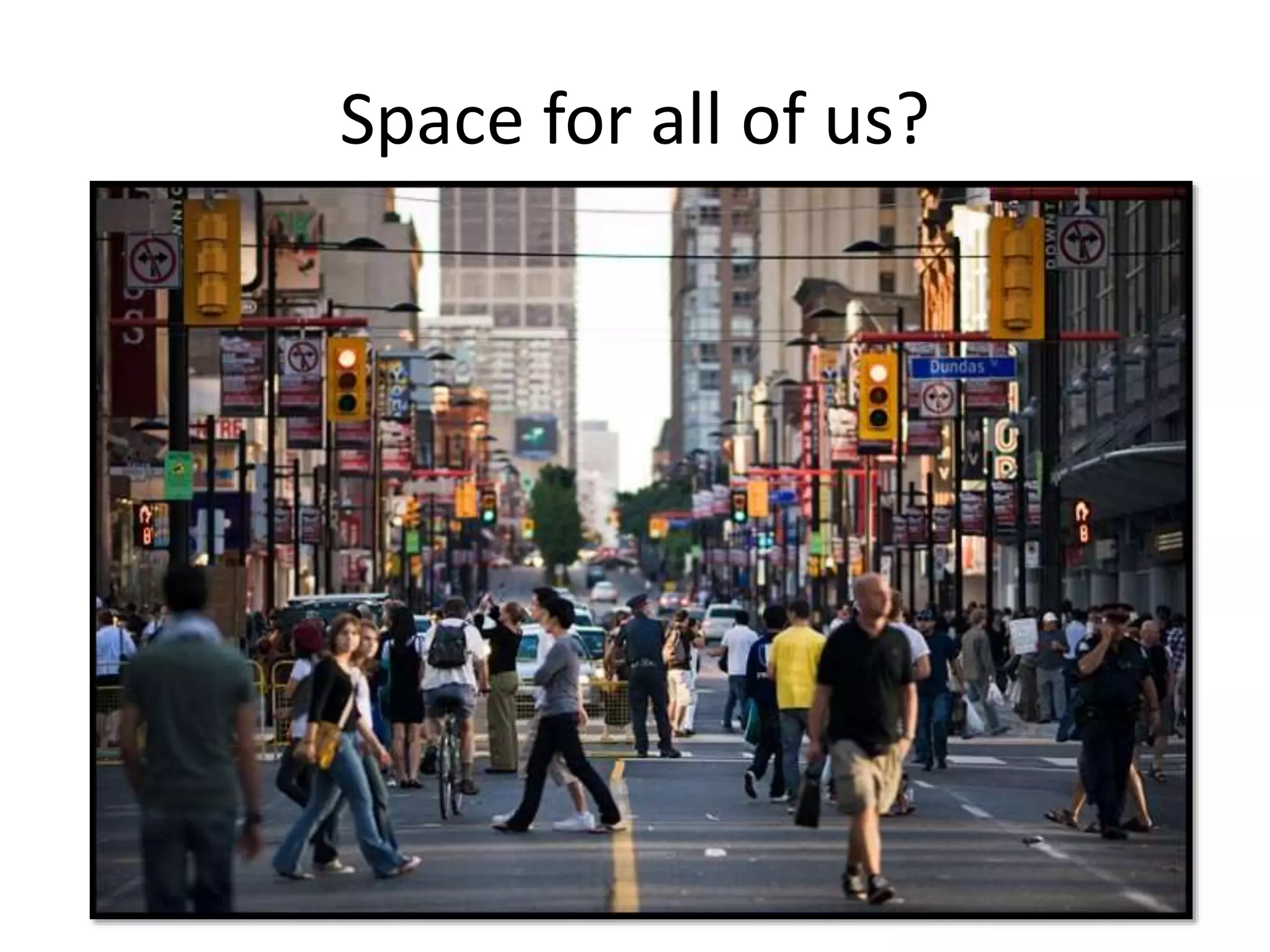
Space for all of us?
Our Public Realm
“How public spaces are planned, designed and
built, how clean they are, and how safe we feel
while using them influence both the quality of
our experience of the city, and how we feel
about it as the place in which we live, socialise,
visit or work. Dublin’s identity is inseparable
from the user’s experience of the city. Our
everyday history, our heritage and culture, and
the impact of innovations are all around us in
the public realm.” [DCC Public Realm Strategy]
MedievalDublin
Medieval Dublin
Developer’s Dublin
Withdrawal of the Elite to Gated Communities
Jane Jacobs (1916-2005)
City life – a fragile, complex ,
diverse ecosystem with
pockets of vivid experience.
Brooks: The passersby come
and go like animals, each
performing his or her little
unconscious service to the
ecosystem. …
“[Jacobs] has taken the pastoralism of Emerson and Thoreau and reconciled it with
modern urban life. … It is complexity she admires, the small unplanned niches were
specialized activities can thrive. “
(Brooks 126-7)
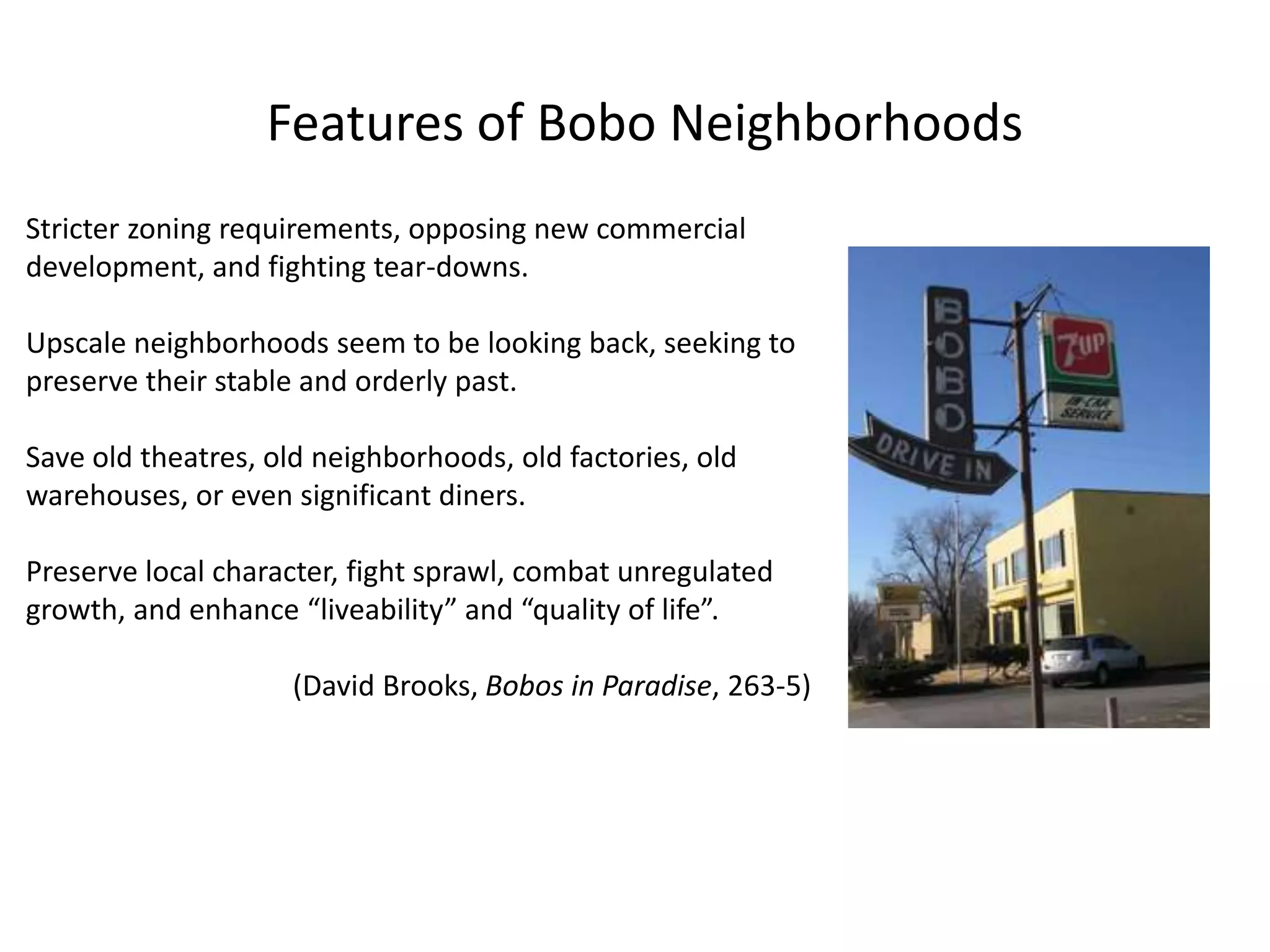
Features of Bobo Neighborhoods
Stricter zoning requirements, opposing new commercial
development, and fighting tear-downs.
Upscale neighborhoods seem to be looking back, seeking to
preserve their stable and orderly past.
Save old theatres, old neighborhoods, old factories, old
warehouses, or even significant diners.
Preserve local character, fight sprawl, combat unregulated
growth, and enhance “liveability” and “quality of life”.
(David Brooks, Bobos in Paradise, 263-5)
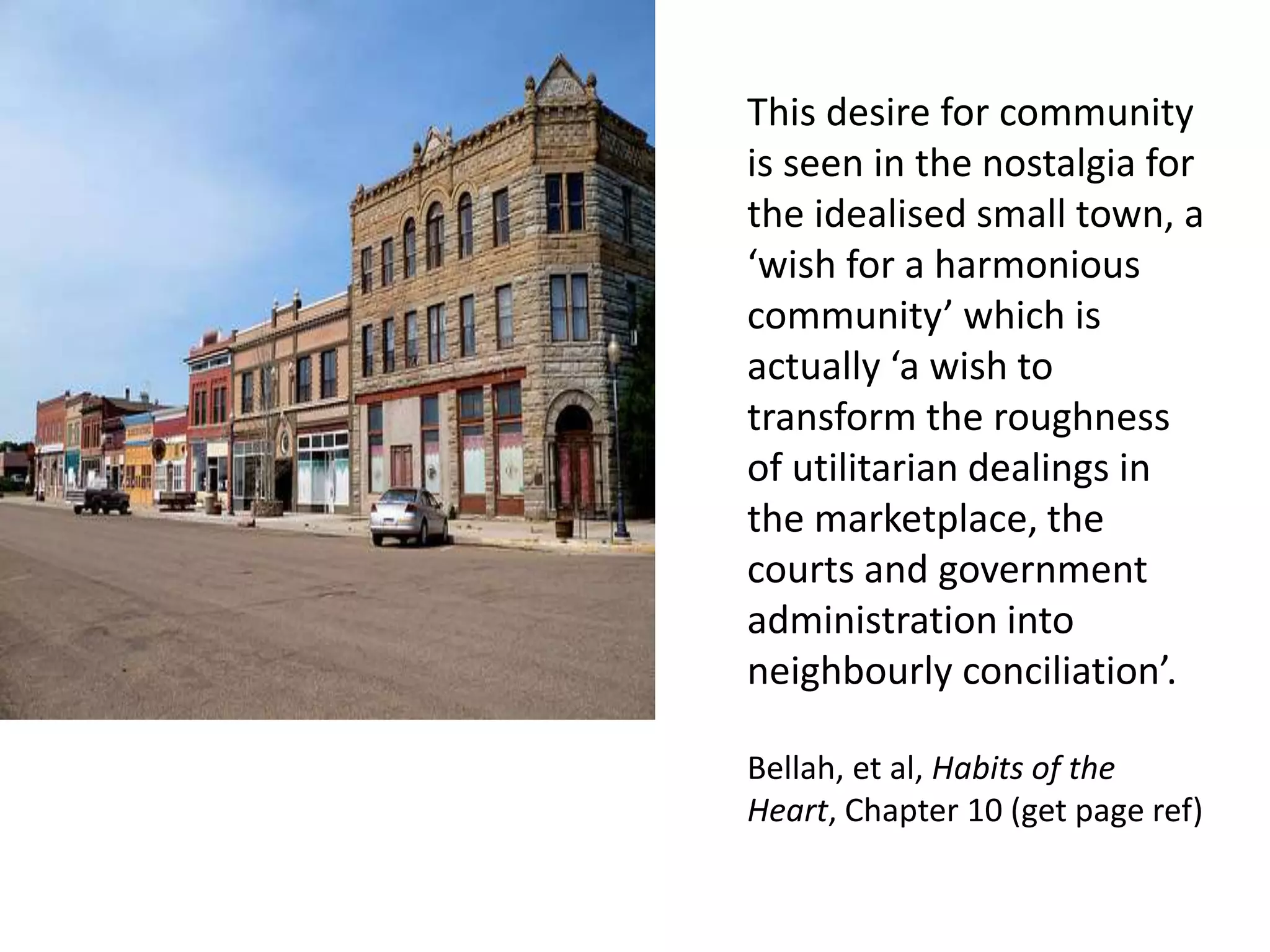
This desire for community
is seen in the nostalgia for
the idealised small town, a
‘wish for a harmonious
community’ which is
actually ‘a wish to
transform the roughness
of utilitarian dealings in
the marketplace, the
courts and government
administration into
neighbourly conciliation’.
Bellah, et al, Habits of the
Heart, Chapter 10 (get page ref)
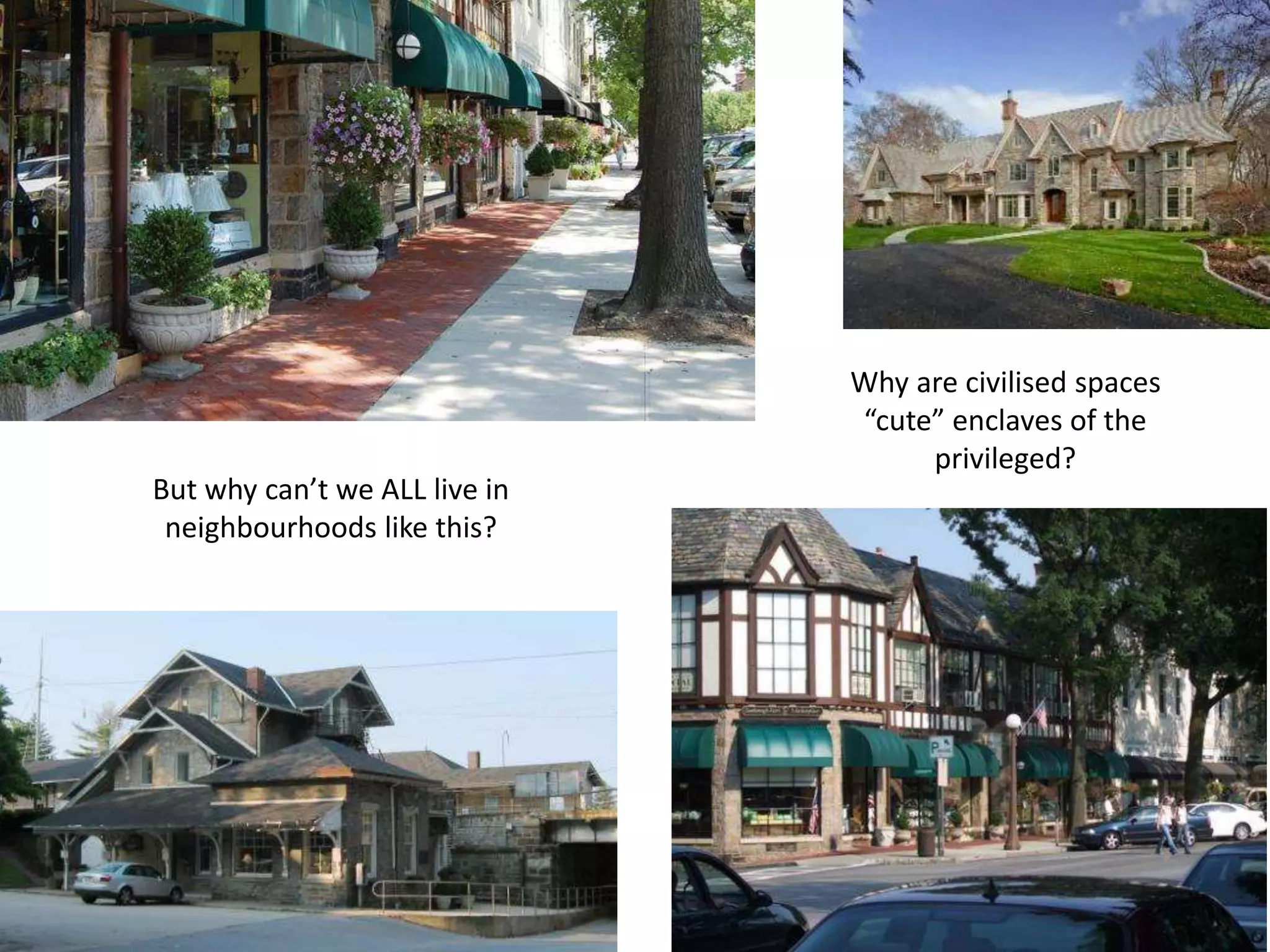
But why can’t we ALL live in
neighbourhoods like this?
Why are civilised spaces
“cute” enclaves of the
privileged?
Inequality & Urban Flight
“Those left behind were then
subjected to the systematic
withdrawal of institutional support,
both public and private.” (Bellah, et al,
xx)
[Time Magazine Photo essay,
“Detroit Beautiful, Horrible
Decline”]
Gentrification in San Fran
QUOTATION OF THE DAY
"You can't have a city of just rich people. A city needs
restaurant workers, a city needs schoolteachers, a
city needs taxi drivers.“
KEVIN STARR, an urban planning expert at the University of
Southern California, on San Francisco, where highly paid tech
workers are seen as driving out less-affluent people.
• http://www.nytimes.com/2013/11/25/us/backlash-by-the-bay-tech-
riches-alter-a-
city.html?nl=todaysheadlines&emc=edit_th_20131125&_r=0
Public
Private Space
Temple Bar
Meeting House Square
Public Space & Protest
The Right to the City
“The right to the city is far more than the
individual liberty to access urban resources: it is a
right to change ourselves by changing the city. It
is, moreover, a common rather than an individual
right since this transformation inevitably depends
upon the exercise of a collective power to reshape
the processes of urbanization. The freedom to
make and remake our cities and ourselves is, I
want to argue, one of the most precious yet most
neglected of our human rights.”[David Harvey, The
Right to the City, 5]
BREAK
What makes a good city?
• DIVERSITY:
• “what results when places become both dense and diverse, as
in packed streets or squares, their functions both public and
private; out of such conditions comes the unexpected
encounter, the chance discovery, the innovation.” (Richard
Sennett)
3 measurements of an open city
1. PASSAGE TERRITORIES: Look out for “porous”
barriers – these are areas where people can
access buildings or businesses in a way that
makes connections.
3 measurements of an open city
• 2. INCOMPLETE FORM – the existence of one
building sited in such a way that it encourages the
growth of other buildings around it. Connections
between buildings, not just standing alone. Also
means buildings that could over time serve different
purposes – from office space to residential, for
example.
3 measurements of an open city
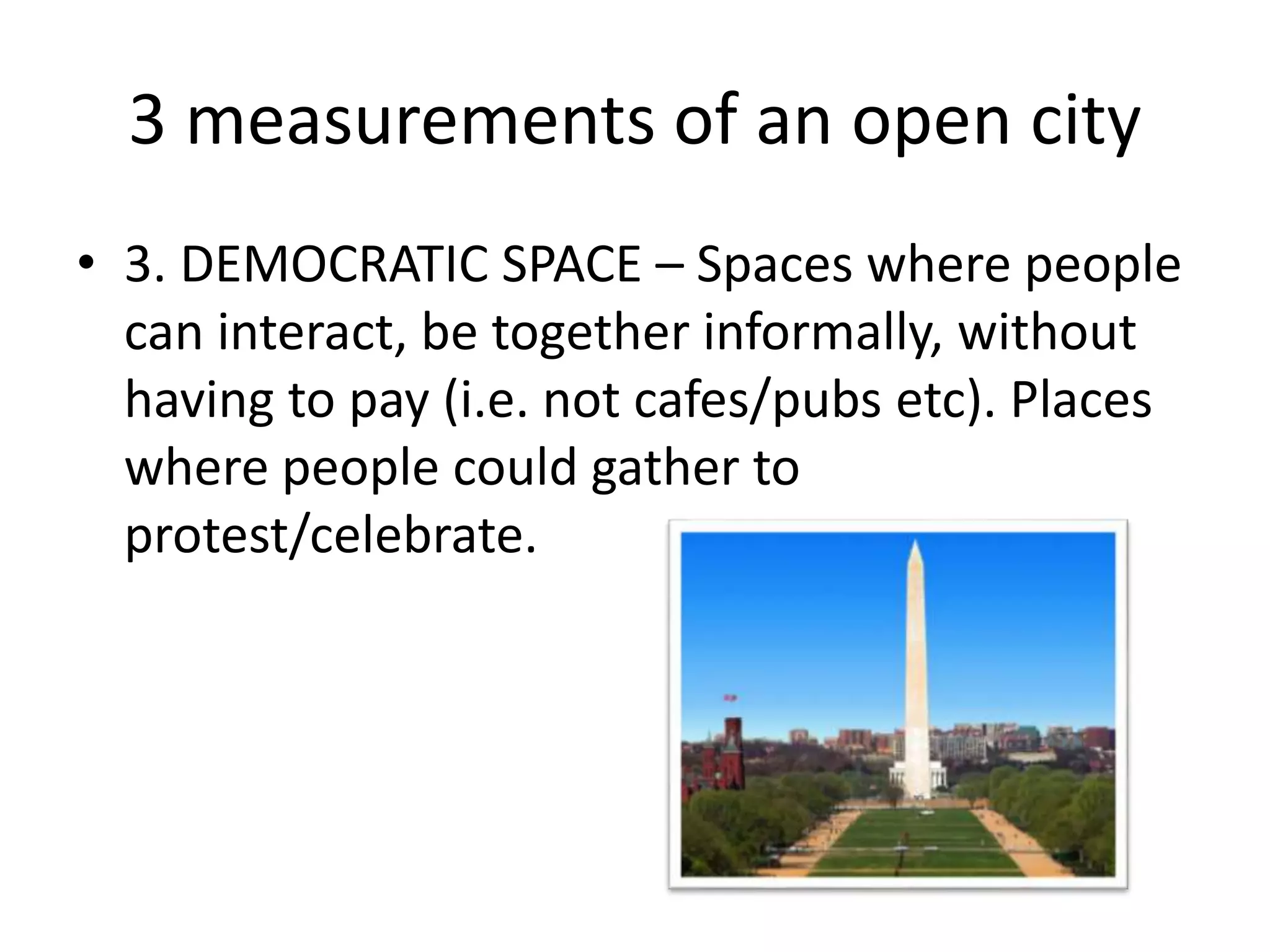
• 3. DEMOCRATIC SPACE – Spaces where people
can interact, be together informally, without
having to pay (i.e. not cafes/pubs etc). Places
where people could gather to
protest/celebrate.
Good Public space: criteria
PROTECTION: (against)
• Traffic and accidents – feeling safe
– (pedestrians-friendly, eliminating fear of traffic)
• Crime and violence – feeling secure
– (lively public realm, eyes on the street, overlapping
functions day and night, good lighting)
• Unpleasant sensory experiences
– (wind, rain / snow, cold / heat, pollution, dust noise
glare, pools of weekend vomit or other anti-social
behaviour)
Good Public space: criteria
COMFORT: (Opportunities to)
• Walk
– (room for walking, interesting façades, no obstacles, good surfaces,
accessibility for everyone)
• Stand / stay
– (edge effect / attractive zones for standing / staying, supports for standing,
façades with good details that invite staying)
• Sit
– (zones for sitting, utilizing advantages – view sun people, good places to sit,
benches for resting)
• See
– (reasonable viewing distances, unhindered views, interesting views, lighting)
• Talk and listen
– (low noise levels, street furniture that provides ‘talkscapes’)
• Play and exercise
– (physical activity, exercise, play and street entertainment, by day and night, in
summer and winter)
Good Public space: criteria
• ENJOYMENT:
– Scale
• (buildings and spaces designed to human scale)
– Opportunities to enjoy the positive aspects of climate
• (sun / shade, heat / coolness, shelter from wind
/breeze)
– Positive sensory experience
• (good design and detailing, good materials, fine
views, trees, plants, water)
Public space and happiness

Public space and happiness

  • 1.
    Public Space &Happiness What Makes A Good Public Space?
  • 2.
  • 3.
    Our Public Realm “Howpublic spaces are planned, designed and built, how clean they are, and how safe we feel while using them influence both the quality of our experience of the city, and how we feel about it as the place in which we live, socialise, visit or work. Dublin’s identity is inseparable from the user’s experience of the city. Our everyday history, our heritage and culture, and the impact of innovations are all around us in the public realm.” [DCC Public Realm Strategy]
  • 4.
  • 5.
  • 6.
  • 7.
    Withdrawal of theElite to Gated Communities
  • 8.
    Jane Jacobs (1916-2005) Citylife – a fragile, complex , diverse ecosystem with pockets of vivid experience. Brooks: The passersby come and go like animals, each performing his or her little unconscious service to the ecosystem. … “[Jacobs] has taken the pastoralism of Emerson and Thoreau and reconciled it with modern urban life. … It is complexity she admires, the small unplanned niches were specialized activities can thrive. “ (Brooks 126-7)
  • 9.
    Features of BoboNeighborhoods Stricter zoning requirements, opposing new commercial development, and fighting tear-downs. Upscale neighborhoods seem to be looking back, seeking to preserve their stable and orderly past. Save old theatres, old neighborhoods, old factories, old warehouses, or even significant diners. Preserve local character, fight sprawl, combat unregulated growth, and enhance “liveability” and “quality of life”. (David Brooks, Bobos in Paradise, 263-5)
  • 10.
    This desire forcommunity is seen in the nostalgia for the idealised small town, a ‘wish for a harmonious community’ which is actually ‘a wish to transform the roughness of utilitarian dealings in the marketplace, the courts and government administration into neighbourly conciliation’. Bellah, et al, Habits of the Heart, Chapter 10 (get page ref)
  • 11.
    But why can’twe ALL live in neighbourhoods like this? Why are civilised spaces “cute” enclaves of the privileged?
  • 12.
    Inequality & UrbanFlight “Those left behind were then subjected to the systematic withdrawal of institutional support, both public and private.” (Bellah, et al, xx) [Time Magazine Photo essay, “Detroit Beautiful, Horrible Decline”]
  • 13.
    Gentrification in SanFran QUOTATION OF THE DAY "You can't have a city of just rich people. A city needs restaurant workers, a city needs schoolteachers, a city needs taxi drivers.“ KEVIN STARR, an urban planning expert at the University of Southern California, on San Francisco, where highly paid tech workers are seen as driving out less-affluent people. • http://www.nytimes.com/2013/11/25/us/backlash-by-the-bay-tech- riches-alter-a- city.html?nl=todaysheadlines&emc=edit_th_20131125&_r=0
  • 14.
  • 15.
  • 16.
    The Right tothe City “The right to the city is far more than the individual liberty to access urban resources: it is a right to change ourselves by changing the city. It is, moreover, a common rather than an individual right since this transformation inevitably depends upon the exercise of a collective power to reshape the processes of urbanization. The freedom to make and remake our cities and ourselves is, I want to argue, one of the most precious yet most neglected of our human rights.”[David Harvey, The Right to the City, 5]
  • 17.
  • 18.
    What makes agood city? • DIVERSITY: • “what results when places become both dense and diverse, as in packed streets or squares, their functions both public and private; out of such conditions comes the unexpected encounter, the chance discovery, the innovation.” (Richard Sennett)
  • 19.
    3 measurements ofan open city 1. PASSAGE TERRITORIES: Look out for “porous” barriers – these are areas where people can access buildings or businesses in a way that makes connections.
  • 20.
    3 measurements ofan open city • 2. INCOMPLETE FORM – the existence of one building sited in such a way that it encourages the growth of other buildings around it. Connections between buildings, not just standing alone. Also means buildings that could over time serve different purposes – from office space to residential, for example.
  • 21.
    3 measurements ofan open city • 3. DEMOCRATIC SPACE – Spaces where people can interact, be together informally, without having to pay (i.e. not cafes/pubs etc). Places where people could gather to protest/celebrate.
  • 22.
    Good Public space:criteria PROTECTION: (against) • Traffic and accidents – feeling safe – (pedestrians-friendly, eliminating fear of traffic) • Crime and violence – feeling secure – (lively public realm, eyes on the street, overlapping functions day and night, good lighting) • Unpleasant sensory experiences – (wind, rain / snow, cold / heat, pollution, dust noise glare, pools of weekend vomit or other anti-social behaviour)
  • 23.
    Good Public space:criteria COMFORT: (Opportunities to) • Walk – (room for walking, interesting façades, no obstacles, good surfaces, accessibility for everyone) • Stand / stay – (edge effect / attractive zones for standing / staying, supports for standing, façades with good details that invite staying) • Sit – (zones for sitting, utilizing advantages – view sun people, good places to sit, benches for resting) • See – (reasonable viewing distances, unhindered views, interesting views, lighting) • Talk and listen – (low noise levels, street furniture that provides ‘talkscapes’) • Play and exercise – (physical activity, exercise, play and street entertainment, by day and night, in summer and winter)
  • 24.
    Good Public space:criteria • ENJOYMENT: – Scale • (buildings and spaces designed to human scale) – Opportunities to enjoy the positive aspects of climate • (sun / shade, heat / coolness, shelter from wind /breeze) – Positive sensory experience • (good design and detailing, good materials, fine views, trees, plants, water)