WRITING LESSON
The Process, Title to Outline, Taking Notes, Thesis
Statements
WRITING LESSON
The Process, Title to
Outline, Taking Notes,
Thesis Statements
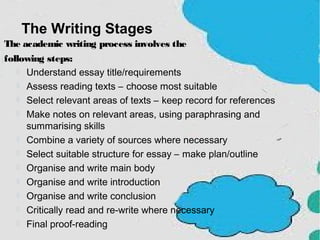
The Writing Stages
The academic writing process involves the
following steps:
 Understand essay title/requirements
 Assess reading texts – choose most suitable
 Select relevant areas of texts – keep record for references
 Make notes on relevant areas, using paraphrasing and
summarising skills
 Combine a variety of sources where necessary
 Select suitable structure for essay – make plan/outline
 Organise and write main body
 Organise and write introduction
 Organise and write conclusion
 Critically read and re-write where necessary
 Final proof-reading
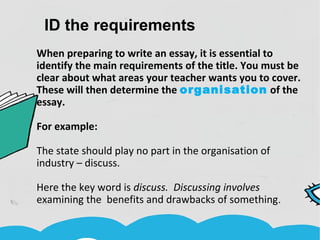
ID the requirements
When preparing to write an essay, it is essential to
identify the main requirements of the title. You must be
clear about what areas your teacher wants you to cover.
These will then determine the organisation of the
essay.
For example:
The state should play no part in the organisation of
industry – discuss.
Here the key word is discuss. Discussing involves
examining the benefits and drawbacks of something.
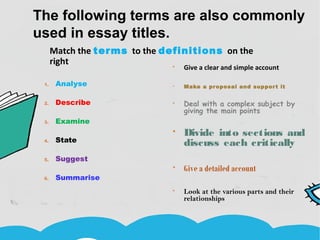
The following terms are also commonly
used in essay titles.
1. Analyse
2. Describe
3. Examine
4. State
5. Suggest
6. Summarise
 Give a clear and simple account
 Make a proposal and support it
 Deal with a complex subject by
giving the main points
 Divide into sections and
discuss each critically
 Give a detailed account
 Look at the various parts and their
relationships
Match the terms to the definitions on the
right.
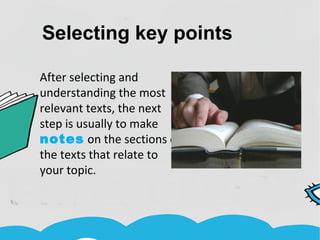
Selecting key points
After selecting and
understanding the most
relevant texts, the next
step is usually to make
notes on the sections of
the texts that relate to
your topic.
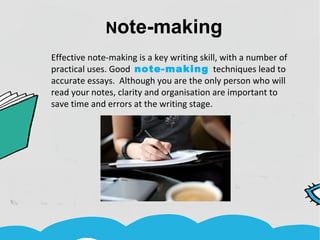
Note-making
Effective note-making is a key writing skill, with a number of
practical uses. Good note-making techniques lead to
accurate essays. Although you are the only person who will
read your notes, clarity and organisation are important to
save time and errors at the writing stage.
Combining Sources
 Most essays require the writer to
read more than one book or
article.
 Your essay should include a
summary of the views of the
different sources you have
studied.
 In some cases the contrast
between the ideas of different
writers may be the focus of the
essay.
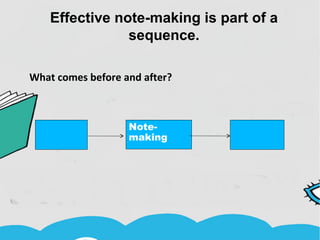
Effective note-making is part of a
sequence.
What comes before and after?
Note-
making
Planning Essays: Outlines
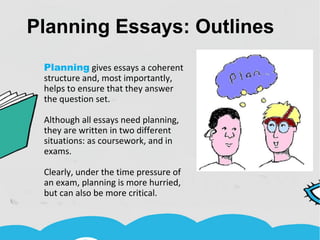
Planning gives essays a coherent
structure and, most importantly,
helps to ensure that they answer
the question set.
Although all essays need planning,
they are written in two different
situations: as coursework, and in
exams.
Clearly, under the time pressure of
an exam, planning is more hurried,
but can also be more critical.
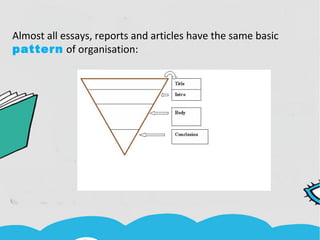
Almost all essays, reports and articles have the same basic
pattern of organisation:
Brainstorming
 In the case of essays written
in exams, it is best to begin
planning by analysing the title
and then writing down any
ideas that seem relevant.
 This process is called
‘brainstorming’, and at
first ideas are collected in any
order.
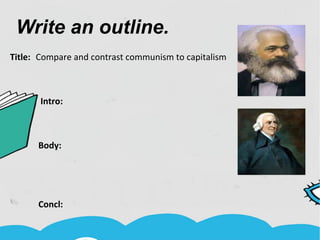
Write an outline.
Title: Compare and contrast communism to capitalism
Intro:
Body:
Concl:
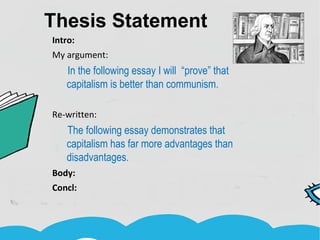
Thesis Statement
Intro:
My argument:
In the following essay I will “prove” that
capitalism is better than communism.
Re-written:
The following essay demonstrates that
capitalism has far more advantages than
disadvantages.
Body:
Concl:

Week 1 s teps in the writing process

  • 1.
    WRITING LESSON The Process,Title to Outline, Taking Notes, Thesis Statements WRITING LESSON The Process, Title to Outline, Taking Notes, Thesis Statements
  • 2.
    The Writing Stages Theacademic writing process involves the following steps:  Understand essay title/requirements  Assess reading texts – choose most suitable  Select relevant areas of texts – keep record for references  Make notes on relevant areas, using paraphrasing and summarising skills  Combine a variety of sources where necessary  Select suitable structure for essay – make plan/outline  Organise and write main body  Organise and write introduction  Organise and write conclusion  Critically read and re-write where necessary  Final proof-reading
  • 3.
    ID the requirements Whenpreparing to write an essay, it is essential to identify the main requirements of the title. You must be clear about what areas your teacher wants you to cover. These will then determine the organisation of the essay. For example: The state should play no part in the organisation of industry – discuss. Here the key word is discuss. Discussing involves examining the benefits and drawbacks of something.
  • 4.
    The following termsare also commonly used in essay titles. 1. Analyse 2. Describe 3. Examine 4. State 5. Suggest 6. Summarise  Give a clear and simple account  Make a proposal and support it  Deal with a complex subject by giving the main points  Divide into sections and discuss each critically  Give a detailed account  Look at the various parts and their relationships Match the terms to the definitions on the right.
  • 5.
    Selecting key points Afterselecting and understanding the most relevant texts, the next step is usually to make notes on the sections of the texts that relate to your topic.
  • 6.
    Note-making Effective note-making isa key writing skill, with a number of practical uses. Good note-making techniques lead to accurate essays. Although you are the only person who will read your notes, clarity and organisation are important to save time and errors at the writing stage.
  • 7.
    Combining Sources  Mostessays require the writer to read more than one book or article.  Your essay should include a summary of the views of the different sources you have studied.  In some cases the contrast between the ideas of different writers may be the focus of the essay.
  • 8.
    Effective note-making ispart of a sequence. What comes before and after? Note- making
  • 9.
    Planning Essays: Outlines Planninggives essays a coherent structure and, most importantly, helps to ensure that they answer the question set. Although all essays need planning, they are written in two different situations: as coursework, and in exams. Clearly, under the time pressure of an exam, planning is more hurried, but can also be more critical.
  • 10.
    Almost all essays,reports and articles have the same basic pattern of organisation:
  • 11.
    Brainstorming  In thecase of essays written in exams, it is best to begin planning by analysing the title and then writing down any ideas that seem relevant.  This process is called ‘brainstorming’, and at first ideas are collected in any order.
  • 12.
    Write an outline. Title:Compare and contrast communism to capitalism Intro: Body: Concl:
  • 13.
    Thesis Statement Intro: My argument: Inthe following essay I will “prove” that capitalism is better than communism. Re-written: The following essay demonstrates that capitalism has far more advantages than disadvantages. Body: Concl: